I was pushing a C-17 Globemaster III down a fog-covered runway in the middle of a freezing night when I saw a single red light where no light should have been.
The tower’s next instructions were clear: both aircraft were to remain where they were while emergency crews assessed the situation.
The 747’s crew had taxied onto the active runway in error, and the immediate priority was making sure neither aircraft moved again until ground personnel could establish exactly what had happened.
I kept the C-17 stopped and monitored the aircraft while the tower coordinated the response. The braking maneuver had generated tremendous heat, and our landing gear needed to be inspected before we could consider moving the jet.
Outside, emergency vehicles approached through the fog. Their lights swept across the runway, illuminating the gap between the two aircraft. Twelve meters was an astonishingly small distance between two machines of that size, especially when one had been accelerating toward the other at takeoff speed.
Alex and I had done what our training demanded. We had recognized the danger, acted immediately, and stopped the aircraft before impact.
But the incident raised a question that could not be answered from the cockpit alone: how had a fully loaded military transport and a commercial 747 ended up occupying the same active runway in near-zero visibility?
The tower and ground crews would have to reconstruct the sequence of clearances, taxi movements, and communications to determine where the breakdown had occurred. A single mistaken turn, a misunderstood instruction, or a missed warning could have consequences far beyond the two flight decks.
There was no instant explanation that could erase the danger we had just faced.
For me, the most important fact was simpler. I had seen a light that did not belong, and I had acted before I could prove to anyone else what it meant.
In aviation, that distinction matters. Procedures and instruments are essential, but pilots must also recognize when the situation in front of them no longer matches the one they believe they are in.
That night, the C-17 stopped short of the 747. The passengers and crew had avoided a collision, but the aircraft still needed inspection, the runway needed to be secured, and the sequence of events needed to be understood before normal operations could resume.
The immediate disaster had been avoided. The investigation into how it nearly happened was the next step.
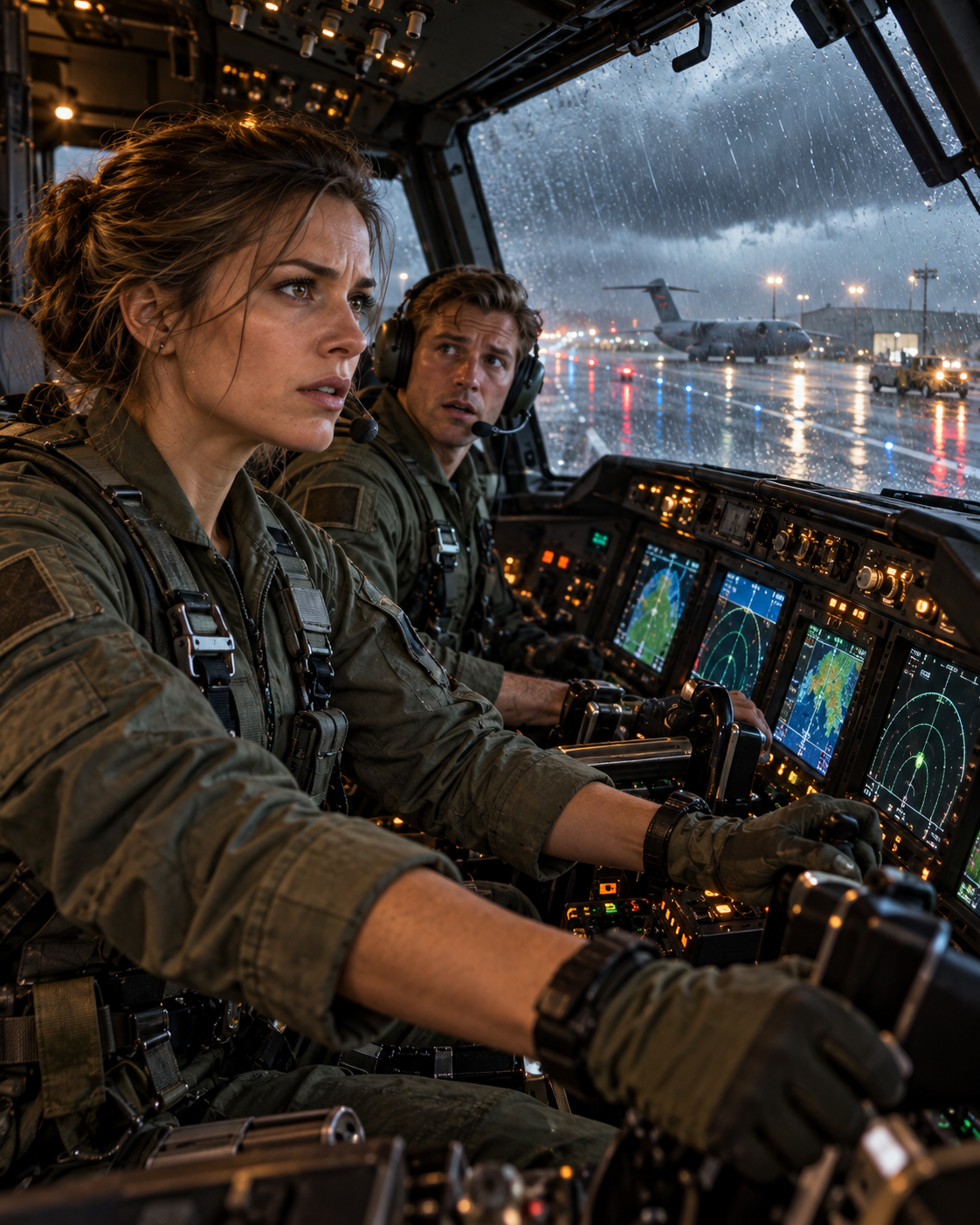
The investigation began before sunrise.
By then, the fog had thickened again, swallowing the emergency vehicles one by one as they moved around the two aircraft. Red and blue lights flashed across the wet tarmac, reflecting off the C-17’s enormous wings and the polished fuselage of the Boeing 747. The runway looked less like an airport and more like the scene of an accident that had somehow stopped a few seconds before it happened.
I sat in the cockpit with my hands resting on my knees, trying to stop them from shaking.
Alex Turner had gone unusually quiet.
He was usually the kind of first officer who filled silence with small observations, dry humor, or comments about whatever problem we had faced during the day. Now he stared through the windshield at the 747, his jaw tight and his eyes fixed on the narrow strip of pavement between our aircraft and the commercial jet.
“Twelve meters,” he finally said.
I looked at him.
“That’s what the ground crew measured. Twelve meters from our nose to their fuselage.”
“I heard you the first time,” I replied.
“I know.”
He swallowed and looked away.
“I just keep thinking about how quickly it happened.”
I understood exactly what he meant. We had spent years training for emergencies, rehearsing engine failures, rejected takeoffs, instrument malfunctions, and dozens of other scenarios. We had practiced until the correct response became almost automatic.
But training never completely prepared you for the moment when a decision stopped being theoretical.
A few seconds earlier, we had been preparing to fly.
Now we were calculating how close we had come to killing everyone aboard two aircraft.
A knock sounded against the cockpit door. One of the ground personnel had arrived to tell us that the aircraft would remain immobilized until the emergency inspection was complete. The brakes had reached temperatures that made an immediate taxi unsafe, and the maintenance team needed to inspect the wheels, tires, and braking systems.
I acknowledged the instruction and turned back toward the windshield.
The red navigation light on the 747 was still visible through the fog.
I could not stop looking at it.
There had been something almost unreal about that light during the takeoff roll. It had been the only detail that made sense in a scene where everything else had seemed normal. No warning horn had sounded. No instrument had announced that another aircraft was occupying our path. The runway lights had continued flashing as they always did.
The danger had revealed itself through one small inconsistency.
And I had nearly dismissed it.
That thought bothered me more than the shaking in my hands.
Because I knew how easily an experienced pilot could become trapped by the expectation that everything was operating correctly.
At thirty-eight, I had enough flight hours to recognize patterns quickly. That experience was valuable, but it could also create confidence in the picture I believed I was seeing. When an unexpected detail appeared, the mind naturally tried to fit it into the existing explanation rather than abandon the explanation altogether.
A reflection.
A misleading light.
A harmless object near the runway.
For one brief moment, I had considered every possibility except the one that would have forced me to act.
The 747 was real.
And the time available to decide was almost gone.
About twenty minutes later, the tower requested that both flight crews provide their initial accounts separately. The investigators would need to preserve the details while they were still fresh, before conversations and assumptions began influencing what people remembered.
A safety officer met me beside the aircraft and escorted me to a small operations room.
The room smelled of burnt coffee and damp wool. A large airport diagram covered one wall, while several monitors displayed runway layouts, weather information, and the movements of aircraft on the ground.
Two investigators sat at a table.
One introduced himself as Captain Michael Reeves, an experienced aviation safety investigator assigned to the incident. The other was a civilian specialist responsible for reviewing communications and ground movements.
Neither man appeared interested in dramatic explanations.
They wanted times, distances, instructions, and decisions.
“Start from the moment you received your takeoff clearance,” Reeves said. “Tell us exactly what you remember. If you don’t know something, say so. Don’t fill in the gaps.”
I described the taxi to the runway, the clearance, the acceleration, and the first appearance of the red light.
I told them how the light had seemed stationary while the centerline lights raced beneath us.
I explained the moment I recognized the shape of the 747 and the decision to reject the takeoff.
Then Reeves asked the question I had been expecting.
“Did your first officer call V1?”
“No.”
“Did you wait for a verbal confirmation before initiating the reject?”
“No.”
“Why not?”
“Because I believed the runway was obstructed and that continuing the takeoff would expose us to an immediate collision risk.”
He studied me for a moment.
“You’re aware of the consequences of rejecting a takeoff at high speed?”
“Yes.”
“Aircraft damage. Tire failure. Brake overheating. The possibility of losing directional control.”
“I understand.”
“And you made that decision without waiting for your first officer?”
“I made it because waiting could have removed our last opportunity to stop.”
Reeves wrote something in his notebook.
There was no accusation in his voice, but the question stayed with me.
I knew the significance of V1. It was not a magic boundary that made an aircraft incapable of stopping, nor was it a universal command to continue regardless of circumstances. It was a carefully calculated decision speed based on the aircraft’s performance, conditions, and operating procedures.
A high-speed reject was dangerous.
But an obstacle directly in the aircraft’s path was dangerous, too.
There had been no perfect option.
There had only been the decision I had made with the information available at that instant.
The civilian investigator leaned forward.
“One more question. Did you see any movement from the 747 before you stopped?”
“No. Not that I could identify.”
“Did you see its landing lights?”
“No. Only the red navigation light at first.”
He exchanged a glance with Reeves.
That glance was brief, but I noticed it.
“What is it?” I asked.
“We’re still assembling the evidence,” Reeves replied. “We don’t want to draw conclusions prematurely.”
I had spent enough years in aviation to recognize when someone was withholding information because it had not yet been verified.
I also knew that silence could be more unsettling than bad news.
When the interview ended, I returned to the operations area, where Alex was waiting with two paper cups of coffee.
He handed me one.
“Any answers?”
“Not yet.”
“Did they ask about V1?”
“Several times.”
He nodded slowly.
“I’ve been thinking about that.”
“So have I.”
He looked down at his coffee.
“If you had waited for my call, we might not have stopped in time.”
I did not answer immediately.
“I don’t know,” I said. “And neither do you.”
“But you saw it first.”
“Yes.”
“And you acted.”
I looked at him.
“That’s what we’re supposed to do. If either of us sees an immediate threat, we speak up. We don’t wait for the other person to discover it.”
Alex nodded, but I could see that the question was not settled for him.
Neither was it for me.
At 05:12, the airport authority suspended operations on the affected runway while the investigation expanded. Other traffic was redirected, and ground personnel began checking the relevant taxiways and runway entrances.
The first technical findings confirmed that our C-17 had experienced substantial brake heating during the rejected takeoff. The tires appeared intact, but the aircraft would require a detailed inspection before it could be cleared to fly.
That was the practical consequence of my decision.
We had avoided a collision, but we had not escaped without cost.
Then, shortly after six in the morning, Reeves returned.
This time, he carried a folder.
“We’ve reviewed the initial tower recordings,” he said. “We have also spoken to the 747’s crew.”
I felt Alex straighten beside me.
“What happened?” I asked.
Reeves placed the folder on the table but did not open it immediately.
“The 747 crew believed they were following the correct taxi route. They received an instruction that they interpreted as directing them toward the runway entrance. However, the controller’s intended routing was different.”
“So they turned onto the active runway?”
“That’s what the evidence currently indicates.”
“Didn’t the tower see them?”
“The controller was managing multiple aircraft movements in difficult visibility. The ground surveillance display did not provide an unambiguous picture of the 747’s position at the critical moment. We are examining why.”
The explanation sounded plausible, but something about it bothered me.
“Did the tower believe the runway was clear when they issued our takeoff clearance?”
“Yes.”
“And the 747 was already on it?”
“That is what the initial timeline suggests.”
I stared at the folder.
Two crews.
A control tower.
Ground surveillance equipment.
Radio instructions.
Runway lights.
Every part of the system had been designed to prevent exactly this situation, yet we had nearly collided with another aircraft at high speed.
“How did nobody catch it?” Alex asked.
Reeves took a breath.
“That is the question the investigation must answer. We need to determine not only what each person did, but what information each person had available, and what the systems should have revealed.”
He opened the folder and placed a printed timeline on the table.
Several entries had been highlighted.
Our clearance.
The 747’s taxi instruction.
The time its crew crossed the runway holding position.
The moment our aircraft began its takeoff roll.
The first emergency call.
I studied the times.
There was a gap between the 747’s entry onto the runway and our takeoff clearance. It was not a long gap, but it was long enough to make the sequence difficult to understand.
“Was the runway occupancy indication functioning?” I asked.
“That is still being verified.”
“Because if the system had registered the 747 correctly, the tower should have received a warning.”
“Potentially,” Reeves said. “We need to establish exactly what the equipment detected, what it displayed, and whether any alert was generated.”
He closed the folder.
“Captain, there is something else. We would like you and your first officer to help us reconstruct the event in a simulator.”
I looked at Alex.
He gave a small nod.
“When?”
“As soon as the aircraft data and recorded communications have been analyzed.”
I agreed.
For the first time since the incident, I felt that we were approaching something solid. Memories could change under pressure. Human recollection was imperfect. But recorded data, cockpit voice recordings, and aircraft parameters could reveal what had happened in the seconds when our lives had depended on a decision.
Still, as I left the operations room, Reeves’s words followed me.
What information had each person available?
The answer would determine far more than whether I had acted correctly.
It would determine whether the next crew facing the same conditions would have a better chance of seeing the danger before it was too late.
The simulator session took place later that morning.
A technical team had recreated the runway environment using the available weather data, airport layout, aircraft performance figures, and the timeline reconstructed from the recordings.
Alex sat beside me in the simulator cockpit.
The instructor explained that the purpose was not to judge us on how dramatic the event had felt. It was to understand what we could realistically have perceived, how quickly the situation had developed, and what options remained available.
We began the sequence.
The C-17 rolled down the runway. The centerline lights passed beneath us, and the fog reduced the world outside to a dim tunnel.
The instructor had recreated the 747’s position as accurately as the evidence allowed.
At first, there was nothing unusual.
Then the red light appeared.
My heart reacted before my mind could fully catch up.
“Stop the simulation,” I said.
The instructor paused it.
“What did you see?”
“The red navigation light.”
“What did you conclude?”
“That an aircraft was occupying our path.”
“How certain were you?”
“Not completely certain. But certain enough that continuing was unacceptable.”
The instructor restarted the sequence.
This time, we watched the same scene from a different viewpoint, examining the visual references and the rate at which the aircraft approached the obstacle.
The result was sobering.
The light had become recognizable only when the available stopping distance was already severely limited. The fog had concealed most of the 747’s shape, and the runway lighting had offered few additional clues.
The simulator could not tell us exactly what would have happened in reality. It could, however, show why even a short delay in recognizing the threat could have made the outcome far worse.
We repeated the sequence several times, testing different reaction points and stopping assumptions.
On one run, I hesitated for less than a second.
The simulated C-17 struck the 747.
The instructor stopped the exercise before the impact animation completed.
Nobody spoke.
Alex removed his headset and rubbed his face.
“That was less than a second,” he said.
The instructor nodded.
“Small delays can matter enormously when speed and stopping distance are involved.”
I looked at the frozen image of the two aircraft.
In the real world, we had stopped twelve meters short.
In the simulator, a brief hesitation had erased that margin entirely.
For the first time, I understood why I had been unable to shake the feeling that the incident was not truly over.
We had survived the event, but we had not yet understood how narrow the boundary between survival and disaster had been.
The investigation continued into the afternoon.
By then, the team had begun comparing the tower recordings, ground movement data, aircraft records, and the testimony of both flight crews.
A clearer picture gradually emerged.
The 747 had been taxiing in poor visibility when its crew received an instruction they understood to mean they should continue toward a runway entry point. The controller intended a different route, and the communication had not produced a shared understanding of the aircraft’s position.
The 747 crossed the holding position and entered the active runway.
The crew did not recognize that they had entered the wrong surface in time to prevent the incident.
The tower, meanwhile, believed the runway was available for our departure.
The ground surveillance information did not provide an effective warning early enough to prevent our takeoff clearance.
Then our C-17 began accelerating.
The precise chain of events was still being examined, but the central failure was becoming apparent: several safeguards had failed to create a common, accurate picture of where the aircraft were.
No single person had possessed the complete picture.
And the system had allowed that uncertainty to persist until an accelerating aircraft crew discovered the danger with their own eyes.
When Reeves briefed us again, he was careful not to assign final blame before the technical review was complete.
“Human error is part of the picture,” he explained. “But we need to look at the conditions that made the error possible, the barriers that should have caught it, and why those barriers were insufficient.”
I appreciated that approach.
It would have been easy to blame the 747’s crew. It would have been equally easy to blame the controller. Either explanation might have satisfied people looking for a simple answer, but neither would necessarily prevent another occurrence.
The real question was how the airport could permit a misunderstanding to become a runway incursion, and how that incursion could remain undetected while another aircraft was cleared to take off.
I asked Reeves whether the investigation would examine the clarity of the taxi instructions and the reliability of the ground surveillance system.
“Both,” he replied. “And the procedures surrounding runway entry, position confirmation, and takeoff clearance.”
He paused.
“We also need to examine the way the system encourages people to trust an apparently normal situation.”
That sentence stayed with me.
Trust was essential in aviation. No crew could operate safely while doubting every instrument, every instruction, and every procedure.
But trust became dangerous when it turned into an assumption that the absence of a warning meant the absence of a threat.
That night, the runway had appeared ready.
The tower had cleared us.
Our instruments had shown no immediate reason to expect an obstruction.
Yet an aircraft stood directly in front of us.
The system had told us one thing.
The world outside the windshield had told us another.
I had chosen to believe what I could see.
By the following evening, the story had begun circulating among the crews at Ramstein. The details spread quickly, as they always do when something terrible nearly happens.
Some people called us lucky.
Others said the decision to reject the takeoff had been reckless because of the dangers associated with a high-speed stop.
A few asked whether we should have waited for clearer confirmation before acting.
I understood the questions.
They were reasonable questions, and they deserved serious answers.
What bothered me was how easily the entire event could be reduced to an argument about one pilot’s decision.
I did not want the lesson to become that instinct was always better than procedure, or that an experienced captain should disregard established limits whenever something felt wrong.
That would have been the wrong lesson.
The truth was more complicated.
Procedures existed because aviation was too dangerous to depend on intuition alone. But procedures could not anticipate every possible combination of failures, misunderstandings, and unexpected events.
When reality no longer matched the assumptions behind a procedure, a crew had to recognize the difference and respond to the actual threat.
The challenge was knowing when that moment had arrived.
Two days after the incident, the maintenance team completed the initial inspections of our C-17. The braking system required servicing and further checks, and the aircraft remained unavailable until the appropriate technical approvals were completed.
The forty passengers had been transferred to another arrangement, and the classified cargo had been secured under the relevant procedures.
Nobody complained to me about the delay.
Some passengers had learned how close we had come to another aircraft. Others knew only that an unexpected technical issue had interrupted their journey.
I was grateful they had not experienced what Alex and I had seen through the windshield.
Before the next scheduled departure, I visited the aircraft.
The C-17 stood in the hangar under bright maintenance lights, its immense wings casting shadows across the floor. Without the engines running, it looked strangely peaceful.
A technician was checking one of the landing gear assemblies.
I stood near the nose and remembered the final seconds of the rejected takeoff.
The trembling airframe.
The sound of the engines.
The red light emerging from the fog.
Twelve meters.
I had imagined that returning to the aircraft would bring some kind of closure. Instead, it reminded me that survival did not erase fear. It simply gave you the opportunity to decide what to do with it.
Alex found me there.
“You planning to stare at it until it apologizes?” he asked.
I almost laughed.
“That would be a long inspection.”
He stood beside me, looking at the aircraft.
“I spoke with Reeves this morning,” he said. “They want recommendations from both of us.”
“Good.”
“I’ve been thinking about what happened. Not just the reject. Everything before it.”
“So have I.”
He folded his arms.
“We had a clearance. The tower believed the runway was clear. The other crew believed they were following the correct route. Everyone was acting on a picture that turned out to be wrong.”
“Exactly.”
“What happens next time, when nobody sees a red light?”
That was the question.
What happened when the fog concealed the danger completely?
What happened when the unexpected detail never appeared?
I had no reassuring answer.
So we began writing down everything we believed the investigation should consider: clearer taxi instructions, more reliable confirmation of runway occupancy, improved coordination between ground and tower controllers, and procedures that reduced the chance of an aircraft entering a runway without everyone understanding its position.
We emphasized that safety could not depend on one pilot spotting a mistake at the last possible moment.
A system that worked only when someone noticed the danger by chance was not a system that worked well enough.
The recommendations would need to be evaluated by the appropriate authorities and technical specialists. We could describe what we had experienced, but we could not pretend to know which engineering solution would be most effective without a full assessment.
What we could do was make certain that the experience was documented honestly.
No exaggeration.
No convenient omissions.
No attempt to turn the event into a heroic story in which one perfect decision solved everything.
Because the truth was that we had been lucky, too.
The C-17 had stopped.
The runway had provided enough remaining distance for the maneuver to succeed.
The braking system had absorbed the energy.
The obstacle had become visible just early enough.
And I had acted before hesitation consumed what little margin remained.
Any one of those facts could have been different.
Several weeks later, the formal review produced additional recommendations for improving runway safety, communication discipline, and the handling of aircraft movements in low visibility. The review examined the sequence of clearances and the information available to the crews and controllers, rather than treating the near collision as the result of a single isolated mistake.
Some of the changes would require technical work and coordination across different parts of the airport operation.
Others involved habits that could be improved immediately.
We discussed the incident during crew briefings, using it to reinforce the importance of clear communication, positive identification of threats, and the willingness to challenge an assumption when the evidence did not support it.
I spoke openly about my hesitation when I first saw the red light.
I could have left that detail out.
It would have made the story cleaner and made me appear more certain than I had been.
But that would have undermined the lesson I wanted other pilots to understand.
I had not recognized the 747 instantly.
For a fraction of a second, I had tried to explain away what I was seeing.
My experience had helped me identify the danger, but experience had not made me immune to doubt.
What mattered was that I did not allow the doubt to become an excuse for inaction.
During one briefing, a young pilot raised his hand.
“Captain, if you could go back to that night, would you make the same decision?”
The room became quiet.
I thought about the question carefully.
“With the same information and the same threat in front of me, I would make the decision I believed gave us the best chance of avoiding a collision. But I would never tell you that a high-speed rejected takeoff is something to do casually. It is an emergency decision with serious risks.”
He nodded.
I continued.
“The point is not that you should ignore procedures. The point is that you must understand them well enough to recognize when an immediate threat requires action. And if something doesn’t make sense, you need to communicate it. Don’t assume somebody else has seen it. Don’t assume the system has already accounted for it.”
Another pilot asked whether I had been frightened.
I looked around the room.
“Yes.”
The answer surprised some of them.
“I was frightened because I understood what was at stake. Fear isn’t the same as panic. You can feel fear and still make a decision. What you cannot afford is pretending you’re certain when you aren’t, or waiting for perfect certainty when the situation won’t give you enough time.”
I never forgot the look on the young pilot’s face.
Perhaps he had expected a more dramatic answer.
Perhaps he thought experience meant the absence of fear.
I hoped he remembered something different: that responsibility was not about appearing fearless. It was about recognizing danger, acting within the limits of your judgment and training, and accepting that every decision carries consequences.
Months passed.
The foggy night at Ramstein became part of my professional history, though it never became an ordinary memory.
The aircraft returned to service after the required inspections and maintenance.
The passengers continued with their journeys.
The 747 crew returned to their duties after the appropriate reviews and follow-up actions.
The airport continued operating, with the incident contributing to the examination of its runway safety procedures.
From the outside, life resumed.
There were more departures, more arrivals, more checklists, more weather reports, and more nights when the runway lights stretched into darkness.
But I found myself listening differently during briefings.
When a taxi instruction sounded ambiguous, I asked for clarification.
When a situation did not match the expected picture, I wanted the discrepancy resolved rather than explained away.
And when a younger crew member challenged something I had said, I listened.
Not because every challenge was correct, but because a cockpit was safer when both pilots understood that speaking up was part of their responsibility.
Alex changed, too.
He became more deliberate about verbalizing uncertainties, particularly during complex ground operations. He had always been a capable first officer, but afterward he seemed more conscious of how easily silence could be mistaken for agreement.
We never discussed the incident every day.
We did not need to.
It lived in the way we worked.
One winter evening, nearly a year after the near collision, I found myself preparing for another departure in poor visibility.
The weather briefing described low cloud, freezing conditions, and limited visibility on the ground. The aircraft was ready, the crew had completed its checks, and the tower was managing traffic under restricted conditions.
As we approached the runway, I felt the familiar tightening in my stomach.
For a moment, I was back at Ramstein, staring into the fog.
I could almost see that single red light again.
Alex noticed my silence.
“You all right?”
I looked at the instruments, then at the runway ahead.
“Yes,” I said. “Just remembering something.”
He followed my gaze.
“We’re not taking anything for granted tonight,” he said.
“No,” I replied. “We’re not.”
We completed the required checks, confirmed our instructions, and made certain that the runway status and our understanding of the clearance were consistent with the available information.
The departure proceeded safely.
There was no hidden aircraft.
No emergency stop.
No dramatic radio transmission.
Only another flight, completed as it should have been.
Yet as the aircraft climbed into the night, I felt something I had not expected.
Relief, certainly.
But also gratitude for the ordinary nature of the flight.
For years, I had thought of a successful mission as something defined by what we accomplished: the destination reached, the cargo delivered, the passengers transported, the task completed.
After Ramstein, I began to think about success differently.
Sometimes success was the mission you never had to abort.
Sometimes it was the mistake someone admitted before it became dangerous.
Sometimes it was the controller who asked for clarification, the first officer who questioned an assumption, or the ground crew member who noticed a discrepancy and refused to ignore it.
And sometimes success was simply the absence of tragedy.
People rarely celebrate the disasters that never happen.
There are no photographs of the passengers who arrive safely because someone noticed an unexpected light. There are no headlines about the aircraft that stopped short, the warning that was taken seriously, or the question that prevented a chain of mistakes from continuing.
When everything works, nobody sees the danger that was avoided.
That is why I tell this story.
Not because I believe I was extraordinary.
Not because I think every emergency has a simple answer.
And certainly not because I believe that instinct should replace training, discipline, or sound judgment.
I tell it because forty passengers were aboard our C-17 that night, and another crew carried its own passengers and responsibilities on the other aircraft. Every person aboard both jets had placed their trust in a system designed to bring them safely to their destination.
They were entitled to more than luck.
They were entitled to crews who paid attention, controllers who communicated clearly, equipment that provided reliable information, and procedures that acknowledged the reality of human error.
The twelve meters between our aircraft and the 747 were not merely a measurement of the distance we had left.
They were a reminder of how little space can separate an ordinary night from an irreversible disaster.
I still remember the red light.
I remember the split second when I wanted it to be something harmless.
I remember how tempting it was to trust the picture I had expected to see rather than the one appearing in front of me.
And I remember the decision that followed.
If there is one lesson I want people to take from that night, it is this: never confuse confidence with certainty, and never confuse silence with safety.
Question what does not make sense.
Speak when something seems wrong.
Listen when someone challenges your assumptions.
And when the evidence in front of you contradicts what you expected, have the courage to reconsider your understanding before the opportunity disappears.
In aviation, that can be the difference between a safe landing and a catastrophe.
In ordinary life, the consequences may be different, but the principle remains the same.
A warning sign rarely arrives with an explanation attached. Sometimes it is a strange sound in a machine, a detail in a report that does not fit, a colleague who seems unusually concerned, or a small inconsistency everyone else has decided to ignore.
You may not immediately know what it means.
You may even be wrong about the cause.
But uncertainty is not a reason to dismiss a potential danger. It is a reason to look closer, ask questions, and take the appropriate steps before the situation becomes impossible to correct.
That freezing night, the red light did not tell me everything I needed to know.
It simply told me that something was wrong.
For a few precious seconds, that was enough.
And twelve meters short of disaster, I learned that sometimes the most important decision you will ever make is the one that gives you the chance to discover the truth before it is too late.