I was helping my nine-year-old daughter finish a puzzle at our kitchen table when I realized that losing my job might have cost me far more than a paycheck.
The first three months back at Ridgeway Construction were harder than I had expected.
Not because the work was difficult. I had spent most of my adult life solving engineering problems, reviewing structural designs, and identifying weaknesses before they became disasters.
The real challenge was learning to work in a place where trust had become a luxury.
People were watching me.
Some believed I had returned to save the company. Others thought I was there to punish everyone who had ever questioned me. A few simply wanted to know whether the new position would give me enough authority to make their own jobs more difficult.
I understood their hesitation.
For years, Ridgeway had rewarded people who delivered impressive presentations, protected executive reputations, and kept uncomfortable questions away from the boardroom.
Nathan Hayes hadn’t created that culture by himself.
He had simply learned how to use it.
And that realization became the foundation of my first major decision.
I wasn’t going to start by changing the company’s engineering procedures.
I was going to find out why so many people had been afraid to speak.
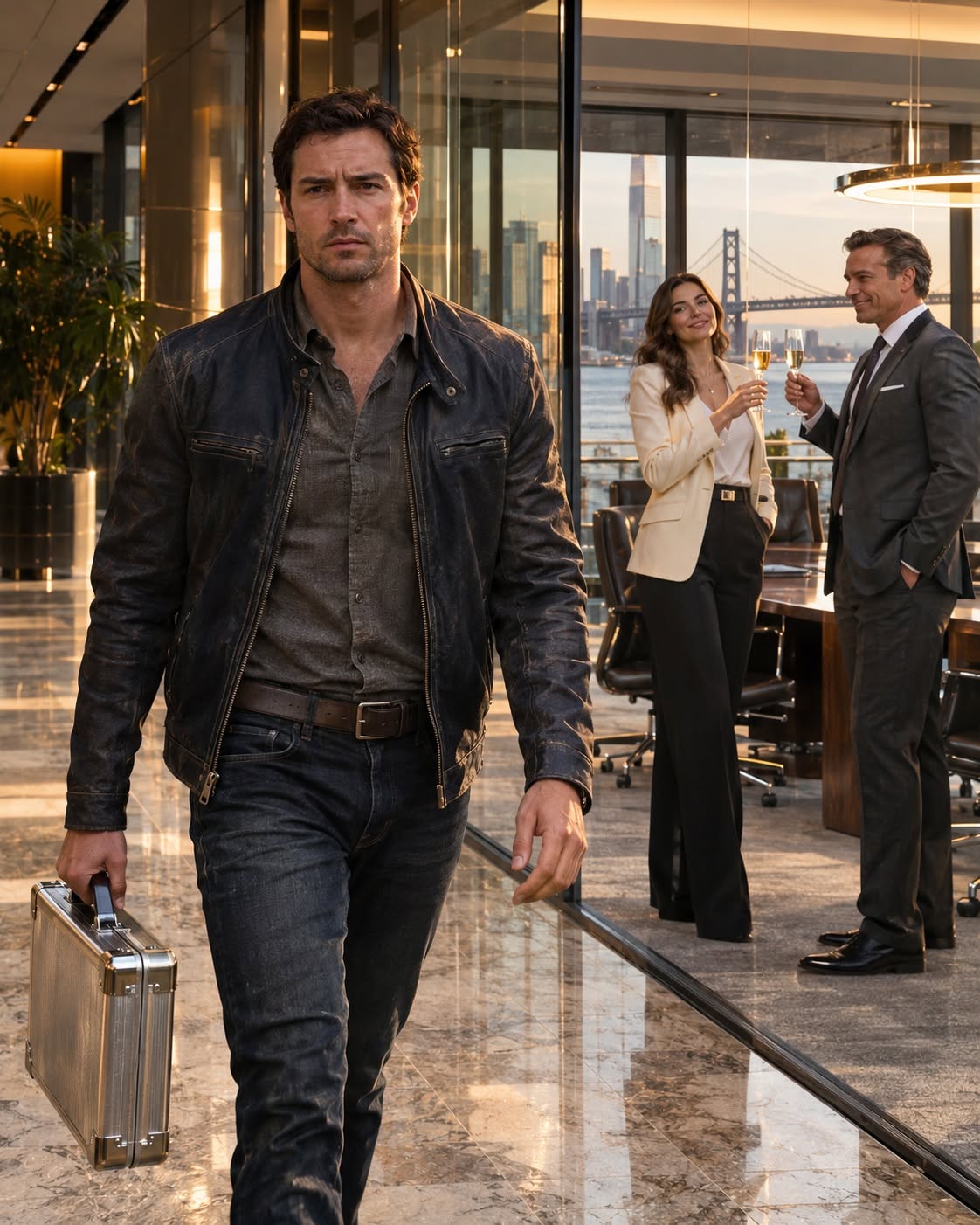
My new office was on the fourth floor, overlooking the Allegheny Bridge. Victoria had arranged for the room to be renovated, but I asked her to remove the expensive furniture and replace it with a large conference table.
I wanted engineers, project managers, purchasing employees, and site supervisors to have somewhere they could sit down without feeling they were being summoned to an executive hearing.
I also established a confidential reporting system.
Employees could report suspicious transactions, unsafe practices, manipulated inspections, or pressure from management without going through their immediate supervisors.
The first week, nobody used it.
The second week, I received one anonymous message.
It contained just six words.
“Please look at the Riverside project.”
There was no signature and no explanation.
I pulled the project files that afternoon.
Riverside was a commercial development outside Pittsburgh, a project Nathan had personally overseen before his dismissal. The records showed that the company had purchased nearly $680,000 worth of specialized structural steel.
According to the delivery reports, everything had arrived.
But when I compared those reports with the original transportation manifests, I noticed something familiar.
The quantities didn’t match.
I checked the invoices again.
Then I checked the inspection photographs.
The missing materials were not a clerical error.
Someone had certified deliveries that had never happened.
I immediately contacted the independent auditors who had handled Nathan’s investigation.
Their initial response was disturbing.
The Riverside discrepancy appeared to involve a different supplier and a different payment route from the original embezzlement scheme.
That meant Nathan might not have been working alone.
Or worse, someone else had learned from him.
I called Victoria into my office.
She read the documents without speaking.
“Do you think he’s involved?” she finally asked.
“I don’t know,” I answered. “But I know somebody believes they can continue doing what he did.”
Victoria looked toward the window.
“Then find out who.”
Before she left, I stopped her.
“One more thing. I want the investigation to remain independent. Nobody in the executive team should have access to the evidence until the auditors are ready.”
She frowned.
“Not even me?”
“Especially not you.”
For a moment, I thought she might take offense.
Instead, she nodded.
“Fair enough.”
That evening, I arrived home at 5:42.
Chloe was sitting on the living room floor with a drawing in her lap.
She had drawn a picture of our house, a yellow sun, and two people standing in front of the door.
One was taller than the other.
Above them, in uneven blue letters, she had written: DADDY IS HOME.
I smiled.
“Is that supposed to be us?”
She nodded proudly.
“I made it for your office. So you remember where you have to come back to.”
I knelt beside her.
“I don’t think I’ll ever forget.”
She handed me the drawing, and I placed it inside my briefcase.
For a moment, I allowed myself to believe that the hardest part of returning to Ridgeway was behind me.
I was wrong.
Three days later, someone broke into my office.
Nothing valuable was taken.
My laptop remained on the desk. The company phone was untouched. Even the small amount of cash I kept in a drawer was still there.
But the Riverside project files had been disturbed.
And the envelope containing the original transportation manifests was gone.
I stood in the doorway, staring at the empty space where I had left it.
Then I noticed something else.
The drawing Chloe had made was lying on the floor.
A muddy shoeprint covered the little yellow house.
I picked it up carefully.
My hands were shaking.
This wasn’t someone trying to steal money.
It was someone trying to tell me to stop.
I called security and Victoria immediately.
Within twenty minutes, she arrived with the head of corporate security.
“Are you all right?” she asked.
“I’m fine.”
“Daniel, somebody entered a restricted office and went through confidential investigation materials.”
“I know.”
She looked at the drawing in my hand.
Her expression changed.
“We’re involving the police.”
I nodded.
But before anyone could leave, I asked security to check the building access logs.
The office had been entered at 8:16 the previous evening.
The access card belonged to someone in senior management.
A man named Martin Cole.
Martin was Ridgeway’s vice president of procurement.
He had worked for the company for fourteen years and had been publicly praised by Nathan on several occasions.
Victoria stared at the screen.
“Martin?”
I looked at her.
“Do you know him well?”
“Well enough to trust him.”
I almost laughed, but there was nothing funny about the situation.
“That’s what I used to think about this company.”
The following morning, Martin arrived at work as if nothing had happened.
He greeted the receptionist, collected his coffee, and walked toward his office.
Victoria asked him to attend an emergency meeting.
He entered the conference room carrying a folder.
“What’s this about?”
I placed a printed copy of the access log on the table.
For the first time, his expression changed.
Then he smiled.
“Someone must have used my card.”
“Your card was used with your personal access code,” the security director replied.
Martin leaned back.
“Then somebody knows my code.”
Victoria folded her hands.
“Did you enter Daniel’s office last night?”
“No.”
“Did you authorize anyone else to enter?”
“No.”
I watched him carefully.
There was something familiar about his confidence.
It was the same certainty Nathan had displayed when he believed nobody could challenge him.
I opened the Riverside records.
“Martin, why did your department approve payments for 420 tons of steel when the supplier’s transportation records show only 351 tons were shipped?”
He barely glanced at the document.
“Delivery adjustments happen all the time.”
“Not without documentation.”
“Maybe you should spend more time understanding procurement before accusing people.”
I remained calm.
“I spent twenty years understanding how materials move from a purchase order to a construction site. I know exactly what should happen.”
He turned toward Victoria.
“Are you seriously allowing this man to interrogate department heads? He was brought back to review engineering integrity, not run a witch hunt.”
Victoria didn’t answer immediately.
Then she said something I hadn’t expected.
“Daniel has authority to investigate discrepancies involving any department. That includes yours.”
Martin stood.
“This is ridiculous.”
He walked out, leaving his folder behind.
Inside it was a printed email.
At first glance, it looked ordinary.
It was a message from an outside supplier confirming a delivery adjustment.
But the date was wrong.
The email claimed to have been sent three weeks before the original purchase order had even been approved.
I looked at Victoria.
“Do you see it?”
She nodded slowly.
“Someone fabricated this.”
The investigation expanded.
Over the next ten days, auditors reviewed procurement records, supplier contracts, and internal communications.
They discovered that three companies had been receiving payments through different subsidiaries.
All three had the same registered mailing address.
And all three shared a financial connection to an investment company based in Delaware.
That company was controlled by a person named Andrew Cole.
Martin’s younger brother.
Suddenly, the picture became clearer.
Nathan had not simply inflated invoices and pocketed the money.
He had established relationships with suppliers willing to create false paperwork. Martin had continued those arrangements after Nathan’s dismissal, using his position to make sure the money kept moving.
The original audit had uncovered Nathan’s involvement, but it had never identified the full network.
Someone had deliberately kept part of the operation hidden.
And now we knew why.
Martin had been protecting it.
The auditors estimated that another $1.3 million had been diverted through the Riverside project and two smaller developments.
Combined with the original losses, Ridgeway was facing a financial scandal that could exceed three million dollars.
But there was something even worse.
One of the affected projects was a public parking structure in downtown Pittsburgh.
Its construction records showed that lower-grade reinforcement steel had been substituted for the material specified in the engineering design.
The substitution had never been approved.
And the inspection certificates had been altered.
I felt my stomach tighten.
Money could be recovered.
Contracts could be canceled.
Executives could be replaced.
But structural safety was different.
People trusted those buildings with their lives.
I called the site engineer, a young man named Ethan Brooks.
“How long has the substitute material been installed?”
He hesitated.
“Most of the lower levels were completed two months ago.”
“Did you approve the change?”
“No, sir.”
“Who signed the inspection report?”
Another pause.
“Martin’s office sent it back with the approval already attached.”
I closed my eyes.
“Listen carefully. Stop work immediately. Nobody touches the affected sections until an independent structural assessment is completed.”
“Understood.”
“And Ethan?”
“Yes?”
“You did the right thing by telling me.”
He sounded as though he was about to cry.
“Nobody wanted to listen before.”
That sentence stayed with me long after the call ended.
We shut down the affected work areas and brought in an independent engineering firm.
The first assessment confirmed that several reinforcement components did not meet the required specifications.
The structure had not failed, but it could not safely proceed without corrective work.
The repairs would cost hundreds of thousands of dollars and delay the project by several months.
Victoria was furious.
She called an emergency board meeting.
Martin was suspended pending investigation, and the company referred the suspected fraud and document falsification to law enforcement.
Nathan, who had apparently believed his dismissal marked the end of the investigation, suddenly found himself facing additional questions about the larger network.
But the real surprise came from someone I hadn’t expected.
A week after the shutdown, I received a phone call from Ethan.
“Daniel, I think you should know something.”
“What is it?”
“I found an old inspection report in the site archive. It has your name on it.”
I sat up.
“My name?”
“Yes. It says you approved the original material substitution.”
My heart began pounding.
“Send me a copy.”
He did.
When I opened the document, I felt the room go cold.
The signature looked almost identical to mine.
Almost.
There was a small difference in the way I crossed the letter D.
It was a detail most people would never notice.
But I knew my signature.
I had signed thousands of engineering documents throughout my career.
This one was forged.
Someone had not only stolen money and endangered a construction project.
They had tried to make me responsible for it.
I immediately contacted the auditors and requested a forensic examination.
The results came back two days later.
The signature had been digitally copied from an old engineering approval I had signed years earlier.
The document’s metadata showed it had been created on a company workstation assigned to Martin’s department.
Victoria read the report in my office.
For several seconds, she said nothing.
Then she looked at me.
“Daniel, I don’t know how to apologize for this.”
I leaned back.
“I don’t need another apology, Victoria. I need this company to stop treating honesty like an inconvenience.”
She nodded.
“You’re right.”
That afternoon, she addressed the entire company.
She didn’t mention names or disclose confidential details, but she admitted that Ridgeway had failed its employees.
She acknowledged that people had been punished for raising concerns, that oversight had been weak, and that leadership had allowed personal relationships to interfere with accountability.
She announced new independent reporting protections, mandatory external inspections for high-risk projects, and a board-level ethics committee.
For the first time since I had returned, I saw employees looking at the company differently.
Not with admiration.
With cautious hope.
Still, I knew a speech wasn’t enough.
The next few weeks were exhausting.
I worked with the independent engineers to identify every project that might have received noncompliant materials.
We reviewed thousands of records and contacted suppliers.
Some employees cooperated immediately.
Others were frightened.
A few refused to speak.
I made it clear that nobody would be punished simply for admitting they had followed an instruction from a supervisor, provided they had not knowingly participated in fraud or concealed a safety issue.
I wanted the truth, not a collection of convenient scapegoats.
Then, one afternoon, a woman knocked on my office door.
Her name was Rebecca Mills.
She worked in accounts payable.
She looked nervous and carried a small notebook.
“Mr. Daniel, I think I have something you should see.”
I invited her inside.
She opened the notebook.
“I noticed unusual payments almost a year ago. I reported them to Martin.”
“What happened?”
“He told me I was misunderstanding the accounts. Then he said my contract might not be renewed if I continued making accusations.”
“Did you keep any records?”
She nodded.
“I printed some payment confirmations before the files were changed.”
I examined the pages.
They connected Martin to a second shell company that had not yet appeared in the auditors’ findings.
But there was something else.
A handwritten note in the margin of one payment confirmation contained two initials.
N.H.
Nathan Hayes.
Rebecca looked down.
“I didn’t know what to do. I needed the job.”
I put the documents on the table.
“You shouldn’t have had to choose between protecting your family and telling the truth.”
Her eyes filled with tears.
“I was afraid nobody would believe me.”
“I believe you.”
Those three words seemed to release something she had been holding inside for months.
Her evidence became the missing link.
Investigators traced the payments to accounts controlled by Martin and a business associate connected to Nathan.
The authorities expanded their investigation.
Within weeks, both men were facing serious legal scrutiny involving fraud, conspiracy, forged documents, and financial misconduct.
The company’s board also discovered that two former directors had ignored earlier warnings about procurement irregularities.
They resigned.
It was an ugly process.
But for the first time, the truth was being addressed instead of buried.
And somewhere in the middle of that chaos, I realized something important.
I had returned to Ridgeway believing my biggest responsibility was repairing the company’s engineering systems.
Instead, I was helping repair something much more fragile.
Its conscience.
One Friday evening, I was reviewing the final safety assessment when my phone rang.
It was Chloe’s school.
My heart immediately tightened.
“Dad?”
It was Chloe’s voice.
She sounded upset.
“What’s wrong, sweetheart?”
“Are you coming to my school tonight?”
I looked at the clock.
6:18.
I had completely forgotten.
Her class was holding a small family presentation. She had been preparing it for weeks.
“I’ll be there,” I said immediately.
“But you said that yesterday.”
The words hit harder than any accusation Martin could have made.
I looked at the reports spread across my desk.
There were still dozens of unfinished tasks.
Victoria had been expecting my final review before the next morning.
I could hear the familiar voice in my head telling me that the company needed me.
Then I heard Chloe again.
“It’s okay, Daddy. I know you’re busy.”
That was the worst part.
She wasn’t angry.
She was learning to expect disappointment.
I closed the folder.
“I’m leaving now.”
I arrived at the school twenty minutes later.
The presentation had already started.
I slipped into the back of the room and saw Chloe standing beside a poster covered with colorful drawings.
She was holding a photograph of our kitchen table.
The picture showed the puzzle we had worked on together the day I was fired.
Underneath it, she had written:
MY DAD BUILDS THINGS.
SOMETIMES HE FIXES BRIDGES.
BUT MY FAVORITE THING HE BUILDS IS TIME WITH ME.
I stood there, unable to move.
Then she spotted me.
Her face lit up.
“Daddy!”
She ran over and hugged me.
I held her tightly.
“I’m sorry I’m late.”
She shook her head.
“You came.”
That night, after she went to bed, I sat alone in the kitchen.
I looked at the drawing she had made months earlier, the one that had been stepped on during the break-in.
The muddy footprint was still visible.
I had kept it.
And suddenly I understood that I had been making the same mistake in a different form.
When I first left my senior engineering position after my wife’s death, I thought I was choosing between my career and my daughter.
When I returned to Ridgeway, I had promised myself I wouldn’t make that choice again.
Yet slowly, without noticing, I had started allowing the company to take more and more of the time I had fought so hard to protect.
I couldn’t blame Victoria for that.
I couldn’t blame the board.
I had to take responsibility for my own boundaries.
The next morning, I requested a meeting with Victoria.
She arrived at my office carrying a cup of coffee and a stack of documents.
“You look serious,” she said.
“I need to talk about my position.”
She put down the coffee.
“All right.”
“I can’t continue being the person every department calls when something goes wrong. That’s not a sustainable system, and it isn’t what I agreed to.”
She looked concerned.
“Are you considering leaving?”
“I’m considering changing how we work.”
I explained that Ridgeway needed a permanent engineering integrity department, not one person acting as its entire conscience.
I proposed hiring two independent structural auditors, appointing a compliance director who reported directly to the board, and creating regional teams responsible for monitoring project documentation.
I also wanted protected working hours, a clear emergency rotation, and a rule that nobody would be expected to handle routine matters after hours.
Victoria listened carefully.
When I finished, she remained quiet.
Then she smiled slightly.
“You’re asking me to build a company that doesn’t depend on you.”
“Exactly.”
She leaned forward.
“Do you know how unusual that is? Most people in your position would want more control.”
“Control isn’t the same as responsibility.”
She looked at me for a long moment.
“Approved.”
There were still difficult conversations ahead.
Some directors resisted the additional costs.
A few managers complained that the new reporting requirements slowed projects.
But the board eventually approved the restructuring.
And something remarkable happened.
Within six months, Ridgeway began identifying problems before they became expensive disasters.
Employees started reporting concerns earlier.
Suppliers understood that false documentation would no longer be tolerated.
Project managers stopped treating inspection procedures as obstacles.
The company wasn’t perfect.
No company is.
But it was becoming more honest.
The financial investigation also reached an important milestone.
Authorities announced charges against Nathan and Martin, while the company pursued recovery of misappropriated funds through legal proceedings.
The full amount had not yet been recovered, and the cases would take time.
But Ridgeway had stopped pretending the problem was smaller than it was.
Walter Price called me one afternoon.
He had been following the changes closely.
“Daniel, I’d like you to come to Philadelphia next month.”
“What for?”
“I want you to speak at the company’s annual leadership meeting.”
I hesitated.
“I’m an engineer, Walter. Not a motivational speaker.”
He chuckled.
“That’s exactly why I want you.”
I agreed.
A month later, I stood in front of nearly two hundred employees and executives.
I didn’t prepare a presentation full of impressive statistics.
Instead, I told them about the day I was fired.
I told them about the puzzle on my kitchen table, the little girl who asked whether I could spend more time with her, and the evidence I had carried in a cardboard folder because nobody at the company wanted to listen.
I told them about Rebecca, who had been afraid to speak.
About Ethan, who had found an unsafe substitution and worried that telling the truth would cost him his job.
And about the employees who had quietly done the right thing even when doing so made their lives harder.
Then I said something I had learned the difficult way.
“A company doesn’t become trustworthy because its leaders talk about integrity. It becomes trustworthy when an ordinary employee can report a serious problem without wondering whether tomorrow will be the last day of their career.”
The room was silent.
I continued.
“Bridges don’t collapse all at once. Small weaknesses accumulate. A missing bolt. A neglected inspection. A material substitution nobody questions. Eventually, the structure reaches a point where it cannot carry the weight placed on it.”
I paused.
“Organizations work the same way. Dishonesty doesn’t always begin with millions of dollars. Sometimes it begins when someone notices a small problem and everyone else decides it’s easier to look away.”
I looked toward Victoria and Walter.
“And sometimes the most important thing a leader can do is listen to the person nobody else wants to hear.”
When I finished, the applause was immediate.
But I wasn’t thinking about the applause.
I was thinking about getting home.
That evening, I walked through our front door at 5:30.
Chloe was waiting at the kitchen table.
The old puzzle was gone.
In its place was a new one, spread across the table in a neat arrangement.
“What’s that?” I asked.
She grinned.
“It’s a bridge!”
I pulled out a chair.
“Looks complicated.”
“It is. But I think we can finish it.”
I sat beside her.
We worked for almost an hour, searching for matching pieces and laughing whenever one of us tried to force a piece into the wrong place.
At one point, she looked up.
“Daddy?”
“Yes, sweetheart?”
“Are you happy at your new job?”
I considered the question.
It wasn’t really a new job.
It was the same company that had once pushed me out, only now I had a different understanding of what I wanted from it.
“I think I am,” I said. “But do you know what makes me happiest?”
She shook her head.
“Coming home to you.”
She smiled and returned to the puzzle.
A few months later, Ridgeway invited me to attend the reopening ceremony of the Riverside project.
The structure had been repaired, independently inspected, and certified as meeting the required specifications.
The company had lost money, time, and a considerable amount of its reputation.
But it had also learned a lesson that could not be measured on a balance sheet.
Before the ceremony, Victoria approached me.
“I want you to know something,” she said.
“When we first hired you back, I thought we were giving you a second chance.”
I looked at her.
“And now?”
She smiled.
“I think you gave us one.”
I didn’t know what to say.
She continued.
“You could have walked away. You could have taken the evidence to the authorities and never looked back. Nobody would have blamed you.”
“Maybe.”
“But you chose to help us become better.”
I glanced toward the structure behind her.
“I didn’t do it for the company alone.”
“I know.”
“I did it because people deserve to work somewhere they don’t have to be afraid of telling the truth. And because I don’t want another employee to go home believing that doing the right thing means losing everything.”
Victoria nodded.
“Neither do I.”
The ceremony began.
There were speeches, photographs, and the usual announcements about future projects.
But I was most interested in watching the construction workers standing together near the entrance.
Ethan was there.
Rebecca was there.
They had both been promoted into positions where their experience and judgment could help protect other employees.
When Ethan noticed me, he raised his hand.
I returned the gesture.
For the first time, I didn’t feel like the person who had been fired and later invited back.
I felt like an engineer doing work that mattered.
On the drive home, Chloe asked whether we could stop for ice cream.
I agreed.
We sat at a small table outside the shop, watching cars pass along the street.
She was halfway through her chocolate cone when she asked another question.
“Daddy, are you going to build another bridge?”
I laughed.
“Maybe someday.”
“Will it be a big one?”
“Hopefully.”
She thought about that for a moment.
“Then you should make sure it doesn’t fall down.”
I smiled.
“That’s the plan.”
She took another bite.
“And make sure you come home afterward.”
I reached across the table and held her hand.
“That’s the most important part.”
Later that night, after Chloe was asleep, I stood by the window and looked at the distant lights of Pittsburgh.
The Allegheny Bridge was somewhere beyond them.
I had spent years believing it was the greatest thing I would ever build.
It had taken losing my job, nearly losing my reputation, and being forced to question everything I believed about success to understand how wrong I had been.
A bridge was important.
A career was important.
A company built on honesty was important.
But none of those things could replace the little girl sleeping down the hall.
I had once believed that being a good father meant sacrificing the career I loved.
Then I had believed that rebuilding my career meant fighting for a place in the company that had rejected me.
Now I understood that neither choice had to define me.
I could be an engineer and a father.
I could demand accountability without becoming consumed by anger.
I could give people a second chance without giving them unlimited access to my trust.
And I could forgive a company without forgetting what it had done.
Ridgeway eventually became a stronger organization, not because it had found another brilliant executive, but because it had finally learned to value the people who spoke up when something was wrong.
As for me, I kept my position, my boundaries, and the promise I had made to my daughter.
There were still late nights occasionally, especially when a safety issue required immediate attention.
But they became exceptions rather than expectations.
And whenever I had to stay late, I made sure Chloe knew why and when I would be home.
I also learned to say no.
It was a small word, but it changed my life.
A year after my return, I found Chloe’s old drawing tucked inside a desk drawer.
The one with the muddy footprint.
I had considered throwing it away several times.
Instead, I took it to a framing shop and placed it on the wall outside my office.
Beside it, I hung a photograph of the Allegheny Bridge.
Two things I never wanted to forget.
One reminded me of what I had built.
The other reminded me of why it mattered.
And every morning, before opening my emails or reviewing another engineering report, I looked at both.
Because the greatest achievement of my life was never going to be measured in steel, concrete, or millions of dollars.
It would be measured in the moments I showed up for the people who needed me.
Sometimes, the strongest structures are the ones we build with honesty.
Sometimes, the most important bridges connect people who have almost lost their way back to each other.
And sometimes, the greatest second chance isn’t the opportunity to return to where you once belonged.
It’s the opportunity to build something better than what you left behind.
The company had given me back my career.
But Chloe had taught me what that career was actually worth.
And if I had to choose again, knowing everything I knew now, I would still choose the little girl at my kitchen table.
Every single time.