I lost my job over 23 minutes of kindness. By the next morning, the woman I had stopped to help was standing on the runway
“Before we discuss our partnership,” Julianna said, “I’d like to know why you fired the technician who stopped to help me during yesterday’s storm.”
For a moment, nobody moved.
Richard Hayes stood at the foot of the private jet, his hand still extended, his confident smile fading beneath the gray morning sky. Behind him, the Westbridge management team exchanged uneasy glances. A few employees had gathered near the hangar, curious about the unexpected arrival of one of the aviation industry’s most influential executives.
“I’m afraid there’s been a misunderstanding,” Richard said, forcing a laugh. “We maintain strict operational standards here. Mr. Daniel was dismissed for violating our attendance policy.”
Julianna looked at him steadily.
“Did you ask him why he was late?”
Richard hesitated.
“His explanation was irrelevant to the policy.”
“And did you investigate the circumstances?”
“Our procedures are applied consistently.”
Julianna slowly nodded, as though his answers had confirmed something she had already suspected.
“Interesting. Because when my car broke down last night, I was stranded beside a flooded highway. Dozens of vehicles passed me. Your technician was the only person who stopped.”
She paused, letting the words settle over the silent runway.
“He spent twenty-three minutes helping a complete stranger. Then he drove to work, where you punished him for being twenty-three minutes late.”
Richard’s face tightened.
“With respect, Ms. Vance, you don’t know the full circumstances.”
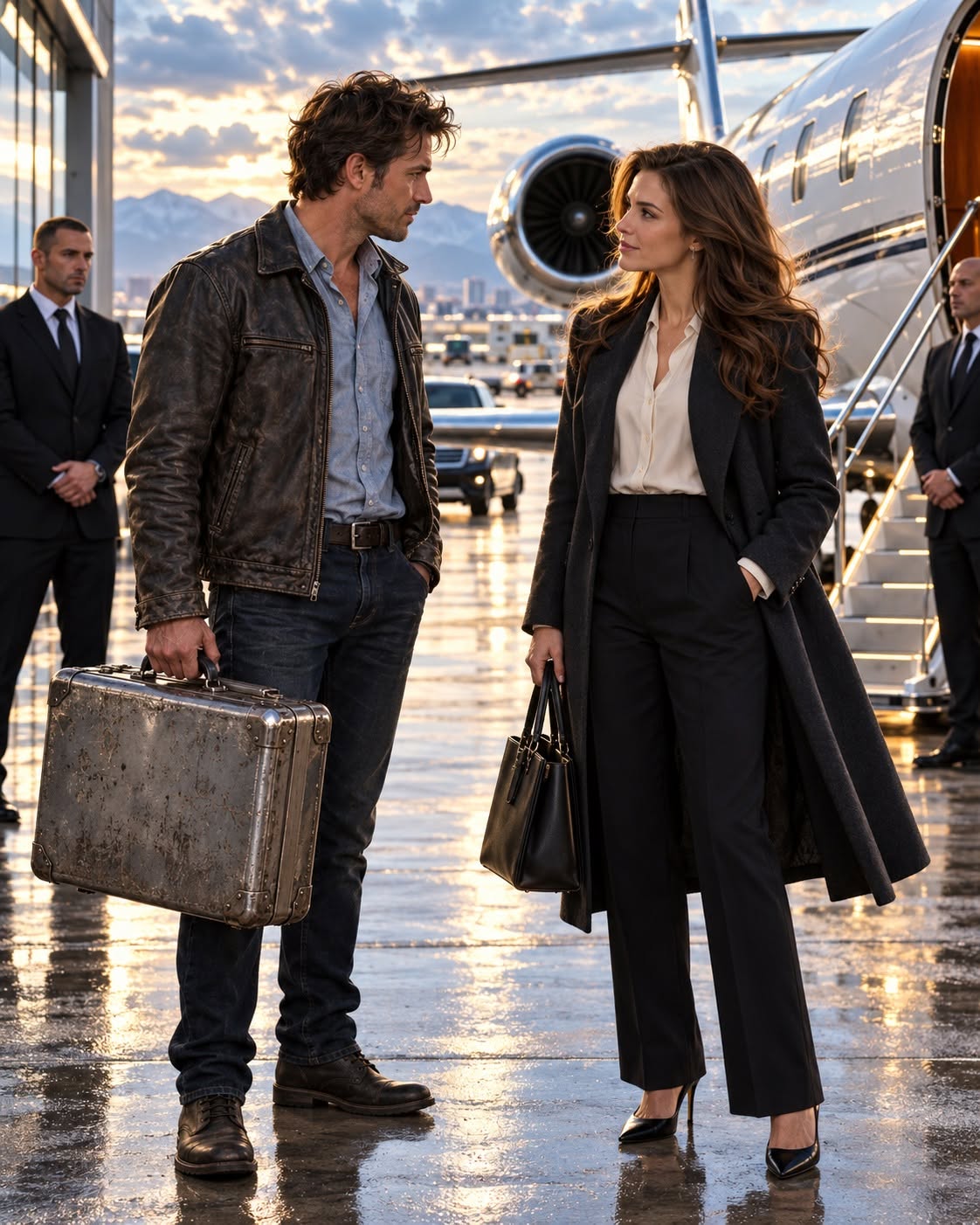
“Then let’s find out.”
She turned toward the company’s human resources director.
“Please bring me his employment record, including every performance review and disciplinary report.”
The director glanced nervously at Richard before hurrying inside.
I wasn’t there to witness any of this.
At that moment, I was sitting at my kitchen table, staring at an unpaid electricity bill while Lily colored beside me. I had spent the morning calling every maintenance company within driving distance. Most had no openings. Others promised to call back.
None did.
Lily looked up from her drawing.
“Daddy, are you going to work today?”
I swallowed hard.
“Not today, sweetheart. But I’m trying to find something.”
She considered that for a moment before returning to her crayons.
“That’s okay. Maybe you can help me build my cardboard airplane instead.”
I smiled because I didn’t know what else to do.
The cardboard airplane had been her idea for weeks. Before losing my job, I had promised to help her build one large enough for her stuffed animals. We had planned to spend Saturday making it, but now I couldn’t even concentrate on something that simple.
I felt as though the entire future of our little family was balanced on the edge of a table, and one wrong movement would send everything crashing to the floor.
Then my phone rang.
It was a number I recognized immediately.
Westbridge Aviation Services.
I almost let it go to voicemail.
Instead, I answered.
“Daniel,” a nervous voice said, “this is Melissa from human resources. Could you come to the facility this afternoon? There’s been a development concerning your termination.”
I stared at the phone.
“Am I in trouble again?”
“No,” she replied quickly. “Not at all. We need to speak with you in person.”
When I arrived at Westbridge, the receptionist who had watched security escort me out the previous day looked startled to see me.
She didn’t say anything, but her expression told me she knew something had changed.
Melissa met me in the lobby and led me toward the conference room.
Through the glass walls, I could see several senior managers sitting around a long table. At the far end stood a woman in a dark navy suit.
Julianna Vance.
For a second, I wondered whether I had walked into the wrong building.
She recognized me immediately.
“Daniel,” she said, approaching with a warm smile. “I’m glad you came.”
I shook her hand, still struggling to understand what was happening.
“What’s going on?”
“Please, sit down.”
I took a seat opposite her. Richard was nowhere to be seen.
Julianna explained that she had requested my employment record after arriving that morning. It contained years of positive evaluations, commendations for difficult repairs, and repeated notes about my reliability.
There were no previous disciplinary warnings.
Not one.
“Your former supervisor made a decision without considering your circumstances,” she said. “That decision is now being reviewed.”
I rubbed my palms against my trousers.
“I’m grateful you’re looking into it, but I don’t understand why this matters so much to you. You don’t even know me.”
She looked at me for several seconds.
“Perhaps not. But I know what happened on that road.”
Then she told me something I hadn’t expected.
Her car hadn’t merely broken down.
She had been traveling to the airport after receiving an urgent call about her younger brother, Thomas, who had suffered a serious medical emergency while visiting a nearby city. Her driver had been unable to reach her through the storm, and her phone had almost run out of battery.
She had been frightened, exhausted, and completely alone.
“When you stopped, you didn’t ask who I was,” she continued. “You didn’t ask whether I could pay you. You simply helped.”
I remembered the rain running down her face and the trembling in her hands as I worked beneath the hood.
At the time, I had assumed she was worried about her expensive car.
I hadn’t realized she was terrified for someone she loved.
“Thomas survived,” she said quietly. “I reached the hospital in time to see him. He’s recovering now.”
Her voice softened.
“I wanted to thank you properly. Instead, I discovered that helping me had cost you your job.”
I lowered my eyes.
“I didn’t do anything special. Anyone should have stopped.”
“That’s exactly what concerns me,” she replied. “It shouldn’t be unusual for someone to do the decent thing.”
Before I could respond, the conference room door opened.
Richard walked in, accompanied by the company’s chief operating officer.
He looked as though he hadn’t slept.
“Daniel,” he began, avoiding my eyes, “I understand this situation has caused considerable confusion.”
Julianna leaned back in her chair.
“Confusion?”
Richard cleared his throat.
“The decision was made to uphold our attendance standards. It was never my intention to cause personal hardship.”
I felt something rise inside me. For the first time since being fired, I wasn’t afraid to speak.
“With respect, sir, you didn’t ask me a single question. You didn’t even let me finish explaining.”
He looked at me sharply.
“I was managing a business.”
“And I was trying to help someone who was stranded in a storm.”
Silence filled the room.
I had imagined confronting Richard a hundred times since the previous morning. In those fantasies, I shouted at him, demanded an apology, and told him exactly what his decision had done to my daughter and me.
But sitting there, I found that I didn’t want revenge.
I wanted him to understand that the people who worked for him had lives beyond the time clock.
Julianna turned toward the chief operating officer.
“I’ve reviewed enough to know that this isn’t simply about one termination. I want an independent review of disciplinary practices, employee complaints, and management conduct before we proceed with any partnership.”
The executive nodded.
“That’s reasonable.”
Richard’s face lost what little color remained.
“Ms. Vance, surely we can resolve this without jeopardizing the agreement.”
“The agreement was never guaranteed,” she replied. “Trust is earned, just like business.”
She gathered her documents.
“Until the review is complete, our negotiations are suspended.”
Then she looked at me.
“Daniel, I would like to offer you a position with Vance Aeronautics Group. But I want you to understand something. This isn’t charity.”
I blinked.
“You’re offering me a job?”
“A senior maintenance position at our regional aviation facility. Better compensation, comprehensive benefits, and a schedule that gives you more time with your daughter.”
I could barely process her words.
“There is one requirement,” she added. “You’ll need to pass our technical assessment. We hire based on ability, experience, and judgment. I won’t make an exception for you.”
I nodded immediately.
“That’s fair.”
For the first time in two days, I felt as though the ground beneath my feet was solid again.
But the story wasn’t over.
The following week, I returned to the aviation facility for my assessment.
I arrived early, wearing my cleanest work shirt and carrying the small notebook in which I had recorded years of maintenance procedures, troubleshooting methods, and lessons learned from difficult jobs.
Three assessors waited for me inside a hangar.
They tested my knowledge of aircraft systems, fault diagnosis, inspection procedures, and emergency response. Then they presented me with a simulated electrical fault that had caused several experienced technicians to struggle during previous assessments.
I didn’t rush.
I examined the diagrams, checked the available readings, and explained each step before proceeding.
For years, I had learned that a machine rarely failed without leaving clues. The trick was to listen to what those clues were telling you instead of forcing the answer you wanted.
After nearly three hours, the lead assessor closed his folder.
“Excellent work, Daniel. You’ve passed with distinction.”
I let out a breath I hadn’t realized I was holding.
A week later, I signed my contract.
My new salary was enough to cover our rent, groceries, school expenses, and the bills that had kept me awake at night. The schedule was more predictable, and the benefits meant I no longer had to lie awake worrying about what would happen if I became ill or injured.
But the greatest change wasn’t financial.
It was the feeling that I could finally be present in my daughter’s life without constantly calculating how much time I could afford to spend with her.
On my first evening home from the new job, Lily ran to the door.
“Daddy! Are you home already?”
I lifted her into my arms.
“Yes, sweetheart. And I have some news.”
I told her about the job, the new schedule, and the fact that we could finally build her cardboard airplane together.
She squealed with excitement.
“Does this mean we can make the wings really big?”
“Absolutely.”
“And paint it blue?”
“Blue, yellow, and any other color you want.”
She hugged me so tightly that I laughed.
Then she pulled away and studied my face.
“Daddy, why do you look like you’re going to cry?”
I brushed a tear from my cheek.
“Because sometimes grown-ups get scared, too.”
She wrapped her arms around my neck again.
“It’s okay. You always tell me that things can get better.”
I held her for a long time.
That night, we spread cardboard across the kitchen floor and built an airplane with crooked wings, oversized windows, and a tail that refused to stay straight. Lily insisted on painting a bright yellow sun on the side.
Underneath it, she wrote three words in careful, uneven letters.
“WE CAN FLY.”
I looked at the words and felt my chest tighten.
For the first time since my wife died, I allowed myself to imagine a future that wasn’t built entirely around surviving the next day.
I began to believe that life might still hold something good for us.
Meanwhile, the investigation at Westbridge uncovered problems that went far beyond my dismissal.
Several employees described being threatened with termination for minor mistakes. Others had been pressured to work through unsafe conditions because Richard feared delays would upset clients. One technician had even been reprimanded for reporting a faulty piece of equipment that should have been taken out of service.
The company had spent years measuring punctuality and productivity while ignoring the people responsible for keeping its operations safe.
Richard was removed from his leadership position pending further disciplinary action. The board introduced new procedures for reviewing terminations, reporting safety concerns, and appealing unfair decisions.
The investigation also found that some of the complaints against Richard had been raised before, only to disappear inside the management system.
It wasn’t enough to replace one supervisor.
The company needed to change the culture that had allowed him to behave that way.
Several months later, Westbridge invited representatives from Vance Aeronautics Group to review the reforms. Julianna agreed to attend, but she made one request.
She wanted to speak with the employees themselves.
During the meeting, a young mechanic stood up and admitted that he had once stayed silent when a colleague was unfairly blamed for a mistake.
“I was afraid I’d lose my job,” he said. “I told myself it wasn’t my problem.”
Julianna listened without judgment.
“Fear makes people protect themselves,” she said. “But when everyone stays silent, unfairness becomes a system.”
The room grew quiet.
Then she added, “A good company isn’t one where nobody ever makes a mistake. It’s one where people can tell the truth, correct mistakes, and treat one another with dignity.”
For the first time, several employees began speaking openly about changes they wanted to see.
I watched from the back of the room, feeling something I hadn’t expected.
I had lost my job because I stopped to help one person.
Now that decision had helped expose a problem affecting dozens of others.
Still, I never believed I had changed the world.
I had simply stopped a car.
I had tightened a connection, checked the engine, and made sure a frightened woman could continue her journey.
The rest had happened because other people chose what to do with the truth.
One afternoon, several months after my dismissal, Julianna visited our facility to discuss a new maintenance initiative. After the meeting, she asked whether I had a few minutes to talk.
We walked beside the hangar while the afternoon sun stretched across the runway.
“How are you and Lily doing?” she asked.
“Better than I could have imagined a few months ago.”
She smiled.
“I’m glad.”
I hesitated before asking the question that had been on my mind.
“Can I ask you something? Why did you go to so much trouble over what happened to me?”
She stopped walking.
“Because I know what it feels like when people decide your worth without bothering to understand your circumstances.”
She told me that early in her career, she had once made a costly mistake during a major project. A senior executive had publicly blamed her, and several colleagues had accepted his version of events without asking questions.
One experienced engineer had defended her, risking his own position to explain what had really happened.
That engineer had changed the course of her career.
“I never forgot what he did,” she said. “When I met you, I saw the same willingness to help someone who couldn’t offer you anything in return.”
She looked toward the aircraft lined up beyond the hangar.
“Success gives people opportunities. Character determines what they do with them.”
I thought about that sentence for days afterward.
Not because it sounded profound, but because I finally understood how easily the world could make an ordinary person believe that kindness was a luxury reserved for people who could afford it.
I had been afraid to stop that night.
I had thought about my daughter, my responsibilities, and the consequences of arriving late.
Those fears had been real.
But so had the woman standing alone beside a flooded highway.
I hadn’t known that helping her would lead to a better job. I hadn’t known who she was or what she might do the next morning.
If I had known, perhaps I would have stopped for a different reason.
And that would have changed the meaning of everything.
A year after the storm, Lily’s school held a family day. Each child had been asked to draw a picture of someone who had taught them an important lesson.
When Lily’s teacher invited me into the classroom, I found my daughter’s drawing displayed beside the window.
It showed a man standing beside a broken car beneath dark clouds. Rain fell around him, but a small yellow sun appeared in the corner of the page.
Beside the man stood a woman holding an umbrella.
Above them, Lily had written:
“MY DADDY HELPED SOMEONE EVEN WHEN IT WAS HARD.”
Her teacher smiled at me.
“Lily says you taught her that doing the right thing matters, even when nobody is watching.”
I looked at my daughter, who was waiting anxiously for my reaction.
I knelt beside her.
“You know, sweetheart, I was scared that night.”
She tilted her head.
“Scared of the storm?”
“Scared of losing my job. Scared I wouldn’t be able to take care of you.”
She thought about that for a moment.
“But you helped her anyway.”
“Yes.”
“Then you were brave.”
I pulled her into my arms.
Perhaps she was right.
Bravery wasn’t always a dramatic act performed by someone who felt no fear. Sometimes, it was a tired father making a decision on a dark road, knowing he might pay for it later.
And sometimes, the most important thing that decision changed wasn’t a career, a contract, or a company’s leadership.
It was the example a child carried into the world.
That evening, Lily and I sat at the kitchen table with our cardboard airplane between us. Its wings were still crooked, and one corner had begun to peel away, but she refused to let me repair it.
“It doesn’t have to be perfect,” she insisted. “It just has to fly.”
I smiled and handed her another strip of tape.
Outside, the sky turned orange as the sun disappeared behind the neighboring buildings.
I thought about the twenty-three minutes that had nearly broken my life apart. For a while, I had believed those minutes were proof that doing the right thing could destroy everything you worked for.
Now I understood something different.
Kindness doesn’t guarantee that life will reward you. Sometimes, people will misunderstand you. Sometimes, doing the right thing will cost you money, comfort, or opportunities you desperately need.
And there may be no wealthy stranger waiting on a runway to make everything right.
But that doesn’t make kindness worthless.
It means the responsibility to build a better world belongs to all of us: to the person who stops to help, to the leader who chooses fairness over pride, and to the bystander who finally finds the courage to speak.
I couldn’t control how Richard treated me. I couldn’t predict what Julianna would do. I couldn’t protect Lily from every disappointment life might bring.
But I could show her what it meant to be the kind of person who didn’t look away when someone needed help.
As I tucked her into bed that night, she reached for my hand.
“Daddy?”
“What’s that, sweetheart?”
“If I see someone who needs help, should I stop too?”
I sat beside her and thought carefully before answering.
“Yes, but remember to keep yourself safe. Find a trusted adult or call for help if something seems dangerous. You don’t have to face every problem alone to do the right thing.”
She nodded sleepily.
“Okay. I think I understand.”
I kissed her forehead and turned off the light.
Walking back into the kitchen, I noticed the drawing she had made months earlier, the one that had broken my heart after I lost my job.
“My daddy can fix anything.”
I picked it up and smoothed its folded corner.
I still couldn’t fix everything.
I couldn’t bring my wife back. I couldn’t erase the fear of those desperate days or guarantee that Lily would never know hardship.
But I could keep showing up for her. I could do honest work, treat people with dignity, and teach her that a person’s worth was never measured by a job title or a paycheck.
And perhaps that was the most important thing I had ever learned.
The world may measure your value in minutes, money, and productivity.
But the moments that reveal who you really are often happen when there is nothing to gain.
That night, I had stopped for twenty-three minutes.
I lost a job.
I found a different future.
But the greatest thing those minutes gave me was not a second chance at success.
It was the knowledge that when Lily looked at me and believed I could fix anything, she wasn’t talking about engines, machines, or broken parts.
She was talking about the kind of man I chose to be.
And that was something worth protecting, no matter what it cost.