I let my son and his wife move into my mortgage-free home after my husband died. I thought we were helping each other through a difficult time.
The First Thing I Did Was Call a Lawyer
I stood in the hallway, holding the document with both hands, but I could barely feel my fingers.
For several seconds, I simply stared at the words printed across the top.
PROPOSED PERMANENT RESIDENTIAL PLACEMENT AND PROPERTY TRANSFER AUTHORIZATION.
Beneath the title were my name, my address, and a series of paragraphs describing a plan to move me into an assisted living facility.
My son, Daniel, was listed as the primary contact.
His wife, Melissa, was listed as the person authorized to coordinate the arrangements.
And at the bottom was a section for my signature.
My signature.
Except I hadn’t signed it.
I read the document again, hoping I’d misunderstood something. Perhaps it was a form they had downloaded to help me explore my options. Perhaps there was an innocent explanation.
Then I noticed the paragraph about the house.
It described transferring ownership of my property into a family-managed trust, supposedly to simplify my future care expenses.
The proposed beneficiaries were Daniel and Melissa.
I felt something inside me go very quiet.
They weren’t simply thinking about moving me somewhere.
They were planning to take control of the house my husband and I had spent thirty-seven years paying for, repairing, decorating, and turning into a home.
A house where our son had taken his first steps.
A house where my husband had held my hand through chemotherapy appointments, family celebrations, and ordinary Sunday mornings.
A house that was still legally mine.
I folded the papers carefully and returned them to the envelope.
Then I heard footsteps upstairs.
I slipped the envelope into my handbag and walked into the kitchen.
Melissa entered a moment later, wearing her usual bright smile.
“Oh, you’re still up?”
“Couldn’t sleep,” I replied.
She opened the refrigerator and frowned at the shelves.
“We’re almost out of milk. Could you pick some up tomorrow?”
I looked at her.
For the first time, I didn’t immediately answer yes.
“Perhaps,” I said.
Her eyebrows lifted slightly.
“Well, Daniel has an early meeting, and I have a lot to do.”
“I’m sure you’ll manage.”
She closed the refrigerator a little harder than necessary.
I smiled politely and went upstairs.
That night, I didn’t sleep much.
But I made a decision.
I would not confront them until I understood exactly what they were planning.
And I would not let anyone make decisions about my future without my permission.
The following morning, I called my husband’s old attorney, Robert Hayes.
He had handled our wills, property documents, and estate planning for decades. When I explained what I’d discovered, he became unusually quiet.
“Do you have the document in front of you?”
“Yes.”
“Don’t sign anything. Don’t give anyone access to your financial records. And whatever you do, don’t tell them you’ve spoken to me.”
His voice was serious enough to make my stomach tighten.
“Robert, can they take my house?”
“Not without your authorization, assuming your ownership and legal documents are as you described. But we need to examine whether they’ve already taken steps involving your finances or legal authority.”
I swallowed.
“Could they have done something without me knowing?”
“They could have tried. Let’s establish the facts before we assume anything.”
He scheduled an appointment for that afternoon.
For the first time in months, I felt that I wasn’t completely alone.
When I arrived at his office, Robert greeted me with a warm hug.
He was older now, his hair almost entirely white, but he still had the same careful manner I remembered.
I handed him the envelope.
He read everything twice.
Then he removed his glasses.
“This is concerning.”
“What does it mean?”
“It appears someone has prepared documents intended to transfer control of your property and arrange a residential placement. There are references to financial management authority, too.”
“Can Daniel sign these for me?”
“Not unless you have legally granted him the necessary authority. Have you?”
I shook my head.
Robert checked our previous records.
“No. Your husband and you established separate ownership arrangements, and the house passed directly to you after his death. Daniel has no ownership interest.”
I felt a wave of relief.
Then Robert pointed to something on the second page.
“There’s another issue. This appears to be part of a larger application for a senior-care placement. Someone has already made preliminary inquiries.”
“Without telling me?”
“That’s what it looks like.”
My eyes filled with tears.
I wasn’t afraid of growing older. I wasn’t even afraid of needing help someday.
I was afraid that my own son had decided my wishes no longer mattered.
Robert placed the papers on his desk.
“We’ll prepare a written notice confirming that no one has authority to sell, transfer, or manage your property without your direct consent. We’ll also review your accounts and update your estate documents.”
He paused.
“But I want to ask you something. Do you actually want Daniel and Melissa living in your house?”
I stared out the window.
For months, I’d been telling myself that their behavior was temporary. That grief had made all of us difficult. That a little patience would eventually restore the family atmosphere we’d once enjoyed.
But I knew the truth.
I no longer felt comfortable in my own home.
“No,” I said quietly. “I don’t think I do anymore.”
Robert nodded.
“Then we should discuss your options.”
I left his office with a folder of paperwork and a plan.
And for the first time since my husband died, I felt like I was making decisions for myself.
The next few days were strangely peaceful.
I didn’t argue with Melissa when she complained about groceries.
I didn’t apologize when I wanted to watch television in the living room.
I didn’t rush downstairs every time someone called my name.
Instead, I began paying attention.
And what I noticed made my heart ache.
Daniel rarely spoke to me unless he needed something. Melissa had begun referring to the house as “our place” whenever she spoke to friends.
One afternoon, I overheard her on the phone.
“Once everything is finalized, we can finally renovate the downstairs. The old lady won’t be in the way anymore.”
The old lady.
I stood frozen outside the laundry room.
She was talking about me.
My own daughter-in-law had reduced me to a problem standing between her and a renovation project.
Later that evening, Daniel approached me while I was watering the flowers.
“Mom, Melissa and I were thinking. Maybe it would be good for you to have someone come in and help around the house.”
“Someone?”
“A caregiver. Just a few hours a day.”
“Why?”
He shifted his weight.
“You’re getting older. It’s a lot to manage.”
I looked at him.
“I’m sixty-eight, Daniel. Not ninety-eight.”
“That’s not what I meant.”
“Then what did you mean?”
He sighed.
“Mom, you make everything difficult.”
I almost laughed.
I had spent years making everything easy for him.
I had watched him through fevers, school troubles, failed relationships, and financial mistakes. After his father died, I had opened my home to him without asking for rent or even a grocery contribution.
And now I was difficult because I wanted to know why strangers were making decisions about my future.
“I’ll consider it,” I said.
He seemed satisfied and walked away.
That night, I called my daughter, Claire.
She lived three states away, had two teenage children, and worked as a nurse manager at a hospital.
We spoke regularly, but I’d never told her how bad things had become.
I didn’t want her worrying.
But now I needed someone who would listen without trying to explain away what was happening.
When I told her about the document, she went silent.
Then she said, “Mom, are you safe?”
The question broke something inside me.
I started crying.
Not because I was physically afraid of Daniel.
Because I had finally admitted that I didn’t feel safe emotionally in the place where I was supposed to feel most protected.
Claire listened until I finished.
Then she said, “I’m coming.”
“Claire, you have work.”
“I’ll figure it out.”
“Your children—”
“They have a father. You have me. And I’m not letting you handle this alone.”
Two days later, Claire arrived with a suitcase and a determined expression.
She hugged me in the driveway.
Then she looked at the house.
“Where are Dad’s pictures?”
I turned toward the front window.
“They’re in the storage closet.”
“Why?”
I didn’t answer.
She walked inside, found the box, and began carrying the photographs back downstairs.
When Melissa saw her arranging them along the hallway, her expression tightened.
“Oh, I thought we were going for a more modern look.”
Claire looked at her.
“It’s Mom’s house.”
Melissa gave a short laugh.
“Obviously.”
But there was nothing obvious about it anymore.
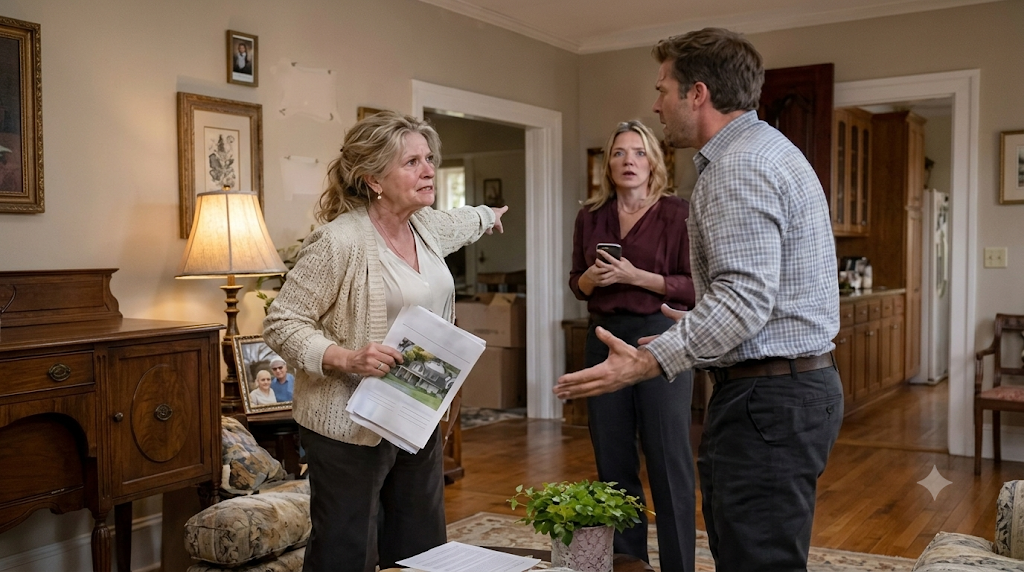
That evening, the four of us sat around the dining table.
Claire had insisted that we eat together.
Daniel looked uncomfortable from the moment he sat down.
Melissa kept checking her phone.
I placed the document Robert had reviewed in the middle of the table.
Daniel stared at it.
“What’s this?”
“You tell me.”
His face changed.
“Mom, why were you going through our things?”
“Why were you making plans for my future?”
Melissa immediately sat straighter.
“Nobody was making decisions for you. We were exploring possibilities.”
“Possibilities involving moving me out of my house?”
“Your house is becoming too much for you,” she replied.
“Then why does this document discuss transferring ownership?”
Daniel rubbed his forehead.
“Mom, please. You’re misunderstanding the paperwork.”
“Then explain it.”
He opened his mouth but said nothing.
Claire leaned forward.
“Why are you listed as the person coordinating her permanent placement?”
Melissa’s expression hardened.
“Because somebody has to be practical.”
I looked at Daniel.
“Did you know about this?”
He stared at the table.
“Yes.”
The single word hurt more than anything Melissa had said.
“How long?”
He swallowed.
“A few weeks.”
“A few weeks?”
“We were trying to figure out what was best.”
“For whom?”
He finally looked at me.
“Mom, you don’t understand how expensive everything is these days. We have bills, school loans, and the kids’ activities. We’re trying to build a future.”
I stared at him.
“What does that have to do with my house?”
He hesitated.
Melissa answered for him.
“If we had more stability, we could make better financial decisions. The house has so much potential. It’s sitting here underused.”
I looked around the dining room.
This was where Daniel had celebrated his high school graduation. Where his father had carved the Thanksgiving turkey every year. Where we had celebrated Claire’s wedding.
Underused.
“Your father and I didn’t spend thirty-seven years building this home so someone could decide it was an investment opportunity.”
Melissa crossed her arms.
“Nobody is asking you to leave tomorrow.”
I looked at the document.
“It says otherwise.”
Daniel finally raised his voice.
“Mom, can we please stop making this into some horrible betrayal?”
I felt my hands trembling, but my voice remained steady.
“Then tell me why you didn’t ask me.”
Neither answered.
I stood.
“Until we understand exactly what happened, neither of you is to contact anyone about my property or sign anything on my behalf. Robert Hayes is handling my legal affairs now.”
Melissa’s face went pale.
“You hired a lawyer?”
“I consulted my attorney. The house belongs to me.”
Daniel pushed his chair back.
“You’re seriously doing this to your own son?”
I looked at him for a long moment.
“No, Daniel. I’m finally doing something for myself.”
He walked out of the dining room.
Melissa followed him, muttering something under her breath.
Claire reached across the table and took my hand.
For the first time in months, I didn’t feel like the person who needed to keep everyone happy.
I felt like the person whose happiness mattered, too.
But the confrontation was only the beginning.
The next morning, Robert called.
He had reviewed the additional documents Claire had photographed during the previous evening’s discussion.
There was something else.
A preliminary financial authorization form had been submitted to a local bank.
It had not been approved, but it requested permission for Daniel to receive information about my accounts and assist with transactions.
The signature section was blank.
Someone had apparently intended to obtain my consent later.
Robert asked me to contact the bank immediately and make sure no one had access to my information.
I did.
The bank confirmed that no authorization had been granted.
They also recommended that I change my passwords, establish additional account protections, and request alerts for unusual activity.
I followed every instruction.
Then I changed the locks on my office.
Not the house.
Not yet.
I still hoped there was a way to end this without turning my family into enemies.
That afternoon, Daniel came home early.
He found me sitting on the back porch with a cup of tea.
“Mom, we need to talk.”
I motioned toward the chair beside me.
He didn’t sit.
“Melissa is upset.”
“I’m sure she is.”
“She thinks you’re treating us like criminals.”
I looked at him.
“Do you think I should treat you like family?”
He frowned.
“Of course.”
“Then why did you hide this from me?”
He rubbed his face.
For a moment, he looked like the little boy who used to come to me after making a mistake.
“Mom, we were in trouble.”
I waited.
He finally sat down.
“Melissa’s business hasn’t been doing well. We fell behind on some payments. I lost money trying to help her keep it going. We didn’t want you to know.”
There it was.
Not an explanation for everything, but perhaps the beginning of one.
“How much?”
He hesitated.
“Enough.”
“Daniel.”
He looked down.
“About forty thousand dollars.”
I closed my eyes.
Forty thousand.
I thought about the expensive shoes Melissa had recently purchased, the new television, and the weekend trips she kept mentioning to her friends.
I also thought about the times Daniel had asked whether I had considered selling the house.
“Did you plan to sell it?”
“No. Not exactly.”
“Then what did you plan?”
He stared at the garden.
“We thought if you moved somewhere smaller, we could use the equity from the house to get back on our feet.”
I felt cold.
“By transferring my house into a trust?”
“We would have paid you back.”
“With what?”
He had no answer.
I looked at him.
“Did you ever think about what would happen if I said no?”
He lowered his head.
“We thought you’d understand.”
“Understand what? That you needed money?”
He nodded.
“Why didn’t you ask me?”
His eyes became wet.
“Because I knew you’d say no.”
That answer stayed with me long after he went back inside.
It wasn’t simply that he had planned something behind my back.
He had known I wouldn’t agree, so he had decided my agreement wasn’t necessary.
That evening, Claire sat beside me in the kitchen.
“Are you going to let them stay?”
I looked toward the stairs.
“I don’t know.”
“Mom, you don’t owe them your house because they’re your children.”
“I know.”
“Do you?”
I didn’t answer.
She took my hand.
“Being their mother doesn’t mean you have to become their safety net at the expense of your own future.”
I knew she was right.
But knowing something and accepting it are two different things.
For the next week, Daniel barely spoke to me.
Melissa became increasingly hostile.
She stopped putting my mail on the kitchen counter and began leaving it on the stairs.
She complained when I used the washing machine.
She even told Claire that she was making the situation worse by interfering.
Claire didn’t respond.
She simply helped me prepare dinner.
Then, on a Thursday afternoon, I received a call from an unfamiliar number.
It was a woman named Patricia from a senior living community.
She explained that someone had contacted them regarding a possible admission for me.
They needed to confirm my preferences and arrange an assessment.
I thanked her and asked who had provided my information.
She gave me Daniel’s name.
I felt my stomach drop.
I explained that I had never requested an assessment and had no intention of moving.
Patricia apologized.
“We were given the impression that you were interested but needed some assistance making the arrangements.”
“I am not interested.”
“Of course. I’ll update the file.”
After hanging up, I sat very still.
This was no longer a private family disagreement.
They had been speaking to strangers as if my future had already been decided.
I called Robert.
He advised me to send a written notice to the facility stating that I had not authorized any placement arrangements.
He also recommended that I document every incident.
I followed his advice.
Then I did something I had never imagined doing.
I asked Daniel and Melissa to attend a family meeting with Robert present.
Daniel agreed reluctantly.
Melissa refused at first.
But when I told them that their living arrangement would be formally reviewed, she changed her mind.
The meeting took place the following Monday.
Robert sat at one end of the dining table with a legal folder.
Claire sat beside me.
Daniel and Melissa sat opposite us.
Robert began calmly.
“Your mother owns this property outright. She has not granted either of you authority to transfer it, sell it, borrow against it, or make residential decisions on her behalf.”
Melissa rolled her eyes.
“We know that.”
“Then this should be straightforward,” Robert replied.
He explained that any future planning would require my informed and voluntary consent.
He also explained that I was entitled to decide who lived in my home and under what conditions.
Daniel looked miserable.
“Mom, what do you want from us?”
I took a breath.
“I want my home back.”
Melissa gave a bitter laugh.
“You’re throwing us out?”
“I’m asking you to leave.”
The silence that followed was enormous.
Daniel stared at me as if I had slapped him.
“Where are we supposed to go?”
I felt the familiar urge to rescue him.
To say they could stay another month.
To offer money.
To make the discomfort disappear.
But I remembered the hidden document.
I remembered the phrase the old lady.
I remembered how many times I had swallowed my feelings to keep the peace.
“You are adults,” I said quietly. “You will find somewhere.”
Melissa stood.
“This is unbelievable. After everything we’ve done for you.”
I looked at her.
“What exactly have you done?”
She opened her mouth.
Then closed it.
Daniel leaned forward.
“Mom, please. We can fix this.”
“Can you?”
“Yes.”
“Then start by respecting the fact that this is my house.”
Robert outlined a reasonable move-out arrangement.
They would have thirty days to find another place, pack their belongings, and return the keys.
There would be no transfer of ownership and no financial agreement involving my property.
Daniel signed the written acknowledgment.
Melissa refused.
She said she needed time to think.
Robert explained that her signature wasn’t required for me to withdraw permission for them to live there, but he would document her refusal.
The meeting ended with Melissa storming upstairs.
Daniel remained seated.
“Are you really going to let this happen?”
I looked at my son.
“I’ve let too much happen already.”
He left without saying goodbye.
The following thirty days were the longest of my life.
The atmosphere in the house became unbearable.
Melissa moved around as if I were invisible.
Daniel spent most evenings away.
Claire stayed until the final week, helping me sort through the things that had been moved and restoring the rooms to the way I remembered them.
We found my husband’s photographs in a storage box behind the furnace.
One frame was cracked.
It was the photograph from our twenty-fifth anniversary, taken in the garden.
My husband had his arm around my shoulders, and I was laughing at something he had whispered.
I held the frame against my chest.
“Your father would be furious,” Claire said softly.
I smiled through my tears.
“Your father would probably have said something terribly sarcastic.”
We laughed.
It felt good.
On the twenty-eighth day, Daniel knocked on my bedroom door.
“Can I come in?”
I let him.
He looked exhausted.
“Mom, Melissa and I found an apartment.”
“That’s good.”
“We’re moving Saturday.”
I nodded.
He stood awkwardly near the door.
“Are you happy?”
The question surprised me.
“No,” I said honestly. “I’m relieved. That’s not the same thing.”
He looked down.
“I know I messed up.”
I waited.
“I shouldn’t have hidden those documents. I shouldn’t have talked about moving you without asking. And I shouldn’t have let Melissa treat you the way she did.”
For the first time, he sounded like he understood what he had done.
“Why did you let it happen?”
He sat on the edge of the chair.
“Because I was scared. We were drowning financially, and I thought if I could convince you to move, everything would somehow work out.”
“Even if I didn’t want to?”
He nodded.
“I wasn’t thinking about what you wanted.”
His eyes filled.
“I’m sorry, Mom.”
I wanted to reach for him.
I wanted to tell him that everything was forgiven.
But forgiveness offered too quickly can sometimes become another way of avoiding the truth.
So I simply said, “I hope you mean that.”
He nodded.
Then he left.
Saturday morning arrived.
A moving truck pulled into the driveway.
Melissa barely looked at me as she carried boxes outside.
Daniel loaded furniture with the help of a friend.
By noon, the house was almost empty.
Before leaving, Melissa approached me in the hallway.
“I hope you’re happy now.”
I looked at her calmly.
“I hope you learn that someone’s kindness is not permission to take advantage of them.”
She rolled her eyes and walked out.
Daniel was the last to leave.
He stood in the doorway holding his car keys.
“Can I call you?”
“Yes.”
“Can I visit?”
“Sometimes. But we’ll need to rebuild things.”
He nodded.
“I understand.”
I watched him walk down the front steps.
Then the car disappeared around the corner.
And just like that, the house was mine again.
I thought I would cry.
Instead, I walked into the living room, opened the curtains, and let the afternoon sunlight fill the room.
The silence was unfamiliar.
But it wasn’t frightening.
It was peaceful.
That evening, Claire prepared dinner before returning home the next morning.
We ate at the dining table beneath the old chandelier.
My husband’s photograph stood on the mantel.
For the first time in months, I looked around and recognized my home.
Not because every object was in the right place.
But because I no longer felt like I had to ask permission to exist there.
The weeks that followed were surprisingly busy.
I had the locks rekeyed.
I updated my estate documents.
I established clear financial safeguards and made sure my medical and legal preferences were recorded in ways that reflected my actual wishes.
I also hired a gardener to help with the heavier work.
For years, I had assumed accepting help meant admitting weakness.
Now I understood that asking for help was very different from surrendering control.
I joined a local book club at the library.
I began having coffee with a neighbor named Evelyn, whose husband had died the year before.
We quickly became friends.
One afternoon, she invited me to a community center meeting about older adults living independently.
I went out of curiosity.
I came home with three phone numbers, two new friends, and an idea.
I wanted to help other women understand their rights when it came to their homes, finances, and family decisions.
Not because every child was dishonest.
Not because every family disagreement was dangerous.
But because too many people believed that growing older meant becoming less entitled to make their own choices.
I knew better now.
I began volunteering twice a month, helping organize information sessions about financial safety, estate planning, and independent living.
Robert even agreed to attend one of the meetings and answer questions.
At our first session, a woman in her seventies raised her hand.
“My daughter says I should sign my house over to her now, just to make things easier. She says it’s what families do.”
The room went quiet.
I looked at the woman and recognized the uncertainty in her face.
I knew exactly how she felt.
“Before you sign anything,” I told her, “talk to an independent attorney. Make sure you understand what you’re giving away. And remember that you are allowed to say no.”
She nodded.
Then she began to cry.
After the meeting, she hugged me.
“Thank you. I thought I was being selfish.”
I held her hand.
“Protecting your future isn’t selfish.”
That night, I returned home and stood in the hallway beneath the photographs of my husband.
I touched the frame with my fingertips.
“I think you’d be proud of me,” I whispered.
And for the first time, I believed it.
Daniel and I didn’t repair our relationship overnight.
There were difficult conversations.
There were awkward phone calls.
There were times when I wanted to return to the old habit of saying yes just to avoid tension.
But I learned to pause.
When he asked for money, I asked what the money was for.
When he suggested I should move closer to him, I reminded him that I was happy where I was.
When he complained that I was being distant, I told him that trust required more than an apology.
Melissa and I remained polite but distant.
I didn’t hate her.
I simply stopped giving her access to parts of my life she had shown she couldn’t respect.
About six months after they moved out, Daniel came to visit alone.
He brought a small wooden box.
“I found this while unpacking,” he said.
Inside was a collection of old photographs.
My husband holding Daniel as a baby.
Claire wearing a ridiculous birthday hat.
The four of us standing in front of the house on the day we bought it.
I smiled.
“I thought these were lost.”
Daniel looked uncomfortable.
“Mom, there’s something else.”
He sat down.
“Melissa and I are having problems. We might separate.”
I felt sorry for him.
But I didn’t rush to fix anything.
“I’m sorry you’re going through that.”
He nodded.
Then he looked around the living room.
“Everything looks like it used to.”
“Not everything,” I said. “I’ve changed a few things.”
He smiled faintly.
“I can see that.”
We sat together for a while, talking about his father, his childhood, and the things we’d both been too afraid to say.
Before leaving, he stood in the doorway.
“Mom, I know you may never trust me the way you used to.”
I looked at him.
“Trust isn’t something you get back because you ask for it, Daniel. It’s something you build by what you do afterward.”
He nodded.
“I want to try.”
“Then try.”
He hugged me.
It wasn’t the warm, effortless embrace we once shared.
It was hesitant.
But it was real.
And sometimes, real is where healing begins.
A year after that terrible night when I discovered the hidden document, I hosted a small dinner party.
Claire came with her children.
Evelyn brought a homemade pie.
Two neighbors joined us.
Daniel came too, alone.
He arrived early and asked whether I needed help setting the table.
I looked at him for a moment.
Then I handed him the plates.
“Yes, thank you.”
He arranged them carefully, checking with me before moving anything.
It was a small thing.
But I noticed.
During dinner, my grandson asked why Grandpa’s photographs were displayed everywhere again.
I smiled.
“Because some people deserve to be remembered.”
Everyone laughed.
Later, as I stood in the kitchen washing dishes, Daniel came beside me.
“Mom, you don’t have to do all that.”
I looked at him.
“I know.”
He picked up a towel and began drying.
We worked quietly for a few minutes.
Then he said, “I used to think you would always be there to catch me.”
I rinsed a plate.
“I used to think that was my job.”
He looked at me.
“Wasn’t it?”
I turned off the faucet.
“My job was to raise you, love you, and teach you how to stand on your own feet. It was never to sacrifice the rest of my life so you wouldn’t have to.”
He absorbed that in silence.
Then he nodded.
“I wish I’d understood that sooner.”
“So do I.”
When everyone had gone home, I stepped onto the back porch.
The garden was quiet.
The roses had begun blooming again.
I sat in my husband’s old chair and looked toward the windows glowing with warm light.
For a long time, I had believed that keeping a family together meant enduring whatever hurt came my way.
I thought a good mother always made room.
A good widow always stayed grateful.
And a good grandmother never made trouble.
But I had confused love with permission.
I had confused patience with silence.
And I had confused being needed with being valued.
The truth was much simpler.
I could love my son without handing him the keys to my future.
I could forgive him without pretending nothing had happened.
I could welcome family into my home without allowing them to take ownership of my life.
And I could grow older without becoming invisible.
My husband and I had built that house together.
Every wall held a memory.
Every garden bed carried a piece of our story.
But the most important thing he had left me wasn’t the property, the furniture, or the money in the bank.
It was the life we’d worked so hard to build.
And I finally understood that I had every right to keep living it on my own terms.
Sometimes, standing your ground means losing the version of your family you thought you had.
Sometimes, it means accepting that the people you love may disappoint you.
But sometimes, it also gives them the opportunity to become better people.
I don’t know what the future holds for Daniel and me.
I only know that our relationship is healthier now because I stopped pretending that everything was fine.
And if there’s one thing I would tell anyone facing a similar situation, it’s this:
Never let guilt convince you that you must surrender your dignity to prove your love.
Your children may always be your children.
But you are still your own person.
Your home is still your home.
Your voice still matters.
And your future belongs to you.
That night, before going to bed, I turned off the hallway light and paused beneath my husband’s photograph.
I smiled at him.
“Good night, sweetheart.”
Then I walked into my bedroom, closed the door, and felt something I hadn’t felt in a very long time.
I was home.