I almost dropped my car keys when I saw the man standing beside the old farmhouse. The last time I had seen him
The final page contained a name I never expected to see.
Not Jackson’s.
Not Richard’s.
It was the name of a retired Navy intelligence officer who had been involved in the mission that nearly cost me my life twelve years earlier.
General Thomas Whitaker.
I stared at the signature at the bottom of the document, struggling to understand what I was seeing.
The report stated that Jackson had not merely disobeyed an order during that mission. It claimed he had deliberately abandoned his assigned position, endangered the entire operation, and compromised classified intelligence.
But there was something else.
A confidential payment authorization, dated just three days after the incident, had been issued to a private security contractor. The amount was substantial, and the authorization bore Whitaker’s approval.
Richard cleared his throat.
“That document is classified,” he said. “You have no authority to distribute it.”
I looked up.
“Then why is it sitting in my company’s financial records?”
He didn’t answer.
Our legal director, Margaret, slowly removed her glasses.
“There’s another problem,” she said. “The company receiving those payments is currently owned by a holding group connected to Richard’s family.”
The room fell silent.
Richard stood abruptly.
“This meeting is over.”
“No,” I replied. “It isn’t.”
He looked at me with an expression I had never seen before. His usual confidence had disappeared, replaced by something much closer to fear.
“You’re making a mistake you can’t undo.”
I leaned back in my chair.
“Then I suppose we’d better make sure we understand exactly what that mistake is.”
I instructed security to prevent the removal of any company records and asked Margaret to contact outside investigators.
Richard left without another word.
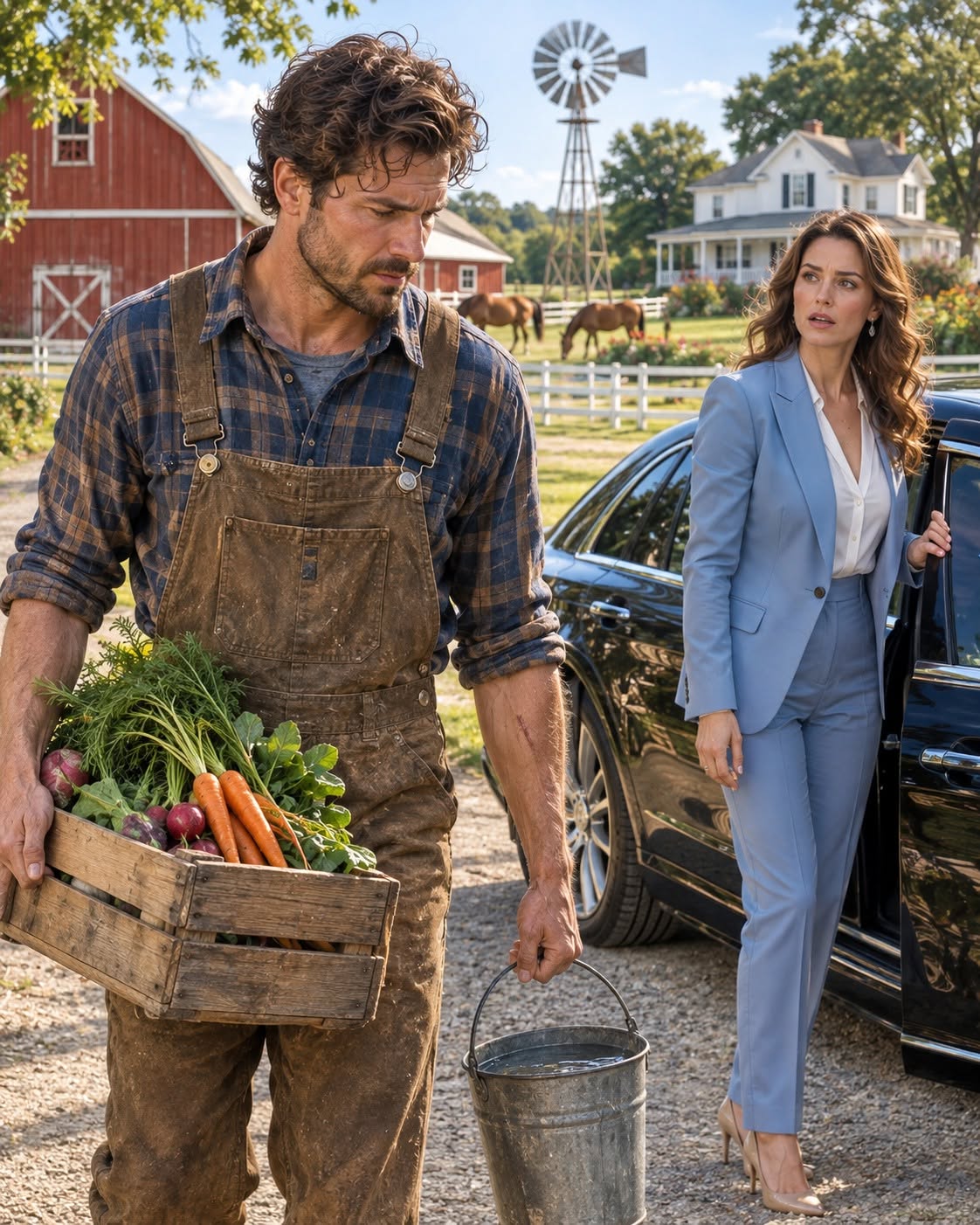
But before the door closed, he turned around.
“Ask Jackson what really happened that night,” he said. “You might discover he wasn’t the hero you remember.”
His words stayed with me long after he disappeared.
Because suddenly, I wasn’t sure whether I was uncovering a corporate scandal or reopening a military secret that powerful people had spent twelve years trying to bury.
And I knew there was only one person who could help me understand the truth.
Jackson.
THE MAN WHO NEVER ASKED FOR THANKS
I drove back to the farmhouse the following morning.
The sky was gray, and a cold wind swept across the open fields. Jackson was repairing a section of wooden fencing when I pulled into the driveway.
He recognized my vehicle immediately.
“Back again?” he called, wiping his hands on an old towel.
“I need to ask you something.”
He studied my face.
“That sounds expensive.”
Despite everything, I laughed.
Then I showed him a photograph of the document bearing General Whitaker’s signature.
The change in his expression was immediate.
His shoulders stiffened. The towel slipped from his hand.
“Where did you get that?”
“From my company’s records. Richard said I should ask you what really happened the night you rescued me.”
Jackson looked toward the farmhouse.
For several seconds, he said nothing.
Then he walked toward the porch and motioned for me to follow.
Inside, the house smelled of coffee, old wood, and something baking in the kitchen. Family photographs covered one wall. A younger Jackson stood beside a woman and two children in several of them.
He poured two cups of coffee.
“I wondered when this day would come,” he finally said.
“What does Whitaker have to do with your discharge?”
Jackson rubbed his forehead.
“That night, your vehicle wasn’t supposed to be where it was.”
I frowned.
“What do you mean?”
“Our convoy received updated coordinates shortly before the mission. We were told the route was secure. But somebody had changed the intelligence report.”
He paused.
“When your vehicle overturned, I saw movement on the ridge. The enemy knew exactly where we would be.”
I remembered flashes of that night. The explosion. The screaming. The smell of burning rubber.
I remembered being unable to move my legs.
And I remembered a man reaching through shattered glass, telling me to keep breathing.
“You pulled me out,” I whispered.
“I did.”
“But you were ordered to hold your position.”
Jackson nodded.
“There were two injured soldiers in your vehicle. You were trapped, and the fire was spreading. I had seconds to decide. My commanding officer ordered me to stay with the main unit because he believed rescuing you would expose the rest of the team.”
“Why did he blame you afterward?”
Jackson looked down at his coffee.
“Because somebody needed to take responsibility for the intelligence failure.”
He explained that after the mission, the official report had been altered. Communications records disappeared. Witness statements were rewritten. The rescue was described as an unauthorized action that had compromised the operation.
His commanding officer initially defended him.
But within weeks, that officer was transferred. Jackson was investigated, stripped of his clearance, and eventually separated from the Navy.
“Did you ever appeal?”
“Twice.”
“What happened?”
“Both requests disappeared into the same system that had buried the original report.”
He gave a tired smile.
“Eventually, I stopped fighting. I had a wife and two children. I couldn’t spend the rest of my life trying to convince people that I had done the right thing.”
I looked at the photographs on the wall.
“What about your family?”
“My wife, Ellen, died six years ago. Cancer.”
His voice softened.
“My daughter lives in Colorado. My son is a mechanic in town. They’re good kids. That’s what matters.”
I felt ashamed that I had spent twelve years building a successful company while the man who had saved my life had been forced to rebuild his from almost nothing.
“Jackson, I am going to make this right.”
He shook his head.
“Don’t.”
I stared at him.
“Don’t what?”
“Don’t make promises because you feel guilty.”
His voice wasn’t angry. That somehow made it worse.
“I didn’t save you because I wanted a favor. I made a decision. I would make the same one again.”
I swallowed hard.
“But someone destroyed your career.”
“Then find out who did it. Just don’t turn my farm into another battlefield.”
I promised him I wouldn’t.
But as I drove away, I realized that keeping that promise might be harder than I imagined.
THE FIRST WARNING
Three days later, Margaret called me into her office.
She had spent the weekend reviewing the transactions and discovered something that changed everything.
Richard wasn’t working alone.
Three executives had approved payments to shell companies over a period of eighteen months. Those companies had hired private investigators, environmental consultants, and security contractors to create pressure around several rural properties.
Jackson’s farm was only one of six targets.
The properties all shared something in common.
They sat near transportation corridors that my company had been considering for a classified logistics project.
The project involved building a secure distribution network for military equipment and emergency supplies.
The land was valuable.
But the owners had refused to sell.
Someone had decided that making their lives miserable would be cheaper than negotiating fairly.
“How far does this go?” I asked.
Margaret placed another folder on my desk.
“Farther than the property acquisitions. We’ve found payments to people with access to military intelligence databases.”
I stared at her.
“Military databases?”
“Someone appears to have been collecting old operational reports, including records from your rescue mission.”
I felt the room grow colder.
“Why?”
Margaret hesitated.
“Because the mission may have exposed a much larger intelligence operation.”
Before she could explain, my assistant knocked and entered.
“There’s a man downstairs asking to see you. He says he served with Jackson.”
“What’s his name?”
“Daniel Brooks.”
Margaret and I exchanged a glance.
I told her to bring him up.
A few minutes later, a thin man in his late fifties entered the office. He walked with a slight limp and carried a battered leather folder.
He introduced himself as a former Navy communications specialist.
“I heard you’re asking questions about the mission twelve years ago,” he said.
“I am.”
He opened his folder.
“I was the one who transmitted the updated coordinates.”
My stomach tightened.
“Did you know they were wrong?”
He shook his head.
“Not at the time. I received the changes through an authenticated command channel. Everything looked legitimate.”
He placed a printed communication log on my desk.
“Years later, I discovered that the transmission had been routed through an account belonging to a senior intelligence officer. The account was supposedly inactive.”
I looked at the authorization code.
It matched the code on the financial document.
“General Whitaker?”
Daniel nodded.
“But there’s something you need to understand. Whitaker didn’t just cover up the intelligence failure. He was investigating someone who had been selling operational information to private contractors.”
“Who?”
Daniel closed the folder.
“Your vice president.”
For a moment, I couldn’t speak.
Richard had joined my company five years earlier. He had helped expand our operations, managed sensitive contracts, and earned the trust of our board.
He had also been the person I relied on to protect our security systems.
“Why didn’t anyone tell me?”
“Because the investigation was shut down before it reached you.”
Daniel leaned forward.
“There’s a reason Richard wanted Jackson’s farm. He believes the original mission records are hidden somewhere on that property.”
I frowned.
“Jackson doesn’t have military records.”
“Maybe not. But the night your vehicle was destroyed, one of the team members recovered a damaged communications device. Jackson kept it because it contained the final transmission he received before the ambush.”
My pulse quickened.
“Does he still have it?”
Daniel nodded.
“Last I heard, he did.”
THE NIGHT THE FARMHOUSE WENT DARK
I called Jackson immediately.
He didn’t answer.
I tried again.
Nothing.
Then my phone rang from an unfamiliar number.
It was Jackson’s son, Michael.
“Something’s wrong,” he said. “Dad’s truck is here, but he isn’t answering the door.”
I was already reaching for my keys.
“Call the sheriff. Don’t go inside alone.”
When I arrived, two police cruisers were parked near the farmhouse. Michael stood beside them, his face pale.
The front door was open.
Inside, drawers had been pulled out, papers scattered across the floor, and a kitchen window had been shattered.
Jackson was nowhere to be found.
A deputy approached me.
“Do you know what happened here?”
“I think someone is looking for something.”
Michael picked up a photograph from the floor.
It showed Jackson standing with his old military team.
Someone had drawn a red circle around his face.
On the back, written in black marker, were four words.
STOP DIGGING OR ELSE.
The deputy called for additional officers.
I contacted Margaret and told her to notify our outside investigators. Then I noticed something strange.
The old wooden cabinet beside the fireplace was still locked.
According to Michael, his father had never allowed anyone to open it.
I asked the deputy for permission to examine the area.
Inside the cabinet, beneath several old family documents, I found a small metal box.
It was locked, but the key was taped underneath the bottom shelf.
Inside lay a damaged military communications device, a handwritten notebook, and several photographs.
I carefully opened the notebook.
The first page contained a list of coordinates, dates, and names.
The last entry was dated two days before the ambush.
Beside it, Jackson had written:
“Someone on command is selling our movements. If anything happens, preserve the original transmission.”
I felt my throat tighten.
He had known something was wrong.
And he had kept the evidence for twelve years.
Then I heard a voice behind me.
“Put that down.”
I turned.
Richard stood in the doorway.
He was holding a handgun.
The deputy immediately reached for his weapon.
“Drop it!” the officer shouted.
Richard looked at me, his expression twisted with desperation.
“You have no idea what you’ve just uncovered.”
The deputy repeated his command.
Richard lowered the gun slightly but didn’t release it.
“You think you’re protecting that old soldier? You’re destroying everything you’ve built.”
I stared at him.
“You broke into his home.”
“I was trying to recover company property.”
“That belongs to Jackson.”
Richard laughed bitterly.
“Jackson should have stayed out of something he didn’t understand.”
The deputy moved closer.
Richard suddenly raised the weapon.
A single gunshot shattered the silence.
For one terrible second, I thought someone had been hit.
Then Richard dropped the gun and clutched his shoulder.
Another officer had fired.
He collapsed against the doorframe.
Within minutes, he was handcuffed and taken away.
As the officers secured the house, I looked down at the notebook again.
There was one final page.
It contained a name I recognized.
Not Whitaker.
Not Richard.
It was the name of the company’s original founder.
My father.
THE SECRET MY FATHER TOOK TO HIS GRAVE
I sat in my car for nearly twenty minutes before I could bring myself to call Margaret.
My father had founded the company thirty years earlier. He had built it from a small transportation business into one of the country’s most respected defense logistics organizations.
He had taught me that integrity was more important than profit.
He had also died four years earlier.
According to Jackson’s notebook, my father had known about the altered coordinates before the mission.
I didn’t want to believe it.
But the notebook included a handwritten note:
“Founder informed. Original evidence delivered. No action taken.”
Margaret listened without interrupting.
Then she said something that made my hands go cold.
“Your father authorized an internal investigation at the time. I found the archived case number this afternoon.”
“Why wasn’t I told?”
“Because the investigation was classified. And because it was closed before any formal findings were issued.”
I closed my eyes.
“Who closed it?”
There was a long pause.
“General Whitaker.”
The next morning, I went to the company archives.
An older records manager named Samuel had worked for my father for nearly twenty years. He was nearing retirement and had always treated me with the kind of respect reserved for someone he had watched grow up.
When I showed him Jackson’s notebook, his face changed.
“I wondered when someone would find that,” he whispered.
He unlocked a storage room and brought out a sealed archive box.
Inside were letters, investigation reports, and a recorded statement from my father.
I found the recording and pressed play.
My father’s familiar voice filled the room.
“If anyone is listening to this, it means the truth about the operation has finally resurfaced.”
He sounded tired.
“The intelligence failure was deliberate. I was shown evidence that senior officials had been sharing operational information with private contractors. I wanted to expose it, but I was warned that doing so would endanger the company, its employees, and my family.”
He paused.
“Jackson did exactly what a soldier should do. He protected a life when every second mattered. The official report is false.”
I felt tears gathering in my eyes.
“Instead of defending him, I chose silence. I convinced myself I was protecting the company. In reality, I was protecting my own position.”
His voice broke slightly.
“I have regretted that decision every day since.”
The recording ended.
I sat there, unable to move.
My father had not been the villain behind the conspiracy.
But he had been a man who knew the truth and lacked the courage to speak it when it mattered.
And his silence had cost Jackson twelve years of his life.
I realized something then.
The company I had inherited wasn’t just responsible for correcting Richard’s crimes.
It was responsible for confronting the choices that had allowed those crimes to survive.
THE BOARDROOM CONFRONTATION
Two weeks later, the company held an extraordinary board meeting.
This time, the room was filled with outside attorneys, independent investigators, and representatives from federal authorities.
Richard had been placed on administrative leave pending criminal proceedings.
Two other executives had resigned.
General Whitaker had been contacted by investigators and agreed to provide a statement, although his attorney insisted he had acted within his authority.
I placed three items on the table.
Jackson’s original communications device.
My father’s recorded confession.
And the official report that had destroyed Jackson’s military career.
“These documents establish that our company was involved in a deliberate effort to conceal an intelligence failure,” I began.
“No business objective, no government contract, and no executive’s reputation can justify what happened.”
One board member shifted uncomfortably.
“We should be careful about accepting the conclusions of an unfinished investigation.”
I nodded.
“Absolutely. That’s why we have independent investigators and federal authorities reviewing the evidence. We will not decide anyone’s guilt in this room.”
I turned to the legal director.
“But we can decide what our company does now.”
I proposed three immediate actions.
First, all contracts connected to the shell companies would be suspended pending review.
Second, every employee involved in the property acquisition campaign would be investigated, regardless of position.
Third, the company would publicly cooperate with the military review of Jackson’s discharge.
A board member objected.
“That could expose us to enormous financial liability.”
I looked directly at him.
“Then we will accept the consequences of our actions.”
Nobody spoke.
For the first time since becoming CEO, I understood that leadership wasn’t about protecting the institution from embarrassment.
It was about protecting people from the institution when it went wrong.
The board approved the measures.
But I knew the hardest conversation was still ahead.
I needed to tell Jackson everything.
THE APOLOGY
Jackson returned home three days later.
He had been found at an abandoned equipment shed on the far side of his property. He had been held there overnight by two men hired through one of Richard’s contractors.
They had demanded that he reveal the location of the communications device.
He had refused.
When I arrived, he was sitting on the porch with a bandage around his forehead.
Michael was repairing the damaged front door.
“You’re becoming a regular visitor,” Jackson said when he saw me.
“I suppose I am.”
I sat beside him.
For a while, neither of us spoke.
Then I told him about my father’s recording.
I told him about the investigation, the shell companies, and the board’s decision.
Most importantly, I told him that my father had known the official report was false.
Jackson listened quietly.
When I finished, he looked out across the fields.
“Your father came to see me once,” he said.
I turned toward him.
“What?”
“About six months after the mission. He offered me a job with your company. Said I had a future in logistics.”
“Did you accept?”
“No.”
“Why?”
Jackson smiled sadly.
“I asked him whether he believed the report about me. He said he couldn’t discuss it.”
I lowered my head.
“He should have told you the truth.”
“Yes. He should have.”
I struggled to find the right words.
“I’m sorry.”
Jackson looked at me.
“You didn’t write the report.”
“But I inherited the company that helped bury it.”
He was silent for a moment.
Then he said something I would remember for the rest of my life.
“An apology doesn’t change what happened. But what you do after apologizing can change what happens next.”
I nodded.
“I want to help restore your record.”
Jackson looked skeptical.
“Can you do that?”
“I can’t change the past by myself. But I can make sure the people reviewing it have every piece of evidence we found.”
He took a long breath.
“Then let’s see what the truth can do.”
THE HEARING
Four months later, Jackson received an official invitation to attend a military review hearing.
The investigation had uncovered communications showing that the original mission coordinates had been deliberately altered.
Financial records linked the intelligence leak to private contractors who had been receiving classified information in exchange for money.
General Whitaker was eventually charged with multiple offenses related to the conspiracy. Richard and several associates faced separate criminal proceedings involving fraud, bribery, and unlawful interference with property owners.
The evidence also established that Jackson’s actions during the mission had prevented further casualties.
On the morning of the hearing, I met him outside the building.
He wore a simple dark suit.
His hands trembled slightly as he adjusted his tie.
“Never thought I’d be back here,” he said.
“Are you nervous?”
“More than I was before my first combat deployment.”
I smiled.
Inside, the hearing lasted nearly six hours.
Daniel Brooks testified about the altered communications.
Investigators presented the original transmission logs.
Margaret submitted the financial records and my father’s recorded statement.
Then Jackson was asked to describe the moment he decided to leave his assigned position.
He stood.
“I heard the explosion. I saw the vehicle overturned. I knew the fire was spreading. I also knew I had been ordered to hold position.”
The room was completely silent.
“I had seconds to decide whether to follow that order or try to save the people inside. I made my decision based on what I believed was right.”
A reviewer asked whether he understood that his actions could compromise the mission.
“I did.”
“Would you make the same decision again?”
Jackson didn’t hesitate.
“Yes.”
“Even knowing what it would cost you?”
He looked down briefly.
Then he raised his head.
“I would rather lose my career than spend the rest of my life knowing I left someone to die when I could have helped.”
Nobody moved.
I felt tears running down my face.
For twelve years, that man had carried the weight of a decision that should have been recognized as an act of courage.
Now, for the first time, the truth was being heard.
THE DECISION
The review panel took six weeks to issue its findings.
When the letter finally arrived, Jackson asked me to come to the farmhouse.
I found him sitting at the kitchen table with the envelope in front of him.
His son and daughter were there too.
“Open it,” I said gently.
Jackson shook his head.
“You do it.”
I carefully opened the envelope and unfolded the letter.
The first paragraph stated that the original investigation had relied on falsified intelligence and incomplete testimony.
The second acknowledged that Jackson’s decision to rescue the injured personnel had been consistent with his duty to protect human life under the circumstances.
The final paragraph contained the words he had waited twelve years to read.
His record was formally corrected.
The adverse findings were withdrawn.
His service and conduct were to be recognized in an official military commendation.
Jackson stared at the page.
His daughter began crying.
Michael reached over and placed a hand on his father’s shoulder.
But Jackson didn’t celebrate.
He simply sat there, looking at the letter.
Then he covered his face with both hands.
For the first time since I had known him, I saw him cry.
Not loudly.
Not dramatically.
Just quietly, like a man who had finally been allowed to put down something he had carried for far too long.
“I didn’t need a medal,” he whispered.
“I know,” I replied.
“I just wanted them to stop calling me a coward.”
I reached across the table and placed my hand over his.
“They were wrong, Jackson. They always were.”
He nodded.
And for a long time, nobody said anything.
A DIFFERENT KIND OF REWARD
Six months later, my company completed its internal restructuring.
Richard was convicted of fraud, bribery, and conspiracy-related offenses after a lengthy legal process. General Whitaker’s case proceeded separately, and several other individuals involved in the intelligence leak were held accountable.
The company paid restitution to the property owners who had been targeted. We also established an independent ethics office with authority to investigate senior executives without interference from the CEO or board.
But one decision mattered more to me than any corporate reform.
I returned to Jackson’s farmhouse with a proposal.
He was outside repairing a tractor when I arrived.
“What are you selling today?” he asked.
“Nothing.”
“That’s disappointing. I was hoping for a new tractor.”
I laughed.
I handed him a folder.
Inside was a proposal to establish a training and rehabilitation center for former service members on a parcel of company-owned land nearby.
The center would provide vocational training, counseling, employment opportunities, and support for veterans whose careers had been disrupted by injury, wrongful investigations, or circumstances beyond their control.
I wanted Jackson to help design the program.
And I wanted him to lead it if he chose.
He read the proposal slowly.
Then he looked at me.
“Why me?”
“Because you’ve spent twelve years rebuilding a life after people told you that you had no future. You know what it feels like when the system stops listening.”
He closed the folder.
“I don’t know anything about running a center.”
“You know how to lead people. We can hire the specialists for everything else.”
He looked across the fields.
“What happens to the farm?”
“Nothing. I would never ask you to give it up.”
He smiled.
“Good answer.”
He didn’t accept immediately.
He took a week to think about it, discussed it with his children, and asked several questions about funding and oversight.
When he finally agreed, he added one condition.
“No military slogans on the walls. No speeches about being heroes. I want people to feel like they can come here without having to prove anything.”
I agreed.
The center opened the following spring.
We named it the Second Chance Project.
Jackson refused to have his name placed above the entrance.
Instead, he insisted that the building display a simple sentence:
“Your past does not decide what you are worth.”
The first group included twenty-three veterans.
Some had lost their jobs.
Some were struggling with injuries.
Others had simply returned home and discovered that the world they had fought to protect no longer seemed to have a place for them.
Jackson greeted each person personally.
He never asked what rank they had held.
He never asked how many missions they had completed.
He asked their names.
He asked what they wanted to learn.
And he listened.
THE LAST VISIT
A year after we opened the center, I returned to the farmhouse for a small celebration.
The property was beautiful that afternoon. The grass had turned green, the fence had been repaired, and Jackson’s old pickup sat beside the barn.
He was standing on the porch when I arrived.
“You’re late,” he said.
“I had a board meeting.”
“Sounds terrible.”
“It was.”
He laughed and handed me a cup of coffee.
We sat together watching the sunset.
After a while, I asked him something I had wanted to ask for a long time.
“Do you ever regret saving me?”
He turned toward me.
“Why would you ask that?”
“Because it cost you so much.”
Jackson looked at the horizon.
“There’s something I learned a long time ago. You can’t measure the value of a decision only by what it costs you.”
He paused.
“That night, I saw someone who needed help. I had a chance to save a life. I took it. Everything that happened afterward was someone else’s choice.”
I looked down at my coffee.
“I wish I could give you back those twelve years.”
“So do I,” he said with a small smile. “But you can’t.”
Then he looked at me.
“You can make sure somebody else doesn’t lose theirs.”
Those words stayed with me.
I had spent much of my career believing success meant expanding a company, winning contracts, and protecting its reputation.
But Jackson had taught me something more important.
A company could survive losing money.
A leader could survive losing a position.
Even a career could be rebuilt after being destroyed.
What was much harder to repair was the damage caused when good people were abandoned by those who had the power to protect them.
Before I left, Jackson walked me to my car.
I stopped beside the driver’s door.
“Twelve years ago, you carried me out of a burning vehicle,” I said. “I never got to thank you properly.”
He shrugged.
“You thanked me when you got out of that vehicle and kept living.”
I shook my head.
“That’s not enough.”
He smiled.
“Then do something useful with the life you got to keep.”
I got into the car, but before closing the door, I looked at him one last time.
The man standing beside the old farmhouse no longer looked like someone who had lost everything.
He looked like someone who had finally reclaimed the truth about himself.
And as I drove down that dusty gravel road, I understood that the greatest debt I owed Jackson could never be repaid with money, a title, or a medal.
It could only be repaid by refusing to look away when someone was being treated unjustly.
Because courage isn’t always found on a battlefield.
Sometimes it’s found in a boardroom, when telling the truth could cost you everything.
Sometimes it’s found in a quiet farmhouse, where a man refuses to surrender his dignity.
And sometimes it’s found in the simple decision to stand beside someone when the rest of the world has decided to walk away.
Jackson had once risked his life to save mine.
Years later, he had given me something even more valuable.
He had reminded me what being a decent human being was supposed to mean.
I never forgot that lesson.
And neither did the twenty-three people who walked through the doors of the Second Chance Project that first spring.