For six years, I kept Black Hawk 0417 alive with grease under my fingernails and my head down. Nobody at Halden Mountain Outpost
The first light of morning had barely reached Halden Mountain Outpost when I heard footsteps behind me.
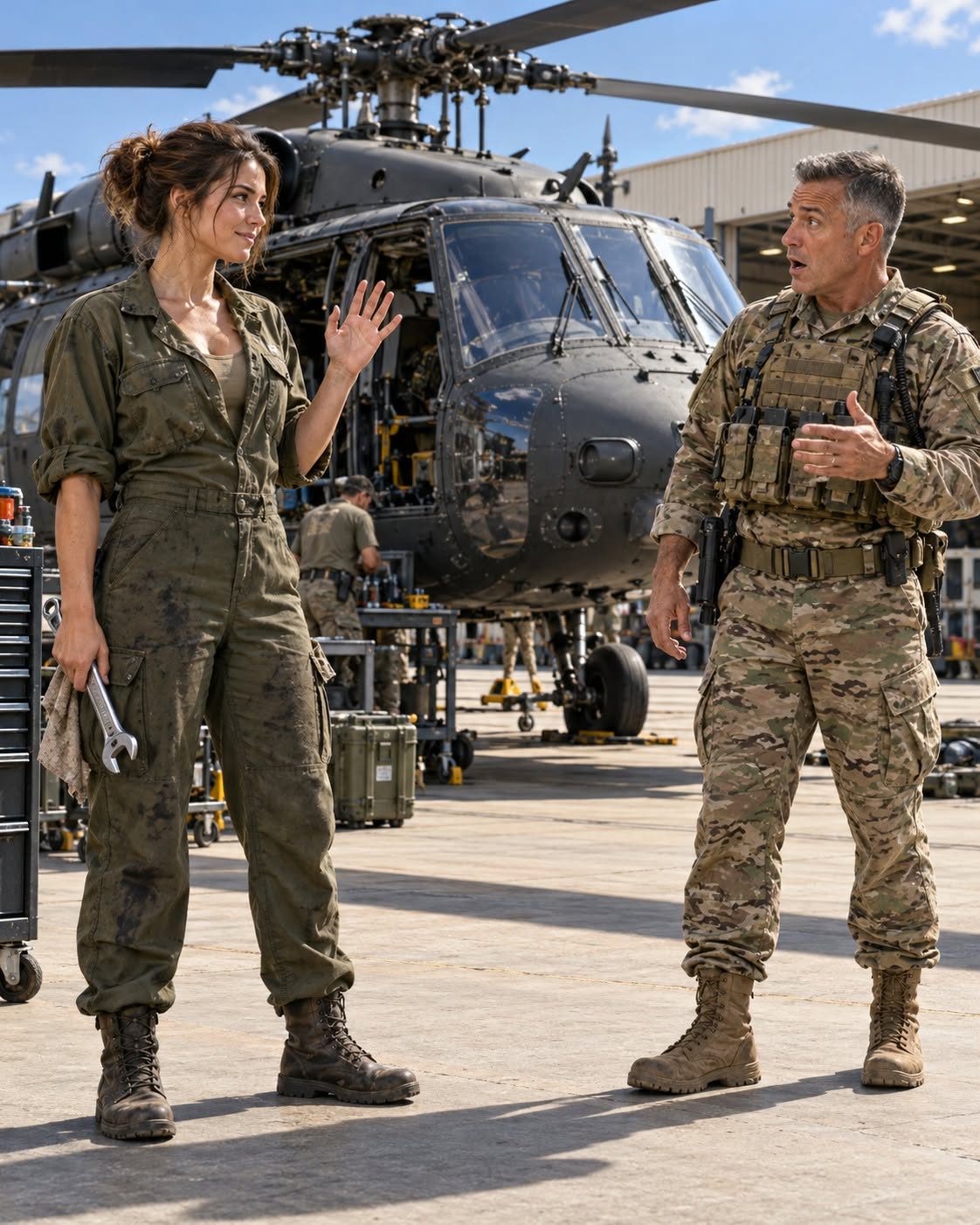
I was leaning over the open engine compartment of Black Hawk 0417, checking a connection that had loosened during the flight home. My uniform was still stained with dust, and my hands were trembling from exhaustion more than cold.
“Do you ever sleep, Daniel?”
I recognized Elena Ross’s voice before I turned around.
She stood at the hangar entrance, holding a clipboard against her chest. Her eyes were red, and her usually immaculate uniform looked as though she had spent the entire night fighting a battle of her own.
“Sometimes,” I said. “When the machines let me.”
She didn’t smile.
“Commander Thorne wants you in the briefing room. Now.”
I wiped my hands on a rag and climbed down from the maintenance platform.
“Is Hayes all right?”
“He’s alive. All nine of them are alive.” She paused, then added, “But that’s not why you’re being summoned.”
I had expected this moment.
The military could forgive a difficult landing. It could forgive a damaged aircraft, a broken chain of command, and even an officer making a decision under pressure.
But it rarely forgave someone who had deliberately stepped outside the boundaries of an official medical disqualification.
I followed Elena across the compound.
Every person we passed seemed to know what had happened. Some stared at me with open curiosity. Others offered quiet nods. A young mechanic who had ignored me for nearly two years stood straighter when I approached.
I didn’t know what to do with their attention.
For six years, invisibility had been my shelter.
Now it was gone.
Inside the briefing room, Commander Jonathan Thorne stood beside a table covered with maps and mission reports. Arthur Gable sat nearby, his right arm secured in a sling. Lucas Moretti leaned against the wall, looking unusually serious.
Two unfamiliar officers occupied the opposite side of the table.
One wore the insignia of a medical command. The other was a colonel whose expression suggested that he had never encountered a problem he couldn’t solve with a regulation.
“Daniel,” Thorne said, “take a seat.”
I remained standing.
The colonel opened a folder.
“Former Captain Daniel Mercer. Callsign Ghost. Flight record includes multiple combat insertions, emergency extractions, and one highly publicized rescue operation six years ago. Subsequently disqualified from flight duties following a vestibular injury.”
He looked up.
“Yesterday, you knowingly operated a military helicopter despite that disqualification. You did so without an active pilot authorization, using an aircraft that had not been cleared for the mission profile you attempted.”
“That’s correct.”
“You understand the seriousness of those actions?”
“Yes, sir.”
“Then perhaps you can explain why we shouldn’t regard your decision as reckless disregard for military procedure.”
I looked at Thorne.
He offered no help.
That was fair. He had already risked his own career by authorizing the mission.
“Because nine soldiers were trapped behind enemy lines,” I said. “And there was nobody else who could reach them in time.”
“That doesn’t make you medically fit to fly.”
“No, sir. It doesn’t.”
The colonel leaned back, apparently dissatisfied that I hadn’t argued.
“Then what does?”
I considered the question.
“Nothing I can say in this room. My performance yesterday doesn’t erase my medical history. If you want to know whether I’m fit to fly, conduct the examinations. If I’m not, I’ll accept that.”
The medical officer finally spoke.
“That’s a surprisingly reasonable answer from someone who just ignored a permanent disqualification.”
“Yesterday, I made a decision based on the information and circumstances I had. I won’t pretend that means I can make the same decision safely every day.”
For the first time, Elena looked directly at me.
Something in her expression had changed.
The colonel closed the folder.
“Until a formal review is complete, you are relieved of aircraft maintenance duties involving 0417. You will remain available for questioning. You are not to enter the cockpit or operate any aircraft.”
I nodded.
“Understood.”
“Do you have anything else to say?”
“Yes, sir.”
I looked around the room at the people who had watched me fly into a storm that might have killed all of us.
“Please don’t make the rescue the only thing that matters. Nine men came home because a team worked together. Arthur monitored the aircraft. Lucas got those soldiers aboard. The mechanics kept 0417 running. Commander Thorne accepted responsibility. If you’re going to investigate what happened, investigate all of it.”
The colonel’s face hardened.
Then, unexpectedly, he wrote something in his notebook.
“Dismissed.”
I left the room without knowing whether I had just defended myself or made my situation worse.
But I knew one thing.
For the first time in six years, I had told the truth about who I was without asking anyone to forgive me for it.
By noon, the story had spread beyond Halden.
Someone had recorded the rescue aircraft’s return from the edge of the landing pad. Another person had recognized the callsign Ghost. Before the day ended, an old military aviation forum had connected my name to the mountain rescue that had supposedly ended my career.
Messages began arriving through channels I hadn’t used in years.
Former squadron mates asked if the rumors were true.
An old flight instructor sent three words: I always wondered.
I read them all and answered none.
I wasn’t ready to become a legend again.
Legends didn’t have to live with the consequences of being human.
They didn’t have to explain the nights when the floor seemed to tilt beneath them, or the way a sudden turn of the head could make a familiar room feel like a ship in rough seas.
They didn’t have to remember the sound of a helicopter spinning out of control.
I did.
That evening, I found Hayes in the medical ward.
He was pale beneath the hospital lights, with bandages around his shoulder and ribs. His left arm rested in a sling, and a monitor beside his bed measured the steady rhythm of a heart that had nearly stopped beating in the mountains.
When I entered, he stared at me for several seconds.
Then he laughed.
It turned into a painful cough.
“Six years,” he said when he could speak again. “Six years, and you show up looking like somebody’s exhausted uncle.”
“Good to see you too, Sergeant.”
He reached for a bottle of water.
“Do you know what I told my men when the radio operator said Ghost was coming?”
“What?”
“I told them it was impossible. I told them Ghost was gone, and whoever was on that frequency had the wrong callsign.”
He looked toward the window.
“Then I heard your voice.”
Neither of us spoke for a while.
I remembered the night six years earlier when I had pulled Hayes from a mountain ledge. He had been young, frightened, and bleeding badly. I had carried him through a storm while the helicopter shook beneath me, and he had gripped my sleeve as though I were the last solid thing in the world.
Now he was looking at me with the same expression.
Only this time, I wasn’t sure which of us had been rescued.
“You saved my life twice,” he said.
“I got you out of a difficult position twice.”
“That’s what people say when they don’t want gratitude.”
“I don’t know what to do with gratitude.”
“Then don’t do anything with it.” He shifted carefully against the pillows. “Just tell me something.”
“Go ahead.”
“Were you afraid yesterday?”
I almost gave him the answer I had given countless younger soldiers.
The answer about training, confidence, and trusting the aircraft.
Instead, I sat down beside his bed.
“I was terrified.”
Hayes nodded slowly.
“Good.”
I frowned.
“Good?”
“If you’d told me you weren’t afraid, I’d have wondered whether the years had made you stupid.”
For the first time that day, I laughed.
The sound surprised me.
Hayes grew serious again.
“My men are alive because you came. But I don’t want you thinking you owe us another miracle. Do you understand?”
I looked at him.
“I didn’t come because I owed you anything.”
“Then why?”
The answer had been waiting inside me for six years, buried beneath anger and shame.
“Because I couldn’t stand the thought of hearing your voice on that radio and doing nothing.”
Hayes held my gaze.
“That’s a reason,” he said. “Just don’t turn it into a life sentence.”
I left the ward carrying those words with me.
For years, I had believed that the only way to honor the pilot I’d been was to keep his memory alive through Black Hawk 0417. I had mistaken devotion for punishment. I had kept an old aircraft running because I couldn’t accept that my own flying career might truly be over.
But perhaps Hayes was right.
A rescue could be an act of courage without becoming a debt that lasted forever.
Three days later, the formal medical review began.
The first examinations were humiliating.
Doctors tested my balance, my eye movements, and my response to sudden changes in position. I stood on padded platforms while sensors measured movements I could barely feel. I walked straight lines, turned my head, and stared at lights until nausea rolled through my stomach.
Some results were encouraging.
Others were not.
My injury had improved, but the underlying damage remained. The specialists explained that my performance during the rescue, however impressive, could not establish that I was safe to return to regular flight duties.
One physician, Dr. Miriam Cole, was particularly direct.
“Your brain has learned to compensate for some of the damage,” she said. “That is not the same as your vestibular system being restored.”
“Could I pass a flight evaluation?”
“Possibly. But we would need to establish the limits of your compensation, examine your symptoms under controlled conditions, and determine whether those limits are compatible with operational flying.”
“And if they aren’t?”
“Then you don’t fly.”
I looked down at my hands.
Six years earlier, those words had felt like the closing of a door.
Now I was trying to understand whether they might simply describe a boundary I had to respect.
Dr. Cole studied me.
“You flew yesterday in severe turbulence, correct?”
“Yes.”
“Did you experience dizziness?”
“Several times.”
“Visual disorientation?”
“Yes.”
“Did you conceal either symptom from your co-pilot?”
I hesitated.
Arthur had seen my hands shaking. He had monitored the instruments and called out changes in the aircraft’s behavior. But I had not told him everything I was feeling.
“Yes,” I admitted.
Dr. Cole wrote something down.
“Then your rescue may have been successful, but your decision-making still requires examination. Courage is not a substitute for medical fitness.”
“I know.”
“Do you?”
Her question stung because I couldn’t dismiss it.
For years, I had judged myself by what I could endure. I had thought that if I worked hard enough, remained quiet enough, and never asked anyone for help, I could prove that losing my wings hadn’t made me less of a man.
Perhaps I had simply found a different way to hide.
The review continued.
Meanwhile, Black Hawk 0417 remained grounded.
Without my maintenance authorization, another team inspected the aircraft. They found several issues that required attention, including a component that had worn more quickly than expected during the flight.
The helicopter had survived the mission, but survival wasn’t the same as airworthiness.
I wanted to return to the hangar and help.
Instead, I was assigned to administrative duties while the investigation proceeded.
On the fourth morning, Lucas found me sorting maintenance records in a cramped office.
“You look miserable,” he said.
“I’m having a wonderful time.”
“Good. Then you’ll love this.”
He dropped a thick binder onto my desk.
I opened it and stared at the pages.
It was the complete maintenance history of Black Hawk 0417, including the discrepancies I had documented over the years, the parts we had struggled to obtain, and the inspections I had insisted on completing even when others considered them unnecessary.
“What is this?”
“Your paperwork.”
“Why?”
“Because the investigation team wants to know why that old bird was still flying at all.”
I flipped through the records.
Every repair was documented. Every questionable component had been flagged. Every unresolved issue had been recorded rather than hidden beneath a signature.
For six years, I had believed that keeping 0417 alive was a private obsession.
Now I was seeing what that work really meant.
The aircraft had remained serviceable because I had refused to let neglect become normal.
Lucas pulled a chair beside my desk.
“There’s something else,” he said.
“What?”
“Thorne has been fighting to keep the investigation focused on the whole mission. He’s made it clear that nobody should pretend your decision happened in a vacuum.”
I closed the binder.
“He shouldn’t have to risk his career for me.”
“Maybe he’s not doing it for you.”
Lucas leaned forward.
“Maybe he’s doing it because he was the commander, nine people were in danger, and he knows the difference between accepting responsibility and blaming the nearest person.”
I thought about that for a long time.
Then I opened the binder again.
“Help me organize these records chronologically.”
Lucas grinned.
“Now you’re talking.”
We spent the rest of the afternoon building a timeline of 0417’s maintenance history. What had once seemed like a collection of insignificant repairs became a clear record of decisions, risks, and lessons learned.
When we finished, I understood something I had missed for years.
I hadn’t merely been maintaining an aircraft.
I had been protecting the people who might someday depend on it.
And the work had mattered, even when nobody knew my name.
A week after the rescue, the investigation board assembled in the main conference room.
This time, I was allowed to sit at the table.
Commander Thorne described the operational emergency. Elena presented the communications logs and weather reports. Arthur explained what he had observed from the right seat, including the moments when my symptoms had become apparent.
He did not soften the facts.
When the board asked whether I had demonstrated sound judgment, he paused.
“You could argue that his decision to fly was necessary,” he said. “You could also argue that it was dangerous. Both statements are true.”
The colonel raised an eyebrow.
“Then what is your recommendation?”
Arthur looked at me.
“Don’t confuse the success of the mission with proof that every decision was correct. We brought nine soldiers home. That matters. So does making sure the next crew doesn’t have to depend on someone taking the same risks.”
I felt a strange surge of respect.
Arthur had once looked at me as if I were a fool.
Now he was giving the board the most honest account possible, even though it might prevent me from ever flying again.
The questioning continued for hours.
Finally, the senior officer removed his glasses.
“The board finds that the rescue was conducted under extraordinary operational circumstances. Commander Thorne’s authorization and the absence of available qualified pilots are relevant mitigating factors. However, they do not eliminate the medical restrictions or the procedural violations.”
He paused.
“Captain Mercer, your actions saved lives. Your medical status remains unresolved, and you are not cleared for flight duty. Your case will be referred for further medical assessment. Your maintenance qualifications will be reviewed separately, and no finding of misconduct will be made until that process is complete.”
I nodded.
It wasn’t the answer I had secretly wanted.
There would be no immediate reinstatement, no dramatic declaration that the past six years had been a mistake, and no promise that I would ever return to the cockpit.
But neither was I being reduced to a single act of disobedience.
For the first time, the institution I had feared was willing to examine the circumstances rather than simply stamp a verdict onto my life.
As the meeting ended, Thorne approached me.
“You handled yourself well.”
“I told them what happened.”
“Exactly.”
He glanced toward the corridor.
“There’s a position opening in aviation safety and maintenance evaluation. The outpost needs someone who understands what happens when equipment, procedure, and human judgment collide.”
I looked at him.
“You want me to teach people how not to become me?”
“I want you to teach them how to recognize a problem before it becomes a rescue mission.”
He held out a folder.
“Your record with 0417 is exceptional. Your experience in the cockpit is valuable, whether or not you ever return to it. And your mistakes are valuable too, provided you’re willing to examine them honestly.”
I took the folder.
For years, I had believed there were only two possible endings to my story.
I would either become Ghost again, or remain the mechanic who had failed to save himself.
Thorne was offering me a third possibility.
I could use everything I had learned without pretending the injury had never happened.
“I’ll consider it,” I said.
“Take your time.”
He turned to leave, then stopped.
“One more thing, Mercer.”
“Yes, sir?”
“Hayes asked to see you before his unit transfers out.”
I found Hayes in the rehabilitation room that afternoon, attempting to walk a short distance with a therapist beside him.
He looked furious with every step.
“Don’t laugh,” he warned when he saw me.
“I wouldn’t dare.”
“You’re thinking it.”
“I am.”
He completed the walk, lowered himself into a chair, and accepted a glass of water.
Then he reached into a bag beside him and pulled out a small object wrapped in cloth.
“I’ve been carrying this since the first rescue,” he said.
He unfolded the cloth.
Inside was a battered metal flight tag, scratched and darkened with age. It had been part of the equipment I had worn during the mountain extraction six years earlier. I had lost it in the confusion after landing, and I had never known what became of it.
Hayes placed it in my palm.
“You dropped it when you pulled me aboard.”
I turned the tag over between my fingers.
“Why didn’t you return it?”
“I tried. By the time I found someone who knew where you were, you’d disappeared from the aviation records I could access. Eventually, I figured you wanted to be left alone.”
“I did.”
“I know.”
He closed my fingers around the metal.
“But I also figured you might need reminding that the person who saved me was real. Not a rumor, not a callsign, and not a man who only existed in old reports.”
I stared at the tag.
For six years, I had kept 0417 alive because I feared that if I let it go, the last connection to my old life would disappear.
Now I was holding a piece of that life in my hand, and it no longer felt like an anchor dragging me backward.
It felt like evidence that the past had happened, that the people mattered, and that I didn’t have to keep suffering to prove I remembered.
“Thank you,” I said.
Hayes nodded.
“Good. Now do something with it.”
“What?”
“Whatever comes next.”
Two weeks later, I accepted the aviation safety position.
The work was less glamorous than flying through a storm. It involved reports, inspections, training sessions, and difficult conversations with people who sometimes preferred an easy answer to an uncomfortable truth.
I was good at it.
I taught mechanics how to document defects even when a deadline was approaching. I taught crew chiefs to speak up when something didn’t feel right. I taught pilots that confidence was useful, but honest uncertainty could save their lives.
I also learned to listen.
When a young technician admitted that he had overlooked a recurring fault because he was afraid of disappointing his supervisor, I didn’t lecture him about discipline.
I asked him what had made the truth so difficult to tell.
Then we fixed the process that had encouraged his silence.
At the beginning of the next month, Black Hawk 0417 was cleared for a limited return to service after a complete inspection and the replacement of several worn components.
I stood beside the aircraft as the maintenance crew completed its final checks.
Its paint was still faded. Scratches marked the fuselage, and the cabin carried the familiar smell of metal, oil, and old canvas.
It wasn’t a legendary aircraft.
It was a machine that had survived years of hard use because people had cared enough to maintain it properly.
I ran my hand along the side.
“Ready for another life?” I murmured.
Lucas appeared beside me.
“Talking to helicopters again?”
“It’s a professional relationship.”
“Of course.”
He watched the ground crew prepare the aircraft.
“Do you ever think about getting back in the cockpit?”
“Every day.”
“And?”
I looked toward the mountains beyond the outpost.
“Some days I think I could. Other days, I remember what the doctors said. I’m still working through the evaluations.”
Lucas nodded.
“You don’t have to decide today.”
That simple statement stayed with me longer than he knew.
I had spent six years treating every day as a verdict on my worth. If I could not fly, I was less than the man I had been. If I could not return to the cockpit, the rescue would become a final, desperate exception rather than the beginning of something new.
But a life was not a courtroom, and every morning did not require a ruling.
I could be uncertain and still move forward.
I could grieve what I had lost without rejecting what remained.
Three months after the rescue, I received the results of my latest medical evaluation.
The specialists had found meaningful improvement in some areas, but the risk of disorientation under demanding flight conditions remained too high for unrestricted operational duty. Further assessment was possible, but no one could promise a different outcome.
The decision was clear.
I would not return to combat flight operations.
I read the report twice.
Then I folded it, placed it in my desk drawer, and went to work.
There was no dramatic collapse. No shattered window, no angry speech, no desperate trip to the hangar.
There was only grief.
Quiet, familiar grief.
For the first time, I allowed myself to feel it without turning it into punishment.
That evening, I walked to the aviation pad alone.
Black Hawk 0417 stood beneath the fading light, its rotors still, its shadow stretching across the gravel.
I remembered the first time I had lifted it into the air after months of repairs. I remembered the storm, the watchtower, Hayes’s voice breaking through the radio, and the terrible instant when the aircraft drifted toward the rocks.
I remembered coming home.
And I finally understood that the rescue had not proved I was still the man I had been six years earlier.
It had proved that the man I had become could still make a difference.
Those were not the same thing.
The next morning, Commander Thorne called an assembly of the aviation personnel.
Hayes and his men had recovered enough to attend before their transfer, and several members of the rescue team stood beside the hangar.
Thorne spoke briefly about the mission, acknowledging the decisions that had gone right and the risks that could not be repeated. He praised the maintenance crew, the medical personnel, the communications staff, and everyone who had contributed to bringing nine soldiers home.
Then he called me forward.
I nearly refused.
Public recognition had always made me uncomfortable, and I had no desire to stand before the outpost as though I had done everything alone.
But I stepped forward.
Thorne handed me a small framed citation recognizing my role in the rescue and my subsequent contributions to aviation safety.
I accepted it.
Then I looked at the assembled personnel.
“I used to think that being a pilot meant being the person who took the aircraft into the sky,” I said. “I thought the cockpit was where the important decisions happened, and everything else was preparation.”
I glanced toward the hangar.
“I was wrong.”
The crowd fell silent.
“The aircraft only flies because people do their jobs when nobody is watching. Someone notices a damaged connection. Someone reports a fault that would be easier to ignore. Someone asks a question when everyone else wants to move on. And when things go wrong, the people who matter most are the ones willing to tell the truth, even when it costs them something.”
I took a breath.
“Yesterday’s rescue doesn’t mean we should celebrate breaking rules. It means we should understand why we found ourselves in a situation where breaking them seemed like the only option. If we can learn from that, maybe the next nine soldiers won’t need a miracle.”
For several seconds, no one moved.
Then Hayes began to clap.
Lucas joined him. Arthur followed, his injured arm still in a sling. Soon the entire assembly was applauding.
I stood there, uncomfortable and humbled, realizing that I had spent years trying to recover a name that had never belonged to me alone.
Ghost had always been more than one pilot.
It was every person who refused to abandon someone in need.
Later that afternoon, I returned to the hangar to finish an inspection report.
A young mechanic named Peter stood beside 0417, staring at a warning light on a diagnostic panel.
“Sergeant Mercer?”
“Daniel is fine.”
He swallowed.
“I found something unusual in the readings. It might be nothing, but I don’t want to sign off until somebody checks it.”
He looked embarrassed, as though he expected me to tell him he was wasting my time.
I took the report from his hand.
“Show me.”
We spent the next hour examining the system. The fault turned out to be minor, but it was real. Left unattended, it could have become a more serious problem.
When we finished, Peter looked relieved.
“I thought you’d be annoyed.”
“Why?”
“Because the aircraft is supposed to be ready.”
I handed him the corrected inspection sheet.
“An aircraft isn’t ready because we want it to be ready. It’s ready when the evidence says it is.”
He nodded and returned to his tools.
I watched him for a moment, then went back to my desk.
Outside, the wind was rising over Halden Mountain Outpost. Somewhere beyond the ridgeline, clouds were gathering, dark and heavy against the evening sky.
For once, I felt no urge to prove that I could fly through them.
I had a job to do here.
A different kind of job, perhaps, but one that mattered.
Black Hawk 0417 would fly again under qualified pilots. Hayes and his men would carry their scars into whatever missions came next. Arthur would return to duty when his arm healed. Elena would continue preparing for emergencies that everyone hoped would never happen.
And I would keep teaching people that courage was not the absence of fear, nor was it the willingness to ignore every warning.
Sometimes courage meant stepping forward when everyone else stepped back.
Sometimes it meant admitting that you needed help.
And sometimes it meant accepting that the life you had planned was gone, then building something meaningful from the life that remained.
That night, before leaving the hangar, I placed Hayes’s battered flight tag inside the small drawer of my desk.
I didn’t lock it away.
I didn’t wear it around my neck.
I simply let it rest there, where I could see it whenever I opened the drawer.
The past no longer needed to be a wound I kept reopening.
It could be a reminder of what I had survived, what I had learned, and whom I had been fortunate enough to bring home.
At the hangar entrance, I stopped and looked back at Black Hawk 0417.
For six years, I had cared for that helicopter because I thought it was the last piece of Ghost left in the world.
Now I understood that I had been wrong.
Ghost was never the aircraft.
Ghost was never the rank, the uniform, or the stories people told about a pilot who had flown into impossible places.
Ghost was the part of me that still believed no life should be abandoned simply because the odds were bad.
And that part of me had never disappeared.
I stepped into the cold mountain air and pulled the hangar doors closed behind me.
For the first time in six years, I wasn’t walking away from the cockpit because I had been defeated.
I was walking toward a future I had finally chosen for myself.
The mountains stood silent beneath the stars, and the wind swept across the empty pad.
Tomorrow, there would be more inspections, more training, more difficult decisions.
There would be days when I missed flying so badly that the ache felt physical.
There might even come a day when the doctors allowed me to take the controls under carefully defined conditions, though I no longer needed that possibility to justify my existence.
Whatever happened, I would face it honestly.
Because the greatest lesson of Black Hawk 0417 was not that a broken pilot could become a hero again.
It was that a person did not have to recover everything he had lost to become useful, worthy, or whole.
Sometimes, the bravest thing a person can do is stop trying to become who he used to be.
And begin, at last, to become who he still has the chance to be.