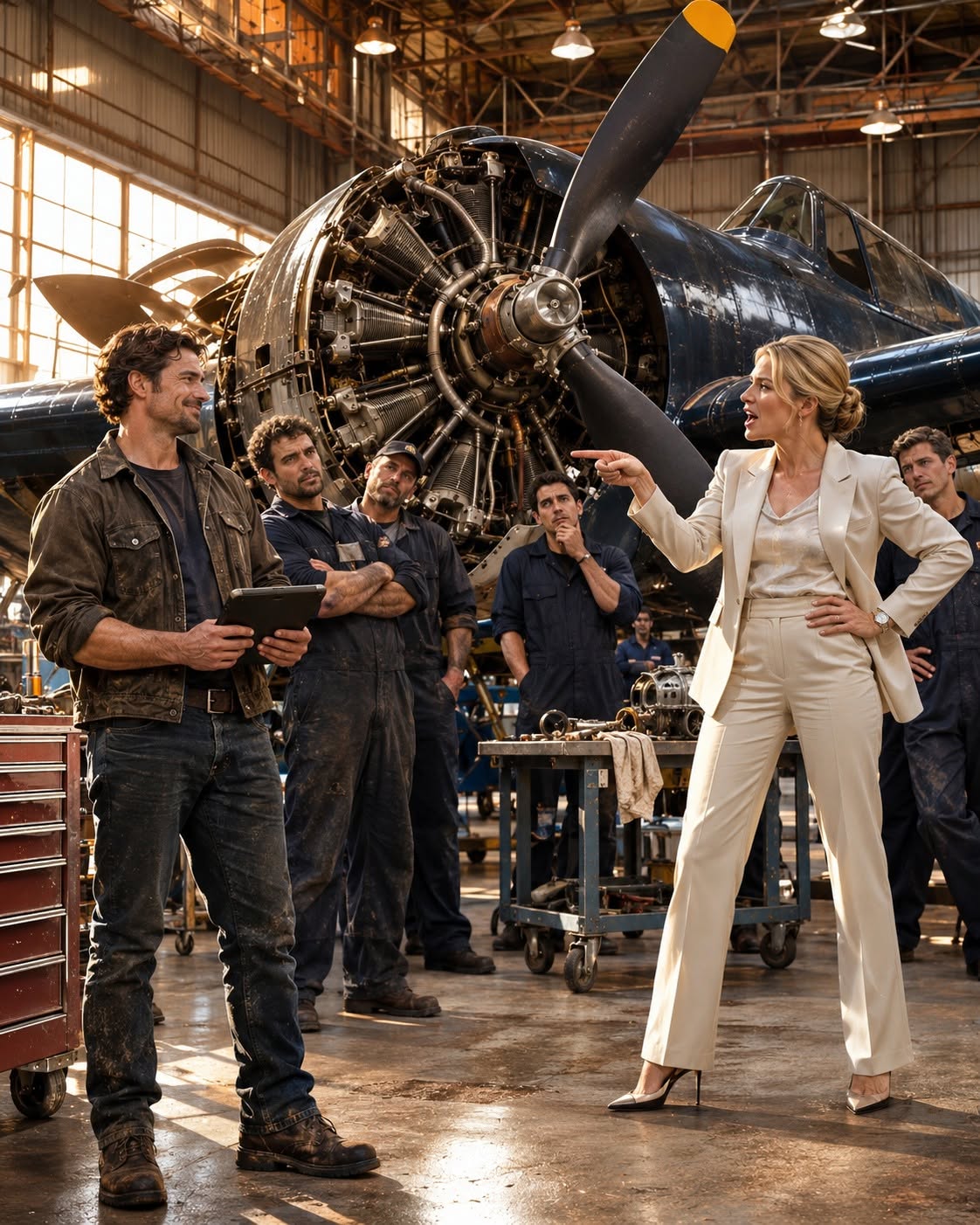
For nine straight days, seven certified aircraft mechanics had failed to start the vintage engine in Karen Sterling’s hangar
Karen looked at Walter for a long moment.
Then she glanced at the engine, still vibrating softly as it settled into its idle rhythm.
“What exactly are you asking me to understand?” she asked.
I took a breath.
“That this aircraft almost lost the one thing that made it special because everyone assumed the factory manual contained everything worth knowing. And the man who knew the missing piece was sitting in a retirement home, convinced the world had moved on without him.”
Nobody spoke.
I continued.
“You offered two million dollars to whoever could solve this problem. But the truth is, you didn’t need another expensive expert. You needed someone who remembered what happened before the paperwork was rewritten.”
Karen’s expression changed slightly.
For the first time, she looked uncomfortable.
Walter slowly lowered himself onto a nearby chair.
“I don’t need two million dollars,” he said. “I just wanted to hear her run again.”
Karen turned toward him.
“Mr. Sinsky, you understand that the wager was real. I don’t make promises I don’t intend to keep.”
Walter smiled faintly.
“Then perhaps you should pay the person who found me.”
I shook my head immediately.
“Please, don’t.”
Karen raised an eyebrow.
“Why not?”
“Because I didn’t fix the engine. I found a piece of paper and remembered a name. Walter did the rest.”
The old man looked at me.
“That’s more than most people would have done.”
Lily stepped closer to her grandfather-sized new friend and held out the photograph.
“Mr. Sinsky, can I ask you something?”
“Of course, sweetheart.”
“Who was Ray?”
Walter stared at the photograph again.
For a few seconds, the noise of the hangar seemed to disappear from his world.
“Raymond Miller,” he finally answered. “My best friend.”
He ran a trembling finger along the edge of the photograph.
“We were both young. Too young to understand how quickly life could change. He was the pilot, and I was the mechanic. He could make that airplane do things nobody else thought possible.”
He smiled.
“Whenever something went wrong, he’d say, ‘Walter, if you can build it, I can fly it.'”
Lily giggled.
“That sounds dangerous.”
Walter laughed.
“It was.”
Then his expression grew serious.
“Ray and I designed that adjustment together. We spent weeks getting it right. He trusted my work with his life.”
I noticed Karen pull up a chair.
For once, the billionaire wasn’t standing above everyone else.
She was sitting down to listen.
“What happened to him?” she asked.
Walter looked toward the aircraft.
“Ray died in 1956.”
His voice became quieter.
“He was flying a demonstration flight when a sudden storm moved across the area. The aircraft never made it back.”
Nobody interrupted.
“I blamed myself for years. I kept thinking that if I’d designed something differently, if I’d checked one more component, maybe he would have come home.”
He looked down at his hands.
“Eventually, I stopped working on aircraft. I couldn’t stand looking at an engine without hearing his voice.”
I felt something tighten in my chest.
The maintenance records hadn’t mentioned any of that.
They contained measurements, replacement parts, and inspection signatures.
They had preserved the technical history while leaving the human story behind.
“Why did you never come back?” I asked.
Walter looked at me.
“Because nobody asked.”
Those three words landed harder than anything else that afternoon.
Karen slowly stood.
“Mr. Sinsky, I owe you an apology.”
Walter seemed surprised.
“I was dismissive when you arrived. I judged you by your age and your appearance instead of listening to what you had to say.”
He nodded.
“People do that.”
“I don’t want to be one of those people anymore.”
Karen turned toward her lead mechanic.
“Have the engine inspected again. Every component. I want an independent safety assessment before anyone considers flying this aircraft.”
The mechanic nodded immediately.
“Absolutely.”
She looked back at Walter.
“And I want your help documenting the original modification. Properly this time. With your name on it.”
Walter stared at her.
“My name?”
“Your name. And Ray’s, if you agree.”
For the first time, the old man’s face brightened in a way that had nothing to do with the running engine.
“I’d like that.”
Over the next several days, the hangar became a different place.
The mechanics stopped treating Walter like a visitor.
They brought him coffee, asked questions, and listened carefully as he described the aircraft’s original configuration.
He didn’t pretend to remember everything.
When he wasn’t sure, he said so.
And when he remembered something important, he explained why it mattered.
I spent hours comparing his recollections with the archived documents.
We found handwritten sketches, old inspection reports, and a series of letters exchanged between Walter and Ray.
One afternoon, I discovered a small envelope tucked inside a maintenance binder.
It had been folded twice and was almost hidden beneath a loose page.
The handwriting on the front was unmistakable.
Walter Sinsky.
Inside was a letter dated October 1956.
I carried it straight to the hangar.
Walter was sitting at a workbench, watching two mechanics inspect a component.
“Mr. Sinsky, I think you should see this.”
He opened the envelope carefully.
His eyes moved across the first few lines.
Then he stopped.
His fingers began to shake.
“Where did you find this?”
“Inside the original maintenance binder.”
He read silently for another minute.
Then he handed it to me.
It was a letter from Ray, written just weeks before his final flight.
The words were simple.
He thanked Walter for his friendship, praised his ability to solve problems, and joked about how the two of them would probably still be arguing about engine adjustments when they were eighty.
But near the bottom was one sentence that made Walter close his eyes.
“If anything ever happens to me, don’t let one bad day convince you that all the good work we did meant nothing.”
Walter pressed the letter against his chest.
For a long time, he didn’t speak.
Then he whispered, “I forgot he wrote that.”
Lily, who had been drawing at a nearby table, approached him.
“Does it make you sad?”
Walter looked at her.
“Yes, a little.”
“Then why are you smiling?”
He considered the question.
“Because sometimes, when you miss someone for a very long time, you forget that they wanted you to keep living, too.”
Lily nodded as though she understood.
Then she returned to her drawing.
That evening, Karen called a meeting in her office.
I expected her to discuss the restoration budget.
Instead, she placed two documents on the table.
The first was a check for two million dollars.
The second was a proposal to establish a permanent aviation history and preservation program at the airfield.
“I’ve made a decision,” she said.
“The wager stands. Wes, you found the information and brought Walter here. Walter restored the original knowledge that made this engine work. Both contributions matter.”
I shook my head.
“Karen, I really don’t want—”
She raised a hand.
“Let me finish.”
She pushed the check toward me.
“Two million dollars was the amount I promised. I’m not going to pretend my word becomes optional because I underestimated the people in front of me.”
Then she pushed a second document toward Walter.
“This program will preserve historical maintenance records, interview retired aviation professionals, and document knowledge that might otherwise disappear. I want you to be its first senior adviser.”
Walter stared at the paper.
“At my age?”
“Especially at your age.”
He looked at me.
I smiled.
“Seems like they need you.”
Walter chuckled.
“Well, I suppose I could use something to do besides watching cars in a parking lot.”
Karen turned to me again.
“And there’s one more thing. I want you to lead the archives program. You’ll have the resources to organize the collection properly, digitize the records, and build a system that connects every aircraft’s history to the people who worked on it.”
I couldn’t answer immediately.
For years, I had been the quiet man in the back office.
The person people contacted when they needed an old document.
The person who spent his lunch breaks reading handwritten notes nobody else cared about.
Now, someone was asking me to build something meaningful out of all those forgotten pages.
I looked down at the check.
Two million dollars was more money than I had ever imagined holding.
But something else mattered more.
“Can I use part of it to establish a scholarship?” I asked.
Karen tilted her head.
“For whom?”
“For young people who want to work in aviation but can’t afford the training. Especially those who don’t have connections or come from families with money.”
She smiled.
“That can be arranged.”
I looked at Walter.
“And I’d like to create a program where retired mechanics can teach apprentices. Not just from manuals. From experience.”
Walter’s eyes softened.
“Now that’s a good idea.”
The following month, the restoration team completed its inspections.
The engine had been brought back to its historically accurate configuration, but nobody was allowed to rush into a flight.
Independent specialists reviewed the work, checked the systems, and confirmed that the aircraft met the required safety standards.
Walter attended every meeting he was physically able to attend.
Some days he was tired.
Other days his memory was sharp enough to surprise everyone.
He never demanded attention.
He simply shared what he knew.
And people listened.
Six weeks after that first successful engine test, Karen invited everyone back to the hangar.
The aircraft stood beneath the lights, polished and ready.
A small plaque had been installed beside the entrance.
It read:
IN MEMORY OF RAYMOND MILLER AND WALTER SINSKY.
TWO FRIENDS WHO BELIEVED THAT GOOD WORK SHOULD OUTLIVE THE PEOPLE WHO CREATED IT.
Walter stood in front of the plaque for a long time.
Then he reached out and touched the engraved letters.
“I never thought I’d see my name here,” he said.
Karen approached him.
“There’s something else.”
She handed him a small wooden box.
Inside was the original photograph of Walter and Ray, restored and protected behind glass.
Beneath it was a copy of Ray’s letter.
Walter’s eyes filled with tears.
“Thank you,” he whispered.
Karen nodded.
“You don’t have to thank me. I should have listened sooner.”
The day of the aircraft’s first official demonstration flight finally arrived.
The weather was clear, the wind was light, and the airfield was crowded with people.
Mechanics, pilots, collectors, families, and aviation enthusiasts gathered near the runway.
Walter sat in the front row with Lily beside him.
He wore a clean blue jacket, and someone had placed a small commemorative pin on his lapel.
He looked nervous.
“Are you excited?” Lily asked.
Walter smiled.
“More than you can imagine.”
The pilot completed the preflight inspection and climbed into the cockpit.
The engine started on the first attempt.
Its familiar rumble rolled across the runway.
Walter closed his eyes.
For a moment, I wondered whether he was remembering the first time he had heard it in 1953.
Or perhaps he was imagining Ray standing beside him again.
The aircraft began moving.
Slowly at first.
Then faster.
Its wheels lifted from the runway, and the vintage machine climbed into the bright Kansas sky.
The crowd erupted in applause.
Lily grabbed Walter’s hand.
“Look! It’s flying!”
Walter laughed through his tears.
“Yes, sweetheart. It certainly is.”
The aircraft circled the airfield twice before returning for a smooth landing.
When the pilot climbed out, Walter was waiting.
He shook the man’s hand.
“How did she feel?”
The pilot grinned.
“Like she was built to fly.”
Walter looked toward the sky.
“She was.”
That evening, after the crowd had gone home, I found Walter sitting alone in the hangar.
The photograph of Ray rested on the workbench beside him.
“Can’t sleep?” I asked.
He smiled.
“At my age, sleep comes and goes.”
I pulled up a chair.
For a while, we listened to the quiet sounds of the airfield.
Then he spoke.
“You know what the hardest part of getting old is, Wes?”
“What?”
“People begin speaking about you as though your story has already ended.”
I looked at him.
“They see your age. They see your limitations. They assume the most important things you’ve done are behind you.”
He paused.
“But sometimes, you still have something to give. Sometimes, you haven’t even told the best part of your story yet.”
I thought about my own life.
How often I had accepted being invisible.
How many times I had stayed quiet because I assumed nobody would care what I had found.
And how easily an entire room of professionals could overlook a useful idea simply because it came from the wrong person.
“Do you think things would have turned out differently if I hadn’t found that photograph?” I asked.
Walter considered it.
“Perhaps.”
Then he shook his head.
“But somebody should have looked for me long before you did.”
That answer stayed with me.
Because he was right.
We had treated his knowledge as something that needed to be rescued at the last minute.
But the truth was that it should never have been forgotten in the first place.
A year later, the airfield’s new preservation center opened.
The two-million-dollar wager had become something much larger than a prize.
Part of the money funded scholarships for young aviation students.
Another part supported the preservation of historical aircraft and the digitization of thousands of maintenance records.
The retired mechanics program became one of the center’s most popular initiatives.
Young technicians came from across the country to learn from people who had spent decades working with their hands.
Walter became its first honorary instructor.
He couldn’t stand for long periods anymore, so we arranged a comfortable chair beside the training equipment.
He would explain an old engine design, tell a story about a difficult repair, or describe a mistake he had once made and what it taught him.
The students loved him.
One afternoon, a young mechanic asked him whether he thought modern technology had made the older generation’s knowledge irrelevant.
Walter smiled.
“Technology changes. Problems change. Tools change. But the ability to observe carefully, admit when you don’t know something, and learn from the people around you never goes out of date.”
The student nodded and wrote it down.
Lily, now twelve, had become a regular visitor to the center.
She had started a small project of her own: collecting stories from retired workers and recording them so future generations could hear them.
She called it The People Behind the Machines.
Walter loved the name.
One afternoon, she interviewed him for the project.
She placed a small recorder on the table and asked her first question.
“Mr. Sinsky, what are you most proud of?”
Walter looked at the old photograph beside his chair.
For a moment, I thought he would talk about the aircraft.
Or the engine.
Or the restoration.
Instead, he said, “The people who remembered me.”
Lily smiled.
“That’s a good answer.”
Walter chuckled.
“Then make sure you remember it.”
When I look back on that afternoon in Karen Sterling’s hangar, I no longer think about the two million dollars.
I remember the seven mechanics who had spent nine days searching for an answer.
I remember a billionaire who learned that confidence and knowledge aren’t always the same thing.
I remember a little girl who noticed that an old man might be lonely when everyone else saw only a retired mechanic.
And I remember Walter Sinsky, whose hands trembled but whose mind still carried the solution everyone else had overlooked.
Most of all, I remember the lesson hidden inside those old maintenance records.
Some of the most valuable things in the world don’t look valuable at first.
They may be buried in forgotten paperwork, carried quietly by an elderly person, or held by someone whose job title makes others underestimate them.
We often spend so much time searching for the newest technology, the most expensive expert, or the loudest voice in the room that we forget to listen to the people who have already walked the road ahead of us.
Knowledge doesn’t become worthless because its owner grows older.
Experience doesn’t disappear because the world develops new tools.
And a person’s story doesn’t end simply because other people stop asking questions.
Sometimes, the answer we’re searching for is already sitting in the room.
Sometimes, all it takes is one person willing to listen.
And sometimes, the greatest thing we can give someone isn’t money, recognition, or a second chance.
It’s the simple reminder that they still matter.