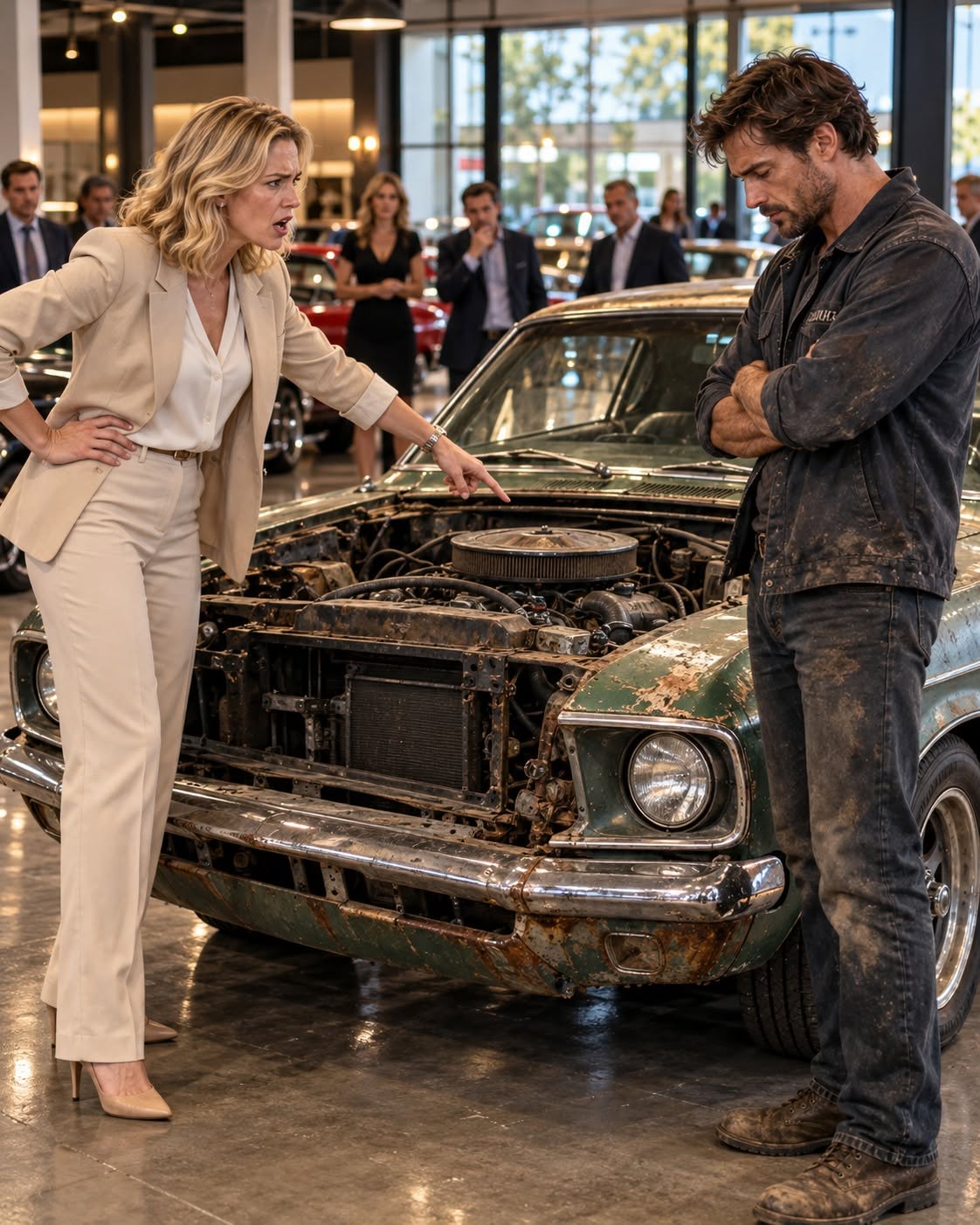
Eleanor Vance laughed when Julian Thorne rolled a rust-covered wreck onto the grounds of Sterling Motors.
The following weeks brought Julian Thorne something he had almost forgotten how to recognize: peace.
Not the kind of peace that came from an empty room or the silence of a house after midnight, but the quieter, deeper peace of knowing that he had finally kept a promise.
Every morning, he unlocked the doors of Carter Restorations before sunrise. The smell of oil, metal, and old leather greeted him like familiar friends. The restored Shelby GT500 stood beneath the brightest light in the garage, its dark paint reflecting the wooden beams overhead. Sometimes Julian caught himself staring at it for several minutes, remembering the day he had dragged it out from behind the collapsed barn.
Back then, it had looked like something the world had already forgotten.
Now it was the most beautiful thing he had ever rebuilt.
Yet the car was not what changed his life most.
It was what happened after the exhibition.
Within days, letters began arriving at the garage. Some were from collectors who wanted to purchase the Shelby. Others came from strangers who had seen the viral video and wanted to apologize for laughing at him. A few were from people who had their own forgotten projects, their own neglected dreams, and their own reasons for believing that it was too late to begin again.
One letter came from a retired mechanic in Ohio who had spent thirty years restoring a 1930s roadster. Another came from a young woman whose father had left her an old motorcycle that everyone in her family insisted was worthless.
The messages were different, but they carried the same question.
How had Julian found the courage to keep going when everyone else thought he was wasting his time?
He never knew quite how to answer.
He had not been courageous every day. Some nights, he had sat on the cold concrete floor beside the Shelby and wondered whether he was merely hiding from his grief. There had been mornings when the smallest sound—a wrench falling, a radio playing an old love song—had brought back memories so sharply that he had needed to step outside just to breathe.
He had continued because stopping would have meant abandoning the one thing his wife had asked him to do.
And somewhere along the way, continuing had become its own kind of healing.
One Thursday afternoon, Samuel Miller arrived carrying a stack of printed emails and a paper bag filled with sandwiches.
“You realize what you’ve done, don’t you?” Samuel asked, dropping the emails onto Julian’s workbench.
Julian wiped his hands. “Finished a car?”
Samuel stared at him. “You have people calling from three states away. A television producer wants to interview you. Nathaniel Cole’s office has called twice this week. And someone just offered to buy your garage building.”
“Then they can call back when I’m not busy.”
Samuel groaned and pushed a sandwich toward him. “You are impossible.”
“That’s why you keep coming back.”
Samuel laughed, but his expression softened when he glanced toward the Shelby.
For years, he had watched Julian move through life as though every day were something to be endured rather than lived. He had tried to persuade his friend to take vacations, meet new people, and stop spending every holiday alone in the garage.
Julian had always refused.
Now, for the first time, Samuel saw a difference.
Julian still carried his grief. It was there in the way he sometimes paused before answering a question, in the photographs he kept tucked inside a drawer, and in the small silver ring hanging from a chain beneath his shirt.
But the grief no longer seemed to be the only thing keeping him company.
“There’s one more thing,” Samuel said.
He handed Julian a folded letter.
The envelope bore the name Sterling Motors.
Julian opened it, expecting another corporate invitation or perhaps a request for a photograph of the Shelby.
Instead, he found a formal proposal signed by Eleanor Vance.
Sterling Motors wanted to establish a permanent heritage restoration program. The company would provide funding, equipment, and access to its historical automotive collection. In return, Julian would be invited to lead a workshop teaching young mechanics the principles of authentic restoration.
At the bottom of the letter, Eleanor had written a personal note.
I understand that I have no right to ask for your trust. I also understand that an apology means very little if nothing changes afterward. If you believe this program could help people who deserve an opportunity, I hope you will consider it.
Julian read the note twice.
Then he folded it carefully and set it aside.
Samuel raised an eyebrow. “Well?”
“I don’t know.”
“You don’t know?”
“It’s a good proposal.”
“That’s generally what people say when they want to accept something.”
Julian smiled faintly. “Or when they need time to decide whether the offer is good for the right reasons.”
Samuel leaned against the workbench. “You think she’s trying to repair her reputation?”
“Maybe.”
“And if she is?”
“Then she can start by doing something that helps people, even when nobody is watching.”
Samuel considered that.
“So what are you going to do?”
Julian looked at the Shelby, at the old magazine clipping resting in its protective frame, and at the rows of tools that had accompanied him through the loneliest years of his life.
“I’ll meet with her,” he said. “But I’m not going to let them turn this into another showroom.”
Across town, Eleanor Vance was learning that success could become a dangerous habit.
For years, she had believed that every problem could be solved through strategy, negotiation, and the careful management of appearances. If a customer complained, her team crafted a response. If a project failed, they found a way to soften the announcement. If an employee made a mistake, she demanded accountability, often without asking what had caused the mistake in the first place.
She had built Sterling Motors into a respected company, and she had convinced herself that the results justified her methods.
Then Julian’s Shelby had forced her to confront a truth she could no longer dismiss.
She had not merely insulted a man in front of his audience. She had demonstrated to everyone watching that she believed a person’s worth could be determined by the first thing she saw.
The viral video had cost the company several lucrative partnerships. A few customers publicly criticized Sterling Motors, while others questioned whether its celebrated heritage exhibition had become little more than a marketing spectacle.
Eleanor could have hired a public relations firm to bury the story beneath new announcements.
Instead, she watched the video again.
There she was, standing in an expensive coat, laughing at a man whose hands were stained with the work she claimed to respect.
She remembered the satisfaction she had felt when the employees joined her laughter. In that moment, she had mistaken their agreement for proof that she was right.
The realization embarrassed her more than any public criticism could have.
She called Arthur Davies into her office.
“We need to discuss the heritage program,” she said.
Arthur settled into a chair. “Good. I have three ideas for turning the Shelby story into a campaign. We could use the restoration footage, create a limited-edition merchandise line, and invite Julian to appear in our next advertisement.”
“No.”
Arthur blinked. “No?”
“We are not using his wife’s memory to sell cars.”
“Eleanor, with respect, this is an extraordinary opportunity. The public already knows the story.”
“The public knows the part I made entertaining. That doesn’t mean we own the rest of it.”
Arthur shifted in his seat.
For the first time since the incident, Eleanor noticed that he looked less concerned about the harm they had caused than about the money they might lose.
She wondered how often she had rewarded that instinct.
“I want you to prepare a different proposal,” she continued. “A training program for young mechanics. Paid apprenticeships, proper equipment, and scholarships for people who cannot afford formal automotive education. No publicity requirements. No requirement that Julian endorse Sterling Motors.”
Arthur frowned. “That will be expensive.”
“Yes.”
“And if it doesn’t improve our reputation?”
Eleanor looked directly at him.
“Then at least it will have been worth doing.”
Arthur left without another word.
Three days later, Julian arrived at Sterling Motors for the first time since the humiliation.
He came in his old work jacket, carrying a notebook and a list of conditions. Eleanor met him in a conference room overlooking the showroom. She had asked her assistants to leave, and there were no cameras waiting outside.
Julian sat across from her.
“I read your proposal,” he said.
“And?”
“I’ll consider it if the students come first. They need proper wages, not promises. They need instructors who know what they’re doing. And they need permission to make mistakes without being treated as failures.”
Eleanor listened.
“The program also needs to preserve old vehicles honestly. If a component is original, we don’t replace it just because a new one looks prettier. If something must be changed for safety, we document it. We teach people to understand the difference between restoring a machine and disguising its history.”
Eleanor nodded and wrote down each point.
“And one more thing,” Julian added. “I won’t be the face of your company.”
“I understand.”
“No promotional appearances. No staged photographs. If you want people to know about the program, let them see what the students accomplish.”
Eleanor closed her notebook.
“Agreed.”
Julian studied her for a moment.
“Why are you doing this?”
She could have offered a polished answer about community engagement, preserving automotive heritage, or investing in the future.
Instead, she told him the truth.
“Because I don’t want to be the person in that video anymore.”
Julian’s expression remained unreadable.
“Then don’t be,” he replied. “But don’t expect one good decision to erase a bad one.”
“I don’t.”
For the first time, Eleanor understood that he was not offering her forgiveness as a reward for doing the right thing. He was giving her an opportunity to prove that she could change.
That distinction would matter more than either of them realized.
The program officially opened six weeks later in a renovated section of Sterling Motors’ oldest workshop. Twelve apprentices were selected from hundreds of applications. Some were recent graduates who had struggled to find employers willing to train them. Others were adults changing careers after years in jobs that paid the bills but left them feeling empty.
Among them was a nineteen-year-old named Daniel Brooks.
Daniel had grown up helping his grandfather repair farm equipment. When his grandfather died, Daniel inherited an old pickup truck that had been sitting behind the family barn for years. He wanted to restore it, but he had neither the money nor the confidence to attempt the work.
At his first meeting with Julian, Daniel kept his eyes fixed on the floor.
“I don’t have much experience with modern engines,” he admitted. “And I know I’m behind the other applicants.”
Julian handed him a small metal component from a disassembled carburetor.
“Tell me what you see.”
Daniel examined it. “Corrosion around the edges. The passage is partly blocked. Maybe a damaged seal.”
“Good. What would you do?”
“Replace it?”
“Why?”
Daniel hesitated. “Because it’s damaged.”
Julian pulled a chair beside him.
“Damaged doesn’t automatically mean useless. First, find out why it failed. Then determine whether it can be repaired safely. Replacing a part without understanding it might get the engine running, but it won’t teach you much.”
He placed the component in Daniel’s palm.
“Never be ashamed of what you don’t know. Be ashamed only if you stop trying to learn.”
Daniel looked down at the part as though Julian had given him something far more valuable than a lesson in mechanics.
Eleanor watched the exchange from the doorway.
She had expected Julian to be demanding. He was. He insisted on accurate measurements, careful documentation, and work that could withstand scrutiny. But he never confused a student’s lack of experience with a lack of potential.
He corrected mistakes without humiliating anyone.
When an apprentice stripped a bolt, Julian explained how it had happened and demonstrated a better technique. When someone failed to identify a faulty component, he asked questions until they discovered the answer themselves.
Eleanor began visiting the workshop once a week.
At first, she came to review budgets and schedules. Gradually, she found herself staying longer, listening to the students discuss their projects and watching Julian explain why the smallest details mattered.
One evening, she found him alone beside the Shelby.
The garage was quiet, and the overhead lights cast long shadows across the polished bodywork.
“Do you ever regret refusing Nathaniel’s offer?” she asked.
Julian glanced up.
“Not once.”
“Millions of dollars could have changed your life.”
“They would have changed my bank account.”
“Isn’t that sometimes the same thing?”
“Sometimes.” He returned his attention to the car. “But money can’t tell you what your life is supposed to mean.”
Eleanor leaned against the workbench.
“Do you still think about her every day?”
Julian’s hands became still.
For a moment, Eleanor thought she had crossed a line.
Then he nodded.
“Every day.”
“Does it get easier?”
“Some parts do. Others don’t.”
He wiped a small patch of dust from the Shelby’s hood.
“For a long time, I thought getting better meant reaching a day when I wouldn’t miss her anymore. I waited for that day like it was a finish line. It never came.”
“What changed?”
“I realized I was asking the wrong question. I didn’t need to stop missing her. I needed to learn how to live without treating every happy moment as a betrayal of the life we’d had together.”
Eleanor said nothing.
Julian continued quietly.
“She loved seeing people discover what they could do. If someone brought her a broken chair, she’d help repair it. If a neighbor’s child struggled with school, she’d spend hours helping them. She never believed that something became worthless just because it needed work.”
He looked toward the framed magazine clipping.
“I spent years thinking the Shelby was a promise I had to finish for her. Now I think she was reminding me of something much bigger.”
“What was that?”
“That broken things still deserve care.”
The words stayed with Eleanor long after she left the workshop.
Months passed. The apprenticeship program grew, and the first students began completing projects that once seemed beyond their abilities. Daniel rebuilt his grandfather’s pickup with Julian’s guidance, documenting every repair and learning to distinguish original components from later modifications.
When the engine finally started, Daniel stood motionless beside the truck.
Then he laughed, and the sound quickly turned into tears.
Julian did not tell him to calm down. He simply placed a hand on the young man’s shoulder and waited until he was ready to speak.
“My grandfather would have loved this,” Daniel whispered.
“I think he would,” Julian replied.
The moment was captured in a photograph by one of the workshop instructors, who later hung it on the wall beside a picture of the Shelby at the heritage exhibition.
Underneath, Julian wrote a simple caption.
The value was there before anyone recognized it.
But the greatest test of the program came when a fire broke out in Sterling Motors’ secondary storage building.
It happened late on a Friday evening, just as the last employees were leaving. An electrical fault ignited packaging materials near a row of stored components. Within minutes, smoke poured through the loading bay, and alarms echoed across the property.
Security staff called emergency services and began evacuating the area.
Inside the building were several historically significant vehicles, along with boxes of original parts collected over decades. Among them was a rare racing engine that Sterling Motors had planned to display at an upcoming international exhibition.
When Julian received the call, he drove to the site immediately.
Firefighters were already working when he arrived. Eleanor stood behind the safety barriers, pale and visibly shaken. Flames had damaged one section of the roof, and smoke was spreading toward the adjoining workshop.
“Are the apprentices accounted for?” Julian asked.
“All of them,” Eleanor replied. “They were dismissed before the alarm.”
“Good. Then nobody goes inside.”
He began helping the staff establish a list of the vehicles and components stored in the affected building. His engineering background allowed him to identify which materials posed additional risks and which areas could be assessed safely once the firefighters gave permission.
He did not rush into the smoke. He did not attempt to become a hero.
He organized, documented, and waited for the professionals to declare the building safe.
By dawn, the fire was under control.
Several vehicles had suffered smoke damage, and part of the storage collection had been lost. The rare racing engine survived, though its protective casing was badly damaged. More importantly, no one had been injured.
Eleanor stood among the exhausted employees, staring at the blackened doorway.
“This collection represented decades of work,” she said. “Years of history.”
Julian looked at the damaged building.
“Some of it can still be saved.”
“And the rest?”
“We document what happened. We preserve whatever evidence remains. We don’t pretend the damage never occurred.”
Eleanor turned toward him.
“You really do believe that applies to everything, don’t you?”
“Not everything can be restored to what it was,” Julian replied. “But that doesn’t mean nothing can be done.”
The following morning, Sterling Motors’ board convened an emergency meeting. Several directors argued that the apprenticeship program should be suspended until the company recovered financially from the fire. Others proposed selling part of the historical collection to cover the losses.
Eleanor listened to every argument.
Then she stood.
“We created this program because we believed preserving our heritage meant more than displaying expensive objects. If we abandon the people learning to protect that heritage the moment things become difficult, then we never understood our own mission.”
One director objected that the company could not afford to make emotional decisions.
Eleanor met his gaze.
“This isn’t an emotional decision. It’s a decision about what kind of company we intend to be.”
She presented a revised budget, cutting several executive travel allowances, postponing a planned showroom renovation, and redirecting a portion of the marketing budget toward restoring the damaged collection and keeping the apprentices employed.
The board approved the plan by a narrow margin.
When Julian heard what she had done, he said nothing for several seconds.
Then he nodded.
“That was the right decision.”
Eleanor smiled faintly. “I’m learning that doing the right thing doesn’t always feel comfortable.”
“Usually means you’re paying attention.”
The fire left scars on the storage building, but it also changed the company. Employees who had rarely spoken to one another began sharing knowledge. Former mechanics volunteered to help assess damaged components. Collectors donated tools, manuals, and spare parts to support the restoration effort.
Even Nathaniel Cole returned, this time without a purchase offer.
He brought a collection of rare technical manuals and announced that he would fund two additional apprenticeships.
“I still want to own that Shelby,” he told Julian.
Julian laughed. “I know.”
“But I think I finally understand why you won’t sell it.”
Nathaniel looked toward the car, visible through the open workshop doors.
“Some things are worth more when they’re allowed to keep telling their story.”
For the first time, Julian shook the collector’s hand without feeling that he needed to explain himself.
A year after the day Eleanor had laughed at the rusted wreck, Sterling Motors held another heritage exhibition.
This time, the event opened with no grand announcement and no celebrity guests standing beneath a banner. The centerpiece was not the most expensive vehicle in the collection, nor the most powerful.
It was a simple display documenting the restoration of a forgotten Shelby GT500.
Alongside photographs of the ruined car were images of the original components, George’s donated trim pieces, and the handwritten notes Julian had kept throughout the process. The old magazine clipping sat in a glass case, protected from light and dust.
Visitors moved slowly through the exhibit, reading the story.
At the end stood a small plaque.
Preservation is not the act of making something look new. It is the act of recognizing what deserves to survive.
Julian arrived shortly before the doors opened.
He wore the same work jacket he had worn the day he first brought the Shelby to Sterling Motors. It had been patched at the elbows, and a small stain of oil remained near one pocket.
Eleanor noticed it as she approached.
“You could have worn something more formal,” she said.
“I did. This is my formal work jacket.”
She laughed, but there was no mockery in it.
They stood together for a moment, watching the first visitors enter.
Then Eleanor handed him a small envelope.
Inside was a photograph of Julian’s wife, taken years earlier at an automotive gathering. She stood beside a Shelby similar to his, smiling at someone outside the frame.
Julian stared at it.
“Where did you get this?”
“George sent it to us. He found it among some old photographs he’d kept with the trim parts. He said your wife might have been there that day.”
Julian’s fingers trembled slightly as he held the photograph.
On the back, in faded handwriting, was a date and a short message.
One day, we’ll find ours.
He sat down on a nearby bench.
For a moment, the noise of the exhibition seemed to fade away. He could almost hear his wife’s laughter, almost see her leaning over the hood of a car to point out a detail he had missed.
He had spent years believing that remembering her meant returning to the place where he had lost her.
Now, surrounded by people learning, repairing, and discovering, he understood that memory could also lead him somewhere new.
Eleanor sat beside him without speaking.
After a while, Julian folded the photograph carefully and slipped it into his jacket pocket.
“Thank you,” he said.
She nodded.
“I wish I had understood all this sooner.”
“So do I.”
She accepted the honesty without trying to defend herself.
Across the hall, Daniel was explaining his restored pickup to a group of visitors. George stood beside the Shelby, proudly answering questions about the trim pieces he had donated. Samuel was telling anyone who would listen that he had predicted Julian’s success from the beginning, a claim Julian knew was completely untrue.
The room was full of laughter.
Not the laughter that had greeted Julian when he arrived with a rust-covered wreck, but the kind that brought people together rather than making someone smaller.
Eleanor watched the scene with a quiet expression.
She had once believed that leadership meant being the person who could identify value before anyone else. Now she understood that it also meant creating a place where people had the opportunity to discover value for themselves.
As the exhibition drew to a close, she approached Julian one final time.
“I have a question,” she said.
“Go ahead.”
“If you could return to that first day, knowing everything you know now, would you still bring the car here?”
Julian considered the question.
“Yes.”
“Even knowing what I would say?”
“Even then.”
Eleanor looked surprised.
“Why?”
“Because your reaction showed me something I needed to understand, too.”
“What was that?”
Julian glanced toward the Shelby.
“That I couldn’t spend my life waiting for people to recognize what mattered to me. I had to do the work because it was worth doing, even if nobody applauded.”
He paused.
“But that doesn’t mean your words didn’t hurt. And it doesn’t mean people should have to endure humiliation to prove their worth.”
Eleanor lowered her eyes.
“I understand.”
“I hope so.”
They shook hands, not as old friends or perfect people, but as two people who had learned something important from the same mistake.
That evening, Julian returned to Carter Restorations.
The garage was quiet again, but the silence no longer felt empty. Daniel had left a thank-you note on the workbench. Samuel had forgotten another paper bag of sandwiches. A fresh application for the apprenticeship program lay beside a stack of repair manuals.
Julian switched on the lights and walked toward the Shelby.
He ran his fingers lightly over the restored chrome, then stopped beside the framed magazine clipping.
For years, he had thought the car was the thing he needed to save.
Now he knew the truth was more complicated.
He had saved the car’s history from being erased. He had helped young people discover abilities they did not know they possessed. He had given George a reason to open the box he had carried through decades of loneliness. He had even helped Eleanor understand that success without humility could leave a person surrounded by impressive things and still unable to recognize what mattered.
And in the process, he had begun to recover a part of himself.
He took the silver ring from beneath his shirt and held it in his palm.
“I found it,” he whispered.
He wasn’t certain whether he meant the car, the promise, or the life he had almost stopped believing he could have.
Perhaps it was all three.
Outside, the last light of evening settled over the brick walls of Carter Restorations. The Shelby stood beneath its hanging lamp, no longer hidden behind a collapsed barn or dismissed as a heap of rust.
But Julian knew its greatest value had never been its paint, its engine, or its rarity.
It was the reminder that time could damage something without erasing its meaning, that loss could change a life without ending it, and that even the smallest act of care could become the beginning of something extraordinary.
The world would always be full of people who judged too quickly, who mistook wealth for wisdom and appearances for truth.
Julian could not change all of them.
He could only keep his doors open, teach what he knew, and offer others the chance he had once needed himself.
And perhaps that was enough.
Because the most important things in life rarely arrive polished and perfect. Sometimes they arrive covered in rust, carrying a history no one bothers to ask about.
Sometimes they arrive in the hands of a grieving man who has almost forgotten how to hope.
And sometimes, if we are willing to look beyond the surface, we discover that what we nearly threw away was never worthless at all.
It was simply waiting for someone who could see its value.