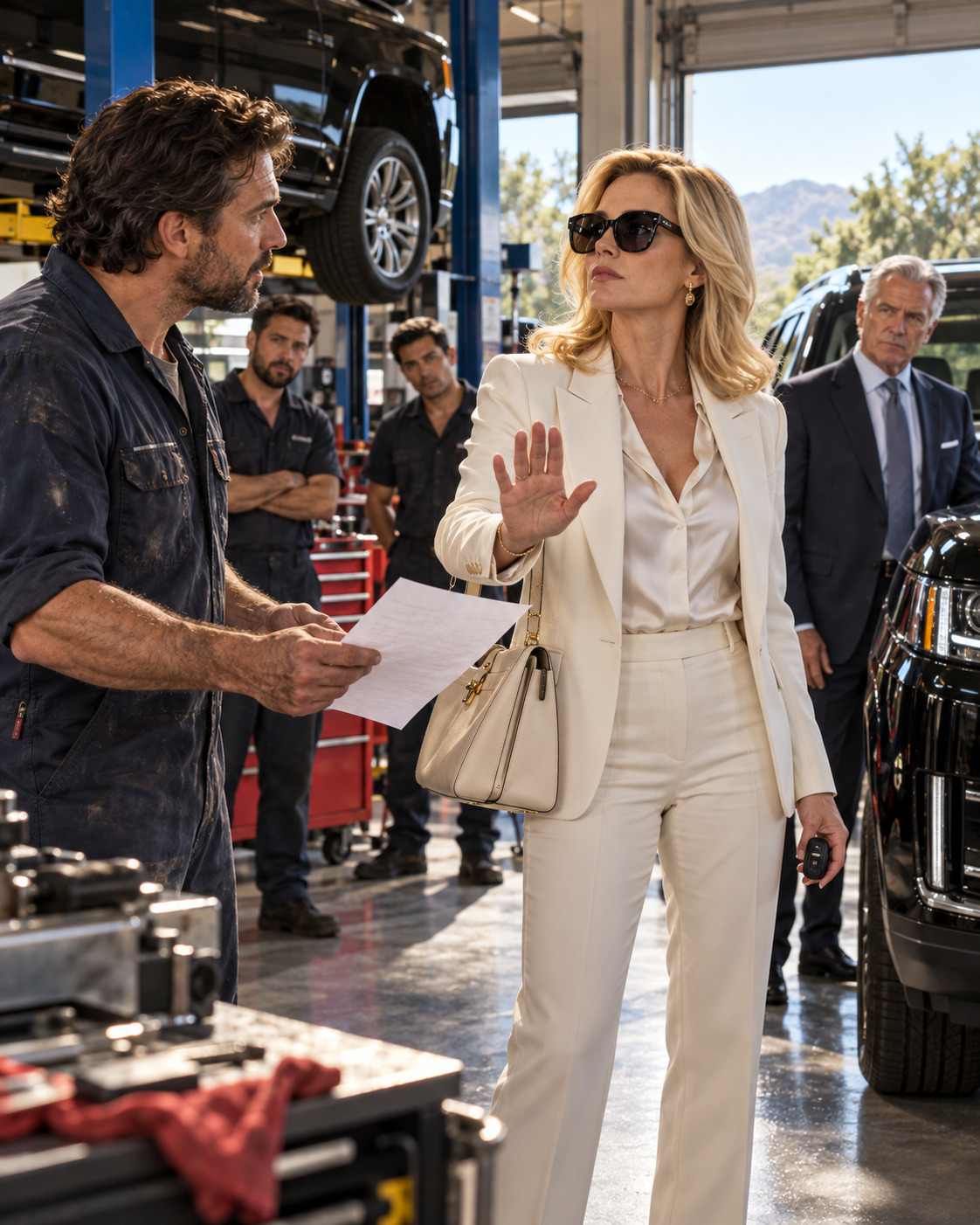
Eleanor Vance dropped her Porsche Cayenne’s repair invoice on my counter, glanced at the $247 total, and told me she wasn’t paying a cent.
I stared at the check, then at Arthur.
“Why me?” I asked. “You barely know me.”
Arthur gave a small nod, as if he had expected that question.
“I watched what happened with my daughter,” he said. “Most people would have shouted, threatened to call a lawyer, or tried to embarrass her in return. You had every reason to be angry, but you chose not to turn it into a battle.”
He paused before adding, “I wanted to know whether that was who you really were.”
Arthur explained that he had hired a private investigator to learn more about me. At first, I felt uncomfortable hearing a stranger had examined my life so closely. Then he began describing things I had never mentioned to him.
He knew I sometimes let struggling families pay their repair bills over several weeks. He knew I coached youth hockey, even when it meant giving up evenings I could have spent earning extra money. He knew I had kept my assistant on the payroll during a difficult stretch when I could barely cover my own expenses.
None of those things had made me rich. Some had cost me money.
Arthur said they reminded him of a mechanic who had helped him decades earlier, back when he was broke and trying to build a future from almost nothing. That mechanic had treated him with dignity when he had little to offer in return.
“I never forgot what that felt like,” Arthur told me. “And I don’t want to forget it now that I have the means to do something about it.”
The eleven million dollars, he explained, would establish a network of community trade and repair centers across Ontario. The centers would provide affordable vehicle repairs to families in need while creating training opportunities for young people entering the trades.
He wanted me to lead the project.
I looked at the check again. It was more money than I had ever imagined seeing in my life. But I wasn’t interested in becoming someone who signed his name to a good cause and disappeared.
“If I do this,” I told him, “the centers have to serve the people they’re supposed to help. Not just look good in a brochure.”
Arthur smiled.
“That’s precisely why I’m asking you.”
I accepted the responsibility, with one condition: my own shop would remain open. I had built it from years of hard work, and the people who depended on it weren’t going to be abandoned just because a bigger opportunity had arrived.
The following four months were exhausting. There were buildings to secure, equipment to purchase, staff to hire, and partnerships to establish. I still worked at my shop, still checked Toby’s homework, and still tried to make it home in time for dinner.
But gradually, the plan became real.
When the first community repair center opened, families gathered outside while local tradespeople demonstrated the equipment and introduced themselves to their new trainees. Parents who had postponed essential car repairs finally had somewhere they could afford to turn. Young people who weren’t sure what to do after school could see a path toward a skilled profession.
I stood near the entrance, watching Toby proudly hand out the opening-day programs.
Then I noticed Eleanor.
She stood at the back of the crowd, quiet and alone. She wasn’t wearing the same expression she’d had in my shop that morning. She watched the families, the mechanics, and the young trainees with an attention that seemed to come from somewhere deeper than curiosity.
Later, I learned that Vance Capital had arranged for the outstanding $247 payment to be sent to my shop, along with a formal apology.
The amount hadn’t changed. The meaning of the moment had.
Eleanor had once assumed that her status placed her above an ordinary man’s work. Now she was watching that same man’s work become the foundation of something that could help thousands of people.
She approached me before leaving.
“I owe you an apology,” she said quietly.
I accepted it. There was no reason to humiliate her in return.
That evening, I drove home with Toby beside me, talking excitedly about the new center and the people he’d met. The eleven million dollars had opened a door I could never have opened alone, but the reason it mattered had nothing to do with the number on the check.
It mattered because someone had finally invested in the kind of work that often goes unnoticed.
And because, in the end, I hadn’t needed to defeat Eleanor Vance to prove my worth.
I had only needed to keep being the man I wanted my son to become.
The first winter after the community repair center opened, I learned that changing lives was a lot harder than fixing engines.
A broken engine usually gave you clues. A strange vibration, a warning light, a smell of burning oil. If you were patient enough, you could find the problem and work out how to repair it.
People were different.
They carried years of disappointment, private fears, and wounds they had learned to hide. Sometimes, the thing they needed most wasn’t money or a new opportunity. Sometimes, they needed someone to believe they were worth helping.
I began to understand that during our third month of operation, when a young man named Marcus walked into the center with his hands shoved deep into the pockets of a torn jacket.
He was seventeen, thin as a fence post, and had the wary expression of someone who expected every adult to disappoint him eventually.
Our training coordinator, Peter, had just finished explaining the apprenticeship program to a group of students when Marcus interrupted.
“Do you actually hire people like me?”
Peter looked at him. “What do you mean?”
“People who didn’t finish school. People who have been in trouble.”
The room fell silent.
Marcus had been suspended twice, dropped out of school the previous spring, and spent several nights in a youth shelter after things became difficult at home. His record wasn’t violent, but it was enough to make several local employers turn him away without giving him a chance to explain.
I recognized something in his eyes. Not because our lives had been the same, but because I knew what it felt like to stand in front of someone and wonder whether they had already decided what you were worth.
“We don’t hire perfect people,” I told him. “We hire people who are willing to learn.”
He studied me suspiciously.
“What if I mess up?”
“You will.”
He blinked.
“Everyone does. The question is whether you’ll take responsibility, learn from it, and come back the next day.”
Marcus didn’t smile, but he signed up for an interview.
Three weeks later, he was our youngest apprentice.
I thought about that conversation often because it reminded me why Arthur’s eleven million dollars mattered. We weren’t simply repairing vehicles. We were giving people a chance to become something they had almost stopped believing they could be.
But success has a strange way of attracting people who want to control it.
By the following spring, our first center had become a local success. Donations were arriving, community organizations were asking to partner with us, and newspapers were publishing stories about families who had finally been able to get their cars back on the road.
Then Arthur called me into his office.
He looked older than he had the day he first walked into my shop. His silver hair seemed thinner, and he took longer to rise from his chair.
“I need to tell you something before you hear it from anyone else,” he said.
I sat down.
“Vance Capital is preparing to sell a substantial part of its holdings. Eleanor is leading the negotiations.”
I wasn’t sure why that mattered to me.
Arthur opened a folder and pushed it across his desk.
Inside were financial projections for the community repair network. They were impressive, but the final pages contained a proposal that made my stomach tighten.
A private investment group wanted to take over the centers’ administration in exchange for expanding the program across the province. The proposal promised faster growth, better equipment, and additional funding.
It also included a clause allowing the group to revise eligibility rules and introduce market-rate service packages.
In plain English, families who couldn’t afford ordinary repair bills might eventually find themselves paying prices they couldn’t manage.
“They say the centers need to become financially independent,” Arthur explained. “They believe government grants and private donations won’t sustain the program forever.”
“They might be right about the funding,” I said. “But that doesn’t mean we should change who we’re here for.”
Arthur nodded slowly.
“That’s what I told them.”
“Then what’s the problem?”
He looked down at the papers.
“The investors have made their offer conditional on Eleanor’s support. And Eleanor believes the agreement is worth considering.”
I felt a familiar discomfort settle in my chest.
I had accepted Arthur’s offer because he wanted to help people who were often overlooked. I had never imagined that one day I would have to defend that mission against the very company that had helped make it possible.
“What does Eleanor say?”
“She wants to meet with you.”
I almost laughed.
The last time Eleanor and I had spoken, she had apologized for refusing to pay a $247 bill. I had accepted her apology, and I had honestly believed that the matter was finished.
Apparently, life had other plans.
Two days later, she arrived at the center wearing a dark blue suit and carrying a leather portfolio.
She looked around at the service bays, where mechanics were teaching apprentices how to inspect suspension systems. Near the reception desk, an elderly woman was talking with one of our staff members about the cost of replacing her alternator.
Eleanor watched them for a moment before turning toward me.
“You’ve built something impressive,” she said.
“We have.”
She raised an eyebrow at my correction, but didn’t challenge it.
We sat in a small conference room overlooking the workshop.
“The investors aren’t trying to destroy the program,” she began. “They’re trying to make it sustainable.”
“I understand that.”
“They can fund ten additional centers within two years. Possibly more. We could reach communities that currently have no affordable repair services.”
“And what happens when someone can’t afford the new rates?”
“We would maintain a limited assistance fund.”
“How limited?”
She opened her portfolio and showed me the projections.
The assistance fund would cover a small percentage of annual customers. Everyone else would pay according to a revised pricing structure designed to generate revenue.
“Those numbers look good in a presentation,” I said. “But I’ve spent years watching people choose between fixing their cars and buying groceries. A limited fund won’t help the family that doesn’t qualify because their income is twenty dollars over the cutoff.”
“Daniel, we can’t help everyone.”
“No. But we can refuse to pretend that people who need help are a bad investment.”
Her jaw tightened.
For a moment, I saw the woman who had stood at my counter, convinced that the rules shouldn’t apply to her.
Then she looked away.
“You think this is about me trying to prove I’m in charge,” she said.
“I didn’t say that.”
“You didn’t have to.”
She closed the portfolio.
“My father has spent his life giving money away to causes he believes in. He’s never had to explain to a board why the numbers don’t work. I’ve spent twenty years making sure Vance Capital survives.”
“And I respect that. But this isn’t your company.”
Her eyes snapped back to mine.
“No, it’s my father’s money.”
“And now it’s our responsibility.”
The silence that followed was uncomfortable enough that I could hear an impact wrench running in the workshop below us.
Finally, Eleanor stood.
“The board meets next Thursday. I hope you’ll come prepared to explain how you intend to fund your principles.”
She walked out before I could answer.
That night, I barely slept.
I wasn’t afraid of losing my position. I could return to my shop, keep repairing cars, and live a quieter life. I was afraid that thousands of people would lose something they had only just begun to trust.
I thought about the elderly woman asking about her alternator. I thought about Marcus, who had spent the afternoon carefully rebuilding a transmission under the supervision of his instructor.
And I thought about Toby.
He was ten now, old enough to understand more about the world than I sometimes wished he did. When I came downstairs the next morning, I found him sitting at the kitchen table with his cereal untouched.
“Are you going to lose the centers?” he asked.
I stopped beside him.
“Who told you that?”
“I heard you talking to Arthur on the phone last night.”
I pulled out the chair across from him.
“I don’t know yet.”
“Can you stop it?”
“I can try.”
He thought about that, stirring his cereal with a spoon.
“Then why are you worried?”
I smiled faintly.
“Because trying doesn’t always mean you’ll win.”
Toby considered this with the seriousness only a child can bring to a difficult question.
“Mom used to say doing the right thing was still right even if nobody clapped.”
My throat tightened.
His mother had been gone for three years, but sometimes her words returned through him so unexpectedly that it felt as if she had only stepped into another room.
“She did say that,” I whispered.
“Then why do you need to win?”
I had no answer.
For the first time in days, I felt my shoulders relax.
I didn’t need to defeat Eleanor. I didn’t need to embarrass the investors or prove that I was morally superior to anyone in that room.
I needed to make the strongest possible case for the people who depended on us.
So I went back to work.
Over the next several days, I asked every center manager to send me real stories, not polished testimonials. I wanted to know how many customers had delayed repairs before finding us, how many apprentices had struggled to find work, and how much it actually cost to keep a service bay running.
We collected invoices, maintenance records, training expenses, and customer feedback.
Then I asked a question that our financial advisers had overlooked.
What if the centers didn’t have to choose between affordable services and financial stability?
What if local businesses, municipalities, technical colleges, and fleet operators could support the program without controlling who received help?
The idea wasn’t revolutionary. It was simply more complicated than handing everything over to one investment group.
But it gave us another path.
Our managers helped design a sliding-scale system based on household circumstances rather than a rigid income cutoff. Local businesses could sponsor apprenticeship placements. Municipalities could contract with the centers to maintain certain public vehicles at agreed rates. Commercial customers would pay full price, helping subsidize repairs for families in need.
We also proposed a transparent annual report showing exactly where every dollar went.
The plan wasn’t perfect. It required careful management, honest accounting, and a commitment to reinvest any operating surplus into the program.
But it protected the mission without pretending that money didn’t matter.
On Thursday morning, I walked into the Vance Capital boardroom carrying a thick binder and wearing the only suit I owned.
The room was filled with people who looked as if they had never once worried about whether their car would start on a freezing morning.
Eleanor sat near the head of the table.
Arthur was beside her, his expression unreadable.
A man named Richard Hale, the investment group’s representative, introduced himself and explained why his firm believed professional management was essential.
His presentation was polished. He spoke about scale, efficiency, measurable outcomes, and long-term value.
He showed projections that promised impressive growth.
Then he displayed a slide comparing our centers’ current operating costs with the projected expenses under his firm’s management.
“Under the existing model,” he concluded, “expansion will be slow and unpredictable. The proposed partnership provides the capital and discipline needed to turn a promising local initiative into a province-wide institution.”
Several board members nodded.
Richard turned toward me.
“Mr. Daniel, we respect your commitment. But goodwill is not a business model.”
I stood.
“You’re right,” I said.
The room became quiet.
“Goodwill alone won’t pay for brake pads, diagnostic equipment, insurance, or wages. That’s why we prepared a different model.”
I distributed our financial projections.
I explained the sliding-scale system, commercial service contracts, municipal partnerships, and apprenticeship subsidies. I showed how each center could track its operating costs and measure its impact without making essential repairs inaccessible.
Richard studied the pages with growing impatience.
“Your projections depend on partnerships that aren’t guaranteed.”
“So do yours,” I replied. “Your proposal assumes that commercial demand will remain strong and that your assistance fund will be sufficient. Neither of those things is guaranteed either.”
He leaned back.
“At least we have the capital to absorb risk.”
“Then let’s use that capital to strengthen the centers without giving one private group the power to decide which families deserve help.”
One of the board members asked about accountability.
I showed them our proposed independent audits and public reporting requirements.
Another asked what would happen if a center consistently lost money.
I explained the review process, including the possibility of merging administrative functions, renegotiating contracts, or temporarily redirecting resources. Protecting the mission didn’t mean refusing to acknowledge failure.
For nearly an hour, we discussed every weakness in the plan.
Some questions were uncomfortable. A few exposed gaps I hadn’t considered, and I made notes rather than pretending to have all the answers.
Then Richard asked the question I had been dreading.
“And what happens when the money runs out, Mr. Daniel? Will you stand in front of those families and tell them that your principles were more important than keeping the doors open?”
The room fell silent.
I looked at the financial projections in front of me.
Then I looked at Arthur.
“I would never promise families something I couldn’t deliver,” I said. “That’s why we need a plan that can survive without depending on one wealthy man’s generosity forever.”
I paused.
“But if the only way to keep the doors open is to turn away the people who need us most, then we haven’t saved the program. We’ve just changed its name.”
No one spoke.
Then Eleanor rose from her chair.
“I’d like to ask a question,” she said.
Richard gestured for her to continue.
She turned toward the board, not me.
“When I was younger, my father told me that a company reveals its character through the people it is willing to disappoint. I thought that was sentimental nonsense. In my world, disappointing someone was often the price of making a difficult decision.”
She glanced at me.
“Three years ago, I would have signed Richard’s proposal without a second thought. It was efficient, profitable, and easy to defend.”
She took a breath.
“But I visited one of the centers last week without telling Daniel I was coming. I watched a mechanic spend an extra forty minutes explaining a repair to an elderly customer who was worried about being cheated. I watched an apprentice make a mistake, admit it, and receive another chance instead of being sent home.”
Her voice grew quieter.
“And I watched a mother bring in a car that had failed its inspection. She told the staff she needed it to get to work because she was raising two children alone. She had enough money to pay for the parts, but not enough to cover the full labor cost.”
Eleanor rested her hands on the table.
“Under our proposed agreement, she would have been turned away unless she qualified for the assistance fund. Under Daniel’s plan, we could help her without making her prove that her hardship was severe enough to deserve our attention.”
Richard shifted in his seat.
“Personal anecdotes are not financial evidence.”
“No,” Eleanor replied. “But they are evidence of what our financial decisions actually do.”
She turned to her father.
“I was wrong about this project. And I was wrong about Daniel when I met him at his shop.”
Arthur’s expression softened, but he said nothing.
Eleanor faced the board again.
“I recommend that we reject the proposed takeover and fund a two-year expansion under the revised operating model, with independent audits and quarterly performance reviews.”
The room erupted into discussion.
Richard argued that the board was abandoning a proven investment structure for an untested alternative. Some members agreed. Others questioned whether our partnerships could generate sufficient revenue.
The vote was delayed until the following week.
When I left the building, I felt as if I had been holding my breath for hours.
Eleanor caught up with me near the elevators.
“I owe you another apology,” she said.
I studied her face.
“For what?”
“For thinking that because I could measure something, I understood its value.”
I nodded slowly.
“That’s a difficult mistake to recognize.”
“I know.”
She looked down at her hands.
“When you refused to argue with me about that invoice, I thought you were being condescending. I assumed you wanted me to feel guilty without having the courage to say it.”
“I was angry,” I admitted. “I just didn’t want Toby learning that anger had to decide what happened next.”
She looked at me for a long moment.
“Your son is fortunate.”
“No,” I said gently. “He’s fortunate he had a mother who taught him things I still struggle to understand.”
For the first time, Eleanor’s composure broke. She looked away, blinking rapidly.
“My father has spent years trying to teach me the same lessons,” she said. “I suppose I wasn’t ready to listen.”
“Sometimes people need to hear a lesson from someone who isn’t trying to teach them.”
She gave a small, sad laugh.
“Is that what you think you did?”
“No. I think I was just trying to get through my day.”
We stood quietly for a moment.
Then she extended her hand.
“Whatever the board decides, I want to help you find a way forward.”
I shook it.
This time, her apology felt less like a conclusion and more like the beginning of something neither of us could fully predict.
The following Wednesday, Arthur called me before sunrise.
“The board approved it,” he said.
I sat up in bed.
“Approved what?”
“Your plan. Two years of expansion funding, with independent oversight and quarterly reviews. Eleanor persuaded enough members to support it.”
I let out a breath I hadn’t realized I was holding.
“How many centers?”
“Six more over the next two years, provided the first phase meets its targets. The commercial partnerships will be negotiated separately, and no investor will have the authority to remove the affordability protections without board approval.”
I closed my eyes.
It wasn’t a complete victory. There would still be arguments, financial pressure, and difficult decisions ahead.
But the centers would remain what they had been created to be.
“Thank you,” I said.
Arthur was quiet for a moment.
“Don’t thank me yet. The hard work is yours.”
He was right.
The next two years tested us in ways that no boardroom presentation could have prepared me for.
One center struggled with staffing. Another suffered unexpected equipment failures. A promised municipal contract was delayed, leaving us scrambling to cover operating expenses.
There were months when I went back to my original shop after closing the center’s office and worked until midnight because I couldn’t afford to hire another administrator.
There were arguments about budgets, difficult conversations with employees, and nights when I lay awake wondering whether I had taken on more than I could handle.
But there were victories too.
Marcus completed his apprenticeship and earned a full-time position at our second center. On his last day as a trainee, he came to my office carrying a small cardboard box.
Inside was a socket wrench set.
“I bought these with my first proper paycheck,” he said.
I smiled.
“Those are good tools.”
“I wanted you to have them.”
“Why?”
He shrugged, suddenly embarrassed.
“Because you gave me a chance when nobody else would.”
I pushed the box gently back toward him.
“Keep them. You’ll need them more than I will.”
He shook his head.
“I’ve got another set.”
Then he looked at me with the same wary expression he’d worn when he first entered the center, except this time there was something else behind it.
Confidence.
“One day, I want to teach here,” he said. “I want to be the person who gives somebody else a chance.”
I felt a lump rise in my throat.
“Then you’ve already understood the most important part of the job.”
By the end of the second year, we had seven centers operating across Ontario, including our original location. Hundreds of vehicles had been repaired at reduced rates, and dozens of young people had begun careers in the trades.
Our financial reports weren’t flawless, but they were honest. We had learned to adjust when a plan failed rather than hide the failure behind impressive language.
The centers were becoming something that could outlast the people who had started them.
And Eleanor changed too.
She began attending apprenticeship ceremonies and meeting with families who used our services. She insisted that Vance Capital publish the full details of its charitable contributions, including administrative costs and the criteria used to allocate funds.
Some executives thought she had become too sentimental.
Others said she was damaging the firm’s reputation by speaking openly about its mistakes.
Eleanor no longer seemed particularly concerned with either opinion.
One afternoon, she visited my original shop carrying a small envelope.
“I found something,” she said.
Inside was the original $247 invoice.
It had been folded in half, and the edges were worn.
“I asked my assistant to retrieve it from the company records,” she explained. “I wanted to see whether I remembered it correctly.”
She placed it on the counter.
“I didn’t.”
She had remembered the amount. She had remembered the argument. But she had forgotten the most important part: I had offered to explain every charge, and she had refused to listen.
“I spent years believing that power meant never having to admit you were wrong,” she said. “Now I realize that the longer you protect that belief, the more people you end up hurting.”
I looked at the invoice.
“It was a small bill.”
“Not to you.”
“No,” I said. “Not to me.”
She reached into her bag and took out a check.
“This is for the repair.”
I glanced at it.
It was for $247, exactly what she owed.
“No donation?” I asked.
“No donation. No publicity. Just payment for work your shop completed.”
I smiled and accepted it.
“Then we’re square.”
She nodded, but didn’t leave.
“There is something else,” she said. “My father has been discussing his retirement. He wants me to take a larger role in the foundation that oversees the centers. I’ve been thinking about it.”
“And?”
“I want to do it. But I don’t want you to think I’m asking because I want to control what you’ve built.”
I considered her carefully.
“Then don’t try to control it. Help protect it.”
She smiled.
“I can do that.”
A few months later, Arthur invited us to a small ceremony marking the opening of our seventh center.
He had become frailer, and he used a cane to walk from the parking lot. Yet when he stood before the crowd, his voice was steady.
He spoke about the mechanic who had helped him decades earlier, the man who had treated a broke young stranger with dignity when there had been no obvious reward for doing so.
“For most of my life,” Arthur said, “I believed success meant building something that could not be taken away from you. Money, influence, a company with your name on the door.”
He paused, looking across the crowd.
“Eventually, I learned that the most valuable things are the ones you pass on. A skill. A second chance. The belief that someone can become better than the worst thing they’ve done.”
He turned toward me.
“Daniel reminded me of that. But he didn’t do it by giving a speech. He did it by how he treated my daughter when she gave him every reason not to treat her kindly.”
I felt my face warm as the crowd applauded.
Then Arthur said something I would remember for the rest of my life.
“The eleven million dollars was never the most important thing I gave Daniel. The most important thing was the opportunity to build something that could continue helping people long after my money, and my name, no longer mattered.”
After the ceremony, I found him sitting on a bench outside the center.
Toby was beside him, showing him a small model car he had built in school.
Arthur listened attentively as Toby explained how the wheels worked and why the engine in his model was different from the one in a real vehicle.
When Toby finally ran off to join the other children, Arthur turned to me.
“I’ve been thinking about that day at your shop,” he said.
“The day Eleanor refused to pay?”
“Yes. I watched you let her walk away, and I wondered whether you were foolish or wise.”
“And what did you decide?”
He smiled.
“That the distinction depends on what a person is trying to protect.”
He looked toward the workshop windows, where Marcus was helping a young apprentice fit a new brake assembly.
“You could have used your anger to make my daughter feel small. Instead, you protected your own character. That’s a rare thing.”
I sat beside him.
“I wasn’t sure it was the right decision.”
“Neither was I, when I was your age.”
We watched the apprentices for a while.
Then Arthur reached into his coat and handed me a small, worn photograph.
It showed a young man standing outside a tiny garage, his sleeves rolled up, one hand resting on the hood of an old truck.
Arthur was barely recognizable beneath the dark hair and youthful expression.
Beside him stood the mechanic who had helped him years earlier.
On the back, in faded handwriting, were the words: Never forget who gave you a chance when you had nothing.
I handed the photograph back carefully.
“You should keep this.”
“I have another copy,” he said. “This one belongs somewhere it can remind people why the centers exist.”
I looked around at the building, the equipment, and the people working inside.
For the first time, I understood that Arthur hadn’t simply handed me eleven million dollars.
He had handed me a responsibility that stretched backward through generations and forward into lives I would never meet.
A chain of kindness, passed from one person to another, with no guarantee that the next person would ever know where it began.
That evening, Toby and I drove home in my old pickup.
The sky over Millhaven was streaked with orange and gold, and the road was quiet beneath the tires.
“Do you think Mr. Vance is happy?” Toby asked.
“I think so.”
“Do you think Eleanor is happy?”
I considered the question.
“I think she’s learning how to be.”
He nodded as if that made perfect sense.
After a few minutes, he asked, “Dad, do you think I’ll ever be rich?”
I glanced at him and laughed softly.
“Maybe. Why?”
“Just wondering.”
I kept my eyes on the road.
“There’s nothing wrong with earning money, Toby. It can give you choices and help you take care of people. But don’t confuse having money with being worth more than someone else.”
He looked out the window.
“Like Eleanor did?”
“Like all of us can, if we’re not careful.”
He was quiet for a moment.
“Then how do you know if you’re a good person?”
I thought about his mother, Arthur’s photograph, Marcus’s tools, and the elderly woman who had once worried she couldn’t afford to fix her car.
“You don’t know because of what you say about yourself,” I answered. “You learn by watching what you do when you have the chance to make somebody else’s life a little easier.”
Toby leaned against the seat.
“I think Mom would like that answer.”
I swallowed hard and nodded.
“Me too, buddy.”
When we reached home, he hurried inside to finish his homework while I stayed in the driveway for a moment, listening to the engine tick as it cooled.
My life hadn’t become easier simply because Arthur had trusted me with his money. If anything, I had more responsibilities than ever. There were budgets to balance, people depending on us, and decisions that would never have a perfect answer.
But I had gained something I hadn’t expected.
I had learned that doing the right thing wasn’t always dramatic. It didn’t always come with applause, a newspaper headline, or an eleven-million-dollar check.
Sometimes, it was an exhausted father choosing patience when anger would have been easier.
Sometimes, it was a wealthy executive admitting she had been wrong.
Sometimes, it was a young man deciding that his past didn’t have to determine his future.
And sometimes, it was a mechanic charging exactly what he was owed, even when the person who owed him the money could have bought his entire shop without noticing the expense.
Years later, people would ask me how the community repair centers began.
They would mention Arthur’s generosity, the money, and the boardroom decision that allowed us to expand. They would ask whether I had ever imagined that one unpaid invoice could lead to something so large.
I would tell them the truth.
No, I hadn’t.
I had only been trying to get through an ordinary morning without becoming someone I wouldn’t want my son to imitate.
That was all.
The eleven million dollars changed what I could build. It opened doors, bought equipment, created jobs, and gave families opportunities they might never otherwise have received.
But it wasn’t the money that made the work meaningful.
It was what we chose to do with it.
And if there is one thing I hope Toby remembers when he is grown, it isn’t that his father once received a fortune from a wealthy man.
It’s that a person’s dignity is never measured by the balance in their bank account, the car they drive, or the title printed on their business card.
It’s measured by how they treat others when there is nothing to gain.
Because one day, every fortune will be spent, every company will change hands, and every name carved into a building will eventually fade.
But a kindness offered at the right moment can travel farther than any of us will ever see.
It can help a struggling mechanic become a mentor, a troubled teenager become a skilled tradesman, and a proud woman learn that admitting a mistake does not make her smaller.
It can even teach a little boy, growing up without his mother, that strength isn’t about winning every argument.
It’s about choosing what deserves your heart, and refusing to let bitterness decide who you become.
And sometimes, all of that begins with a $247 invoice, a decision not to fight, and one simple question:
What kind of person do you want the people you love to see when life gives you every reason to be angry?