Edward Vance smirked when I admitted I had never flown this route before. An hour later, with smoke pouring from the right wing
The first thing I noticed after the applause faded was that my hands were shaking.
Not badly. Not enough for anyone standing nearby to notice. But as I watched the emergency crews surround the aircraft, I could feel the adrenaline draining from my body, leaving behind a deep, unfamiliar exhaustion.
I had flown combat missions over hostile territory, taken off from carrier decks in darkness, and brought damaged aircraft back through weather that would have sent most pilots searching for another route.
Yet nothing had prepared me for the sight of hundreds of ordinary people stepping off a commercial airliner, holding one another and crying because they had survived.
There were children among them.
Elderly passengers who could barely walk without assistance.
A young mother carrying a sleeping toddler against her shoulder, her face streaked with tears.
They hadn’t signed up for danger. They hadn’t volunteered for a mission. They had simply bought tickets, boarded a plane, and expected to arrive at their destination.
And for a few terrifying minutes, that ordinary expectation had nearly been taken away from them.
I stood beside the aircraft until a paramedic approached me.
“Ma’am, we need to check you over.”
“I’m fine.”
He gave me the look medical personnel reserve for pilots who have just survived something extraordinary and are already trying to return to work.
“That’s what everyone says.”
I allowed him to examine me.
My pulse was elevated, my blood pressure was higher than normal, and a small cut on my forehead had started bleeding again. Nothing appeared serious, but he insisted that I sit down while he cleaned the wound.
Across the tarmac, Rachel Diaz was being escorted toward an ambulance for evaluation. She kept looking back at the aircraft as if she couldn’t quite believe it was still sitting on its wheels.
When our eyes met, she raised one hand.
I raised mine in return.
We had survived the landing.
But I could already tell that the real consequences of that flight were only beginning.
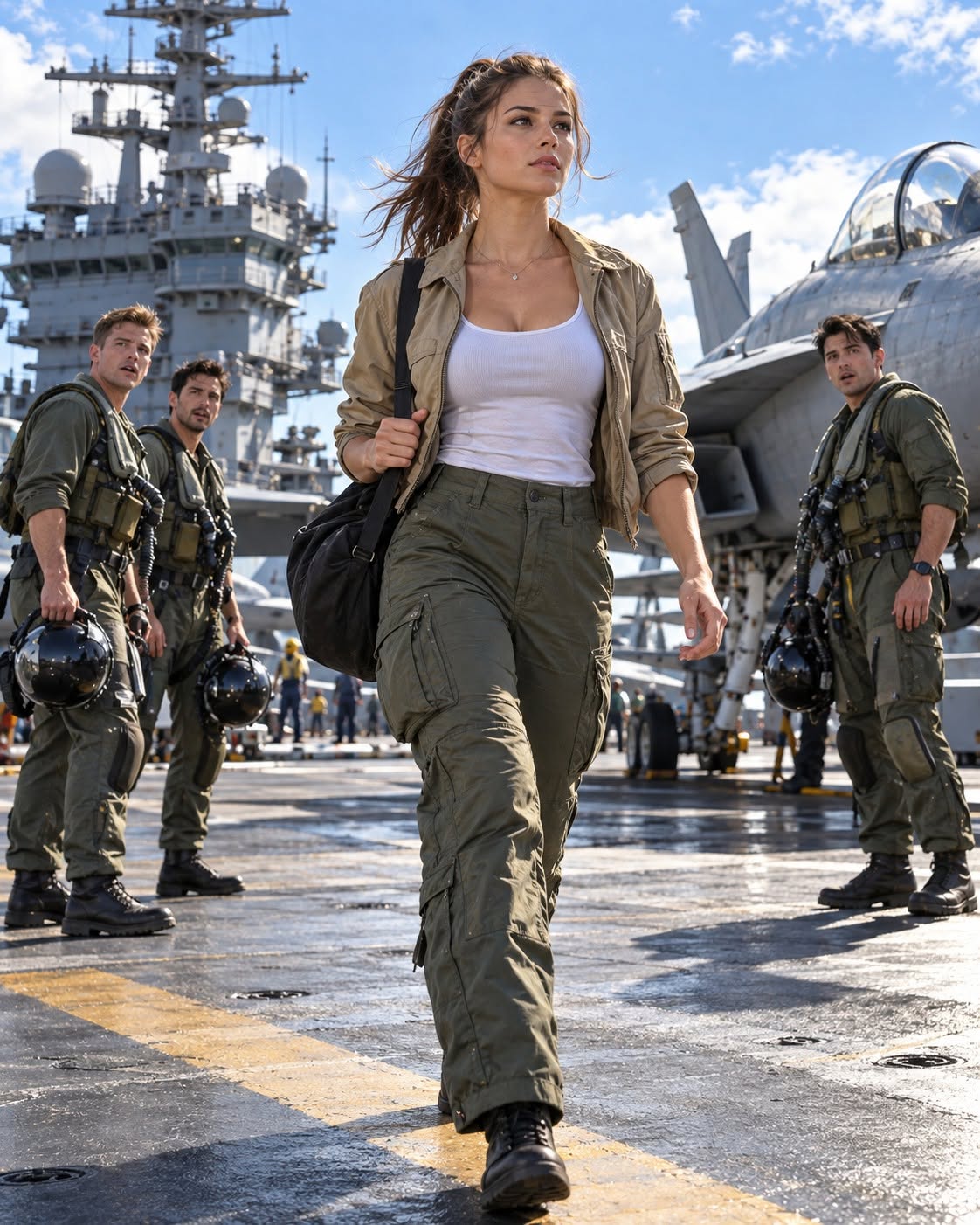
The Question Nobody Could Answer
Less than an hour later, I was sitting in a private room at Denver International Airport when two federal investigators entered.
One introduced herself as Special Agent Helen Carter. The other was an aviation safety investigator named Thomas Reed.
They were polite, professional, and clearly aware that the incident would be examined from every possible angle.
“Lieutenant Commander Vance,” Carter began, “we appreciate your assistance during the emergency. We need to establish exactly what happened after the captain became incapacitated.”
I nodded.
Reed opened a notebook.
“Let’s begin with the engine failure. What did you observe?”
I described the initial bang, the smoke coming from the right wing, the abnormal control response, and the warning indications Rachel had reported. I explained which emergency procedures we had worked through and how we had coordinated our efforts during the approach.
I was careful not to claim knowledge I didn’t have.
I hadn’t been in the cockpit when the first failure occurred. I hadn’t inspected the engine. I couldn’t identify the original mechanical fault simply by looking through a passenger window.
What I could describe was what I had seen, what Rachel had told me, and what we had done after I arrived.
Reed listened closely.
“Your military background helped you recognize the seriousness of the situation?”
“Yes.”
“But you weren’t qualified to operate that specific commercial aircraft.”
“Correct.”
Carter looked up.
“Then why did you take responsibility for advising the first officer?”
I considered the question.
“Because she was dealing with an emergency, her captain was incapacitated, and she needed another experienced pilot to help her organize the information in front of her. I didn’t replace her authority or pretend I knew every detail of her aircraft. I supported her while she worked through the procedures available to her.”
“Were you ever concerned that your advice could make the situation worse?”
“Every decision carried that possibility.”
I paused.
“That’s why I listened to Rachel, paid attention to what the aircraft was telling us, and avoided assuming that fighter-pilot experience made me an expert in every airplane.”
The investigators exchanged a glance.
Then Reed closed his notebook.
“One more question. Did you believe the aircraft was going to crash?”
I looked down at my hands.
For a moment, I saw the runway approaching through the windshield again. I remembered the sluggish controls, the smoke, and the horrible feeling that the aircraft was refusing to respond to the pilot trying to save it.
“Yes,” I said quietly. “I believed it was possible that we wouldn’t make it.”
Carter’s expression softened slightly.
“Thank you for being honest.”
When they left, I sat alone for several minutes.
I had expected questions about the landing, the escort fighters, and the decisions we’d made. I hadn’t expected the question about fear to stay with me.
In combat, fear was familiar. It came with the job, and training gave you a framework for functioning despite it.
But on that commercial flight, the stakes had felt different.
There had been no mission briefing, no carefully assembled team, and no time to establish the kind of trust that normally developed between pilots.
There had been a frightened first officer, a failing aircraft, and hundreds of people who had no idea how close they were to disaster.
I hadn’t been certain we could save them.
I had simply known that doing nothing wasn’t an option.
My phone vibrated.
A message from my commanding officer appeared on the screen.
Call me as soon as you’re cleared by the medical team. We need to discuss what happened.
I stared at it for a moment before typing my reply.
Understood, sir.
Then another notification appeared.
This one came from an unfamiliar number.
My name is Rachel Diaz. I know you’re probably exhausted, but I wanted to thank you before we get separated by the investigation. I don’t think I could have done that approach alone.
I read the message twice.
Then I answered.
You weren’t alone. And you brought us home.
A minute later, she replied.
I hope I can become the kind of pilot who does that for someone else.
I smiled for the first time since leaving the aircraft.
You already started.
The Video That Changed Everything
By the following morning, the story had escaped the airport.
Someone had recorded the moment the two F/A-18 pilots saluted me on the tarmac. Another passenger had captured footage of the damaged airliner surrounded by emergency vehicles.
Before long, clips were circulating online with dramatic captions.
YOUNG WOMAN SAVES HUNDREDS AFTER PILOT COLLAPSES.
PASSENGERS DIDN’T KNOW A NAVY COMBAT PILOT WAS SITTING AMONG THEM.
THE PASSENGER EVERYONE UNDERESTIMATED.
The footage spread faster than anyone could control.
My face appeared on television screens. Reporters began searching for my military biography. Commentators debated whether the airline had handled the emergency correctly and whether my involvement should become part of a new aviation safety protocol.
Some called me a hero.
Others questioned why a fighter pilot had been traveling without identifying herself to the crew before an emergency occurred.
One television personality went so far as to suggest that my civilian clothing had made the situation more dangerous because nobody had recognized my qualifications sooner.
That particular argument irritated me more than I expected.
I wasn’t wearing a uniform because I wasn’t on duty.
I had been a passenger, just like everyone else.
I hadn’t been hiding my identity. I simply hadn’t felt the need to announce my career to a stranger sitting beside me.
And I wasn’t going to apologize for that.
When my commanding officer called, his voice was measured.
“Vance, I’ve seen the footage.”
“I assumed you had, sir.”
“Your actions appear to have been helpful, but we need to be careful about how this is discussed publicly. The investigation is ongoing. You are not to speculate about the cause of the failure or provide technical commentary without authorization.”
“Understood.”
He paused.
“I’m also concerned about the attention this is attracting. You are a Navy officer, not a media personality.”
“I understand that, sir.”
“Good. Because this isn’t about making you famous.”
I looked out the hotel window at the airport roads below.
“No, sir. It isn’t.”
After the call, I turned off the television.
For a few hours, I wanted to be nobody.
No call sign.
No rank.
No face attached to a viral story.
Just a woman in a gray hoodie who had survived a terrible flight and wanted to sleep.
But the world had other plans.
That afternoon, an email arrived from a young woman named Olivia Bennett.
She was nineteen and had recently applied to a naval aviation program. Her message was short, but I read it several times.
I’ve wanted to become a pilot since I was a little girl. My family keeps telling me the cockpit isn’t a place for someone like me. When I saw the video, I cried. Not because you saved those passengers, although that was incredible. I cried because you looked like a normal person. You looked like someone I could become.
I leaned back in my chair.
There were hundreds of messages waiting for me, but that one stayed on the screen.
I remembered being seventeen and standing outside a recruiting office, listening to someone explain how demanding military aviation would be.
I remembered the instructors who pushed me harder than I thought I could endure, the examinations I had to repeat, and the days when my mistakes seemed to outweigh my achievements.
I also remembered the people who had believed in me before I knew how to believe in myself.
One instructor had once told me, after a particularly difficult training flight, that confidence wasn’t something you were born with.
It was something you earned through preparation, humility, and repetition.
I opened Olivia’s email again and began typing.
Don’t let someone else’s assumptions make your decision for you. Research the requirements. Train seriously. Ask difficult questions. Find mentors who will challenge you honestly. And if you discover that aviation is truly what you want, give yourself the chance to earn your place there.
I stopped, then added one more sentence.
You don’t have to look like anyone else’s idea of a pilot. You do have to become someone other people can trust when things go wrong.
I sent the message.
I didn’t know whether Olivia would ever fly a military aircraft.
But I hoped she would make that decision based on her own abilities and ambitions, rather than on someone else’s limited imagination.
The Man in Seat 14B
Three days after the emergency, I received another unexpected message.
It was from Edward Vance.
His name appeared on the screen, followed by a request to meet.
I almost ignored it.
I had already accepted his apology at the airport. There was nothing more I needed from him, and I wasn’t interested in spending an afternoon discussing the assumptions of a stranger who had judged me before knowing anything about me.
Then I noticed the final sentence.
There’s something I should have told you, and I think you deserve to hear it in person.
Curiosity won.
We met in a quiet café near the airport, away from reporters and cameras.
Edward arrived early. He wore a dark jacket and carried no briefcase, no laptop, and no visible signs of the confidence he’d displayed on the flight.
For several seconds, neither of us spoke.
Then he placed a folded piece of paper on the table.
“I wrote down what I wanted to say because I didn’t trust myself to say it properly.”
I glanced at the paper but didn’t pick it up.
“You don’t have to make a speech.”
“I know. But I need to explain something.”
He took a breath.
“I spent most of my career in corporate management. I traveled constantly, negotiated contracts, and made decisions that affected hundreds of employees. I was used to walking into a room and having people assume I knew what I was doing.”
He gave a humorless laugh.
“I suppose I became addicted to that feeling.”
I waited.
“When I sat beside you, I saw a young woman who didn’t fit my idea of someone important. So I decided you must be inexperienced. I made a joke because it made me feel knowledgeable.”
He looked down at his hands.
“Then the plane started coming apart, and suddenly I was the one who knew nothing. I couldn’t fix the engine. I couldn’t interpret the warning lights. I couldn’t even tell whether the aircraft was going to stay in the air.”
His voice grew quieter.
“And the person I’d dismissed was the one helping us survive.”
I finally picked up the paper.
It contained only a few lines.
I was wrong to assume that appearance revealed ability. I was wrong to treat my own confidence as evidence of competence. And I was wrong to believe that I could recognize an expert simply by looking at someone.
I set the paper down.
“Why did you want to meet?”
Edward hesitated.
“Because I keep thinking about something you said. You told me to give people a chance to show me who they are.”
He looked directly at me.
“I’ve spent years making decisions about people based on first impressions. Hiring managers. Young employees. Women who wanted positions traditionally held by men. I always told myself I had good instincts.”
He swallowed.
“Now I’m wondering how many people I dismissed before they had a chance to prove themselves.”
For the first time, I felt that his apology had become more than embarrassment.
He wasn’t merely upset that he’d been wrong about me.
He was beginning to question the system of assumptions that had made him comfortable being wrong.
“That isn’t something I can answer for you,” I said. “But you can start by changing how you make those decisions.”
He nodded slowly.
“I intend to.”
I stood to leave, but he spoke again.
“One last thing. When you stood up to help, were you thinking about what would happen if you failed?”
“Yes.”
“Weren’t you afraid everyone would blame you?”
I considered the question.
“Of course I was afraid. But there were people in danger, and I had relevant experience. I didn’t need to be certain I’d succeed. I needed to be honest about what I could contribute.”
Edward looked at the folded paper.
“I wish I’d understood that before.”
“So do I,” I replied.
We shook hands, and I left the café without any dramatic final words.
I didn’t need him to become a different person overnight.
Real change was rarely that simple.
But as I walked toward the parking lot, I hoped the next time he encountered someone who didn’t fit his expectations, he would pause long enough to ask a question instead of delivering a judgment.
Sometimes, that small pause was where everything began.
The Call From Denver
Two weeks later, my commanding officer summoned me to a meeting.
The aviation incident investigation had uncovered several issues that required further examination. The airline’s captain had suffered a sudden medical emergency, and investigators were studying the aircraft’s mechanical failures, crew coordination, and the sequence of events that had led to the emergency landing.
No final conclusions had been issued.
My role in the cockpit had also drawn attention from aviation safety specialists interested in how an experienced outsider could support a flight crew without taking over responsibilities they were not qualified to assume.
My commander was waiting when I entered.
“Sit down, Vance.”
I took the chair opposite him.
He slid a folder across the desk.
“An aviation safety group in Denver wants to speak with you. They’ve asked whether you’d be willing to participate in a discussion about emergency decision-making, cockpit communication, and the management of unexpected crises.”
I opened the folder.
The invitation was formal, but the purpose was clear. They weren’t asking me to explain how to fly a commercial airliner. They wanted to understand what had helped a frightened crew regain enough structure to manage an unfolding emergency.
“Are they expecting me to discuss the technical details of the aircraft failure?”
“No. Those questions belong to the investigators. You’ll discuss your own experience, the importance of staying within your expertise, and how communication can help under pressure.”
I thought about Rachel’s face when I entered the cockpit.
I remembered how she had been surrounded by alarms, warnings, and responsibilities she had never expected to carry alone.
I remembered the moment she committed to the landing.
“Yes, sir,” I said. “I’ll participate.”
The event took place in a conference hall filled with pilots, flight attendants, emergency responders, and aviation students.
Rachel attended as well.
She had recovered from the incident and returned to work, although she admitted that the first time she heard an engine make an unusual noise afterward, her heart had started racing.
“I thought I was ready to fly again,” she told me privately before the event. “Then I realized that being ready and feeling ready aren’t always the same thing.”
“That’s true of most difficult things,” I said.
She smiled.
“I’ve been practicing the approach in a simulator. Over and over.”
“Good.”
“I keep thinking about the way you spoke to me. You didn’t tell me that everything would be fine.”
“No one could promise that.”
“You told me what we could do next.”
I nodded.
“Because that was the part we could control.”
When the discussion began, the moderator asked me what I had learned from the experience.
I looked across the audience.
“I learned that preparation matters most when it gives you the ability to think clearly under pressure. But I also learned that experience can become dangerous if it makes you assume every unfamiliar situation is just another version of something you’ve already handled.”
Several people began taking notes.
“My military background helped me stay calm and recognize the need for disciplined communication. But I wasn’t an expert on that aircraft. Rachel was the commercial pilot responsible for flying it, and I had to respect her knowledge as much as I relied on my own.”
The moderator asked, “What would you say to someone who believes confidence is the most important quality in an emergency?”
I thought for a moment.
“Confidence can help you act, but it can’t replace competence. And competence includes knowing when you need someone else’s expertise.”
Rachel sat beside me, listening.
I continued.
“An emergency is not the time to protect your ego. It’s the time to make the information clear, identify the immediate priorities, and use every available resource responsibly. The goal isn’t to prove who’s the smartest person in the room. The goal is to give everyone the best possible chance of getting home.”
The room fell quiet.
Then someone near the back raised a hand.
It was Olivia Bennett, the young woman who had emailed me.
I recognized her immediately.
She had traveled from another state to attend the event.
“Lieutenant Commander,” she said, “how do you know when you’re ready to take responsibility for something that scares you?”
I looked at her for a long moment.
“You don’t wait until you’re no longer afraid. You prepare until you understand the risks, know your limitations, and can make a responsible decision despite the fear.”
She nodded.
“And what if someone tells you that you don’t belong there?”
I smiled slightly.
“Ask yourself whether they’ve offered evidence or merely an opinion. Listen to people who are qualified to evaluate your work. Learn from criticism that makes you better. But don’t confuse someone else’s prejudice with a professional assessment.”
Olivia lowered her hand.
I could see that she was trying not to cry.
For a moment, I remembered the young pilot I’d once been, sitting in a training room and wondering whether I would ever become good enough.
I hoped she would remember this day when her own doubts became loud.
Not because I had saved hundreds of passengers.
But because she had asked a question that mattered, and someone had taken it seriously.
The Second Emergency
The greatest lesson from that flight came several months later.
I was back aboard my carrier, preparing for a routine training mission, when a message arrived from the aviation safety group.
Rachel had been operating another commercial flight when the aircraft encountered severe turbulence over the Midwest. Nobody was injured, and the plane landed safely. But afterward, she had contacted the group to report a problem.
During the event, a junior crew member had noticed an unusual indication and hesitated to speak because a more senior colleague had dismissed the concern.
Rachel wanted to know how to encourage people to report problems without allowing a cockpit to become chaotic.
The message included a request for my thoughts.
I sat with it for a long time.
Tariq Gorge had taught me that technology could fail.
The commercial flight had taught me that even capable people could become overwhelmed.
Now Rachel was confronting another danger: the possibility that someone might see a warning sign and remain silent because they were afraid of looking foolish.
I sent her a reply.
Make it clear that anyone can raise a safety concern. Then make it equally clear that concerns must be communicated precisely, assessed professionally, and addressed according to the situation. Respect is not the same as accepting every suggestion without question. It means taking a concern seriously enough to evaluate it.
She responded the following day.
That’s exactly what I needed. Thank you.
I didn’t know how much difference the advice would make.
But I began to see a pattern connecting the experiences we’d all shared.
Edward had mistaken confidence for knowledge.
Rachel had feared that uncertainty would undermine her authority.
I had nearly allowed the desire to act quickly to obscure the importance of communicating my decisions.
Each of us had faced a different version of the same challenge.
We had to learn that competence wasn’t about never being wrong.
It was about creating the conditions in which mistakes could be recognized, corrected, and prevented from becoming disasters.
That lesson followed me back into the cockpit.
During a later training exercise, one of my younger wingmen questioned an instruction I had given. His concern turned out to be justified.
I changed the plan.
Afterward, he apologized for challenging me.
“Don’t apologize for identifying a legitimate problem,” I told him. “Just make sure you explain what you’ve seen and why it matters.”
He looked relieved.
“I thought you’d be angry.”
“I would have been angrier if you had stayed quiet and let us make a mistake we could have avoided.”
He nodded, and we went our separate ways.
It was a small moment.
Nobody filmed it.
Nobody wrote a headline about it.
But it mattered just as much as the dramatic landing that had made my name recognizable to strangers.
Because the best outcome of an emergency isn’t simply surviving it.
It’s learning enough from the experience that the next emergency becomes less likely to happen—or less dangerous when it does.
What Edward Did Next
Nearly a year after the flight to Chicago, Edward sent me a photograph.
It showed a group of young professionals seated around a conference table. He was standing at the front, listening to a woman who appeared to be explaining something on a screen.
The message read:
I wanted you to see this. I’ve changed the way we conduct interviews and evaluate candidates. We use structured questions, consistent criteria, and practical assessments wherever possible. We also train managers to recognize when they’re relying on assumptions rather than evidence.
He added another line.
I can’t undo the times I judged people unfairly. But I can stop pretending that my first impression is always right.
I studied the photograph.
Then I typed a reply.
That’s a good place to start.
He responded almost immediately.
I still remember your face when I told you to sit down. You didn’t argue. You just looked at me as though you were waiting for me to realize how little I knew.
I smiled.
I was mostly trying to get your hand off my sleeve.
His answer came with a laughing emoji.
For the first time, I could laugh about the moment, too.
I had no idea whether Edward’s new approach would transform his entire organization. Change was rarely that dramatic.
But perhaps a young employee would be taken seriously because of it.
Perhaps a qualified candidate would receive an opportunity that might otherwise have gone to someone who simply looked more familiar.
Perhaps a manager would pause before dismissing a concern.
Those outcomes would never become viral videos.
They wouldn’t generate headlines or attract thousands of comments.
But they might change someone’s life.
And that was enough.
The Final Lesson
On the anniversary of the emergency landing, I found myself sitting beside an airport window, waiting for another commercial flight.
I was wearing a gray hoodie, black sneakers, and jeans.
The same kind of clothes I’d worn on the day my life briefly became a story that strangers felt entitled to tell.
A young woman sat down across the aisle, carrying a backpack and a folder full of papers. She looked nervous. Every few seconds, she checked the departure board.
Eventually, she noticed the small Navy insignia on the keychain attached to my bag.
“Are you in the military?” she asked.
“Yes.”
“Do you fly?”
“I do.”
Her eyes widened.
“That’s amazing. I’ve always wanted to become a pilot, but I’m not sure I’m good enough.”
I recognized the uncertainty in her voice.
“What makes you think you aren’t?”
She hesitated.
“I’m not the kind of person people usually imagine when they think of a pilot.”
I looked at her carefully.
“Then find out what it actually takes to become one. Learn the requirements. Talk to instructors. Get honest feedback. Put in the work.”
She glanced down at her folder.
“And if I fail?”
“Then you’ll have learned something important about what you need to improve. Failure can tell you where the work is. It doesn’t have to decide your entire future.”
She looked up again.
“You make it sound simple.”
“It isn’t simple,” I said. “It’s just worth approaching one step at a time.”
A boarding announcement interrupted us.
She stood, thanked me, and walked toward the gate.
I watched her disappear into the crowd, wondering what she would do next.
Maybe she would become a pilot.
Maybe she would discover another ambition that suited her better.
Either outcome would be hers to choose.
That was the point.
I didn’t need her to become someone like me.
I wanted her to have the opportunity to discover what she could become without someone else deciding her limits in advance.
When my flight was called, I picked up my bag and joined the line.
I thought about Rachel, who had learned to trust her judgment while remaining open to help.
I thought about Edward, who had begun questioning the confidence that once made him dismiss people too quickly.
I thought about Olivia, who was still working toward her aviation goals, and about the passengers who had stepped onto the runway believing they had been given a second chance at life.
And I thought about the cockpit.
The moment the first officer had asked for help, nobody had cared what I was wearing.
Nobody had cared whether I looked like a fighter pilot.
Nobody had cared how impressive my career sounded on paper.
They had needed someone who could contribute, listen, and help them make responsible decisions under pressure.
So I had stepped forward.
Not because I was certain I could save everyone.
Not because I wanted recognition.
But because I had spent years preparing for situations in which hesitation could cost lives, and this was a moment when that preparation might matter.
I had been fortunate.
The crew had worked together. The aircraft had remained controllable long enough to reach the runway. The emergency teams had been ready. The fighter pilots had provided support, and hundreds of passengers had walked away alive.
No single person could claim all the credit.
That was perhaps the most important truth of all.
We remember dramatic rescues because they give us a face to associate with courage. We celebrate the person who stands up when everyone else is afraid.
But behind every successful rescue are countless people whose contributions never become part of the story.
The crew member who notices a problem.
The mechanic who catches a fault before takeoff.
The instructor who refuses to let a student advance before mastering a difficult skill.
The colleague who asks a question nobody else wants to ask.
The stranger who offers help without demanding recognition.
Courage can begin with one person stepping forward.
But lasting safety depends on everyone being willing to do their part.
As I boarded the aircraft, I passed a little boy sitting beside his father. He was staring at the plane with wide eyes, holding a toy airplane in both hands.
“Dad,” he whispered, “do you think the pilots are brave?”
His father smiled.
“I think they work very hard to be ready.”
I kept walking, but those words stayed with me.
They were better than the usual stories about fearless heroes.
Because pilots weren’t fearless.
Neither were doctors, firefighters, soldiers, or the ordinary people who found themselves facing extraordinary circumstances.
Bravery wasn’t a magical quality that separated certain people from everyone else.
It was often the result of preparation, responsibility, and the decision to act despite uncertainty.
I had never intended to become a symbol.
I was still the same woman who had boarded that flight hoping for a quiet trip to Chicago.
I still wore comfortable clothes when I traveled. I still enjoyed being anonymous. And I still believed that the best recognition was often the kind you never received because the people around you simply trusted you to do your job.
Edward had looked at me and seen a young woman who didn’t appear qualified.
The emergency had forced him to confront the difference between appearance and ability.
But I didn’t want the lesson to be that people should wait until a crisis to discover someone’s worth.
I wanted them to learn to look more carefully before the crisis came.
Ask questions.
Examine evidence.
Listen when someone raises a concern.
Respect expertise, even when it comes from a person who doesn’t fit your expectations.
And never assume that the quietest person in the room has the least to offer.
The aircraft pushed back from the gate.
As the engines began to hum, I settled into my seat and looked out at the runway.
Somewhere in the distance, another plane was climbing into the sky. Its passengers were probably checking their phones, reading magazines, or thinking about the meetings and family visits waiting for them at their destination.
They weren’t thinking about emergency procedures.
They weren’t thinking about the people responsible for keeping them safe.
They were simply living their lives.
And that was exactly how it should be.
Because the purpose of competence is not to be admired.
It is to make safety possible enough that other people can live without constantly thinking about the danger.
The purpose of courage is not to make yourself look extraordinary.
It is to do what the moment requires, even when nobody is watching.
And the purpose of respect is not to praise someone after they’ve saved the day.
It is to give them a fair chance before you know what they are capable of.
I closed my eyes as the aircraft began its takeoff roll.
The runway stretched ahead, the engines grew louder, and the world outside the window began to move.
For a moment, I remembered the damaged airliner, Rachel’s trembling hands, the frightened passengers, and the runway that had appeared through the windshield when we needed it most.
I remembered Edward’s smirk, too.
But I no longer thought of that expression as the most important part of the story.
What mattered was what happened after it disappeared.
A frightened pilot had accepted help.
A group of strangers had worked together.
A man had begun questioning his assumptions.
And hundreds of people had been given the chance to return to their lives.
That was the story I wanted to remember.
Not that a young woman had surprised everyone by being capable.
But that people had survived because, when it mattered, capability had been allowed to speak louder than appearances.
The plane lifted into the sky.
I watched the city grow smaller beneath us and felt the familiar calm that came with being airborne.
Then I rested my head against the seat and smiled.
I was still Comet.
Still a Navy fighter pilot.
Still a woman who had spent years learning how to function when the world seemed to be falling apart.
But I was also something much simpler.
A person who had been in the right place at the right time, with the right experience to help.
And perhaps that was the lesson worth carrying forward.
You never truly know who is sitting beside you.
You don’t know what they’ve survived, what they’ve learned, or what they might be capable of doing when the moment arrives.
So don’t mistake quietness for weakness.
Don’t confuse confidence with competence.
And don’t let the limits of your imagination become the limits you place on someone else.
Because sometimes, the person you underestimate is the one who will help you find your way home.
And sometimes, the greatest thing you can do for another human being is to recognize their potential before the world gives you a dramatic reason to believe in it.