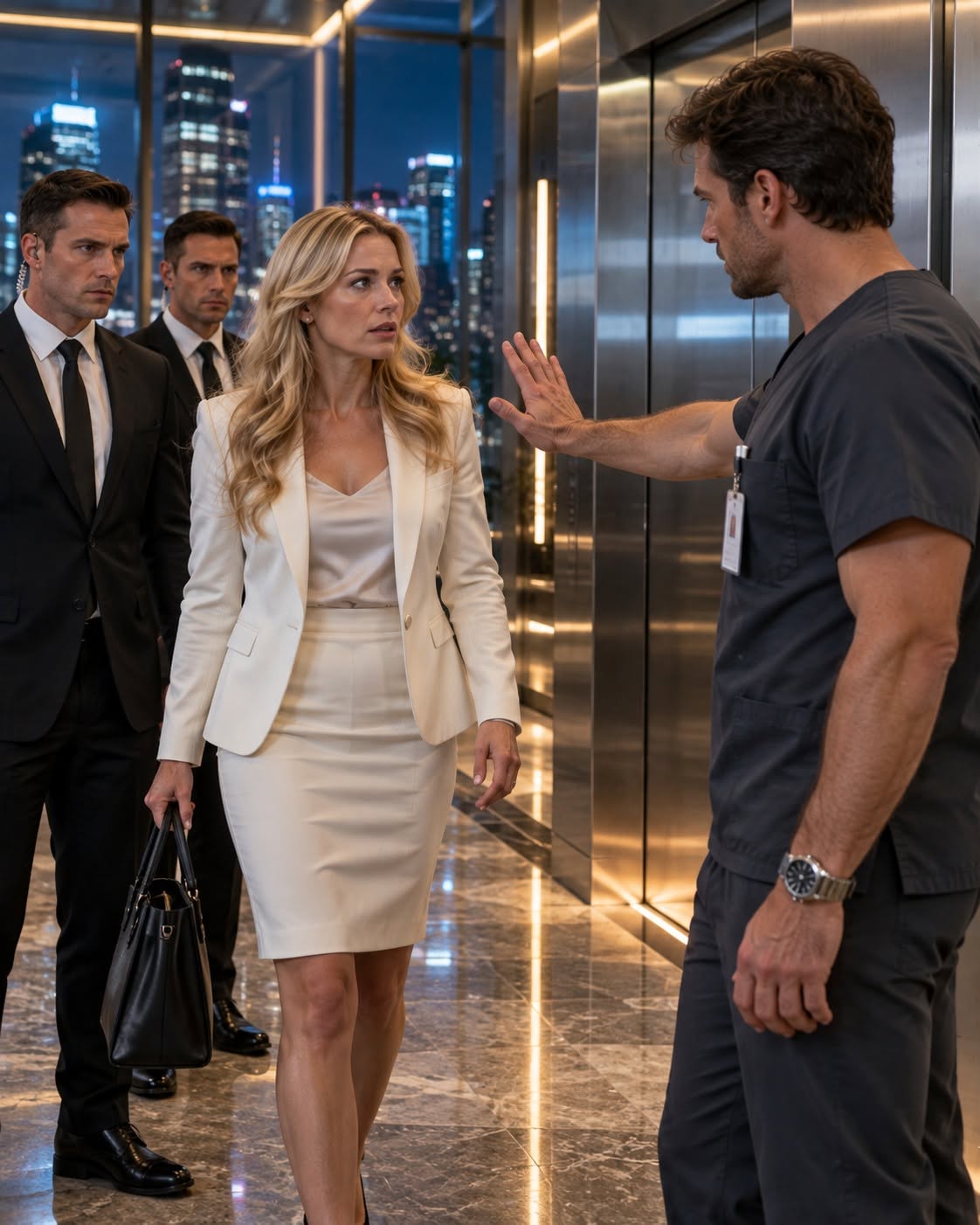
“Don’t move. Don’t speak!” I shouted at the billionaire CEO standing just a few feet away from me. Two security guards immediately lunged in my direction
For the first time in years, I stopped counting my life in overdue bills and exhausted nights.
I began counting it in smaller things: the sound of Chloe laughing over breakfast, the stories she told me on the drive to school, and the evenings when I could sit beside her without glancing at my watch every few minutes.
I thought that was the happy ending I had been working toward.
I was wrong.
Sometimes, when life finally gives you room to breathe, it also gives you a reason to discover just how much courage you have left.
Three months after Eleanor Vance promoted me to oversee building safety operations, I received a call at 6:12 on a Tuesday morning.
I was making pancakes for Chloe when my phone vibrated across the kitchen counter.
“Dad, they’re burning,” Chloe announced, pointing at the pan.
I turned off the stove, rescued what I could, and answered the call.
It was Martin Cole, the director of facilities at Vance Global.
“Daniel, I need you downtown immediately.”
His voice sounded strained.
“What happened?”
“Something’s wrong at the Hudson Tower. The building’s environmental monitoring system has triggered three separate alarms, and the automated reports don’t make any sense.”
“Is everyone safe?”
“We don’t know yet.”
I looked at Chloe, who was sitting at the table in her pajamas, carefully cutting a pancake into tiny squares.
For a moment, I considered asking Martin to send someone else. I had only recently begun this position, and I knew there were more experienced engineers who could handle a technical emergency.
Then I remembered what Eleanor had told me during our first meeting.
She hadn’t hired me because I knew everything.
She had hired me because I knew when something didn’t look right.
“I’ll be there in twenty minutes,” I said.
I called our neighbor, Mrs. Bennett, who had helped me through countless difficult mornings since my wife died. She agreed to take Chloe to school.
Before leaving, I knelt beside my daughter.
“Something’s come up at work, sweetheart. Mrs. Bennett will take you to school, and I’ll try to be home for dinner.”
Chloe wrapped her arms around my neck.
“Promise?”
I held her close.
“I’ll do my best.”
I hated that answer. After losing her mother, Chloe had heard too many promises followed by empty chairs and unanswered questions.
But I had learned that being a good father wasn’t about pretending life would always cooperate. It was about telling the truth and showing up whenever I could.
I kissed her forehead, grabbed my jacket, and left.
Hudson Tower was one of Vance Global’s newest properties, a forty-eight-story glass building overlooking the Hudson River. It housed executive offices, research laboratories, conference facilities, and several hundred employees.
When I arrived, the lobby was crowded with people holding coffee cups and staring at their phones.
Everything appeared normal.
That was the first thing that bothered me.
Martin met me near the security desk.
“The building management system reports abnormal pressure in the lower mechanical levels,” he explained. “Then it reports a temperature spike on the twenty-sixth floor. Now it says the backup ventilation system has shut down.”
“Have you sent anyone down to inspect it?”
“Our engineers checked the central console. Everything looks normal from here.”
I looked at him.
“That’s not the same as checking the equipment.”
He rubbed his forehead.
“That’s why I called you.”
We entered the control room, where a wall of monitors displayed floor plans, ventilation readings, electrical loads, and security alerts.
I studied the figures.
The system showed a sudden increase in air pressure in one section of the building, followed by a series of minor electrical fluctuations. The ventilation alarms had then appeared almost simultaneously.
It looked like a software error.
But there was something strange about the timestamps.
“Who last serviced the environmental controls?” I asked.
Martin checked the maintenance log.
“An outside contractor. Meridian Systems. They upgraded the monitoring software two weeks ago.”
“Did they replace any physical sensors?”
“No. The contract specifically called for software integration only.”
I leaned closer to the screen.
“Then why did three independent sensors stop reporting within the same minute?”
Martin didn’t answer.
I asked for the original sensor readings, not the summaries generated by the software. A technician brought up the raw data, and I began comparing it against the building’s maintenance records.
The numbers told a different story.
The pressure sensor in the lower mechanical level had been drifting for several days. A temperature sensor on the twenty-sixth floor had been reporting intermittent spikes, while a ventilation damper had repeatedly failed to reach its commanded position.
The software had labeled each issue as a minor fault.
Individually, they seemed unimportant.
Together, they suggested something was interfering with the building’s ability to regulate airflow.
“Martin, we need to evacuate the affected floors.”
His face tightened.
“Daniel, we don’t have evidence of an immediate threat. An evacuation of this building will cost hundreds of thousands of dollars, and the executive board is already questioning the disruption caused by the previous safety review.”
I stared at him.
“Would you rather explain an evacuation or explain why you ignored a warning before someone got hurt?”
He looked away.
I picked up the radio.
“This is Daniel Mercer, building safety operations. Initiate a precautionary evacuation of floors twenty through twenty-eight. Notify emergency services, isolate the affected ventilation zones, and suspend all nonessential mechanical operations.”
A voice responded immediately.
“Who authorized that?”
I recognized the speaker as Richard Hale, Vance Global’s chief operating officer.
“I did,” I answered.
“You don’t have authority to shut down an entire section of Hudson Tower without executive approval.”
“Then consider this my formal recommendation to evacuate. The alarms indicate a possible ventilation failure, and we cannot verify the system is operating safely.”
“Daniel, listen carefully. We have an investor presentation scheduled in forty minutes. If this is a false alarm, your judgment will be reviewed.”
I tightened my grip on the radio.
“Understood, sir.”
Then I repeated the evacuation order.
Within minutes, employees began leaving their offices. Security officers guided them toward the stairwells, while facilities staff worked to isolate the ventilation system.
I went down to the mechanical level with two engineers.
The air was unusually warm, and a faint vibration traveled through the floor beneath our boots.
At the far end of the room, a large ventilation fan was running at an inconsistent speed. Its motor housing trembled against the mounting frame.
I crouched beside it.
One of the engineers checked the control panel.
“The system says the fan is operating within normal limits.”
“Forget what the screen says,” I replied. “Listen to the motor.”
He leaned closer.
A metallic grinding sound rose from inside the housing.
I recognized it immediately.
The bearing was failing.
But that wasn’t the worst part.
The ventilation damper downstream was stuck partially closed, forcing the fan to work against abnormal resistance. The motor was overheating, and the system’s pressure readings suggested that airflow was being redirected into areas that should have remained isolated.
I ordered the engineers to shut down the fan and activate the independent emergency ventilation procedure.
As they worked, a sharp crack echoed through the mechanical room.
A section of ductwork buckled inward.
One of the engineers stumbled backward.
“Everybody out!” I shouted.
We hurried toward the exit as a cloud of dust spread through the room. Behind us, metal groaned under pressure, and another duct connection tore loose.
We made it into the service corridor seconds before a heavy section of ductwork collapsed.
The engineer beside me stared at the damaged equipment.
“If we’d stayed in there another minute…”
He didn’t finish the sentence.
I radioed the control room.
“Mechanical failure confirmed. Keep the affected floors evacuated. Nobody reenters until the entire ventilation network has been inspected.”
For the first time that morning, no one questioned my authority.
But as emergency crews arrived and the building was secured, I began to suspect that we were dealing with more than neglected maintenance.
The software had failed to identify a dangerous mechanical condition.
That could have been a design flaw.
It could have been incompetence.
Or it could have been deliberate.
And if someone had deliberately concealed the problem, I needed to know why.
By noon, the immediate danger had passed. No one had been seriously injured, although several employees had been treated for anxiety and minor respiratory irritation caused by dust.
The building remained closed while engineers inspected the ventilation network.
Eleanor Vance arrived just after one o’clock.
She stepped out of her car, ignored the waiting reporters, and walked straight toward the temporary operations center.
“Daniel,” she said, “tell me what happened.”
I explained the sensor failures, the inconsistent software readings, the failing fan, and the damaged ductwork.
She listened without interrupting.
When I finished, she asked the question I had been dreading.
“Was this preventable?”
“Yes.”
“Could it have killed someone?”
I looked at the evacuated building.
“Yes.”
She closed her eyes briefly.
“Then we need to know why it happened.”
Richard Hale joined us a few minutes later. He looked composed, but his expression changed when Eleanor asked him about the Meridian Systems contract.
“It’s a routine software upgrade,” he said. “The company has worked with us for years. There’s no reason to suspect wrongdoing.”
“Did you review the maintenance exceptions?” I asked.
He turned toward me.
“I reviewed the reports provided to the executive office.”
“Those reports didn’t include the original sensor data.”
“Are you suggesting someone falsified the records?”
“I’m suggesting the records don’t match the equipment.”
Eleanor looked at Martin.
“Preserve every maintenance log, every system backup, and every communication related to this building. I want an independent engineering team here before the end of the day.”
Hale’s jaw tightened.
“Eleanor, we should be careful not to turn a mechanical failure into a corporate scandal.”
She regarded him steadily.
“I’m being careful. That’s why I’m asking for evidence.”
The independent inspection began that afternoon.
By evening, the engineers had discovered that several critical alarm thresholds had been altered during the recent software upgrade. Some warnings had been delayed, while others had been classified as low-priority notifications.
The changes had not been documented in the contractor’s official report.
Even more troubling, the same software configuration had been installed in six other Vance Global properties.
One of them was the company’s main research campus, where hundreds of employees worked with specialized equipment and controlled laboratory environments.
If the same fault existed there, the consequences could be far worse.
Eleanor ordered immediate inspections across all seven buildings.
Then she asked me to meet her privately.
Her office overlooked the city, but neither of us looked at the view.
“Daniel,” she said, “I need you to take charge of the safety review.”
I hesitated.
“I’m not a software engineer.”
“No. But you’re the person who recognized that the equipment was telling a different story from the computer.”
“I’ll need people with the right technical expertise.”
“You’ll have them.”
She slid a folder across the desk.
Inside were the preliminary findings, contractor records, and a list of internal approvals associated with the upgrade.
One name appeared repeatedly.
Richard Hale.
I looked up.
“Are you sure you want me involved in this?”
“Why wouldn’t I?”
“Because if the investigation reaches senior management, it may become uncomfortable.”
Eleanor leaned forward.
“Daniel, the purpose of a safety system isn’t to protect the company’s reputation. It’s to protect the people inside the building. If those priorities ever become confused, I want someone who remembers which one matters.”
I accepted the assignment.
Over the next four days, I worked with independent engineers, cybersecurity specialists, and building inspectors. We reviewed thousands of records, compared equipment logs, and traced the software changes back to their source.
The pattern was disturbing.
Meridian Systems had installed an unauthorized update that altered the way critical alarms were processed. The changes made the buildings appear more efficient on paper, reducing the number of reported maintenance incidents and preventing automatic shutdowns during minor faults.
That had made the company’s performance reports look better.
It had also concealed problems that required immediate attention.
The investigation revealed that the software had been promoted internally as a cost-saving improvement. Maintenance expenses had fallen, building availability had increased, and executive reports showed fewer interruptions.
But those numbers were misleading.
The problems hadn’t disappeared.
They had simply stopped being reported.
I found the first direct evidence of deliberate interference late on Thursday night.
A service record showed that a technician had flagged the ventilation damper at Hudson Tower as unsafe twelve days before the failure. The report had been closed without a physical inspection.
The approval came from a regional facilities manager.
Attached to the record was a note instructing staff to classify the issue as a software discrepancy.
The note had been signed by Richard Hale.
I read it twice.
Then I printed the record and carried it to Eleanor’s office.
She was still working.
When she saw the document, her expression became unreadable.
“Could this be a misunderstanding?” she asked.
“Possibly. But the technician’s original report says the damper was physically sticking. The closure note says the fault was software-related. No inspection was performed.”
“Have you spoken to the technician?”
“I’m meeting him tomorrow.”
She placed the document on her desk.
“Then we’ll hear what he has to say before we draw conclusions.”
The technician’s name was Samuel Ortiz.
He was a quiet man in his early forties who had worked for Vance Global for eleven years. When we met in a conference room the following morning, he looked as though he hadn’t slept.
I explained that the investigation was independent and that he would not be penalized for reporting a genuine safety concern.
For several minutes, he said nothing.
Then he opened a folder he had brought with him.
Inside were photographs of the damaged damper, copies of his original inspection report, and emails showing that he had repeatedly requested repairs.
His final message had received a reply from Hale’s office.
Do not delay the scheduled upgrade. Reclassify the issue and proceed as directed.
Samuel’s hands trembled.
“I knew it was wrong,” he said. “But I’d already been warned about causing unnecessary delays. My supervisor told me the company couldn’t afford another maintenance shutdown.”
“Did you believe the building was safe?” I asked.
“No.”
“Why didn’t you escalate the issue?”
He looked down.
“My wife was recovering from surgery. We had two children. I couldn’t afford to lose my job.”
His answer struck me harder than I expected.
I knew that fear.
I knew what it felt like to measure every decision against the possibility of losing the income your family depended on. I knew how easily a person could convince himself that staying quiet was the only responsible choice.
I leaned forward.
“Mr. Ortiz, I’m not going to pretend I understand everything you were facing. But I need you to know something. The people who reported these problems were not the ones who created them.”
He looked up.
“And the people who ordered you to hide them cannot use your fear as an excuse for what they did.”
His eyes filled with tears.
“I should have done more.”
“You should have been listened to when you did the right thing the first time.”
We secured his evidence and added it to the investigation.
By Friday afternoon, the pattern was undeniable. The altered software had been installed despite documented mechanical warnings, and internal reports had been manipulated to conceal the resulting risks.
Eleanor summoned Richard Hale to an emergency board meeting.
I was asked to attend as the lead investigator.
Hale arrived carrying a thick folder and wearing the same confident expression he had displayed when he first questioned my evacuation order.
He began by describing the incident as an unfortunate convergence of technical problems.
“The system was designed to reduce unnecessary shutdowns,” he explained. “There was no intention to compromise safety.”
Eleanor folded her hands.
“Then explain the instruction to reclassify a documented mechanical fault without inspection.”
Hale glanced at the printed email.
“Operational decisions are made at multiple levels. That message was taken out of context.”
I placed the original inspection report beside it.
“Here is the technician’s report. Here is the closure notice. Here are the sensor readings showing the problem continued after the software update. And here is the maintenance log confirming that no physical inspection took place.”
I let the documents speak for themselves.
Hale flipped through them, his expression gradually hardening.
“You’re a building safety manager, Mr. Mercer. Not a forensic auditor. You may be misunderstanding the technical details.”
I had expected him to attack my qualifications.
What I hadn’t expected was how little his words affected me.
Three months earlier, I might have looked at my uniform and wondered whether I belonged in that room.
Now I thought about the collapsed ductwork, the frightened employees, and Samuel Ortiz sitting across from me with photographs of a danger he had tried to report.
“I may not be a forensic auditor,” I replied. “That’s why independent specialists verified the findings. You don’t have to take my word for it. You can read theirs.”
I pushed the final report across the table.
The room fell silent.
Eleanor turned to the board.
“Effective immediately, Richard Hale is suspended pending an independent investigation. All contracts involving Meridian Systems are frozen. We will refer the evidence to the appropriate authorities, and no employee will be disciplined for raising a good-faith safety concern.”
Hale stood abruptly.
“You’re making a serious mistake. This company cannot operate if every manager is afraid to make a decision.”
Eleanor’s voice remained calm.
“Making decisions is part of management. Concealing a safety hazard is not.”
He looked around the table, searching for support.
No one spoke.
When he left the room, the silence remained.
I thought the worst was over.
It wasn’t.
That evening, an anonymous email arrived in my work inbox.
It contained a photograph of Chloe walking out of her school with Mrs. Bennett.
Beneath it were seven words.
You should have stayed in your own lane.
For a moment, I couldn’t breathe.
The room seemed to shrink around me. My hands went cold, and every sound from the corridor faded into the background.
I had faced dangerous machinery, angry executives, and the possibility that a building full of people could have been hurt because someone had ignored a warning.
None of that frightened me as much as seeing my daughter’s photograph.
I called the school immediately.
The principal confirmed that Chloe was safe and still inside the building with staff. I asked them to keep her there until I arrived, then contacted the police and Eleanor.
She was at my office within twenty minutes.
When I showed her the message, her face changed.
“Has anyone contacted Chloe directly?”
“Not that I know of.”
“We’re going to make sure that doesn’t happen.”
She arranged for the company’s security team to coordinate with the police, while I drove to the school with a security officer.
Chloe came running toward me when she saw my car.
“Daddy!”
I knelt and held her so tightly that she protested.
“Dad, you’re squishing me.”
I loosened my arms but didn’t let go.
“I’m sorry, sweetheart.”
She looked at my face.
“Are you okay?”
I tried to smile.
“I’m okay now.”
That night, I sat beside her bed long after she had fallen asleep. The photograph remained on my phone, and the anonymous message seemed to burn through the screen.
I had spent years trying to give Chloe a life in which she wouldn’t have to be afraid.
Now someone had used her as a way to frighten me into silence.
I thought about resigning.
The idea came quietly, almost reasonably. I could leave Vance Global, find another job, and return to a life in which my daughter wasn’t connected to a corporate investigation.
No promotion was worth putting her at risk.
But then I remembered the reason I had accepted the position.
Safety was not an abstract concept. It was a child waiting at home, a technician trying to support his family, an employee walking through a building believing the alarms would warn him if something went wrong.
If I walked away because someone had threatened Chloe, the people responsible would have learned that fear was an effective substitute for accountability.
Still, I couldn’t pretend the danger didn’t matter.
The next morning, I told Eleanor I was considering stepping aside.
She listened without trying to persuade me immediately.
“You have every right to protect your daughter,” she said. “I won’t ask you to take a risk you’re not willing to accept.”
“I don’t want to abandon the investigation.”
“Then don’t make that decision alone. Let the police handle the threat. Let our security team help protect your family. And decide what you can safely do from here.”
She paused.
“Daniel, courage isn’t the same as refusing to be afraid. Sometimes it’s recognizing that you need help.”
Those words stayed with me.
The police traced the anonymous email to a temporary account that had been accessed through a compromised contractor’s network. Investigators soon identified a former Meridian Systems consultant who had been paid to delete records related to the software changes.
When confronted with the evidence, the consultant agreed to cooperate.
He admitted that Hale had authorized the unauthorized update and ordered the suppression of several maintenance reports. He also revealed that the threats were intended to pressure the investigation team into withdrawing its findings.
The photograph of Chloe had been obtained from a public school event page. No one had approached her, and the police found no evidence of a planned physical attack, but they treated the threat seriously.
Hale was subsequently questioned by investigators and faced formal consequences for his role in concealing the safety problems. Meridian Systems lost its contract, and the company’s executives were required to cooperate with a broader review of their work at other properties.
The investigation took months to complete.
During that time, I continued working with the safety team, though I no longer carried the burden alone. We established an independent reporting channel, required physical inspections whenever critical sensors disagreed, and introduced a rule that no executive could override a documented life-safety concern without a written technical review.
We also created a protection policy for employees who reported hazards.
Samuel Ortiz became one of the first people to use the new system. He was appointed as a senior maintenance specialist, with the authority to escalate unresolved safety issues directly to the independent review committee.
At the small ceremony announcing the changes, he approached me afterward.
“I never thanked you properly,” he said.
“For what?”
“For listening.”
I shook my head.
“You reported the problem. You gave us the evidence. You did the difficult part.”
“Not soon enough.”
“Soon enough for us to learn from it.”
He looked toward the employees gathered in the room.
“I spent years believing that being a good employee meant not making trouble.”
“Being a good employee means doing your job honestly,” I told him. “Sometimes that means making trouble for the people who would rather not hear the truth.”
He laughed softly.
“That’s a lesson I wish I’d learned earlier.”
“Me too.”
Several months later, Hudson Tower reopened after a comprehensive engineering review. The ventilation system had been rebuilt, the monitoring software replaced, and every safety-critical component independently tested.
On the morning the building reopened, Eleanor asked me to accompany her through the lobby.
We stopped beneath the entrance where the decorative fixture had fallen months earlier.
The damaged marble had been repaired. The new fixture was smaller, secured by redundant mounting systems, and inspected under a stricter maintenance schedule.
Eleanor looked up at it.
“Do you ever think about that night?”
“Every so often.”
“What do you remember most?”
I considered the question.
“The sound. That first metallic creak.”
She nodded.
“Most people remember the crash.”
“By the time you hear the crash, it’s too late to prevent it.”
For a moment, she said nothing.
Then she looked at me.
“I used to believe leadership meant finding the smartest person in the room and giving them the authority to solve the problem. I’ve learned that it also means creating a room where people aren’t afraid to tell you there’s a problem in the first place.”
I thought of Samuel, who had tried to report a dangerous fault. I thought of the employees who had trusted the building’s alarms, and the executives who had mistaken fewer warnings for fewer problems.
“People need to know they’ll be heard,” I said.
Eleanor nodded.
“Then that’s what we’ll build.”
That evening, I left work early enough to pick Chloe up from school.
She climbed into the car carrying a large sheet of construction paper.
“Daddy, look!”
She had drawn a tall building with blue windows, a row of tiny people standing outside, and a smiling figure wearing a yellow safety vest.
“What is this?” I asked.
“It’s your building.”
I smiled.
“Why am I wearing yellow?”
“Because you’re the safety man.”
She pointed to the tiny people.
“And these are all the people you help keep safe.”
I studied the picture.
“That’s a lot of people, sweetheart.”
“I know.”
Then she pointed to a small house beside the building.
“And that’s our house. So you can come home after you help everybody.”
My throat tightened.
I reached across the seat and took her hand.
“That sounds like a good plan.”
She looked at me with the serious expression she sometimes wore when she was thinking about her mother.
“Mom would be proud of you.”
For a moment, I couldn’t answer.
I had spent so long trying to be both parents that I sometimes forgot I was allowed to miss the person who had once shared the burden with me.
I looked out the windshield until I could trust my voice.
“I hope so, sweetheart.”
Chloe squeezed my hand.
“I think she would.”
We drove home beneath a sky turning gold at the edges. For the first time in months, I didn’t think about the next meeting, the next inspection, or the next emergency waiting to happen.
I thought about dinner.
I thought about helping Chloe with her school project.
I thought about the simple privilege of being there.
The following year, Vance Global established the Eleanor Vance Safety Initiative, a program designed to identify overlooked hazards, train maintenance workers, and protect employees who raised concerns. I was asked to help lead it.
At the launch event, Eleanor invited me to speak.
I stood before a room filled with executives, engineers, contractors, and building staff. Some wore expensive suits. Others wore work boots and uniforms marked by years of practical labor.
I looked across the audience and remembered the man I had been on the night of the gala: exhausted, worried about money, and convinced that the world had little use for his experience.
Then I began.
“I want to tell you something about the night the fixture fell. People often say I saved Eleanor Vance’s life because I ran toward her and shouted for her to stop. That’s true, but it’s not the whole story.”
I paused.
“I recognized the danger because I’d spent years repairing things other people didn’t notice. I knew what a failing bracket sounded like because I’d worked with machinery. I knew when something was wrong because I had learned to pay attention.”
I glanced toward the maintenance staff in the back.
“None of those skills disappeared when I put on a cleaning uniform. They were still there. The world simply stopped asking me to use them.”
The room grew quiet.
“And later, when the ventilation system failed at Hudson Tower, the same principle applied. The warning signs were there. The reports existed. The people who understood the danger had tried to speak. What failed wasn’t just a machine. It was our willingness to listen.”
I let the words settle.
“We spend a great deal of time asking people to take responsibility. But responsibility must work in both directions. If we expect employees to report danger, we must make it safe for them to do so. If we expect managers to protect people, we must hold them accountable when they hide problems. And if we want to prevent disasters, we must learn to respect the people who notice trouble before everyone else can see it.”
When I finished, the applause lasted longer than I expected.
But the most meaningful moment came afterward, when a young maintenance apprentice approached me.
“Mr. Mercer, I was thinking about leaving this field,” he admitted. “I figured I’d never get anywhere because nobody takes people like us seriously.”
I remembered asking Eleanor why she had chosen me.
“What makes you think you can’t get somewhere?” I asked.
“I’m just a maintenance worker.”
I smiled.
“So was I.”
He looked at me, uncertain whether I was joking.
“Your job title tells people what you do today,” I said. “It doesn’t tell them everything you know, what you can learn, or what you might become. Keep developing your skills. Document what you find. Speak up when something is wrong. And don’t let someone else’s failure to recognize your value convince you that you have none.”
He thanked me and walked away, standing a little straighter than before.
That night, I returned home to find Chloe waiting at the kitchen table with a bowl of popcorn and a movie already playing.
“You’re late,” she announced.
I checked my watch.
“I’m twelve minutes late.”
“Twelve minutes is late.”
I laughed and hung up my jacket.
“You’re absolutely right.”
She patted the seat beside her.
“Come on, Dad. I saved you the good spot.”
I sat down, and she leaned against my shoulder as the movie began.
For years, I had believed that success meant earning enough money to keep fear away from our front door. I thought that if I worked hard enough, sacrificed enough, and endured enough, I could eventually build a life in which Chloe would never have to worry.
I understood now that security was not something money could guarantee.
It was built through honesty, preparation, trust, and the willingness to act before a small problem became a catastrophe. It was built by people who did their jobs with care, and by leaders who understood that no one was too important to listen and no one was too ordinary to matter.
I had saved a billionaire from a falling light fixture.
She had given me an opportunity I might never have found on my own.
But neither of those moments was the real heart of the story.
The real story was about a father who discovered that his experience still mattered, a company that learned the cost of ignoring its own warnings, and a little girl who no longer had to wonder whether her dad would be home in time for dinner.
As Chloe rested her head against my shoulder, I kissed the top of her hair and listened to her laughter.
Tomorrow would bring new problems. There would be difficult decisions, unexpected setbacks, and moments when doing the right thing would cost more than doing nothing.
But I no longer believed that I had to face every challenge alone.
I had learned to trust my judgment, ask for help, and speak when silence would put others at risk.
And I had learned something even more important: the worth of a person cannot be measured by the uniform they wear, the office they occupy, or the amount of money in their bank account.
Sometimes, the person who can prevent the greatest disaster is the one everyone has walked past without noticing.
Sometimes, the smallest warning deserves the greatest attention.
And sometimes, changing a life doesn’t begin with a grand gesture or a fortune.
It begins when someone sees a person standing quietly in the background and chooses to listen.
That night, I tucked Chloe into bed, turned off the light, and stood in the doorway for a moment, watching her sleep.
I thought about the man I had been before the gala, pushing his cleaning cart through polished corridors, trying to remain invisible because invisibility seemed safer than disappointment.
I wished I could go back and tell him something.
You are not invisible.
Your work matters.
Your knowledge matters.
And your life is not finished simply because the world has failed to notice what you can do.
Then I closed the door gently and walked toward the kitchen, where tomorrow’s lunch was already waiting in the refrigerator.
For the first time in a long while, I wasn’t afraid of what the morning might bring.
I was ready to meet it.
Because the greatest lesson I had learned was not that one brave act could change a life.
It was that a life could change when courage met opportunity, when responsibility met compassion, and when people finally learned to see the value that had been there all along.
And if I could leave Chloe with one lesson to carry into the world, it would be this:
Never measure someone by where they stand in the room. Measure them by what they notice, what they do when it matters, and how they treat the people who cannot offer them anything in return.
That is where character lives.
That is where real leadership begins.
And that is how ordinary people make extraordinary differences.