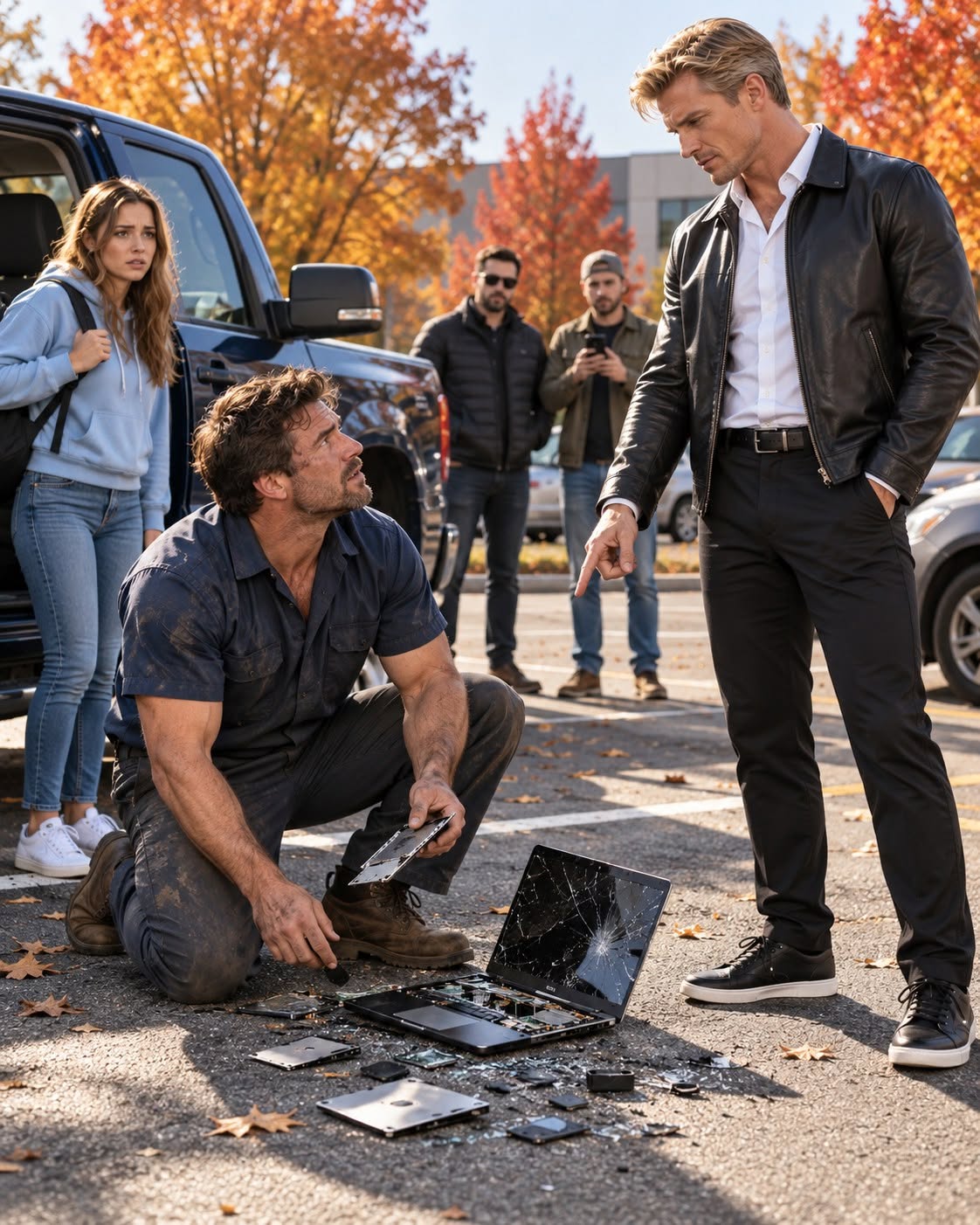
Brett Vance laughed as he smashed my daughter’s laptop against the pavement in a supermarket parking lot.
Three days later, the first crack appeared in the wall the Vances had built around themselves.
It came in the form of a phone call from an unfamiliar number just after midnight. Russell answered, listened for nearly a minute, and then looked at me with an expression I had not seen since our time in the service.
“Someone wants to talk,” he said after hanging up. “Someone who works for Colton.”
“Why now?”
“Because he thinks the people he works for are about to let him take the fall.”
The caller was a man named Wade Harlan, a mechanic who had maintained the Vance fleet for nearly eight years. I remembered him from the county garage, where he occasionally delivered parts. He had never seemed particularly friendly, but neither had he seemed like a criminal. According to Russell, Wade had been keeping quiet about defects in Colton’s trucks because he feared losing his livelihood.
Now he was frightened for a different reason.
He claimed that after I refused to falsify the maintenance reports, Colton had ordered his staff to identify every weakness they could exploit against me. Brett had volunteered to handle the intimidation. Sheriff Mercer had promised that any complaints would be buried before they reached anyone who might investigate them.
Wade also knew something about my truck.
He did not claim to have watched Brett cut the brake line himself. What he did know was that, two days before the sabotage, Brett had asked another employee where I parked and whether I usually inspected my own vehicle. The employee had laughed it off at the time. After hearing about the damaged brake line, he had stopped laughing.
“Will he testify?” I asked.
“He says he will if somebody can protect him,” Russell replied. “He won’t walk into Mercer’s office. He doesn’t trust anyone in this county anymore.”
Neither did I.
That morning, we contacted the state investigative bureau through a number Russell obtained from a former colleague. We provided a summary of the case without sending every sensitive document immediately. We requested an investigator who had no connection to Marlo Creek or its sheriff’s department, and we asked for a secure way to preserve the evidence.
Two days later, an investigator named Mara Ellis met us at a roadside diner beyond the county line.
She was in her forties, with tired eyes, a plain coat, and a notebook she kept closed while we spoke. She did not interrupt to tell us how shocking everything sounded. She did not promise that justice would be swift. When I described the brake line, she asked for the name of the independent mechanic who had inspected it, the date the truck had been towed, and the exact location of the damaged section.
When I mentioned Dylan Price, she asked whether he was a minor and whether anyone had contacted his family.
When I told her about Sheriff Mercer, she put down her pen.
“Then we need to be very careful about who learns what,” she said. “I won’t ask you to take risks to prove something you can document safely. And I don’t want you or your friend confronting anyone on our behalf.”
Russell gave a brief nod.
“That works for us.”
For the first time in months, I felt that someone was listening to the facts instead of judging the man telling them.
Investigator Ellis examined the diagnostic report, the photographs of my truck, the surviving maintenance records, the threatening messages, and the videos we had preserved. She explained that every item needed to be authenticated and that an accusation, even one that sounded convincing, was not the same as proof.
We understood.
We had no intention of turning our pain into an excuse to destroy innocent people. If we wanted the Vances to answer for what they had done, the case had to be stronger than anger.
Over the following week, the investigation widened. Ellis arranged for an independent commercial vehicle inspection and requested records through the proper legal channels. She also assigned a separate team to examine the allegations of organized car theft involving teenagers.
Dylan met with investigators and a youth advocate before giving his formal statement. He described how older men had recruited students with promises of easy money. At first, the boys were told they were only moving cars or delivering packages. Later, they learned that some of the vehicles were stolen and that asking questions could bring threats against their families.
Dylan had refused to participate after realizing what was happening. That decision had made him a target.
“I kept telling myself it wasn’t my problem,” he admitted when I saw him outside the investigator’s office. “Then I found out one of the cars they wanted me to move had been reported stolen by an elderly couple. They weren’t some insurance company. They were real people who had saved for years to buy it.”
“You did the right thing by speaking up,” I told him.
His eyes dropped to the floor.
“I should have done it sooner.”
“Maybe. But the important thing is what you choose to do now.”
He looked at me then, and I saw how young he really was. He wasn’t a hardened criminal. He was a frightened teenager who had made mistakes and finally found the courage to stop making excuses for them.
I hoped the investigators would see that distinction, too.
Meanwhile, the video of Brett smashing Sadi’s laptop continued circulating around Marlo Creek. Some people mocked me for kneeling. Others claimed I had deserved what happened because I had somehow provoked the Vances.
A few strangers sent messages calling me a coward.
I stopped reading them.
The hardest part was not the insults directed at me. It was seeing Sadi glance at her phone whenever a notification appeared, wondering whether another classmate had shared the clip.
One evening, she came into the garage where I was cleaning tools and asked if I regretted not fighting Brett.
I set the wrench down.
“Sometimes I regret how helpless I felt,” I admitted. “But I don’t regret keeping you behind me.”
“What if you had hit him? Maybe everyone would have seen that he was wrong.”
“Maybe. Or maybe they would have seen two men fighting, and the truth about why it started would have disappeared. Maybe one of his friends would have hurt you while I was looking at Brett. Maybe I would have gone to jail, and the people responsible would have used that to silence everything else.”
She was quiet for a moment.
“So you were thinking about all that?”
“I was thinking about getting you out of there alive. I didn’t have time to make a perfect decision. I had time to make one decision that gave us the best chance of getting home.”
She considered my answer, but she didn’t smile.
“I still wish you had made them stop.”
“So do I, sweetheart.”
It was important that she knew I had not been fearless. I had been afraid, angry, and ashamed of what those men had done. But none of those feelings changed what I had needed to do.
“I can’t promise I’ll always make the right decision,” I told her. “But I can promise that I will never measure my courage by how badly I can hurt someone.”
She nodded slowly, then returned to her homework.
That night, after she went to bed, I sat at the kitchen table and thought about the life we had lost since my wife’s death. I had spent years believing that if I worked hard enough, stayed honest enough, and kept my head down, I could give Sadi a safe little corner of the world.
The Vances had shown me how easily a powerful man could threaten that corner.
But they had also forced me to learn something I should have understood earlier: protecting a family does not mean pretending the world is fair. Sometimes it means asking other people to stand with you when you can no longer hold the line alone.
Our chance came from a place nobody expected.
The supermarket where Brett had destroyed Sadi’s laptop still had security footage from the parking lot. An assistant manager had preserved it after hearing about the online controversy, concerned that the viral video showed only a portion of the confrontation.
The original recording captured more than Brett breaking the computer.
It showed his men surrounding us before anyone touched the laptop. It recorded Brett demanding to know whether I had changed my mind about Colton’s maintenance records. It captured his laughter when I refused to answer, followed by the sound of the laptop striking the pavement.
Then came the moment that mattered most.
Brett leaned over me while I shielded Sadi and said, clearly enough for the camera microphone to pick up, “Maybe next time you’ll learn what happens when you cross my family.”
The manager had not wanted to become involved. His business depended on customers from every part of the county, and the Vances bought fuel and supplies locally. But when state investigators contacted him, he agreed to preserve the footage and provide a formal statement.
The recording did not prove every allegation against Colton, Brett, or Mercer. It did establish that my complaint had been more than a story told by a disgruntled mechanic.
It also undermined the edited clip that had been used to portray me as an unstable man who had started a confrontation and then collapsed.
When Ellis showed me the complete recording, I watched it once and then asked her to turn it off.
I had already lived through that moment. I did not need to witness it again.
The investigation moved faster after that.
A second mechanic agreed to explain how maintenance entries had been altered at the Vance depot. The independent inspection of several fleet vehicles identified safety defects that had been recorded as repaired without adequate evidence that the work had ever been completed. Investigators compared those records with invoices, parts orders, inspection logs, and testimony from people who had handled the vehicles.
Wade Harlan eventually agreed to cooperate under arrangements made with the investigators. His account helped establish how the company pressured employees to approve questionable records and how workers who objected were threatened with losing their jobs.
Then came the break in the storage unit.
At first, we had assumed that Brett’s men had stolen our printed files simply to frighten us. But investigators discovered evidence connecting the break-in to a vehicle associated with one of Colton’s employees. They also found messages indicating that the men had been looking for documents they believed could expose the fleet’s unsafe maintenance practices.
The thieves had taken papers, but their failure to destroy the digital copies left a traceable timeline of what they had tried to conceal.
For the first time, the Vances had a problem they could not solve by calling a friendly sheriff.
They responded the way they always had.
They came after me.
I was finishing a late shift at the small repair shop that had given me temporary work when a dark pickup rolled slowly past the entrance. It made a second pass ten minutes later. When I left to buy food, I found a folded note tucked beneath my windshield wiper.
It contained six words.
“Your daughter deserves a better father.”
My hands tightened around the paper until it crumpled.
For one terrible second, all I could think about was Brett standing in the parking lot, smiling into his phone. I wanted to find him. I wanted to make him understand exactly what it felt like to be afraid for someone you loved.
Then I remembered Sadi’s face when she had asked me to come home every night.
I photographed the note, put it in a clean envelope, and called Investigator Ellis.
She arranged for the threat to be documented and reviewed. We also strengthened our safety plan, changed a few routines, and made sure Sadi knew whom to contact if anyone approached her. We did not turn our home into a fortress, and we did not try to outsmart men who were willing to cross lines we were determined not to cross.
Two evenings later, someone tried to force open the door of our house while Russell and I were away buying supplies. Sadi was staying with a trusted neighbor, as we had arranged. A camera recorded a figure trying the lock before leaving in a waiting vehicle.
The police report was filed with the state investigators, not Sheriff Mercer.
I remember standing in my doorway afterward, looking at the scratches around the lock and thinking how easily this could have ended differently. I had worked so hard to make our house feel safe that I had begun to treat it as if safety were something the walls could guarantee.
I finally understood that protecting Sadi also meant letting trusted people help protect us.
Within days, Ellis told us that investigators had obtained enough corroborating evidence to seek search warrants for the Vance fleet yard and several related locations. She made it clear that the case was not yet won. Warrants would permit investigators to collect evidence, not declare anyone guilty.
Still, something had changed.
The Vances could no longer be certain who would answer the phone when they called for help.
On the morning the warrants were executed, Russell and I stayed away from the operation. We received updates only when investigators were ready to share them.
At the fleet yard, officials recovered maintenance files, electronic records, and vehicles requiring further inspection. Investigators also found material connecting several vehicles to the theft operation Dylan had described. At another location, they recovered communications that appeared to document efforts to intimidate witnesses and identify people who had cooperated with the investigation.
Sheriff Mercer was ordered to surrender records connected to my complaint and the handling of other reports involving the Vances. When independent investigators compared those records with dispatch logs and communications, they found discrepancies that raised serious questions about why certain complaints had gone nowhere.
Mercer was placed under investigation for suspected misconduct and obstruction-related offenses. He was later arrested after further evidence was collected.
Colton Vance was taken into custody on allegations involving fraudulent vehicle records and his alleged role in the wider criminal operation. Brett was arrested separately in connection with the assault, property damage, threats, and the developing investigation into the sabotage of my truck.
I learned about Brett’s arrest from Russell while I was standing beside a broken air compressor.
“He’s in custody,” Russell said.
I looked at him, waiting for the rush of satisfaction I had imagined so many times.
It didn’t come.
Instead, I felt exhausted. Not because I felt sorry for Brett, but because I understood how much fear and damage had accumulated before anyone finally acted.
“Does this mean it’s over?” I asked.
“No,” Russell said. “It means they have to answer questions they can’t control anymore.”
He was right.
Charges were only the beginning. Lawyers argued over records, witnesses were interviewed repeatedly, and investigators continued examining the evidence. Colton’s attorneys claimed that disgruntled former employees had fabricated a conspiracy to damage his business. Brett’s defense argued that the parking lot incident had been exaggerated online and that his other actions had been misunderstood.
The Vances still had money. They still had people willing to defend them. Their names had not suddenly lost every ounce of influence.
But they no longer controlled the investigation.
The case against Mercer became public, and several residents who had previously kept quiet came forward with complaints of their own. Some involved traffic stops and missing reports. Others described pressure to withdraw accusations against people connected to the Vance family.
Not every allegation could be substantiated. Some cases remained unresolved, and investigators refused to treat every rumor as fact. But the number of people willing to speak had grown, and the documented pattern of interference was becoming increasingly difficult to dismiss.
One afternoon, Investigator Ellis called with news about my truck.
A specialist had reviewed the damaged brake line, and the inspection findings were consistent with deliberate interference rather than ordinary wear. Investigators had also gathered evidence linking a man associated with Brett to the period when the sabotage occurred. The evidence still needed to be presented and tested in court, but the case no longer rested on my suspicion alone.
I sat down on the garage floor after the call ended.
For months, I had replayed the possibility that I might have driven Sadi down the highway with a brake system that could fail at any moment. I had imagined losing control at an intersection, reaching for the pedal, and discovering too late that somebody had decided my daughter’s life was an acceptable price for refusing to lie.
Now, at last, there were people investigating that danger as a real crime rather than treating it as an unfortunate story told by a man who had lost his job.
I covered my face with my hands and let the tears come.
Russell found me there but didn’t ask me to explain.
He simply sat beside me until I was ready to stand.
The months that followed were not a victory parade. They were hearings, depositions, financial strain, and long days spent repairing ordinary vehicles while a legal process moved at its own stubborn pace.
I was still a mechanic. I still had rent to pay. Sadi still needed school supplies, meals, and a father who could listen when her day had been difficult.
We couldn’t live forever inside the case.
So we began rebuilding the parts of our life that had nothing to do with the Vances.
A local charity provided Sadi with a refurbished laptop after learning that she had lost the computer she used for school. Her teachers helped her recover some assignments, and a classmate shared notes from projects she had missed while everything was unfolding.
Sadi accepted the replacement quietly, though I noticed the way she ran her fingers over the keyboard before opening it.
“It’s not the same,” she said.
“No,” I agreed. “But it gives you a place to start again.”
She looked at me and smiled a little.
“I think I can do that.”
The community that had once watched our humiliation began to change, too. Not everyone apologized. Some people were too embarrassed to admit that they had believed the worst. Others had genuinely feared the Vances and had convinced themselves that staying silent was the only sensible choice.
I learned not to demand that everybody explain themselves to me.
But I also learned to recognize the people who had stood up when it mattered.
The supermarket manager gave a statement. The mechanic who inspected my truck continued cooperating. A few local business owners privately admitted that they had turned me away because they were afraid of losing customers and contracts.
One of them, a man named Howard, eventually called me to offer work.
“I should’ve hired you the first time you came in,” he said. “I let fear make the decision for me.”
I studied his face for a moment.
“Are you offering me a job because the Vances are in trouble, or because you need a mechanic?”
He looked uncomfortable, but he answered honestly.
“Both, probably.”
I almost laughed.
At least he wasn’t pretending to be a hero.
“I’ll take the work,” I said. “But I’m not going to lie on an inspection report to keep a customer happy. Not for you, not for anyone.”
Howard held out his hand.
“Fair enough.”
It wasn’t a grand moment. No reporters stood outside the shop. Nobody applauded. But walking back to my truck afterward, I felt something I had not felt since the day I had refused Colton’s demand.
I felt that I could earn a living without surrendering the part of myself I needed to respect.
Eventually, the criminal proceedings began to produce real results. Colton faced charges supported by the records recovered during the investigation, the testimony of former employees, and evidence connected to the theft operation. Brett faced charges arising from the parking lot assault, the threats, and the investigation into the sabotage. Mercer faced a separate case concerning his official conduct and interference with complaints.
Their lawyers challenged the evidence, and the court required prosecutors to prove their allegations rather than rely on public outrage. Some counts were narrowed as the proceedings developed. Others were supported by stronger records and witness testimony than the defense had expected.
The cases did not depend on one brave mechanic, one frightened teenager, or one viral video. They depended on the accumulated weight of evidence.
Dylan’s cooperation proved particularly important. Investigators corroborated parts of his account through messages, vehicle records, and statements from other witnesses. His youth and his willingness to acknowledge his own mistakes became part of the picture, rather than a reason to dismiss him.
When he learned that his statement had helped move the investigation forward, he called me.
“I kept thinking I was going to ruin my life by telling them,” he said.
“What do you think now?”
He paused.
“I think staying quiet would’ve meant helping them ruin other people’s lives instead.”
I smiled, though he couldn’t see it.
“That’s a hard lesson to learn.”
“Yeah,” he said. “But I guess I learned it.”
By the time the most significant proceedings reached their conclusions, Colton’s power had shrunk considerably. His business interests faced financial and legal consequences, and he was convicted on several counts arising from the evidence presented against him. Brett was convicted on offenses connected to the assault and intimidation. Evidence relating to the brake sabotage also led to further criminal accountability for the people the investigation established were involved.
Mercer lost his position and was convicted in the separate proceedings arising from his misconduct and obstruction. Not every accusation made against every person connected to the Vances resulted in a conviction, but enough of the operation had been proven to dismantle the protection network that had allowed it to flourish.
When the final major judgment was announced, I sat in a courtroom beside Russell and listened as the result was read.
I had imagined the moment a hundred different ways. In some versions, I stood up and told the men what they had done to my family. In others, I looked directly at Brett and watched him understand that he was powerless.
In reality, I felt no desire to speak.
I thought about the defective trucks that might never make another journey. I thought about the people who had been pressured to keep quiet, the teenagers who had been used, and the families who had spent months wondering whether anyone would listen to them.
Then I thought about my wife, who had always believed that a person’s character was revealed most clearly when doing the right thing became expensive.
I wished she had been there to see what Sadi and I had survived.
Outside the courthouse, reporters gathered around people who had followed the case. A few called my name. One asked whether I felt vindicated.
I considered the word.
“I’m relieved the evidence was heard,” I answered. “But this wasn’t about proving I was tougher than Brett Vance. It was about proving that no one gets to decide which lives matter just because they have money or influence.”
Another reporter asked what I would say to anyone who had watched the original video and called me a coward.
I glanced toward the courthouse doors.
“I’d tell them they saw a few seconds of a terrible day,” I said. “They didn’t see what happened before the camera came on, and they couldn’t know what I was trying to protect. I don’t need everyone to agree with my decision. I just hope they think twice before judging a parent for choosing their child’s safety over their own pride.”
When the reporters moved on, Russell clapped me on the shoulder.
“You did all right, mechanic.”
“High praise from you.”
He laughed, and for the first time in a long while, the sound lifted something heavy from my chest.
That evening, I returned home to find Sadi at the kitchen table. My old combat photograph was beside her notebook, the same picture she had held when she asked why I had let those men hurt us.
She looked up as I entered.
“So?”
“The court made its decisions.”
“And?”
“And the people responsible are facing consequences. Some things will take longer to settle, but the investigation wasn’t buried.”
She studied my expression.
“Are you happy?”
I hung my keys on the hook beside the door and sat across from her.
“I’m relieved. I’m grateful. I’m still angry about what happened to us. I don’t think those feelings cancel one another out.”
She nodded as though she had been expecting that answer.
“Do you still wish you had fought Brett?”
The question caught me off guard. Months had passed, but she had carried it all this way, waiting for a moment when she could ask again.
I took a slow breath.
“I wish he’d never touched you. I wish I’d never had to choose between my anger and your safety. But I don’t regret keeping you out of that fight.”
She looked down at the photograph.
“I think I understand now.”
“What do you understand?”
“That you weren’t letting him win. You were trying to make sure I wasn’t the one who paid for what he did.”
My throat tightened.
“That was the idea.”
She reached across the table and took my hand, just as she had the night she asked me to come home safely.
“I was embarrassed that day,” she whispered. “I thought everyone would think my dad was weak.”
“I know.”
“But I was scared, too. And you stayed in front of me.”
I squeezed her fingers.
“I’m sorry you had to see it.”
“I’m sorry I blamed you.”
Neither of us said anything for a while. Outside, a car passed along the quiet street. The refrigerator hummed in the kitchen, and the old clock above the doorway ticked toward another ordinary evening.
It was the kind of peace I had wanted since my wife died—not the kind that came from believing nothing bad could happen, but the kind that came from knowing we could face what happened without losing each other.
Sadi eventually turned the photograph over and picked up her pencil.
“What are you working on?” I asked.
“A school essay.”
“What’s it about?”
She hesitated, then showed me the title she had written at the top of the page.
What Courage Looks Like.
I pulled my chair closer but didn’t read the page without asking.
“Want some help?”
“Maybe later. I think I know what I want to say.”
“All right.”
She bent over her notebook, and I went to the sink to wash the grease from my hands.
For months, I had thought the parking lot would remain the defining moment of our lives. I had believed the image of me kneeling beside my daughter would follow us everywhere, a permanent record of the day powerful men had humiliated us and I had failed to stop them.
I was wrong.
The recording showed what Brett had done. It did not show every decision I made afterward, every sleepless night, every careful step toward the truth, or every moment when I could have surrendered to anger and chose not to.
It showed a father on his knees.
It could never tell the whole story of why he had knelt, what he had endured to protect his child, or what he stood up to do afterward.
I still think about that day when the garage grows quiet and my hands are busy with an engine. I still remember the sound of Sadi’s laptop striking the pavement. Some wounds do not disappear simply because the people who caused them are punished.
But the memory no longer tells me that I was weak.
It reminds me that courage does not always arrive with a raised fist or a loud declaration. Sometimes it looks like restraint in the face of humiliation. Sometimes it means protecting someone who cannot protect themselves. Sometimes it means admitting that you need help, gathering the evidence, telling the truth, and refusing to let fear decide what kind of person you become.
The Vances believed power meant making other people afraid to speak.
They were wrong.
Real power was in the witness who finally told the truth, the investigator who followed the evidence beyond the reach of a corrupt sheriff, the mechanic who refused to falsify a record, and the teenager who decided that his silence was helping the wrong people.
It was in Sadi, who had every reason to lose faith in the world and still found the courage to trust her father again.
And it was in the promise I made to her, a promise that had never been about revenge.
I could not guarantee that she would never be hurt. I could not promise that every powerful man would face justice or that honesty would always be rewarded. I could only show her, through my choices, that doing the right thing was worth the cost—even when the cost was frightening, unfair, and far heavier than anyone should have to bear.
That night, after Sadi went to bed, I stood at her bedroom door for a moment and watched her sleep. Her new laptop sat on the desk beside her books. The old photograph was tucked into the frame beside her bed.
I switched off the light and walked toward the kitchen.
For the first time in months, I did not feel as if I were waiting for the next threat to arrive.
Tomorrow, I would go to work. I would repair engines, check brake lines, and make sure the vehicles entrusted to me were safe. I would pick Sadi up from school and ask about her day. I would pay what bills I could and make a plan for the ones I could not.
It was an ordinary life, still imperfect and still uncertain.
But it was ours.
And I had finally learned that the strongest thing a father can teach his child is not how to strike back at every person who causes pain.
It is how to recognize injustice without becoming unjust, how to stand firm without surrendering to hatred, and how to keep walking toward the truth even when the path is lonely.
Brett had wanted a video of a defeated man.
Instead, he had captured a father making a choice.
The rest of the story was what happened after I stood up.