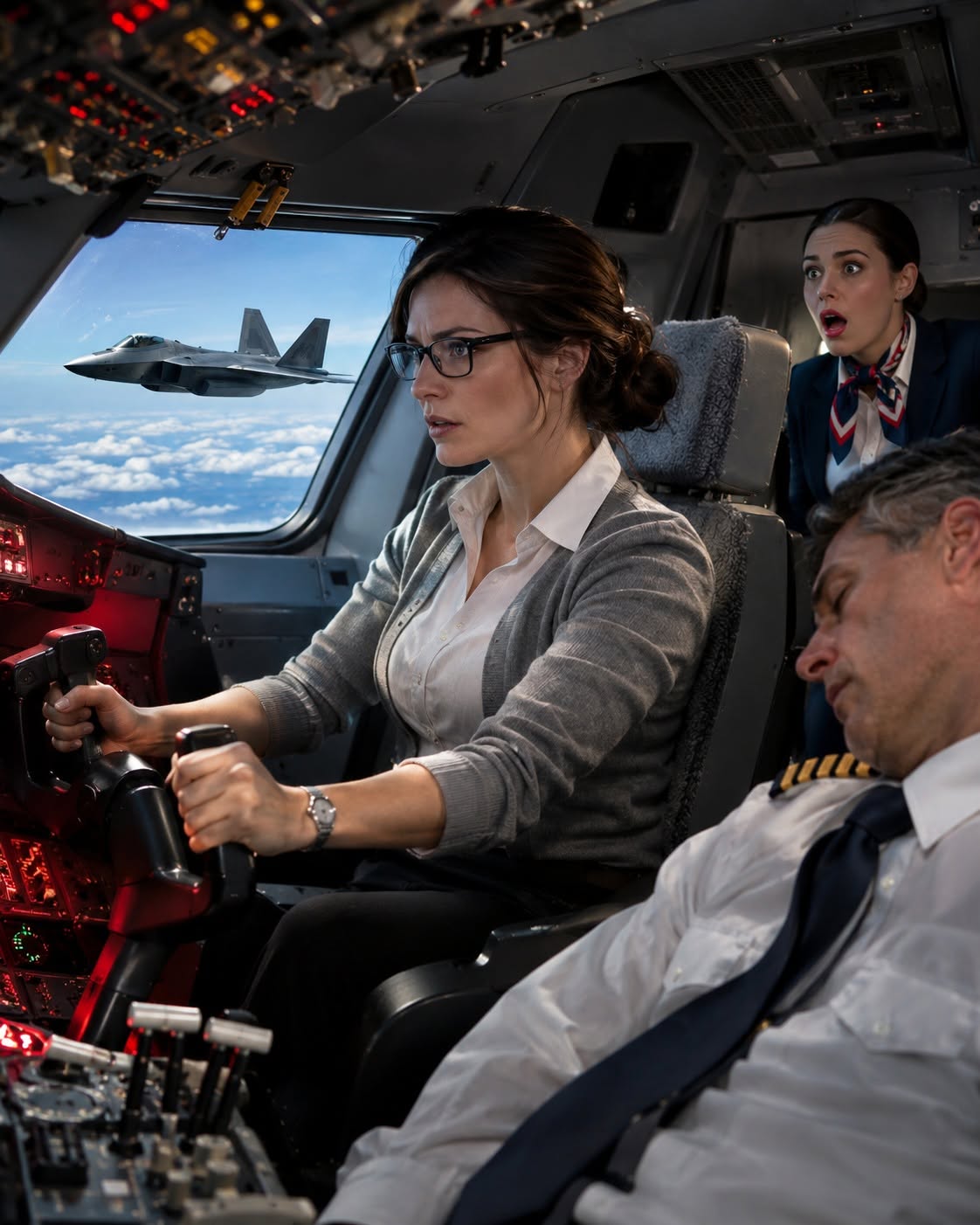
At 35,000 feet, with fifty-two people screaming behind me and the Pacific Ocean rushing toward our windshield
The Truth Behind Operation Nightfall
I stared at my trembling hands for a long time.
Twelve years ago, those hands had held the controls of an F-22 while three aircraft disappeared into a storm of fire and static. I’d spent every day since convincing myself that the past belonged to someone else.
But now Daniel’s voice had returned.
And with it, everything I’d tried to bury.
“Where in Washington?” I asked.
General Hayes glanced at Ethan.
“Joint Military Intelligence Center. We have a secure aircraft waiting.”
I shook my head.
“No.”
Hayes raised an eyebrow.
“No?”
“I have fifty-two passengers who need to be accounted for, two injured pilots who need medical attention, and a symposium tomorrow morning. I’m not disappearing into a government building because someone suddenly remembers I exist.”
For the first time, Ethan almost smiled.
“Still stubborn.”
“Still alive. I’d like to keep it that way.”
Hayes closed the folder.
“Maris, I understand your reluctance. But the recording may contain evidence of something much bigger than the mission itself.”
“Then tell me what you know.”
The general studied me.
“Twelve years ago, your squadron was assigned to Operation Nightfall. Officially, the mission involved intercepting an unidentified aircraft carrying sensitive military technology through international airspace. Your team was ordered to identify the aircraft, establish visual contact, and escort it away from a restricted maritime corridor.”
“I remember.”
“What you weren’t told was that the aircraft had already been identified.”
I frowned.
“Identified by whom?”
“By our own intelligence service. It wasn’t hostile. It was an American reconnaissance platform operating under a separate classified program.”
I felt the blood drain from my face.
“Then why were we sent to intercept it?”
“That’s what we need to establish.”
Hayes opened the folder again and pointed to a document.
“Your squadron received an amended flight path shortly before the engagement. The new coordinates directed you directly into a severe electromagnetic disturbance. Your instruments malfunctioned, communications were disrupted, and the aircraft you were supposed to intercept vanished from radar.”
I remembered the night.
The strange lights.
The impossible readings.
Daniel’s voice breaking through the radio.
And the final order.
“Break formation. Return to base.”
Except we hadn’t all returned.
“What happened to the third pilot?” I asked.
Hayes didn’t answer.
I looked at him more carefully.
“General, you told me Daniel’s recording was recovered. What about Lieutenant Noah Bennett?”
Ethan’s jaw tightened.
“His aircraft was never recovered.”
I closed my eyes.
Noah had been twenty-four.
He’d been the youngest member of our squadron, a brilliant pilot with a habit of making terrible jokes whenever the tension became unbearable.
He’d called me Professor because I used to explain the physics behind every maneuver.
I’d promised him we’d all come home.
And I’d broken that promise.
“Why are you telling me this now?”
Hayes lowered his voice.
“Because three weeks ago, someone accessed the original Nightfall archive using a credential that should have been permanently disabled.”
“Whose credential?”
He looked directly at me.
“Yours.”
For a moment, the rain seemed to disappear.
“That’s impossible.”
“Your authentication signature was used to retrieve the original flight recordings, the mission orders, and the classified communications log.”
“I haven’t touched a military terminal in twelve years.”
“We know.”
“Then someone is using my identity.”
“That’s one possibility.”
I looked at Ethan.
He wasn’t surprised.
That bothered me more than anything else.
“How long have you known?”
He hesitated.
“About the archive breach? Four days.”
“And you didn’t think to call me?”
“We couldn’t confirm whether the person responsible was inside or outside the military.”
I laughed bitterly.
“So you waited until I accidentally landed a damaged passenger aircraft on a military runway.”
“Apparently, that worked.”
I turned away.
I was tired.
Tired of secrets.
Tired of men in uniforms deciding how much truth I was allowed to know.
And most of all, tired of being afraid of a night that had happened twelve years earlier.
“Fine,” I said.
Hayes nodded.
“Good. We’ll leave within the hour.”
“Not tonight.”
“Captain—”
“Maris,” I corrected him. “My name is Maris. And I’m not going anywhere until I know those passengers are safe.”
Hayes stared at me for several seconds.
Then he nodded.
“Very well.”
He handed the folder to Ethan.
“Tomorrow morning. Eight o’clock.”
I took the folder.
“One more thing.”
“Yes?”
“If somebody is using my old credentials, I want to know who.”
Hayes gave me an expression I couldn’t read.
“So do I.”
That night, I barely slept.
I was given a small room inside the base medical facility while the injured passengers were transported to nearby hospitals.
The captain survived.
The co-pilot survived.
Every passenger made it out alive.
At 2:17 a.m., my phone buzzed.
It was an unknown number.
I almost ignored it.
Then a message appeared.
You shouldn’t have landed at that base.
My stomach tightened.
A second message followed.
Daniel didn’t die because of the weather.
I sat upright.
Before I could respond, the phone rang.
I answered without speaking.
A man’s voice came through.
“Maris?”
I recognized it immediately.
My throat tightened.
“Noah?”
There was a pause.
Then a quiet laugh.
“Hey, Professor.”
I dropped the phone.
It hit the floor, and the call ended.
For several seconds, I couldn’t move.
Noah Bennett.
The pilot whose aircraft had vanished.
The man I’d mourned for twelve years.
Alive.
Or someone knew exactly how to make me believe he was.
I picked up the phone and called Ethan.
He answered on the second ring.
“What happened?”
I could barely get the words out.
“Noah is alive.”
Silence.
Then Ethan said something that made my blood run cold.
“Maris, don’t leave that room.”
“Why?”
“Because we just found out the person who accessed your file wasn’t using your credentials.”
He paused.
“They were using Noah’s.”
The next morning, I arrived at the intelligence center at exactly eight.
Ethan was waiting outside the entrance.
He looked exhausted.
“Did you sleep?”
“Not particularly.”
“Neither did I.”
We walked through several security checkpoints before entering a windowless briefing room.
General Hayes stood beside a large display.
A woman in civilian clothing sat at the far end of the table.
She introduced herself as Dr. Evelyn Shaw, a senior investigator assigned to the Nightfall archive breach.
She looked at me with a mixture of curiosity and concern.
“Captain Vance, we need to ask you some difficult questions.”
“I’ve already answered enough questions to last a lifetime.”
“Then perhaps it’s time someone answered yours.”
She pressed a button.
A satellite image appeared on the screen.
It showed a remote stretch of the Pacific Ocean, hundreds of miles from the coast.
A small red marker blinked over the water.
“Three weeks ago, an underwater surveillance system detected a transmission from this location.”
“What kind of transmission?”
“A military emergency beacon.”
I leaned forward.
“From an aircraft?”
“From an F-22.”
My chest tightened.
“That’s impossible.”
“That’s what we thought.”
Dr. Shaw changed the display.
A second image appeared.
It showed a submerged object lying on the ocean floor.
The outline was unmistakable.
An aircraft fuselage.
The tail number was partially visible.
I knew it by heart.
Noah’s aircraft.
“How deep?” I whispered.
“Approximately two hundred and forty feet.”
“Any sign of a pilot?”
“Not yet.”
I looked at the image.
Something was wrong.
The aircraft appeared almost intact.
The wings were damaged, but the fuselage had not broken apart.
If Noah had ejected, there should have been evidence.
If he’d gone down with the aircraft, there should have been something more.
“How long has that signal been transmitting?”
“Three weeks.”
“Then someone activated it recently.”
Dr. Shaw nodded.
“Correct.”
I looked at Hayes.
“Why didn’t you tell me yesterday?”
“Because we didn’t know whether it was a trap.”
“And now?”
“Now we believe someone wants you to find it.”
The room fell silent.
I turned toward the screen.
“Who authorized the recovery?”
“No one,” Shaw replied.
“Then I’ll ask a different question. Who knows about the location?”
She glanced at her notes.
“Six people.”
“Names?”
She hesitated.
“Three are currently in this building.”
I looked around the room.
Hayes.
Ethan.
Dr. Shaw.
And me.
“Who are the other three?”
Before she could answer, the room’s lights went out.
A sharp electronic tone sounded.
The security door locked.
Ethan immediately moved toward the entrance.
“Stay back!”
The display flickered.
A new image appeared.
A dark, grainy video feed.
A man sat in a metal chair, his face partly hidden by shadows.
He lifted his head.
My breath stopped.
Noah.
Older.
Thinner.
But unmistakably Noah Bennett.
He looked directly into the camera.
“Hello, Professor.”
My hands gripped the edge of the table.
“Where are you?”
Noah smiled faintly.
“Somewhere nobody wants you to find.”
“What happened twelve years ago?”
His expression changed.
“Daniel found out the mission orders had been altered.”
I felt my pulse quicken.
“By whom?”
“By the people who wanted the reconnaissance aircraft destroyed.”
“Why?”
“Because it was carrying evidence.”
“What evidence?”
Noah leaned closer to the camera.
“Proof that someone inside our own command had been selling military technology to a foreign intelligence network.”
General Hayes stepped forward.
“Lieutenant Bennett, identify your location.”
Noah laughed.
“Still giving orders, General?”
“Your family has been notified that you may be alive. We can help you.”
“No, you can’t.”
His eyes returned to me.
“Maris, listen carefully. Daniel didn’t abandon you. He stayed behind because he knew someone had changed your navigation data.”
I remembered the final moments.
The sudden course correction.
Daniel’s warning.
The command to break formation.
“Who changed it?”
Noah’s face darkened.
“Robert Hayes.”
Everyone in the room froze.
I slowly turned toward the general.
He didn’t move.
“That’s a lie,” Ethan said.
Noah shook his head.
“I wish it were.”
Hayes reached for the communication console.
Dr. Shaw immediately stepped between him and the equipment.
“General, don’t.”
For the first time, I saw something unfamiliar in Hayes’s eyes.
Fear.
Not confusion.
Not anger.
Fear.
He looked at me.
“Maris, you need to understand something. The recording was never intended to reach you.”
“Why?”
“Because it doesn’t contain the whole story.”
Noah’s voice came through the speakers again.
“He’s telling the truth about that part.”
The screen changed.
A second video appeared.
It showed the cockpit of an aircraft twelve years earlier.
Daniel was sitting in the pilot’s seat.
His face was bruised.
Blood ran down one side of his forehead.
But he was alive.
He looked directly into the camera.
“Maris, if this recording reaches you, it means the operation has failed.”
I stepped closer.
Daniel’s voice was weak.
“The orders were changed before we took off. Someone wanted the reconnaissance aircraft destroyed, but they needed a fighter squadron to take the blame.”
He paused, struggling to breathe.
“I found the original flight plan. Your aircraft was never supposed to enter the electromagnetic zone. The coordinates were deliberately altered.”
The recording crackled.
Then Daniel said the words that shattered everything I’d believed.
“I tried to warn you. But I was told your aircraft had already been compromised.”
I covered my mouth.
Daniel continued.
“Maris, there is one thing you must never forget. You didn’t abandon us. You were the only one who tried to bring everyone home.”
The video stopped.
I couldn’t speak.
Twelve years of guilt had rested on one moment.
One decision.
One order I’d followed because I believed it came from people who knew more than I did.
And now I was learning that someone had built an entire lie around it.
“General Hayes,” I said quietly.
He looked at me.
“Did you change the flight plan?”
He didn’t answer.
“Did you?”
His shoulders dropped.
“Yes.”
Ethan took a step toward him.
“Sir?”
Hayes raised one hand.
“Don’t.”
He looked at me.
“I was given intelligence suggesting the reconnaissance aircraft had been compromised. I was told it carried a weapon system that could trigger a regional conflict if it fell into the wrong hands.”
“And you believed them?”
“I had orders.”
“That’s not an answer.”
He closed his eyes.
“No. It isn’t.”
Dr. Shaw moved toward the security console.
“General Hayes, you’re relieved of command pending investigation.”
Hayes didn’t resist.
But as two security officers entered the room, he looked at me one last time.
“There’s something else you need to know.”
I stared at him.
“Daniel was recovered alive.”
The world seemed to tilt.
“What?”
“His aircraft went down, but he survived. He was taken into custody by the people responsible for the operation.”
I grabbed the table.
“Where is he?”
Hayes lowered his head.
“I don’t know.”
For twelve years, I’d believed Daniel was dead.
Now I was being told that he might still be somewhere in the world.
And that the man who had ordered our mission had spent more than a decade hiding the truth.
The room erupted into activity.
Dr. Shaw ordered an emergency investigation.
Ethan contacted the Pacific recovery unit.
Security personnel escorted Hayes away.
I stood motionless, staring at the frozen image of Daniel.
Then the screen flickered again.
Noah’s face returned.
“Professor, there’s not much time.”
“Tell me where you are.”
“I can’t.”
“Then tell me how to find you.”
He looked over his shoulder.
Someone was approaching.
“Listen carefully. The aircraft isn’t the important part. There’s a data recorder inside the cockpit. It contains the original orders and the names of everyone involved.”
“Why didn’t you retrieve it?”
“Because the aircraft is being watched.”
“By whom?”
Noah leaned closer.
“Someone who thinks he’s still protecting the country.”
The feed began to distort.
“Maris, there’s a reason they waited twelve years to contact you.”
“What reason?”
“Because you’re the only person who can authenticate the final recording.”
The screen went black.
I looked at Ethan.
“What does that mean?”
He rubbed his forehead.
“Your aircraft carried the squadron’s encrypted mission recorder. It was designed to recognize your flight signature and voice authorization.”
“And?”
“And the final recording may be locked until you verify it.”
I stared at the screen.
“So someone needs me to open it.”
“Yes.”
“Then let’s find the aircraft.”
The recovery operation began two hours later.
A military helicopter transported Ethan, Dr. Shaw, and me to a naval vessel positioned near the signal coordinates.
I hadn’t worn a flight suit in twelve years.
The fabric felt unfamiliar against my skin.
Yet when I stepped onto the deck, I recognized the smell of saltwater, aviation fuel, and wet metal.
Memories came rushing back.
I stopped beside the railing.
Ethan noticed.
“You all right?”
“No.”
He nodded.
“Good. I’d be worried if you said yes.”
I almost smiled.
A recovery team had already prepared a remotely operated vehicle.
We watched from the operations room as the camera descended through dark water.
At two hundred and forty feet, the wreckage appeared.
Noah’s aircraft rested on the seabed.
The right wing was torn away.
The canopy was cracked.
But the cockpit remained mostly intact.
Then the camera moved closer.
A small light blinked beneath the instrument panel.
The emergency beacon.
The recovery team approached the cockpit.
Suddenly, another light appeared.
Then another.
Dr. Shaw leaned toward the screen.
“Those aren’t aircraft systems.”
“What are they?” I asked.
She studied the readings.
“Explosive charges.”
Ethan swore.
The recovery operator immediately pulled the vehicle back.
A bright flash filled the camera.
The underwater feed disappeared.
Everyone in the room went silent.
“Was that an explosion?” I asked.
“Yes,” Dr. Shaw replied.
“Is the aircraft destroyed?”
“We don’t know.”
I looked at the coordinates.
Someone had been waiting for us.
And they had known exactly when we would arrive.
My phone buzzed.
A message appeared from the unknown number.
You have one hour to leave the ship.
A second message followed.
Or Daniel dies.
I showed it to Ethan.
His expression hardened.
“We’re being watched.”
“Obviously.”
He turned to Dr. Shaw.
“Secure communications. Nobody leaves this room.”
Then he looked at me.
“Maris, I need you to stay here.”
I shook my head.
“No.”
“This isn’t a cockpit emergency. We have no idea who we’re dealing with.”
“Neither did I twelve years ago.”
“That’s exactly why I’m asking.”
I stepped closer.
“Ethan, I spent twelve years believing I killed two friends because I made one wrong decision. I’m not going to sit in a room while someone uses their lives to control me.”
He held my gaze.
Then he nodded.
“All right. But we do this carefully.”
We discovered the first clue twenty minutes later.
Dr. Shaw had been examining the recovered signal logs when she noticed something strange.
The emergency beacon hadn’t been transmitting continuously.
It had been activated for exactly eleven seconds every six hours.
A pattern.
Not a distress signal.
A message.
She isolated the intervals and converted them into a coordinate sequence.
The location was a small island roughly forty miles from our position.
Noah’s final message had been hidden inside the signal.
We launched a search helicopter.
The island was uninhabited, covered in dense vegetation and surrounded by steep cliffs.
A narrow concrete structure stood near its northern shore.
An abandoned communications station.
The helicopter landed on a flat clearing.
Ethan and two naval security officers moved ahead.
I followed Dr. Shaw toward the building.
Inside, we found old computers, rusted equipment, and a collection of military documents.
On the central desk sat a photograph.
Three young pilots.
Daniel.
Noah.
Me.
Someone had written a message on the back.
You were never supposed to come home alone.
I turned it over again.
My fingers went cold.
Beneath the photograph was a small audio recorder.
I pressed play.
Daniel’s voice filled the room.
“Maris, if you’re hearing this, then Noah succeeded.”
A long pause followed.
“I need you to know that I never blamed you.”
I closed my eyes.
“The mission was compromised before we took off. I discovered that our navigation data had been altered, but by the time I understood what was happening, the aircraft had already entered the restricted zone.”
His voice broke.
“I could have turned back. I could have saved myself. But I knew they would come after you if I didn’t stay behind.”
I swallowed hard.
“I’ve spent twelve years trying to get this recording to you. Not because I want revenge. Because I don’t want you spending another twelve years believing a lie.”
The recording ended.
I stood in silence.
Then I noticed a second device beneath the desk.
A small encrypted drive.
Dr. Shaw examined it.
“This could be the original mission data.”
“Can you open it?”
“Not without the authentication key.”
She looked at me.
“That’s why they need you.”
I picked up the device.
It was smaller than a matchbox.
Twelve years of lies, compressed into something I could hold between two fingers.
Then a voice came from behind us.
“Put it down.”
We turned.
A man stood in the doorway holding a pistol.
He was wearing civilian clothes.
His hair was gray, his face weathered, and his left hand trembled slightly.
I didn’t recognize him.
But Ethan did.
“Director Voss.”
Dr. Shaw went pale.
“You’re supposed to be in Washington.”
The man smiled.
“Apparently, I missed a meeting.”
Voss had been the director of the classified intelligence program responsible for Operation Nightfall.
He was also the person who had signed the original mission orders.
“Give me the drive,” he said.
I held it tightly.
“Where is Daniel?”
Voss shrugged.
“Still alive. For now.”
“Where?”
“Somewhere safe.”
“Safe for whom?”
His smile disappeared.
“You have no idea what you’re interfering with.”
I took one step forward.
“Then explain it.”
He raised the pistol.
“Twelve years ago, the reconnaissance aircraft carried evidence of a weapons transfer that could have destabilized an entire region. We were trying to prevent a catastrophe.”
“By sending three pilots into a compromised mission?”
“By containing a threat.”
“You destroyed their lives.”
“I made a decision.”
I looked at him.
“So did I.”
His eyes narrowed.
“What?”
“I decided twelve years ago that I wasn’t going to let another person die because someone in an office wanted to protect their reputation.”
I tossed the drive toward Dr. Shaw.
Voss turned instinctively.
Ethan moved.
The first shot struck the wall.
The second hit the ceiling.
Ethan tackled Voss to the ground, and the pistol skidded across the concrete.
The security officers rushed into the room and restrained him.
For several seconds, nobody spoke.
Then Dr. Shaw picked up the drive.
“I have it.”
I looked at Voss.
“Where is Daniel?”
He stared at me with hatred.
“You’ll never find him.”
I crouched beside him.
“Then you have nothing left to negotiate.”
His expression changed.
For the first time, he looked genuinely afraid.
“He’s in an underground facility outside San Diego,” he whispered. “They’ve been holding him there under a false identity.”
Ethan immediately called for a rescue team.
But Voss wasn’t finished.
“You’re making a mistake,” he said. “You think releasing those files will make the world safer? You don’t understand what they contain.”
I stood.
“Maybe not.”
I looked toward the open doorway.
“But I understand what happens when people are allowed to hide behind secrets.”
The rescue operation began before sunset.
Daniel was found in a small medical facility beneath an abandoned industrial complex.
He was alive.
Barely.
Twelve years of confinement had left him weak, his hair almost completely gray, and his body covered with old injuries.
But when I entered the room, his eyes found mine.
For a long moment, neither of us spoke.
Then he smiled.
“You’re late, Kestrel.”
I laughed.
It came out as a sob.
“Traffic.”
He reached for my hand.
I held it.
And for the first time in twelve years, I allowed myself to cry.
Noah was recovered two days later from a second location.
He had escaped his captors months earlier and had been hiding while trying to expose the people behind Nightfall.
He had used the emergency beacon to draw us toward the wreckage, knowing the encrypted drive would eventually lead to Daniel.
The investigation lasted nearly a year.
The original mission recordings were authenticated.
The altered flight plans were exposed.
Several senior intelligence officials were arrested, including Voss and others who had helped conceal the operation.
General Hayes cooperated with investigators.
He admitted that he had approved the amended flight plan based on fabricated intelligence, then concealed the truth when he realized the operation had been manipulated.
He was convicted of multiple charges related to the cover-up and obstruction of justice.
He never asked me to forgive him.
And I never offered.
Daniel and Noah entered long-term medical rehabilitation.
Neither returned to military service.
Neither wanted to.
As for me, I received an official letter restoring my former rank and recognizing my actions during Operation Nightfall.
I read it once.
Then I placed it in a drawer.
It wasn’t the recognition I wanted.
It was the truth.
A year after the emergency landing, I returned to Oregon.
My students had spent months asking where I’d disappeared to.
I’d told them I had a family emergency.
They accepted that explanation because teenagers are surprisingly good at understanding when an adult isn’t ready to talk.
On my first day back, I walked into the classroom carrying my usual notebook and a box of colored pens.
Someone had written on the whiteboard:
WELCOME BACK, PROFESSOR.
I stopped.
Then I noticed a second message beneath it.
IS IT TRUE YOU CAN FLY FIGHTER JETS?
The entire class looked at me.
I adjusted my glasses.
“Today we’re studying Newton’s laws.”
A student raised his hand.
“That’s not an answer.”
“No,” I replied. “It’s a lesson in priorities.”
The room erupted in laughter.
That afternoon, after the final bell, I found a package waiting on my desk.
Inside was a photograph.
Three aircraft on a runway.
The same photograph General Hayes had shown me.
But this time, someone had written something on the back.
Three pilots. One promise. We finally made it home.
It was signed by Daniel and Noah.
I sat quietly for a while.
Then I placed the photograph inside my desk drawer, beside the letter restoring my rank.
I didn’t need to forget Kestrel.
I didn’t need to become her again, either.
She had been part of me all along.
But she wasn’t the whole of me.
The following weekend, Daniel and Noah visited Oregon.
We sat together on the porch of my small house, drinking coffee and watching the rain move across the garden.
For a while, nobody mentioned the mission.
We talked about ordinary things.
Daniel complained about physical therapy.
Noah made jokes about my ancient Honda.
And I told them about a student who had somehow managed to set a classroom ruler on fire during a lesson about friction.
We laughed until our stomachs hurt.
Eventually, Daniel looked at me.
“Do you ever miss flying?”
I considered the question.
“Sometimes.”
“Would you go back?”
I watched the rain.
“Not the way I used to.”
He nodded.
“That’s probably a good thing.”
I smiled.
For twelve years, I’d believed courage meant being willing to climb into a cockpit, face impossible odds, and bring everyone home.
I understood something different now.
Sometimes courage was telling the truth when powerful people wanted silence.
Sometimes it was asking for help instead of carrying every burden alone.
And sometimes it was walking into a classroom on an ordinary Monday morning, knowing that the past had finally stopped deciding your future.
A few weeks later, my students began a project on aviation physics.
I brought in a photograph of an F-22 and explained lift, drag, thrust, and the delicate balance that kept a massive aircraft in the sky.
One student asked, “What’s the most important thing a pilot needs?”
I looked at the photograph.
Then I thought about Daniel.
Noah.
The fifty-two passengers.
And all the people whose lives had been changed by one night of lies.
“Judgment,” I said.
“More than courage?”
“Absolutely. Courage without judgment can put everyone in danger. And talent without responsibility is just another kind of weapon.”
The student wrote it down.
I turned back to the board.
Outside, the clouds were beginning to break.
A narrow beam of sunlight fell across the empty desks.
For the first time in twelve years, I no longer felt as though I were looking at the sky through the wreckage of my past.
I was simply looking at the sky.
And that was enough.
THE END