At 3:07 a.m., thirty thousand feet above the Mediterranean, my fighter jet began spinning uncontrollably toward the dark water.
I reached for the canopy release.
“Don’t touch that handle, Captain.”
The voice came from outside the cockpit.
I looked down and saw two military police officers standing beside the aircraft. One had his hand resting on his holster. The other held a pair of handcuffs.
Colonel Sterling stood several feet behind them, watching me with an expression that almost looked like satisfaction.
Almost.
“Captain, you have been ordered to shut down your aircraft and surrender government property,” he said. “You are also under investigation for disobeying a direct order, unauthorized weapons release, and the destruction of a military aircraft.”
I stared at him.
“That aircraft was destroyed before I ever took off, Colonel. You just made sure I was the one sitting inside it.”
His jaw tightened.
“Watch your words.”
“No, sir. I’ve been watching my words for six months. I’m done doing that.”
The younger military police officer stepped closer.
“Captain, please lower your hands and come out of the cockpit.”
I could feel my pulse beating against my temples. My body was still recovering from the violent maneuver over the Mediterranean. My vision blurred whenever I moved my head too quickly.
But I knew that once I handed Sterling the data cartridge, there might never be another opportunity to recover what was on it.
“Before I open this canopy,” I said, “I want confirmation that an independent Inspector General representative has been notified and is on the way.”
Sterling laughed quietly.
“You don’t get to dictate the terms of your arrest.”
“Then you shouldn’t have given me a reason to broadcast everything on an international emergency frequency.”
His smile disappeared.
For the first time, I saw something behind his eyes that hadn’t been there all night.
Fear.
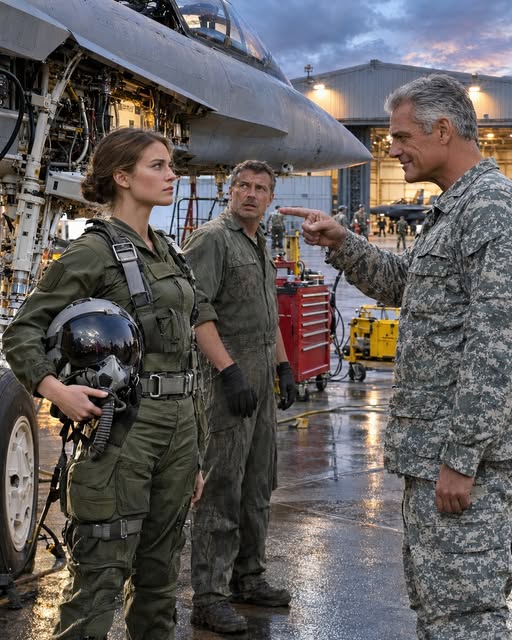
“Captain, you have no idea what you’ve done,” he said.
“I think I do.”
He turned toward the military police.
“Take him into custody. Immediately.”
One of the officers reached for the ladder.
Then a voice came through the loudspeaker near the hangar.
“All personnel, remain in position. No one is to approach aircraft 89-20104.”
Everyone stopped.
A black government vehicle had entered the flight line. Behind it came two more vehicles, followed by a white military van.
The doors opened.
A woman in civilian clothes stepped out, carrying a leather briefcase. She was in her late fifties, with silver hair pulled tightly behind her head and an expression that suggested she had spent her entire career dealing with people who thought they were untouchable.
I recognized her immediately.
Special Agent Margaret Hayes.
She was the senior investigative representative from the Department of Defense Inspector General’s office.
And she wasn’t alone.
Two federal investigators followed her, carrying sealed evidence cases.
Sterling walked toward her before she had taken three steps.
“Agent Hayes, this is a serious operational security incident. I have already initiated the appropriate disciplinary procedures.”
She didn’t even look at him.
“Colonel, step away from the aircraft.”
“Excuse me?”
“You heard me.”
Sterling glanced at the military police, expecting them to support him.
Neither officer moved.
Hayes approached my cockpit.
“Captain, are you injured?”
“Nothing that requires immediate evacuation, ma’am.”
“Are you carrying the evidence you referenced in your transmission?”
“Yes.”
“Has anyone accessed it?”
“No, ma’am.”
She nodded.
“Then leave it exactly where it is. Do not hand it to anyone until my team has documented the chain of custody.”
Sterling stepped forward again.
“Agent Hayes, you are interfering with an active military investigation.”
She finally turned toward him.
“No, Colonel. I’m preventing you from interfering with one.”
The silence that followed was almost physical.
I released the canopy.
The hydraulic mechanism struggled, then opened with a metallic groan.
As I climbed out, my legs nearly gave way. The military police officer caught my arm before I fell.
“Easy, Captain.”
I nodded, embarrassed by how badly I was shaking.
Hayes looked at my damaged flight suit, then at the aircraft.
“Get him medical attention. Now.”
Sterling raised his voice.
“He’s a security risk. He released a missile without authorization and transmitted classified information over an unsecured frequency. He should be detained immediately.”
Hayes opened her briefcase.
“Colonel, I have an emergency preservation order covering the flight records, maintenance logs, communications, and all related evidence concerning tonight’s mission.”
She removed a document and handed it to him.
“Effective immediately, you are relieved of access to the relevant records pending an independent investigation. You will surrender your command-issued communications devices and remain available for questioning.”
Sterling stared at the paper.
“This is absurd.”
“Then you should have no difficulty cooperating.”
For a moment, I thought he might refuse.
Then he slowly folded the document and handed it back.
“You’re making a serious mistake.”
Hayes gave him a cold look.
“That’s what we’re here to determine.”
I was escorted toward the medical vehicle.
As I passed Sterling, he leaned close enough that only I could hear him.
“You think you’ve won? You have no idea how many people are involved.”
I stopped.
“Then I guess the investigators have more work to do.”
He said nothing.
For the first time in months, I walked away without looking over my shoulder.
But I wasn’t free yet.
And the truth was about to become much bigger than one damaged fighter jet.
By sunrise, the story had spread through every command office connected to the Mediterranean operation.
My emergency transmission had been recorded by multiple naval communications stations. A civilian maritime monitoring facility had also captured part of it.
The audio was already being preserved by investigators.
Leo arrived at the medical facility just after six.
He looked exhausted. His flight suit was still on, and his face was covered in a thin layer of sweat and dust.
He walked straight toward my bed.
“You absolute idiot.”
I managed a weak smile.
“Good morning to you too.”
He shook his head.
“You know you nearly gave me a heart attack?”
“I wasn’t exactly enjoying myself.”
He pulled a chair beside the bed.
For several seconds, neither of us spoke.
Then his expression changed.
“Sterling called me before you landed.”
I looked at him.
“What did he want?”
“He ordered me to submit a report stating that you had ignored his abort command because you were emotionally unstable and determined to complete the mission.”
I felt my stomach tighten.
“And?”
“I told him I’d report what actually happened.”
“Which was?”
Leo looked directly at me.
“That he deliberately sent you into an aircraft we both knew was unsafe. That he tried to make you abandon an interception when you were the only pilot equipped to stop the drone. And that he sounded almost disappointed when you were still alive.”
I stared at him.
“You know that could end your career.”
He gave a humorless laugh.
“Maybe. But I’m not interested in building a career on a lie.”
I reached out and shook his hand.
It was a small gesture, but it meant more than I could explain.
Later that morning, Agent Hayes came to see me.
She placed a recording device on the table.
“Captain, we need to establish exactly what happened before your aircraft departed.”
I told her everything.
I described Sterling’s sudden grounding order, the maintenance discrepancy, Miller’s warning, and the radio exchange during the interception.
I also explained the emergency procedure I’d used to recover the aircraft.
Hayes listened without interrupting.
When I finished, she opened her notebook.
“Why didn’t you eject when Colonel Sterling ordered you to?”
I considered the question.
“Because the drone was still approaching the carrier. I believed I could recover the aircraft and complete the interception.”
“Was that decision consistent with your training?”
“Not entirely. It was an emergency decision based on a procedure I had studied. I understood the risks.”
“And you understood that your actions could result in disciplinary consequences?”
“Yes, ma’am.”
She studied me for a moment.
“Then why take the risk?”
I looked toward the window.
Beyond it, the morning sky was perfectly clear.
“Because there were thousands of people on that carrier who had no idea what was happening. They trusted us to protect them. I couldn’t abandon them simply because someone had decided my life was expendable.”
Hayes closed her notebook.
“That’s an important distinction, Captain. But understand something. Courage doesn’t automatically make every decision correct. We’ll examine your decisions just as carefully as we examine his.”
“I wouldn’t expect anything less.”
She nodded.
“Good. That’s how an honest investigation should work.”
Before leaving, she paused at the door.
“One more thing. Your report wasn’t the only evidence we found.”
I sat up.
“What do you mean?”
“We recovered a second set of maintenance records from a secure archive. They show that your aircraft had been scheduled for a routine inspection, while 89-20104 had three unresolved discrepancies.”
“Three?”
“Three documented discrepancies. Two were marked as flight-critical.”
My throat went dry.
“Who signed the clearance?”
Hayes looked down at her notes.
“Colonel Sterling.”
I closed my eyes.
For months, I had suspected him of falsifying reports.
Now there was a paper trail.
But Hayes wasn’t finished.
“There’s something else. The drone wasn’t simply an unidentified threat.”
I opened my eyes.
“What was it?”
“An experimental unmanned platform operated by a defense contractor. It had lost communication with its control station several hours earlier. Its flight path had changed unexpectedly, and its onboard systems were behaving outside their programmed parameters.”
“Was it carrying a weapon?”
“Not according to the original mission documentation. But its navigation system had been modified, and the modification was never entered into the approved technical records.”
I felt a chill move through me.
“Why was that information withheld?”
“That’s one of the questions we’re investigating.”
She gathered her files.
“Captain, I want you to understand that this investigation is no longer limited to your squadron.”
After she left, I sat alone with the realization that Sterling’s actions might have been part of something far more dangerous.
The next three days were a blur of medical examinations, interviews, and legal consultations.
My aircraft was moved into a secure hangar. Investigators photographed every damaged component, downloaded the flight computer, and preserved the maintenance records.
The data cartridge was sealed in front of witnesses.
I was allowed to review the evidence inventory, but not to access the files myself.
That was when I discovered something I hadn’t expected.
One of the files was missing.
It was the final section of my original report, containing a list of senior officers who had approved questionable maintenance certifications.
I had saved the section separately as a precaution.
Now it was gone.
I immediately informed Hayes.
She didn’t look surprised.
“Did you make another copy?”
“Yes. An encrypted copy stored outside the base network.”
“Where?”
“With my attorney.”
She nodded.
“Good. Don’t access it or transfer it without coordinating with our team.”
I hesitated.
“Agent Hayes, if the original cartridge was tampered with, how do we know the same thing hasn’t happened to the other records?”
“We don’t. That’s why we’re examining the access logs and independent backups.”
She leaned forward.
“Captain, whoever did this knew exactly what to look for. This wasn’t someone randomly deleting files.”
“You’re saying there’s another person involved.”
“I’m saying we shouldn’t assume Sterling acted alone.”
That evening, I received a message from an unknown number.
It contained only one sentence.
STOP DIGGING. YOU SURVIVED ONCE.
I read it three times.
Then I showed it to Hayes.
She immediately arranged for the message to be preserved and traced through the appropriate investigative channels.
“Don’t respond,” she said. “And don’t go anywhere alone until we know who sent it.”
I nodded.
But I couldn’t shake the feeling that someone was watching every move I made.
The following morning, Miller requested permission to speak with investigators.
He arrived carrying a thick folder.
His hands were shaking.
“I should have reported this earlier,” he said.
Hayes invited him to sit.
Miller opened the folder.
Inside were photographs, handwritten maintenance notes, and copies of work orders that had never appeared in the official aircraft records.
“I documented the failures on 89-20104,” he explained. “Every time the aircraft was returned to service, I was told to close the discrepancy. When I refused, my supervisor changed the paperwork.”
“Who was your supervisor?” Hayes asked.
Miller swallowed.
“Lieutenant Colonel Daniel Reeves.”
I recognized the name.
Reeves had been Sterling’s deputy commander.
Miller continued.
“He told me the colonel needed that aircraft available for an emergency readiness exercise. He said if I kept refusing to sign, I’d be transferred somewhere nobody wanted to go.”
Hayes examined the photographs.
“Why did you keep these?”
“Because I knew one day someone would ask why an aircraft that should never have flown was still being assigned to combat missions.”
He looked at me.
“I tried to warn you, sir. I really did.”
I shook my head.
“You did more than enough, Sergeant.”
His eyes became wet.
“I watched you climb into that cockpit. I knew something was wrong, and I couldn’t stop it.”
“You warned me. I made the decision to fly.”
“But I should have done more.”
I leaned forward.
“Then help us make sure nobody else has to face that decision.”
Miller nodded.
That was the first time I saw him look relieved since the night of the mission.
The investigation moved quickly after that.
A week later, Lieutenant Colonel Reeves was suspended from his duties.
Two days after that, investigators discovered a series of private communications between Reeves and Sterling.
The messages showed that they had discussed grounding my aircraft, transferring me to the Hangar Queen, and ensuring that I would be removed from operational duty before my scheduled Inspector General interview.
But the most disturbing message was dated three hours before my mission.
Reeves had written:
“If he returns with the report, we have a problem.”
Sterling’s response was short.
“He won’t return with anything.”
When Hayes showed me the message, I read it several times.
I wanted to feel vindicated.
Instead, I felt sick.
There had been a moment when I had wondered whether I was simply becoming paranoid. Whether the strange maintenance orders, missing reports, and sudden disciplinary threats were unrelated.
Now I knew.
Someone had made a calculated decision that my death was an acceptable outcome.
And they had nearly succeeded.
The next major development came from the naval communications recordings.
Investigators recovered the complete audio of my emergency transmission.
But they also found something else.
A second recording had been captured by Leo’s aircraft.
It contained a conversation between Sterling and an unidentified officer shortly before takeoff.
Sterling could be heard saying:
“Once he’s airborne, we let the situation resolve itself.”
The unidentified officer replied:
“And if he survives?”
There was a pause.
Then Sterling answered:
“Then we deal with him when he gets back.”
Hayes played the recording for me in a secure interview room.
When it ended, nobody spoke.
Finally, I asked the question that had been bothering me.
“Who was the other officer?”
“We’re still verifying the voice,” she said. “But preliminary analysis suggests it may be someone from the contractor’s liaison office.”
“The company responsible for the drone?”
“That’s correct.”
I leaned back.
“So this wasn’t only about readiness reports.”
Hayes folded her hands.
“We have evidence that Sterling’s office had been concealing deficiencies in the aircraft fleet. We also have evidence that he communicated with representatives connected to the drone program. Whether those activities were directly related is still under investigation.”
I stared at the recording device.
“What was he getting out of it?”
“That’s what we’re trying to establish.”
For the next month, I was placed on temporary administrative status.
My flight privileges were suspended pending the investigation. I hated every minute of it.
I had spent my entire adult life in the cockpit. Now I was sitting in offices, answering questions, reviewing documents, and watching other pilots prepare for missions I couldn’t fly.
Some people treated me like a hero.
Others treated me like a liability.
A few officers stopped speaking whenever I entered a room.
I learned quickly that surviving a dangerous mission didn’t mean everyone wanted to hear what happened.
Then came the formal hearing.
It was held in a secure military facility in Germany, with representatives from the Air Force, the Inspector General’s office, and the Department of Defense.
Sterling arrived in a dark uniform, his decorations perfectly arranged.
He looked older than I remembered.
But he still carried himself like a man accustomed to being obeyed.
When I entered the room, he glanced at me.
For a moment, our eyes met.
He gave me a faint smile.
I didn’t return it.
The hearing began with questions about my conduct.
Why had I accepted an aircraft with known discrepancies?
Why had I continued toward the target after receiving an abort command?
Why had I used an emergency recovery procedure that was not authorized for routine operational use?
Why had I transmitted information over an international emergency frequency?
I answered every question honestly.
I did not pretend I had made perfect decisions.
I admitted that I had taken extraordinary risks. I acknowledged that my actions would require careful review.
But I also explained the circumstances surrounding each decision.
Then Sterling’s attorney stood.
“Captain, isn’t it true that you had a personal dispute with Colonel Sterling?”
“No, sir.”
“Isn’t it true that you were preparing a report intended to damage his career?”
“I was preparing a report documenting irregularities in squadron maintenance and readiness records.”
“Which you intended to submit to the Inspector General?”
“Yes.”
“So you had a personal motive to embarrass him.”
I looked at the attorney.
“Reporting falsified safety records isn’t a personal dispute.”
He frowned.
“Please answer the question.”
“I just did.”
A few people shifted in their seats.
The chairman instructed everyone to remain professional.
Then the prosecution introduced the maintenance records.
Miller testified about the unresolved failures.
Leo testified about Sterling’s radio instructions.
Investigators presented the communications logs and the recovered messages.
Finally, they played the recording.
“He won’t return with anything.”
Sterling’s expression changed.
For the first time, his carefully controlled face cracked.
His attorney requested a recess.
The hearing was suspended for forty minutes.
When it resumed, Agent Hayes entered carrying a new evidence file.
She approached the chairman and handed him a document.
“Additional evidence has been recovered from a contractor-controlled communications archive,” she said. “It includes financial records and correspondence that materially affect the scope of this investigation.”
Sterling stood abruptly.
“Objection. This is outside the scope of the hearing.”
The chairman looked at him.
“Colonel, sit down.”
Hayes continued.
The documents showed that Sterling had approved false readiness certifications in exchange for undisclosed financial benefits routed through an intermediary.
The contractor had been awarded a series of maintenance and modernization contracts based partly on those certifications.
In other words, the readiness numbers had not simply been exaggerated to protect Sterling’s reputation.
They had helped conceal a financial arrangement.
And the drone program had become entangled in the same network.
The contractor had received approval to test a modified navigation system under operational conditions. The modification had not been properly disclosed to the carrier group.
When the drone lost communication, its unexpected flight path brought it dangerously close to the USS Gerald R. Ford.
The evidence did not establish that Sterling had deliberately caused the drone to malfunction.
But it showed that he had concealed information that could have helped prevent the incident.
His decision to assign me to the defective aircraft had another consequence.
If I died, the report connecting the maintenance irregularities to his office would likely disappear before anyone understood its significance.
Sterling stared at the table.
The chairman called a recess.
This time, nobody spoke to him.
The case took several more months to conclude.
During that time, investigators interviewed dozens of personnel, examined financial transactions, and reviewed thousands of pages of operational records.
I returned to Aviano only once, to provide additional testimony.
The base felt different.
The same runways were there. The same hangars. The same mountains in the distance.
But the people had changed.
Some were relieved.
Some were angry.
Others were frightened that the investigation might expose mistakes they had made under pressure.
I understood that fear.
Not everyone involved had been corrupt. Some had simply followed instructions because they believed questioning a senior officer would destroy their careers.
But silence had allowed the problem to grow.
And eventually, silence had put an entire aircraft and its pilot in danger.
The final report was released seven months after the incident.
Its findings were devastating.
Colonel Arthur Sterling was formally relieved of command and referred for criminal prosecution on charges related to fraud, conspiracy, and the falsification of official records.
Lieutenant Colonel Reeves received disciplinary action and was charged in connection with the altered maintenance documentation.
Several contractor executives were also indicted.
The military issued corrective orders requiring independent verification of aircraft readiness certifications and stronger protections for personnel reporting safety violations.
The drone program was suspended until its navigation and communication systems could be independently reviewed.
But the report also addressed my conduct.
The investigators found that my decision to continue the interception after receiving the abort command had violated established operational procedures.
They also concluded that my emergency transmission had exposed information that should have been handled through protected channels.
However, the board determined that the circumstances surrounding the mission, the imminent threat to the carrier, and the documented failures in command decision-making substantially mitigated my actions.
I received a formal reprimand for the unauthorized transmission.
My flight privileges were restored after additional evaluation and retraining.
I was not declared innocent of every mistake.
I wasn’t declared guilty of causing the crisis either.
For the first time, I felt that the investigation had reached a conclusion based on evidence rather than rank.
A few weeks later, I received a letter from the commanding officer of the carrier group.
It was addressed simply:
To the pilot who came home.
Inside was a photograph of the USS Gerald R. Ford at sea.
Beneath it, hundreds of sailors had signed their names.
Some had written short messages.
Others had written only a few words.
One message caught my attention:
“We never knew how close we came. Thank you for bringing us home.”
I sat with that photograph for a long time.
Then I placed it beside my desk.
Not as a reminder that I was a hero.
As a reminder of what the job was supposed to mean.
Nearly a year after the incident, I returned to the flight line.
The first time I walked toward a new aircraft, I stopped beside the cockpit and rested my hand on its fuselage.
I remembered Miller’s warning.
I remembered Sterling’s voice.
And I remembered the moment the engine came back to life above the Mediterranean.
Leo was standing nearby.
“Ready to fly again?”
I looked at him.
“Ask me after the first landing.”
He laughed.
Miller had been promoted to a position overseeing aircraft maintenance standards. He was now responsible for helping develop a system in which ground crews could report flight-critical discrepancies directly to independent safety officers without fear of retaliation.
When I saw him at the hangar, he handed me a small metal plaque.
It had been made from a piece of recovered aluminum from 89-20104.
Three lines were engraved on it:
TRUTH DOES NOT REQUIRE PERMISSION.
COURAGE DOES NOT REQUIRE RANK.
AND NO MISSION IS WORTH A LIFE BUILT ON LIES.
I ran my fingers across the words.
“Where did you get this?”
“Had it made,” Miller said. “Figured someone should remember what happened.”
I smiled.
“Thank you, Sergeant.”
He shook his head.
“Thank you for listening that night.”
I wanted to tell him that I hadn’t been brave enough to deserve the gratitude.
That I had been terrified.
That there had been several moments when I had seriously considered ejecting.
But perhaps that was exactly what courage meant.
Not the absence of fear.
The decision to do what was right while fear was still there.
A few months later, I was invited to speak to a group of newly assigned pilots.
They expected a story about the interception, the emergency recovery, and the missile strike.
Instead, I began with a question.
“How many of you believe that following orders is the most important part of being a military officer?”
Every hand went up.
I nodded.
“Good. Now let me ask you something else. What happens when the person giving the order is the one putting everyone at risk?”
Nobody answered immediately.
I walked toward the front of the room.
“Discipline matters. The chain of command matters. Trust matters. But none of those things should ever become excuses for ignoring the truth.”
I told them about 89-20104.
About the crew chief who had tried to stop a dangerous launch.
About the wingman who refused to falsify his report.
About the investigators who insisted on preserving evidence even when powerful people wanted it destroyed.
And about a commander who believed that rank could make him untouchable.
Then I told them something I had learned during the investigation.
“Don’t wait until someone is trying to kill you to start documenting what is wrong. Don’t assume that everyone knows what you know. And never mistake silence for loyalty.”
After the presentation, a young lieutenant approached me.
“Sir, can I ask you something?”
“Of course.”
“If you could go back to that night, would you still get into that aircraft?”
I thought about the question.
I remembered the warnings. The damaged systems. The spinning horizon. The dark water rushing toward me.
I remembered Leo shouting over the radio.
And I remembered the sailors aboard the carrier, unaware that their lives depended on a decision being made thousands of feet above them.
“I would still try to protect those people,” I said. “But I would also make sure the people responsible for the aircraft’s condition were exposed before the mission ever began. No pilot should have to choose between protecting innocent lives and protecting their own.”
The lieutenant nodded slowly.
“That makes sense, sir.”
I placed a hand on his shoulder.
“One more thing. Never let anyone convince you that questioning an unsafe order makes you disloyal. Sometimes, the most loyal thing you can do for your unit is refuse to let it destroy itself.”
He thanked me and walked away.
That evening, I returned to my office.
The photograph from the carrier was still beside my desk. Next to it sat the small plaque Miller had made.
I looked at both for a long time.
For months, I had believed that surviving that night was the hardest thing I would ever do.
I was wrong.
The hardest part had been telling the truth when I knew it could cost me everything.
There had been no dramatic applause when the investigation ended. No perfect moment when everyone admitted they had been wrong. Some people apologized. Others never did. A few continued to believe that I should have kept my mouth shut.
I learned to live with that.
Because justice doesn’t always arrive with a clean ending, and doing the right thing doesn’t guarantee that everyone will understand why you did it.
But I also learned that one honest voice can give others the courage to speak.
Miller spoke.
Leo spoke.
Investigators followed the evidence.
And eventually, the truth became too large for anyone to bury.
Sometimes, when I fly over the Mediterranean at night, I glance toward the dark water below.
I remember the moment the aircraft began spinning.
I remember the order to eject.
And I remember the voice inside my helmet telling me that I had one final decision to make.
I used to think the most important moment of my life was when the engine restarted.
Now I know it was the moment I chose not to let fear silence me.
Because a uniform does not make someone honorable.
A rank does not make someone right.
And obedience, without conscience, can become another form of cowardice.
I still serve.
I still fly.
And I still believe in the mission.
But I no longer believe that protecting an institution means protecting the people who abuse it.
Real loyalty means protecting the people who depend on you, even when doing so makes powerful enemies.
If I could leave every young pilot with one lesson, it would be this:
Never confuse keeping your head down with keeping your honor.
The night I nearly died above the Mediterranean, I thought I was fighting to save a carrier full of sailors.
I was.
But I was also fighting for something that mattered long after the missile struck its target.
The right of ordinary people to tell the truth, even when the person standing against them has more power, more medals, and more authority.
And if that truth costs you something, remember this:
A career can be rebuilt.
A reputation can be restored.
Even a damaged aircraft can be replaced.
But once you surrender your conscience to someone else’s ambition, getting it back may be the hardest mission of all.
I survived the flight. I survived the investigation. And in the end, I learned that the greatest victory wasn’t bringing the aircraft home.
It was making sure that no one else would have to climb into that cockpit knowing the truth had already been buried.