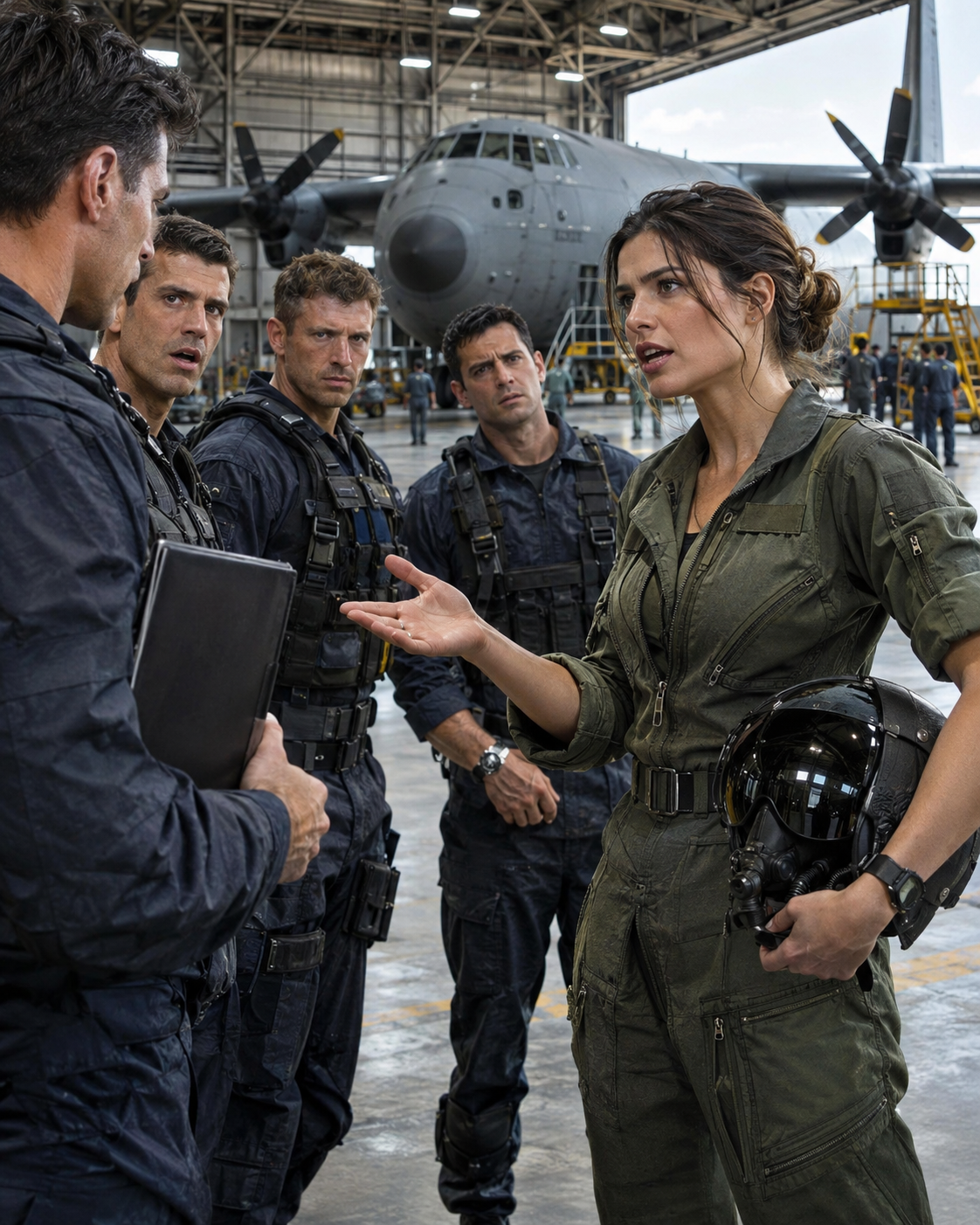
At 22:17, inside Hangar 4 at Forward Operating Base Kestrel, a SEAL commander was begging for an AC-130 pilot
The morning after the mission, I received an order to report to the operations building at 0800.
I had barely slept.
Every time I closed my eyes, I saw the school bus from eighteen months earlier. I heard the commander’s voice ordering me to proceed. I remembered the silence that followed my refusal.
But this time, there was something different.
I wasn’t walking into that building alone.
Commander Sterling was waiting outside the briefing room when I arrived. Beside him stood Lieutenant Reins, Master Sergeant Callaway, and a woman in a dark blue uniform whom I recognized from headquarters.
Colonel Evelyn Hart.
She was the officer who had signed the paperwork suspending my flight privileges.
“Captain,” she said, her voice formal. “Come inside.”
I followed them into the room.
A large screen displayed the mission report from the previous night. Three photographs showed Raymond Solis and the two other intelligence officers after their extraction. Solis was lying in a hospital bed, but he was alive.
Colonel Hart gestured toward an empty chair.
“Before we discuss your future, I want to discuss something that happened eighteen months ago.”
My stomach tightened.
“I assume you’ve reviewed my disciplinary record, ma’am.”
“I have. I’ve also reviewed your flight history, your mission reports, and the investigation that followed your refusal to execute that strike.”
She paused.
“There’s something you should know. The original investigation was never completed.”
I looked up.
“What do you mean?”
“Several documents were classified beyond the review board’s access. The officer who authorized the strike was subsequently reassigned. The intelligence assessment supporting the target identification was never independently verified.”
Sterling leaned forward.
“So she was punished without anyone establishing whether her decision was wrong?”
Colonel Hart didn’t answer immediately.
“That’s one way to describe it.”
“No,” I said quietly. “It’s the accurate way to describe it.”
For the first time, Colonel Hart looked uncomfortable.
She changed the display.
A photograph appeared on the screen.
It was an aerial image of the village from my old mission. The road, the school, and the building identified as the hostile command center were all visible.
Then another photograph appeared.
A school bus.
My hands went cold.
“Where did you get that?”
“From a civilian intelligence archive that was recently declassified for internal review,” she answered.
I stared at the screen.
The bus was the same one I’d seen eighteen months earlier.
But there was something I hadn’t noticed during the original mission.
A small white marking on its side.
The symbol of the local medical relief organization.
Colonel Hart continued.
“An independent investigation conducted several weeks after your mission established that the building designated as the target was being used as a temporary communications center by an armed group. However, the school bus was carrying children and two teachers. It was traveling toward a medical evacuation point.”
I closed my eyes.
For eighteen months, I’d wondered whether I’d made the right decision.
Now I had an answer.
“Did anyone get hurt?” I asked.
“Not during that operation.”
I exhaled slowly.
Not because the information made me feel victorious.
Because a group of children had gone home that day.
And I had been allowed to live with that knowledge, even if nobody had bothered to tell me.
Sterling folded his arms.
“Then why wasn’t her record corrected?”
Colonel Hart looked toward the window.
“Because the investigation also uncovered something more complicated.”
She brought up another document.
The original strike authorization had been signed by a senior intelligence officer named General Nathaniel Voss.
I recognized the name immediately.
He had been the operational commander eighteen months earlier.
“General Voss retired six months ago,” Hart said. “But before his retirement, he authorized several mission assessments that are now under review.”
“Why?” Reins asked.
“Because the school bus incident wasn’t the only questionable intelligence assessment.”
The room became silent.
“There were at least four other operations where pilots reported discrepancies between the assigned targets and what they observed from the air. In two cases, personnel requested additional verification. Those requests were denied.”
My heart began beating faster.
“Did they refuse?”
“One pilot complied. Another requested an immediate diversion. The third never filed a formal complaint.”
Sterling stared at the screen.
“How many civilians?”
“We don’t have a confirmed number yet.”
I looked at Colonel Hart.
“Then this isn’t about my flight privileges.”
“No,” she replied. “It isn’t.”
She closed the document.
“It’s about whether our people can trust the information they’re given, and whether they’re allowed to speak when something doesn’t make sense.”
I sat back.
For eighteen months, I’d believed my career had ended because I’d made a decision nobody wanted to defend.
Now I was beginning to understand that the decision had exposed something much larger.
Colonel Hart placed a folder on the table.
“Captain, your temporary flight authorization has been restored pending a formal review. However, I need to ask whether you’re willing to participate in the investigation.”
I looked at the folder but didn’t touch it.
“What would that involve?”
“Testifying about the original mission, reviewing the other incident reports, and helping us establish a better process for identifying discrepancies during operations.”
Sterling spoke before I could answer.
“She should be in the cockpit, not buried in another office.”
I almost smiled.
Colonel Hart gave him a sharp look.
“Commander, nobody is assigning her anywhere until this review is complete.”
Then she turned back to me.
“This is your decision, Captain.”
I thought about the previous night.
The three intelligence officers.
The wounded man being carried toward the extraction vehicle.
The crew who had trusted me to bring them home.
I finally opened the folder.
“I’ll help.”
Three weeks later, the investigation became public within the military command structure.
It was not a dramatic announcement. There were no speeches or reporters waiting outside headquarters.
Just a formal notice establishing an independent operational review.
But behind closed doors, things were moving quickly.
My old flight records were being examined. The original mission recordings had been recovered. Several former crew members had been contacted.
And then I received a call from someone I hadn’t spoken to in eighteen months.
Lieutenant Daniel Mercer.
He had been my co-pilot during the mission when I refused the strike.
I remembered him sitting beside me, staring at the coordinates while command repeated the order.
He had remained silent when I refused.
At the time, I’d interpreted his silence as disagreement.
Now his voice sounded different.
“Captain, I heard they’re reopening the investigation.”
“That’s correct.”
“I need to tell you something.”
I sat down.
“Go ahead.”
“I supported your decision.”
I didn’t speak.
“I wanted to say it during the original inquiry, but I was told my testimony would compromise my future assignments. They said you had acted emotionally and that the command decision had already been reviewed.”
My throat tightened.
“Why are you telling me now?”
“Because I kept thinking about that bus.”
He paused.
“I’ve got two kids. Every time I drive past a school, I remember that night. And I know I would have wanted someone to stop if my children had been on that road.”
I looked down at my hands.
“Daniel, you don’t owe me anything.”
“Maybe not. But I owe the truth to the people who were there.”
That afternoon, Mercer submitted a formal statement.
He wasn’t the only one.
Over the next several days, four more personnel came forward.
Some had witnessed questionable targeting decisions. Others had been pressured to modify reports or avoid documenting disagreements.
One maintenance officer even provided an archived message showing that an intelligence discrepancy had been identified before the original mission.
The message had never reached the flight crew.
The investigation was no longer simply reviewing my actions.
It was examining the entire chain of decisions that had led to them.
Then came the moment I hadn’t anticipated.
I received an invitation to meet Raymond Solis.
He was recovering at a military medical center, and Sterling had told him about the investigation.
When I entered his room, he was sitting upright, reading a book.
His right arm was still in a sling.
“Captain?” he asked.
“Yes.”
He closed the book.
“I wanted to thank you.”
I shook my head.
“You don’t have to do that.”
“I know. But I want to.”
He gestured toward the chair.
“Commander Sterling told me you were the pilot who kept the air support in place while they reached me.”
“I was part of a crew.”
“That’s not what he said.”
I sat down.
Solis studied me for a moment.
“Can I ask you something?”
“Of course.”
“When you were flying over the compound, did you ever consider leaving?”
I thought about it.
“Several times.”
“Why didn’t you?”
“Because your team was still down there.”
He nodded slowly.
“My daughter is twelve. Before I deployed, she gave me a little drawing. It was a picture of our family standing in front of our house.”
He smiled faintly.
“She told me not to be a hero. She told me to come home.”
I didn’t know what to say.
“I was thinking about that drawing when I was lying on the ground. I thought I’d never see her again.”
His eyes became wet.
“Then I heard someone on the radio say the aircraft was still overhead.”
He looked directly at me.
“That was you.”
I felt something shift inside my chest.
For eighteen months, I’d measured my worth by what I’d lost.
My position.
My reputation.
My place in the cockpit.
But this man was sitting in front of me because a crew had done its job and refused to abandon him.
I finally understood that my career wasn’t the only measure of whether I had made a difference.
“How’s your daughter?” I asked.
“She wants to know why I have a scar.”
I laughed softly.
“What did you tell her?”
“That I tripped.”
We both laughed.
For a few seconds, the room felt lighter.
Then he reached toward the bedside table and picked up a folded piece of paper.
It was a child’s drawing.
Three figures standing in front of a small house.
He placed it in my hand.
“She made another one after she heard I was coming home. I think you’d understand why I wanted you to see it.”
I looked at the drawing for a long time.
“Thank you,” I whispered.
When I left the hospital, I sat in my vehicle for nearly ten minutes before starting the engine.
I had spent eighteen months believing I needed to prove I deserved to fly again.
But perhaps the real question was whether I still understood why I had wanted to fly in the first place.
The answer was becoming clearer.
Then, just when I thought the investigation was finally moving toward a conclusion, everything changed.
On a Thursday morning, Colonel Hart summoned me to headquarters.
Her expression was serious.
“Captain, we received a new statement overnight.”
She slid a document across the table.
It came from a former intelligence analyst who had worked directly under General Voss.
According to the statement, the original target coordinates from eighteen months earlier had been changed shortly before the mission.
The analyst claimed the revised coordinates had been approved without a complete civilian assessment.
I read the document twice.
“Who authorized the change?”
Colonel Hart pointed to a signature.
General Voss.
But there was another name beneath it.
Colonel Adrian Pike.
My former squadron commander.
The man who had recommended my administrative reassignment.
I felt the room tilt slightly.
“Pike knew?”
“That’s what we’re trying to establish.”
I looked at Hart.
“Why would he keep that information from the investigation?”
“That’s a question we’re going to ask him.”
Two days later, I was called to testify.
The hearing took place in a secure conference room with senior officers, legal representatives, and investigators seated around a long table.
Colonel Pike sat at the far end.
He looked older than I remembered, but his expression was unchanged.
When my testimony began, he listened without interrupting.
I explained what I’d observed during the original mission. I described the bus, the discrepancy in the intelligence briefing, and the repeated orders to proceed.
Then the legal officer asked the question that had followed me for eighteen months.
“Captain, did you refuse the order because you believed the target identification was incorrect?”
“Yes.”
“Did you understand that refusing the order could result in disciplinary action?”
“Yes.”
“Did anyone threaten your career?”
I glanced at Colonel Pike.
“Not directly during the flight.”
The legal officer looked down at his notes.
“Then what happened afterward?”
I described the administrative reassignment and the suspension of my flight privileges.
I explained how my records had been altered to emphasize the disciplinary decision rather than the circumstances that led to it.
Then Pike finally spoke.
“Captain, with respect, you were not in a position to understand the broader operational picture.”
I turned toward him.
“Sir, I was in a position to see the school bus.”
A few people around the table shifted in their seats.
Pike leaned forward.
“You were given a direct order.”
“And I requested verification.”
“You were expected to trust the intelligence assessment.”
“I did trust it. Until what I saw contradicted it.”
“That’s not how military operations work.”
I took a breath.
“Then perhaps that’s exactly what needs to change.”
The room went silent.
Pike’s face tightened.
“Are you suggesting that every pilot should ignore command whenever they disagree with an assessment?”
“No, sir. I’m suggesting that when someone identifies a credible risk to civilians, there must be a way to stop and verify the information before irreversible action is taken.”
The legal officer raised his hand.
“Captain, one final question. If you were placed in the same situation again, would you make the same decision?”
I didn’t hesitate.
“Yes.”
“Even if it cost you your career?”
I looked around the room.
“Especially then. A career can be rebuilt. The lives lost because someone was afraid to question an order cannot be brought back.”
Nobody spoke for several seconds.
Then Colonel Hart asked for a recess.
When I stepped into the hallway, Sterling was waiting.
He had attended the hearing as an observer.
“How do you feel?”
“Like I just walked through a wall.”
He smiled.
“Good. Sometimes that’s what it takes.”
I looked back toward the conference room.
“Do you think they’ll believe me?”
Sterling’s expression became serious.
“I think the evidence will speak louder than any of us.”
The final report was released eleven days later.
It confirmed that the original intelligence assessment had contained significant errors. It also established that the concerns raised by the flight crew had not been properly documented or investigated.
General Voss’s authorization had violated several internal verification requirements.
Colonel Pike had received information about the targeting discrepancy before the mission and had failed to forward it to the review board.
Both men were referred for further administrative and legal proceedings.
The report also found that my refusal to execute the strike had been justified under the circumstances.
My disciplinary record was corrected.
My flight privileges were fully restored.
But the most important part of the report wasn’t about me.
It established a new review process that allowed aircrews to formally challenge questionable targeting information without automatically facing career-ending consequences.
It required additional documentation when a crew identified possible civilian presence.
And it made clear that operational urgency could not replace reasonable verification.
When Colonel Hart delivered the decision, she offered me a handshake.
“Captain, on behalf of the command, I apologize for what happened.”
I accepted her hand.
“Thank you, ma’am.”
She hesitated.
“I know an apology doesn’t give you back eighteen months.”
“No,” I said. “It doesn’t.”
“Is there anything we can do?”
I thought about the pilots who had remained silent because they feared what would happen if they spoke.
“Make sure the next person who raises a concern gets heard before it’s too late.”
She nodded.
“I’ll make sure that recommendation is included in the final implementation review.”
That evening, I returned to Hangar 4.
The same hangar where, several weeks earlier, armed operators had laughed when I offered to fly the Ghost Rider.
The aircraft stood beneath the overhead lights.
Callaway was checking a maintenance panel when he noticed me.
“Well, look who finally got her wings back.”
I smiled.
“Looks like it.”
He wiped his hands on a cloth.
“Got a flight assignment yet?”
I shook my head.
“Not officially.”
“Then you’d better talk to Sterling. He’s been asking about you.”
I walked toward the office.
Commander Sterling was standing over a mission board with Delgado and Chen.
When he saw me, he smiled.
“Captain. I was beginning to think headquarters had forgotten how to process paperwork.”
“They remembered eventually.”
He pushed a folder across the desk.
Inside was a proposed assignment to the flight operations training program.
I looked up.
“Training?”
“Temporary instructor position. You’ll continue flying, but you’ll also help develop the new operational review procedures.”
I studied the document.
“I thought you wanted me in the cockpit.”
“I do.”
He leaned against the desk.
“But I’ve learned something. A good pilot can save people during a mission. A good instructor can help prevent the mistakes that put them in danger.”
I turned another page.
There was a second assignment.
A permanent flight qualification review.
My name appeared beside the position of aircraft commander candidate.
I looked at Sterling.
“Are you serious?”
“Dead serious.”
I couldn’t help smiling.
“You’re going to regret this.”
“Probably. But not tonight.”
The next morning, I returned to the flight line.
The Ghost Rider was scheduled for a routine training sortie.
Delgado was already waiting near the aircraft.
He looked at my uniform, then at the flight insignia.
“About time.”
Chen appeared behind him.
“Try not to get sentimental. We have a checklist to finish.”
I laughed.
The three of us climbed aboard.
As I settled into the cockpit, my fingers rested briefly on the controls.
I remembered the first time I’d flown a C-130.
I remembered the excitement of takeoff, the fear of my first difficult landing, and the pride of bringing a crew home safely.
Then I remembered eighteen months behind a desk.
I had thought that period of my life had been wasted.
But it had taught me something the cockpit never could.
How easily a person’s silence could be mistaken for agreement.
How quickly a system could turn a difficult question into a disciplinary problem.
And how important it was to protect the people who were willing to speak up.
The engines started.
The familiar vibration traveled through the seat.
“Captain,” Delgado said, “ready?”
I looked through the windshield.
The runway stretched ahead.
“Ready.”
We received clearance and began our takeoff roll.
As the aircraft lifted into the morning sky, the base became smaller beneath us.
For the first time in eighteen months, I wasn’t thinking about what I’d lost.
I was thinking about where we were going.
Six months later, I received an invitation to speak at a military aviation safety conference.
I almost declined.
I wasn’t particularly comfortable standing in front of a room full of people and talking about myself.
But Sterling convinced me.
“Don’t make it about your career,” he said. “Make it about the people who might never get a chance to tell their story.”
So I accepted.
The conference was held in a large auditorium filled with pilots, intelligence officers, commanders, and maintenance personnel.
When I stepped onto the stage, I recognized several faces from the investigation.
I placed my notes on the podium.
For a moment, I looked across the audience and remembered the laughter in Hangar 4.
Then I began.
“Eighteen months ago, I was told to carry out a mission that didn’t make sense to me. I saw something that contradicted the information I’d been given. I asked for clarification. I asked for more time. And when those requests were denied, I refused to proceed.”
I paused.
“Some people called that insubordination. Others called it a failure of discipline.”
I looked toward the back of the auditorium.
“But the truth is that the most important responsibility I had that night wasn’t to protect my rank, my record, or my future. It was to make sure that the decisions made in that cockpit didn’t cost innocent people their lives.”
Nobody moved.
“I want to be clear about something. Military discipline matters. Trust matters. Following lawful orders matters. But responsibility doesn’t disappear simply because someone higher in the chain of command makes a decision.”
I let the words settle.
“Every person in this room has a responsibility to speak when something is wrong. Not because we’re always right, but because silence can make a preventable mistake impossible to correct.”
When I finished, the auditorium remained quiet for a moment.
Then someone began clapping.
A few seconds later, the entire room joined in.
I didn’t feel like a hero.
I felt relieved.
After the conference, a young female lieutenant approached me.
She couldn’t have been more than twenty-six.
“Captain, can I ask you something?”
“Of course.”
She looked nervous.
“What if you’re right about something, but nobody believes you?”
I studied her face.
It was the same uncertainty I’d once seen in my own reflection.
“Document what you observe. Ask questions. Use the proper channels. Find people who will listen. And never confuse being afraid of the consequences with being wrong.”
She nodded.
“But what if I lose everything?”
I smiled gently.
“Then make sure you haven’t lost the reason you started.”
She thanked me and walked away.
I watched her disappear into the crowd.
For a moment, I wondered whether she would ever face the same decision I had.
I hoped she wouldn’t.
Because the purpose of what we’d gone through was not to create more stories like mine.
It was to make sure fewer people ever had to experience them.
A year after the night at Kestrel, I was assigned to command a training flight for a new group of C-130 pilots.
Before the first sortie, I stood in front of the crew and introduced myself.
I didn’t mention my disciplinary record.
I didn’t mention the investigation.
I simply told them what I expected.
“Check your aircraft. Trust your training. Communicate clearly. Look after your crew. And if something doesn’t make sense, say so.”
One young pilot raised his hand.
“Even if the mission commander disagrees?”
I smiled.
“Especially if the mission commander disagrees. Respectfully, professionally, and with evidence. The point isn’t to challenge authority for the sake of challenging it. The point is to make sure we’re doing the right thing.”
He nodded.
After the briefing, I walked alone toward the aircraft.
The sun was rising over the runway, painting the hangar doors in pale gold.
I climbed the steps and entered the cockpit.
For a second, I thought about the woman I’d been eighteen months earlier.
The one standing beside a metal bench with a battered logbook, surrounded by people who didn’t believe she belonged there.
I wished I could go back and tell her something.
That losing her position didn’t mean she had lost her purpose.
That being questioned didn’t mean she was wrong.
And that sometimes the longest road back to the sky was the one that taught you how to fly with greater responsibility.
My co-pilot appeared in the doorway.
“Captain, we’re ready.”
I placed my hand on the controls.
“Then let’s bring everyone home.”
The engines came alive.
The aircraft began to move.
And as we rolled toward the runway, I finally understood the lesson that had taken me eighteen months to learn.
Being a good pilot isn’t simply about knowing when to take off, how to navigate through danger, or how to bring an aircraft safely back to the ground.
It’s also about knowing when not to release a weapon.
When to ask another question.
When to stand firm.
And when the lives of others depend on your judgment, having the courage to say no.
I had once believed that the uniform gave me my identity.
I had believed that the cockpit was the only place where I could make a difference.
I was wrong.
The uniform was only a responsibility I had agreed to carry.
The cockpit was only one place where I could serve.
And my worth had never depended on whether someone gave me permission to belong there.
That night at Forward Operating Base Kestrel, several armed operators laughed when I stood up and said I could fly their gunship.
They saw a woman in the corner.
They saw an administrative officer with an old flight logbook.
They saw someone whose best days, they assumed, were already behind her.
But they didn’t know the whole story.
They didn’t know about the school bus.
They didn’t know about the eighteen months of silence.
And they didn’t know that the person they were laughing at had already made the hardest decision of her career long before she ever climbed into the Ghost Rider.
I never needed their laughter to stop before I could prove who I was.
I only needed to remember why I had stood up in the first place.
Because courage isn’t always loud.
Sometimes it looks like a pilot refusing to carry out an order she believes could kill innocent people.
Sometimes it looks like a young officer telling the truth after eighteen months of fear.
And sometimes it looks like an entire room finally learning that respect should never depend on someone’s appearance, rank, or job title.
The sky had always been my home.
But the greatest lesson I learned wasn’t about flying.
It was about responsibility.
Never allow the fear of losing your position to become greater than your responsibility to do what is right.
Because a career can be rebuilt.
A reputation can be restored.
A uniform can be replaced.
But a life taken because nobody had the courage to question a dangerous decision can never be returned.
And if I had to choose all over again, knowing exactly what it would cost me, I would still make the same decision.
Every single time.