At 11:47 p.m., a teenage girl was pounding on the glass doors of my auto repair shop, crying so hard she could barely explain
The first sign that something was wrong came three months after my shop reopened with its new equipment.
It was a Tuesday morning, cold enough that the windows of the garage fogged whenever someone drove a wet car inside. I was reviewing the week’s appointments when my receptionist, Linda, appeared in the office doorway with an expression I had never seen before.
“Daniel, there’s a woman here asking for you.”
“Is her car having trouble?”
Linda hesitated.
“She says she knows you. She also says you need to see something before you agree to anything.”
I looked up from the invoices.
“What’s her name?”
“Karen. She came with Grace.”
I smiled immediately. Grace and her mother had become familiar faces at the shop. They occasionally stopped by with homemade food, and Karen had developed a habit of asking whether I was eating properly, as if I were another exhausted nurse under her care.
“Send them in,” I said.
But when Karen stepped into my office, I knew this wasn’t an ordinary visit.
She looked pale and tired, and her hands were wrapped tightly around a thick manila envelope. Grace stood behind her, unusually quiet, her eyes fixed on the floor.
“Daniel,” Karen began, “I’m sorry to come here without calling.”
“You don’t have to apologize. What’s going on?”
She glanced at her daughter before setting the envelope on my desk.
“Someone has been using your name.”
For a moment, I didn’t understand.
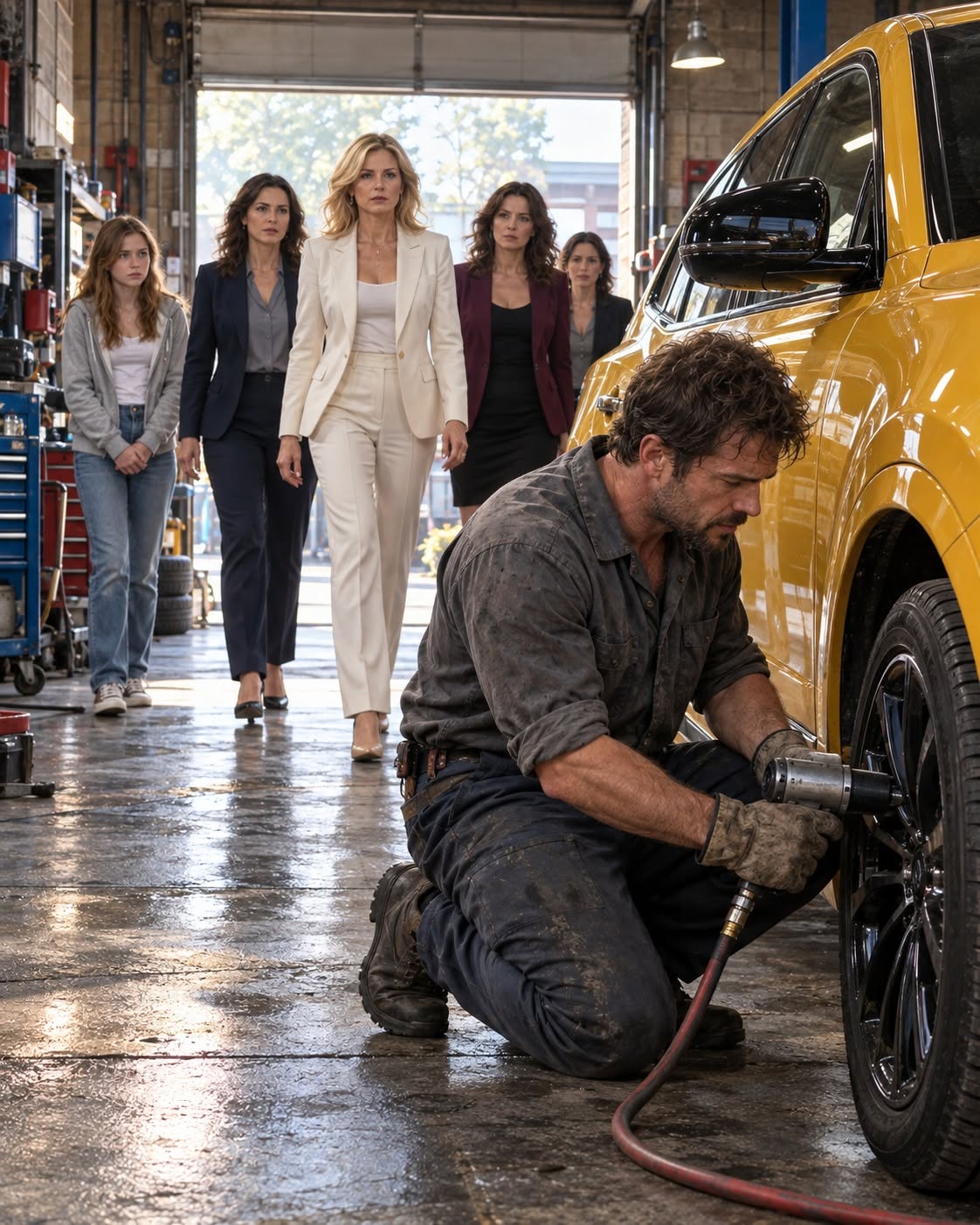
“What do you mean?”
Karen opened the envelope and pulled out several printed pages. The first showed a photograph of my garage, the same photograph a local news station had used when reporting the story about Grace.
Above it, in bold letters, was a headline that made my stomach tighten.
LOCAL MECHANIC DANIEL CARTER LAUNCHES COMMUNITY RELIEF FUND FOR STRUGGLING FAMILIES.
I stared at the page.
“I didn’t launch any fund.”
“I know,” Karen said. “That’s why we’re here.”
The article claimed that I had established a charitable organization to provide emergency car repairs, transportation assistance, and financial support to families in need. It even included a photograph of me standing beside Grace and Karen outside my shop.
The picture was real.
Everything else was a lie.
According to the article, donations were being collected to help people who couldn’t afford essential vehicle repairs. The page included a donation link and a statement supposedly written by me, promising that every dollar would go directly toward helping struggling families.
At the bottom was a photograph of a smiling man in a business suit.
Peter Lang.
My heart began to pound.
“Peter?” I whispered.
Karen shook her head.
“That’s what we thought at first. But the man collecting the money isn’t Peter. At least, that’s what Peter’s office told us when we called.”
I leaned back in my chair, trying to understand how a story that had started with a broken coolant hose had become something so ugly.
“Who sent this to you?”
“Someone from the hospital,” Karen explained. “She knew what happened to Grace. She saw the page and asked whether we were involved in the charity. When I told her no, she sent me the link.”
Grace finally looked up.
“Dad’s friends have been asking about it, too,” she said quietly. “One of them donated fifty dollars because he thought you were helping people.”
I felt sick.
Fifty dollars might not sound like much to someone with money to spare. But I knew what fifty dollars meant to a family trying to buy groceries, fill a gas tank, or keep the electricity from being shut off.
And someone was taking that money by pretending to be me.
“Have you contacted the police?” I asked.
“Not yet,” Karen replied. “We wanted to tell you first.”
I picked up my phone and called Peter.
He answered on the second ring.
“Daniel. Good morning. How’s the expansion going?”
“Peter, I need you to look at something immediately.”
I sent him the photographs and the link.
The silence on the other end lasted several seconds.
“Don’t touch anything on that page,” he finally said. “Don’t message the person behind it, and don’t ask anyone to confront them. I’m forwarding this to our legal team.”
“Someone is collecting money using my name.”
“I can see that.”
“And your photograph is on the page, too.”
Another pause followed.
“Daniel, I want you to listen carefully. I had nothing to do with this.”
“I believe you,” I said, although the words came out more cautiously than I intended.
Peter exhaled.
“Good. Because I think this may be connected to something I should have told you earlier.”
Those words made the room feel smaller.
“What should you have told me?”
“Someone approached my firm several weeks ago, claiming to represent a charitable initiative connected to your shop. They asked whether I would endorse it. I declined because I couldn’t verify the organization.”
“Did you find out who they were?”
“We’re looking into it. But there’s something else. They already knew details about your business that weren’t publicly available.”
I glanced at the office door.
For months, I had been so focused on the expansion that I had barely thought about the risks involved in becoming more visible. The new service bays were busy, the mechanics were working steadily, and for the first time in years, I had begun sleeping without calculating every bill in my head.
Now it felt as if someone had reached into the life I had fought to rebuild and threatened to pull it apart.
“Peter,” I said, “I don’t care how complicated this gets. We need to find out who’s doing it.”
“We will,” he replied. “But we need evidence, not guesses.”
By noon, his legal team had begun documenting the fraudulent page, preserving screenshots, and contacting the platform hosting it. I filed a report with the local police and provided copies of everything Karen had brought.
I thought that would be the end of the first day’s work.
I was wrong.
At three in the afternoon, a man wearing a gray coat walked into my garage carrying a small cardboard box.
He looked to be in his late thirties. His hair was neatly combed, and he kept glancing over his shoulder as if he expected someone to follow him.
“Are you Daniel Carter?” he asked.
“I am.”
“My name’s Michael Reeves. I think I can explain what’s happening.”
I gestured toward my office.
“Then you’d better start talking.”
Michael set the box on my desk and opened it.
Inside were printed emails, copies of donation receipts, and a small notebook filled with names and amounts of money.
“I used to work for a marketing company,” he said. “A few months ago, we were hired to promote a charitable campaign supposedly connected to your business.”
“Supposedly?”
He nodded.
“We were told you had approved it. They gave us your photograph, your news interview, and a statement with your name on it. I thought everything was legitimate.”
“Who hired you?”
“A man named Victor Hale.”
The name meant nothing to me.
Michael continued, explaining that Victor had presented himself as a consultant who worked with investors and small businesses. He claimed that Peter’s firm had agreed to support a community assistance program and that my garage would serve as its local headquarters.
The story sounded convincing because it contained enough truth to hide the lies.
Victor had copied details from my news interview, used photographs of Grace and me, and built an entire campaign around a kindness I had never intended to advertise.
At first, Michael had believed he was helping.
Then he noticed that the donation receipts listed a company he couldn’t find in the business registry. When he questioned Victor, he was told to stop asking questions and continue promoting the page.
Two days later, Michael discovered that several donors had complained that they couldn’t obtain confirmation of where their money was going.
He resigned.
“I should have come forward sooner,” he said, staring at his hands. “I kept thinking I might lose my job if I made a fuss. Then I realized people were losing money because I stayed quiet.”
I looked at the notebook.
“How much?”
“From the records I could access, at least forty thousand dollars. It may be more.”
I felt the air leave my lungs.
Forty thousand dollars.
That was more than I had earned in some entire years before the investment.
“Why bring this to me?”
“Because Victor is planning another event.”
Michael pulled a final page from the box.
It advertised a community fundraiser scheduled for Saturday evening at a hotel downtown. My name appeared prominently at the top, beneath a promise that I would personally present assistance grants to struggling families.
I had never agreed to attend.
I had never even heard of the event.
“He’s using your reputation to attract more donations,” Michael said. “And he’s telling people you’ll be there.”
I stood up so quickly that my chair rolled backward.
“Then we need to stop him.”
Michael looked frightened.
“If he finds out I gave you these records, he’ll know it was me.”
I understood his fear. People who did the wrong thing weren’t always the only ones who felt trapped. Sometimes the people who finally tried to do the right thing had the most to lose.
“You did the right thing coming here,” I told him. “We’ll make sure the authorities know what you provided.”
That evening, Peter came to my house.
I had expected to discuss the investigation at the garage, but he asked whether we could talk somewhere private. When he arrived, Chloe was sitting at the kitchen table doing homework.
She looked up and smiled.
“Hi, Mr. Lang.”
Peter returned her greeting before taking a seat across from me.
For several seconds, neither of us spoke.
Then he said, “Victor Hale used to work with one of my former business partners.”
I frowned.
“Does that mean you know him?”
“Not personally. But I know the kind of operation he runs. He identifies people whose stories attract public sympathy, builds fraudulent campaigns around them, and moves donations through organizations that are difficult to trace.”
“So he saw my story and decided to turn it into a business.”
“That’s what it looks like.”
I rubbed my forehead.
“Why would anyone believe that I started a charity without contacting me?”
“Because the story was emotional. People wanted to believe that something good had grown out of it. And Victor gave them an easy way to participate.”
I looked toward Chloe, who had returned to her homework but was clearly listening.
For a moment, I felt ashamed.
I had spent years teaching her that helping others mattered. Now someone had taken that lesson and used it to deceive people.
“Maybe I should never have let the story spread so far,” I muttered.
Peter leaned forward.
“No. Don’t do that.”
I looked at him.
“Don’t blame your kindness for someone else’s dishonesty. The fact that someone exploited your story doesn’t make the original act any less worthwhile.”
I wanted to believe him, but the thought of those families losing their money wouldn’t leave me alone.
“What if people think I was involved?”
“Then we give them the truth.”
Peter explained that his legal team could issue a public statement, but he wanted me to speak for myself. He believed that hiding from the situation would allow Victor to control the story.
I wasn’t sure I wanted to stand in front of cameras again.
The last time had been an accident. This time, the attention came with accusations, suspicion, and the possibility that everything I had built could be damaged by association.
But then Chloe set down her pencil.
“Dad?”
“What’s up, sweetheart?”
“Remember when you told me that doing the right thing doesn’t mean everyone will understand why you did it?”
I nodded slowly.
She looked at me with the serious expression she sometimes wore when she was trying to make sense of something much bigger than herself.
“Maybe this is one of those times.”
I reached across the table and squeezed her hand.
“You might be right.”
For the first time since Karen had walked into my office, I felt something other than anger.
I felt determined.
On Friday morning, we released a statement confirming that I had never established a charity, authorized the fundraising campaign, or received any donations through it. We provided the fraudulent website’s details to investigators and asked anyone who had contributed to preserve their receipts and contact the authorities.
I also recorded a short video from my office.
I didn’t wear a suit. I didn’t stand beside the new equipment or try to make the garage look impressive. I simply sat at my desk and told the truth.
“I repaired a young woman’s car because she needed help getting home safely,” I said. “I never expected anything in return. I certainly never asked anyone to donate money in my name.”
I paused, searching for the right words.
“If you gave money to this supposed charity, please know that you deserved honesty. I am sorry that someone used my story to take advantage of your trust. I can’t promise that I can recover what was lost, but I can promise that I will cooperate with every effort to find out what happened.”
Before ending the video, I added something I hadn’t planned to say.
“Please don’t let this experience convince you that helping people is foolish. Just make sure you know who you’re helping and where your money is going. Kindness should come with compassion, but generosity also deserves protection.”
By lunchtime, the video had been shared thousands of times.
Some people defended me. Others demanded answers. A few accused me of trying to distance myself from the fundraiser after getting caught, even though the evidence showed I had never authorized it.
The comments hurt more than I expected.
I could handle a difficult customer or an engine that refused to start. I had never learned how to watch strangers judge my character based on a few sentences on a screen.
That afternoon, a local television station called and asked whether I would appear at Saturday’s fundraiser to confront Victor publicly.
I declined.
“I won’t participate in an event I never approved,” I told the producer. “If the authorities need me, I’ll cooperate. But I’m not going to turn this into a spectacle.”
The producer sounded disappointed.
I hung up feeling strangely relieved.
For once, I had chosen not to chase the attention, even when it might have made the story more dramatic.
Saturday arrived with heavy clouds and a bitter wind.
I spent the morning at the garage, trying to concentrate on repairs. Customers still came in, although a few asked uncomfortable questions. Most understood once I explained the situation.
Around noon, Grace arrived with Karen.
Grace had grown noticeably more confident since the night her car broke down. She no longer twisted her sleeves whenever she spoke to me, and she had recently started talking about studying automotive technology after graduation.
That day, however, she looked worried again.
“Daniel,” she said, “I need to tell you something.”
Karen stood beside her, holding a folded piece of paper.
“What is it?”
Grace took a breath.
“Victor contacted me.”
My stomach tightened.
“When?”
“Yesterday. He sent me a message saying that if I attended the fundraiser and thanked him for supporting the charity, he could arrange a scholarship for me.”
I stared at her.
“He offered you a scholarship?”
“He said it would cover automotive school. He knew that’s what I wanted to study.”
Karen’s expression hardened.
“When Grace told him she needed to talk to me first, he said it would be a shame if people started questioning whether your original story was real.”
For several seconds, I couldn’t speak.
Victor wasn’t merely stealing money. He was trying to turn the people at the center of my story into tools for protecting his lie.
“Did you respond?” I asked.
Grace shook her head.
“I showed Mom the message. We saved everything.”
“Good,” I said. “Don’t contact him again. Give the messages to the investigators.”
Grace swallowed.
“I just wanted to help you. I thought if I went, maybe people would stop accusing you.”
I shook my head gently.
“You don’t owe me that. You didn’t ask for any of this.”
“But you helped me when I had nothing.”
“And that doesn’t mean you have to put yourself in danger to pay me back.”
She looked down, and I realized that she had been carrying a burden I had never intended to give her.
I placed a hand on her shoulder.
“Grace, the only thing I ever wanted that night was for you to get home safely. That’s still all I want.”
Her eyes filled with tears, but this time she wasn’t crying because she was frightened.
She was crying because someone had finally told her she didn’t have to fix everything.
That afternoon, Peter called with an update.
The investigators had identified the company receiving donations and were tracing its financial transactions. Michael’s records, the fraudulent emails, and the messages sent to Grace had provided important leads.
They had also learned that Victor intended to use the fundraiser to transfer the remaining money before closing the donation page.
The event was still scheduled for that evening.
I felt a surge of anger.
“Can the police stop it?”
“They’re working on it,” Peter said. “But they need to coordinate their response. We shouldn’t interfere.”
I agreed, although waiting was harder than I expected.
At six o’clock, I closed the garage and drove home. I wanted to spend the evening with Chloe instead of watching a stranger turn my life into another headline.
We made spaghetti, and she told me about a science project she was preparing. For a little while, the world felt ordinary again.
Then my phone rang.
It was Peter.
“Daniel, the police have made contact with Victor at the hotel.”
I stood up.
“What happened?”
“They confronted him with the evidence. He’s being questioned, and the fundraiser has been stopped.”
I closed my eyes and let out a breath I felt as though I’d been holding for days.
“Did they recover the money?”
“Some of it. The investigation is ongoing, so we don’t know how much can be returned. But the records have given them a much clearer picture of where it went.”
I thanked him and hung up.
Chloe watched me from across the table.
“Is it over?”
“I think the worst of it might be.”
She considered that for a moment.
“Then can we finish dinner?”
I laughed, and for the first time in days, the sound came easily.
“Absolutely.”
The following weeks brought more paperwork, interviews, and difficult conversations. Victor was eventually charged in connection with the fraudulent fundraising operation, and investigators continued working to identify victims and trace the stolen donations.
The legal process took time. Not everyone recovered their money, and that fact bothered me more than any insult directed at me.
A retired couple had donated several hundred dollars because they believed they were helping families keep their cars running. A single mother had contributed money she had been saving for her son’s school supplies. Another donor had given a portion of a tax refund she had planned to use for overdue bills.
Those people hadn’t been foolish.
They had believed their generosity would make a difference.
And someone had betrayed that belief.
I couldn’t undo what had happened, but I refused to let the fraudulent campaign become the only thing people remembered about the original story.
With Peter’s help, I worked with a local community organization that already provided transportation assistance to families facing financial hardship. We didn’t create a flashy new charity or ask people to send money to a personal account. Instead, we established a transparent program through the existing organization, with independent oversight, clear eligibility rules, and published records of how contributions were used.
The money Peter committed to the program came from his own investment firm’s community budget, not from the stolen donations. Every contribution was documented, and no one was asked to trust us simply because a story had gone viral.
I insisted on one rule.
No family would ever have to tell their story publicly to receive help.
“If someone needs a repair,” I told the committee, “we should ask what the car needs, not whether their hardship makes a good headline.”
The first application came from a father whose delivery van had broken down. Without it, he couldn’t work, and without his wages, his family was struggling to cover rent.
We repaired the van at no cost to him.
The second came from a woman who needed her car to get to chemotherapy appointments. The third came from an elderly man whose brakes had worn dangerously thin.
None of them appeared on television.
None of them had to stand in front of a camera and explain why they deserved help.
And every time we completed a repair, I felt that we were finally doing what I had hoped the original story would inspire.
Not admiration.
Not publicity.
Something useful.
By spring, the garage was busier than ever, but the atmosphere had changed. The mechanics understood why I refused to exaggerate repair estimates or recommend work a vehicle didn’t need. Linda kept a list of community referrals near the front desk, and customers occasionally covered the cost of small repairs for people they had never met.
Some days, I found anonymous envelopes containing grocery gift cards or notes that simply said, “Keep going.”
I never knew who left them.
I stopped trying to find out.
Then, one Thursday afternoon, Grace walked into the office carrying a large white envelope.
“I have something for you,” she said.
I glanced at the envelope.
“If that’s another banana bread recipe from your mother, I’m beginning to suspect she wants to open a bakery.”
Grace laughed.
“It’s better than banana bread.”
She handed me the envelope.
Inside was an acceptance letter from a technical college in Ohio. Grace had been admitted to its automotive technology program, with a scholarship covering much of her tuition.
I looked up at her.
“You did it.”
She nodded, smiling so widely that she looked like a completely different person from the frightened teenager who had stood outside my doors months earlier.
“I almost didn’t apply,” she admitted. “After everything that happened, I started wondering whether I was being ridiculous. Then I remembered what you said about not owing anyone your future just because they helped you in the past.”
I felt a lump form in my throat.
“So I applied,” she continued. “I worked hard, got recommendations from my teachers, and took the entrance exams. I wanted to see whether I could do it on my own.”
“You did do it on your own,” I told her. “You earned this.”
She shook her head.
“I had help. But you’re right. That doesn’t mean someone else gets to decide what I do with my life.”
We stood there smiling at each other until she suddenly reached forward and hugged me.
“Thank you,” she whispered.
I hugged her back.
“You’re welcome.”
That evening, I told Chloe about Grace’s acceptance. She listened carefully, then asked whether Grace would eventually become a mechanic at our shop.
“Maybe,” I said. “If she wants to.”
Chloe grinned.
“Then we should save her a toolbox.”
I promised we would.
A year after the night Grace’s car broke down, we held a small gathering at the garage to mark the first anniversary of the community repair program.
There were no television crews, no speeches prepared by publicists, and no giant banner displaying my name. We invited the people who had helped build the program, including Karen, Grace, Michael, and Peter.
Michael had found a new job with a different company and was volunteering his time to help the program review its records. He still regretted how long it had taken him to speak up, but he had stopped treating his mistake as something he could never overcome.
“I used to think doing the right thing meant never making a wrong decision,” he told me while we stood near the service bays.
“I think it means what you do after you realize you’ve made one,” I replied.
He nodded.
Across the garage, Karen was arranging plates of food while Grace told Chloe about her first semester. Peter stood near the entrance, speaking with one of our mechanics about expanding the program to include basic vehicle safety inspections.
I watched them for a moment and thought about how differently the past year might have unfolded.
If I had turned Grace away that night, I would never have met her family. My business might have continued struggling, and perhaps I would never have encountered Peter. The fraudulent fundraiser might never have existed, either.
But I couldn’t measure the value of helping someone by what happened afterward.
Sometimes good things followed.
Sometimes trouble did.
And sometimes a person did everything right and still couldn’t prevent someone else from causing harm.
That didn’t make kindness a mistake. It meant kindness needed to be accompanied by judgment, honesty, and the courage to protect people from those who would exploit them.
As the gathering began to wind down, Grace approached me with a small wooden box.
“I made this in my workshop class,” she said. “It’s not perfect, but I wanted you to have it.”
I opened the lid.
Inside was a small metal keychain shaped like a wrench. On one side, she had engraved the words SOMEONE OPENED THE DOOR.
On the other side were three simple words.
PASS IT ON.
I turned the keychain over in my palm.
“Grace, this is wonderful.”
She smiled.
“I thought about what happened that night a lot. I used to remember it as the night my car broke down. Now I remember it as the night I learned I didn’t have to face every problem alone.”
She paused.
“And I think that’s what I want to do for someone else someday.”
I couldn’t think of anything to say.
So I pulled her into another hug.
Later that night, after everyone had gone home, I walked through the quiet garage, checking the doors and switching off the lights. The equipment hummed softly as it cooled, and the smell of oil lingered in the air.
I stopped beside the bay where I had repaired Grace’s sedan.
It was an ordinary space, surrounded by ordinary tools, in a business that had nearly failed before a stranger decided to invest in it.
Yet that small space had become the starting point for something I could never have planned.
I thought about my wife, about the years I had spent trying to make sure Chloe never went without, and about all the times I had mistaken success for the ability to handle everything alone.
I had believed that being a good father meant giving my daughter a secure future.
Now I understood that it also meant showing her how to treat people when the world gave her no reason to expect anything in return.
Chloe was waiting for me at home when I arrived. She had left a drawing on the kitchen table: a little garage, a silver car, and several people standing together beneath a bright yellow sun.
At the top, she had written, “GOOD THINGS GROW WHEN PEOPLE HELP.”
I pinned it to the refrigerator.
Then I placed Grace’s keychain beside my car keys.
The next morning, just before closing time, a battered blue minivan pulled into the garage. A tired-looking father stepped out with a little boy holding his hand.
The man explained that his brakes had started making a grinding noise. He had been putting off getting them checked because he was behind on rent and couldn’t afford an unexpected repair.
I listened, then asked one of my mechanics to bring the van into the service bay.
The man looked at me nervously.
“Before you start, I need to be honest. I don’t have much money right now.”
I thought of Grace standing outside my glass doors, her hands trembling around her phone.
I thought of the donors who had been deceived, the families who had needed help, and the people who had chosen to speak up when remaining silent would have been easier.
Then I looked at the little boy beside the van.
“We’ll inspect it first,” I said. “We’ll explain exactly what’s wrong, and we’ll work out what we can do.”
The man’s shoulders relaxed slightly.
“Thank you.”
I nodded toward the service bay.
“Let’s take a look.”
As the mechanic began examining the brakes, I returned to my office and glanced at the small metal keychain on my desk.
SOMEONE OPENED THE DOOR.
PASS IT ON.
I finally understood that the real legacy of that night wasn’t the investment, the larger garage, or even the community program.
It was the reminder that a single act of kindness could change someone’s direction, even when it couldn’t solve every problem or protect them from every disappointment.
We couldn’t control what others did with our generosity. We couldn’t guarantee that every good deed would be rewarded or that every dishonest person would be stopped before causing harm.
But we could choose to act with compassion without surrendering our judgment. We could help people without demanding their gratitude, protect their dignity without asking for recognition, and build systems that made generosity safer and more effective.
Most importantly, we could refuse to let someone else’s cruelty convince us that caring was pointless.
That night, Grace had arrived at my garage believing she had run out of options.
She left knowing that help could come from an unexpected place.
A year later, I realized she had given me something in return that no investor could put into a contract and no amount of money could buy.
She had reminded me why I opened the shop in the first place.
Not just to repair engines.
Not just to pay the bills.
But to be the kind of person who, when someone stood outside in the cold with nowhere else to turn, would take a moment to listen before deciding what to do.
And sometimes, that was where the most important repairs began.