After spending $2 million and five years trying to bring my dead father’s Ferrari back to life, the world’s finest specialists told me to sell it for parts
The next morning, Gerald arrived at Meridian carrying a leather folder that had not been opened in more than sixty years.
What he revealed would change everything I thought I knew about my father—and explain why a Ferrari worth millions had been deliberately made impossible to start.
Gerald placed the folder on the workbench.
“Before anyone touches that car again,” he said, looking directly at Adrian, “you need to understand what it was built to protect.”
Adrian frowned.
“With all due respect, Gerald, the vehicle has already been restored to operating condition. Whatever historical details you’re talking about can be discussed afterward.”
Gerald shook his head.
“That’s precisely the problem. Everyone has been so concerned with making this car run that nobody has bothered to ask why it was designed to stop running in the first place.”
I looked at Isaac.
He stood beside the Ferrari, his expression unusually serious.
Gerald opened the folder and removed several yellowed photographs.
The first showed a younger version of my father standing beside a red Ferrari in a workshop in Milan. He couldn’t have been much older than thirty.
The second showed another man, tall and thin, with dark hair and grease covering his hands.
“That’s Vittorio,” Gerald explained. “The original engineer responsible for the car’s unusual ignition mechanism.”
I leaned closer.
“Why would my father need a special ignition system?”
Gerald hesitated.
“Because in 1963, this Ferrari wasn’t simply a car. It was part of a promise.”
He turned another photograph toward me.
It showed my father standing beside a woman I had never seen before. She was holding a little girl, perhaps four or five years old.
On the back, someone had written a short sentence in Italian.
Perché nessuno venga dimenticato.
So that nobody would be forgotten.
“Who are they?” I asked.
Gerald sat down.
“Your father had a sister.”
I stared at him.
“What?”
“Her name was Elena. She was older than your father by six years. She and her husband lived in northern Italy. They had a daughter named Sofia.”
I had never heard those names in my entire life.
“My father never mentioned a sister.”
“Because he spent the rest of his life believing he had failed her.”
Gerald explained that in 1963, Elena’s husband had become involved in a dangerous dispute involving stolen engineering documents and falsified ownership records. Several valuable automobiles had been moved across borders using forged paperwork. Vittorio had discovered the fraud and begun collecting evidence.
Elena had helped him.
She was a bookkeeper, and she had carefully recorded the transactions, names, and payments that connected the operation to several influential people.
When those people realized what she knew, she and her daughter disappeared.
My father had been working in Milan at the time. He helped Vittorio hide the original records and arranged for Elena and Sofia to leave the country.
But the plan went wrong.
The family was separated during their escape.
My father made it to safety.
Elena and Sofia did not.
“Did they die?” I asked.
Gerald looked down at the photographs.
“Your father never found out.”
I felt something tighten in my chest.
“Then why did he keep this car?”
“Because Vittorio built something into it that could preserve the truth. A hidden compartment. Original documents. Names. Evidence that could prove what happened and expose the people responsible.”
I looked toward the Ferrari.
“You’re saying there’s evidence inside the car?”
Gerald nodded.
“Your father believed it was safer there than anywhere else.”
Adrian gave a short, disbelieving laugh.
“That’s an extraordinary story. But we’ve inspected the entire vehicle. There is no hidden compartment.”
Isaac finally spoke.
“Not one that would appear on an ordinary restoration diagram.”
Gerald turned toward him.
“You recognize the system?”
“I recognize Vittorio’s work,” Isaac replied. “He used to tell me that a machine could be built with two purposes. One that everyone could see, and another that only the right person would understand.”
Adrian folded his arms.
“And you expect us to believe there’s a secret archive inside a sixty-year-old Ferrari?”
Isaac didn’t argue.
Instead, he approached the driver’s side and knelt beside the lower dashboard.
“Not an archive,” he said. “A mechanical release.”
He pointed toward the small engraving.
“Sempre tua. Milano, 1963.”
Then he looked at me.
“Your father didn’t just preserve this inscription. He preserved the original mechanism associated with it.”
I swallowed.
“What happens if we activate it?”
Isaac looked at Gerald.
“That depends on what’s still inside.”
For the next two hours, nobody spoke unnecessarily.
Isaac worked with extraordinary patience. He removed a narrow trim panel, inspected a concealed linkage, and carefully tested several mechanical connections.
Eventually, he stopped.
“There’s a second lock.”
“Can you open it?” I asked.
“Yes. But I need the original key.”
I reached into my pocket and pulled out the small brass key my father had left with his personal belongings.
It had never opened anything in our house.
I had kept it because throwing it away had somehow felt wrong.
Isaac examined it under the workshop light.
His expression changed.
“Where did you get this?”
“It belonged to my father.”
He turned it over.
On one side were two tiny letters: E.M.
“Elena Moretti,” Gerald whispered.
Isaac nodded.
“This is it.”
He inserted the key into a narrow opening beneath the center console.
It resisted at first.
Then, with a careful turn, something clicked deep inside the dashboard.
A section of the floor panel released.
I stepped back.
Beneath it was a small metal compartment, sealed inside a protective casing.
Adrian moved closer.
For the first time, he looked genuinely speechless.
Isaac didn’t open it immediately.
He examined the seals, checked the casing, and photographed its condition.
Then he looked at me.
“Whatever is inside belongs to your family. I won’t open it without your permission.”
I nodded.
“Open it.”
He carefully released the final latch.
Inside were three things.
A leather-bound notebook.
A small envelope.
And a photograph.
The notebook was wrapped in faded cloth, but its pages had been remarkably well preserved.
The envelope carried my father’s handwriting.
My name was written across the front.
I recognized it immediately.
My hands began shaking.
“How long has that been there?”
Gerald looked at me.
“Since 1963, most likely.”
I opened the envelope.
Inside was a letter.
The first line made my knees feel weak.
My dear child, if you’re reading this, then someone has finally found the way to bring this car back to life.
I stopped.
I had to read it again.
Then I continued.
I wanted to tell you about Elena. I wanted to explain why I spent so much of my life protecting something you might never understand. But I was afraid that telling you would place a burden on your shoulders that you had never asked to carry.
Your aunt was the bravest person I ever knew. She believed that truth mattered more than comfort, and that a person’s name was worth protecting even when powerful people wanted it erased.
I failed to bring her home. I have spent every year since wondering whether I could have done more.
The notebook inside this compartment contains the original records Vittorio and Elena collected. It also contains the names of those who helped them disappear.
But there is something more important than the documents.
If you have found this letter, I hope you have learned that the car was never the most important thing I left behind.
It was the promise.
I lowered the letter.
For a moment, I couldn’t hear anything.
My father had spent his final years knowing there was a mystery hidden inside the machine I had loved since childhood.
And I had spent five years trying to make it start without understanding why.
Then I noticed something else.
The letter continued on the second page.
There is one person who may still be alive. Her name is Sofia.
My breath caught.
Gerald took the paper from my hand and read the sentence again.
“Your father’s niece,” he whispered.
I looked at him.
“Do you know where she is?”
He shook his head.
“No. But if these records are genuine, we might finally find out.”
That afternoon, we contacted an independent archival specialist and a lawyer experienced in international property and historical records.
Nobody was allowed to remove the notebook without a documented chain of custody.
The documents were photographed, cataloged, and placed in secure storage.
Isaac insisted on one more precaution.
He wanted the original ignition mechanism preserved exactly as it had been found.
“It would be a mistake to replace it with a modern system,” he explained. “The car has survived because someone understood that its history was part of its design.”
For the first time, Adrian didn’t disagree.
In fact, he approached Isaac later that evening.
“I owe you an apology,” he said.
Isaac looked up.
“For what?”
“For assuming that your uniform told me everything I needed to know about you.”
Isaac considered his words.
Then he nodded.
“People make that mistake more often than you think.”
Adrian extended his hand.
Isaac shook it.
But the most extraordinary discovery was still waiting for us.
Three weeks later, the archival specialist confirmed that the notebook contained authentic records from 1963.
Several names matched individuals involved in a documented investigation into stolen automotive property and forged provenance records.
One of those names belonged to a man whose descendants still controlled a major European restoration business.
Another belonged to a former official who had helped bury the original investigation.
But the most important entry was on the final page.
It contained an address in Buenos Aires.
And beside it was a name.
Sofia Moretti.
A current address could not be established immediately, but the research team traced the name through immigration records, old correspondence, and a small community organization in Argentina.
Eventually, they found a woman who had been born in Milan in 1959.
Her mother had been Elena Moretti.
She had moved to Argentina as a child.
And she was still alive.
I stared at the photograph the specialist sent us.
An elderly woman stood in front of a modest house, holding a small white dog.
Her eyes were unmistakable.
They were the same eyes as the little girl in the photograph from 1963.
I called the number provided by the researcher.
A woman answered in Spanish.
I had prepared several sentences, but when I heard her voice, everything disappeared from my mind.
“Hello,” she repeated.
I took a breath.
“Is this Sofia Moretti?”
“Yes. Who is calling?”
“My name is Daniel. My father was Marco Moretti.”
There was a long silence.
Then I heard her whisper something in Italian.
“Marco?”
“Yes.”
She began crying.
Not loudly.
Not dramatically.
Just the quiet, uncontrollable crying of someone who had spent decades believing a door would never open again.
“My uncle,” she said. “My mother used to talk about him.”
I closed my eyes.
“She did?”
“Every year. On his birthday, she would tell me that he had tried to save us. She said he was the only person who never stopped looking.”
I couldn’t speak.
Then Sofia asked the question that changed everything.
“Is he still alive?”
I looked at the Ferrari across the room.
“No,” I said softly. “He passed away several years ago.”
She went quiet.
“I’m sorry,” I continued. “But he never forgot you.”
For a long moment, there was only breathing on the other end.
Then she said, “I thought he had forgotten us.”
I shook my head even though she couldn’t see me.
“He didn’t.”
We spoke for nearly two hours.
She told me that her mother had escaped Italy with her after the separation. They had spent years moving between relatives and temporary homes before settling in Argentina.
Elena had died when Sofia was in her twenties.
Before her death, she had given Sofia a small photograph of Marco and told her never to believe anyone who claimed he had abandoned them.
“He was trying to protect us,” Sofia said. “I know that now.”
I promised I would send her copies of the photographs and the letter.
Then I asked if she would ever consider visiting Los Angeles.
She laughed through her tears.
“At my age? I don’t know if I can travel that far.”
“Then I’ll come to you.”
There was another silence.
“Your father would have liked that,” she said.
Two months later, I flew to Buenos Aires.
I brought the photograph, the letter, and a small object I had found inside my father’s desk.
It was a silver pendant engraved with the initials E.M.
Sofia recognized it immediately.
“My mother wore that every day,” she said.
She held it against her chest and closed her eyes.
Then she invited me inside.
Her home was filled with ordinary things: family photographs, books, a worn wooden table, and a little garden visible through the kitchen window.
Nothing about it suggested the extraordinary history that had brought me there.
We sat together for hours.
She showed me pictures of her children and grandchildren.
She told me about Elena’s kindness, her stubbornness, and the way she used to sing while cooking.
And for the first time, I began to understand something my father had never been able to explain.
The Ferrari had not been a symbol of wealth.
It had been a promise that someone would keep looking.
Before I left, Sofia asked me one question.
“Will you keep the car?”
I thought about the two million dollars, the five years, the experts, the failed attempts, and the extraordinary discovery hidden beneath the dashboard.
“I don’t know,” I admitted.
She smiled.
“Then don’t decide because of what it is worth.”
She reached for my hand.
“Decide because of what it means.”
I returned to Los Angeles with more answers than I had ever expected.
The story eventually became public, although I refused to turn it into a spectacle.
The notebook was transferred to the appropriate authorities and historical archives. The records helped reopen questions surrounding several fraudulent provenance claims, and the investigation led to the correction of long-standing historical accounts.
Some of the people named in the documents were already dead.
Others were forced to answer questions they had avoided for decades.
The Ferrari became the subject of renewed interest among collectors.
Offers arrived from private museums, wealthy enthusiasts, and international auction houses.
One buyer offered nearly three million dollars.
I turned him down.
Not because I suddenly believed the car was priceless.
But because I had finally understood that its value couldn’t be measured by an auction estimate.
I established a small foundation in my father’s and Elena’s names.
Its purpose was to preserve historical records, support independent archival investigations, and help families recover stories that had been lost through displacement, fraud, or deliberate concealment.
Isaac helped me establish its restoration and preservation program.
I also made him an offer.
A position as its chief technical director.
He looked at the proposal for several minutes before speaking.
“Are you sure you want someone like me running this?”
I smiled.
“I think I’ve learned that the people most qualified to do something aren’t always the people wearing the most impressive titles.”
He laughed.
Then he accepted.
Within a year, Isaac was leading a small team of engineers and restoration specialists.
Some had spent decades in prestigious workshops.
Others were young apprentices who had never worked on an expensive vehicle.
Isaac treated them all the same.
He taught them that a restoration wasn’t successful simply because an engine started or a body looked perfect.
It was successful when the work respected the truth of the object.
And Adrian?
He became one of our most valuable partners.
He later admitted that the Ferrari had changed the way he approached difficult restoration projects.
“I used to think expertise meant knowing how to solve every problem,” he told me. “Now I think it also means knowing when you’ve misunderstood the problem.”
A year after my visit to Argentina, Sofia came to Los Angeles.
She was eighty-seven by then, but she insisted on seeing the Ferrari herself.
I arranged a private visit to Meridian.
When she entered the workshop, she stopped in front of the car.
For several seconds, she simply looked at it.
Then she placed one hand on the red bodywork.
“My mother used to talk about this car,” she whispered.
I stood beside her.
“She remembered it?”
“She remembered the sound.”
I asked if she wanted to hear it.
She smiled.
“Very much.”
Isaac had prepared everything.
He checked the mechanical systems, inspected the fluid levels, and made sure the original ignition sequence remained untouched.
Then he stepped aside.
I handed Sofia the key.
She looked at it for a long time.
“Your uncle would have wanted you to do this,” I said.
She sat carefully in the passenger seat.
I took the driver’s seat.
My fingers rested on the steering wheel.
For a moment, I remembered being a little boy in the garage with my father.
I remembered his explanations.
His patience.
The way he always said that machines deserved respect because people had put their lives into building them.
Then I followed the sequence Isaac had taught me.
The concealed release.
The narrow control.
The pause.
The ignition.
The Ferrari roared to life.
Sofia began to cry.
But this time, the tears were different.
She was smiling.
She reached toward the dashboard and touched the little engraving.
“Sempre tua,” she whispered.
Always yours.
The engine continued running smoothly.
Outside the workshop, sunlight moved across the concrete floor.
And I understood that the sound I had spent five years chasing was never just the sound of an engine.
It was the sound of a promise finally being kept.
After Sofia returned to Argentina, I began visiting her regularly.
We never ran out of stories.
She told me things about my father that I had never known. How he used to send money anonymously when she was young. How he had kept every letter Elena ever wrote. How he had once traveled to Buenos Aires but turned back after receiving a message that suggested the family was being watched.
He had spent his entire life carrying a guilt that wasn’t entirely his to carry.
I began to see him differently.
Not as a man who had hidden a secret from his son, but as a man who had been trying, imperfectly, to protect a promise he couldn’t finish.
One evening, while looking through his old photographs, I found a note written in the margin of an album.
It was dated several months before his death.
If Daniel ever finds the truth, tell him this: You don’t have to spend your life repairing what happened before you were born. Sometimes, the most important thing you can do is make sure the next person doesn’t have to carry the same silence.
I read those words several times.
Then I put the photograph back in its place.
For years, I had believed that loving my father meant finishing everything he had left unfinished.
But he had never asked me to spend my life paying for his regrets.
He had simply hoped I would understand why he had cared so deeply.
The Ferrari still sits in the Meridian facility today, although it no longer remains hidden away.
We occasionally display it at historical preservation events, alongside copies of the original notebook, photographs, and the story of Elena and Vittorio.
The small engraving remains untouched.
And whenever someone asks why we haven’t replaced the unusual ignition system with something more modern, Isaac gives the same answer.
“Because not everything old needs to be improved. Some things need to be understood.”
Last month, a young apprentice asked me whether I regretted spending two million dollars trying to start a car.
I thought about the question.
Then I looked at the photograph of my father, Elena, and little Sofia.
“No,” I told him. “But not because the car was worth the money.”
I explained that I had spent five years believing the greatest loss in my life was an engine that would no longer start.
I had been wrong.
The real loss was a family story that had almost disappeared.
The car had simply been the last place where that story remained intact.
And Isaac, the man everyone had overlooked because of the uniform he wore, had been the only person patient enough to listen to what it was trying to tell us.
I still remember the day he first examined the engraving.
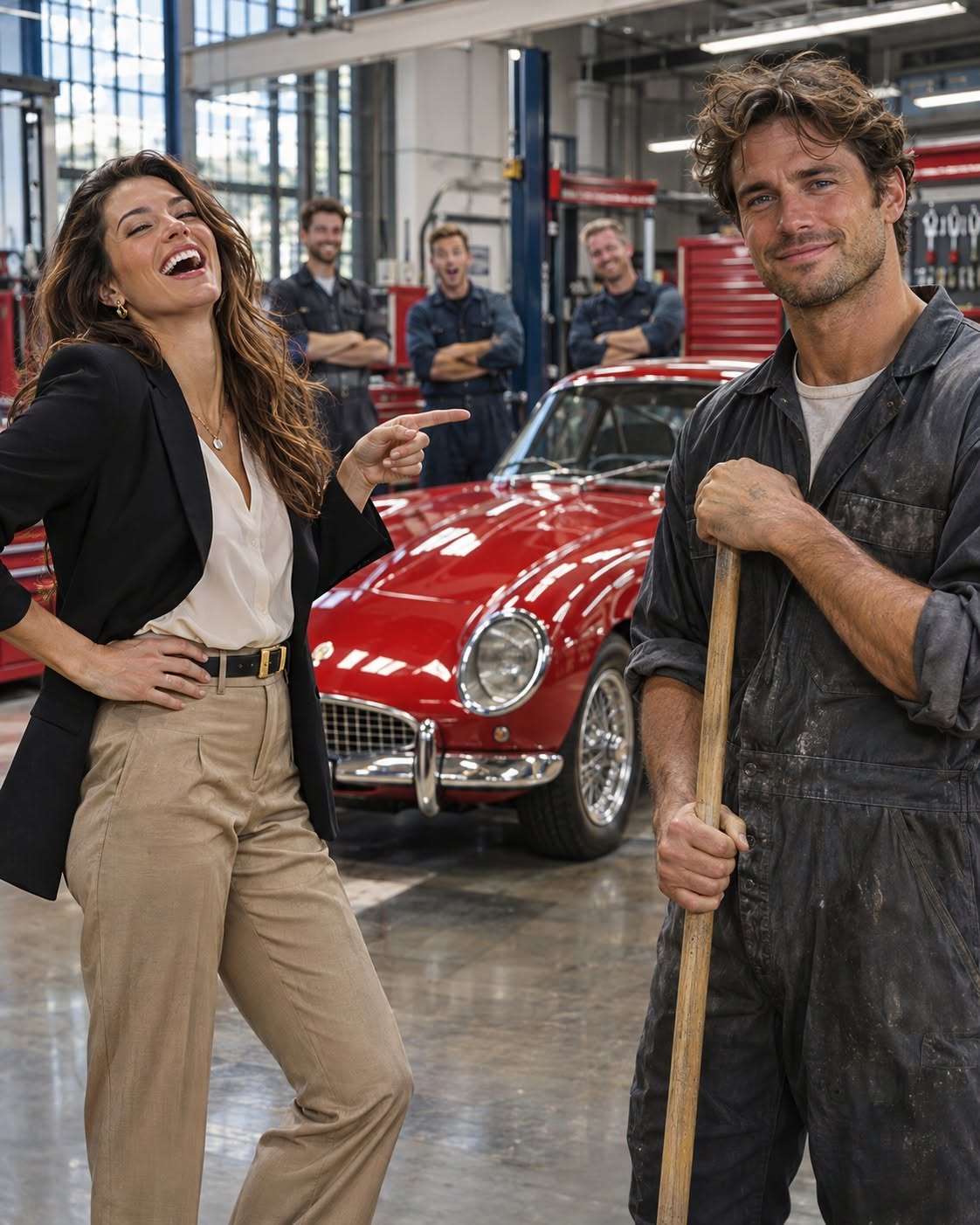
I remember how everyone laughed when I handed him the keys.
I remember how the world’s finest specialists had declared the Ferrari beyond repair.
But I remember something else, too.
My father once told me that the most valuable things in life rarely announce their importance.
Sometimes they sit quietly in a corner, waiting for someone to notice.
Sometimes they are hidden beneath layers of dust, behind a locked door, or inside a machine that refuses to cooperate.
And sometimes, they are carried by people we barely acknowledge.
That Ferrari taught me a lesson I will never forget:
Never confuse someone’s position with their potential, and never assume that something is broken simply because you haven’t learned how to understand it.
Because the right person may see what everyone else has missed.
And because the greatest treasures we inherit aren’t always objects, money, or machines.
Sometimes, they’re promises.
And the courage to finally keep them.