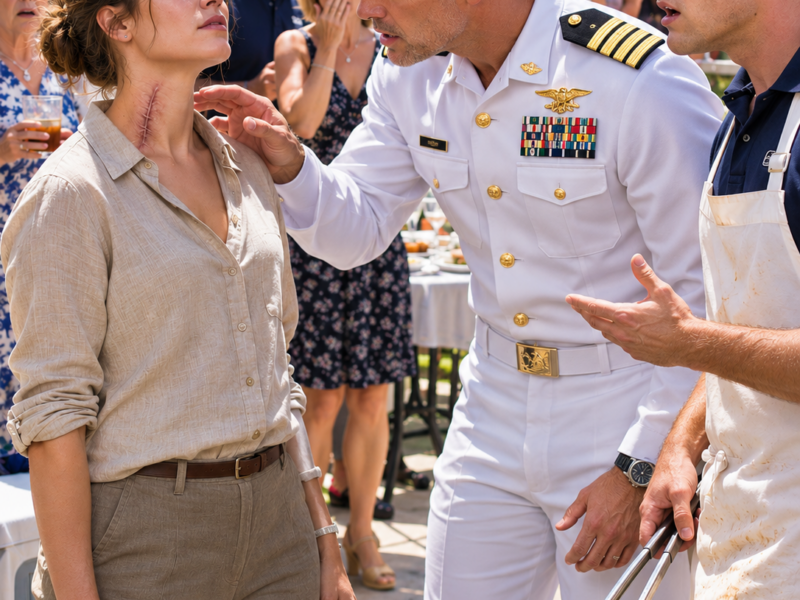
My Younger Brother Humiliated Me in Front of 80 Guests at His Navy Promotion Barbecue, Calling My Neck Scar Disgusting. He Ordered Me to Hide It Before His Commanding Officer Arrived, Certain Everyone Would Laugh at My Embarrassment. But When a SEAL Team Five Commander Saw the Scar, His Face Went Pale, and One Question Silenced the Entire Backyard. What Did He Recognize That My Family Never Knew?
My Younger Brother Humiliated Me in Front of 80 Guests at His Navy Promotion Barbecue, Calling My Neck Scar Disgusting. He Ordered Me to Hide It Before His Commanding Officer Arrived, Certain Everyone Would Laugh at My Embarrassment. But When a SEAL Team Five Commander Saw the Scar, His Face Went Pale, and One Question Silenced the Entire Backyard. What Did He Recognize That My Family Never Knew?
Part 1…
My younger brother pointed a pair of stainless steel grill tongs at my neck and laughed loudly enough for all 80 guests to hear.
“Button your shirt, Bryn. Nobody wants that ugly kitchen scar ruining my promotion pictures.”
The laughter spread across the patio.
I stood perfectly still.
My brother Lucas was celebrating his new Navy logistics commission, and apparently, humiliating his older sister was part of the entertainment.
I could have corrected him.
I could have told everyone exactly where the jagged, three-inch scar near my collarbone came from.
But I didn’t.
I simply adjusted my linen collar and stepped toward the garden fence.
Ten minutes later, a Navy commander walked into that backyard.
He took one look at my neck.
And stopped breathing for what felt like an eternity.
What happened next would change the way my family looked at me forever.
My name is Bryn Gallagher.
For as long as I can remember, my family has revolved around one person.
Lucas.
My younger brother was the golden child. The successful one. The one whose smallest accomplishments deserved applause.
When Lucas made the honor roll, our parents took him to dinner.
When he graduated, they threw a party.
When he received his Navy assignment, they invited practically everyone they knew.
Me?
I was the quiet daughter.
The one who never made a fuss.
For six years, I’d been away on Department of Defense contract deployments overseas. I rarely discussed those assignments, partly because much of the work wasn’t something I could casually explain.
Eventually, I settled into civilian freight routing.
That was the version of my life my family understood.
Boring paperwork.
Shipping schedules.
A forgettable job.
And I let them believe it.
Explaining myself had never been worth the arguments.
Especially with Lucas.
He had recently secured an administrative shore billet at Naval Amphibious Base Coronado, working with logistics systems and supply coordination.
It was a respectable assignment.
I was genuinely happy for him.
But Lucas behaved as though he’d personally conquered every battlefield in American military history.
Our parents encouraged it.
Every Sunday dinner became another celebration of his brilliance.
His career.
His future.
His supposed importance.
Meanwhile, if someone asked about my work, Mom usually answered before I could.
“Oh, Bryn just handles freight paperwork.”
Just.
That little word followed me everywhere.
I learned to smile through it.
Until that July afternoon.
San Diego was sweltering.
The temperature had climbed past 90 degrees, and the backyard shimmered beneath the afternoon sun.
Guests crowded around patio tables beneath white umbrellas.
Someone had music playing near the pool.
The smell of grilled burgers drifted through the air.
Lucas stood beside his expensive stainless steel grill, wearing a spotless apron and entertaining a circle of neighbors.
He looked delighted with himself.
I arrived wearing a lightweight linen shirt, tailored trousers, and comfortable flats.
My collar was buttoned high.
It always was.
The scar on the left side of my neck had been there for years, but I still preferred keeping it covered.
Not because I was ashamed.
Because I hated questions.
And I hated the memories that followed them.
Unfortunately, Aunt Claire noticed.
“Bryn, sweetheart, aren’t you roasting in that shirt?”
I gave her a small smile.
“I’m fine, Aunt Claire.”
Before I could change the subject, Lucas called out from the grill.
“Don’t bother asking her!”
Several people turned.
He raised his tongs like a microphone.
“She’s hiding her greatest kitchen disaster!”
I felt my stomach tighten.
Here we go.
Lucas grinned.
“Remember when she dropped that cast-iron skillet full of hot oil down her neck? She was twenty-two. Couldn’t even handle a frying pan!”
A few guests chuckled.
Others looked uncomfortable.
Lucas loved an audience.
He wasn’t finished.
“Seriously, Bryn. Either button that collar all the way up or go sit inside with Mom’s potato salad.”
He gestured toward me again.
“I don’t need your ugly kitchen battle scar showing up in my official promotion photos.”
More laughter.
My face grew warm.
Not from the heat.
From the familiar humiliation of being treated like a family joke.
I looked toward my parents.
Mom was arranging hamburger buns.
Dad was talking to a neighbor.
Neither intervened.
Of course they didn’t.
They never did.
I pressed my fingers against my collar.
For one brief second, I considered telling Lucas the truth.
The real story.
The place.
The night.
The reason that scar existed.
Then I remembered the years of dismissive comments.
The constant comparisons.
The way every conversation somehow became another opportunity to remind me that Lucas was exceptional and I was ordinary.
I swallowed the words.
“Enjoy your party, Lucas.”
That was all I said.
I moved toward the fence, hoping to disappear into the background.
Then the side gate opened.
Everything changed.
A tall man in a dark civilian polo stepped onto the patio.
His posture was straight, his expression composed, and his movements carried the unmistakable confidence of someone accustomed to responsibility.
Lucas immediately abandoned the grill.
He nearly stumbled over his deck shoes trying to reach the newcomer.
“Commander Hayes! Sir!”
His voice jumped an octave.
“Thank you so much for coming!”
I recognized the name.
Commander Jonathan Hayes.
SEAL Team Five.
Lucas had mentioned him constantly for two months.
According to Lucas, Hayes’s endorsement could help him secure an elite logistics position supporting Coronado’s special warfare group.
That recommendation meant everything to him.
And now the man himself was standing beside the patio table.
“Afternoon, Lieutenant,” Hayes said pleasantly.
Lucas practically glowed.
“Sir, please, let me get you something to eat.”
He grabbed a clean plate.
Then immediately launched into an explanation of the supply routing metrics he’d submitted the previous Friday.
I watched from a distance.
It was almost painful.
Lucas kept talking.
Hayes listened politely.
And I noticed something strange.
Every time the commander shifted his attention toward the backyard, Lucas moved slightly to block his view of me.
I almost smiled.
Even now, he couldn’t bear sharing the spotlight.
I walked toward the cooler to put down my empty glass.
A sudden breeze moved across the patio.
It lifted the loose edge of my linen collar.
Just an inch.
Maybe two.
Enough.
The left side of my neck became visible.
I didn’t notice immediately.
But Commander Hayes did.
He stopped listening to Lucas.
His expression changed.
Completely.
One moment, he was a polite guest at a summer barbecue.
The next, he looked as though he’d seen something impossible.
His eyes fixed on my neck.
His jaw tightened.
“Lieutenant.”
Lucas stopped talking.
“Yes, sir?”
Hayes didn’t look at him.
“Where did your sister receive that injury?”
My heart gave one hard beat.
Lucas laughed.
“Oh, that? Just a kitchen accident, sir.”
He waved dismissively.
“She dropped a frying pan full of hot oil years ago. Bryn’s always been a little uncoordinated.”
Hayes didn’t smile.
Not even slightly.
Instead, he stepped around Lucas.
And walked directly toward me.
The backyard suddenly seemed quieter.
I stood beside the cooler, my empty glass still in my hand.
Hayes stopped about three feet away.
His gaze remained on the scar.
“May I take a closer look?”
I hesitated.
Then nodded.
His expression became intensely focused.
“Hot oil doesn’t typically leave a pattern like that.”
Lucas appeared beside him.
“Sir, honestly, it’s nothing.”
Hayes ignored him.
He studied the hardened, star-shaped tissue extending from beneath my ear toward my collarbone.
His voice grew lower.
“Those radial tracks. The alignment. The distinct points of impact.”
My fingers tightened around the glass.
Nobody in my family had ever described my scar that way.
Nobody had ever looked closely enough.
Hayes lifted his eyes to mine.
“High-velocity fragmentation.”
My breath caught.
“Directional charge. Tungsten bearings. Upward dispersion.”
The patio fell silent.
Aunt Claire slowly lowered her iced tea.
Mom stopped walking.
Even Lucas looked confused.
Then Hayes said something that made the entire afternoon disappear around me.
“Al-Nuri District. West Mosul. Summer 2019.”
He paused.
“Am I close?”
For a moment, I wasn’t standing in San Diego anymore.
I could almost smell the powdered concrete.
Feel the weight of my equipment.
Hear the distant, distorted sounds of a place I’d spent years trying not to revisit.
I looked directly at him.
“1800 hours, sir.”
My voice was steady.
“Building Three. Water purification facility. Southern courtyard perimeter.”
Hayes went completely still.
His eyes widened.
And then something extraordinary happened.
The commander’s posture changed.
His shoulders straightened.
His expression filled with a recognition so powerful that I had to look away.
Behind him, Lucas gave a strained laugh.
“Wait. What are you two talking about?”
Neither of us answered.
Hayes turned slowly toward the guests.
“Five years ago,” he began, “my joint reconnaissance team was trapped inside the collapsed basement of a water treatment facility in West Mosul.”
The backyard was silent.
No one moved.
“An armed group breached our outer perimeter. A directional fragmentation device went off near the doorway.”
My stomach tightened.
I knew what came next.
I had lived it.
“Two Navy corpsmen were pinned beneath fallen concrete. They couldn’t get clear.”
Hayes paused.
“Then a female joint terminal attack controller attached to our unit made a decision that saved their lives.”
I stared at the ground.
Please.
Not here.
Not in front of my family.
But Hayes continued.
“She moved between those men and the incoming fragments. Her protective equipment absorbed much of the impact, but several pieces struck her neck and shoulder.”
A faint gasp came from the deck.
My mother.
I didn’t look at her.
“Despite her injuries, she remained at her position and coordinated dangerously close air support so our evacuation aircraft could reach us.”
My chest felt impossibly tight.
I remembered the dust.
The radio.
The desperate effort to keep my voice clear.
And the two men who couldn’t get out.
Hayes turned toward me.
“That operator was evacuated to Landstuhl before my detachment ever learned her civilian name.”
His voice softened.
“We knew only her call sign.”
He paused.
“Vanguard 09.”
The glass nearly slipped from my hand.
For five years, I hadn’t heard that name spoken aloud.
Not once.
Hayes looked at me with unmistakable respect.
“We’ve been trying to find her. All this time.”
Lucas’s smile disappeared.
His beer bottle slipped from his fingers and landed on the lawn.
Mom covered her mouth.
Dad stared at me as though I were a stranger.
And I realized something.
For the first time in my life, my family wasn’t looking at Lucas.
They were looking at me.
But Lucas couldn’t accept it.
“Sir, there’s obviously been some mistake.”
His voice cracked.
“Bryn worked in supply routing. Administrative work. She’s not some frontline operator.”
Hayes turned.
Slowly.
Lucas kept talking.
“She probably read about that incident somewhere. I mean, with all due respect, sir, you can’t seriously believe—”
“Lieutenant.”
One word.
Lucas stopped.
Hayes’s expression hardened.
And suddenly, I understood that my brother had made a terrible mistake.
Not because he’d embarrassed me.
Not even because he’d lied about my scar.
But because he was now challenging a commander who knew exactly what had happened in that courtyard.
In front of 80 witnesses.
Hayes looked directly at him.
“A naval officer’s first responsibility is integrity.”
Lucas swallowed.
“Sir, I—”
“You publicly mocked an injury you knew nothing about. Then, when confronted with the truth, you tried to discredit your own sister.”
Nobody moved.
Hayes continued.
“She is a Purple Heart recipient and a Silver Star nominee.”
My mother made a small, broken sound.
Lucas stared at me.
For once, he had nothing clever to say.
Hayes stepped closer to him.
“And you’ve just demonstrated something far more important than your ability to manage a spreadsheet.”
Lucas’s face drained of color.
The commander paused.
“Your character.”
The grill hissed behind us.
Somewhere, a chair scraped against the patio stones.
I stood frozen, knowing Lucas’s entire future depended on what Commander Hayes said next.
Continue in the comments 👇…
Part 2….
“Tomorrow morning at 0800, I’m withdrawing my endorsement.”
Commander Hayes spoke quietly.
Lucas looked stunned.
“Sir, please. It was only a family joke.”
“A leader doesn’t diminish someone else’s sacrifice to make himself look important.”
Hayes didn’t raise his voice.
He didn’t need to.
“Integrity isn’t something you demonstrate only when your superiors are watching.”
Lucas turned toward me.
Desperation replaced his arrogance.
Within minutes, guests began leaving.
The laughter was gone.
So was the celebration.
My parents sat silently on the deck while I collected my belongings.
Then Lucas cornered me beside the kitchen island.
“Bryn, please. Tell him it was a misunderstanding. That endorsement is my future.”
I looked at him.
“You laughed at something that nearly ended mine.”
His eyes filled with panic.
“We’re family!”
“Then you should have treated me like family.”
I picked up my keys.
Outside, Commander Hayes caught me near the driveway.
His expression had softened.
“Gallagher. There’s something you deserve to know.”
My heart tightened.
“The two corpsmen you protected. Miller and Ortiz. They both made it home.”
I couldn’t speak.
“Miller has a daughter now. Ortiz teaches trauma medicine in Chicago.”
He handed me a small embossed card.
“Every November, our detachment meets in Coronado. You belong at that table.”
I stared at the card.
For years, I’d hidden the scar.
But standing there, I finally understood what it represented.
Not shame.
Not weakness.
A sacrifice that had never needed my family’s approval.
SAY ”Full Story” IF YOU WANT TO READ THE FULL STORY ✨💕