My Husband Called Me “Just a Soldier” and Took His Mother to Hawaii to Celebrate His Big Promotion. My Mother-in-Law Laughed When He Said I Was Too Embarrassing to Introduce to His Wealthy Business Associates. I Smiled and Wished Them a Wonderful Vacation, Then Quietly Opened the Drawer Containing My Late Father’s Documents. What I Discovered Made Me Question Whether My Husband’s Newfound Success Was Built on Something He Never Owned.
My Husband Called Me “Just a Soldier” and Took His Mother to Hawaii to Celebrate His Big Promotion. My Mother-in-Law Laughed When He Said I Was Too Embarrassing to Introduce to His Wealthy Business Associates. I Smiled and Wished Them a Wonderful Vacation, Then Quietly Opened the Drawer Containing My Late Father’s Documents. What I Discovered Made Me Question Whether My Husband’s Newfound Success Was Built on Something He Never Owned.
Part 1…
“You’re just a soldier, Caroline. You’re not in my league.”
My husband said those words without hesitation while packing for his promotion celebration in Hawaii.
His mother laughed.
I smiled.
“Enjoy your vacation.”
Neither of them realized that something inside me had changed forever.
It was Thursday, shortly after six in the evening. I had just returned from Fort Liberty to our oceanfront home in Wrightsville Beach, North Carolina.
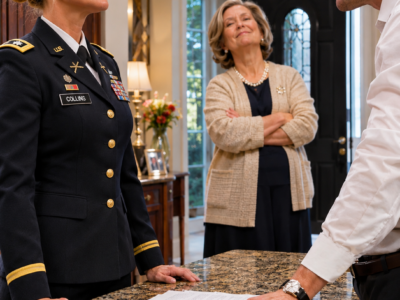
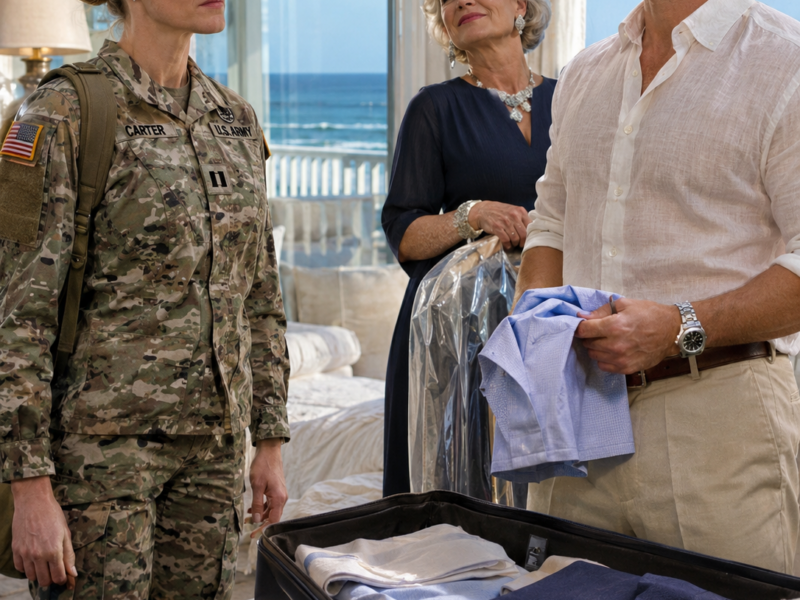
I was still wearing my Army uniform.
My husband, Grant, stood beside our bed, carefully arranging expensive clothes inside two open suitcases.
New linen shirts. Designer loafers. A navy blazer with the price tags still attached.
I leaned against the doorway.
“Going somewhere fancy?”
He barely glanced at me.
“The resort has a dress code.”
“What resort?”
His hands stopped moving.
“The one in Maui. For my promotion.”
I waited for him to explain.
He didn’t.
Grant had recently become vice president of Coastal Meridian Development, a luxury real estate company based in Wilmington.
For three weeks, I’d listened to him talk about his new position.
I’d congratulated him. Celebrated with him. Told him how proud I was.
But this was the first I’d heard about Hawaii.
“When were you planning to tell me?”
“I thought Mom mentioned it.”
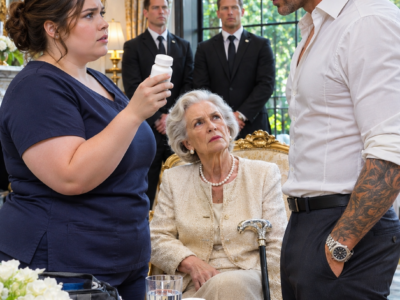
As if summoned by her name, my mother-in-law appeared in the hallway carrying a garment bag.
Evelyn’s silver hair was freshly styled. Diamond earrings sparkled beneath the bedroom lights.
“Grant, sweetheart, don’t forget your dinner jacket.”
Then she noticed me.
“Oh, Caroline. You’re home early.”
Apparently, I was.
Early enough to discover that my husband had organized a family celebration without his wife.
Grant sighed when I asked who was going.
“It’s a professional event. Investors, executives, important people.”
“And your mother?”
Evelyn smiled.
“Family connections matter in those circles.”
I looked directly at Grant.
“Then why wasn’t your wife invited?”
He finally turned toward me.
“Because it’s for people with status.”
His eyes moved over my uniform.
“You’re just a soldier. You’re not in my league.”
Silence.
Then Evelyn laughed.
It wasn’t a loud laugh. It was worse than that.
It was the quiet, satisfied amusement of someone who had been waiting years to hear those exact words.
I stared at the man I’d been married to for twelve years.
This was the same man who once brought me coffee before five in the morning because he knew I had physical training.
The same man who drove three hours through a thunderstorm when my father was hospitalized.
Where had that man gone?
I could have reminded Grant that I was a major in the United States Army.
I could have explained that I was responsible for personnel and equipment worth more than everything inside his company’s office.
But I refused to defend my worth to someone who had already decided I had none.
“Enjoy Hawaii,” I said.
He blinked.
“That’s it?”
“That’s it.”
I walked downstairs before either of them noticed my trembling hands.
The kitchen overlooked the Atlantic Ocean.
My father had installed those windows himself, back when the neighborhood had more fishing boats than luxury vacation rentals.
I filled the kettle.
Upstairs, Evelyn continued discussing restaurant reservations.
Grant’s brother, Peter, was going. Several business associates were going. Their spouses were going.
Everyone belonged.
Except me.
The kettle began whistling.
I turned off the stove without making tea.
Twelve years earlier, Grant had been an ambitious commercial property salesman with an infectious smile and enormous dreams.
I believed in him.
During our fourth year of marriage, his company downsized, and he lost his job.
I covered the mortgage on our townhouse. I paid the insurance and most of our household bills.
When another opportunity appeared, I helped him prepare.
When that opportunity disappeared, I helped him start again.
Never once did I call him unsuccessful.
Never once did I suggest he was beneath me.
That’s what marriage meant to me.
Five years earlier, my father, Robert Hale, passed away after a brief illness.
Dad had spent most of his life repairing fishing boats and carefully saving his money.
His beach house was his greatest pride.
He left it to me.
Grant suggested selling our townhouse and moving into the inherited property so we could save more for retirement.
I agreed.
Then Evelyn sold her condominium and asked whether she could stay with us temporarily.
Temporary became permanent.
She occupied the guest suite, complained about my early mornings, and gradually started calling the property “our family beach house.”
I paid the taxes.
I paid the insurance.
I handled the repairs.
Grant contributed toward groceries and utilities occasionally.
Evelyn never paid rent.
Still, I convinced myself that helping family was the right thing to do.
That Thursday evening, I opened the drawer beneath our kitchen telephone.
Inside was a photograph of Dad standing beside his fishing boat.
Behind it rested a folder containing his estate documents.
I remembered something he’d told me shortly before he passed.
“Carrie, helping people is a good thing. Just don’t let them start believing your kindness belongs to them.”
I’d laughed when he said it.
I wasn’t laughing anymore.
I opened the folder.
The deed contained one name.
Mine.
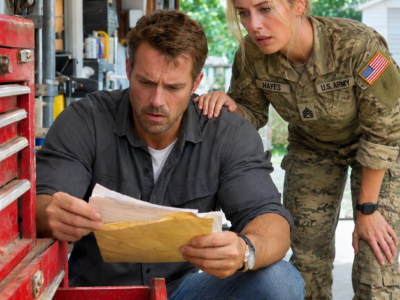
Then I noticed an unopened envelope tucked behind the paperwork.
It had arrived two weeks earlier, addressed directly to me.
The return address belonged to a real estate investment company in Wilmington.
Across the front, someone had written three words.
Already taken care.
I recognized Grant’s handwriting immediately.
My stomach tightened.
Why would my husband be handling correspondence concerning property he didn’t own?
And why hadn’t he mentioned it?
I slipped the envelope into my work bag and emailed Margaret Ellis, the attorney who had settled Dad’s estate.
I requested an appointment.
Upstairs, Grant was laughing with his mother.
I pressed send.
Suddenly, Hawaii seemed like the least important part of my marriage.
By seven the following morning, Grant was complaining that his coffee wasn’t hot enough.
Evelyn sat at the breakfast counter wearing expensive sunglasses.
Their flight departed from Raleigh that afternoon, with a connection in Dallas.
“Did you schedule the lawn service?” Grant asked.
“No.”
He frowned.
“We’re having important people over when we get back. The property needs to look presentable.”
“Then you should call them.”
Evelyn lowered her sunglasses.
“There’s no need to be difficult, Caroline.”
I rinsed my breakfast bowl.
“I’m going to work.”
Grant followed me into the hallway.
He insisted that his promotion was important and that he’d spent fifteen years building his career.
Apparently, maintaining a particular image mattered.
“And having your wife there would ruin that image?” I asked.
“That’s not what I said.”
I picked up my keys.
There was no point arguing with someone already rewriting the conversation we’d had less than twenty-four hours earlier.
At 11:45, my phone buzzed.
Grant had sent a photograph of himself and Evelyn standing beside their luggage at the airport.
Both were smiling.
See you Tuesday.
I put my phone away.
Margaret’s receptionist had scheduled my appointment for 3:30, and I’d arranged a few hours of approved personal leave.
That afternoon, I drove to Wilmington with the mysterious envelope beside me.
Margaret’s office occupied the second floor of an old brick building near Market Street.
She’d known my father since I was in high school.
When she saw me, she stood and hugged me.
Then she studied my expression.
“This isn’t a social visit, is it?”
I shook my head.
I told her everything.
The promotion. The vacation. The conversation in our bedroom.
She listened quietly.
When I finished, she removed her glasses.
“That was an ugly thing for him to say.”
I nodded.
“But you didn’t come here because your husband hurt your feelings.”
“No. I need to understand my rights concerning Dad’s house.”
Margaret opened the property records.
Dad had purchased the original cottage in 1989. Over the years, he’d expanded it, repaired storm damage, and refused repeated offers from developers.
The recorded deed still identified me as the sole owner.
Grant’s name wasn’t there.
Neither was Evelyn’s.
For the first time since the previous evening, I felt a little stronger.
Then Margaret asked whether either of them had a rental agreement.
They didn’t.
She asked who paid the taxes, insurance, and major repairs.
I explained our financial arrangements.
Margaret took notes.
“Ownership and occupancy are different issues, Caroline. Your marriage also creates complications we need to consider.”
“So I can’t simply change the locks?”
“Not safely.”
I’ll admit that part of me had imagined Grant returning from Hawaii to find his suitcases sitting outside.
But Margaret warned me against giving him a legal problem he could use against me.
No changing locks.
No removing belongings.
No shutting off utilities.
We would document everything and follow the proper procedures.
It wasn’t the immediate satisfaction I’d imagined.
But it made sense.
Then I remembered the envelope.
“I found something else.”
I placed it on her desk.
Margaret examined the return address before carefully opening it.
Three pages slid onto the polished wood.
The company was Atlantic Crest Investment Partners.
She began reading.
Her expression changed.
“Caroline, has Grant discussed selling your house?”
“No.”
“Has anyone approached you about purchasing it recently?”
“No. I’ve never wanted to sell.”
She turned the second page toward me.
A paragraph identified Grant as the owner’s authorized representative in preliminary property negotiations.
I read it twice.
Then a third time.
“That can’t be right.”
Margaret pointed toward another paragraph.
It referenced a signed authorization supposedly submitted earlier that month.
My mouth went dry.
I hadn’t signed anything.
Margaret requested the latest recorded property documents from her assistant.
While we waited, she explained that the correspondence didn’t establish that a sale had occurred.
It didn’t even establish whether Grant’s authority had been verified.
But someone had represented that he had my permission.
The assistant returned.
Thankfully, the deed remained unchanged.
No property transfer had been recorded.
Margaret picked up the correspondence again.
Then she looked directly into my eyes.
“Did you ever authorize your husband to negotiate the sale of this house?”
“No.”
“Did you sign anything allowing him to represent you?”
“Absolutely not.”
She slowly closed the folder.
“Then we need to find out who told them you did.”
I drove home without turning on the radio.
At a traffic light, I checked my phone.
Grant had posted another photograph.
He was holding a glass of champagne beside Evelyn in the Dallas airport lounge.
The caption read:
Hard work finally pays off.
For twelve years, I’d helped pay for the life he was celebrating.
Now, I was wondering whether my husband had decided that the last thing my father left me was simply another business opportunity.
And I still hadn’t seen the document that supposedly carried my permission.
Continue in the comments 👇…
Part 2…
That evening, Margaret contacted Atlantic Crest and requested that the company preserve every document connected to the proposed transaction.
She warned me not to confront Grant.
By Monday, maintaining my composure was becoming increasingly difficult.
That evening, my neighbor, Nora Bennett, arrived with homemade chicken soup.
Halfway through dinner, she asked something that made me freeze.
“Caroline, are you selling the house?”
I lowered my spoon.
“Why would you ask that?”
She explained that Grant had shown two men and a woman around my property on Wednesday, April 29.
One carried a leather folder.
Grant had described the property’s redevelopment potential and assured them that he expected the owner to cooperate.
The owner.
Not his wife.
The following morning, Margaret called.
Atlantic Crest had verified my identity and agreed to release the submitted documents.
That afternoon, a secure email arrived.
There were photographs of my father’s house, preliminary pricing discussions, and correspondence involving Grant.
Then I opened the final attachment.
An authorization form.
My full name appeared at the top.
At the bottom was a signature that resembled mine.
Almost.
The capital C was wrong. The final stroke was wrong.
And on the date listed, I’d been working at Fort Liberty from before sunrise until evening.
I immediately called Margaret.
“That’s not my signature.”
“I suspected you’d say that.”
Outside, the ocean looked impossibly peaceful.
I stared at the screen, wondering who had put my name on that document—and how far my husband had intended to go.
SAY ”Full Story” IF YOU WANT TO READ THE FULL STORY ✨💕