My Sister’s Fiancé Mocked My Army Service for Three Years, Then Ripped My Unit Patch Off at His Engagement Party. He Dropped It Into a Punch Bowl While 41 Guests Watched, Expecting Everyone to Laugh at My Humiliation. My Sister Stayed Silent, Just Like Always, Until an Older Man Standing Behind Her Fiancé Put Down His Glass. What That Stranger Said Next Exposed a Secret I Had Kept Buried for Four Years.
My Sister’s Fiancé Mocked My Army Service for Three Years, Then Ripped My Unit Patch Off at His Engagement Party. He Dropped It Into a Punch Bowl While 41 Guests Watched, Expecting Everyone to Laugh at My Humiliation. My Sister Stayed Silent, Just Like Always, Until an Older Man Standing Behind Her Fiancé Put Down His Glass. What That Stranger Said Next Exposed a Secret I Had Kept Buried for Four Years.
Part 1…
The ice cubes were still clicking against my Army unit patch when the silver-haired man standing six feet behind my sister’s fiancé put down his glass.
“Apologize. Right now.”
His voice wasn’t loud.
It didn’t need to be.
Forty-one people had gathered at that engagement party outside Charlotte, North Carolina. Twenty minutes earlier, they’d been laughing, drinking, and congratulating my sister Megan on her upcoming wedding.
Now the room was going silent.
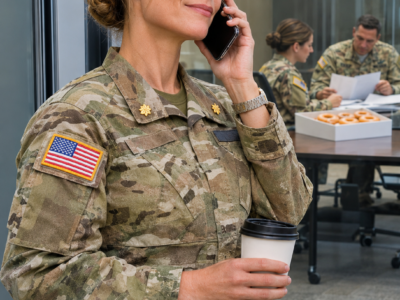
My name is Jolene Beckett. I was an Army combat medic, and for three years, the man my sister planned to marry had called me the “Band-Aid girl.”
He thought it was hilarious.
I never did.
But standing there with my damaged uniform patch floating between orange slices in a bowl of fruit punch, I realized something.
Kyle Prether had finally made a joke in front of someone who understood exactly what it meant.
And that man knew a name my own family had never heard.
To understand what happened that night, you need to understand how long I’d been swallowing my anger.
Megan met Kyle at a financial planning seminar in Charlotte when she was twenty-six. He was twenty-nine, confident, broad-shouldered, and remarkably skilled at making every conversation about himself.
Especially his military experience.
Or what he called military experience.
Kyle had spent two years in ROTC at a state university before leaving the program.
Officially, he’d struggled academically.
According to Kyle, he’d walked away because the training wasn’t challenging enough.
He repeated that explanation so confidently that people rarely questioned it.
I knew better.
When Megan first brought him home for Thanksgiving, I was twenty-four and had already served five years in the Army.
I was a 68 Whiskey combat medic assigned to an infantry company in the 3rd Brigade, 10th Mountain Division.
I’d completed one deployment to Afghanistan.
My second was sixty days away.
That Thanksgiving, I remember the smell of roasted turkey, the sound of football playing in the living room, and Kyle’s unnecessarily firm handshake.
“Megan says you’re in the Army.”
I nodded.
“I’m a combat medic.”
He smirked.
“So you hand out aspirin and do paperwork?”
I waited for the punch line.
That was it.
Megan gave me a small, familiar smile. The kind that silently begged me not to create an uncomfortable situation.
So I said nothing.
I wish I’d known what that silence would cost me.
Because Kyle never stopped.
At Christmas, he called me the Band-Aid girl while everyone passed dinner plates.
At family gatherings, he joked that I was basically a school nurse wearing camouflage.
At restaurants, he’d introduce me to strangers by asking whether I’d brought enough aspirin for everyone.
People laughed awkwardly.
Megan always smiled.
And I kept swallowing the humiliation because I loved my sister.
That was the worst part.
I wasn’t afraid of Kyle.
I’d faced things far more frightening than an insecure man making jokes across a dinner table.
I just didn’t want Megan caught between us.
My father, Frank, understood more than anyone.
He’d served in the infantry himself, completing two tours in the early 1990s.
He returned home with a damaged vertebra and memories he rarely discussed.
For twenty-three years, he drove a delivery truck.
He never displayed his discharge papers.
Never bragged.
Never turned his service into dinner conversation.
He kept one photograph in his wallet.
Twelve soldiers standing together beside a concrete barrier.
When I was sixteen, he showed it to me once.
“Those are the men I’d die for.”
Then he carefully put the picture away.
Dad knew what combat medics did.
He also knew why some stories couldn’t be told over mashed potatoes.
Whenever Kyle insulted me, Dad’s expression changed.
He’d grow quiet.
Sometimes he’d set down his fork.
But he respected my decision not to confront Kyle.
And I thought keeping the peace was worth it.
Until Afghanistan changed everything.
During my second deployment, our platoon was conducting a clearing operation in Paktika province.
It was March.
The air was dry. Dust clung to our equipment.
Then everything happened at once.
Our platoon came under attack inside a compound.
The engagement lasted forty-one minutes.
Three soldiers were seriously injured within the first ninety seconds.
I was sixty meters from cover.
My medical bag was strapped against me, and every instinct told me how exposed I was.
But someone was calling for a medic.
So I ran.
The first soldier was a specialist with a dangerous leg injury.
I reached him, applied a tourniquet, and pulled him toward cover while impacts struck the wall behind us.
Then I went back.
The second soldier had a serious chest injury.
I treated him in a doorway while our squad leader protected our position.
My hands moved automatically.
Training took over.
There wasn’t time to be frightened.
Then I heard about the lieutenant.
He was unconscious.
I couldn’t carry him alone.
A sergeant from second platoon appeared beside me, and together we moved him through a drainage ditch to the casualty collection point.
One hundred and ten meters.
I remember the weight.
I remember the dirt.
I remember wondering whether we’d reach safety in time.
We did.
All three soldiers survived.
I didn’t think of myself as heroic.
I’d done my job.
But Captain Aldridge, our company commander, saw things differently.
He recommended me for a Bronze Star with Valor device.
The battalion commander approved it.
Sixteen days later, Brigadier General Harlan Pierce pinned the medal onto my uniform.
I barely remember the ceremony.
I hadn’t slept properly in thirty hours.
My hands still trembled whenever I remembered that doorway.
Afterward, General Pierce pulled me aside.
He was tall, with gray beginning to show at his temples and a voice that could quiet a room without effort.
“Beckett, do you know what they’re calling you?”
I shook my head.
“Razor.”
I stared at him.
He almost smiled.
“Because you cut through it. No hesitation. No wasted motion.”
He told me the soldiers had started using the name after hearing how I’d crossed sixty meters of exposed ground to reach the injured.
Then he shook my hand.
“Remember that name. You earned it.”
Razor.
Five letters.
A name born from the worst forty-one minutes of my life.
It stayed with me.
Not on official paperwork.
Not on my driver’s license.
But among the soldiers who knew what had happened.
I never told my family.
Not about Razor.
Not about the operation.
Not even about the Bronze Star.
I kept that medal tucked inside a sock drawer beneath old clothes in my apartment.
When Mom asked about my deployment, I mentioned receiving a commendation.
She said she was proud.
Kyle asked whether it came with a raise.
I changed the subject.
Four years passed.
And then came the engagement party.
Megan and Kyle had been together for three years when he proposed that August.
He talked endlessly about the ring.
Its price.
Its size.
How difficult it had been to choose.
Megan seemed happy, although sometimes I wondered whether she was simply relieved to be getting married.
Their celebration was scheduled for a Saturday in October at Winslow Farm Estate, about twenty minutes outside Charlotte.
The venue looked beautiful.
String lights hung above the gathering space.
A rustic barn provided the perfect backdrop for photographs.
A DJ played soft rock.
There was even a signature cocktail Kyle had named after himself.
Of course there was.
I arrived at six o’clock wearing slacks and my old field jacket.
The jacket had my 10th Mountain Division patch sewn onto its left shoulder.
It wasn’t a dress uniform.
It was simply something I owned.
Something I’d earned.
And after years of hiding parts of myself to keep Kyle comfortable, I wanted to wear it.
Dad noticed immediately.
He touched the patch gently with two fingers.
Then he nodded.
That small gesture meant more than any compliment.
Twenty minutes later, Kyle noticed too.
He was standing near the bar with two college friends, holding bourbon and retelling one of his familiar ROTC stories.
His eyes landed on my shoulder.
His smile widened.
“Look who’s here. The Band-Aid girl.”
His friends chuckled.
I greeted them politely and reached for water.
Kyle stepped closer.
“Seriously, Jolene? You wore that here?”
I looked down at my jacket.
“It’s a jacket, Kyle.”
“It’s a costume.”
His friends laughed again.
Then he made another joke about handing out aspirin overseas while pretending he’d accomplished something extraordinary.
I felt Dad move closer.
“Kyle. That’s enough.”
Kyle waved him off.
“Relax, Frank. I’m joking.”
Then he turned toward me.
“Right, Jolene?”
I didn’t answer.
I was tired.
Tired of defending a career he didn’t understand.
Tired of watching my sister smile while he belittled me.
Tired of pretending his cruelty was harmless.
Kyle mistook my silence for a challenge.
He reached toward my shoulder.
At first, I thought he was going to point at the patch.
Instead, his fingers caught its edge.
Then he pulled.
The stitching tore with a sharp, ugly sound.
I froze.
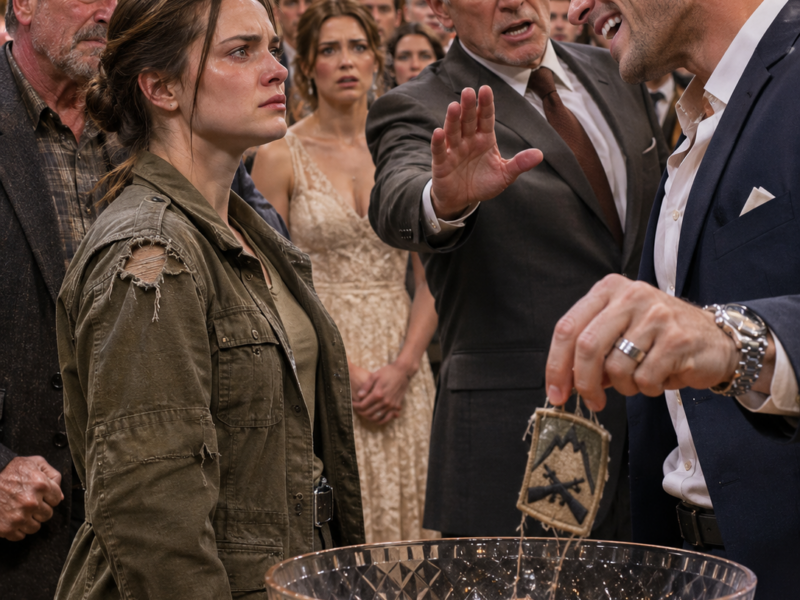
He had ripped the unit patch straight off my jacket.
For one second, I couldn’t believe what I was seeing.
Kyle held it up like a prize.
His friends stared.
Then, with a theatrical grin, he turned toward the punch bowl.
And dropped it in.
The patch floated briefly.
Orange slices bumped against the fabric.
Ice cubes gathered around the torn stitching.
“There,” Kyle announced.
“Now it’s a party.”
Several people laughed nervously.
Others went silent.
My father stood beside me, his jaw tightening.
Across the room, Megan had seen everything.
She looked at Kyle.
Then at me.
And there it was again.
That same pleading smile.
Please don’t make a scene.
Please let this go.
Please make things easier for everyone.
Something inside me finally gave way.
Not loudly.
Not dramatically.
I simply stopped wanting to protect people from the consequences of their choices.
I stared at the punch bowl.
And suddenly I wasn’t seeing orange slices or ice.
I was remembering a doorway in Paktika.
A medical bag.
Three injured soldiers.
The lieutenant’s weight as we struggled through that drainage ditch.
I remembered General Pierce shaking my hand.
Razor.
You earned it.
Kyle had just thrown something meaningful to me into a bowl of punch for entertainment.
And my sister expected me to smile.
I opened my mouth.
But someone spoke first.
Six feet behind Kyle, an older man in a gray civilian suit had set down his sparkling water.
He was sixty-one.
Silver-haired.
Clean-shaven.
Standing perfectly straight.
I hadn’t noticed him arrive with his wife earlier that evening.
They were guests of the venue owner’s family.
I hadn’t seen him in four years.
Not since that formation in Afghanistan.
But I recognized him instantly.
Lieutenant General Harlan Pierce.
Retired only eight months earlier.
A three-star general.
The man who had once commanded the brigade in which I’d served.
He looked at the punch bowl.
Then at Kyle.
“Apologize. Right now.”
Kyle turned around.
“Excuse me?”
The general’s expression didn’t change.
“Take that patch out. Dry it. Return it to her. Then apologize.”
Kyle blinked.
“Who are you?”
The older man straightened slightly.
“My name is Harlan Pierce. Retired lieutenant general, United States Army.”
Kyle’s smile disappeared.
And then General Pierce said something that made every conversation in that room stop.
“That woman is the reason three soldiers in my brigade came home to their families.”
Someone lowered the music.
Kyle’s bourbon trembled in his hand.
The general took one measured step forward.
And I knew he was about to tell forty-one strangers the story I’d spent four years keeping to myself.
Continue in the comments 👇…
Part 2….
“Her name in my brigade was Razor,” General Pierce said.
“Razor Beckett.”
My chest tightened.
He described the operation in Paktika. The exposed ground. The injured soldiers. The medical decisions that had kept three men alive.
Then came the words I’d never expected my family to hear.
“I personally pinned her Bronze Star with Valor device onto her uniform.”
Nobody laughed.
Kyle looked toward Megan.
Her familiar smile was gone.
But before he could speak, a woman near table four stood up.
“Lieutenant Colonel Ann Weston. Retired. Third Brigade staff.”
She said she remembered my call sign from the casualty reports.
Then another voice came from near the back door.
“Master Sergeant Donald Frey.”
I turned.
My breath caught.
He was the sergeant who had helped me carry the lieutenant through that drainage ditch.
“She carried most of his weight,” Frey said quietly.
Three veterans.
Three witnesses.
All standing inside my sister’s engagement party.
Megan stared at me, then at Kyle.
For the first time, she wasn’t asking me to keep the peace.
“Kyle,” she said.
“Get her patch.”
He turned toward the punch bowl.
His face had lost every trace of confidence.
I watched him reach into the orange-colored punch.
And suddenly I understood that the hardest part of that evening wouldn’t be hearing the truth about my service.
It would be watching my sister finally confront what she’d allowed for three years.
SAY ”Full Story” IF YOU WANT TO READ THE FULL STORY ✨💕