My Sister Humiliated Me in Front of 200 Guests at Our Parents’ Anniversary Dinner, Claiming My Army Service Had Left Me Without a Real Career. My Mother Sat Quietly While My Brother-in-Law Smirked, Never Imagining What My Uniform Actually Represented or Who Was Sitting Just Down the Hall. Then a One-Star General Walked Into the Ballroom, Took the Microphone, and Said Something That Made My Entire Family Go Silent.
My Sister Humiliated Me in Front of 200 Guests at Our Parents’ Anniversary Dinner, Claiming My Army Service Had Left Me Without a Real Career. My Mother Sat Quietly While My Brother-in-Law Smirked, Never Imagining What My Uniform Actually Represented or Who Was Sitting Just Down the Hall. Then a One-Star General Walked Into the Ballroom, Took the Microphone, and Said Something That Made My Entire Family Go Silent.
Part 1…
My sister took the microphone at our parents’ anniversary dinner and told 200 people I had wasted my life.
She didn’t use those exact words.
That would have been too obvious.
Instead, she smiled beneath the ballroom chandeliers and said, “Elena joined the Army straight out of high school, so she never really had a career path to speak of.”
A few people chuckled politely.
My brother-in-law nodded.
My mother didn’t object.
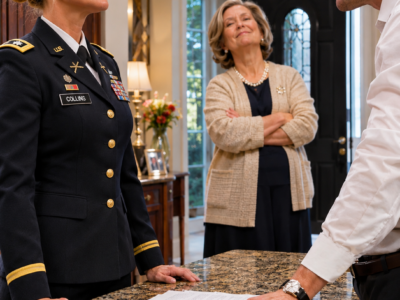
And I sat twelve feet away, wearing my Army dress uniform, feeling something inside me go painfully still.
I didn’t stand up.
I didn’t interrupt.
I had spent seventeen years learning when to speak and when to remain silent.
But what my sister didn’t know was that another military officer was attending a dinner approximately 200 feet away.
A man whose signature appeared on three commendations in my classified file.
A man who knew exactly what I had sacrificed.
And before that evening was over, he would pick up a microphone of his own.
But I’m getting ahead of myself.
Let me tell you how it started.
I had been awake for thirty-one hours when I walked into the Meridian Hotel.
My flight from Fort Bragg had landed at 6:40 that evening.
I changed into my dress uniform in an airport bathroom, balancing my bag against a sink while trying to straighten the brass on my jacket.
The fluorescent lights were unforgiving.
So was the mirror.
I looked exhausted.
There was a stubborn crease in my collar from the deployment bag. My hair was neatly secured, but my face carried the kind of fatigue no makeup could hide.
Still, I was there.
That mattered to me.
My parents were celebrating their anniversary, and I had promised myself I wouldn’t miss another important family occasion.
I had missed too many already.
Thanksgivings.
Birthdays.
Christmas mornings.
Ordinary Sunday dinners that probably meant more than anyone realized.
My work had taken me away from home for years, sometimes to places I couldn’t discuss.
I couldn’t explain why.
I couldn’t even explain where.
And over time, my family had decided that my silence meant I had nothing particularly important to say.
The cab pulled up at the hotel shortly after seven.
I was three minutes late.
My mother was waiting near the ballroom entrance.
She looked beautiful in a carefully tailored evening dress, her hair arranged exactly the way she liked it.
Her eyes traveled down my uniform.
Then back to my face.
“You look tired,” she said.
Not hello.
Not I’m glad you’re here.
Just tired.
“I had a long trip, Mom.”
She gave a small nod.
“Well, everyone’s already seated.”
I followed her inside.
The ballroom glittered.
White tablecloths covered round tables. Silver-framed family photographs stood beside elaborate centerpieces.
Soft music floated beneath the conversations.
Waiters moved between guests carrying polished trays.
Everything looked perfect.
My sister Ranata had organized it.
Of course she had.
Ranata had always known how to create the perfect impression.
She graduated from Georgetown, married a successful corporate attorney named Victor, and built the kind of life my parents could describe proudly to anyone who asked.
Her accomplishments had titles.
Her husband’s accomplishments had salaries.
Their lives came with photographs, promotions, and stories that sounded impressive at dinner parties.
Mine came with restrictions.
That was the difference.
As I walked toward my table, I noticed the family photographs.
Ranata appeared in four.
I appeared in one.
And even there, I was standing at the edge of a group picture, partly cut off by the silver frame.
I stopped for half a second.
Then kept walking.
It was such a small thing.
But small things become heavy when you’ve been carrying them for years.
Ranata spotted me near the center of the room.
Her expensive dress shimmered beneath the lights.
I knew exactly how much it cost because she’d told me in a text.
The same message had included a cheerful reminder not to look “too military.”
I had read that sentence three times.
Then put my phone away.
My sister wasn’t deliberately cruel in the way people imagine cruelty.
She could be generous.
She remembered birthdays.
She sent expensive gifts.
But she had a fixed picture of what success looked like.
And I had never fit inside it.
I joined the Army at eighteen.
While Ranata was building her future at Georgetown, I was learning how to survive pressure, follow orders, and make decisions that affected people beyond myself.
At first, she called every month.
Then only on holidays.
Eventually, mostly Christmas.
When she married Victor, I returned from my second deployment just forty-eight hours before the ceremony.
I barely remember sleeping.
I do remember Victor shaking my hand.
“So you’re the Army one.”
I smiled politely.
He asked whether I worked in logistics.
I gave him the simplest answer I could.
Something close enough to the truth.
Because explaining my actual responsibilities wasn’t an option.
For the past six years, I had worked in special operations intelligence.
My assignments weren’t something I could describe over dinner.
I couldn’t tell my mother which country I’d recently returned from.
I couldn’t explain why the name in certain records differed from the name on my uniform.
And I certainly couldn’t show my family the secured documents containing my commendations.
So they filled the silence themselves.
I became the daughter who never went to college.
The sister who never built a proper career.
The family member who had somehow chosen the difficult road instead of the respectable one.
I told myself their opinions didn’t matter.
Most days, I believed it.
But sitting in that ballroom, surrounded by photographs that barely acknowledged my existence, I wasn’t entirely sure.
My assigned seat was beside Aunt Cecilia.
She was my mother’s older sister, a retired schoolteacher with gentle hands and sharp eyes.
She was also the only relative who consistently wrote to me during deployments.
Real letters.
Paper envelopes.
Sometimes newspaper clippings.
Sometimes nothing more than a few sentences about the weather or the flowers blooming in her yard.
She never demanded explanations.
She simply reminded me that someone remembered I existed.
When I sat down, she squeezed my hand.
“You look strong, Elena.”
I almost laughed.
“I look exhausted.”
“No,” she replied softly. “You look like someone who carries important things.”
I looked at her.
For a moment, I couldn’t speak.
Then I squeezed her hand back.
“Thank you.”
Across the table, Victor leaned toward me.
“Still at the same base?”
“I’ve been reassigned.”
He nodded before I’d finished speaking.
His attention had already moved elsewhere.
My mother reached over to refill his water glass.
Mine was empty.
She didn’t notice.
I stared at the glass for a moment, then turned my attention toward the stage.
It wasn’t worth mentioning.
None of it was.
Or so I kept telling myself.
Earlier, during the cocktail hour, I had overheard Victor speaking to another guest.
He hadn’t realized I was close enough to hear.
“She doesn’t have anything to show for it, really.”
His voice was casual.
Almost bored.
He was talking about me.
I recognized the tone immediately.
The tone people use when discussing someone they consider disappointing.
I didn’t confront him.
I simply remembered.
At 8:15, the speeches began.
My father went first.
He had built his hardware store from almost nothing, and I had always admired his determination.
He wasn’t comfortable speaking before crowds.
That evening, his voice trembled slightly as he thanked my mother, his employees, and the people who had supported their marriage.
He thanked his daughters.
Both of us.
Then he moved on.
It was the closest thing to personal recognition I’d received from him in three years.
I applauded anyway.
I loved my father.
That had never changed.
Then Ranata stepped onto the stage.
The microphone suited her.
She spoke beautifully.
She told stories about our parents’ early marriage, the struggles they had overcome, and the values they had passed down.
People smiled.
Some wiped their eyes.
Even I felt myself relaxing.
For eight minutes, she was everything a daughter should be at an anniversary celebration.
Then she began talking about us.
“Victor and I found our path through education,” she said, gesturing toward her husband. “Through building something meaningful together.”
Victor smiled.
A few guests applauded.
Then she turned toward me.
“And my sister Elena joined the Army straight out of high school, so she never really had a career path to speak of.”
She paused.
Smiled.
“But she’s here tonight, and that’s what matters.”
Then she continued with another family memory.
Just like that.
As though she hadn’t publicly reduced seventeen years of service to a failed career decision.
My fingers tightened around my napkin.
I could feel the fabric pressing into my palm.
My face stayed calm.
Inside, something hurt.
Not because I needed strangers to admire me.
Not because I wanted my sister’s success.
I had never wanted her life.
I wanted her to understand that mine wasn’t empty.
And the worst part?
She hadn’t even looked embarrassed.
She genuinely believed she had said something kind.
Aunt Cecilia turned toward me.
Her expression changed.
She opened her mouth, then closed it.
I gave her a small shake of my head.
Not here.
Not tonight.
I wasn’t going to turn my parents’ anniversary into a confrontation.
So I sat through the rest of the speech.
I applauded when everyone else applauded.
I smiled when someone looked my way.
And I let the room believe whatever it wanted.
At 8:40, I excused myself.
Dessert was being served.
Ranata was surrounded by guests congratulating her on the beautiful celebration.
My mother looked delighted.
My father was personally refilling coffee cups.
I walked into the lobby.
I needed quiet.
That was when I remembered the event board I’d noticed earlier.
The Veterans Foundation was hosting its annual dinner in the adjacent ballroom.
I had registered the information automatically when I arrived.
The location.
The entrances.
The nearby corridors.
Old habits.
I hadn’t thought much about it.
Until I reached the east corridor.
A glass-paneled door stood partly open.
Beyond it, I heard conversation and the faint clinking of silverware.
An Army aide in dress blues stood outside holding a tablet.
He looked up.
His eyes moved over my uniform.
My rank.
My insignia.
My name.
Then his expression changed.
“Captain Ortiz?”
“Yes.”
He straightened.
“One moment, please.”
Before I could ask why, he disappeared through the doorway.
I stood alone beneath the hallway lights.
The patterned burgundy carpet stretched beneath my shoes.
Behind me, my family’s celebration continued.
Ahead of me, chairs shifted inside the other ballroom.
I heard footsteps.
Then the door opened.
And Brigadier General Marcus Webb stepped into the corridor.
I knew him immediately.
He was the one-star general who had commanded me for the past three years.
His signature appeared on three commendations in my secured records.
He knew things about my service that my own family would never be permitted to hear.
I hadn’t expected him in the city.
I hadn’t seen his name on any schedule available to me.
Yet there he was.
Standing only a few feet away.
He studied my face.
Then came the smallest suggestion of a smile.
“Captain.”
“Sir.”
He glanced toward the lobby.
“I heard there’s a party.”
My stomach tightened.
I didn’t know how much he’d heard.
I didn’t know why he’d come out.
But when he turned toward the main ballroom, his aide following two steps behind, I understood that he intended to accompany me.
We walked together.
No dramatic announcement.
No raised voices.
Just the quiet footsteps of two officers crossing a hotel lobby.
At 8:53, we entered my parents’ ballroom.
I checked my watch automatically.
The first guests noticed us near the entrance.
Then others turned.
Conversation began fading.
My father stood.
My mother’s smile disappeared.
Ranata stopped speaking in the middle of a sentence.
The general walked toward the stage.
He reached for the microphone.
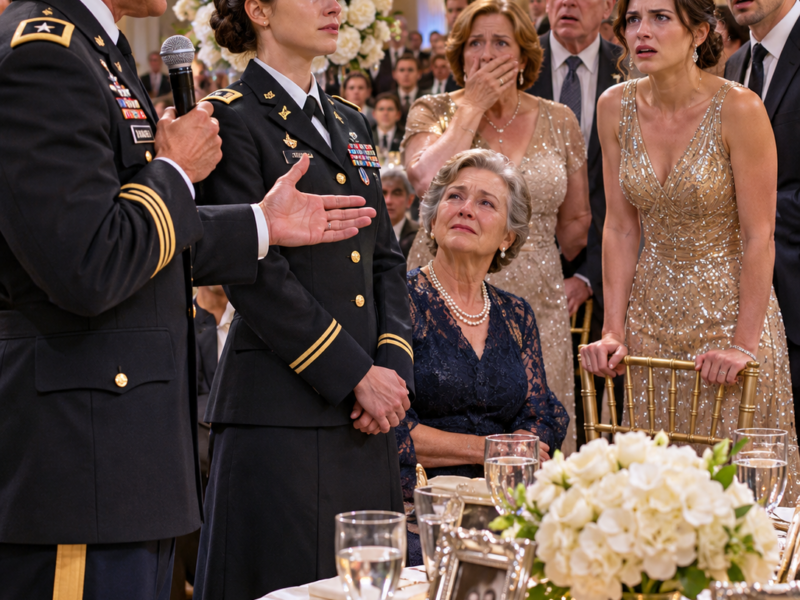
And suddenly, two hundred people were watching him.
“I apologize for the interruption,” he began.
His voice was steady.
“My name is Marcus Webb. I’m a brigadier general in the United States Army, and I’ve had the privilege of serving alongside your family’s daughter for the last three years.”
Nobody moved.
He explained that he had been attending another event in the hotel when a member of his staff recognized Captain Ortiz’s name on the anniversary program.
Then he paused.
“I believe in showing up when it counts.”
I felt my heartbeat in my throat.
He looked toward me.
“Captain Elena Ortiz is one of the finest officers I have commanded.”
My mother’s hand rose toward her mouth.
Ranata’s face went pale.
The general continued.
“The nature of her work means I cannot stand here and list what she has done.”
He allowed the words to settle.
“But what I can tell you is that people in this room are safer because of choices she made in places you will never hear about.”
The ballroom was completely silent.
“She does not get to wear her commendations on the outside. That is the nature of her service.”
Then his expression changed.
Only slightly.
But I recognized it.
He had something else to say.
Something that made me realize he knew far more about what had happened that evening than I had imagined.
He looked across the room.
And repeated five words I had heard Victor say earlier.
“She doesn’t have anything to show for it.”
My breath caught.
How had he heard that?
The general waited.
Then he said, “There is a document in a secured file with her name on it that would answer that statement in full.”
Another pause.
“I signed it myself.”
He let the silence stretch.
“Three times.”
My sister gripped the back of a chair.
Victor stopped smiling.
And I realized that the evening my family had planned so carefully had just become something none of us could control.
Continue in the comments 👇…
Part 2….
The general set down the microphone.
“Enjoy your evening. It’s a beautiful celebration.”
Then he walked toward me.
As he passed Aunt Cecilia, he paused beside her.
“She always knew,” he said quietly.
My aunt’s eyes shone.
I couldn’t move.
For seventeen years, I had accepted that my family would never fully understand my work.
Now a man who knew the truth had defended me before two hundred strangers.
And somehow, that hurt almost as much as my sister’s speech.
My father sank into his chair.
My mother covered her mouth.
Ranata stood motionless.
Then Victor approached me.
“Elena, I had no idea.”
He repeated it louder.
I looked at him.
“I know.”
My mother reached me next.
“Why didn’t you tell us?”
The question landed harder than she realized.
“I couldn’t, Mom.”
Around us, conversations resumed in uneasy whispers.
But my attention remained on Ranata.
She had organized everything.
Every photograph.
Every speech.
Every seat.
Yet she had never once asked what my life was really like.
Later, Aunt Cecilia found me outside with two cups of coffee.
She sat beside me in the November cold.
“I’ve waited seventeen years for them to understand,” she whispered.
I stared at the parking lot.
Then, at 10:15, Ranata found me near the coat check.
Her hands were trembling around her clutch.
“Elena, I didn’t know.”
I looked straight at her.
“You never asked.”
She swallowed.
And for the first time that evening, my sister had no prepared response.
SAY ”Full Story” IF YOU WANT TO READ THE FULL STORY ✨💕