My Mother Let 200 Guests Laugh While My Sister Called Me the Daughter Who Almost Destroyed Our Family. For 26 Years, My Parents Blamed Me for a Terrifying Afternoon at Our Lake Cabin and Punished Me. I Sacrificed My Career, My Savings, and My Happiness Trying to Earn Their Love, but Nothing Was Ever Enough. Then I Walked Into Their Anniversary Party Carrying a Flash Drive That Could Change Everything.
My Mother Let 200 Guests Laugh While My Sister Called Me the Daughter Who Almost Destroyed Our Family. For 26 Years, My Parents Blamed Me for a Terrifying Afternoon at Our Lake Cabin and Punished Me. I Sacrificed My Career, My Savings, and My Happiness Trying to Earn Their Love, but Nothing Was Ever Enough. Then I Walked Into Their Anniversary Party Carrying a Flash Drive That Could Change Everything.
Part 1…
Two hundred guests watched my family’s anniversary slideshow call me the daughter who almost ruined everything.
And my mother applauded.
She actually stood up and clapped.
My sister Chloe raised her champagne glass, laughing as the words glowed across the giant screen.
“For the daughter who almost ruined everything. We love you anyway.”
The room erupted in laughter.
I sat at table 22, hidden beside the swinging kitchen doors, feeling the familiar heat of humiliation climb my neck.
I was 38 years old.
A military veteran. A medical instructor. A woman who had spent years helping people survive their worst moments.
Yet somehow, sitting in that ballroom, I was twelve again.
My grandfather Arthur reached beneath the tablecloth and squeezed my hand.
“Whenever you’re ready, Abby.”
Across from me, Marcus Bell leaned forward.
“Say the word, Sarge.”
I looked toward my parents.
My mother was smiling.
My father sat beside her.
And Chloe looked delighted with herself.
None of them knew what I was holding beneath the table.
A flash drive.
Inside were documents, photographs, and a recording that had survived for more than twenty-five years.
I had spent six months preparing.
But the truth began long before that night.
It began on June 27, 1998.
I was twelve.
My sister Chloe was seven.
Our family owned a small cabin at Lake Arrowhead, tucked into California’s San Bernardino Mountains.
The place smelled of pine trees, sunscreen, and warm wooden boards.
There was a screened porch and an old dock my father promised to repair every summer.
That Saturday, my parents were enjoying themselves on our neighbor Gwen Talbot’s pontoon boat.
It floated roughly 150 yards from shore.
Music played across the lake.
Gwen had brought drinks and her little silver camera.
My mother called toward the dock.
“Abby! Watch your sister until we get back!”
I shouted that I would.
Chloe was wearing a yellow swimsuit with a sunflower across the front.
She bounced along the dock, begging me to watch her jump.
“Stay near the ladder,” I warned.
She rolled her eyes.
I remember that clearly.
I also remember sitting on the warm boards with a library book.
I had taken Red Cross swimming lessons for a year.
I was a strong swimmer.
I checked on Chloe between pages.
But I was twelve.
And twelve-year-olds don’t always understand how quickly an ordinary afternoon can change.
One moment, Chloe was splashing near the ladder.
The next, she was gone.
I looked up.
The water was strangely still.
Then I saw yellow beneath the dock.
Eight feet down.
My stomach dropped.
I jumped without thinking.
The lake was cold and green.
I grabbed my sister beneath her arms and kicked upward with everything I had.
My legs burned.
My lungs ached.
Somehow, I pulled her onto the dock.
She wasn’t breathing.
“Chloe! Please!”
I remembered the lessons.
The practice dummy.
The instructions.
I tried to help her breathe and began chest compressions.
I screamed toward the boat.
Nobody came.
The music kept playing.
I dragged Chloe toward the cabin, grabbed the kitchen telephone, and called 911.
The cord barely reached.
I placed the receiver beside me so I could keep helping her.
A woman answered.
Her voice was calm.
“Sweetheart, how old are you?”
“Twelve. My sister’s seven. She’s not breathing.”
She guided me through every terrifying second.
I counted aloud.
Again.
And again.
Then Chloe coughed.
She started crying.
I have never heard anything more beautiful.
The ambulance arrived nine minutes later.
A sheriff’s deputy named Ray Callahan followed.
By the time my parents returned, Chloe was wrapped in an emergency blanket.
I thought they would hug me.
I thought they would be grateful.
I was wrong.
At the hospital, a woman carrying a clipboard asked who had been supervising Chloe.
My mother’s hand tightened around my shoulder.
“Abby was supposed to watch her,” she said. “She got distracted reading.”
I stared at her.
“But Mom, I got her out.”
Her fingers pressed harder.
“Not now, Abigail.”
That was the beginning.
Not of my sister’s recovery.
Of my punishment.
That night, my father confronted me in our Pasadena kitchen.
“You were responsible,” he said. “You almost cost us your sister.”
I tried to explain.
He wouldn’t listen.
I cried upstairs until my pillow was soaked.
Nobody came.
Nobody thanked me.
And nobody mentioned the CPR I had performed.
Chloe remembered almost nothing about the accident.
She grew up believing our parents’ version.
I was the careless sister.
The selfish daughter.
The girl who nearly destroyed the family.
I was grounded until August.
My thirteenth birthday passed without a cake.
My mother said our family had experienced enough drama.
At sixteen, I received twenty dollars and a bus pass.
When Chloe turned sixteen, my parents surprised her with a used Jeep Wrangler.
A giant red bow covered the hood.
My father proudly showed everyone photographs.
I learned not to ask questions.
But I kept swimming.
Water had frightened me once.
Now it was the only place I felt free.
During my junior year, I qualified for the CIF Southern Section Championships in the 200-yard freestyle.
I wrote the date on our kitchen whiteboard.
I taped the schedule to the refrigerator.
At the competition, I searched the bleachers.
Hundreds of people.
Not one familiar face.
I finished fourth.
My coach asked where my parents were.
“They had something else,” I lied.
When I returned home, my mother barely looked up.
“Oh. Was that this weekend?”
I stopped expecting applause.
At graduation in June 2004, my parents attended but left before the photographs.
Chloe had a sleepover.
I wanted to study medicine.
My parents said money was tight.
So I walked into an Army recruiting office and enlisted as a combat medic.
The military offered a path toward college.
It also gave me something I had never received at home.
Purpose.
Respect.
A place where my actions mattered.
Years later, my parents contributed $14,000 toward Chloe’s marketing education at UCLA.
I didn’t argue.
I was already used to paying my own way.
In March 2011, while serving in Kandahar Province, Afghanistan, our convoy came under attack.
Specialist Marcus Bell was seriously injured.
His breathing was failing.
I knelt beside him.
And suddenly, I heard that dispatcher from 1998 in my memory.
Count.
Stay calm.
Keep going.
Marcus survived.
I received the Army Commendation Medal.
I mailed my parents a photograph from the ceremony.
For once, I thought they might be proud.
Several Thanksgivings later, I found that photograph facedown in their junk drawer.
It was buried beneath takeout menus.
On the living room wall hung Chloe’s real estate license.
In a beautiful gold frame.
Something inside me quietly cracked.
Around 2014, I transferred to the Army Reserve, settled in Long Beach, and continued my education.
I borrowed another $29,000.
Eventually, I became a trauma skills instructor at St. Brendan’s Medical Center.
I taught nurses and paramedics how to respond when seconds mattered.
An Army counselor once told me something I couldn’t forget.
“Abby, I think you’ve been going back to that dock your whole life.”
I cried in her office.
Because she was right.
I kept trying to save people.
Maybe I thought that someday, if I saved enough, my parents would finally believe I was good.
Then February 2021 arrived.
My mother called after midnight.
“Abby. It’s your father.”
He had suffered a stroke.
He was sixty-two.
His right side was badly affected, and speaking became difficult.
His insurance covered far less than expected.
Rehabilitation bills accumulated.
My mother panicked.
A home aide cost thirty-eight dollars an hour.
I suggested California’s In-Home Supportive Services program.
She refused.
She called it a government handout.
But when I asked whether Chloe could help, my mother became defensive.
“She has a child and a business, Abby.”
So I stepped in.
I used my paid family leave.
I reduced my hours at the hospital.
I drove from Long Beach to Pasadena through exhausting traffic.
I arranged appointments.
Managed medications.
Paid caregivers.
Covered pharmacy expenses.
For forty months, my life revolved around my father’s needs.
He attended 118 medical appointments.
I took him to 115.
Chloe attended three.
She posted photographs from waiting rooms with captions about family loyalty.
Then she returned to her real estate business.
I said nothing.
When my father turned sixty-five, I organized his birthday celebration.
I paid $2,400 for the barbecue catering.
My mother publicly thanked Chloe for bringing the banner.
I smiled.
I had become very good at smiling.
Eventually, I calculated what caregiving had cost me.
$71,400 from my savings.
Another $46,000 in lost wages.
A total of $117,400.
I stared at the number written on a yellow legal pad.
Then I cried.
Not because I regretted helping my father.
Because I knew nobody would ever acknowledge what it had taken.
One afternoon, while I was tending to his medical needs, he looked toward the window.
His words came slowly.
“Chloe’s gentler.”
I froze.
Chloe had never handled that part of his care.
She had never even tried.
“Okay, Dad,” I whispered.
I finished helping him.
Then I sat in my car and cried for twenty minutes.
In February 2023, my father spent time in intensive care with a serious respiratory infection.
I remained beside him for thirty-one hours.
During that time, Chloe posted a sunset photograph from Maui.
She wore a white sundress.
Her caption read, “Resetting. Grateful for my people.”
I turned off my phone.
My father recovered.
And I continued helping.
Then, in April 2024, I visited my parents to organize his weekly medication.
I was searching for a pharmacy statement when I noticed a thick legal folder on the kitchen table.
It came from an estate attorney.
I opened it.
The heading read:
AMENDMENT TO THE BROOKS FAMILY REVOCABLE TRUST.
The document had been signed March 4.
My parents had changed their estate plan.
Everything went to Chloe.
The Pasadena house, worth approximately $1.4 million.
The Lake Arrowhead cabin, worth approximately $650,000.
The investment accounts.
All of it.
And me?
I was left my grandfather’s pocket watch.
And one dollar.
I stared at the page.
Then I reached the paragraph explaining why.
It accused me of negligence during the June 1998 lake incident.
It said my recent caregiving was an obligation I owed the family, not a gift deserving recognition.
My hands began shaking.
Clipped to the document was a yellow sticky note.
My mother’s handwriting.
“Keep this part exactly as written. D.”
I couldn’t breathe properly.
Twenty-six years.
Twenty-six years of blame.
And even after everything I had sacrificed, my mother wanted that accusation preserved in a legal document.
I photographed every page.
Then I returned the folder to its place.
And I finished organizing my father’s medication.
Because apparently, even after reading those words, I still didn’t know how to stop taking care of them.
That evening, I sat on my kitchen floor and called my grandfather.
Arthur Miller.
My mother’s father.
An eighty-eight-year-old Army veteran.
I told him about the trust.
About the accusation.
About the lake.
He went silent.
Then I heard him take a long, trembling breath.
“Abby, honey,” he whispered. “I’ve been waiting twenty-six years for you to ask me about that day.”
The next afternoon, his old Buick pulled up outside my apartment.
He climbed the stairs carrying a worn leather Bible.
We sat at my kitchen table.
He opened it to the Book of Psalms.
Between the pages lay a stiff certificate with a gold seal.
My name was printed across it.
Junior Life-Saving Citation.
Awarded to Abigail Brooks, age twelve, for courage and skill in saving a life.
I stared at the words.
The county fire department had recognized me.
In 1998.
My grandfather’s eyes filled.
“They mailed it to your parents that August.”
My throat tightened.
“Then why have I never seen it?”
His answer nearly broke me.
“Your mother threw it in the trash. I found it with the coffee grounds.”
I covered my mouth.
For twenty-six years, I had believed nobody knew what I did.
But someone had known.
Someone had recognized me.
And my mother had thrown the proof away.
“Why didn’t you tell me?” I asked.
Grandpa lowered his head.
“Because she was my daughter. I kept hoping she’d do the right thing.”
He reached for my hand.
“I waited too long. I’m sorry.”
I held him and cried.
That week, I requested the original records from the San Bernardino County Sheriff’s Department.
Three weeks later, an envelope arrived.
Inside was Deputy Ray Callahan’s report.
Then a records clerk called.
“Miss Brooks, we found something unusual.”
I sat down.
She explained that the original 911 recording had survived.
It had been preserved in a dispatcher training library.
For more than twenty-five years.
Every new class had heard it.
The label was simple.
“Tape 7. The 12-Year-Old.”
I could barely speak.
The clerk offered to release a copy to me.
I also asked whether the dispatcher was still alive.
Two days later, my phone rang.
“Is this Abigail?”
The voice was older.
But I recognized it.
Immediately.
“My name is Marian Hail. I was the dispatcher who answered your call.”
I started crying before she finished.
She told me she had played my recording for every class she trained.
She wanted new dispatchers to understand courage under pressure.
For twenty-six years, my family had called me careless.
Meanwhile, strangers had been learning from my actions.
The following Saturday, I visited Gwen Talbot at Lake Arrowhead.
She was eighty now.
When I explained why I had come, she began to cry.
She admitted she had been drinking with my parents that afternoon.
Then she disappeared into her house.
She returned holding an old photograph.
It showed my parents laughing aboard her pontoon boat.
Both held drinks.
In the corner was an orange timestamp.
June 27, 1998.
3:02 p.m.
Eight minutes before my emergency call.
I held the photograph carefully.
It was more than a memory.
It was evidence.
In September, my mother finally emailed an invitation to my parents’ fortieth anniversary party.
Everyone else had received theirs six weeks earlier.
Chloe had arranged the seating.
My assignment?
Table 22.
The back corner.
Beside the kitchen doors.
I called Grandpa.
“Where are you sitting?”
His answer was immediate.
“Wherever you are, sweetheart.”
That was when I made my decision.
On October 12, I entered the Lantern House in Pasadena wearing a plain navy dress.
Grandpa walked beside me.
Marcus followed.
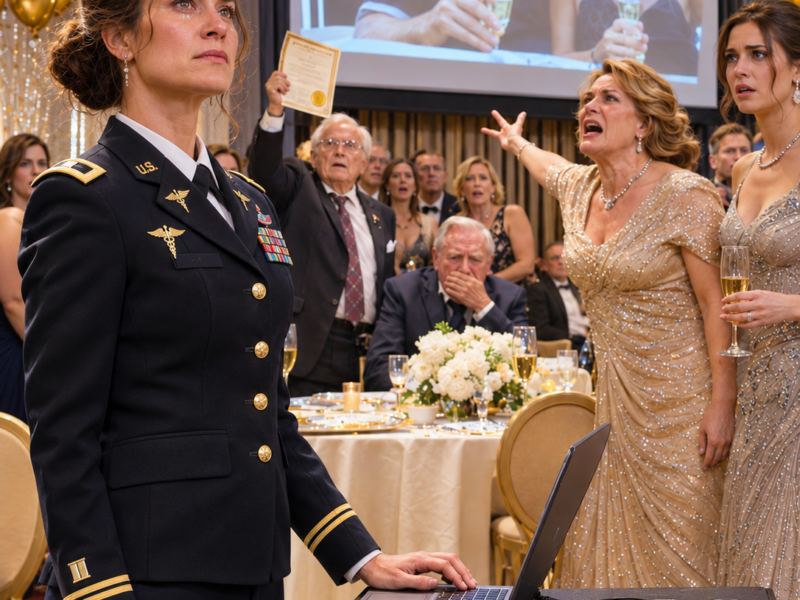
Inside, the ballroom glowed with golden lights.
Chloe’s slideshow began.
Ninety-six photographs.
I appeared in seven.
Every time, I was cropped, blurred, or pushed to the edge.
Then came the final message.
The laughter.
My mother’s applause.
Chloe’s champagne toast.
And her speech about loyalty.
“Some people make everything about themselves,” she announced, looking toward my table.
The guests applauded again.
I pushed back my chair.
The scraping sound cut through the room.
My mother noticed.
“Abigail. Sit down.”
I didn’t.
I walked toward the DJ booth.
Twenty-four seconds.
That was all it took.
I held up the flash drive.
“That’s one version,” I said.
Then I plugged it into the computer.
“Here’s the other.”
The screen went black.
Two hundred guests fell silent.
And the first document appeared.
Continue in the comments 👇…
Part 2….
The words filled the screen.
SAN BERNARDINO COUNTY SHERIFF’S DEPARTMENT.
June 27, 1998.
Deputy Ray Callahan’s report described a seven-year-old child rescued from Lake Arrowhead.
Then came the sentence my parents had spent twenty-six years hiding.
Both parents had been observed drinking aboard a neighboring pontoon boat while their twelve-year-old daughter performed CPR and called emergency services.
My mother screamed.
Her chair crashed backward.
“Turn that off!”
A white-haired man stepped forward from near the bar.
“Diane. Sit down.”
She stopped.
He looked toward the guests.
“I’m Ray Callahan. I wrote that report.”
The room went silent.
I clicked again.
Gwen’s photograph appeared.
My parents laughing on the boat.
The timestamp glowing orange.
3:02 p.m.
Then Grandpa stood, holding my life-saving certificate above his head.
“I pulled this out of the trash,” he said.
My hands trembled as I opened the final file.
The speakers crackled.
A child’s frightened voice filled the ballroom.
“My sister’s not breathing. She’s seven. Please, I’m twelve.”
Chloe’s champagne glass lowered.
Her face went pale.
“Mom,” she whispered. “That’s me.”
My mother reached for her.
Chloe stepped away.
“You told me Abby almost cost me my life.”
I looked at the next folder on my flash drive.
Its title was simple.
WHAT THEY LEFT OUT.
Inside were the missing photographs, the caregiving records, and the trust amendment bearing my mother’s handwritten instruction.
I hadn’t finished.
Not even close.
SAY ”Full Story” IF YOU WANT TO READ THE FULL STORY ✨💕