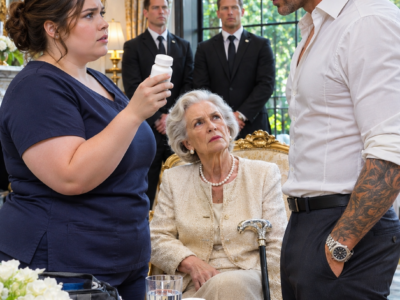
My Mother Brought A Financial Counselor Into My Hospital Room Four Days After Emergency Surgery To Discuss Money. She Claimed Our Family Couldn’t Afford My Medical Bills, Yet Somehow Found $49,000 For My Younger Brother’s Vacation. My Father Stared At The Floor While I Struggled To Understand How My Own Parents Could Abandon Me. Then A Doctor Walked Through The Door, Set His Phone Beside My Bed, And Asked One Devastating Question.
My Mother Brought A Financial Counselor Into My Hospital Room Four Days After Emergency Surgery To Discuss Money. She Claimed Our Family Couldn’t Afford My Medical Bills, Yet Somehow Found $49,000 For My Younger Brother’s Vacation. My Father Stared At The Floor While I Struggled To Understand How My Own Parents Could Abandon Me. Then A Doctor Walked Through The Door, Set His Phone Beside My Bed, And Asked One Devastating Question.
Part 1…
The first word my mother said when she walked into my hospital room wasn’t my name.
It was liability.
Four days earlier, I had undergone emergency surgery following a terrible car accident. Now, lying beneath a thin hospital blanket at Westchester Medical Center in Valhalla, New York, I watched my mother clutch her purse against her chest like I was someone trying to rob her.
My father stood behind her.
He wouldn’t look at me.
A woman wearing a hospital identification badge waited awkwardly in the doorway. Her name was Carol, and she worked in patient financial services.
My mother had insisted she come.
“We just want to be transparent,” Mom announced. “Go ahead, Carol. Tell her.”
Carol glanced at her clipboard.
“Your account is currently registered as self-pay. Your estimated medical expenses are approximately $187,000.”
My mother released a dramatic sigh.
Carol explained that a payment arrangement would require an initial payment of $7,500 and someone willing to cosign.
My mother immediately interrupted.
“And that’s something your father and I simply cannot do.”
Her eyes became suspiciously glossy.
“Honey, we’re on a fixed income. We can’t risk everything we’ve worked for. You understand, don’t you?”
I stared at her.
There was a medical tube taped to my side. Moving even slightly made me uncomfortable, and the medication left me exhausted.
But I understood perfectly.
Just not in the way she expected.
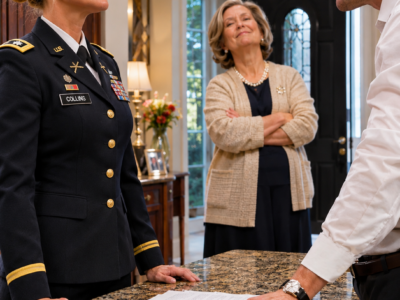
My name is Hannah. I’m 34 years old, a physical therapist, and an active-duty major in the United States Army stationed at West Point.
I’d served for twelve years.
My emergency medical care was covered.
A nurse had already explained that my mother had told hospital staff I didn’t have insurance when they contacted her after the accident.
My military identification was still inside my damaged vehicle.
I could have corrected everything immediately.
Instead, I stayed quiet.
For once, I wanted to discover what my mother would do when she believed I genuinely needed her.
Growing up in Yonkers, I learned early that there were two kinds of children in our household.
My younger brother, Tyler, was the child who needed protecting.
I was the child expected to provide protection.
Tyler was sensitive. Tyler was struggling. Tyler needed time to figure things out.
I was capable.
That word followed me everywhere.
When I earned a full Army scholarship to college, my mother barely looked up before saying, “Wonderful. At least we won’t have to worry about paying for you.”
When Tyler enrolled in community college, she took a second job at a dental office to cover his expenses.
She told everyone at church how much she sacrificed for her children.
Tyler dropped out before Thanksgiving.
I eventually earned my doctorate through the Army.
Years later, when I was promoted to captain, I called home practically shaking with excitement.
“That’s nice, sweetheart,” Mom said. “Listen, Tyler’s transmission stopped working.”
That conversation cost me $1,100.
I didn’t even get to finish telling her about my promotion.
After that, the requests became routine.
Four hundred dollars for property taxes. Nine hundred for a furnace repair. Six hundred for Tyler’s latest business idea.
He wanted to start a mobile car detailing company.
Apparently, his entire business consisted of a pressure washer and a logo.
Whenever I hesitated, Mom knew exactly which words to use.
“I carried you for nine months, Hannah.”
Or she’d threaten to tell Pastor Keith how badly our family was struggling.
Her favorite was always the same.
“Families don’t keep score.”
But I did.
Inside my nightstand was a green spiral notebook containing every payment I’d made. Dates, amounts, explanations.
By the week of my accident, the total was $58,400.
I knew that number by heart.
Yet I continued sending money.
Once, after I’d transferred money for what Mom described as a medical expense, she hugged me for ten full seconds.
I remembered every second.
That’s how desperate I was for something other daughters seemed to receive without asking.
My father, Carl, spent thirty-one years loading trucks at the Hunts Point Produce Market in the Bronx.
He wasn’t openly cruel.
He simply disappeared whenever things became uncomfortable.
When Mom criticized me, he went outside. When Tyler demanded something, Dad studied the television.
Silence was his specialty.
For years, I mistook that silence for kindness.
Eventually, I understood that refusing to defend someone was also a decision.
Fortunately, my life outside that little Cape Cod house was different.
Two years before my accident, I met Nathan.
One of our nineteen-year-old cadets, Evans, had suffered a serious training injury and was receiving treatment at Westchester Medical Center.
I visited regularly to coordinate his rehabilitation.
One afternoon, Evans managed six unsteady steps between the parallel bars.
A tall surgeon wearing wrinkled scrubs suddenly threw both arms into the air.
“Look at you, Evans!”
His excitement was contagious.
When he noticed me watching, he smiled.
“Sorry. I really love this part.”
I laughed.
“You stayed after your shift just to watch him walk?”
“I helped put that hip back together. I wanted to see where it was going.”
Something about him immediately felt different.
My college roommate, Megan, who worked as a nurse at the hospital, leaned toward me.
“He’s single, by the way.”
That was Nathan.
A trauma surgeon with a ridiculous smile and a heart big enough to make me forget how carefully I’d spent my life protecting mine.
Last September, he proposed during a dinner cruise on the Hudson River.
Tiny lights decorated the railing. A jazz trio played softly as the sun disappeared behind the cliffs near West Point.
He barely finished getting down on one knee before I said yes.
I cried until I got the hiccups.
Then I did something I’m still embarrassed to admit.
I didn’t tell my family.
Several weeks later, Nathan gently asked why he’d met my coworkers, my friends, and even Megan’s cat, but not my parents.
“Are you embarrassed by me?”
His expression broke my heart.
“No. I’m embarrassed by them.”
I told him my family was complicated.
What I couldn’t explain was that my mother would hear the words trauma surgeon and immediately start calculating how much money he earned.
I wasn’t hiding Nathan because I didn’t love him.
I was hiding him because I did.
He kissed my forehead.
“Whenever you’re ready.”
I thought I had plenty of time.
I was wrong.
On Thursday, February 6, I was driving home to Beacon after a late session.
The traffic light was green at Route 9W and 17K in Newburgh.
Then headlights flooded my driver’s-side window.
A pickup truck was coming toward me.
My last clear thought was strangely ordinary.
I’d forgotten to answer Nathan’s message about dinner.
Everything went dark.
I later learned firefighters needed twenty-five minutes to free me from my vehicle.
My spleen was badly damaged, and a broken rib had injured my left lung. A medical helicopter transported me directly to Westchester Medical Center.
By an unbelievable coincidence, Megan had been reassigned to the emergency department that evening.
She recognized me as my stretcher passed.
Her clipboard fell to the floor.
“That’s Hannah!”
She immediately called trauma surgery.
Nathan was the only trauma surgeon available in the building.
He didn’t know the patient was me until he entered the emergency department and recognized the engagement ring on my left hand.
Megan later told me his expression changed completely.
His hands trembled once.
Then he became the doctor everyone needed him to be.
He spent four hours keeping me alive before transferring my care to another surgeon.
That same evening, a nurse called my emergency contact.
My mother.
According to the hospital’s notes, her first question was whether the caller was a bill collector.
My parents arrived forty minutes later.
Mom spent much of my surgery talking to Aunt Brenda about who might become responsible for the medical expenses.
Tyler texted Dad that he would check on me the following day.
He never came.
When I finally woke up Saturday, Nathan was sitting beside my bed in the same clothes he’d worn two days earlier.
He held my hand.
“Hey,” he whispered. “You came back.”
I couldn’t speak, so I squeezed his fingers.
He lowered his head against my blanket and cried.
I’d never seen him cry before.
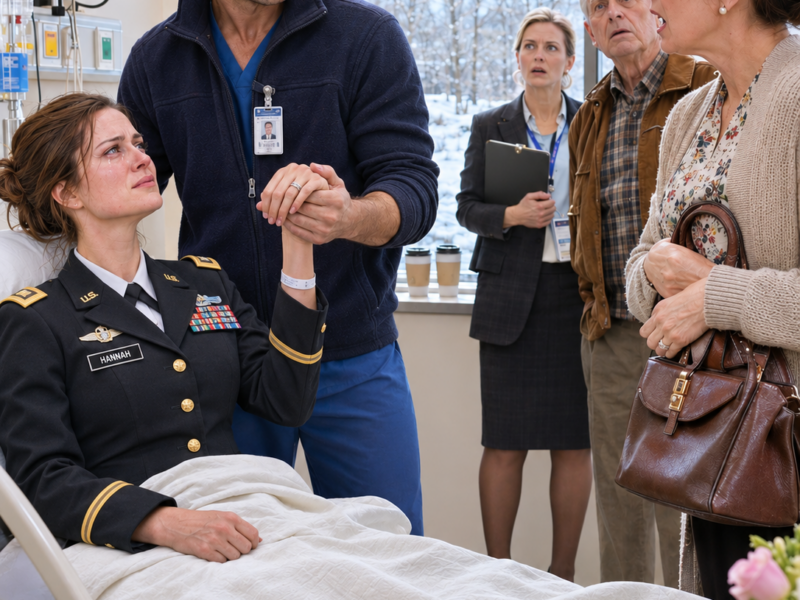
By Monday, I was breathing on my own and recovering in a regular hospital room.
That was when my parents arrived with Carol.
And that was when my mother finally told me something she had been hiding.
“You have to understand, Hannah. Every penny we had went toward Tyler’s trip to Europe.”
I blinked.
“What trip?”
“Forty-nine thousand dollars,” she explained. “It was an investment in his future.”
For a moment, I forgot about the hospital.
I forgot about the discomfort.
All I could hear was that number.
$49,000.
My brother had been receiving grocery money from me every month. Mom had repeatedly claimed he was struggling financially and spending time at home.
Yet somehow, he’d been traveling through Europe.
My mother suddenly realized what she’d admitted.
Her lips tightened.
“That was before any of this happened, of course.”
My father remained silent.
Carol stopped writing.
I turned toward the window because I refused to let my mother watch me cry.
Then I noticed someone standing in the doorway.
Nathan.
He wore jeans and a fleece jacket, with his hospital badge clipped near his collar. He was holding two cups of coffee.
His smile disappeared.
“Am I interrupting?”
My mother barely glanced at him.
“This is a family matter.”
Nathan placed the coffees on the windowsill.
He stepped toward my bed, removed his phone from his pocket, tapped the screen, and placed it facedown on my tray table.
Mom finally noticed his hospital badge.
Her entire personality changed.
“Oh, Doctor! We’re incredibly grateful for everything you’ve done. We were just explaining that we cannot afford to cosign our daughter’s medical expenses.”
Nathan looked at me.
Then he looked at my father.
Finally, he turned toward my mother and took a long, controlled breath.
“Ma’am, I need to ask you something. And I’d appreciate it if you thought very carefully before answering.”
My mother straightened her shoulders.
She clearly expected sympathy.
Instead, Nathan asked a question that made the entire room fall silent.
“Are you really her parents?”
Continue in the comments 👇…
Part 2…
My mother’s cheeks turned bright red.
“Excuse me?”
Nathan didn’t raise his voice.
“In eleven years of trauma medicine, I’ve watched families sleep outside intensive care units. I’ve seen people sacrifice everything for someone they love.”
He glanced at Carol’s clipboard.
“But I’ve never watched parents bring a financial counselor into their daughter’s recovery room after spending $49,000 on another child.”
Mom looked furious.
“You know absolutely nothing about our family!”
“You’re right,” Nathan replied. “That’s the problem.”
He gently lifted my left hand.
The diamond on my engagement ring caught the winter sunlight.
“She’s been wearing this for five months. Did either of you ever notice?”
My mother’s mouth fell open.
“You’re engaged?”
“I’m her fiancé. I’m also the surgeon who spent four hours keeping her alive on Thursday night.”
Dad finally lifted his head.
Carol stared at Nathan.
Then Nathan asked her to check my hospital registration.
“Hannah is an active-duty Army major. She’s covered by TRICARE.”
Carol tapped her tablet.
Her expression changed.
“It says she’s uninsured. That information came from her emergency contact.”
Nathan slowly turned toward my mother.
“You told them that.”
Mom stared at me, suddenly looking less concerned about the medical bill than about what I already knew.
“You knew you were covered?”
I nodded.
“I wanted to see what you’d do, Mom.”
I thought that was the worst discovery I’d make that day.
But hours later, a call from West Point revealed four overdue credit accounts registered in my name.
I only owned two credit cards.
SAY ”Full Story” IF YOU WANT TO READ THE FULL STORY ✨💕