My Husband’s Sister Promised to Protect My Nine-Year-Old Daughter While I Was Deployed Overseas, But One Terrifying Night Changed Everything. My Daughter Called 911 Four Times With Her Address While Her Uncle Tried to Break Down Her Bedroom Door. The Dispatcher Told Her to Go Back to Bed, and By Sunrise, My Little Girl Was Found Behind Our Shed. When I Discovered Who Answered That Call, I Realized Our Family Had Been Hiding Something Far Worse.
My Husband’s Sister Promised to Protect My Nine-Year-Old Daughter While I Was Deployed Overseas, But One Terrifying Night Changed Everything. My Daughter Called 911 Four Times With Her Address While Her Uncle Tried to Break Down Her Bedroom Door. The Dispatcher Told Her to Go Back to Bed, and By Sunrise, My Little Girl Was Found Behind Our Shed. When I Discovered Who Answered That Call, I Realized Our Family Had Been Hiding Something Far Worse.
Part 1…
“Go back to bed, kid.”
Those five words were the last thing my nine-year-old daughter heard before the emergency dispatcher disconnected her call.
My little girl was hiding behind her bedroom door. Her uncle was trying to force his way inside.
She had whispered our home address four times.
Nobody came.
By sunrise, my daughter was curled behind our backyard shed in North Carolina, barefoot, shivering, and too weak to stand.
And the woman who had refused to send help?
She was my daughter’s own aunt.
I didn’t know any of this when it happened.
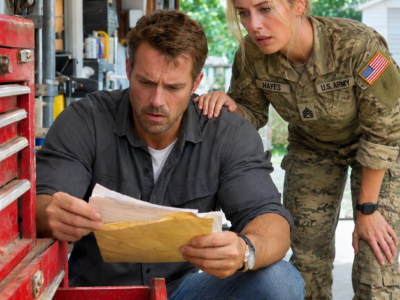
I was thousands of miles away, wearing my Army uniform, believing my family was taking care of the two people I loved most.
My name is Tessa Holloway.
In October 2025, I was 39 years old, a staff sergeant in the United States Army, and a mother who had made one devastating mistake.
I trusted the wrong people.
Our home was a modest brick ranch outside Fayetteville, about twenty minutes from Fort Liberty. We had two maple trees in the front yard, a narrow porch, and a backyard my husband always complained was too big to mow.
My husband, Caleb, used to be the kind of man who could fix anything.
He was an electrician.
He made terrible pancakes every Sunday and insisted they were perfect.
We had been married twelve years when everything changed.
That January, Caleb fell from a ladder at a construction site.
His spinal injury left him unable to walk independently. He could move his arms, but even ordinary daily tasks sometimes required assistance.
Rehabilitation helped.
But recovery was slow.
When my deployment orders arrived that spring, I was terrified of leaving him and our daughter, Maisie.
We arranged professional home assistance, physical therapy transportation, and additional support from relatives.
That’s when Caleb’s older sister, Blythe, stepped forward.
“Don’t worry about a thing,” she told me. “I’ll take care of my brother and that sweet girl.”
Her husband, Darren, promised to handle household repairs, transportation, and anything else Caleb needed.
I remember standing in our kitchen, looking at Maisie’s drawings on the refrigerator, feeling relieved.
I actually thanked Darren.
I shook his hand.
That memory still makes my stomach turn.
Because while I was overseas serving my country, the people I trusted were quietly turning our home into a place my daughter feared.
It began with something that seemed insignificant.
A computer.
A document.
And a number.
$38,000.
On Thursday, October 9, Maisie came home from school around 3:30.
She finished her homework at the kitchen table, ate leftover spaghetti, and watched a documentary about sea turtles.
Caleb was resting after a difficult physical therapy session.
Darren arrived shortly after seven that evening.
He told Maisie he needed to check something on the family computer.
Nothing unusual.
He had been helping with household paperwork for months.
But earlier that afternoon, Maisie had noticed a document on the computer containing her father’s name and a dollar amount she didn’t understand.
Thirty-eight thousand dollars.
When she asked Darren about it, he became irritated.
He told her to mind her own business.
Maisie didn’t understand why.
She was nine.
To her, adults handled money, and children worried about homework, cartoons, and whether there would be dessert after dinner.
But that night, something changed.
She had gone downstairs to retrieve a library book when she noticed Darren standing beside the computer.
He was searching through a drawer.
In his hand was a small black flash drive.
He turned when he saw her.
Then he demanded to know whether she had touched his files.
Maisie said no.
He didn’t believe her.
He kept asking where she had put the flash drive, even though she insisted she hadn’t hidden anything.
His voice grew louder.
She backed away.
He followed her down the hallway.
My daughter ran into her bedroom and locked the door.
Then came the pounding.
Darren struck the door with his fist.
He shouted her name.
And when she refused to open it, he began kicking the door.
Imagine being nine years old.
Imagine standing barefoot in yellow pajamas, listening to a grown man trying to break into the one room where you should feel safe.
Those pajamas were the ones I had bought her before leaving for deployment.
I used to call her my little sunshine whenever she wore them.
That night, she was terrified.
Maisie grabbed an old cell phone from her nightstand.
It didn’t have an active service plan, but it could still make emergency calls.
At 11:46 p.m., she dialed 911.
“Please send somebody,” she whispered. “He’s trying to get in.”
The dispatcher asked for her location.
Maisie gave our address.
Then repeated it.
Again.
And again.
Outside her bedroom, Darren was shouting.
The dispatcher went quiet.
My daughter heard someone breathe into the phone.
Then came an irritated sigh.
“Go back to bed, kid.”
The call ended.
Just like that.
No officer was dispatched.
No one came to the house.
Maisie stared at the screen, unable to understand why the person she had called for help had abandoned her.
She tried dialing again.
But Darren kicked the door so hard that the frame began splitting.
The phone slipped from her hand.
She had seconds to decide what to do.
Her bedroom window overlooked a flower bed.
Years earlier, Caleb had installed a safety latch so she could open it during an emergency.
That small decision may have saved her.
Maisie pushed up the window.
Climbed onto the sill.
And jumped.
She landed awkwardly against the wooden flower-bed border, hurting her ankle and scraping her shoulder.
But she kept moving.
She made it behind our storage shed and curled against the fence.
Inside, Caleb heard the crashing.
He called for Maisie.
His wheelchair had been moved away from the bed after therapy, and his phone was charging in the kitchen.
He couldn’t reach either.
He tried pulling himself toward the edge of the mattress, but the pain stopped him.
He shouted for Darren.
When Darren finally appeared, he claimed Maisie had run outside after an argument.
Caleb demanded that he find her.
Darren searched briefly, then returned with a convenient explanation.
She had probably gone to a neighbor’s house.
He refused to call the police.
My husband spent the rest of the night awake, calling our daughter’s name whenever he heard movement outside.
Meanwhile, Maisie was only a short distance away.
Cold.
Injured.
Waiting for somebody to notice her.
At 6:12 the next morning, our neighbor Odessa Pike stepped into her backyard carrying birdseed.
Odessa was 63, retired from the county school system, and knew practically every child on our street.
She noticed something yellow behind our shed.
At first, she thought someone had thrown away a blanket.
Then it moved.
She hurried over.
Maisie was curled against the fence, shivering. Her arms were scratched, her legs bruised, and one ankle had swollen.
Odessa knelt beside her.
“Sweetheart, can you hear me?”
Maisie opened her eyes.
And the first thing she said was something no child should ever have to say.
“Please don’t tell Uncle Darren.”
Odessa didn’t waste another second.
She called 911, covered Maisie with her cardigan, and stayed beside her until emergency responders arrived.
My daughter was taken to Cape Fear Valley Medical Center.
Doctors examined her injuries.
A social worker became involved.
Caleb was brought to the hospital with assistance.
And Darren?
He told investigators that Maisie had wandered outside and fallen.
Blythe supported his explanation.
My husband’s sister.
The woman who had promised to protect our daughter.
At that point, nobody had told me what had happened.
That afternoon, my first sergeant approached me after a briefing.
His expression immediately frightened me.
“Tessa, we need to talk privately.”
He led me into a small office and handed me a telephone.
A woman explained that my daughter had been hospitalized and an investigation had begun.
Everything inside me went cold.
“Is Maisie alive?”
There was a pause.
“Yes, Sergeant Holloway. She’s alive.”
I sat down.
I couldn’t speak.
For several seconds, all I could hear was the sound of my own breathing.
Then I asked one question.
“Where is my husband?”
By the time I reached North Carolina, I had imagined a hundred terrible possibilities.
None prepared me for the sight of my daughter.
The first thing I noticed when I entered her hospital room was that she wasn’t watching cartoons.
Maisie loved cartoons.
Even when she was sick, she wanted something funny playing in the background.
But that afternoon, she wasn’t looking at the television.
She was staring at the door.
Every time someone walked past the room, her eyes followed them.
I stood there holding my Army duffel bag.
Still in uniform.
Still trying to understand how my little girl had ended up in a hospital while I was gone.
“Hey, Peanut.”
She looked at me.
For one second, she didn’t move.
Then her bottom lip trembled.
“Mom.”
I dropped my bag.
I crossed the room and reached for her.
She reached back.
But when I leaned closer, she suddenly pulled away.
I froze.
My daughter had always thrown herself into my arms.
Now she was afraid of someone getting too close.
“It’s okay,” I whispered. “I’m right here.”
She stared at the marks on her arms.
Then she asked me to close the door.
I closed it halfway so the nurses could still see inside.
I sat beside her.
And waited.
Eventually, her small hand reached for mine.
I held it until she fell asleep.
Nearly twenty years in the Army had taught me how to remain calm during emergencies.
But nothing had prepared me for that hospital room.
I couldn’t fix what had happened.
I couldn’t turn back time.
And I couldn’t stop thinking about how frightened she must have been.
A nurse named Patricia explained that Maisie had bruising, scratches, and a sprained ankle.
Thankfully, her X-rays showed no fractures.
The doctors wanted to monitor her and make sure she could walk safely before discharge.
A specialist would speak with her later.
I was relieved that nobody expected her to repeat everything immediately.
Then I asked about Caleb.
He was waiting in the family room.
I found him sitting near a vending machine, his wheelchair angled toward the window.
He looked exhausted.
Older.
Defeated.
When he saw me, his shoulders dropped.
“Tessa.”
I stood in front of him.
“What happened to our daughter?”
He couldn’t answer.
I waited.
Finally, he whispered, “I heard her screaming.”
My stomach tightened.
“Then why didn’t you help her?”
His hands gripped the wheelchair wheels.
“Darren moved my chair away from the bed. My phone was in the kitchen. I couldn’t reach either one.”
I stared at him.
“Why was Darren in our house at midnight?”
“He said he was checking paperwork.”
Paperwork.
That word kept coming back.
Caleb eventually admitted that Darren had been handling more and more of our finances.
At first, he had offered to organize bills.
Then he started opening mail, questioning purchases, and criticizing the cost of rehabilitation.
Blythe always supported him.
Whenever Caleb objected, Darren reminded him how much assistance he needed.
Then came the threat.
If Caleb stopped accepting their help, Darren said someone might decide Maisie wasn’t safe living with him.
He mentioned social services.
Caleb had been frightened.
He had believed him.
And instead of calling me, he kept everything secret.
I looked at the man I’d married.
I understood his fear.
But I couldn’t ignore what his silence had allowed.
“Our daughter nearly paid for that decision,” I said.
He lowered his head.
He didn’t argue.
Later, when I returned to Maisie’s room, she was picking at the corner of her blanket.
“Did Daddy tell you?”
“He told me some things.”
She studied my face.
“Uncle Darren said nobody would believe me.”
I felt my jaw tighten.
I wanted to ask a thousand questions.
Instead, I kept my voice steady.
“You did the right thing asking for help.”
Her eyes filled with tears.
“But nobody came.”
Those words broke something inside me.
I reached for her hand.
“I know, sweetheart.”
Then she asked the question I had been dreading.
“Are you going away again?”
I couldn’t promise something I hadn’t arranged with the Army.
But I could promise that I would do everything possible to keep her safe.
“I’m here now,” I told her.
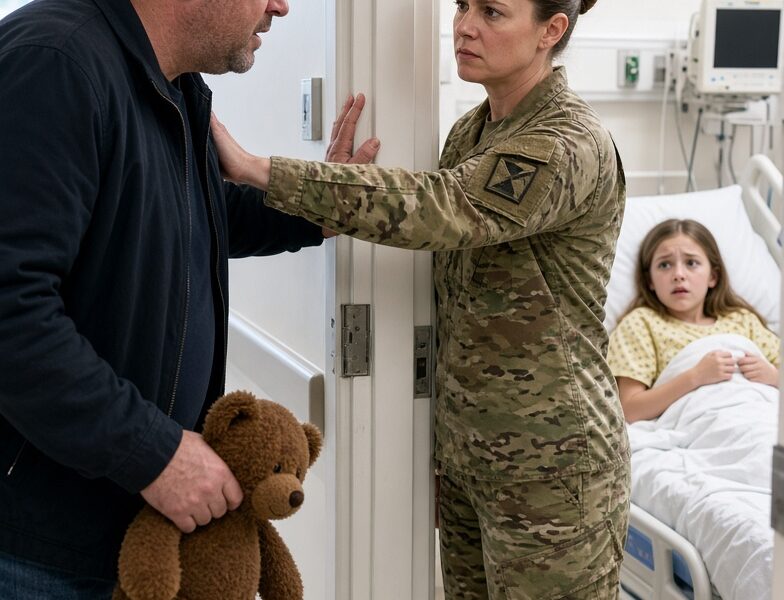
That evening, Darren appeared outside her hospital room carrying a stuffed bear.
He smiled when he saw me.
“Well, look who’s home.”
I stepped into his path.
He tried moving around me.
“Thought I’d check on my favorite niece.”
“She’s resting.”
His smile hardened.
“Don’t make this ugly, Tessa.”
When he reached toward the doorway, I blocked him.
“Step back, Darren.”
He laughed.
“Still playing soldier?”
“No,” I answered. “I’m being her mother.”
I called hospital security.
He left before they arrived.
But not before looking through the doorway.
Maisie saw him.
And pulled her blanket over her head.
That night, Odessa came to visit.
She brought homemade banana bread wrapped in aluminum foil.
Then she reached into her purse.
“Tessa, I found something under Maisie’s window.”
She placed a small plastic keychain on the table.
Inside it was a black flash drive.
Maisie sat straight up.
Her face changed instantly.
“Mom,” she whispered.
I turned toward her.
She pointed at the object.
“That’s what Uncle Darren wanted.”
I stared at the tiny flash drive.
My daughter had been chased through our house because of something small enough to fit in the palm of my hand.
Then Maisie looked at me with terrified eyes.
“Mom, am I in trouble?”
And suddenly, I realized that whatever Darren was hiding might be much bigger than any of us understood.
Continue in the comments 👇…
Part 2….
I pulled my chair closer to Maisie’s hospital bed.
“No, sweetheart. You’re not in trouble.”
She swallowed.
“Uncle Darren said I stole it.”
I looked at the flash drive.
“Did you?”
She shook her head.
“He left it in the computer. I took it because he got mad when I saw Daddy’s name.”
Daddy’s name.
The same document.
The same mysterious $38,000.
I turned to Odessa.
“Where did you find this?”
“In the flower bed beneath her window.”
My hands went cold.
I called Detective Lorna Sykes immediately.
Forty minutes later, she arrived with a notebook and an evidence bag.
She documented how the drive had been found, photographed it, and carefully sealed it.
“Don’t plug this into anything,” she warned.
I nodded.
But I couldn’t stop thinking.
Why would Darren become so desperate over a flash drive?
What did my husband’s name have to do with $38,000?
And why had Blythe defended Darren’s story so quickly?
Detective Sykes explained that investigators would need to examine the files properly.
There would be no immediate answers.
I looked toward Maisie.
She was holding her blanket against her chest, watching every movement.
I had spent my career learning how to recognize danger.
Yet somehow, the danger had been living inside my own family.
And I still hadn’t discovered the most frightening part.
The woman who had promised to protect my daughter had been sitting on the other end of her emergency call.
SAY ”Full Story” IF YOU WANT TO READ THE FULL STORY ✨💕