My Husband Told Me He Wished He Had Never Loved Me, Then Found My Wedding Ring On Our Bed. He Thought I Had Betrayed Him, But I Had Been Protecting Families From Someone He Trusted For Decades. While I Was Recovering From A Secret Emergency, He Believed Every Accusation Against Me Without Asking A Single Question. Then One Suspicious Signature Exposed A Terrifying Truth, And My Husband Realized Someone Had Been Lying To Us Both.
My Husband Told Me He Wished He Had Never Loved Me, Then Found My Wedding Ring On Our Bed. He Thought I Had Betrayed Him, But I Had Been Protecting Families From Someone He Trusted For Decades. While I Was Recovering From A Secret Emergency, He Believed Every Accusation Against Me Without Asking A Single Question. Then One Suspicious Signature Exposed A Terrifying Truth, And My Husband Realized Someone Had Been Lying To Us Both.
Part 1…
At 6:40 in the morning, my husband found my wedding ring lying in the exact center of my side of our bed.
I had placed it there carefully.
A thin gold band. One small diamond. The same ring I had chosen five years earlier because the larger diamonds at the jewelry store seemed ridiculous to me.
My name is Norah Holloway.
And the night before I disappeared from my husband’s house, Graham told me something I never imagined hearing from the man I married.
“I wish I’d never fallen in love with you.”
Seven words.
That was all it took.
Five years of marriage. Thousands of ordinary mornings. Every promise we had made to each other.
And suddenly, I couldn’t remember what it felt like to be safe with him.
I didn’t scream.
I didn’t throw anything.
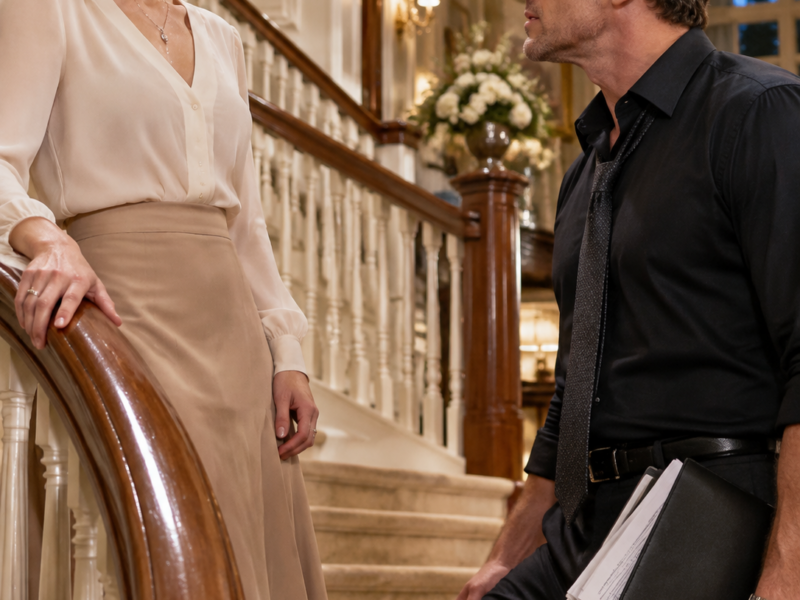
I stood on the staircase with one hand gripping the banister, trying to keep my body steady while something inside me quietly gave way.
Graham stood three steps below me.
In his hand was a folder.
The folder mattered more to him than anything I had tried to explain.
“Eleven calls to a lawyer I don’t pay,” he had demanded. “Two requests for my private trust ledgers. Your signature is on both.”
I remember how tightly he held those papers.
Like they were proof.
Like the woman standing in front of him was already guilty.
“Those requests weren’t mine,” I told him.
He didn’t believe me.
I could see it.
He wanted an explanation that fit what he had already decided.
And I couldn’t give him one without putting other people in danger.
“I was trying to protect some people.”
“From what?”
I looked at him.
“From someone who’s very comfortable in your building.”
He knew who I meant.
Leonard Puit.
For thirty-one years, Leonard had been part of the Holloway family business. He had worked beside Graham’s father and then beside Graham.
He handled legal problems. Financial questions. Difficult employees.
Whenever something went wrong, Graham called Leonard.
Always Leonard.
That was precisely the problem.
But my husband didn’t ask why I was afraid of the man he trusted.
Instead, he said those seven words.
And I finally understood something.
I could survive being misunderstood.
I could survive being doubted.
But I could not keep begging my husband to see me as someone worth believing.
“Then I won’t ask you to keep feeling that way,” I said.
I climbed the remaining stairs slowly.
One step.
Then another.
My hand never left the railing.
He didn’t follow.
And before sunrise, my sister Joan arrived in her old green pickup truck.
She carried my two suitcases because I couldn’t.
I left my car keys hanging beside the kitchen door.
I left my clothes behind.
I left the pink silk scarf I’d worn when Graham and I married at the county courthouse.
And I left my wedding ring.
There was no letter.
I had spent months explaining myself.
I had nothing left to write.
By the time we reached the exit for Madison, the sun was rising over the cornfields.
Joan had been silent for nearly an hour.
For my sister, that was extraordinary.
Finally, she asked, “Is there anybody I need to go back and deal with?”
“No.”
My answer came too quickly.
She glanced at me.
“Norah.”
“He said something,” I whispered. “I don’t want to repeat it.”
She tightened her grip on the steering wheel.
“Then tell me what happened before that.”
I stared through the windshield.
Because the truth hadn’t begun on our staircase.
It had begun in March.
At a folding table inside a free clinic on Milwaukee’s South Side.
I had worked for eleven years as a hospital claims navigator. I understood insurance documents, benefit policies, and the complicated language companies used when they didn’t want ordinary people asking questions.
After leaving that job, I volunteered at the clinic.
Most mornings were simple.
I helped people understand letters.
I explained denied claims.
I found missing information.
Then Denise Markham walked in carrying a manila envelope.
Her husband, Carl, had worked eleven years at a Holloway warehouse in Franklin.
During a December ice storm, he’d fallen from a loading bay and suffered a serious back injury.
He could no longer do his old job.
The company had promised disability coverage.
But when Denise filed the claim, the insurance carrier told her something impossible.
There was no policy.
I remember reading the letter twice.
Then a third time.
“That can’t be right,” I said.
Denise looked exhausted.
“That’s what I keep telling them.”
The company benefits office insisted Carl’s premiums had been paid every month.
The insurance carrier insisted no coverage existed.
Somewhere between those two statements, a family had been abandoned.
I promised Denise I would investigate.
My first mistake was going to Leonard.
I thought he would help.
He listened politely, removed his glasses, and patted my wrist.
“A clerical mess,” he called it.
He promised to straighten everything out.
Then he asked me not to trouble Graham while an important business negotiation in Hamburg was underway.
I agreed.
I wanted to believe him.
But by the middle of April, Carl wasn’t alone.
There were nineteen families.
Nineteen.
Each had a different story.
Missing coverage.
Unanswered claims.
Premiums supposedly paid into policies that couldn’t be found.
Two families had even received letters warning that seeking outside legal help might complicate their eligibility for company benefits.
The letters carried the initials L.P.
Leonard Puit.
That was when I stopped believing in clerical mistakes.
I found a legal aid attorney named Tessa Boyd.
Her office was above a laundromat.
It wasn’t impressive.
There were no marble floors or expensive paintings.
But Tessa read every document.
And unlike Leonard, she didn’t pat my wrist.
She looked me directly in the eyes.
“Norah, don’t tell anyone inside that building until these records are safe.”
I wanted to argue.
Graham was my husband.
Surely I could tell him.
Then I remembered every difficult conversation we’d had about his company.
Every time I’d raised a concern.
Every time he’d said, “I’ll have Leonard look into it.”
Telling Graham meant telling Leonard.
I knew it.
And that frightened me.
So I made a plan.
I would wait until Graham returned from Germany.
Tessa would sit beside me.
We would spread the documents across our kitchen table.
And I would explain everything.
But May arrived.
And everything changed.
On May 1, I was alone in our kitchen when a medical emergency left me unable to stand.
Mrs. Odum, our longtime housekeeper, had already gone home.
I remember the cold tile against my cheek.
Graham’s reading glasses sat on the counter above me.
I could see them.
I couldn’t reach them.
Somehow, I managed to call an ambulance.
The next several hours became a blur.
Hospital lights.
Quiet voices.
A surgeon named Dr. Alan Fitch.
An emergency operation that began shortly before two in the morning and lasted four hours.
When I woke, a nurse was holding my hand.
Graham wasn’t there.
He was in Germany.
And I had made sure nobody called him.
I told myself I was protecting him.
The Hamburg negotiations mattered.
Hundreds of jobs depended on the business.
What could he do from thousands of miles away?
So when I spoke to Leonard, I insisted Graham shouldn’t be disturbed.
And when Graham called, I told him I’d had a procedure.
Nothing more.
He accepted the word “routine.”
I let him.
That was my mistake.
Because while I was trying to protect him from worry, someone else was using my silence for reasons I didn’t understand.
For six weeks, I struggled through recovery.
A visiting nurse came twice a week at first.
Later, I handled the dressings myself.
Some mornings, I needed the bathroom sink just to remain standing.
I slept in the guest room because our large mattress was too uncomfortable.
I couldn’t lift heavy objects.
I couldn’t move quickly.
But I kept telling everyone I was fine.
Especially Graham.
When he returned from Hamburg, he noticed I looked tired.
He didn’t know I’d recently undergone a four-hour emergency operation.
And I didn’t tell him.
Instead, I continued helping the families.
On May 16, I visited Denise and Carl at their apartment.
I arrived by taxi, carrying a cane that still had its hospital tag attached.
Denise wanted me to rest.
But Carl’s appeal couldn’t wait.
Their printer had run out of toner, so I wrote three pages by hand.
My pencil moved slowly.
My side ached.
I kept my coat on because I felt cold.
Denise watched me carefully.
“Are you afraid of what your husband will do when he finds out?”
I shook my head.
“No. Someone has told Graham a different story. When he knows the truth, he’ll fix it.”
I believed that.
I really did.
I believed in the man I married, even while he was beginning to believe the worst about me.
And by June, the questions were getting louder.
Graham had discovered my calls to Tessa.
He had seen the requests carrying my signature.
He knew about the South Side address.
What he didn’t know was that I had never signed those requests.
Or that the records Tessa and I were protecting could expose something much bigger than nineteen missing insurance policies.
When Joan drove me north toward her orchard in Bayfield, she finally asked the question I’d been avoiding.
“Does Graham know about the surgery?”
“He knows I had a procedure.”
“Does he know what actually happened?”
I looked away.
“No.”
Joan’s truck drifted briefly onto the rumble strip.
She corrected it.
Then she asked, very quietly, “Norah, what did the doctor tell you afterward?”
I watched the road disappear beneath us.
I couldn’t answer.
Not yet.
Because saying it aloud would mean admitting how close I’d come to never seeing my husband again.
And the worst part?
I still loved him.
Even after everything.
Back in Milwaukee, Graham was discovering my empty wardrobe.
Mrs. Odum arrived at 7:30 and found him kneeling beside our bed.
He was holding my pink silk scarf.
My wedding ring was folded inside it.
When he told her I had left, she wasn’t surprised.
That troubled him.
Then she mentioned the visiting nurse.
The dressings.
The weeks I’d struggled to stand.
The mornings I’d insisted I was fine.
And for the first time, Graham began to understand how much he hadn’t seen.
He found Dr. Fitch’s appointment card on our refrigerator.
He had walked past it countless times.
At nine fifteen, he sat across from the surgeon.
The doctor refused to reveal my private medical information.
But he confirmed enough.
I had undergone a four-hour operation on May 2.
I was still supposed to avoid lifting anything heavier than a coffee cup.
And when I woke after surgery, nobody from my family had been beside me.
Graham left the office shaken.
Then he checked the company’s telephone records.
At 4:02 that morning, the hospital had called the company duty line.
Leonard had answered.
For three minutes and eleven seconds.
Graham confronted him.
Leonard said I’d asked him not to call Germany.
He claimed he’d been told my condition was routine.
His explanation sounded reasonable.
Almost comforting.
Graham wanted to believe him.
But something was wrong.
That evening, my husband opened the folder again.
He studied the dates.
The signatures.
The tiny gray timestamps.
Then he reached the first request supposedly bearing my signature.
Friday, May 2.
9:20 a.m.
He stared at the page.
Because at 9:20 that morning, I had been recovering from emergency surgery.
I could barely move.
I certainly couldn’t have been signing requests for private financial records.
And someone had made it look as though I had.
For the first time, Graham wasn’t asking why his wife had betrayed him.
He was asking who wanted him to believe she had.
And that question was about to put everything in danger.
Continue in the comments 👇…
Part 2….
Graham called Hal Brennan, his trusted operations manager, just before midnight.
“I need that folder copied. Two copies. Different buildings. Nobody in legal hears about it.”
Hal didn’t ask why.
Meanwhile, I was recovering at Joan’s orchard in Bayfield.
For four mornings, I had known something almost unfamiliar.
Peace.
Then my phone rang.
Tessa Boyd.
Her voice was tight.
“Someone forced my office door last night. They searched the filing cabinets.”
My stomach dropped.
“Did they take anything?”
“No. The originals are safe in the bank box.”
I closed my eyes.
Then Tessa said something unexpected.
“Graham called me.”
I went still.
“He didn’t ask where you were. He asked what the families needed to restore their coverage.”
I couldn’t speak.
“Before hanging up, he asked whether you were warm enough up north.”
Warm enough.
Such a small question.
From the man who had broken my heart.
I looked at the pale mark where my wedding ring had been.
Was he finally beginning to understand?
Or was someone using him to find me?
Tessa wasn’t certain.
Neither was I.
Then she reminded me that whoever searched her office still hadn’t found the original records.
And someone inside Holloway’s company clearly wanted those documents.
I sat alone on Joan’s porch, holding my phone.
For the first time, I wondered whether leaving Graham had actually made me safe.
SAY ”Full Story” IF YOU WANT TO READ THE FULL STORY ✨💕