My Husband Ignored My Desperate Calls While His Stepmother Sat Beside Him, Smiling As Someone Entered Our Home That Night. I Was Six Months Pregnant, Standing Alone In Our Kitchen, When A Man We Both Trusted Delivered A Terrifying Warning. By Morning, I Had Disappeared, Leaving My Wedding Ring, Our Baby’s Blanket, And One Message Hidden Among His Father’s Papers. But My Husband Had No Idea What I Had Recorded Before I Left.
My Husband Ignored My Desperate Calls While His Stepmother Sat Beside Him, Smiling As Someone Entered Our Home That Night. I Was Six Months Pregnant, Standing Alone In Our Kitchen, When A Man We Both Trusted Delivered A Terrifying Warning. By Morning, I Had Disappeared, Leaving My Wedding Ring, Our Baby’s Blanket, And One Message Hidden Among His Father’s Papers. But My Husband Had No Idea What I Had Recorded Before I Left.
Part 1…
At 9:14 on a rainy Thursday night, I stood barefoot in my kitchen in Hoboken, New Jersey, desperately calling my husband.
A man’s boot was wedged against my front door.
My hands were shaking.
“Pick up, Ronan. Please.”
Across the Hudson River, my husband was sitting in the private back room of the Lantern Room in Jersey City.
His phone was vibrating.
My name was on the screen.
And his stepmother, Delphine Ferraro, was sitting right beside him.
I didn’t know it then, but she had placed two fingers on his sleeve and reminded him that the Morano family was watching.
According to her, his pregnant wife could survive one evening without his attention.
Ronan declined my call.
And the man at my door stepped inside.
His name was Rudy Kass.
For five months, Rudy had driven me to doctor’s appointments. He had waited outside examination rooms, carried my bags, and once brought me ginger ale when I couldn’t stomach anything else.
I trusted him.
Or I had.
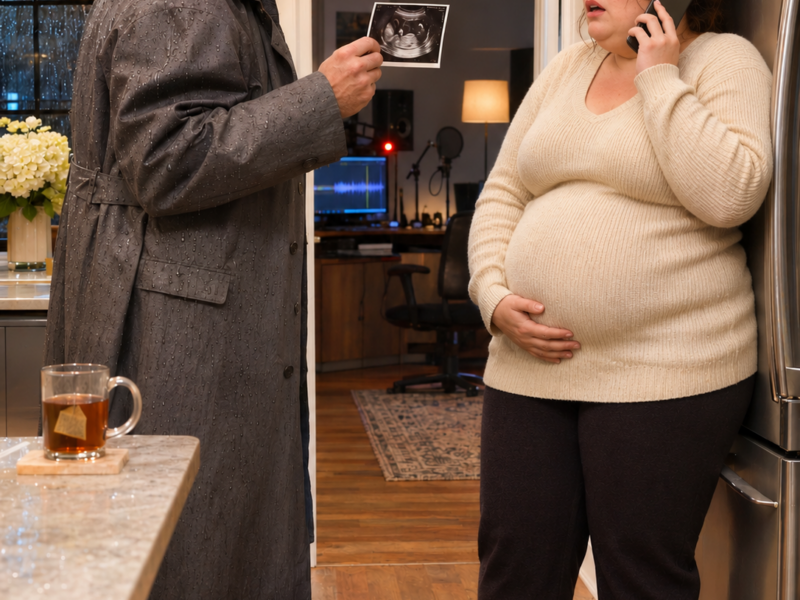
That night, rain dripped from his gray coat onto my kitchen floor.
“Evening, Margot.”
His voice was almost cheerful.
“Sit down. You look tired.”
“Get out of my house.”
He didn’t move toward the door.
Instead, he walked past me.
Straight to the kitchen counter.
My ultrasound picture was lying beside a half-finished mug of cold tea.
He picked it up.
My stomach tightened.
“Twenty-four weeks,” he said, studying the picture. “That’s an important point, isn’t it?”
I backed against the refrigerator.
“What do you want?”
Rudy placed the ultrasound facedown.
Then he said something I will remember for the rest of my life.
“The woman who signs your husband’s checks thinks this baby is a problem.”
Everything inside me went cold.
He continued, calmly.
“She wants the problem taken care of. You can handle it yourself, or she can arrange things. You’ve got until morning.”
I couldn’t speak.
My hand moved instinctively to my stomach.
Our son shifted beneath my palm.
I had spent months imagining his face, his tiny fingers, and the moment Ronan would finally hold him.
Now someone was talking about my child like he was an inconvenience.
And I knew exactly which woman Rudy meant.
Three weeks earlier, I had been clearing Ronan’s study to make room for the nursery.
Inside a box of old financial papers, I found documents connected to his father’s trust.
One name appeared repeatedly.
Delphine Ferraro.
Ronan’s stepmother.
The woman who had raised him after his mother passed away.
The woman he trusted with almost everything.
“You’re lying,” I whispered.
Rudy smiled.
“Call your husband.”
I stared at him.
“Go ahead. See who answers.”
It was 9:19.
I dialed again.
Once.
Twice.
Four rings.
Then Ronan’s recorded greeting.
My husband had ignored me again.
I didn’t know that Delphine had placed her hand over his phone while it rang.
I only knew I was alone.
I set my phone on the counter.
And I left a message.
“Ronan, Rudy Kass is in our kitchen. He says someone wants our baby gone. It’s 9:20. I need you to come home.”
I spoke clearly.
Every word mattered.
Rudy watched without interrupting.
The voicemail continued recording until it ended automatically.
Two minutes and fourteen seconds.
Then Rudy leaned toward my ear.
He whispered something.
Something that made my knees feel weak.
Something I couldn’t force myself to repeat.
Not even to my own husband.
Rudy straightened his coat.
And walked out.
The door closed behind him.
For several seconds, I couldn’t move.
Then our baby kicked.
Hard.
I pressed both hands against my stomach.
And made a decision.
I was leaving.
Not tomorrow.
Not after another conversation.
Tonight.
But first, I needed to protect something.
Something Rudy hadn’t noticed.
Through the open doorway behind me was the small room I used as a recording studio.
I had worked with audio for eight years.
Cleaning interviews.
Editing recordings.
Removing unwanted noise.
And that evening, my recorder had been running.
Its little red light was still blinking.
Two memory cards.
The same recording saved to both.
Rudy had walked into my home without realizing his words were being preserved.
I looked at the studio.
Then at the front door.
For the first time that night, I felt something other than fear.
I had evidence.
But I couldn’t trust just anyone with it.
The Ferraro family had connections throughout the city.
Even at the local police precinct.
And Delphine had connections of her own.
Calling the wrong person could put me right back in Rudy’s path.
So I worked quietly.
At ten o’clock, I stopped the recorder.
I removed both memory cards.
One remained untouched.
The other I secured with a password on my laptop.
Then I went upstairs.
Our nursery smelled of fresh paint.
Soft green walls.
A half-assembled cradle.
Tiny clothes folded in a drawer.
And the blanket.
Cream-colored wool.
Four months of knitting.
Four months of imagining the little boy who would sleep beneath it.
I sat on the floor and held it against my chest.
For a moment, I wanted to cry.
Not because I was leaving a house.
Because I was leaving the life I thought we were building.
Ronan and I had been married for three years.
I still remembered the day we met.
He had come into my recording studio on Washington Street because he needed help recording a eulogy for his father.
He couldn’t bring himself to speak at the funeral.
So he tried recording it.
Seven times.
Seven times, I made him start over.
“Not until you mean it,” I told him.
He returned the next day.
Then the next.
Eight months later, we were married.
I had fallen in love with the man who struggled to speak about losing his father.
Somewhere along the way, that man had stopped listening to me.
He missed appointments.
He missed the heartbeat.
He missed the first time our son kicked.
And whenever I tried to tell him how lonely I felt, there was always another meeting.
Another responsibility.
Another promise that next week would be different.
I kept believing him.
Until that Thursday night.
I carefully opened a small seam in the blanket.
Inside one corner, I sewed a hidden pocket.
Then I slipped the password-protected memory card into it.
Three tiny stitches closed the opening.
Almost invisible.
I ran my thumb over the wool.
And whispered to my baby, “We’re going to be okay.”
I needed to believe it.
Downstairs, I found the last box of Ronan’s father’s papers.
I took a black marker.
And wrote four words across the top.
READ PAGE FOURTEEN.
I didn’t explain anything else.
If Ronan wanted answers, he would have to do something he hadn’t done in months.
Pay attention.
At 11:25, I placed my wedding ring on his desk.
Beside it, I left my phone.
And our baby’s blanket.
I stood there for a long moment.
Looking at the ring.
Remembering how Ronan had slipped it onto my finger.
How certain I had been.
How safe.
Then I picked up one suitcase.
And walked out.
At the corner, rain was falling against a blue mailbox.
I stopped.
Reached into my coat.
And dropped something through the slot.
Then I kept walking.
I didn’t look back.
At 1:10 in the morning, Ronan finally came home.
I learned later that he walked into the study, switched on the lamp, and found the blanket.
My ring was resting on top.
My phone was beside it.
But I was gone.
He checked my call history.
9:14.
9:19.
Two calls.
Both unanswered.
He checked his own phone.
One declined call.
One unanswered call.
No voicemail.
That was strange.
Because I knew what I had recorded.
I knew how long I had spoken.
And I knew my message had been sent.
Someone had made sure he never heard it.
Ronan searched the house.
The kitchen.
The bedroom.
The nursery.
Nothing.
Only my cold tea and the ultrasound picture Rudy had left facedown.
When Ronan turned it over, he saw our son.
The little boy he had barely made time to know.
At 1:20, he called Hank Dorsey.
Hank had worked for Ronan’s father for twenty years and for Ronan for another three.
“She’s gone,” Ronan told him.
“Find her. Nobody touches her. Nobody frightens her.”
By seven that morning, Hank had tracked my movements.
I had withdrawn eight hundred dollars from an ATM near the terminal.
Then purchased a train ticket to Philadelphia.
Cash.
No credit card.
No digital trail.
Ronan assumed I had gone south.
But the station cameras showed something else.
I walked past the Philadelphia train.
And boarded a different train toward Manhattan.
After that, I disappeared.
Hank understood immediately.
I had purchased the ticket to send them in the wrong direction.
Ronan had always known I was clever.
He just hadn’t realized how much I had learned from living around his family.
That morning was Friday.
His thirty-seventh birthday.
At nine, Delphine arrived carrying a white bakery box.
She kissed his cheek.
Wished him a happy birthday.
Then noticed the blanket.
“Oh, darling. I’m so sorry.”
She acted surprised.
Almost sympathetic.
Then she made a remark about women leaving when things became difficult.
She even mentioned Ronan’s mother.
“My mother didn’t leave,” Ronan corrected her.
“She died.”
Delphine apologized smoothly.
As if she had simply confused two appointments.
Then she noticed the wall safe.
She tapped its steel door with one manicured finger.
“Still using your father’s birthday as the combination?”
Ronan said nothing.
“You really should change that. Anyone who loved him could guess it.”
She left the cake behind.
And told him I would return when I needed money.
That was Delphine.
Every insult wrapped in concern.
Every warning delivered with a smile.
After she left, Ronan called Rudy.
“Where were you Thursday night?”
Rudy answered immediately.
“Driving Delphine, boss. All night.”
He claimed he had taken her to the Lantern Room.
Then home.
But Ronan remembered something important.
He had driven Delphine to the Lantern Room himself.
Rudy was lying.
And for the first time, Ronan began questioning the people closest to him.
That evening, he contacted his phone carrier.
He wanted to know whether I had left a voicemail.
The supervisor checked the records.
“Yes, sir. A message began recording at 9:20 p.m.”
Ronan went still.
“How long?”
“Two minutes and fourteen seconds.”
He asked why it wasn’t on his phone.
The woman checked another record.
“Your voicemail was accessed from your handset at 9:31 p.m. The message was deleted during that session.”
Ronan stared at the phone.
At 9:31, he had been sitting at the Lantern Room.
His phone had been inside a leather basket in the middle of the table.
He hadn’t touched it.
Someone else had.
Someone sitting close enough to reach it.
Someone who knew his passcode.
And someone who had heard his pregnant wife begging for help.
Then erased the message.
Saturday morning, Ronan walked into Lindqvist Wool on Central Avenue.
The little shop smelled of cinnamon tea and warm yarn.
Behind the counter stood Bea Lindqvist.
Sixty-six years old.
Silver hair.
Sharp eyes.
She had been my mother’s closest friend until my mother passed away.
Bea had taught me to knit when I was nine.
And she knew me better than almost anyone.
Ronan placed the cream blanket on her counter.
“Where is she?”
Bea studied him.
“Safe.”
“From whom?”
She removed her glasses.
“She called you twice.”
Ronan lowered his eyes.
“I know.”
“Do you?”
She touched the blanket.
“She was making this for your birthday. She wanted to surprise you with the nursery.”
Ronan couldn’t answer.
Then Bea said something unexpected.
The yarn was older than I was.
I had found it in July.
And started knitting immediately.
In September, I had asked Bea to help finish the border.
But I never told her where the wool came from.
Ronan looked confused.
Bea leaned forward.
“Your wife wasn’t only running from them.”
She paused.
“Ask yourself who else she might be running from.”
Ronan looked down at the blanket.
This time, he lifted it carefully.
Not like an object someone had forgotten.
Like something precious.
His thumb brushed one corner.
And stopped.
There was something hard beneath the stitches.
A tiny square.
Bea reached for her scissors.
Three threads came loose.
A memory card slipped into Ronan’s palm.
He stared at it.
Bea spoke quietly.
“Margot said if you came here and found this, I should tell you one thing.”
Ronan looked up.
“The password is the name.”
“What name?”
Bea didn’t answer.
Then she said the words that would haunt him.
“You would know it if you’d ever listened.”
Continue in the comments 👇…
Part 2….
Ronan stood outside the wool shop with the memory card clenched in his hand.
A name.
What name?
He thought about his wife, their unfinished nursery, and the son he had barely taken time to know.
Then he called Hank.
But before he could speak, another thought stopped him.
Delphine.
For nearly thirty years, she had been the person he trusted most.
She had attended his school events.
Taught him how to dress for business.
Stood beside him at his father’s funeral.
Yet Rudy had lied about driving her.
And someone had erased my voicemail.
Ronan returned home with the card hidden inside his jacket.
The study lamp was already on.
Delphine stood beside his desk.
Holding our baby’s blanket.
Her fingers rested on the corner Bea had opened.
“What’s this, darling?” she asked.
“Something of Margot’s?”
Ronan crossed the room.
He gently took the blanket from her hands.
“Don’t touch that.”
Delphine smiled.
But her eyes changed.
Miles away, I sat in a rented room above a closed bakery in Cape May.
I had bought a prepaid phone.
Paid cash for my room.
And written down every word Rudy had whispered before leaving my kitchen.
I signed the statement.
Dated it.
Then stared at the final sentence.
Because the words Rudy had whispered were more frightening than anything he had said aloud.
And Ronan still had no idea what they were.
SAY ”Full Story” IF YOU WANT TO READ THE FULL STORY ✨💕