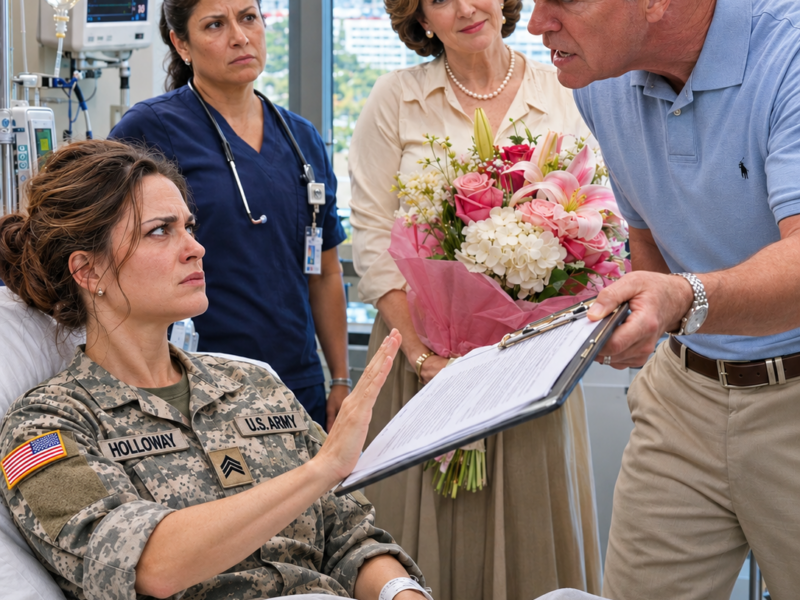
My Father Stood Outside My Hospital Room After My Military Truck Overturned And Told My Surgeon Not To Save Me. While I Lay Unconscious, He Claimed He Was Protecting The Family From Medical Bills He Would Never Owe. But When I Woke Up, A Nurse Showed Me What He Had Said, And I Discovered My Father Had Been Hiding Something Far More Valuable Than Money. One Forgotten Document Was About To Change Everything.
My Father Stood Outside My Hospital Room After My Military Truck Overturned And Told My Surgeon Not To Save Me. While I Lay Unconscious, He Claimed He Was Protecting The Family From Medical Bills He Would Never Owe. But When I Woke Up, A Nurse Showed Me What He Had Said, And I Discovered My Father Had Been Hiding Something Far More Valuable Than Money. One Forgotten Document Was About To Change Everything.
Part 1…
My father stood outside my intensive care room and told my surgeon not to save me if my heart stopped.
He didn’t cry. He didn’t ask whether I was conscious. He didn’t even ask how badly I was hurt.
His first question was about money.
“We are not paying for this.”
Then he gave an instruction that would change everything I believed about my family.
“If her heart stops, you don’t bring her back.”
My name is Laura Holloway. I’m 38 years old, a sergeant in the United States Army, and I’ve spent most of my adult life learning how to keep people alive through careful planning.
I’m a logistics soldier.
I track supplies, inspect paperwork, and make sure the right equipment reaches the right people at the right time.
Details matter in my job.
One missing signature can delay an entire convoy. One incorrect serial number can leave soldiers without equipment they desperately need.
I thought I understood the importance of paperwork.
But one form I’d completed at 20 years old nearly cost me everything.
And the person who tried to use it against me was my own father.
It started Monday, March 3, 2025.
We were training at Fort Irwin, California, in the middle of the Mojave Desert.
The morning was dry and windy. Dust hung over the training roads, and the sunlight bounced off the military vehicles until everything looked almost white.
Our unit was conducting a routine resupply convoy.
Fuel. Water. Replacement parts.
Nothing unusual.
Around 10 that morning, I was riding in a light medium tactical vehicle, an LMTV, when its wheels hit soft sand along a sloping shoulder.
The truck overturned.
I remember a voice crackling through the radio.
Someone was making a joke about the dust.
Then nothing.
Four entire days disappeared from my memory.
I don’t remember the helicopter. I don’t remember the emergency room. I don’t remember the doctors working to stabilize me.
First Sergeant Marcus Bell remembers.
He’d known me for nine years, through three different duty stations.
When the medical evacuation helicopter arrived, Marcus climbed aboard and stayed beside me.
He held my hand throughout the flight to Loma Linda University Medical Center.
Later, he told me something I’ll never forget.
“Laura, I kept telling you to stay with me. I’ve never begged anybody like that before.”
His voice broke when he said it.
I couldn’t answer.
Because while Marcus was fighting to keep me with the living, my father was preparing to make a very different decision.
The accident had caused serious internal injuries.
The trauma team rushed me into emergency surgery.
The doctors managed to stabilize me, but on Tuesday, March 4, complications developed.
Dr. Nathan Brooks, my trauma surgeon, believed another procedure would be necessary within hours.
I was unconscious.
Someone needed to speak for me.
That’s when the Army contacted the person listed on my emergency records.
Douglas Holloway.
My father.
When I enlisted at 20, I’d filled out a DD Form 93, the Army’s Record of Emergency Data.
I listed Dad as my emergency contact.
Every year, someone asked whether I wanted to update it.
Every year, I said no.
“That’s my dad.”
Three simple words.
I never imagined how much I’d regret them.
Dad drove from Whittier to the hospital that afternoon.
He arrived wearing a neatly pressed golf shirt.
Teresa Molina, an experienced intensive care nurse, saw him step off the elevator.
She’d spent 22 years caring for patients and their families.
She knew what frightened parents looked like.
Some cried.
Some prayed.
Some demanded to see their children immediately.
My father did none of those things.
“Where’s the billing office?”
That was his first question.
Dr. Brooks approached him in the hallway and explained that I needed another procedure.
My father crossed his arms.
“I’m her next of kin. I make the decisions.”
The doctor tried to explain the seriousness of my condition.
Dad interrupted.
“We are not paying for this.”
Dr. Brooks stared at him.
Then Dad delivered the instruction Teresa would later write down word for word.
“If her heart stops, you don’t bring her back.”
For a moment, the hallway went silent.
Teresa stepped forward.
She explained that I was an active-duty soldier covered by TRICARE.
My father wasn’t responsible for my medical bills.
Not one dollar.
He barely listened.
“This is a family matter.”
But Teresa wasn’t finished.
She asked whether he had a healthcare power of attorney or another legal document authorizing him to make medical decisions for me.
Dad’s face reddened.
“Do you have any idea who you’re talking to?”
Teresa looked straight at him.
“Yes. A man who asked about money before asking about his daughter.”
Meanwhile, Marcus contacted our unit.
Within an hour, my medical directive arrived by fax.
And that document changed everything.
Years earlier, I’d completed an advance medical directive through the Army’s legal assistance office.
I’d instructed doctors to use every appropriate measure to keep me alive.
I’d also named someone to make medical decisions if I couldn’t speak.
Not my father.
My great-aunt Margie Pruitt.
She was 81 years old and lived in Saratoga Springs, New York.
Dad laughed when he heard her name.
He called her a confused old woman who could barely operate a telephone.
Marcus stepped between him and my room.
“Sir, you need to back away from Sergeant Holloway’s door.”
Teresa stayed after her shift ended.
Every 30 minutes, she tried calling Aunt Margie.
The medical team continued keeping me stable while they worked to reach her.
Finally, at 2 in the morning California time, someone answered.
It was 5 a.m. in New York.
“Is she alive?”
Aunt Margie’s voice trembled.
When Teresa explained what was happening, Margie began crying.
“Do everything. Every single thing. Tell Laura I love her.”
The hospital confirmed her authority.
Dr. Brooks proceeded with the treatment I needed.
And I survived.
Before leaving, Teresa documented my father’s statements, including the exact time.
Marcus prepared a separate signed statement.
Neither of them knew how important those pages would become.
On Friday, March 7, I opened my eyes.
My throat burned.
My body felt impossibly heavy.
Across from my bed was a whiteboard.
Under emergency contact, someone had written:
Douglas Holloway — Father.
A thick red line crossed through his name.
Beneath it, in blue marker, were two words.
Margie Pruitt.
Teresa stood beside me.
“Welcome back, Sergeant.”
She squeezed my hand.
Then she told me there was something I needed to know.
Dr. Brooks came in and pulled a chair close.
Teresa held a sheet of paper.
Her handwriting covered the page.
The time was written in one corner.
3:41 p.m.
“Do you want to hear exactly what your father said?”
My mouth was dry.
“Read it.”
She did.
Every word.
My father had refused to pay for treatment.
Then he’d instructed the surgeon not to restart my heart if it stopped.
I stared at the ceiling.
For a few seconds, I couldn’t move.
I kept waiting for someone to explain that it was a misunderstanding.
Nobody did.
“He knew I had TRICARE,” I whispered.
Teresa shook her head.
“He never even asked.”
Something inside me cracked.
But the worst part wasn’t the shock.
It was the familiarity.
When I was nine, I spent 11 days in the hospital with pneumonia.
My mother, Sharon, never stopped talking about the bill.
Years later, at Thanksgiving dinner, she made a joke in front of our entire family.
“Tyler’s an investment. Laura’s an expense.”
Tyler was my younger brother.
Everyone laughed.
I laughed too.
What else was I supposed to do?
A year after that Thanksgiving, I joined the Army.
I told myself I’d found my own path.
I didn’t realize how desperately I’d wanted to prove I was worth something.
Now, lying in that hospital bed, I understood that my father hadn’t suddenly become cold.
He’d simply stopped pretending.
On March 11, my parents visited.
Dad carried an enormous bouquet.
Mom brought a glittering get-well balloon.
They entered smiling, as though nothing unusual had happened.
“My tough soldier girl!”
Dad leaned down to hug me.
I went rigid.
Mom dabbed her eyes with a tissue.
“We prayed every night, sweetheart.”
Then Dad sat beside me.
His voice changed.
It became softer. Businesslike.
He placed a clipboard on my blanket.
“Just some paperwork so I can handle your bills while you recover.”
I looked down.
It wasn’t a medical billing form.
It was a durable power of attorney.
If I signed, Dad could gain broad authority over my finances, property, and legal affairs.
My hands trembled.
I placed the clipboard on the bedside table.
“I’ll read it when the medication wears off.”
For half a second, his smile disappeared.
Then it returned.
“Of course, sweetheart.”
But I could tell.
He wanted that signature.
Badly.
I was discharged on March 15 and returned to my rental home in Barstow.
Dad wanted me to stay with my parents.
I refused.
Two days later, my doorbell rang.
A stranger stood outside holding an envelope.
“Laura Holloway? You’ve been served.”
Inside was a petition filed in San Bernardino County Superior Court.
My father wanted a conservatorship.
He was asking a judge to give him legal control over my affairs.
His petition claimed I’d suffered a traumatic brain injury and couldn’t manage my own decisions.
I sat down on the porch.
My legs wouldn’t hold me.
First, he’d tried to control whether I received treatment.
Then he’d tried to get my signature.
Now he was asking the court to take away my independence.
Why?
What could I possibly own that he wanted so badly?
I thought about my savings.
My military benefits.
My modest rental home.
None of it made sense.
Then I remembered Aunt Margie.
She had protected me when I couldn’t speak.
Maybe she knew something I didn’t.
After my surgeon cleared me to travel, I flew to Albany on March 22 and drove to Saratoga Springs.
Old snow lined the streets.
Aunt Margie opened her front door wearing an oversized cardigan.
The moment she saw me, she began crying.
“Look at you. You’re alive.”
She held my face between her hands.
Then she said something that made my stomach tighten.
“Your father called me after the hospital. He was screaming.”
She brought me into her kitchen.
A large orange cat named Biscuit curled beside my chair.
Margie made tea, then walked to a green metal filing cabinet.
She returned carrying a thick folder.
“Your grandfather knew your father better than you think.”
Grandpa Harold had founded Pruitt Precision Hydraulics after moving to California in 1978.
He’d started with one rented garage.
Eventually, the company became a successful manufacturing business.
Before he passed away in 2019, he’d sold Dad a small ownership stake and made him president.
That much I knew.
What Margie told me next changed everything.
Grandpa had placed 58% of the company’s voting shares in a trust for me.
Aunt Margie owned another 20%.
Dad owned 18%.
Tyler owned 4%.
I stared at her.
“Fifty-eight percent?”
She nodded.
“Since your thirty-fifth birthday, you’ve had the right to vote those shares yourself.”
I couldn’t speak.
Then I remembered Christmas.
Every year, Dad handed me a document to sign.
He called it routine paperwork related to Grandpa’s old shares.
I never questioned him.
Margie turned another page.
“Those were proxy forms, Laura. You were letting him vote your shares.”
For three years, Dad had been exercising voting power that belonged to me.
But there was more.
Margie showed me a provision in the trust.
If I passed away before turning 42 without children, my shares would transfer to Dad and Tyler.
The kitchen seemed to tilt.
I thought about the hospital.
The clipboard.
The conservatorship petition.
Suddenly, every strange decision fit into a pattern.
Dad wasn’t worried about medical bills.
He was worried about losing control.
Aunt Margie touched my hand.
“The annual shareholders meeting is coming up. And the bank reviews the company’s books shortly afterward.”
Then she reached into the folder and removed a sealed envelope.
My grandfather’s handwriting covered the front.
Margie held it carefully.
“He made me promise not to give you this until the time was right.”
I reached for it.
She shook her head.
“Not yet, sweetheart.”
Her eyes filled.
“He said you should open it after you’ve taken back what’s yours.”
I stared at the envelope.
For the first time, I wondered how much Grandpa Harold had known.
And what he had been trying to protect me from.
Continue in the comments 👇…
Part 2….
I flew back to California with Grandpa’s sealed envelope tucked inside my jacket.
I didn’t open it.
Instead, I called an attorney.
Joan Whitfield worked from a glass office tower in downtown Los Angeles. She was in her fifties, with silver hair and reading glasses hanging from a chain.
She studied Aunt Margie’s documents for 45 minutes.
Then she looked at me.
“Sergeant Holloway, you control the majority of your grandfather’s company.”
I nodded.
“And your father has been voting your shares while trying to obtain control over your personal affairs?”
“Yes.”
Joan removed her glasses.
“We need to examine everything.”
First, we prepared to fight the conservatorship petition.
An Army neurologist would evaluate me. A court investigator would interview me.
But Joan had another concern.
The company records.
Aunt Margie could demand access as a shareholder without immediately revealing my involvement.
So Joan prepared the request.
Dad was furious.
He ordered the company bookkeeper, Lorraine Vega, to send only a financial summary.
But Lorraine had worked there for 27 years.
She knew the difference between a summary and the complete records.
Instead of following Dad’s instructions, she contacted Joan.
The following week, three bankers’ boxes arrived.
Inside were years of invoices, payments, and accounting records.
I didn’t know what they contained.
But when Joan called me, her voice was unusually serious.
“Laura, don’t tell your father we have these.”
Then she added:
“There’s something in these records we need to investigate before the shareholders meeting.”
SAY ”Full Story” IF YOU WANT TO READ THE FULL STORY ✨💕