My Father Spent Eight Years Celebrating My Brother As The Hero Who Saved Three Men From A Sinking Boat. Every February, Our Town Hung My Brother’s Picture While I Quietly Hid The Scars Across Both My Hands. At Our Family Company’s Anniversary Dinner, My Brother Repeated His Famous Rescue Story In Front Of Thirty Guests. But When A Retired Coast Guard Admiral Noticed My Left Hand, He Asked One Question That Made My Brother Turn Pale.
My Father Spent Eight Years Celebrating My Brother As The Hero Who Saved Three Men From A Sinking Boat. Every February, Our Town Hung My Brother’s Picture While I Quietly Hid The Scars Across Both My Hands. At Our Family Company’s Anniversary Dinner, My Brother Repeated His Famous Rescue Story In Front Of Thirty Guests. But When A Retired Coast Guard Admiral Noticed My Left Hand, He Asked One Question That Made My Brother Turn Pale.
Part 1…
“Three men in the water. Twenty-foot waves. I pulled every one of them out myself.”
My brother Cole stood at the head of the dinner table, holding a pint of beer while thirty people listened to him describe the night he became our town’s hero.
My father was practically glowing.
I sat at the opposite end of the table, hiding my left hand beneath a white linen napkin.
Then I reached for my water glass.
One small movement.
That was all it took.
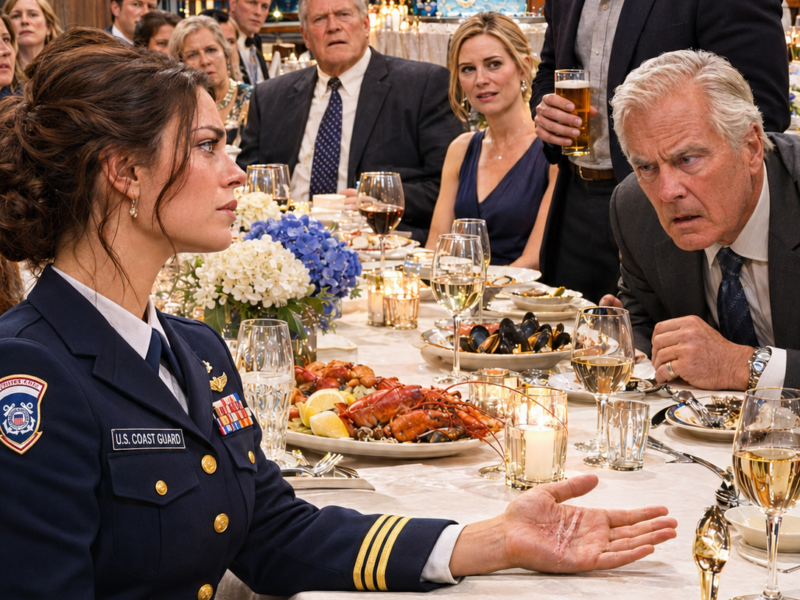
The retired Coast Guard vice admiral sitting beside my father stopped drinking. His eyes dropped to my hand, and something in his expression changed.
He stared at the pale, raised scars crossing my palm.
Then he slowly lowered his glass.
“Son,” he said to my brother, “what did the third man say to you?”
The entire room went silent.
Cole’s smile disappeared.
And for the first time in eight years, I wondered whether the truth was finally about to come out.
But to understand why that question mattered, you need to understand what my family had spent eight years pretending never happened.
My name is Tessa Doyle.
I’m a Coast Guard rescue swimmer stationed at Air Station Cape Cod, where I train new swimmers and take standby flight shifts when needed.
My husband, Ben, serves aboard a cutter. We understand each other’s schedules, missed holidays, and long stretches apart.
My family, however, has never really understood my job.
Or perhaps they never wanted to.
Two days before that dinner, I was sitting at my desk when my father called.
It was Thursday, 5:40 p.m.
Dad rarely called without a reason.
“Tessa. Saturday. The Cormorant. Seven o’clock.”
“I know, Dad. It’s been on my calendar since November.”
Our family business, Marlow and Sons Cold Storage, was celebrating its fortieth anniversary.
My father, Walt Marlow, had built the company from one rented freezer and a pickup truck.
Now it employed sixty-three people.
He was proud of that.
He reminded everyone constantly.
But Saturday’s celebration wasn’t really about forty years of business.
It was about one particular guest.
Vice Admiral Raymond Hollis.
Retired Coast Guard.
Chairman of the Pelham Cove Harbor Commission.
And one of the people who could determine whether my father’s company kept its valuable Pier 9 lease when renewal came around in April.
My father wanted to impress him.
Which meant my brother would be performing his usual role.
The hometown hero.
“Here are the rules,” Dad said.
I closed my eyes.
“Nice dress. No uniform. No sea stories.”
“I wasn’t planning to wear my uniform.”
“You wore it to Aunt Dot’s funeral.”
“She requested Coast Guard honors, Dad.”
He ignored that.
“Ray will want to hear about the Salt Margaret rescue. Cole’s going to tell it. You’re going to let him.”
My fingers tightened around the phone.
“I always do.”
“You make that face, Tessa. Like you’re judging him.”
I looked down at my left hand.
The scars were especially visible beneath the fluorescent office lights.
“Let your brother have this,” Dad continued. “He needs it more than you do.”
There it was.
The sentence that had defined my entire childhood.
Cole needed the attention.
Cole needed the praise.
Cole needed to feel important.
And I was expected to understand.
“Okay, Dad.”
He hung up.
Six minutes.
That was all it took for my father to remind me where I belonged in his family.
The strange thing is, I spent most of my life defending him.
He wasn’t the kind of father who shouted constantly or threw things.
We had food.
We had a home.
We had Christmas presents.
But there are ways to make a child feel invisible without ever raising your voice.
My father had mastered them.
When I was born, the company sign already read MARLOW AND SONS.
I was his first child.
His daughter.
Three years later, Cole arrived.
Suddenly, the sign made sense.
Dad loved boats, fishing, and everything connected to the ocean.
He once considered joining the Coast Guard himself, although he never explained why he hadn’t.
When I enlisted at nineteen, he shook my hand in the driveway.
Not a hug.
A handshake.
Like I was a business associate leaving after a meeting.
I survived rescue swimmer training, one of the most demanding programs in the service.
When I came home wearing my qualification badge, Dad asked whether women were really allowed to jump out of helicopters.
I said yes.
He nodded.
Then he asked Cole about his truck.
Eventually, Dad began telling people I worked in Coast Guard logistics.
Paperwork.
Scheduling.
Supply orders.
It was easier for him to describe me that way.
Meanwhile, Cole worked aboard the family fishing boat, the Ruth Ann.
He was funny, outgoing, and impossible not to like.
I loved my brother.
I still do.
That’s what made everything so complicated.
Eight years earlier, a fishing vessel called the Salt Margaret had gotten into serious trouble offshore during a winter storm.
Three men were rescued from the water.
And somehow, my brother became the man everyone credited with saving them.
The local newspaper ran his photograph.
The town gave him a commendation.
Every February, banners appeared along Wharf Street with his smiling face beneath the words:
COLE MARLOW — SALT MARGARET RESCUE.
Eight years.
Eight celebrations.
Eight years of watching my brother accept applause for something he knew he hadn’t done.
And eight years of keeping a promise that had slowly become unbearable.
I drove home Friday evening.
The banners were already hanging.
I counted six before reaching my parents’ house.
Mom waited on the porch.
Ruth Marlow was a gentle woman who had spent decades keeping the company’s books and smoothing over my father’s moods.
She hugged me tightly.
Then she took my left hand.
Her thumb moved carefully over the scars.
“Does it still ache when it’s cold, Tess?”
Sometimes.
More than I admitted.
But before I could answer, Dad called from the kitchen.
“Ruth! Is that pot going to boil itself?”
Mom released my hand.
And just like that, the conversation ended.
That night, I sat alone in my childhood bedroom.
I opened a folder on my phone.
It had no name.
Inside was one voicemail.
Forty-one seconds long.
Dated February 9, eight years earlier, at 11:47 p.m.
I had transferred that recording onto every phone I’d owned since.
I stared at the file.
My thumb hovered over Play.
But I didn’t press it.
I already knew every word.
The following morning, Dad gave me a tour of the cold storage plant.
He proudly showed me the new blast freezer, then brought me into his office.
Photographs covered the walls.
Fishing boats.
Company milestones.
A picture with the governor.
And directly behind his desk hung a framed newspaper front page.
RUTH ANN CREW SAVES THREE.
Cole stood in the photograph, grinning beneath his yellow raincoat hood.
Dad tapped the glass.
“Three men. Your brother pulled them out himself.”
I looked at the photograph.
Then at the gray steel safe in the corner.
Something about the way Dad stood near that safe made me uneasy.
But I said nothing.
That evening, I dressed in navy blue and flat shoes.
Mom helped zip my dress.
“Your father’s nervous about the admiral,” she whispered. “Please make tonight easy. For Cole.”
I nodded.
I was good at nodding.
At seven, we arrived at the Cormorant Inn.
The upstairs dining room smelled of seafood, warm bread, and damp winter coats.
Outside, the harbor was black.
Boat rigging tapped against metal masts in the wind.
Thirty place cards lined the long table.
My father had written every name himself.
Cole sat near Dad.
The admiral sat on Dad’s other side.
My seat was at the far end, beside a seafood broker and an empty chair near the dessert cart.
I almost laughed.
Even the seating arrangement told the story of our family.
Cole arrived with his wife, Kelsey.
He hugged me so tightly my feet nearly left the floor.
“Tessie. You okay?”
“I’m fine.”
He studied my face a second longer than usual.
Kelsey glanced at my dress.
“Look at you, Tess. So civilian. Nice to see you taking a break from paperwork.”
I smiled politely.
I had learned long ago that correcting people usually caused more trouble than it solved.
The admiral arrived shortly afterward.
Tall.
Silver-haired.
Calm.
My father practically rushed across the room to greet him.
He introduced me as his daughter who handled scheduling and supplies for the Coast Guard.
The admiral shook my right hand.
“Somebody has to keep everything organized,” he said pleasantly.
“Mostly I count pool laps,” I replied.
He smiled and moved on.
Dinner began.
Clam chowder.
Scallops.
Haddock with lemon butter.
Dad ordered expensive whiskey and kept bringing the conversation back to the company’s pier lease.
But eventually, the admiral turned toward Cole.
“Your father tells me you were involved in a remarkable rescue.”
My stomach tightened.
Kelsey touched Cole’s arm.
“Tell him, honey.”
Cole hesitated.
Just briefly.
“That was years ago.”
Dad laughed.
“Come on, son. Tell Ray the whole thing.”
Cole stood.
Lifted his drink.
And began.
“February ninth. Eight years ago. We got a distress call from the Salt Margaret.”
His voice became deeper.
Slower.
The voice he used whenever he told this story.
He described towering waves.
Freezing darkness.
A fishing boat listing dangerously.
He described men struggling in the water.
The guests leaned forward.
I’d heard this performance dozens of times.
But that night, something inside me finally resisted.
When Cole mentioned the timing, I spoke quietly.
“It was after two in the morning, Cole. Not midnight.”
Thirty faces turned toward me.
Dad’s expression hardened.
“Tessa.”
One word.
A warning.
“Let your brother tell his story. You weren’t in the water.”
The silence that followed felt endless.
I looked at him.
My own father.
The man who had never asked how I’d gotten the scars on my hands.
I could have corrected him.
Four words would have changed everything.
I was in the water.
Instead, I remembered that voicemail.
And the promise I’d made.
I lowered my eyes.
“You’re right, Dad. Go ahead, Cole.”
My brother looked at me.
He didn’t look relieved.
He looked frightened.
Then he continued.
“Three men in the water. Twenty-foot seas. I got every one of them out myself.”
And that’s when my left hand slipped out from beneath the napkin.
The admiral noticed.
His entire expression changed.
He set down his glass.
“Son,” he asked quietly, “what did the third man say to you?”
Cole froze.
His wife gave a nervous little laugh.
Dad leaned forward.
But the admiral didn’t smile.
He waited.
And suddenly, I wasn’t sitting in a warm restaurant anymore.
I was twenty-six again.
It was 2:14 in the morning.
A rescue alarm was sounding at Air Station Cape Cod.
The Salt Margaret was thirty-eight miles offshore, taking on water in a storm with winds reaching fifty-five knots.
Six people had been aboard.
My flight mechanic, Marcus Bell, read the dispatch as we ran toward the helicopter.
“The Ruth Ann is standing by. Isn’t that your family’s boat?”
“My brother’s aboard,” I answered. “Keep it out of the cockpit.”
Lieutenant Andrea Voss flew us over the dark Atlantic.
We reached the fishing vessel at 3:06 a.m.
The Salt Margaret was listing badly.
Steel cables swung above the deck.
The Ruth Ann couldn’t safely approach the people in the water.
There was only one way to reach them.
I had to swim.
Marcus lowered me into the ocean.
The cold hit instantly.
I swam along the Ruth Ann’s hull, fighting the waves.
Then I looked up.
Cole stood at the rail.
Yellow slicker.
Bare head.
A rescue line gripped in both hands.
“Cole! Throw the line!”
He stared down at me.
His mouth opened.
But his hands didn’t move.
I called again.
Nothing.
Then a wave carried me away.
I kept swimming.
Two men, Tomas Reyes and Ellis Boone, were clinging to a damaged life raft.
I helped Tomas into the rescue basket at 3:19.
Ellis followed at 3:28.
The third man was farther away.
Peter Hollis.
Twenty-four years old.
A federal fisheries observer.
He was caught by a heavy fishing line still connected to the sinking vessel.
Every movement of the boat pulled the line tighter.
I grabbed it with both gloved hands and held on while working to free him.
The friction ruined my gloves.
Then damaged the skin beneath them.
I refused to let go.
Finally, the line broke free.
Peter grabbed my collar.
“The numbers,” he whispered. “In my jacket. Don’t let them sink.”
Even then, he was worried about his research notebook.
I secured it inside his coat.
“Stay boring, mister,” I told him. “Boring means alive.”
He tried to laugh.
Then the rescue basket lifted him away.
I was the last one brought into the helicopter.
As we flew off, I looked back.
Cole was still standing at the rail.
He hadn’t moved.
Later, at the hospital, my hands were bandaged.
And that night, my brother left the voicemail I would keep for eight years.
Back at the restaurant, the admiral repeated his question.
“What did the third man say to you?”
Cole swallowed.
“Sir, that was a long time ago.”
“I’m aware.”
The admiral’s voice remained gentle.
“My son remembers speaking to someone that night.”
My heart stopped for a moment.
His son?
The admiral looked down the table.
Straight at me.
“Ma’am, would you please show me your left hand?”
Continue in the comments 👇…
Part 2….
I couldn’t move.
Kelsey laughed nervously.
“Oh, those scars? She burned her hand years ago. Nothing serious.”
The admiral ignored her.
“Please,” he repeated.
Slowly, I placed my left hand on the white tablecloth.
Palm up.
The candlelight caught every pale ridge.
The admiral stared.
Then he spoke.
“Eight years ago, my son Peter was aboard the Salt Margaret. He was the third man rescued that night.”
My father went completely still.
The admiral continued.
“Peter remembers a female Coast Guard swimmer. He remembers her hands being badly injured while she helped him.”
Cole lowered his eyes.
“He remembers what she said.”
The admiral looked directly at me.
“I spent six months trying to find that woman. I wrote three letters to Petty Officer Doyle.”
My married name.
The name on my Coast Guard records.
Not the name my father used.
“I never received any letters,” I whispered.
The admiral frowned.
“None?”
I shook my head.
Then I remembered something.
My official home address had remained my parents’ house for years.
Mail sent there would have gone through my father’s hands.
The admiral asked one final question.
“What did Peter say to you in the water?”
I looked at Cole.
His face was pale.
He gave the smallest nod.
And I realized the truth wasn’t just about the rescue anymore.
Someone had been keeping much more from me than I ever imagined.
SAY ”Full Story” IF YOU WANT TO READ THE FULL STORY ✨💕