My Father Slid A DNA Test Across My Grandfather’s Table Just Twelve Days After The Funeral, Questioning Whether I Belonged. My Two Brothers Sat Silent While Our Family Attorney Watched Him Threaten The Inheritance Grandpa Had Left Me. I Agreed To His Humiliating Demand, But Only If Everyone Took The Same Test, Including My Brothers. Then My Younger Brother Followed Me Outside And Whispered Something About Our Late Mother That Made My Heart Stop.
My Father Slid A DNA Test Across My Grandfather’s Table Just Twelve Days After The Funeral, Questioning Whether I Belonged. My Two Brothers Sat Silent While Our Family Attorney Watched Him Threaten The Inheritance Grandpa Had Left Me. I Agreed To His Humiliating Demand, But Only If Everyone Took The Same Test, Including My Brothers. Then My Younger Brother Followed Me Outside And Whispered Something About Our Late Mother That Made My Heart Stop.
Part 1…
“You don’t even look like my daughter.”
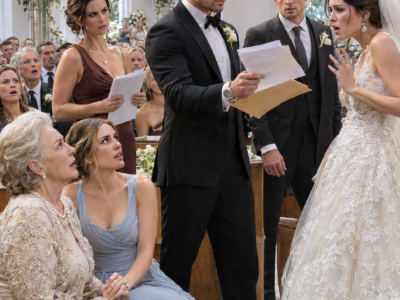
My father said those words across my grandfather’s dining room table, just twelve days after we buried the man who had loved me more openly than my own father ever had.
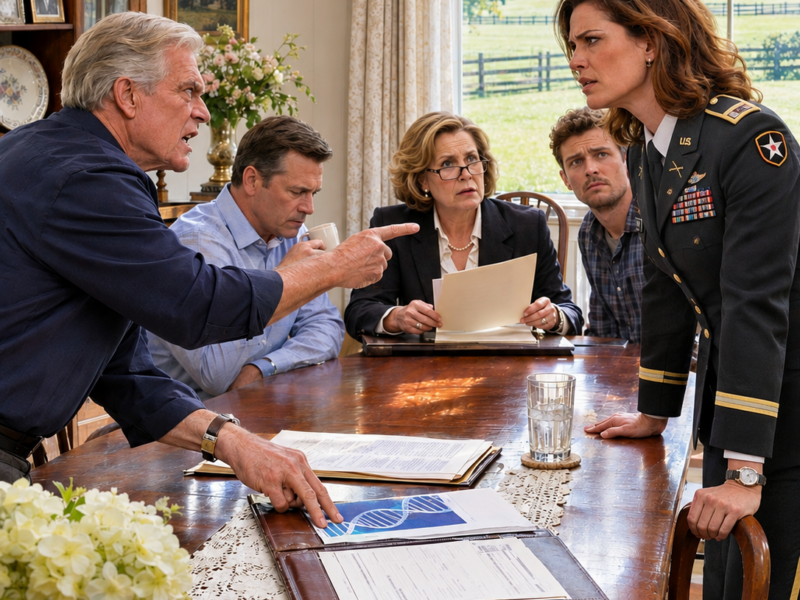
Then he pushed a DNA testing brochure toward me.
Right beside my inheritance papers.
For a moment, I couldn’t move.
My older brother, Russell, stared into his coffee. My younger brother, Colin, shifted uncomfortably in his chair.
Across the table, our family attorney, Miriam Sloane, slowly lowered her reading glasses.
I looked at the brochure.
Then at my father.
“Are you serious?”
Walter Kincaid leaned back in Grandpa’s chair as though he’d been waiting his entire life to have this conversation.
“I’m protecting this family’s interests, Audrey.”
I was forty-four years old.
A retired Army officer.
A woman who had spent twenty years making difficult decisions under pressure.
Yet somehow, sitting in that farmhouse outside Lexington, Kentucky, I felt seventeen again.
Small. Unwanted. Never quite good enough.
And the worst part?
My father knew exactly what he was doing.
It was September 12, 2025.
Grandpa Harold had been gone for twelve days.
Twelve days.
His coffee mug was still in the kitchen cabinet. His worn work boots were still beside the back door.
And his favorite chair was now occupied by the man questioning whether I belonged to our family.
I wanted to scream.
Instead, I folded my hands beneath the table.
Because if the Army had taught me anything, it was how to stay calm when someone was trying to provoke me.
But this wasn’t an enemy.
This was my father.
And that made everything worse.
To understand why his accusation hurt so deeply, you need to understand my grandfather.
Harold Kincaid built Kincaid Industrial Supply in 1968, starting with a rented warehouse and a determination to provide for his family.
He sold work gloves, industrial fasteners, and equipment to businesses throughout Central Kentucky.
By retirement, his company employed thirty-seven people.
He owned a farmhouse, investments, and a controlling interest in the business.
But Grandpa never acted wealthy.
He drove an old Ford pickup.
Bought his coffee at Kroger.
And complained about the electric bill like it was a personal insult.
He believed money mattered.
But people mattered more.
Especially family.
Grandpa had three grandchildren.
Russell, Colin, and me.
At least, that’s what I had believed my entire life.
Russell was the oldest.
He had followed our father into the family business and eventually taken over daily operations.
Colin supervised the warehouse.
And I?
I left Kentucky.
After college, I joined the Army in 2003.
My father never forgave me.
When I received my commission, he said I was wasting my business degree.
When I made major, he asked whether the promotion came with better retirement benefits.
When I retired in 2023, he suggested I find a simple office job at Russell’s company.
“Something you can handle,” he said.
I had managed military logistics involving hundreds of personnel and millions of dollars in equipment.
Apparently, that didn’t qualify me to order office supplies.
Grandpa thought it was hilarious.
“Your daddy couldn’t organize a church picnic without losing the potato salad,” he once told me.
I can still hear his laugh.
God, I miss that laugh.
During his final year, I drove from my home in Georgetown to his farmhouse three or four times a week.
I took him to appointments.
Organized his medications.
Fixed whatever needed fixing.
Sometimes we sat together on the porch without saying anything.
He never asked why I’d come home.
He was simply happy I was there.
My father never understood that.
And now Grandpa was gone.
We had gathered that Friday to discuss the trust he established in 2018.
Miriam explained that the farmhouse, investment accounts, and company shares were held in the trust.
All three grandchildren were named individually as beneficiaries.
My father and Miriam were co-trustees.
Everything seemed straightforward.
Until Dad interrupted.
“Before we distribute anything, there’s a question of eligibility.”
Miriam frowned.
“Walter, we’ve discussed this.”
“Not with everybody present.”
He opened his leather folder.
Pulled out the brochure.
And questioned whether I was his biological daughter.
He claimed my mother had kept secrets.
He insisted Grandpa wanted his estate to remain with his blood relatives.
My mother.
Elaine Kincaid.
She had passed away five years earlier.
She wasn’t here to defend herself.
And my father was using her memory to question my place in the family.
I looked toward Russell.
Surely he would say something.
Surely my older brother would recognize how cruel this was.
Instead, he cleared his throat.
“Maybe we should just get it settled.”
I turned toward him.
“You knew about this?”
He rubbed his forehead.
“Dad mentioned some concerns.”
Concerns.
That was the word he chose.
Not accusations.
Not humiliation.
Concerns.
I looked toward Colin.
He stared out the window.
And suddenly I remembered being seventeen, standing in our kitchen while Dad praised Russell for completing an ordinary delivery.
That same afternoon, he’d criticized me for accepting an out-of-state scholarship.
Mom had stood at the sink.
Washing the same plate twice.
She never knew how to stop those conversations.
And now she was gone.
Miriam’s voice brought me back.
“Audrey, your father cannot simply remove you from the trust because he questions your parentage. You’re specifically named as a beneficiary.”
Dad’s jaw tightened.
“I can challenge it.”
“You can seek legal advice,” Miriam replied. “That doesn’t mean you’ll succeed.”
Dad pointed toward me.
“Then she shouldn’t have a problem proving it.”
My face burned.
Not because I doubted who my father was.
But because he’d chosen this moment.
This house.
This audience.
I reached for my water glass.
My hand trembled.
I set it down.
Then I looked directly at him.
“Fine. I’ll take the test.”
Dad smiled.
A satisfied little smile.
Like he’d finally won something.
“Good. That’s all I’m asking.”
I wasn’t finished.
“On one condition.”
His smile disappeared.
“Russell and Colin take it too.”
Russell sat forward.
“Why would we do that?”
“Because Dad says this is about protecting the family. So everyone should have the same information.”
Russell’s face reddened.
“That’s insulting.”
I held his gaze.
“Yes. It is.”
For the first time that afternoon, Colin made a small sound that might have been a suppressed laugh.
Dad slapped the brochure against the table.
“My sons have nothing to prove.”
There it was.
My sons.
As though I had already been removed from the family.
Miriam intervened before the argument escalated.
She explained that no one could be forced into genetic testing.
Everyone would need to consent voluntarily.
And the results would not automatically determine inheritance rights.
Russell crossed his arms.
Colin finally spoke.
“I’ll do it.”
Everyone turned toward him.
He shrugged.
“If it ends this argument, fine.”
Russell looked at Dad.
Then reluctantly agreed.
I turned back toward my father.
“And you provide a sample too.”
He hesitated.
Just briefly.
But I noticed.
“Otherwise, what exactly are we proving?”
He finally nodded.
Miriam agreed to arrange appointments through an accredited laboratory, with proper consent and authorization for the reports.
Twenty minutes later, I walked outside.
The afternoon sunlight hurt my eyes.
Grandpa’s wind chime moved gently above the porch.
I stood beneath it for a moment.
Listening.
He had bought that wind chime years earlier.
Now its familiar sound was the only comforting thing left in that house.
I walked toward my pickup.
Then I heard footsteps.
“Audrey, wait.”
It was Colin.
He hurried down the porch steps, glancing nervously toward the house.
Something about his expression made me stop.
“What is it?”
He lowered his voice.
“There’s something about Mom you don’t know.”
My stomach tightened.
“What are you talking about?”
Before he could answer, the front door opened.
Russell stood there.
“Colin. Dad wants you.”
My younger brother’s expression changed immediately.
He stepped backward.
“We’ll talk later,” he whispered.
Then he disappeared inside.
I stood beside my truck.
Alone.
For the first time that day, I wasn’t thinking about the inheritance.
I was thinking about my mother.
And what Colin might know.
I sat behind the steering wheel for nearly ten minutes.
Grandpa’s white porch railing gleamed in the sunlight.
I’d painted it that April while he supervised from his rocking chair, insisting I was using too much paint.
The chair was empty now.
I started the engine.
Turned off the radio.
And drove toward Georgetown in silence.
Colin’s words kept repeating in my head.
There’s something about Mom you don’t know.
My mother had died in 2020 at sixty-seven after a short battle with pancreatic cancer.
Whatever disagreements she and Dad had carried through their marriage, I believed most of them had ended with her passing.
Apparently, I was wrong.
The following morning, I drove to see my friend Daphne Rourke.
Daphne and I had served together overseas.
She was forty-six, with short gray-streaked hair, a booming laugh, and absolutely no patience for foolishness.
After leaving the Army, she’d opened an equipment repair shop outside Georgetown.
I found her underneath a riding mower.
“Tell me you brought breakfast,” she called.
I held up a McDonald’s bag.
Two sausage biscuits.
She rolled out from beneath the mower.
“Now I remember why we’re friends.”
We sat on overturned buckets beside her workbench.
And I told her everything.
When I repeated Dad’s accusation, she stopped chewing.
“He said that in front of your brothers?”
I nodded.
“And Russell went along with it?”
“Pretty much.”
Daphne set down her biscuit.
“Audrey, you’ve handled angry colonels and complicated military operations. Why does one seventy-two-year-old man still scare you?”
I looked away.
“Because he’s my father.”
She didn’t respond immediately.
That was one thing I loved about Daphne.
She knew when silence was better than advice.
For twenty years, I’d built a career where my work mattered more than my last name.
In 2010, during a deployment to Afghanistan, our unit discovered that critical vehicle parts had been sent to the wrong location.
Three vehicles were waiting.
A scheduled movement depended on getting them ready.
I spent hours coordinating transportation, maintenance personnel, and authorized transfers.
We solved the problem.
The vehicles were ready.
And months later, I received recognition for my leadership.
I called home to tell Dad.
He listened for about thirty seconds.
“That’s nice, honey. Russell just landed a major contract.”
I stared at the phone after we hung up.
That was the last time I called him specifically to share good news.
Sitting in Daphne’s shop, I realized something painful.
I’d spent my entire adult life hoping retirement would change our relationship.
Maybe coming home would make him appreciate me.
Maybe helping Grandpa would prove I cared.
Maybe he’d finally see me.
But Walter Kincaid hadn’t changed.
And now he was questioning whether I was even his daughter.
By Monday, September 15, the family gossip had begun.
My aunt Marlene called while I was shopping at Kroger.
She said Russell had told her I was threatening to take everyone to court over Grandpa’s money.
I stood beside a display of canned tomatoes.
Speechless.
“Wouldn’t it be easier to walk away?” she asked.
“Grandpa named me in his trust.”
“Money changes people.”
“Apparently. Dad’s demanding a DNA test.”
Silence.
Then she said she didn’t want to get involved.
I looked down at my shopping cart.
“Funny. You called me.”
Two days later, I went to the laboratory appointment Miriam had arranged.
The technician checked my identification.
Explained the consent form.
Collected a cheek swab.
Less than twenty minutes.
That was all it took.
I sat in my truck afterward, feeling ridiculous.
I’d faced deployment briefings with less anxiety.
That evening, Russell called.
“You’ve made this into a circus.”
I was folding towels.
“Good evening to you too.”
He insisted Colin shouldn’t have to participate.
I reminded him Colin had agreed voluntarily.
“You’re putting ideas in his head,” Russell snapped.
I stopped folding.
“Dad questioned whether I’m his daughter. Why aren’t you angry about that?”
Russell sighed.
“Because you know how he gets.”
There it was again.
The excuse our family had used for decades.
I told him I wasn’t changing my mind.
He hung up.
On Friday, September 19, Colin finally came to my house.
He carried a six-pack of ginger ale.
He’d brought me ginger ale since we were teenagers because he knew I rarely drank.
We sat at my kitchen table.
He kept turning the can between his palms.
“Remember how Mom and Dad used to fight when we were little?”
I nodded.
“When I was about sixteen, I heard Dad mention a man named Leonard Shaw.”
The name meant nothing to me.
“Mom told him to stop bringing up the past,” Colin continued. “Dad said Leonard had no business being mentioned in our house.”
“Who was he?”
Colin shook his head.
“I don’t know.”
He looked embarrassed.
“I should’ve told you sooner.”
After he left, I went straight to the hallway storage closet.
Inside were three cardboard boxes of photographs Mom had given me before she died.
I carried them to the kitchen.
Opened the first box.
Then the second.
Christmas pictures.
School portraits.
Faded vacation snapshots.
An entire childhood spread across my table.
Nearly an hour passed.
Then I found it.
An old photograph from a company picnic.
My mother stood beside a dark-haired man wearing a plaid shirt.
They were smiling.
Not politely.
Not like two people posing for an ordinary picture.
Mom looked genuinely happy.
The photograph was dated 1975.
I turned it over.
Six words were written in my mother’s handwriting.
“Elaine and Leonard before everything changed.”
My fingers tightened around the photograph.
Leonard Shaw.
The man my father had apparently forbidden my mother to mention.
I looked at the date again.
1975.
And suddenly, the DNA test wasn’t the only thing frightening me.
Because I realized there might be a reason my father had spent so many years refusing to discuss my mother’s past.
Continue in the comments 👇…
Part 2….
I stared at the photograph until the kitchen grew dark.
My mother’s hand rested on Leonard Shaw’s arm.
Her smile was different from the one I remembered.
And the date bothered me.
1975.
Russell was born in March 1976.
I did the math twice.
Then I told myself to stop.
A photograph wasn’t proof of anything.
But Colin’s story made it impossible to ignore.
The next morning, September 20, I called Calvin Pruitt, a retired employee who’d worked for Grandpa’s company for more than forty years.
When I mentioned Leonard Shaw, Calvin went silent.
“Where’d you hear that name?”
“I found a photograph.”
Another pause.
“Come by tomorrow afternoon.”
Sunday, I drove to his home outside Frankfort.
Calvin studied the picture carefully.
“Leonard worked sales for Harold in the seventies,” he said.
Then he revealed something I hadn’t expected.
“Your mother dated him before she married Walter.”
I felt cold.
“How serious?”
“Serious enough that people expected a wedding.”
Calvin explained that Leonard had left town, then returned sometime in 1975.
My heart pounded.
“Did Dad know?”
“Oh, Walter knew.”
Then Calvin mentioned a terrible argument between my parents shortly after Russell was born.
He’d heard shouting from Grandpa’s office.
But he wouldn’t speculate about what it meant.
I drove home with one terrifying question.
Had my father demanded that DNA test because he doubted me?
Or because he feared what it might reveal about Russell?
SAY ”Full Story” IF YOU WANT TO READ THE FULL STORY ✨💕