My Father Humiliated Me at Thanksgiving, Calling Me an Extra Chair While My Brother Celebrated His Promotion. My Mother Stayed Silent as Everyone Laughed, Never Imagining I Had Spent Years Building a Life Without Them. I Finally Stood Up, Revealed the House I Had Bought 2,500 Miles Away, and Walked Out. But Months Later, My Parents Appeared at My Door Carrying a Cardboard Box That Held Something I Never Expected.
My Father Humiliated Me at Thanksgiving, Calling Me an Extra Chair While My Brother Celebrated His Promotion. My Mother Stayed Silent as Everyone Laughed, Never Imagining I Had Spent Years Building a Life Without Them. I Finally Stood Up, Revealed the House I Had Bought 2,500 Miles Away, and Walked Out. But Months Later, My Parents Appeared at My Door Carrying a Cardboard Box That Held Something I Never Expected.
Part 1…
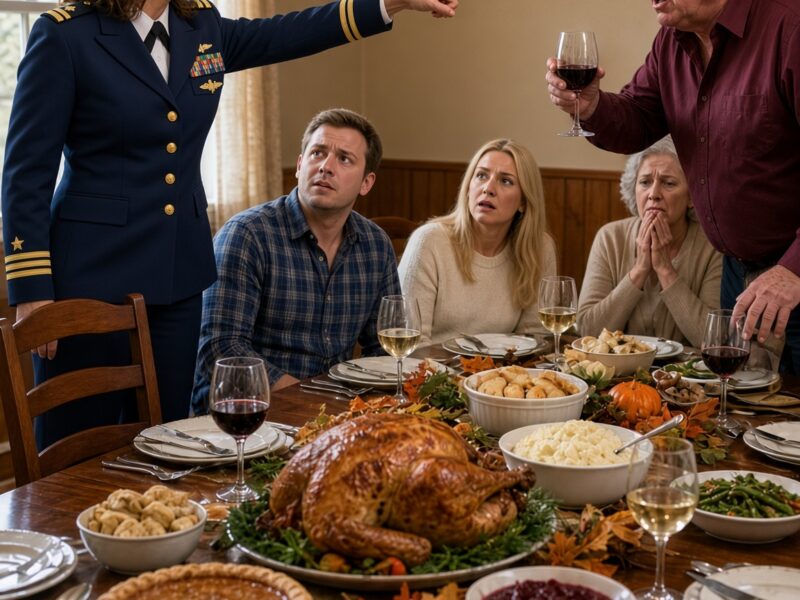
My father raised his glass at Thanksgiving dinner, looked straight at me, and told our entire family I was nothing more than an extra chair at the end of the table.
Everyone laughed.
My younger brother Tyler nearly spilled his drink. His wife, Chloe, covered her mouth, pretending to hide her smile. Even my father’s grandchildren joined in, although they were too young to understand what was happening.
My mother said nothing.
I sat there with my fork in my hand, feeling thirty years of humiliation rise in my throat.
Then I smiled.
I placed my fork beside my plate and said something my father never expected to hear.
“Good thing I just bought my own house in California, Dad. It’s 2,500 miles away. Now you won’t have to worry about making room for me anymore.”
I pushed back my chair.
“That extra chair is all yours.”
The laughter stopped.
My father’s face turned red. Tyler stared at me, his mouth hanging open.
For the first time in my life, I had silenced that dining room.
But what happened afterward would make that Thanksgiving humiliation seem small.
And it all started with a little folding table.
My name is Susan Miller. I grew up outside Batavia, New York, surrounded by cornfields, country roads, and a family business everyone believed would last forever.
My grandfather Walter started Miller and Son Equipment in 1974.
He built it with hard work, borrowed tools, and stubborn determination. He even painted the highway sign himself.
I loved that shop.
But my father, Arthur Miller, had already decided who belonged there.
My little brother Tyler.
Not me.
I was seven when I first understood the difference.
Our dining room had a beautiful oak table surrounded by six sturdy chairs. Every family dinner, those chairs were filled.
Except mine.
My place was a small plastic folding table pushed against the wall.
Its metal legs wobbled. Its edges pressed against my knees. Sometimes I had to turn sideways just to reach my plate.
One evening, I asked my mother why I couldn’t sit with everyone else.
She kissed my forehead.
“Don’t make a fuss, sweetheart. You know how your father gets.”
That was her answer to everything.
Keep quiet. Smile. Don’t upset Dad.
She wasn’t openly unkind.
Somehow, that made it worse.
She could see what was happening. She simply chose not to stop it.
When Tyler turned six, my parents rented a bounce house, arranged pony rides, and hung an enormous birthday banner in the yard.
My birthday that same year?
A grocery-store cake.
They had even spelled my name wrong.
I smiled for the pictures.
Then I cried into my pillow that night.
The only place I felt important was my grandfather’s old equipment shop.
Our head mechanic, Hank Kowalski, let me sit beside him while he repaired engines.
Hank was a big man with grease-stained hands and a laugh that could fill the garage.
One Saturday, he placed a carburetor on his workbench.
“Take it apart, Susan. Then put it back together.”
Four hours later, the engine started.
Hank stared at me.
Then he grinned.
“You’ve got your grandfather’s hands, kiddo.”
I never forgot those words.
Someone had finally seen something valuable in me.
At twelve, I built a miniature self-driving tractor using salvaged parts, a remote-controlled car, and a secondhand sensor kit.
It won first place at the Genesee County Science Fair.
I ran home clutching my blue ribbon.
“Dad! I won!”
Before he could answer, Tyler burst through the door carrying a participation trophy from his football league.
My father jumped out of his recliner.
“There’s my champion!”
He lifted Tyler into the air.
I stood there holding my certificate.
“Dad, look. First place in the whole county.”
He barely glanced at it.
Then he placed Tyler’s plastic trophy directly on top of my certificate.
“Put that somewhere it won’t get in the way.”
I stared at the paper beneath the trophy.
My name had disappeared.
That moment changed something inside me.
I stopped waiting for him to be proud.
Instead, I started planning my escape.
By senior year, I was running five miles every morning before school.
Even in February.
Sometimes the temperature dropped into single digits. Ice covered Route 5, and my lungs burned with every breath.
I kept running.
After school, I worked at the Route 5 Diner.
On weekends, I cleaned a parts warehouse in LeRoy.
Every dollar went into an old cookie tin beneath my bed.
I wanted to attend the United States Air Force Academy.
It was my way out.
One evening, Rosa Delgado, the diner supervisor, found me counting tips.
She placed a plate of pancakes in front of me.
“Sweetheart, what are you working so hard for?”
I told her about the academy.
About the entrance requirements.
About the bus ticket and supplies I would need.
She squeezed my hand.
“Then you keep going until you get there.”
I applied.
I completed the interviews, fitness tests, essays, and paperwork.
I even met with a retired officer named Lieutenant Colonel Darnell Price.
He asked why I deserved an appointment.
My hands trembled beneath the table.
“Because nobody ever made room for me, sir. So I learned to make room for myself.”
He studied me carefully.
Then he nodded.
That April, my rejection letter arrived.
I sat on the porch steps and stared at it.
I had failed.
When I showed my father, he chuckled.
“Told you. The military isn’t a place for a girl.”
He suggested I help my mother with the business bookkeeping instead.
I made it to the diner before I started crying.
Rosa found me in the employee bathroom.
She held me while I struggled to speak.
“You cry tonight,” she whispered. “Tomorrow, you fight.”
The next evening, Colonel Price called.
He told me not to quit.
So I didn’t.
I took college calculus classes, worked both jobs, and trained harder.
My grandmother Martha drove from Rochester every other Sunday.
She always brought food.
And she always told me the same thing.
“Your grandpa Walter would be so proud of you.”
The following spring, another envelope arrived.
This one was thick.
I opened it with shaking hands.
I had been accepted.
A full appointment to the United States Air Force Academy.
I was nineteen.
I ran to find my father.
He was watching baseball.
“Dad, I got in!”
He didn’t turn around.
“Don’t come asking me for money when you quit.”
That was all.
The night before I left, my parents threw Tyler an enormous fifteenth birthday party.
Music shook the walls.
Dozens of guests filled the backyard.
Upstairs, I packed everything I owned into one duffel bag.
Around ten, Rosa appeared outside my window.
She handed me an envelope containing $200.
“For those hundred little things.”
I hugged her so tightly she laughed.
The following morning, my mother drove me to Buffalo airport.
At the curb, she gave me a stiff hug.
Then she noticed my printed boarding pass on the seat.
“Can I keep this?”
I nodded.
At the gate, Grandma Martha called.
“Fly high, baby. Don’t look back.”
As the airplane climbed above the fields of western New York, I checked my phone.
Nothing from Dad.
Not even goodbye.
The Air Force Academy was harder than anything I had imagined.
The altitude made me dizzy.
Training exhausted me.
Upperclassmen inspected everything, from our uniforms to our posture.
But something unexpected happened.
For the first time, people noticed me.
They noticed my mistakes.
They noticed my effort.
And eventually, they noticed my abilities.
During my second year, Colonel Frank Delaney praised an engineering project I had completed.
He held it in front of the class.
“Cadet Miller didn’t just solve the problem. She asked a better question.”
Afterward, he asked where I had learned to think that way.
I smiled.
“A mechanic named Hank. And a folding table.”
Somehow, I ended up telling him my entire childhood story.
He listened.
Really listened.
Over time, he became the father figure I had always needed.
Four years later, I graduated.
Families cheered from the stands.
Parents embraced their children.
My family’s seats were empty.
Grandma Martha couldn’t travel because of her health, but she watched online.
Colonel Delaney pinned my second lieutenant bars onto my shoulders.
“Your father’s missing the best day of his life,” he told me.
I swallowed hard.
That summer, I changed my phone number.
Only Grandma received the new one.
Nine years passed.
I served overseas at Al Udeid Air Base in Qatar, earned a master’s degree, and worked my way up to major ahead of many officers in my class.
Eventually, I was assigned to Los Angeles Air Force Base in El Segundo.
My work involved overseeing contracts for satellite equipment.
I had built a career.
I had friends.
I had a future.
But one thing was still missing.
A place that truly belonged to me.
That changed one November.
I purchased a small Craftsman house in Torrance, California, using a VA-backed home loan.
My first furniture purchase was a custom walnut dining table.
Ten feet long.
Ten matching chairs.
Every chair the same height.
No special seat.
No folding table in the corner.
When the carpenter finished installing it, I ran my fingers along the polished wood.
Then I sat on the floor and cried.
I had finally built the home that little Susan deserved.
Three days later, a message arrived from my mother.
Thanksgiving. Six o’clock. Please come.
Grandma Martha had already encouraged me to visit once, just to see whether anything had changed.
So I requested leave.
I flew to Buffalo and rented a car.
Driving down our old road made my stomach tighten.
The house looked smaller.
The shutters were peeling.
The porch light still flickered.
And inside the dining room, against the wall, stood that same plastic folding table.
My chest tightened.
Mom hugged me.
Dad barely looked up.
Tyler spent dinner bragging about a new Rochester branch and a trucking partnership that would supposedly make the family rich.
Nobody asked about my career.
Nobody asked where I lived.
Then my father mentioned seeing my picture in the newspaper.
“Major. Big deal.”
He turned back to Tyler.
Later, he tapped his glass.
He announced the company’s fiftieth anniversary and Tyler’s promotion to co-manager.
Everyone applauded.
Then he looked at me.
“Some kids are the engine of this family. Others are just an extra chair at the end of the table.”
Everyone laughed.
And I finally stood up.
I told him about my house.
About California.
About the chair he could keep.
Then I walked out.
I barely reached my rental car before my hands started shaking.
I sat behind the steering wheel, unable to turn the key.
Then I cried.
Not like a decorated Air Force officer.
Like the seven-year-old girl who had spent her childhood waiting to be invited to the family table.
When I finally looked toward the house, my mother was standing on the porch in her socks.
She took a step toward me.
Then stopped.
She raised one hand.
I drove away.
A month later, I hosted Christmas dinner in California.
Grandma Martha came.
So did my friend Captain Maya Brooks, Colonel Delaney, my elderly neighbors Walt and June Henderson, and Caleb Vance, an old classmate I had recently reconnected with.
Seven people sat around my table.
Three chairs remained empty.
June looked around.
“Who are the extra seats for?”
I smiled.
“Whoever’s still on their way.”
Before dinner, I raised my glass.
“To everyone who was ever told there wasn’t room.”
Grandma Martha squeezed my hand.
That night, she posted pictures on Facebook.
Her caption was simple.
“My granddaughter’s table. Everyone gets a real chair.”
By morning, people back in Batavia were sharing the pictures.
Some remembered my childhood.
Some remembered that folding table.
At seven o’clock on Christmas morning, my phone rang.
My father.
His voice was furious.
“You made us a laughingstock! My customers are talking. People at church are talking!”
I tried to explain.
“Dad, I just had dinner with people I love.”
He wouldn’t listen.
Then Grandma Martha took the phone.
“Arthur, that’s enough.”
He told her to stay out of it.
But Grandma’s voice became sharper than I had ever heard.
“I stayed out of this for thirty years. Not anymore.”
She looked straight at me.
Then she said something that made my knees weak.
“When I was going through Walter’s old business papers for the anniversary, I found a trust document.”
My father went silent.
Grandma continued.
“Walter left Susan forty thousand dollars for her education. Arthur, you were responsible for that money.”
I gripped the kitchen counter.
Forty thousand dollars?
My grandfather had left me money?
Grandma asked the question I suddenly couldn’t bring myself to say.
“Arthur, where did Susan’s money go?”
The silence on the phone was unbearable.
Then my father finally answered.
And the first words out of his mouth made me realize my childhood had been hiding something far worse than an extra chair.
Continue in the comments 👇…
Part 2….
“The academy was free,” my father muttered. “Susan didn’t need the money.”
My grandmother’s face changed.
“So you spent Walter’s money on Tyler’s truck and tuition?”
Dad didn’t answer.
I felt the kitchen tilt around me.
All those years working late at the diner. Every dollar I saved. Every morning I ran through freezing temperatures.
My grandfather had tried to help me.
And my father had given that help to Tyler.
Grandma’s voice broke.
“She didn’t need money, Arthur. She needed a father.”
The call ended.
I sat there trembling, realizing how carefully my father had hidden the truth.
Three weeks later, at six in the morning, my phone lit up.
An alert from my credit monitoring service.
NEW ACCOUNT REPORTED.
YOU ARE LISTED AS GUARANTOR.
I opened the details.
A $120,000 business loan.
Borrower: Miller and Son Equipment.
Guarantor: Susan Miller.
My name appeared beside an electronic signature.
But I had never applied for that loan.
Never signed anything.
And whoever completed the paperwork knew my Social Security number and date of birth.
Information stored in the old filing cabinet at my father’s shop.
My stomach dropped.
Tyler had access to those records.
I stared at the screen, thinking about his Thanksgiving bragging and that mysterious trucking partnership.
Then I understood something terrifying.
My family hadn’t simply taken money meant for me.
Someone had now put my entire financial future at risk.
SAY ”Full Story” IF YOU WANT TO READ THE FULL STORY ✨💕