My Ex-Husband Told Me Our 12-Year-Old Daughter Was Beyond Hope While I Was Trapped Overseas Serving in the Army. His Girlfriend Mocked My Uniform and Accused Me of Abandoning My Child, but Neither Expected What Happened When I Held Her Hand. Two Tiny Squeezes Made Me Question Everything They Had Told Me About Her Condition. Then I Discovered a Message From the Night of Her Accident That Raised a Terrifying Question.
My Ex-Husband Told Me Our 12-Year-Old Daughter Was Beyond Hope While I Was Trapped Overseas Serving in the Army. His Girlfriend Mocked My Uniform and Accused Me of Abandoning My Child, but Neither Expected What Happened When I Held Her Hand. Two Tiny Squeezes Made Me Question Everything They Had Told Me About Her Condition. Then I Discovered a Message From the Night of Her Accident That Raised a Terrifying Question.
Part 1…
My 12-year-old daughter had been unconscious in a hospital bed for nine days when I finally made it home from my military assignment overseas.
And the first thing I heard was my ex-husband discussing whether it was time to stop the machines helping her breathe.
Not her favorite song.
Not whether she’d opened her eyes.
Not whether she’d recognized someone’s voice.
He was talking about letting her go.
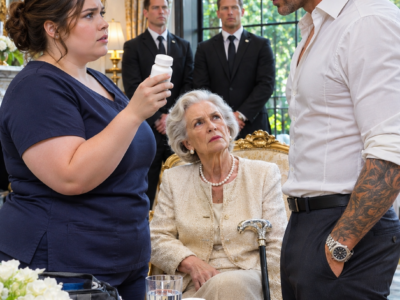
“The doctors want to meet Friday,” Grant said, standing outside her hospital room. “It’s time to let her go.”
I stopped walking.
My boots felt glued to the hospital floor.
Beside him stood his girlfriend, Natalie Price, wearing an expensive-looking outfit and an expression I recognized immediately.
Contempt.
Her eyes traveled over my Army uniform.
“Funny how you can serve your country but can’t show up for your own kid.”
The words landed hard.
I had spent nine days fighting to get back to North Carolina. Nine days making calls from airports, sleeping in uncomfortable chairs, and begging for information about my daughter.
And this woman thought she could measure my love by how quickly I arrived.
I didn’t answer.
I walked straight past them.
Because behind that door was the only person who mattered.
My daughter.
Emily.
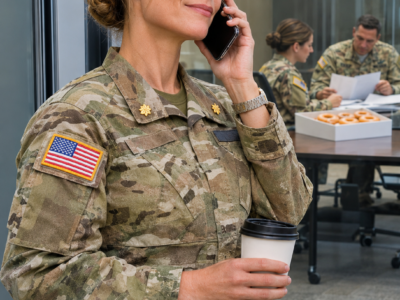
My name is Rebecca Sullivan. I’m 37 years old, a major in the United States Army.
I’ve served for 17 years.
I’ve learned to stay calm when everything around me is falling apart.
But nothing in my military career prepared me for seeing my little girl lying motionless beneath a hospital blanket.
The room was painfully quiet.
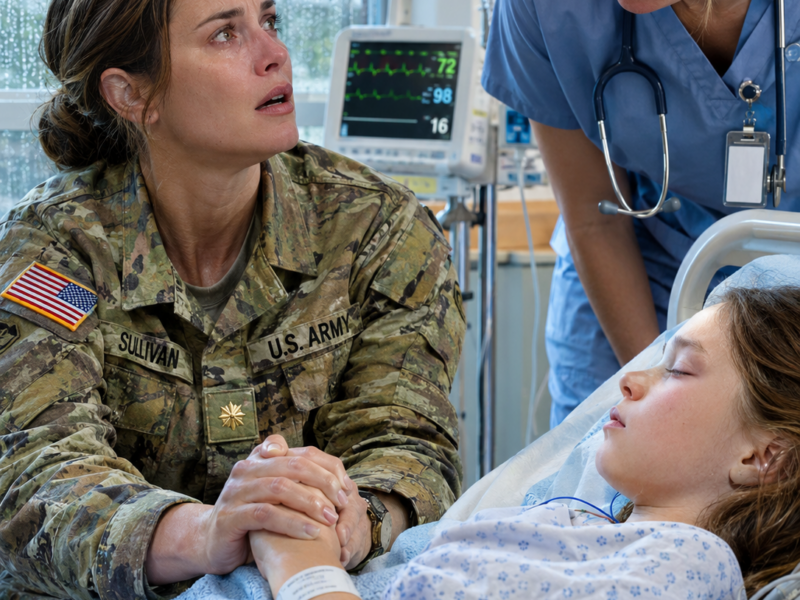
September rain streaked the windows of the Fayetteville hospital. Machines hummed beside Emily’s bed.
Her brown hair had been brushed away from her forehead.
A fading bruise marked her temple.
A ventilator helped her breathe.
I wanted to understand every number flashing across the monitor, but my eyes kept returning to her face.
She looked so small.
Too small.
I pulled a chair beside her bed and took her hand.
“Sweetheart, it’s Mom.”
My voice almost broke.
“I’m here.”
Nothing happened.
I brushed my thumb across her fingers.
Those were the same fingers that had once clung to mine during thunderstorms. The same little hand that had reached for me before her first school performance.
I held on.
Then I felt something.
A tiny movement.
One squeeze.
And another.
My heart seemed to stop.
Because six years earlier, Emily and I had invented a secret signal.
Two squeezes.
Three words.
I’m still here.
I stared at her hand.
Had I imagined it?
Was I so desperate that my mind was turning an ordinary movement into something meaningful?
I couldn’t know.
But I knew what I had felt.
And suddenly, everything Grant had told me about my daughter’s condition seemed worth questioning.
I pressed the nurse’s call button.
A nurse named Angela entered moments later.
“My daughter squeezed my hand twice,” I said. “I need someone to check.”
Angela approached the bed.
Her expression was gentle but serious.
“Can you tell me exactly what happened?”
I explained the movement carefully.
I didn’t mention our secret signal.
Not yet.
I wanted the medical team to evaluate what had happened without being influenced by what I desperately hoped it meant.
Angela documented my observation and contacted the physician.
While we waited, I sat down again.
Nine days.
I had lost nine days beside my daughter.
And I still didn’t know the whole story of how she’d ended up here.
When the accident happened, I was completing a logistics assignment overseas.
My unit had been coordinating equipment transfers between military facilities.
It wasn’t glamorous work.
But it mattered.
Grant called while I was in a briefing.
By the time I returned his call, he sounded strangely calm.
“Emily’s been in an accident,” he said. “She’s at the hospital, but they’re taking care of her.”
I remember gripping my phone.
“Is she awake?”
“Not yet. They’re running tests.”
That was all.
I immediately notified my commanding officer and started arranging emergency travel.
My command supported my return.
But the first available military connection was delayed.
Then a mechanical problem disrupted another flight.
Every hour felt unbearable.
I called Grant whenever I could.
His answers became shorter.
“She’s stable.”
“The doctors are watching her.”
“There’s nothing you can do here.”
That last sentence haunted me.
Nothing I could do?
I was her mother.
Even from thousands of miles away, I should have been involved in understanding her condition.
I tried calling the hospital directly.
But staff couldn’t verify my parental authority using the information available in Emily’s chart.
I asked Grant to fix the problem.
He promised he would.
Apparently, he hadn’t.
By the time I reached Fayetteville, I had barely slept.
And now he was standing outside our daughter’s room talking as though her future had already been decided.
Shortly after Angela contacted the physician, Dr. Hannah Whitaker entered.
She introduced herself as the pediatric critical care doctor overseeing Emily’s treatment.
I told her about the squeezes.
“Does that mean she’s waking up?”
She pulled a chair closer.
“It could be meaningful, Major Sullivan. But after a serious brain injury, some movements can also be reflexive. We need repeated examinations before drawing conclusions.”
“Then please examine her.”
“We will. I’m also requesting another evaluation from neurology.”
I looked toward Emily.
“Her father says you’re taking her off life support Friday.”
Dr. Whitaker’s expression changed.
“No decision like that has been made.”
I stared at her.
“What?”
“We scheduled a family meeting to discuss her condition, prognosis, and treatment options.”
My chest tightened.
“Grant made it sound final.”
“I’m sorry you were given that impression.”
For several seconds, I couldn’t speak.
Emily’s injuries were severe.
Her recovery was uncertain.
But there was no predetermined Friday deadline.
No final decision.
No agreement that we were simply waiting for the end.
Why had Grant described it that way?
I asked whether I could attend every medical discussion.
“Of course,” Dr. Whitaker said. “Our social worker is reviewing the custody documentation to make sure both parents are properly involved.”
After she left, I turned back to Emily.
I remembered a summer evening when she was six.
A thunderstorm had knocked out the power.
Grant was working late.
Emily crawled into my lap, trembling.
“What if I get scared and can’t talk?” she whispered.
I took her hand.
Squeezed twice.
“That means you’re still here,” I told her. “And I’ll squeeze twice so you know I’m right here, too.”
It became our little language.
Before dentist appointments.
Before school performances.
Before difficult goodbyes when my military duties took me away.
Two squeezes meant we were together, even when words weren’t enough.
Now I looked at her motionless face.
I knew the doctors had to be careful.
I understood that one movement couldn’t establish awareness.
But I couldn’t dismiss those two squeezes either.
Not without asking more questions.
Grant returned about an hour later.
He stood in the doorway, avoiding my eyes.
“You shouldn’t get your hopes up.”
I turned toward him.
“I’ve spoken with Dr. Whitaker.”
His jaw tightened.
“Rebecca, you weren’t here. You don’t understand what these nine days have been like.”
“Then help me understand.”
He said nothing.
I waited.
Still nothing.
That silence bothered me more than his anger.
I opened the folder Angela had provided, containing Emily’s admission summary and instructions for requesting additional medical records.
I needed facts.
Dates.
Times.
Something solid beneath all the fear.
Then one detail caught my attention.
The accident had happened at 10:43 Tuesday night.
I stared at the time.
10:43 p.m.
Something about it felt wrong.
I opened my phone and scrolled through my messages with Grant.
There it was.
A message he’d sent at 7:16 that same evening.
“Emily’s home. Already asleep. Everything’s fine.”
I remembered reading those words overseas.
I had been relieved.
My daughter was home.
Safe.
Sleeping.
At least, that was what I’d believed.
Now I looked at the hospital record again.
10:43 p.m.
More than three hours after Grant told me she was already asleep at home.
Why had Emily been out that late?
Why hadn’t he told me?
And why did his description of her accident seem to contain so many missing pieces?
I raised my eyes.
“Grant.”
He looked toward me.
“Why was Emily out that late?”
His expression shifted.
He glanced toward the hallway.
“We’ll talk later.”
“No.”
My voice remained quiet.
“We’ll talk about it now.”
He didn’t answer.
Instead, he turned and walked away.
I watched him disappear down the corridor.
For a moment, I wanted to follow him.
Demand answers.
Make him look me in the eye.
But Emily was still lying in that hospital bed.
And I wasn’t going to leave her alone to chase an argument that might lead nowhere.
I sat beside her again.
The machines continued their steady rhythm.
Outside, rain tapped against the glass.
I thought about the last time we’d spoken before the accident.
Ordinary things.
School.
Homework.
The little garden she wanted us to plant behind the house.
She had been excited about sunflowers.
I had promised we’d grow them together.
I’d believed there would be plenty of time.
That was the thought that nearly undid me.
Not the hospital machines.
Not Natalie’s cruel words.
The idea that my daughter had needed me, and I hadn’t known.
I held her hand again.
“I’m here, sweetheart.”
I waited.
No movement.
Still, I stayed.
I wasn’t ready to accuse anyone of causing what happened.
I wasn’t ready to assume the doctors were wrong.
And I certainly wasn’t ready to pretend those two squeezes proved something they might not.
But I knew one thing.
Grant had told me Emily was asleep at home.
Hours later, she’d been involved in an accident serious enough to bring her here.
And when I asked him why, he walked away.
For the first time since receiving that terrible phone call, my fear had somewhere to go.
I was going to find out what happened.
Not through shouting.
Not through guesses.
Through records, questions, and whatever evidence I could obtain.
Because my daughter deserved the truth.
And I intended to start with the night her father claimed she was safely asleep.
Continue in the comments 👇…
Part 2….
By Friday morning, I had learned that fear doesn’t always make you cry.
Sometimes it makes you sit perfectly still, reading the same document until the numbers blur.
10:43 p.m.
Emily’s accident.
7:16 p.m.
Grant’s message saying she was asleep.
At 7:30 that morning, a hospital social worker named Melissa Carter knocked on Emily’s door.
She carried a folder.
“Major Sullivan, I understand there have been some communication problems.”
I handed her my phone.
Nine days of messages.
“Still stable.”
“No changes.”
“Doctors say wait.”
Then I showed her the one that had troubled me most.
“Don’t keep calling the hospital. You’re upsetting everybody.”
Melissa read it silently.
“Have you received daily updates directly from the medical team?”
“No. I’ve been asking Grant to arrange them.”
She opened Emily’s chart and checked my contact information.
Then she frowned.
“Is your phone number still ending in 4186?”
My stomach dropped.
“That was my number four years ago.”
She looked up.
“The number listed here is disconnected.”
I felt cold.
Grant knew my current number.
He had used it to tell me about the accident.
Melissa promised to investigate who had supplied the outdated information.
She also requested our custody agreement.
Grant and I shared legal custody.
I had never surrendered my right to be involved in Emily’s care.
Now I had two questions.
Why had Grant misrepresented Friday’s meeting?
And why had the hospital been left with a number that couldn’t reach me?
SAY ”Full Story” IF YOU WANT TO READ THE FULL STORY ✨💕