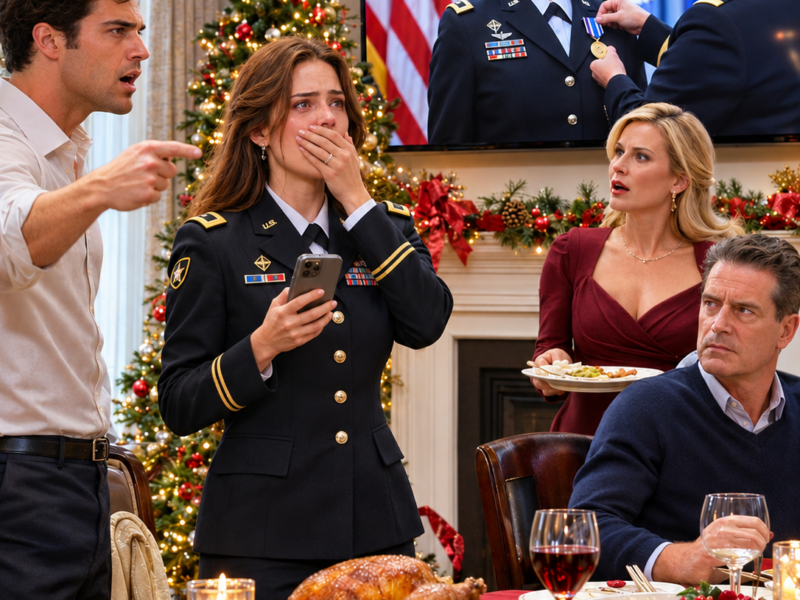
My Daughter Told Me Not to Come to Christmas Dinner Because My Ex-Husband’s New Wife Would Feel Uncomfortable. I Was Standing in a Grocery Store Holding Her Favorite Wine When She Said I Wasn’t Welcome Anymore. I Quietly Put the Bottle Back, Drove Home, and Prepared for a Military Ceremony She Had Chosen to Ignore. But Hours Later, When My Daughter Turned On the Television, She Saw Something That Made Her Reach for Her Phone.
My Daughter Told Me Not to Come to Christmas Dinner Because My Ex-Husband’s New Wife Would Feel Uncomfortable. I Was Standing in a Grocery Store Holding Her Favorite Wine When She Said I Wasn’t Welcome Anymore. I Quietly Put the Bottle Back, Drove Home, and Prepared for a Military Ceremony She Had Chosen to Ignore. But Hours Later, When My Daughter Turned On the Television, She Saw Something That Made Her Reach for Her Phone.
Part 1…
The first time my daughter told me I wasn’t welcome at Christmas, I was standing in a grocery store holding a bottle of her favorite wine.
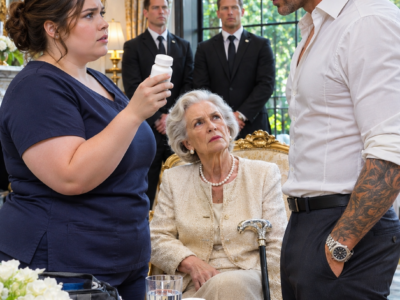
“Mom, Vanessa’s coming,” she said. “Dad’s new wife. We don’t want things to be awkward, so maybe you should stay home this year.”
I stared at the bottle in my hand.
For a moment, I couldn’t speak.
Three weeks earlier, my daughter had invited me to Christmas dinner. She’d asked me to bring my homemade cranberry sauce and the old ornaments she’d made as a little girl.
Now I wasn’t welcome.
Because my ex-husband’s new wife was coming.
“Emily,” I asked quietly, “are you telling me not to come?”
She sighed.
“Please don’t make this dramatic, Mom. It’s just one dinner.”
Just one dinner.
Four words.
Twenty-five years of motherhood suddenly felt reduced to four words.
I swallowed the lump in my throat.
“All right, sweetheart.”
“Thanks for understanding. I’ve got to go.”
The call ended.
I stood motionless beside the wine display while Christmas music played overhead.
A woman pushing a shopping cart asked if I was finished looking at the bottles.
I apologized and stepped aside.
Then I carefully returned the California Pinot Noir to the shelf.
Emily’s favorite.
The same wine we’d shared while cooking Christmas dinner years ago, when she’d stand beside me in the kitchen wearing flour on her cheeks and asking whether she could taste the cranberry sauce.
I could almost hear her laughter.
That little girl was gone.
And the woman she’d become had just told me there wasn’t room for her mother at Christmas.
My name is Catherine Pierce.
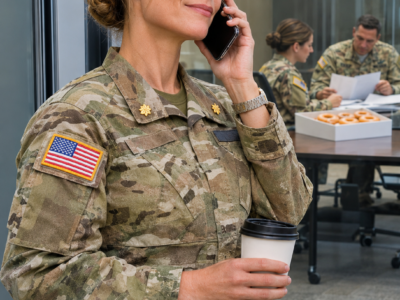
I’m forty-five years old, and I’ve served in the United States Army for more than twenty-two years.
I’m a colonel.
I’ve led soldiers through emergencies, made decisions under enormous pressure, and learned how to keep my voice steady when everything around me was falling apart.
But nothing in my military training prepared me for that phone call.
It was December 23.
Two days before Christmas.
And I had just discovered that my own daughter considered me the problem.
I pushed my cart toward the checkout, barely noticing what I purchased.
Outside, the Virginia winter air stung my cheeks.
I loaded two grocery bags into my car and sat behind the steering wheel.
Across the parking lot, a family was trying to secure a Christmas tree to the roof of their SUV.
The father laughed while his teenage daughter held the rope.
Her younger brother shouted instructions nobody followed.
They looked happy.
Ordinary.
Together.
I watched until they drove away.
Then I lowered my head.
Emily was twenty-five now.
She was married to a good young man named Daniel Brooks and building her own life.
I understood that.
Children grow up.
They get married.
They create new traditions.
I had never expected to remain the center of her world.
But I hadn’t expected to be removed from it either.
Especially not to make another woman comfortable.
Richard, my ex-husband, and I had divorced three years earlier after twenty-two years of marriage.
He worked in commercial sales.
His schedule had allowed him to attend nearly every school concert, soccer game, and parent-teacher conference I missed.
He was a good father.
I would never deny that.
When Emily needed someone to help with homework, Richard was usually there.
When she had a fever, he often sat beside her bed.
When she was little, he even learned to braid her hair.
Meanwhile, I was sometimes thousands of miles away.
Serving my country.
Missing birthdays.
Missing holidays.
Missing moments I could never get back.
Our marriage slowly cracked beneath those absences.
Richard stopped asking when I would return.
I stopped asking whether he was angry.
Eventually, we became strangers sharing a house.
After the divorce, he married Vanessa, a real estate agent who seemed warm, organized, and determined to make everyone feel welcome.
Everyone except me, apparently.
Emily adored her.
I was glad my daughter had a good relationship with her father’s new wife.
I meant that.
But I couldn’t understand why loving Vanessa seemed to require pushing me away.
When I arrived home, my little brick townhouse was quiet.
I carried the groceries into the kitchen.
On the counter sat a bowl of cranberries beside a handwritten recipe card.
Emily had written it in high school.
Her handwriting was messy.
She’d drawn a tiny heart beside the ingredients.
I touched the paper.
Then I walked into the living room.
My Christmas tree stood beside the window, glowing with warm white lights.
It wasn’t fashionable.
The ornaments didn’t match.
Some were chipped.
Others were older than Emily.
Near the bottom hung a crooked paper star covered in faded gold glitter.
Emily had made it when she was seven.
I removed it carefully.
On the back, in uneven purple letters, she’d written:
“To Mommy, my hero.”
That was when I cried.
Not because I wanted anyone’s sympathy.
Not because I regretted my career.
I cried because the little girl who once believed I was her hero had grown into a woman who didn’t even want me at her Christmas table.
I sat on the carpet holding that ridiculous little star.
For several minutes, I let myself feel everything.
The disappointment.
The loneliness.
The years of missed moments.
And the terrible realization that my daughter had begun treating my absence as something she preferred.
Then I looked at the clock.
I had somewhere important to be.
Upstairs, hanging inside a garment bag, was my Army service uniform.
I’d prepared it the previous evening.
My shoes were polished.
My ribbons were straight.
The silver eagle insignia on my shoulder straps gleamed beneath the bedroom light.
That afternoon, I was scheduled to attend a formal military ceremony near Washington, D.C.
A four-star general would be presenting me with the Soldier’s Medal.
Three weeks earlier, I’d invited Emily and Daniel.
“I’d really love for you to come,” I’d told her.
She’d promised to check her schedule.
Later, she’d texted that Christmas preparations were keeping her busy.
I hadn’t pushed.
I never wanted my daughter to feel obligated to attend another military event.
But this ceremony wasn’t another promotion.
It wasn’t a routine recognition.
It was connected to something that had happened eight months earlier.
Something I still thought about when the house became quiet.
A soldier named Aaron Miller had nearly lost his life.
And for a few terrifying minutes, I hadn’t known whether we could save him.
I stood before my bedroom mirror, adjusting my collar.
My eyes were still swollen.
I dabbed beneath them with a tissue.
Then I took a slow breath.
Today wasn’t about Emily.
It wasn’t about Richard.
It wasn’t about Christmas dinner.
It was about Aaron.
Eight months earlier, Sergeant First Class Aaron Miller had been involved in a serious training accident at a military installation in Virginia.
I was there observing a joint logistics exercise.
It should have been routine.
Equipment inspections.
Vehicle movements.
Safety procedures.
Nothing unusual.
Then a heavy support vehicle struck a concrete barrier while maneuvering around another truck.
The impact damaged its engine compartment.
Aaron became trapped inside the cab.
I remembered the sound.
The crushing metal.
The shouted warnings.
Then the smoke.
Thick, dark smoke began rising from beneath the hood.
I ordered nearby personnel to clear the area and directed a lieutenant to call emergency services.
Two soldiers grabbed extinguishers.
Another secured the remaining vehicles.
Aaron was conscious.
His leg was pinned beneath the damaged dashboard.
He was calling for help.
Staff Sergeant Luis Ortega reached the vehicle with a rescue tool.
I followed.
Ortega worked to control the spreading flames while I climbed onto the passenger-side step.
I reached through the damaged doorway.
Aaron’s face was marked from the accident.
His breathing was strained.
“Please don’t leave me,” he said.
Those words stayed with me.
I told him we were getting him out.
Ortega worked beside me.
Another soldier came to help.
The heat intensified.
Smoke filled the air.
But eventually, we freed Aaron’s trapped leg.
Together, we carried him away from the vehicle before the flames spread further.
The entire rescue lasted only minutes.
Yet I remembered every second.
Aaron suffered a serious leg injury and needed months of recovery.
I was treated for minor burns and breathing difficulties.
Ortega received recognition for his courage, too.
I made certain his contribution was documented.
Because the truth was simple.
Aaron survived because several people refused to leave him behind.
Months later, my commanding officer informed me that I’d been recommended for the Soldier’s Medal.
I was stunned.
I’d seen other soldiers act with the same courage.
I didn’t feel more deserving than they were.
But when the award was approved, I called Emily.
“There’s going to be a ceremony in December,” I told her. “I’d love for you and Daniel to come.”
“That’s nice, Mom. Is it another promotion?”
“No, sweetheart. It’s an award.”
“Oh. Congratulations. I’ll check our schedule.”
That was all.
She didn’t ask what the award was for.
She didn’t ask whether I was all right.
And I didn’t explain.
Aaron’s family was still dealing with his recovery.
I didn’t want to turn their difficult experience into a story about myself.
Still, a small part of me had hoped my daughter would be curious.
She wasn’t.
As I drove toward the installation that afternoon, Christmas lights decorated the houses along the road.
At a traffic light, I watched a mother and daughter crossing the street together.
They carried shopping bags and coffee.
They were laughing.
I wondered when Emily and I had last laughed like that.
Without tension.
Without checking our phones.
Without the invisible distance between us.
Richard used to tell people I was married to the Army.
Sometimes jokingly.
Sometimes not.
After our divorce, Emily repeated something he’d said.
“Dad says you were always better at taking care of the Army than taking care of us.”
I never knew how to answer.
I didn’t want to make her choose sides.
So I stayed quiet.
I thought silence would protect her.
Now I wondered whether it had only allowed one version of our marriage to become the truth.
When I arrived at the military installation, a young captain checked my identification.
Inside, the hallway smelled of fresh coffee and floor polish.
A coordinator greeted me.
“Colonel Pierce, General Wickham will arrive shortly. Sergeant Miller and his family are already here.”
My chest tightened.
I followed her into the reception room.
Aaron stood near the window, leaning on a cane.
Beside him was his wife, Rachel.
Their little boy held her hand.
Aaron straightened when he saw me.
“Ma’am.”
I waved him off.
“At ease, Aaron. How’s the leg?”
“Better every week.”
Rachel stepped forward.
She took both my hands.
“I’ve wanted to thank you properly.”
“You don’t owe me anything.”
Her eyes filled.
“Our son still has his father because you and those soldiers didn’t leave him there.”
I couldn’t speak.
Then the little boy looked up.
“Are you the lady who helped Daddy?”
I crouched carefully.
“One of them. A lot of people helped your dad.”
He smiled.
“He’s coming home for Christmas.”
Those five words nearly undid me.
Because just hours earlier, my own daughter had told me not to come home for Christmas dinner.
And now this little boy was celebrating because his father would be there.
Aaron rested a hand on his son’s shoulder.
He looked directly at me.
“That day, Colonel, you were the one who stayed.”
A door opened behind us.
“Colonel Pierce, General Wickham has arrived.”
I stood.
Straightened my jacket.
And followed the coordinator toward the auditorium.
The room was nearly full.
Soldiers sat beside their families.
Spouses held cameras.
Children whispered excitedly.
Small American flags lined the stage.
A Christmas wreath hung near the entrance.
A captain escorted me to the front row.
“Your seat is here, Colonel.”
Three chairs had originally been reserved for my guests.
Two remained empty.
The third had been reassigned after I confirmed that no family members would attend.
I stared at those empty chairs.
Just for a second.
Then I sat down.
Across the aisle, Aaron was helping his son straighten a tiny necktie.
Rachel smiled at me.
I smiled back.
The ceremony began shortly after three.
Everyone stood for the national anthem.
Then General Margaret Wickham approached the podium.
She was a four-star general with nearly four decades of service.
A woman whose presence commanded respect before she spoke a word.
“Today,” she began, “we’re recognizing courage that had nothing to do with a battlefield.”
The auditorium fell silent.
She described the training accident.
The damaged vehicle.
The spreading fire.
The soldiers who had acted without hesitation.
She mentioned Luis Ortega.
She acknowledged the emergency responders.
Then she turned toward me.
“Colonel Catherine Pierce demonstrated exceptional courage under conditions that placed her own life at significant risk.”
I kept my hands folded.
My throat tightened.
I thought about Aaron’s voice.
Please don’t leave me.
Then the general spoke again.
“Colonel Pierce, please join me.”
I stood.
The walk to the stage seemed longer than it was.
My shoes made faint sounds against the polished floor.
The lights were bright.
The audience was silent.
General Wickham shook my hand.
An officer read the official citation.
Then the general fastened the Soldier’s Medal to my uniform.
Applause filled the auditorium.
I looked toward Aaron.
He was standing beside Rachel, balancing on his cane.
Their little boy was holding a handmade sign.
Large blue letters covered the white poster board.
“THANK YOU FOR BRINGING MY DAD HOME.”
My eyes filled instantly.
I pressed my lips together.
General Wickham leaned closer.
“Take your time, Catherine.”
I nodded.
For the first time that day, I didn’t feel invisible.
But the person I had most wanted to see in that room wasn’t there.
My daughter.
Emily had no idea what she was missing.
And I had no idea that, before the evening ended, the entire country would be able to see what she had chosen not to witness.
Continue in the comments 👇…
Part 2….
After the ceremony, I gave a short speech thanking everyone involved in Aaron’s rescue.
I refused to take credit alone.
Aaron was alive because people had worked together.
That mattered more than any medal.
At the reception, his son insisted on taking a picture with me.
Then a television reporter approached.
Her name was Lauren Mitchell.
She was preparing a holiday feature about military families.
“Do you consider yourself a hero, Colonel?”
“No,” I answered. “I’m grateful we had people there who knew what to do.”
She turned toward Aaron.
“What does today mean to your family?”
He looked at Rachel and their son.
“It means I get another Christmas with them.”
The room went quiet.
By five, I was driving home.
My medal rested in its presentation case on the passenger seat.
At home, I changed into sweatpants, heated some soup, and checked my phone.
Several congratulations from colleagues.
Nothing from Emily.
I placed the phone facedown.
Across town, my daughter was preparing Christmas dinner with Daniel, Richard, and Vanessa.
I didn’t know Daniel would soon ask why I wasn’t there.
I didn’t know Richard would dismiss my absence as being “for the best.”
And I certainly didn’t know a national news program was preparing to show my face beside a four-star general.
That evening, my daughter would finally see what she’d missed.
And when she called me, the question she asked would reveal just how little she knew about her own mother.
SAY ”Full Story” IF YOU WANT TO READ THE FULL STORY ✨💕