A Three-Year-Old Girl Walked Into My Waterfront Office and Demanded I Return Her Missing Father’s Fishing Boat. I Had Spent Twenty-Six Years Making Powerful Men Fear My Decisions, Yet This Little Girl Refused to Leave. She Gave Me Until the Tide Came In to Change My Mind, Holding a Purple Stuffed Octopus Like Her Only Protection. Then Something Fell From Her Yellow Raincoat, and I Recognized a Secret From Forty-Two Years Ago.
A Three-Year-Old Girl Walked Into My Waterfront Office and Demanded I Return Her Missing Father’s Fishing Boat. I Had Spent Twenty-Six Years Making Powerful Men Fear My Decisions, Yet This Little Girl Refused to Leave. She Gave Me Until the Tide Came In to Change My Mind, Holding a Purple Stuffed Octopus Like Her Only Protection. Then Something Fell From Her Yellow Raincoat, and I Recognized a Secret From Forty-Two Years Ago.
Part 1…
At 9:50 on a freezing Friday night in November, a three-year-old girl walked into my office and gave me an ultimatum.
I had been feared on the Boston waterfront for twenty-six years.
Bankers lowered their voices around me. Fishermen avoided my eyes. Men twice her size had sat across my desk with trembling hands, begging me to reconsider decisions I had already made.
But this little girl wasn’t begging.
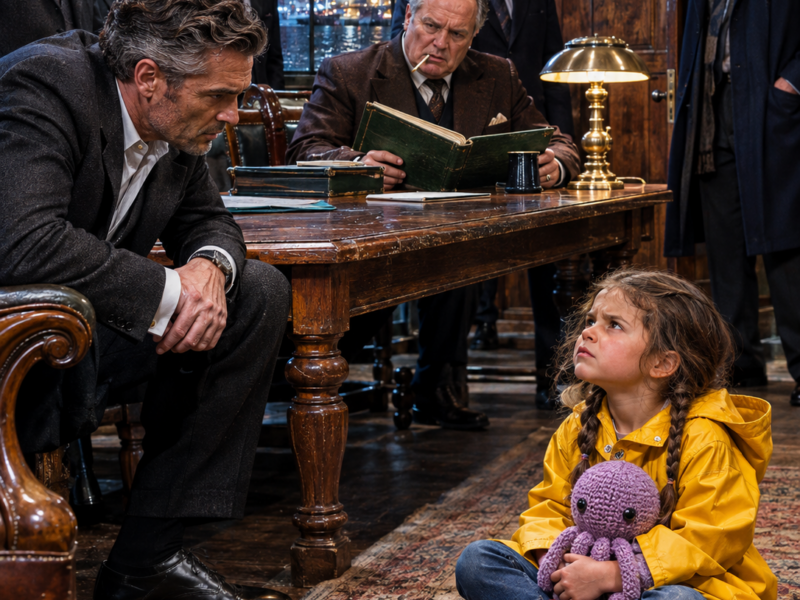
She was wearing an oversized yellow raincoat, red rubber boots, and two messy braids. A purple stuffed octopus dangled from her fist.
And she wanted her father’s boat back.
My name is Declan Ror.
I was fifty-one years old, and I ran my family’s waterfront business from the fourth floor of an old seafood building at Pier 6.
Everyone called my office the loft.
It wasn’t fancy. Just scarred wooden floors, salt-streaked windows, and a long oak table where decisions were made that could change a man’s entire life.
Behind my chair hung a yellowed tide calendar from 1984.
Nobody ever asked why I kept it.
That night, Colm Fallon sat across from me, reading from his green ledger.
Colm was fifty-eight, mild-mannered, and dependable. He had managed our lending operation for years.
I trusted him.
That was something I rarely did.
He turned a cinnamon toothpick between his teeth as he reached the final item.
“Daniel Keane. Fishing vessel Marigold. Two hundred twelve thousand dollars, including penalties. Seized Tuesday.”
He glanced up.
“The buyer from Gloucester can take her Monday.”
I barely considered it.
“Sell it.”
Colm nodded.
My rule was simple. If someone borrowed money, they paid it back.
I didn’t make exceptions.
Not for friends. Not for strangers. Not for anyone.
I was about to close the meeting when Hollis Bright, my longtime driver, turned toward the door.
Something was moving outside.
A soft thump.
Then another.
Hollis opened the door and looked down.
A little girl was crawling up the final steps on her hands and knees.
“Thirty-nine. Forty. Forty-one.”
She stood, wiped her palms on her raincoat, and looked straight at Hollis.
“Excuse me. Is Mr. Ror here?”
Hollis didn’t answer.
She walked right past him.
Five grown men fell silent.
The girl stood on my rug, dripping rainwater onto the wooden floor. She studied each face carefully before settling her enormous brown eyes on mine.
“You’re Mr. Ror.”
I leaned back.
“How do you know?”
“You look like the picture.”
“What picture?”
“I’m not supposed to tell you yet.”
Something about that answer bothered me.
But before I could ask another question, she straightened her little shoulders.
“I came about the boat.”
Colm immediately stood.
“Sweetheart, I think you’re lost.”
He gestured toward Eman Pike, our large security man.
“Eman, take her downstairs.”
I raised one finger.
Colm stopped speaking.
I looked at the child.
“What boat?”
“Daddy’s. The Marigold.”
My hands went still.
That was the boat we’d just discussed.
“She’s at the wrong pier,” the girl continued. “She’s been there since Tuesday. Boats get sad when they’re in the wrong place.”
She swallowed.
“Can we please have her back?”
Outside, a foghorn sounded across the black harbor.
Nobody moved.
I had heard hundreds of desperate requests in that room.
This one was different.
There was fear in her eyes, but she refused to show it.
“Where’s your father?” I asked.
“I don’t know.”
Her voice became smaller.
“That’s why I need the boat.”
For one uncomfortable second, I didn’t know what to say.
Then I reminded myself who I was.
“Your father borrowed money and didn’t repay it. The boat belongs to us now.”
She stared at me.
“I’m sorry,” I added. “The answer is no.”
Her chin trembled.
Just once.
Then she nodded.
“Okay.”
I expected tears.
Instead, she walked to the center of my office, sat cross-legged beneath the old tide calendar, and placed her purple octopus in her lap.
“I’m giving you until the tide.”
I frowned.
“Until what?”
“The tide comes in.”
She smoothed the toy’s eight arms.
“Daddy says the ocean doesn’t wait for anybody. But I can wait a little.”
She looked up.
“If you still say no, I’m going to tell the whole harbor you were mean.”
Eman made a choking sound.
Colm laughed.
The girl lifted her octopus.
“Gerald will tell them, too.”
I should have been amused.
Instead, I felt something unfamiliar tightening in my chest.
Colm leaned forward.
“Declan, we can’t conduct business with a child sitting on the floor.”
He glanced toward Eman.
“Let’s have someone take her back to her grandmother.”
“Nobody touches her.”
My voice was quiet.
Eman immediately sat down.
“She stays.”
And so the strangest meeting of my life continued.
A three-year-old girl sat on my office floor, rocking a purple octopus while five grown men pretended nothing unusual was happening.
She didn’t complain.
She didn’t cry.
She simply watched me.
Then something slipped from inside her raincoat.
A small booklet landed on the rug.
Hollis noticed first.
I saw his eyes move from the booklet to the old calendar behind my chair.
Then back again.
His expression changed.
The booklet was a pocket tide calendar, its cover worn gray from years of handling.
Printed across the front were the words Boston Harbor and Approaches.
The same series as mine.
The same old lighthouse illustration.
My pulse shifted.
I hadn’t seen another copy like that in decades.
Before I could examine it, footsteps thundered up the stairs.
The door opened.
An elderly woman entered, leaning on a black cane.
She was tiny, perhaps five feet tall, with white hair flattened by the rain and fierce blue eyes.
The moment she saw the little girl, her entire body seemed to weaken.
Then she straightened.
“Margaret Eileen Keane!”
The child looked up.
“Hi, Nana.”
“I told you to hold my hand!”
“I did.”
The girl considered this.
“Then I stopped.”
The woman closed her eyes.
I almost smiled.
Almost.
The little girl pointed at her grandmother.
“This is my nana. She’s loud, but she’s nice.”
I stood and approached the woman.
“Mrs. Keane.”
“Mr. Ror.”
She didn’t offer her hand.
“My son hasn’t been home since Tuesday,” she said. “His boat is gone. His daughter barely sleeps. And now she’s decided you’re the only man who can fix it.”
Colm rose.
“Mrs. Keane, your son owes us two hundred twelve thousand dollars. He signed the agreement.”
The woman’s face hardened.
“My Daniel never signed anything with this business.”
Colm’s smile tightened.
“I have the documents.”
“Then somebody’s lying.”
The room went silent.
She stepped toward the table.
“Daniel knows the Ror rule. Every fisherman on this waterfront knows it.”
I stared at her.
“What rule?”
She looked genuinely stunned.
“The rule your father believed in. The rule you made sure this business followed.”
Her voice sharpened.
“The loft never lends against a working fishing boat. Never. Not for any price.”
Something cold moved through me.
Because she was right.
I’d established that rule when I was twenty-five.
I had never broken it.
Not once.
My family’s lending operation financed restaurants, contractors, and other businesses.
But never working fishing boats.
There was a reason.
A reason connected to that calendar behind my chair.
A reason I had spent forty-two years trying to forget.
I turned toward Colm.
“How many fishing boats have we seized?”
He blinked.
“A handful.”
“How many?”
“Eleven. Maybe twelve.”
I felt the room tilt.
“That’s impossible.”
Colm opened his ledger.
“You approved the exceptions yourself.”
He turned the book toward me.
There it was.
My signature.
Beneath a list of fishing vessels.
Beside it, a date.
March 14.
I read it twice.
Then a third time.
Because March 14, five years earlier, was the day I buried my mother.
I remembered that morning perfectly.
The granite church in Dorchester.
The cold air.
The six men carrying her casket.
Colm standing quietly at the back.
He had shaken my hand at the cemetery.
I hadn’t signed a single business document that entire week.
Not one.
Yet there was my name.
I looked at Colm.
“Leave this page with me.”
“Of course, Declan.”
His smile remained.
But the cinnamon toothpick stopped moving.
I noticed.
For the first time in years, I noticed everything.
“We’ll finish Monday,” I said.
The men filed out.
When the door closed, I was left with Hollis, the elderly woman, her granddaughter, and a document bearing a signature I knew I hadn’t written.
“Hollis.”
“Boss?”
“Call Norah Quill. Tell her to come immediately. And tell nobody.”
Norah was our attorney.
She had worked with us for fourteen years and knew every ledger, contract, and account connected to the business.
I needed someone who could tell me what was happening.
Then Hollis bent down.
He picked up the little tide booklet.
“Boss, there’s writing inside.”
He opened the back cover.
Four hurried words were penciled there.
Mr. Ror. Pier 7. Bell.
My breath caught.
I took the booklet.
The handwriting looked rushed, as though someone had written it in darkness.
I read the message again.
“Where did you get this?”
The little girl watched me carefully.
“Daddy gave it to me.”
“When?”
“Before he went away.”
She paused.
“He said not to give it to you right away.”
I looked up.
“Why?”
“He said to watch your face first.”
Her voice became serious.
“If your face gets soft, you’re the one.”
I couldn’t move.
She tilted her head.
“Your face got soft.”
For forty-two years, I’d worked to make sure nobody could read my emotions.
And a three-year-old had just seen straight through me.
She held out her hand.
“You can keep it now.”
I crouched in front of her.
For the first time that evening, we were eye to eye.
“What’s your name?”
“Maisie Keane.”
She lifted three fingers.
“I’m three and a quarter.”
“Maisie, I told you no tonight.”
“Yes.”
“It wasn’t a very good answer.”
“No,” she agreed.
I looked at the booklet again.
“I’m going to inspect your father’s boat.”
Her eyes widened.
“I’m not promising to return it. I’m promising to look.”
She considered this carefully.
“A look is a maybe.”
“Yes.”
“And a maybe can become a yes.”
I nodded.
She seemed satisfied.
“You have to come back before the tide.”
“I will.”
“Promise?”
I placed my hand against my chest.
“I promise.”
Then she pushed Gerald, the purple octopus, into my hands.
I stared at it.
“What’s this for?”
“He has eight arms. He’s good at holding on.”
She looked at me sternly.
“Don’t lose him.”
I slipped the toy into my coat pocket.
Ten minutes later, Hollis drove me through the freezing rain toward Pier 7.
I watched the harbor lights slide across the windshield.
Red.
Green.
Black water.
For forty-two years, I had avoided stepping onto a fishing boat.
That night, I was going back.
And I was beginning to suspect that someone I’d trusted for years had been hiding something terrible in plain sight.
Continue in the comments 👇…
Part 2….
The Marigold was tied at the far end of Pier 7.
Her white paint was weathered, her blue trim chipped. A tiny yellow flower had been painted on her bow.
A child’s red mitten was caught against the railing.
I stepped aboard.
My knees instinctively adjusted to the movement beneath me.
Forty-two years disappeared.
Inside the wheelhouse, I smelled diesel, damp wool, and old coffee.
Then I saw it.
A brass ship’s bell.
Green with age.
Mounted beside the door.
One word was engraved around its rim.
Kittiwake.
My father’s boat.
I couldn’t breathe.
I had watched that boat being taken when I was nine. My father had rung this exact bell before it disappeared from our harbor.
I reached for it.
The wooden mounting shifted.
Click.
A hidden compartment opened behind the bell.
Inside were a black waterproof notebook, eleven photographs, and a folded letter.
My hands shook as I unfolded it.
The letter was from Maisie’s missing father.
He claimed someone from my own business had secretly used his boat for suspicious cargo.
He had taken photographs.
He had kept records.
And the man directing everything, he wrote, always chewed cinnamon toothpicks.
Colm.
My trusted partner.
The final paragraph made my stomach drop.
Danny believed he knew where he might be taken.
An abandoned cold-storage room beneath Pier 9.
A room that flooded at high tide.
Saturday morning’s high tide was 4:12.
Then Hollis found something on the wheelhouse floor.
A freshly chewed cinnamon toothpick.
Someone had been there before us.
And suddenly, Maisie’s warning about the tide wasn’t just a child’s innocent ultimatum.
It was a deadline.
SAY ”Full Story” IF YOU WANT TO READ THE FULL STORY ✨💕