A Staff Sergeant Called Me a Secretary in Front of 24 Soldiers, Then Charged at Me With a Training Knife. He Thought a 43-Year-Old Woman Holding a Clipboard Would Be Easy to Humiliate, Until He Hit the Mat. But When His Commander Revealed My Military Background, the Sergeant Turned His Embarrassment Into an Official Complaint Against Me. And What a Captain Whispered About Three Buried Safety Reports Made Me Realize My Career Wasn’t the Only Thing at Risk.
A Staff Sergeant Called Me a Secretary in Front of 24 Soldiers, Then Charged at Me With a Training Knife. He Thought a 43-Year-Old Woman Holding a Clipboard Would Be Easy to Humiliate, Until He Hit the Mat. But When His Commander Revealed My Military Background, the Sergeant Turned His Embarrassment Into an Official Complaint Against Me. And What a Captain Whispered About Three Buried Safety Reports Made Me Realize My Career Wasn’t the Only Thing at Risk.
Part 1…
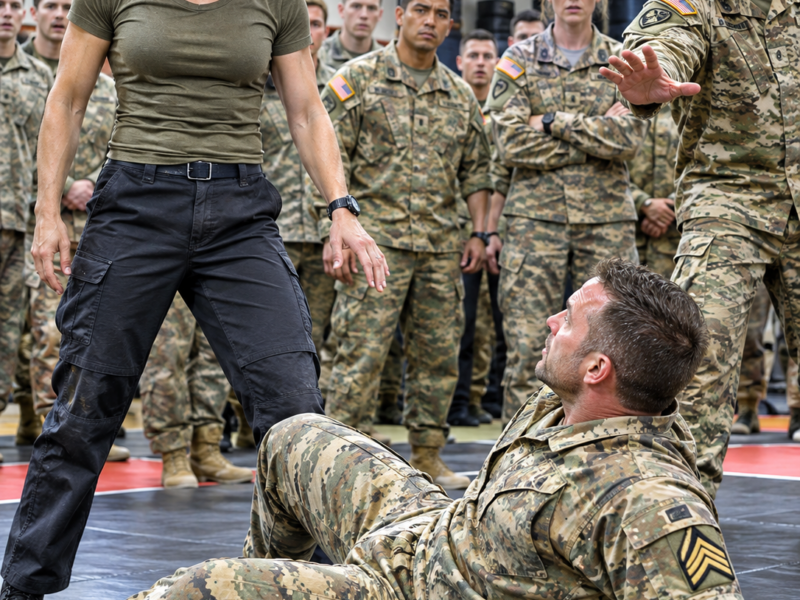
“Who let the secretary play soldier?”
Staff Sergeant Travis Rourke grinned as 24 soldiers watched from the edge of the training mat.
A few men laughed.
Then he raised his rubber training knife and lunged straight toward my chest.
He was moving too fast.
Much faster than we’d agreed.
I stepped sideways, caught his wrist, and turned with his momentum. His free hand struck my injured shoulder, sending a sharp wave of pain down my arm.
For one awful second, my footing slipped.
Then his balance broke.
Three seconds after he’d attacked me, Travis landed flat on the padded mat.
The room fell silent.
“STOP THE EXERCISE!”
Colonel Adrian Sutter’s voice cut through the building.
I released Travis immediately and stepped back. My right shoulder was throbbing, but I kept my expression steady.
Nobody was laughing now.
And what happened afterward nearly cost me my job.
My name is Laurel Hensley. I was 43 years old, a retired United States Army major, and I’d spent 20 years serving in military intelligence.
I’d worked through deployments to Iraq and Afghanistan. I’d supported Special Operations missions and survived assignments that demanded more discipline than most people could imagine.
But that September morning, none of it seemed to matter.
To Travis Rourke, I was just a middle-aged woman carrying a clipboard.
And apparently, that made me an easy target.
It was Tuesday, September 16, 2025.
I’d arrived at the combatives training facility at Fort Liberty, North Carolina, at 8:30 that morning.
My assignment was straightforward.
Evaluate training performance. Review safety procedures. Document whether instructors were following the approved lesson plan.
Nothing more.
I wore a plain olive-green shirt and carried a coffee mug, clipboard, and printed training schedule.
The building smelled of rubber mats, disinfectant, and stale coffee.
Soldiers stretched along the walls while assistant instructors inspected protective equipment.
Travis noticed me immediately.
“Morning, ma’am. Administrative offices are down the hall.”
I looked at him.
“I’m in the right building.”
His eyes dropped to my clipboard.
“Here to count our pushups?”
Several soldiers chuckled.
I kept my voice calm.
“I’m here to evaluate training performance and safety.”
His smile tightened.
“Wonderful. Another desk jockey telling us how to fight.”
I could have corrected him.
I could have explained that I’d spent two decades wearing the same uniform he wore.
I could have mentioned the overseas training compounds, the operational teams, or the senior instructors who’d taught me how quickly arrogance could become dangerous.
But I didn’t.
I wasn’t there to impress anyone.
“Let’s begin with your safety briefing, Sergeant.”
He gave one.
Barely.
Travis hurried through emergency procedures and skipped the section explaining how trainees could stop an exercise.
I noticed immediately.
Then a young specialist raised his hand.
“Sergeant, what if an old injury starts hurting during a drill?”
Travis sighed dramatically.
“If you’re injured, speak up. If you’re uncomfortable, get used to it.”
I wrote down his response.
Across the room, Sergeant First Class Mateo Salcedo glanced toward me.
He’d been checking equipment, but something in his expression caught my attention.
He looked uncomfortable.
Almost resigned.
As though he’d heard that answer before.
At 9:00, the soldiers began practicing defensive movements with flexible rubber training knives.
The approved lesson plan required slow demonstrations before controlled partner exercises.
Travis apparently had another idea.
He grabbed a trainee’s arm, twisted him into position, and shoved him backward.
The young soldier stumbled.
“Come on!” Travis barked. “Nobody’s going to ask permission before attacking you!”
An assistant instructor reminded him to slow down.
Travis waved him away.
I made another note.
That was when he noticed my pen.
“Something wrong, ma’am?”
“I’m documenting the session.”
“Then come down here and document it up close.”
He pointed toward the mat.
“No, thank you. I’m observing.”
His grin widened.
Then came the insult.
“Who let the secretary play soldier?”
Laughter spread through the room.
I felt my jaw tighten.
Not because I’d never been insulted before.
I’d heard worse during my first week as a young lieutenant.
What disturbed me was the message he was sending those soldiers.
He was teaching them that questions were weakness.
That caution was cowardice.
That the loudest man in the room automatically deserved respect.
I’d seen where that thinking could lead.
And I knew how much it could cost.
“Sergeant,” I said, “continue with your scheduled instruction.”
Instead, Travis picked up a rubber knife.
“Come on, princess. Let’s see what you know.”
Before I could respond, the facility door opened.
Colonel Adrian Sutter entered with Captain Bridget Calloway, the officer overseeing the safety evaluation.
Sutter surveyed the room.
“Rourke. What’s happening?”
Travis straightened.
“Offering our evaluator a demonstration, sir.”
I spoke immediately.
“I haven’t agreed to participate.”
Sutter turned toward me.
“Laurel, are you comfortable with one controlled exchange?”
I hesitated.
My shoulder had been aching since Sunday.
That injury wasn’t new.
I’d hurt it during a field exercise in 2021, and surgery had restored most of its function.
But certain movements still caused pain.
I had absolutely nothing to prove.
Still, a supervised demonstration might reveal whether Travis could follow the same safety procedures he was supposed to teach.
“Only under the approved conditions,” I answered.
“Slow speed. One exchange. Immediate stop on command.”
Sutter repeated those conditions aloud.
Travis agreed.
Bridget checked our protective equipment.
Mateo positioned himself beside the mat as safety observer.
“Either participant can stop at any time,” he reminded us.
I nodded.
Travis smiled.
“Ready, Major?”
“Ready.”
Then he lunged.
Too fast.
The rubber blade came toward my upper chest.
I moved off the attack line and caught his wrist.
He tried to overpower me.
His other hand struck my injured shoulder.
Pain flashed through my arm.
My balance shifted.
For a fraction of a second, I wondered whether my shoulder would hold.
Then twenty years of training took over.
I didn’t fight his strength.
I redirected it.
His forward momentum carried him off balance, and I guided him down onto the padded mat.
The rubber knife slipped from his fingers.
I released him immediately.
“STOP!”
Colonel Sutter’s command echoed across the room.
Travis rolled onto one elbow.
His face was red.
“What was that?”
“You exceeded the agreed speed,” I said. “You attacked me.”
Mateo stepped forward.
“Sergeant, I witnessed the exchange.”
Travis ignored him.
“Sir, she used excessive force!”
Sutter’s expression hardened.
“Staff Sergeant, you violated the demonstration conditions.”
“She could’ve broken my arm!”
Then the colonel said something I wished he’d kept to himself.
“She spent years training with Special Operations. You challenged someone whose experience you never bothered to ask about.”
The room went completely silent.
Travis stared at me.
His expression changed.
But not into respect.
It was anger.
Cold, personal anger.
And I recognized it immediately.
He wasn’t upset that he’d broken the rules.
He was furious that everyone had watched him lose.
Sutter suspended the demonstration and ordered the incident documented.
I picked up my clipboard with my left hand.
My right shoulder was already throbbing.
Outside, the September heat pressed against my face as I walked toward my Subaru.
I wanted to go home.
Ice my shoulder.
Feed my elderly Labrador, Buck.
And forget the entire ridiculous confrontation.
But I hadn’t reached my car when someone called after me.
“Ms. Hensley!”
I turned.
Captain Bridget Calloway was hurrying across the parking lot.
Her expression was serious.
“There’s something you should know.”
I waited.
She glanced toward the training building.
“Three previous safety complaints involved Rourke.”
My stomach tightened.
“Three?”
She nodded.
“They were closed without meaningful corrective action.”
I looked back toward the facility.
“Who reviewed them?”
“The training supervisor.”
“Did the soldiers receive follow-up?”
“Not that I’ve been able to establish.”
For a moment, I said nothing.
Inside that building were young soldiers trusting their instructors to prepare them for difficult situations.
Training needed to be demanding.
It also needed to be controlled.
Those two things weren’t opposites.
“Preserve the records through the approved system,” I told Bridget. “We’ll review what we’re authorized to examine.”
She nodded.
Then she lowered her voice.
“Major, one of those soldiers was injured badly enough to leave training.”
I felt my shoulder pulse beneath my shirt.
“And?”
Bridget hesitated.
“The official report doesn’t match what the witnesses told me.”
I stared at her.
“What doesn’t match?”
“That’s what we need to establish.”
Suddenly, the morning felt very different.
I’d arrived expecting an ordinary evaluation.
Instead, I’d encountered an instructor who treated safety rules as inconveniences.
And now there were questions about reports that had supposedly been reviewed and closed.
I reached for my car door.
Something made me look back.
Travis stood behind the facility’s glass entrance.
Watching me.
He wasn’t smiling.
Not anymore.
I knew that look.
The confrontation on the mat was over.
But the real fight had just begun.
By the time I reached home that afternoon, my shoulder hurt badly enough that turning the steering wheel required patience.
I parked beside my garage and sat in silence.
Then my phone buzzed.
A message from Colonel Sutter.
“My office tomorrow. 0800. We need to discuss the incident.”
I read it twice.
Twenty years in uniform.
Retired for barely a year.
And somehow, I was being summoned to a colonel’s office again.
Inside, Buck greeted me with his usual enthusiastic tail wagging.
I fed him, wrapped an ice pack in a kitchen towel, and sat at the table.
My shoulder ached.
But something else hurt more.
I’d spent my career learning that a small warning could prevent a terrible outcome.
In 2018, during an overseas training exercise, a piece of equipment had malfunctioned after several concerns failed to receive proper attention.
A fellow service member had been seriously injured.
I hadn’t commanded that exercise.
Still, I’d helped review parts of its preparation.
And for months afterward, one question followed me.
Could I have noticed something sooner?
That experience changed me.
I became the officer who asked one more question.
Who checked the equipment?
Who approved the plan?
What happens if something goes wrong?
Some people found me exhausting.
I could live with that.
What I couldn’t accept was watching avoidable injuries dismissed as the price of toughness.
And now, at Fort Liberty, those same warning signs were appearing again.
The following morning, September 17, I arrived at Colonel Sutter’s office five minutes early.
He stood when I entered.
“How’s the shoulder?”
“Sore, sir.”
“Have you had it examined?”
“I’ve arranged an appointment.”
He nodded and opened a folder.
Then he looked directly at me.
“Rourke claims you deliberately embarrassed him and used unnecessary force.”
I stared at him.
“He challenged me. You approved the demonstration. Mateo supervised it.”
“I know.”
“Then what’s the question?”
“The complaint requires a documented review.”
I understood.
Procedures mattered, even when they were inconvenient.
Sutter studied my face.
“Could you have handled yesterday differently?”
“Yes, sir. I could have refused to participate.”
I paused.
“But once he lunged, I controlled his movement and released him immediately.”
Sutter nodded.
“Captain Calloway’s notes support that account.”
I folded my hands.
“Then I hope the review also examines what happened before the demonstration.”
He leaned forward.
“Explain.”
So I did.
I described the rushed safety briefing.
The trainee’s unanswered concern.
The assistant instructor’s warning.
The way Travis shoved soldiers during instruction.
Sutter listened without interrupting.
When I finished, he closed the folder.
“Document everything through your assessment.”
“I intend to.”
Then his voice became firmer.
“And Laurel? Don’t discuss the complaint outside the proper channels.”
“Understood.”
I left his office feeling neither relieved nor reassured.
Because one thing had become painfully clear.
Travis wasn’t going to let that morning go.
And now his version of events had become an official complaint.
That evening, I was feeding Buck when Bridget called.
“I located the three earlier safety complaints.”
I sat down.
“Are they within our authorized review records?”
“Yes. All three were closed by the training supervisor.”
“With corrective action?”
“Nothing substantial that I can find.”
I looked toward the ice pack beside my chair.
“Then we need to examine the documentation.”
Bridget went quiet.
Too quiet.
“There’s something else,” she finally said.
I waited.
“One of the soldiers suffered a shoulder injury during a demonstration in June.”
My fingers tightened around the phone.
“Was the instructor warned?”
“According to a witness, yes.”
“And the official report?”
Another pause.
“The warning isn’t mentioned.”
I stared at the kitchen wall.
A soldier had been hurt.
Someone had apparently warned the instructor.
And the report didn’t contain that warning.
I didn’t know who was responsible.
I didn’t know whether the omission was deliberate.
But I knew we couldn’t ignore it.
After we hung up, Buck rested his head against my knee.
I looked at the empty chair across the table.
For the first time, I wondered whether Travis’s arrogance was only the surface of something much bigger.
Because somewhere inside those closed files was a soldier whose experience hadn’t been fully explained.
And somewhere, possibly, was a person who knew why.
Continue in the comments 👇…
Part 2….
By Thursday morning, September 18, Bridget and I were sitting across from each other in a small office at Fort Liberty.
Three complaint files lay between us.
The first involved Private First Class Nolan Voss, 24, who had injured his shoulder during a June demonstration.
The second described a trainee threatened with losing a competitive training opportunity after questioning an unsafe drill.
The third documented repeated requests to slow down an instructor’s demonstration.
All three complaints had been closed by the same supervisor.
I opened Nolan’s file.
Five words caught my attention.
“Instructor counseled, no further action.”
“Who interviewed the soldiers?” I asked.
Bridget searched the records.
“I can’t find any documented follow-up interviews.”
My stomach tightened.
“What about the assistant instructor?”
“Nothing.”
Then Bridget lowered her voice.
“Last spring, I recommended additional instructor oversight. The supervisor rejected it.”
“Did you document that recommendation?”
“Yes.”
I looked at her.
“Good.”
She gave me a tired smile.
“You’re the first person who’s said that.”
I closed Nolan’s folder.
We weren’t authorized to conduct a disciplinary investigation. Any suspected misconduct belonged with the designated reviewers.
But we could preserve the discrepancies.
And there were already too many to ignore.
That afternoon, I returned to the training facility.
Travis wasn’t teaching.
Another instructor had taken over.
During a break, Mateo Salcedo approached me near the water fountain.
“Major, there’s something you should know.”
I turned.
“Rourke’s telling people you set him up.”
I said nothing.
Then Mateo added something worse.
“He says Colonel Sutter is protecting you because you worked together overseas.”
That wasn’t true.
But some younger soldiers believed him.
And as Mateo glanced nervously toward the hallway, I realized Travis’s story was spreading faster than the facts.
SAY ”Full Story” IF YOU WANT TO READ THE FULL STORY ✨💕