“You will marry Lord Hartouse by Friday, or you will leave this house with nothing.”
Susanna read the document once, then again, hoping she had misunderstood what was written.
But the words remained the same.
Her husband had hired a private investigator to examine George Reed’s financial affairs weeks before their wedding. The report listed unpaid gambling debts, suspicious transfers of money, and several payments made from an account bearing her late father’s name.
At the bottom was a handwritten instruction from the Duke himself.
“Find out what became of Miss Reed’s inheritance. Proceed discreetly. She must not suffer further because of her uncle’s dishonesty.”
Susanna lowered herself into the nearest chair.
For years, George had told her that her father died nearly penniless. He had insisted that keeping her fed and clothed was an act of generosity, one she should repay with obedience.
She had believed him.
And now, in the quiet library of Bowmont Abbey, she was holding evidence that her entire life might have been built on a lie.
A floorboard creaked behind her.
“Susanna?”
She turned.
Archerald stood in the doorway, still wearing his riding coat. His dark hair was damp from the rain, and his expression changed the moment he saw the papers in her hands.
“Where did you find those?”
“In your desk.”
He closed the door slowly.
“I see.”
“Do you?”
Her voice was sharper than she intended.
“Because I certainly don’t. Perhaps you could explain why my husband knows more about my father’s money than I do.”
Archerald removed his gloves.
“I intended to tell you.”
“When?”
He hesitated.
That hesitation hurt more than any answer.
“After you had settled here,” he said. “After I had confirmed the facts.”
Susanna stood.
“You investigated my uncle before you married me?”
“Yes.”
“And you knew he had been taking money that belonged to me?”
“I suspected it. I did not yet have proof.”
“Then why didn’t you tell me?”
“Because I knew what George Reed was capable of, and I feared he would destroy the evidence if he learned we were investigating.”
She stared at him.
“You could have trusted me.”
“I was trying to protect you.”
“That is what my uncle always said.”
The words struck him visibly.
For several seconds, neither spoke.
Then Archerald said quietly, “I am not your uncle.”
“No. You’re the Duke of Westmere. Apparently that means you can make decisions for everyone around you.”
His jaw tightened.
“That is unfair.”
“Is it?”
She lifted the letters.
“My uncle decided whom I should marry. You decided what I should know. Both of you believed you knew what was best for me.”
“I gave you a choice about our marriage.”
“Yes, and I chose you. But I did not choose to be kept ignorant of my own life.”
Archerald looked away.
He could have reminded her that he had rescued her from Lord Hartouse. He could have explained the risks he had taken, the money he had spent, and the enemies he had made.
Instead, he said something that surprised them both.
“You’re right.”
Susanna blinked.
He stepped closer but stopped several feet away.
“I have spent my life believing that if I controlled every detail, I could prevent disaster. I thought I was protecting you by handling this alone.”
“And were you?”
“No,” he admitted. “I was protecting myself from the possibility of failing you.”
For a moment, her anger softened.
Then she remembered her father’s handwriting.
“How much did he leave me?”
Archerald looked toward the papers.
“The original settlement suggests nearly twelve thousand pounds, along with income from a small property in Kent.”
Susanna gripped the chair.
Twelve thousand pounds.
It was more money than she had ever imagined possessing.
“Where is it?”
“That is what my solicitor is trying to determine.”
“How much remains?”
“We don’t know.”
She gave a bitter laugh.
“So my uncle may have stolen my inheritance, and you married me while knowing he had probably done so.”
“Yes.”
“Did you marry me because you pitied me?”
His face went still.
“No.”
“Then why?”
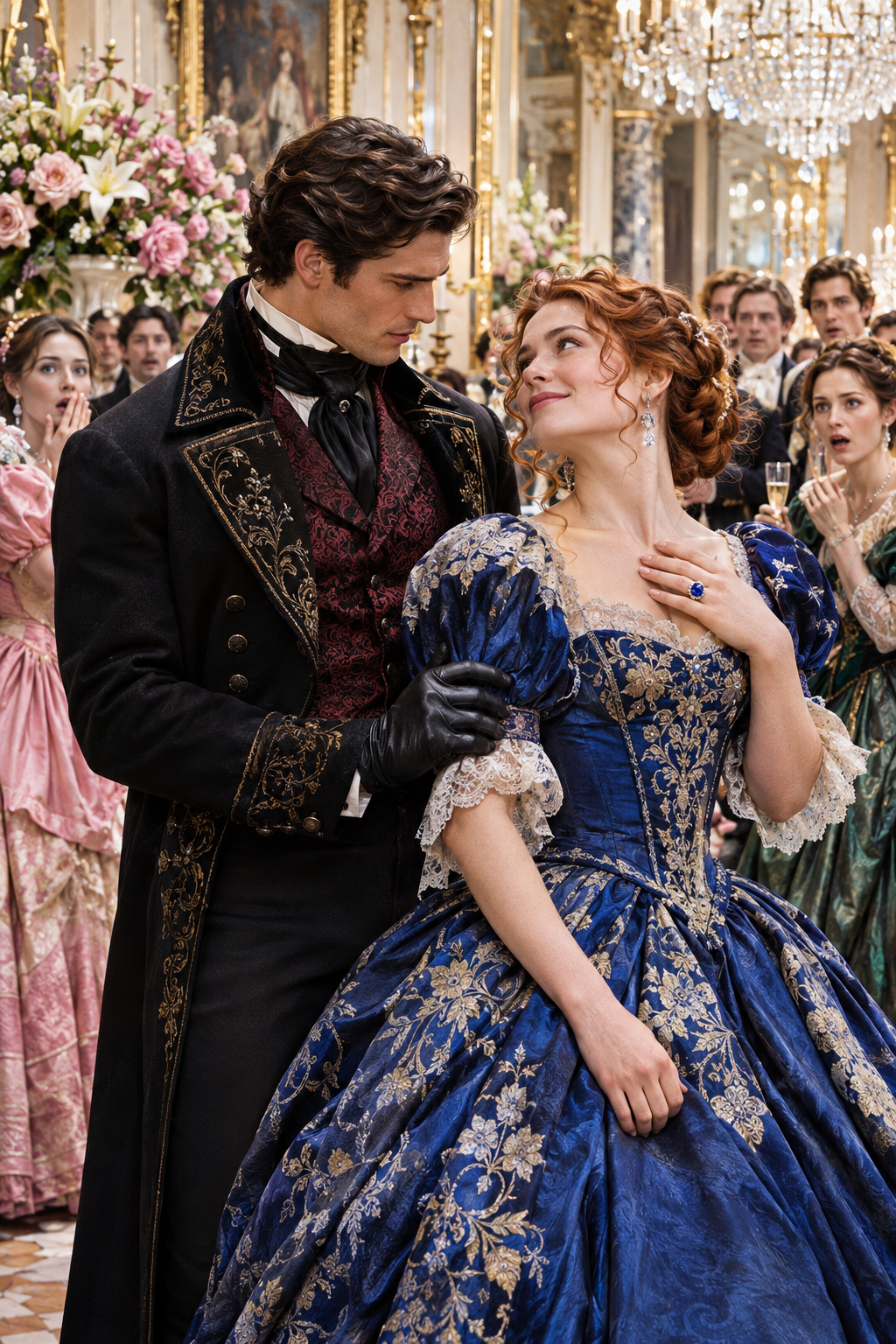
He opened his mouth.
Nothing came out.
Susanna waited, hoping for something honest, something that would explain why he watched her across the dinner table when he thought she wasn’t looking.
But Archerald had spent too many years hiding his feelings behind duty.
“I believed it was the right thing to do,” he finally answered.
She nodded slowly.
“The right thing.”
He heard the disappointment in her voice.
“Susanna—”
“Please leave me alone.”
He wanted to stay.
Instead, he bowed his head and walked out.
That evening, Susanna did not come down to dinner.
The next morning, she was already outside when Archerald entered the breakfast room.
Mrs. Whitcomb, the housekeeper, informed him that Her Grace had gone to visit a tenant family whose youngest child was ill.
“In this weather?” he asked.
Mrs. Whitcomb glanced toward the rain-covered windows.
“Her Grace said the weather would not make the child any less sick.”
Archerald almost smiled.
That sounded exactly like Susanna.
By afternoon, however, the rain had turned bitterly cold.
Susanna returned soaked through, her boots covered in mud. She refused assistance, changed her clothes, and spent another hour arranging food and medicine for the family.
When she finally came downstairs, Archerald noticed that her cheeks were unusually flushed.
“Are you feeling well?”
“Perfectly.”
“You look tired.”
“I’ve had a long day.”
“Perhaps you should rest.”
She looked at him.
“Is that a suggestion or another instruction?”
He lowered his eyes.
“A suggestion.”
“Then thank you.”
She walked past him.
That night, Archerald heard a crash from her bedroom.
He reached the door just as her maid cried out.
“Your Grace! Please come quickly!”
Susanna lay on the carpet beside her bed.
Her skin burned beneath his hand.
Her breathing was shallow, and she was trembling violently.
“Send for the physician,” Archerald ordered.
He lifted her carefully.
“Susanna? Can you hear me?”
Her eyes opened briefly.
“Father?”
His heart twisted.
“No, my dear. It’s Archerald.”
She seemed not to recognize him.
“Don’t let Uncle George take it,” she whispered. “Please.”
Then her eyes closed.
The physician arrived shortly before midnight.
Dr. Bell was an elderly man who had served the Bowmont family for nearly thirty years. He examined Susanna while Archerald stood beside the fireplace, unable to keep his hands still.
“She has a severe fever,” the physician said. “Her lungs are affected. We must watch her closely.”
“Will she recover?”
“I cannot promise anything tonight.”
Archerald felt the room tilt.
Dr. Bell continued giving instructions, but the Duke heard only fragments.
Cool cloths.
Water.
Rest.
Watch her breathing.
He had faced angry creditors, political rivals, and dangerous men without losing his composure.
But the sight of Susanna lying helpless beneath white sheets terrified him.
For three days, the fever refused to break.
Archerald barely left her room.
He sat beside her bed while the servants brought fresh water and clean cloths. He helped her drink when she was conscious enough to swallow.
Sometimes she spoke nonsense.
Sometimes she called for her father.
Once, she began crying and begged someone not to lock her in the dark.
Archerald took her hand.
“No one will ever lock you away again,” he whispered.
She gripped his fingers with surprising strength.
“Promise?”
“I promise.”
During the second night, Mrs. Whitcomb found him sitting beside the bed, his head bowed.
“Your Grace, you must sleep.”
“I can’t.”
“Her Grace would be very unhappy to see you making yourself ill.”
He looked at Susanna.
“She may never have the chance to be unhappy with me again.”
Mrs. Whitcomb’s expression softened.
“Then perhaps you should tell her what you have been unable to say.”
After the housekeeper left, Archerald remained silent for a long time.
Finally, he leaned forward.
“Susanna, I don’t know whether you can hear me.”
Her breathing remained uneven.
“I have been a fool.”
He brushed a damp curl away from her forehead.
“When I first met you, I thought you were the most infuriating woman in London. You argued with men twice your age and looked at me as though my title meant absolutely nothing.”
His voice trembled.
“I had forgotten what it felt like to be surprised by another person.”
He swallowed.
“I told myself I married you because it was my duty. But that was only part of the truth.”
Outside, rain tapped against the windows.
“I married you because I couldn’t bear the thought of you suffering. And somewhere between London and Yorkshire, I discovered that I couldn’t bear the thought of living without you.”
He pressed her hand gently against his cheek.
“I love you, Susanna.”
The words came more easily once he had finally spoken them.
“I love your courage. Your stubbornness. The way you remember every servant’s name. The way you argue with me when you think I’m wrong.”
He closed his eyes.
“And I am sorry I made you feel that your voice did not matter.”
For the first time in years, Archerald Bowmont wept.
Near dawn, Susanna’s breathing changed.
The terrible heat in her skin began to fade.
When Dr. Bell examined her that morning, he allowed himself a cautious smile.
“The fever has broken.”
Archerald gripped the back of a chair.
“She’ll live?”
“If her strength continues to return, I believe she will.”
The Duke sat down so suddenly that Mrs. Whitcomb hurried toward him.
For the next two days, Susanna slept.
When she finally opened her eyes properly, sunlight was falling across the bed.
Archerald sat beside her, asleep in an uncomfortable chair.
His hair was untidy, his face pale, and his hand still rested beside hers.
She watched him for several moments.
Then she whispered, “You look dreadful.”
His eyes opened instantly.
“Susanna?”
“Have you been sleeping in that chair?”
He stared at her as though she had returned from the dead.
Then he leaned forward and pressed his forehead against her hand.
She felt his shoulders shake.
“Archerald?”
“I thought I’d lost you.”
Her expression changed.
She remembered fragments of the fever.
A cool cloth.
A familiar voice.
Someone promising she would never be alone.
And something else.
Something she was almost afraid to believe.
“Did you say you loved me?”
He became completely still.
Then he lifted his head.
“Yes.”
“Was that because you thought I was dying?”
“No.”
“Would you have told me if I hadn’t become ill?”
He looked ashamed.
“I don’t know.”
Susanna studied him.
“Then perhaps we should begin with honesty.”
He nodded.
“I love you,” he said clearly. “I loved you before our wedding, though I was too stubborn to understand it.”
Her eyes filled.
“You could have saved us both a great deal of misery by saying that sooner.”
“I know.”
She reached for his hand.
“I think I have been falling in love with you too.”
He smiled, but she raised one finger.
“That does not mean I have forgiven you for hiding those letters.”
His smile faded.
“I wouldn’t expect it to.”
“Good.”
She squeezed his hand.
“Then we have something to work toward.”
For the first time, Archerald understood that love was not a reward granted after every mistake had been forgotten.
Sometimes it was the courage to face those mistakes together.
But peace at Bowmont Abbey lasted only four days.
A messenger arrived from London carrying two letters.
The first came from Archerald’s solicitor, Mr. Pembroke.
The second bore George Reed’s signature.
Archerald read both in his study.
By the time he finished, his face had hardened.
Mr. Pembroke had uncovered evidence that George had used Susanna’s inheritance to secure gambling loans.
Worse, Lord Hartouse had acquired several of those debts and was now threatening legal action.
George’s letter was shorter.
He claimed Susanna had stolen documents belonging to the Reed family. Unless she returned to London immediately, he would publicly accuse the Duke of coercing her into marriage for financial gain.
Archerald crushed the letter in his fist.
His first instinct was to handle everything himself.
He would summon Pembroke, confront George, and make certain Susanna never heard another word about the matter.
Then he remembered her face in the library.
“You could have trusted me.”
He stood and carried the letters upstairs.
Susanna was sitting beside the window, wrapped in a shawl.
She looked up.
“Something has happened.”
“Yes.”
“Is it my uncle?”
Archerald handed her both letters.
She read them carefully.
When she finished, she was trembling, but her voice remained steady.
“He is threatening us because he is frightened.”
“That is my belief.”
“Then we must find out what frightens him.”
Archerald pulled up a chair.
“Pembroke believes your father’s original trust papers may still exist. Without them, proving the full extent of George’s theft will be difficult.”
“Where would they be?”
“Possibly with the solicitor who prepared the settlement.”
Susanna frowned.
“My father once mentioned a gentleman named Mr. Ellery. He handled family matters before Father died.”
Archerald leaned forward.
“Do you remember where he practiced?”
“Lincoln’s Inn, I believe.”
For the first time since receiving the letters, Archerald looked hopeful.
“Then we have somewhere to begin.”
Susanna folded her hands.
“I want to go to London.”
“No.”
The word escaped before he could stop it.
She raised an eyebrow.
He sighed.
“Forgive me. I meant that I am concerned about your health.”
“Then say that.”
“I am concerned about your health.”
“Much better.”
Despite everything, he laughed.
Dr. Bell insisted she remain in Yorkshire for another week.
Susanna agreed, but only after Archerald promised to share every letter and decision concerning her inheritance.
During that week, something changed between them.
They began taking breakfast together.
Archerald stopped retreating to his study every evening.
Susanna discovered that beneath his serious manner was a surprisingly dry sense of humor.
He discovered that she enjoyed reading poetry aloud, though she insisted she was terrible at it.
One evening, they sat beside the fire while she read a letter from her father.
“I used to think I had forgotten his voice,” she said.
Archerald listened.
“But when I read his words, I can almost hear him again.”
“Tell me about him.”
She looked surprised.
“No one has asked me that in years.”
So she told him.
Her father had loved gardening, hated fashionable parties, and always carried sweets in his coat pockets for children.
“He used to say that kindness was the only kind of wealth that grew when you gave it away.”
Archerald smiled.
“He sounds like a wise man.”
“He was.”
Susanna looked into the fire.
“I wish he could have met you.”
Archerald reached for her hand.
“I wish I could have thanked him for raising you.”
She leaned against his shoulder.
Neither spoke for a long time.
A week later, they returned to London.
Their arrival caused immediate gossip.
The Duke of Westmere had married a nearly penniless ward, vanished into Yorkshire, and now returned with a wife who was rumored to possess a hidden fortune.
George Reed had encouraged every rumor.
He had also convinced Lord Hartouse that recovering Susanna’s inheritance might be their last chance to escape financial ruin.
But neither man expected Susanna to confront them openly.
The meeting took place in Mr. Pembroke’s office.
George arrived wearing an expensive coat that could not hide the strain on his face.
Lord Hartouse followed him.
The moment Hartouse saw Susanna, he smiled.
“My dear Miss Reed.”
“Your Grace,” she corrected.
His smile tightened.
“Of course.”
George stepped forward.
“Susanna, my child, surely we can settle this privately.”
“You had years to settle it privately, Uncle.”
He glanced at Archerald.
“I see your husband has filled your head with accusations.”
“My husband gave me documents. I read them myself.”
George’s expression darkened.
“You always were ungrateful.”
Archerald moved slightly, but Susanna touched his arm.
“I can answer him.”
She turned back to her uncle.
“You told me my father left nothing. You told me I owed you everything. Was any of it true?”
George looked toward Pembroke.
“This is ridiculous.”
“Then answer her,” the solicitor said.
George’s mouth opened.
Before he could speak, the office door swung open.
An elderly gentleman entered carrying a worn leather case.
Mr. Pembroke rose.
“Mr. Ellery. Thank goodness.”
Susanna stared.
The man looked at her for a long moment.
“Miss Susanna?”
Her breath caught.
“Mr. Ellery?”
He smiled sadly.
“You have your father’s eyes.”
Susanna remembered him then.
A kindly gentleman who had visited their home when she was small, always bringing a little wooden toy.
George went white.
“I was told you had retired.”
“I did,” Ellery replied. “But I kept certain papers because your brother specifically instructed me to do so.”
He placed the leather case on the table.
George suddenly stood.
“This meeting is over.”
“No,” Susanna said.
Her voice was quiet, but everyone heard it.
“Sit down.”
To everyone’s astonishment, George obeyed.
Ellery opened the case.
Inside were the original trust documents, copies of bank transfers, and a sealed letter addressed to Susanna.
The solicitor adjusted his spectacles.
“Your father established a trust for you shortly before his death. He appointed your uncle as one of the trustees, but only to oversee expenses until you reached your majority.”
Susanna listened without moving.
“Your uncle had no authority to use the principal for personal debts.”
George began protesting.
Ellery ignored him.
“The records show that substantial sums were withdrawn using false expense claims.”
Lord Hartouse shifted uneasily.
Pembroke placed another document on the table.
“And several of those sums were pledged against gambling debts.”
Hartouse stood abruptly.
“I had no knowledge of any improper arrangement.”
Archerald looked at him.
“Then you will have no objection to explaining the payments you received.”
Hartouse’s face reddened.
“This is an insult.”
“No,” Archerald said. “It is an opportunity to tell the truth.”
For a moment, Hartouse seemed ready to strike him.
Then he saw the two solicitors watching.
He sat down.
George’s hands were shaking.
“Susanna, I did what I had to do. The estate was failing. There were expenses.”
“You told me there was no estate.”
“I was trying to keep us afloat.”
“By marrying me to a man who frightened me?”
George looked away.
Susanna felt something inside her settle.
For years, she had wanted his approval.
She had worked to please him, swallowed insults, and believed every cruel word because he was the only family she had left.
Now she understood something painful.
Some people did not become kinder when you gave them more.
They simply learned how much they could take.
Mr. Ellery slid the sealed letter toward her.
“Your father asked that this be delivered when you came of age. I was told you had received it.”
George stared at the floor.
Susanna broke the seal.
The letter was written in her father’s familiar hand.
“My dearest Susanna,” it began.
She read silently.
Her father wrote about the inheritance, but most of the letter was not about money.
He spoke of her courage, her curiosity, and her habit of asking questions adults preferred not to answer.
Then came the words that made her eyes fill.
“Never allow anyone to convince you that gratitude requires obedience. A person may help you and still be wrong. You may love someone and still disagree with them. Your voice belongs to you, my darling, and no honest love will ever ask you to surrender it.”
Susanna pressed the paper against her chest.
Archerald watched her quietly.
At last, she folded the letter.
“What happens now?” she asked Pembroke.
“The evidence is sufficient to begin legal proceedings. We can seek recovery of the remaining funds and pursue your uncle for what he misappropriated.”
George leaned forward.
“Susanna, please. Think of the family name.”
She looked at him.
“I have thought about the family name every day of my life. You were the one who forgot what it meant.”
He began to cry.
Whether the tears came from regret or fear, she could not tell.
And for the first time, she did not feel responsible for comforting him.
The proceedings that followed were neither quick nor pleasant.
George tried to claim that Susanna’s father had authorized the withdrawals.
The original trust documents disproved him.
Lord Hartouse attempted to distance himself from the arrangement, but correspondence showed he had known George was using his niece’s inheritance as security.
When faced with the possibility of being drawn further into the case, Hartouse withdrew his claims and abandoned his demands.
George was ordered to account for the missing funds and surrender the assets that could be recovered.
Some money was gone forever.
But the remaining inheritance, along with the Kent property, was restored to Susanna’s control.
George lost much of his standing in society.
Several former friends refused to receive him.
Eventually, he left London for a modest house in the countryside, where he lived on an allowance arranged from his own remaining resources.
Susanna never sought revenge.
But she did not invite him back into her life.
One afternoon, after the legal matters were settled, Archerald found her standing alone in their London drawing room.
She held her father’s letter.
“Are you unhappy?” he asked.
She considered the question.
“I thought winning would feel different.”
“How?”
“I thought I would feel triumphant. Instead, I feel sad.”
“Because of your uncle?”
“Because I spent so many years trying to earn love from someone who saw me as a burden.”
Archerald came to stand beside her.
“That was his failure, Susanna. Not yours.”
She looked up.
“I know that now.”
He hesitated.
“There is something I must ask you.”
She smiled faintly.
“That sounds serious.”
“It is.”
He took her hands.
“When I married you, I offered protection. I thought that was enough.”
She remained silent.
“I have learned that protection without trust can become another kind of prison.”
Her eyes softened.
“I never wanted you to feel trapped at Bowmont Abbey,” he continued. “Your inheritance is yours. Your choices are yours. If you wish to spend time in Kent, or travel, or establish a household of your own, I will support you.”
Susanna studied his face.
“And what if I choose to stay with you?”
His voice grew quiet.
“Then I will spend the rest of my life trying to deserve that choice.”
She stepped closer.
“You foolish man.”
He blinked.
“I beg your pardon?”
“Do you truly believe I stayed because I had nowhere else to go?”
He said nothing.
“I stayed because somewhere beneath that terrible serious expression, I found a man who listens when he remembers to stop talking.”
Archerald laughed.
“And because,” she added, “I happen to love him very much.”
He kissed her then.
Not as a Duke claiming his wife.
Not as a rescuer expecting gratitude.
But as a man grateful to be loved freely.
They returned to Bowmont Abbey in early autumn.
The Yorkshire hills had turned gold, and the gardens were heavy with the last roses of the season.
Susanna immediately began making plans.
She used part of her recovered inheritance to establish a small school for the children of estate workers.
Another portion helped create a fund for widows and families facing hardship.
Archerald offered to oversee the arrangements.
Susanna gave him a familiar look.
“I appreciate the offer, Your Grace, but I am perfectly capable of managing my own money.”
He bowed solemnly.
“Of course, Your Grace.”
Then he added, “May I at least carry the account books?”
She laughed.
“That would be very helpful.”
The school opened the following spring.
On its first morning, Susanna stood outside the little stone building while children hurried through the doorway.
One small girl stopped beside her.
“Are you really a duchess?”
Susanna smiled.
“Yes.”
“Does that mean you can do anything you want?”
Susanna considered her answer.
“No, not everything.”
The girl looked disappointed.
“But it means I have a responsibility to do what good I can.”
The child thought for a moment.
“Can you make sure we have books?”
Susanna laughed.
“That, I believe, I can manage.”
Archerald watched from a short distance.
When she joined him, he offered his arm.
“Happy?”
She looked back at the school.
“Very.”
He smiled.
“Then so am I.”
Their marriage was not without disagreements.
Susanna still challenged him when he became too controlling.
Archerald still worried when she took risks.
But they learned to speak honestly, to apologize without excuses, and to remember that love did not require either of them to become someone else.
One evening, nearly a year after their wedding, Susanna found Archerald in the library.
He was sitting at the same desk where she had discovered the letters that changed her life.
A small wooden box rested before him.
“What is that?” she asked.
He opened it.
Inside lay her father’s letter, carefully preserved, along with the original trust documents and the first note Archerald had written to his investigator.
“I thought these should belong together,” he said.
Susanna touched the papers.
“Why?”
“Because they tell the story of how you came to know the truth.”
She looked at him.
“And what story do you think they tell?”
He considered.
“That I was fortunate enough to meet a woman who refused to surrender her voice.”
Susanna smiled.
“And that she was fortunate enough to meet a man willing to learn how to listen.”
He kissed her forehead.
Outside, evening settled over Bowmont Abbey.
The house that had once been silent now echoed with conversation, laughter, and the ordinary sounds of a life shared.
Years later, people would speak of the Duchess of Westmere as a remarkable woman.
They would praise her school, her generosity, and her determination to help those who had been forgotten.
Some would say the Duke had rescued her from a terrible fate.
But Susanna always corrected them.
“He opened a door,” she would say. “I chose to walk through it.”
And when someone asked Archerald how he had won the heart of such a spirited woman, he would smile.
“I didn’t win it. She gave it freely. My task was to become worthy of keeping it.”
For Susanna, the greatest treasure her father left behind was not the money, the property, or even the letter.
It was the belief that her life belonged to her.
And for Archerald, the greatest lesson was that loving someone did not mean protecting them from every difficult truth.
It meant standing beside them when the truth arrived.
Their story began with a frightened young woman being told she had no choice.
It ended with that same woman building a life filled with choices, purpose, and love.
Because the strongest love does not silence your voice, demand your obedience, or make you feel indebted for being cared for.
The strongest love gives you the courage to stand on your own feet, while reminding you that you never have to stand alone.
And as the years passed, Bowmont Abbey became more than a grand estate. It became a home where kindness mattered more than titles, where children were encouraged to ask questions, and where no one was made to feel small because of their circumstances.
Susanna and Archerald eventually welcomed two children, a daughter named Eleanor and a son named Henry.
When Eleanor was old enough to understand, Susanna showed her the letter her grandfather had written so many years before.
“Why do you keep this, Mama?” Eleanor asked.
Susanna smiled and placed the letter in her daughter’s hands.
“Because it reminds me of something important. Never let anyone convince you that you must give up who you are to deserve love.”
Eleanor looked toward the garden, where her father was helping Henry plant a rosebush.
“Does Papa know that?”
Susanna laughed softly.
“He learned it a long time ago.”
That evening, Archerald found his wife standing beside the library window, watching their children play in the fading sunlight.
“What are you thinking about?” he asked.
“The day we met.”
He smiled. “You accused me of trying to purchase a wife.”
“And you looked as though no one had ever dared speak to you that way.”
“No one had.”
She turned toward him.
“Do you regret marrying such a troublesome woman?”
Archerald took her hand and kissed it.
“Every day, I thank heaven that you were troublesome enough to change my life.”
Susanna rested her head against his shoulder.
For a moment, neither spoke.
Outside, Eleanor’s laughter floated through the open window, followed by Henry calling for his father.
Archerald smiled.
“I believe we’re being summoned.”
“Then we had better go.”
Together, they walked into the garden.
And as Susanna watched her husband lift their laughing son into his arms, she thought of the frightened young woman who had once stood in her uncle’s dining room, believing her future had already been decided.
If she could speak to that younger version of herself, she knew exactly what she would say.
“Be brave. The life you deserve is still waiting for you.”
She had lost years to fear, discovered painful truths, and learned that even good people could make mistakes.
But she had also found something she once believed existed only in stories.
A love built on respect.
A home filled with laughter.
And the freedom to be herself.
In the end, Susanna learned that happiness does not come from finding someone powerful enough to save you. It comes from finding someone who respects your strength, believes in your choices, and walks beside you through life’s hardest moments.
And that was the greatest love story Bowmont Abbey would ever know.
THE END.