The Duchess of Ravenshire discovered her husband’s betrayal when another woman walked into the ballroom wearing her missing sapphire brooch.
Alexander unfolded the letter, expecting several pages of complaints, accusations, and perhaps a tearful request for an explanation. Instead, he found only a few carefully written lines.
“Alexander,
I will not be returning to Ravenshire House. You need not explain what happened at the ball, nor trouble yourself with apologies. I have spent ten years waiting for something that was never mine to receive. I ask for nothing from you except the freedom to live the remainder of my life in peace. I simply wish to be finished.
Eleanor.”
He read the letter twice, then a third time.
Something about its simplicity disturbed him more than any angry accusation could have. There was no mention of Celeste. No demand for the return of the sapphire brooch. No threat to expose him before London society.
His wife was not asking him to change.
She was telling him that she no longer cared whether he did.
“Ridiculous,” he muttered, folding the letter.
He rang for his secretary and instructed him to arrange a carriage to Whitmore House the following morning.
He was certain Eleanor would come to her senses. She had always been reasonable, patient, and willing to forgive. Whatever anger she felt would eventually pass.
At least, that was what he told himself.
That evening, Alexander attended a private dinner where Celeste was waiting for him. She greeted him warmly, slipping her hand through his arm.
“I heard your wife has gone to the countryside,” she said.
“A temporary arrangement.”
Celeste smiled. “Perhaps it is for the best. She seemed terribly unhappy at the ball.”
Alexander looked at her.
The sapphire brooch was still pinned to her dress.
“Take that off.”
Celeste blinked. “What?”
“The brooch. Remove it.”
“But you gave it to me.”
“And I am asking you to remove it.”
Her smile faded. She unclasped the jewelry and placed it in his palm.
“I hope you aren’t blaming me for your wife’s behavior.”
Alexander slipped the brooch into his pocket without answering.
For the first time, Celeste’s company offered him no comfort.
The following morning, his carriage arrived at Whitmore House shortly before noon. Alexander expected Eleanor to be waiting inside, perhaps embarrassed by her impulsive departure.
Instead, the housekeeper, Mrs. Bennett, greeted him at the entrance.
“Good morning, Your Grace.”
“Where is my wife?”
“Her Grace is in the garden.”
“Tell her I have arrived.”
Mrs. Bennett hesitated.
“Her Grace has asked not to receive visitors without prior notice.”
Alexander stared at her.
“I am her husband.”
“Yes, Your Grace.”
“Then I am hardly a visitor.”
Before Mrs. Bennett could respond, Eleanor appeared at the end of the hallway. She wore a simple blue dress, and her hair was loosely arranged. There was something different about her appearance, although Alexander could not immediately identify it.
“You may come into the sitting room,” she said.
He followed her inside.
Tea had already been prepared. Eleanor poured herself a cup before offering him one.
Alexander remained standing.
“Have you any idea what people are saying in London?”
“No.”
“They are discussing our marriage.”
“I imagine they have very little else to discuss.”
“This is serious, Eleanor.”
“I agree.”
“Then pack your belongings. We shall return together and put an end to this nonsense.”
She placed her cup on its saucer.
“I am not returning.”
Alexander gave a short, impatient laugh.
“You cannot simply abandon your responsibilities because you are upset.”
“Which responsibilities, precisely?”
“You are the Duchess of Ravenshire.”
“I have been painfully aware of that for ten years.”
“You have obligations to our household, our family, and our position.”
Eleanor studied his face.
“And what obligations did you believe you had toward me?”
The question silenced him.
She continued before he could answer.
“When I was ill three winters ago, you left for a hunting trip. When my father died, you sent flowers because you considered attending the funeral inconvenient. On our tenth wedding anniversary, I waited until midnight for you to return home.”
Alexander looked away.
“I never complained publicly. I never embarrassed you. I fulfilled every responsibility you placed upon me.”
“Eleanor, marriages are not always romantic affairs.”
“I wasn’t asking for romance. I was asking to be treated like someone whose existence mattered.”
He reached into his coat and placed the sapphire brooch on the table.
“There. I have brought it back.”
Eleanor looked at the jewelry.
Once, she had treasured it more than anything else she owned. Now it looked strangely ordinary.
“Keep it.”
“It belongs to you.”
“It belonged to a woman who believed her husband loved her.”
Alexander pushed the brooch closer.
“Surely we can move beyond this.”
“We can,” Eleanor replied. “Separately.”
His expression hardened.
“And how exactly do you intend to support yourself? Have you considered that?”
For the first time during their conversation, Eleanor smiled.
“Of course.”
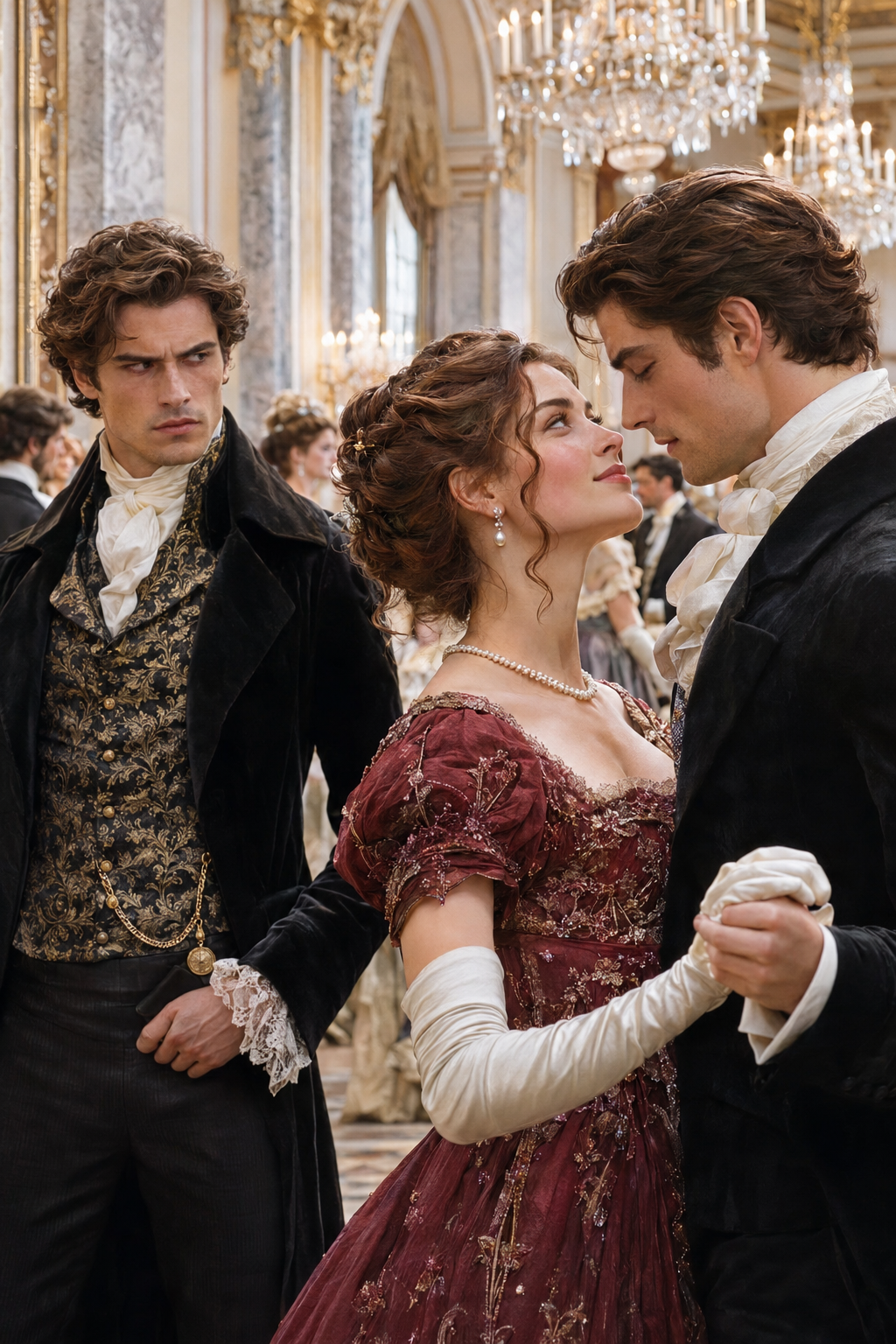
Whitmore House had belonged to her late aunt, who had arranged for the property and a modest income to be held for Eleanor’s separate use. Alexander had always considered the inheritance insignificant compared with his own fortune.
He had never imagined it would become the foundation of her independence.
“You would exchange Ravenshire House for this little estate?”
“Without hesitation.”
He looked around the modest sitting room, unable to understand how anyone could willingly surrender the luxury he provided.
“You will regret this.”
“Perhaps. But at least my regrets will belong to me.”
Alexander left Whitmore House without finishing his tea.
Within a week, news of the Duchess’s departure had spread throughout London. Some claimed Eleanor had suffered a nervous breakdown. Others insisted she was jealous of Celeste’s beauty. A few suggested that Alexander would soon bring his difficult wife home.
Celeste encouraged the rumors whenever she could.
“She has always been rather sensitive,” she told a group of ladies over afternoon tea. “One must feel sorry for Alexander.”
Lady Margaret, who had known Eleanor for years, quietly set down her cup.
“How interesting. I have always felt rather sorry for Eleanor.”
The room fell silent.
Lady Margaret continued.
“Especially after seeing another woman wearing her anniversary brooch.”
Celeste’s face turned pale.
By the following morning, the story of the sapphire had reached nearly every fashionable household in London.
For the first time, Alexander discovered that his title could not protect him from judgment.
Meanwhile, Eleanor was discovering how much of herself she had forgotten.
She began waking early, walking through the gardens, and taking breakfast beside an open window. She reviewed the estate accounts and learned the names of the families living on the surrounding land.
One afternoon, while visiting the village, she noticed a young woman sitting outside a small cottage with two children.
The woman was repairing a torn coat, although her hands were shaking from the cold.
Eleanor stopped.
“Are you quite all right?”
The woman quickly stood.
“Yes, Your Grace. Forgive me.”
“There is nothing to forgive.”
Her name was Sarah Collins. Her husband had died the previous winter, leaving behind debts and two young children. She earned what little she could through sewing, but work was difficult to find.
Eleanor listened carefully.
“How many other women are in similar circumstances?”
Sarah lowered her eyes.
“More than you might imagine, Your Grace.”
That evening, Eleanor could not stop thinking about her.
She had spent a decade feeling powerless despite living surrounded by wealth. Sarah possessed neither wealth nor influence, yet she continued fighting for her children every day.
Eleanor realized that her inheritance could provide more than an escape.
It could become an opportunity for others.
She arranged for several unused rooms in an old building on the estate to be repaired. With the help of Mrs. Bennett, she purchased sewing supplies and hired a retired schoolteacher to provide lessons in reading, writing, and basic accounting.
Women from the village began arriving cautiously.
Some were widows. Others had husbands who had abandoned them. Several were young women hoping to learn a trade before marriage.
Eleanor helped them find customers and made certain they received fair payment for their work.
For the first time in years, she went to bed tired for reasons that had nothing to do with sadness.
Then, nearly two months after the ball, a carriage arrived unexpectedly at Whitmore House.
Lady Margaret stepped out.
Eleanor welcomed her warmly, delighted to see a familiar face.
But Margaret’s expression was unusually serious.
“My dear, there is something you ought to know.”
They sat beside the fireplace.
“Alexander is telling people that you intend to return before Christmas.”
Eleanor frowned.
“I have given him no such indication.”
“I suspected as much. He is also allowing people to believe that your departure was caused by poor health.”
Eleanor slowly lowered her teacup.
“Poor health?”
“He claims you became emotionally exhausted and needed time away.”
Margaret opened her handbag and removed an invitation.
Alexander was hosting a grand winter reception at Ravenshire House. Eleanor’s name appeared beside his as hostess.
“He expects you to attend,” Margaret said.
“And if I refuse?”
“He will probably invent another explanation.”
Eleanor stared at the invitation.
She had hoped that leaving quietly would be enough. She had no desire to destroy Alexander’s reputation or involve herself in public arguments.
But silence had once again become something he could use against her.
“What would you advise?” Eleanor asked.
Margaret leaned forward.
“You need not fight him on his terms. But you must stop allowing him to tell your story.”
Three days later, Alexander received another letter.
This one informed him that Eleanor would attend the reception.
He was delighted.
He immediately ordered the servants to prepare her rooms and instructed his secretary to make certain that several influential guests were present.
He believed her return would settle every rumor.
When the evening arrived, Ravenshire House glittered with candles and expensive decorations. Musicians played beneath the grand staircase, and guests filled the ballroom.
Celeste attended in a striking red gown.
She approached Alexander shortly before Eleanor’s arrival.
“Is it true that your wife is coming?”
“Yes.”
“And what does that mean for us?”
“This is hardly the time.”
Celeste stepped closer.
“You promised me things would change.”
Alexander glanced around nervously.
“Not here.”
At that moment, Eleanor entered the ballroom.
Conversations gradually quieted.
She wore an elegant ivory gown and a simple pearl necklace. Lady Margaret accompanied her, but Eleanor walked with the confidence of someone who no longer needed anyone’s protection.
Alexander hurried toward her.
“My dear, welcome home.”
“Good evening, Alexander.”
He offered his arm.
She accepted it briefly as they greeted their guests.
For nearly an hour, everything proceeded exactly as he had hoped. Eleanor was gracious, composed, and perfectly charming.
Then Alexander made his mistake.
During dinner, he raised his glass and addressed the guests.
“I am particularly grateful that my beloved wife has recovered from her recent difficulties and returned to her rightful place beside me.”
Several guests applauded politely.
Eleanor placed her fork down.
“Thank you, Alexander. However, I believe there has been a misunderstanding.”
The applause stopped.
Alexander turned toward her.
“Eleanor?”
“I have not been unwell, and I have not returned permanently. I am here this evening to make that clear.”
A heavy silence settled over the dining room.
Alexander’s face reddened.
“Perhaps we should discuss this later.”
“I attempted to discuss it privately. Unfortunately, my decision appears to have been misunderstood.”
She looked around the table.
“I have chosen to live at Whitmore House. I am happier there than I have been in many years, and I intend to remain.”
Someone quietly gasped.
Celeste stared at her plate.
Eleanor continued.
“I wish my husband no harm. I simply ask that my decision be respected.”
She lifted her glass.
“Now, please enjoy your evening.”
There was no shouting, no accusation, and no dramatic departure.
Yet Alexander felt more exposed than he ever had before.
After dinner, he found Eleanor in the library.
“How could you humiliate me like that?”
She turned from the window.
“By telling the truth?”
“You made me look like a fool.”
“I corrected something you said about me.”
“You could have protected my dignity.”
Eleanor’s expression softened, but her voice remained firm.
“Alexander, I spent ten years protecting your dignity while you neglected mine.”
He opened his mouth, then closed it.
For once, there was nothing he could say.
Before midnight, Eleanor left Ravenshire House and returned to Whitmore.
This time, no one mistook her departure for a temporary disagreement.
In the weeks that followed, Alexander’s relationship with Celeste began to collapse.
Without the secrecy that had once made their affair exciting, their differences became impossible to ignore.
Celeste wanted expensive gifts, public attention, and assurances about her future. Alexander, increasingly troubled by the consequences of his choices, found himself withdrawing from her.
One evening, she confronted him.
“Do you still love your wife?”
Alexander remained silent.
Celeste laughed bitterly.
“How extraordinary. You ignored her when she wanted you, and now that she doesn’t, you cannot stop thinking about her.”
She left shortly afterward.
Their affair ended before spring.
But losing Celeste did not restore what Alexander had destroyed.
Ravenshire House felt emptier than ever. He began noticing things that had previously escaped his attention: the flowers Eleanor used to arrange, the books she selected for the library, the handwritten instructions she left for the servants.
He discovered that she had quietly managed countless household problems without troubling him.
He had mistaken her competence for an absence of needs.
He had mistaken her patience for permission.
One rainy afternoon, Alexander opened a drawer in his study and discovered a small collection of letters Eleanor had written during the early years of their marriage.
In one, she had invited him to walk with her through the gardens.
In another, she had asked whether they might spend a weekend together away from London.
The final letter contained a single sentence that made his chest tighten.
“I hope that someday you will enjoy my company as much as I enjoy yours.”
He could not remember answering it.
Alexander sat alone for a long time.
Then he did something he had never done sincerely throughout their marriage.
He wrote an apology without asking for anything in return.
He acknowledged the affair, his neglect, his dishonesty, and the years Eleanor had spent trying to earn affection that should have been freely given.
He also instructed his solicitor to prepare a formal separation agreement that would protect her financial independence and allow her to manage her affairs without his interference.
When Eleanor received the documents, she read them carefully.
For a moment, tears filled her eyes.
Not because she wanted Alexander back, but because he had finally acknowledged what she had endured.
Several days later, she signed the agreement after consulting her own solicitor.
She also sent Alexander a short reply.
“Thank you for understanding. I hope you find the courage to become a better man, not for my sake, but for your own.”
A year passed.
The small sewing workshop at Whitmore House grew into a thriving establishment. Women who had once struggled to feed their children were earning steady incomes. Some opened businesses of their own.
Sarah Collins became the workshop’s supervisor, and her eldest child began attending school.
One summer afternoon, Eleanor organized a garden gathering to celebrate their achievements.
Children ran across the lawn. Tables were covered with homemade cakes, fresh flowers, and beautifully crafted goods.
Lady Margaret stood beside Eleanor, watching the celebration.
“You know, London still speaks of you.”
Eleanor laughed.
“Surely they have found another scandal by now.”
“Oh, they have. But your name is mentioned rather differently these days.”
“How so?”
“With admiration.”
Eleanor smiled as Sarah approached with a small package.
“Your Grace, the women wanted you to have something.”
Inside was a delicate silver brooch shaped like an open flower.
It was not particularly expensive, but every woman at the workshop had contributed something toward its purchase.
Eleanor touched it gently.
“It’s beautiful.”
Sarah smiled.
“You gave us a chance to build lives of our own. We wanted you to have something that would remind you of that.”
Eleanor pinned the brooch to her dress.
For the first time, a piece of jewelry brought tears to her eyes for entirely happy reasons.
Later that afternoon, an unexpected visitor arrived.
Alexander stood at the garden entrance, holding his hat.
He had requested permission to attend several days earlier, and Eleanor had agreed.
He looked around at the gathering with genuine surprise.
“You built all of this?”
“Not alone.”
He watched Sarah laughing with her children.
“You seem happy.”
“I am.”
Alexander nodded slowly.
“I used to think giving you a beautiful house was enough.”
Eleanor looked toward the workshop.
“A beautiful house is not necessarily a happy home.”
“I understand that now.”
They stood quietly for a moment.
“Do you ever wish things had been different?” he asked.
“Sometimes,” Eleanor admitted. “But I no longer wish to return to them.”
He accepted her answer.
There was sadness in his expression, but no anger.
“I am sorry it took losing you to understand what I had.”
Eleanor smiled gently.
“I hope you remember what you have learned.”
Alexander departed before sunset.
Eleanor watched his carriage disappear beyond the trees, then returned to her guests.
She felt no desire to follow him.
That evening, after the celebration ended, she sat beside her bedroom window and removed the silver brooch.
She thought about the sapphire that had once represented everything she believed she needed: her husband’s affection, society’s approval, and the security of being chosen.
Losing it had seemed like a tragedy.
Discovering it on another woman’s dress had become the beginning of her freedom.
Eleanor had learned that forgiveness did not require returning to the person who had hurt her. Kindness did not require surrendering her boundaries. And loyalty to another person should never demand the abandonment of oneself.
She had spent ten years believing happiness would arrive when Alexander finally recognized her worth.
Now she understood that her worth had never depended on his recognition.
Outside, the last light of summer faded over Whitmore House. Somewhere downstairs, Mrs. Bennett was laughing with the servants. Tomorrow, the workshop would open again, and there would be new challenges, new plans, and new reasons to look forward to the morning.
Eleanor placed the silver brooch beside her bed and closed the curtains.
She had once believed that the greatest loss of her life would be losing her husband.
Instead, she discovered that the greatest loss would have been spending the rest of her life waiting for someone else to give her permission to be happy.
She was no longer waiting.
And the life she had finally chosen for herself was worth more than every sapphire in London.
Three years later, a letter arrived at Whitmore House bearing the Ravenshire family seal.
Eleanor recognized Alexander’s handwriting immediately. Although they occasionally exchanged polite correspondence concerning their legal arrangements, he rarely wrote to her personally.
She opened the envelope beside the breakfast table.
“Dear Eleanor,
I have decided to leave London for an extended period. Before my departure, there is something I wish to place in your hands. I hope you will accept it, not as an obligation to me, but as an opportunity to continue the remarkable work you have begun.”
Enclosed was a document establishing a generous fund for the women of Whitmore. Alexander had arranged for independent trustees to oversee the money, ensuring that Eleanor would never need his permission to use it.
There was also a smaller envelope.
Inside lay the sapphire brooch.
Eleanor held it beneath the morning light. The stone was just as beautiful as she remembered, but it no longer carried the power it once had over her heart.
Alexander had included one final note.
“I cannot undo the circumstances under which you lost this. What you choose to do with it is entirely yours to decide.”
Eleanor considered keeping it as a reminder of how far she had come.
Instead, she contacted a respected jeweler in London and arranged for its sale. The money was used to purchase books, desks, and supplies for a new school serving the children of the women employed at Whitmore.
When the school opened the following autumn, Sarah Collins stood beside Eleanor at the entrance.
Children rushed past them, laughing excitedly as they discovered their new classrooms.
“Did you ever imagine all this would happen?” Sarah asked.
Eleanor shook her head.
“Not in my wildest dreams.”
Sarah smiled. “Then perhaps life sometimes has better plans for us than the ones we make for ourselves.”
Eleanor watched a little girl carefully write her name on a piece of paper. Her mother stood nearby, wiping tears from her cheeks.
At that moment, Eleanor understood that the sapphire had finally become something truly valuable.
Years continued to pass, and Whitmore House became known far beyond the surrounding villages. Women traveled considerable distances to learn practical skills, receive an education, and find honest employment.
Eleanor never remarried. Not because she had lost faith in love, but because she no longer believed marriage was necessary to make her life complete.
She surrounded herself with loyal friends, meaningful work, and people who appreciated her kindness without taking advantage of it.
Alexander eventually returned to England. He lived more quietly than before, having withdrawn from much of London’s fashionable society. Those who knew him noticed that he had become more considerate and less concerned with appearances.
He and Eleanor occasionally met at charitable gatherings. Their conversations were pleasant, though neither attempted to revive their marriage.
Some wounds had healed, but healing did not mean returning to the circumstances that had caused them.
One afternoon, many years after that unforgettable ball, Eleanor sat beneath an old oak tree in the gardens of Whitmore House.
A young woman named Emily, who had recently joined the workshop, approached her.
“May I ask you something rather personal, Your Grace?”
“Of course.”
“My husband says I would be nothing without him. Sometimes I fear he might be right.”
Eleanor closed the book resting on her lap.
She recognized the uncertainty in the young woman’s eyes. It was the same uncertainty she had once seen in her own reflection.
“Tell me, Emily. Were you a person before you married him?”
Emily nodded.
“Did you have dreams, thoughts, and hopes of your own?”
“Yes.”
“Then those things still belong to you. Marriage does not erase who you are, and another person’s failure to appreciate you does not make you worthless.”
Emily began to cry.
Eleanor took her hand and remained beside her until the tears subsided.
She did not tell Emily what decision to make. Instead, she offered her the support and resources she needed to make that decision for herself.
It was the kind of help Eleanor wished someone had offered her many years earlier.
That evening, Eleanor walked through the halls of Whitmore House, passing photographs, letters, and gifts from the countless families whose lives had changed there.
Above the fireplace hung a small framed photograph of the workshop’s first group of women.
She remembered how frightened they had been when they arrived.
She remembered how frightened she had been, too.
Freedom had not arrived without uncertainty. There had been difficult mornings, lonely evenings, financial worries, and moments when she questioned her choices.
But every challenge she overcame had strengthened her belief in herself.
As she grew older, Eleanor arranged for Whitmore House and its charitable work to continue under the care of the women who had helped build it.
She wanted future generations to have the opportunities that so many women before them had been denied.
On her final birthday celebration at Whitmore, the gardens were filled with former students, workers, teachers, and their families.
Sarah, now a grandmother, stood before the gathering and raised her glass.
“To the woman who taught us that our lives were worth building, even when others told us otherwise.”
Everyone applauded.
Eleanor looked around at the smiling faces and felt an overwhelming sense of gratitude.
She had once stood in a crowded ballroom surrounded by wealthy, influential people and felt completely alone.
Now she stood among ordinary people whose affection was genuine, and she had never felt richer.
Her marriage had taught her the pain of being unappreciated.
Her departure had taught her courage.
And the years that followed had taught her that a meaningful life could grow from even the most painful disappointment.
The sapphire brooch that once broke her heart had helped educate dozens of children. The house she had chosen as a refuge had become a place of hope. The woman who had once begged silently for affection had become someone who helped others discover their own strength.
Eleanor Ravenshire had not defeated her husband through revenge, humiliation, or bitterness.
She had simply refused to spend another day sacrificing her happiness for someone who had taken it for granted.
And that was her greatest victory.
Because sometimes the most powerful thing a person can do is not convince someone to love them, but recognize when it is time to stop asking.
Sometimes walking away is not the end of a beautiful story.
It is the beginning of the life you were always meant to live.
THE END.