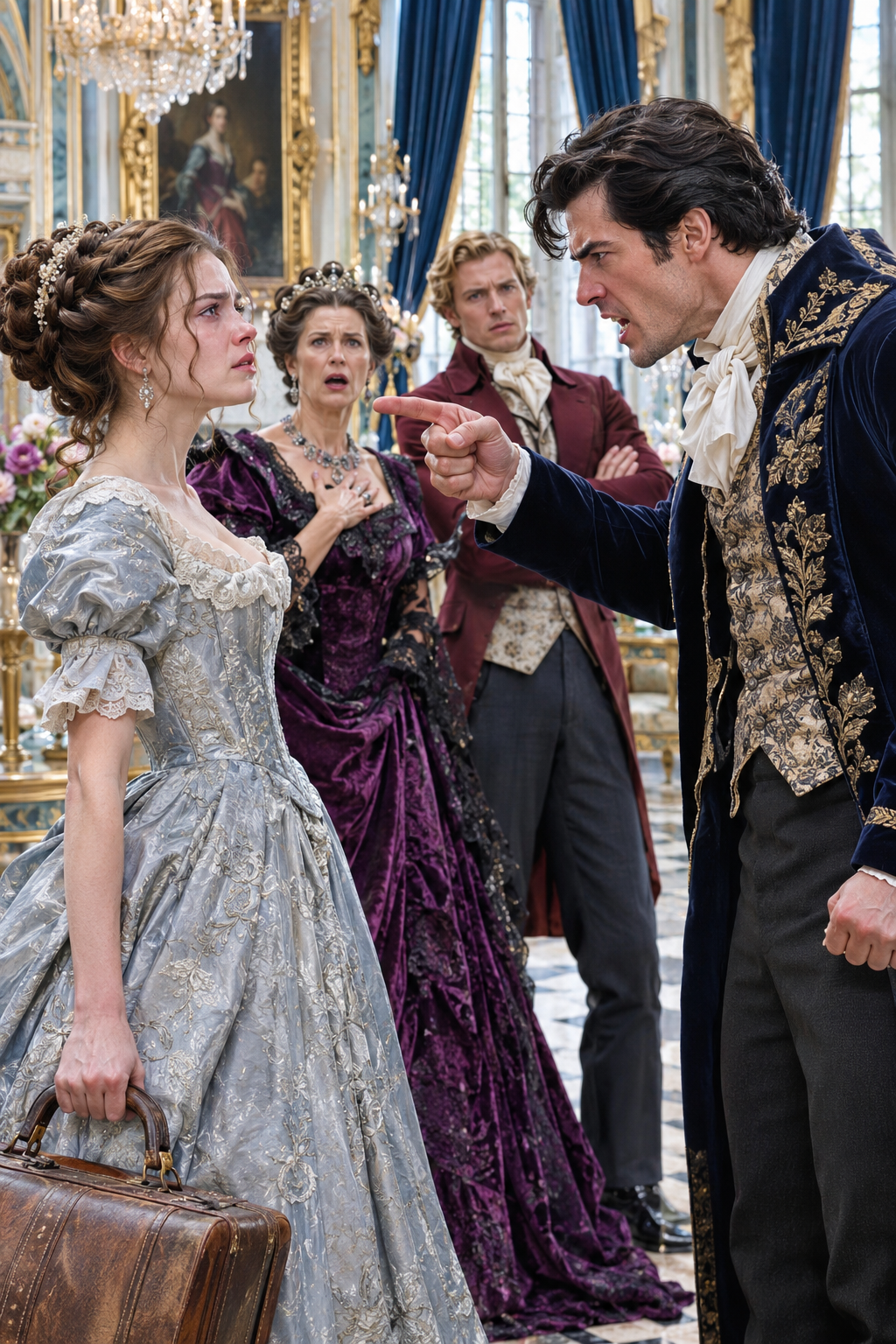
“You will apologize to my cousin,” Duke Leonard Harrington said, “or there will be no wedding.”
His cousin, Edmund Harrington, had always possessed the remarkable ability to look innocent while standing in the middle of a disaster.
But that evening, as he stared at the ledger, the color drained from his face.
“I can explain,” Edmund said.
Leonard leaned back in his chair. “Then explain why three thousand pounds intended for the widows of our estate workers disappeared into an account bearing your name.”
Edmund swallowed. “It was a temporary arrangement.”
“A temporary arrangement?”
“An investment. I intended to return every penny.”
Leonard opened another ledger. “And the money transferred from the orphanage fund? Was that another investment?”
Edmund’s eyes flickered toward the door.
“Sit down,” Leonard commanded.
For the first time in his life, Edmund obeyed without argument.
The fire crackled between them. Outside, rain battered the windows of Harrington House, but Leonard barely heard it.
He was remembering Cordelia’s face when she had first shown him the evidence.
She had not been angry then. She had been frightened.
Frightened for the people who would suffer if the money was not recovered.
And he had mistaken her courage for disloyalty.
“How much?” Leonard asked.
Edmund stared at his hands.
“How much have you stolen?”
“Nearly eight thousand pounds.”
Leonard felt something inside him turn cold.
Eight thousand pounds.
Enough to feed hundreds of families through winter. Enough to repair the orphanage roof. Enough to keep elderly tenants from being driven into the streets.
“Where is it?”
Edmund’s silence stretched.
“Where is the money?”
“Gone.”
Leonard rose so abruptly that his chair struck the wall.
Edmund flinched.
“I had debts,” he whispered. “Gaming debts. I borrowed against investments that failed. Then I borrowed more to cover the losses.”
“And you used my signature.”
“You gave me authority!”
“To manage the accounts. Not to rob helpless people.”
Edmund’s expression hardened.
“Do not pretend you are innocent, Leonard. You signed every document I placed before you. You enjoyed the convenience of never asking questions.”
The accusation struck with terrible accuracy.
Leonard could have dismissed him, called for the servants, or blamed everything on his cousin.
Instead, he looked at the pages covered in his own careless signatures.
“You are right about one thing,” he said quietly. “I made this possible.”
Edmund seized upon the admission.
“Then we must handle it privately. The family cannot survive a scandal.”
Leonard looked toward the engagement ring still lying in a small velvet box on his desk.
He had kept it there since Cordelia returned it.
Once, he had believed the preservation of his family’s reputation justified almost anything.
Now he understood what that belief had cost.
“The family will survive the truth,” he said. “Whether our reputation survives is another matter.”
Edmund went pale.
“You cannot mean to expose me.”
“I mean to recover what can be recovered and repay what cannot.”
“And if I refuse to cooperate?”
Leonard reached for the bell.
“Then you may explain yourself to the magistrate.”
By morning, Edmund had vanished.
So had the original ledger.
Leonard discovered the theft when his steward entered the study carrying an empty leather case.
The lock had been forced, and the pages containing the fraudulent transfers were gone.
Only the copies Leonard had made during the night remained.
But something worse awaited him.
A letter lay beneath the study door.
It contained a single sentence.
If you pursue this matter, Miss Cordelia Ashford will be the one accused.
Leonard read it twice.
Then he reached for his coat.
Across London, Cordelia was discovering that poverty was not the worst consequence of refusing a powerful man.
The worst was how easily other people could rewrite the story of her refusal.
Her landlady, Mrs. Bell, approached her that morning with a newspaper trembling in her hand.
“Miss Ashford,” she said uneasily, “is this about you?”
Cordelia took the paper.
A small article appeared beneath the society notices.
DISGRACED BRIDE SUSPECTED IN CHARITABLE FUND IRREGULARITIES
Her eyes moved rapidly across the page.
The article claimed that a former fiancée of the Duke of Harrington had gained unauthorized access to private accounts shortly before their engagement ended.
It suggested that important financial documents had disappeared.
And it implied that the broken engagement might have been connected to an attempted extortion.
Cordelia felt the room tilt.
“They are accusing me of theft.”
Mrs. Bell looked miserable.
“I do not believe it, miss. But the gentleman who came this morning said there might be an investigation.”
“What gentleman?”
“He would not give his name.”
Cordelia folded the newspaper carefully.
She knew exactly who was responsible.
Edmund had once warned her that a woman without a title or fortune possessed only her reputation.
Now he intended to destroy it.
At noon, the publisher’s messenger arrived.
The translation assignment had been withdrawn.
By two o’clock, the family whose daughters she tutored sent a note dismissing her services.
At four, Mrs. Bell knocked again.
“I am terribly sorry,” she whispered. “My husband says you must leave by the end of the week.”
Cordelia thanked her.
She waited until the door closed before sitting on the narrow bed.
For several minutes, she did nothing.
Then she began to cry.
Not because she regretted leaving Leonard.
Not because she wished she had apologized.
She cried because doing the right thing had become so unbearably expensive.
A knock interrupted her.
She wiped her face and opened the door.
Leonard stood outside.
He looked as though he had not slept.
“I know about the newspaper,” he said.
“Then you know your family has finally found a way to punish me.”
“Edmund has disappeared.”
“And naturally, everyone assumes I helped him.”
“I do not.”
Cordelia gave a bitter laugh.
“How comforting that you believe me now.”
Leonard accepted the blow.
“I have brought copies of the accounts. I intend to make everything public.”
She stared at him.
“Everything?”
“Including my negligence.”
For the first time, she saw something different in his expression.
Not the certainty of a duke accustomed to obedience.
Something far less comfortable.
Shame.
“Why are you telling me?”
“Because Edmund has threatened you. And because I should have listened when you first came to me.”
Cordelia folded her arms.
“An apology does not undo what happened.”
“I know.”
“Neither does a house.”
“I know that too.”
She studied him carefully.
“What do you intend to do?”
“Find Edmund. Recover the records. Restore the missing funds.”
“And my reputation?”
Leonard hesitated.
It was a small hesitation, but Cordelia noticed.
“You still fear the scandal,” she said.
“No,” he replied. “I fear that telling the truth now may not be enough to repair the harm I have done.”
For a moment, she had no answer.
Then she stepped aside.
“Come in. There is something you need to see.”
Leonard entered the freezing room.
Cordelia opened a battered wooden trunk and removed a bundle of letters tied with blue ribbon.
“These came from the families whose allowances were reduced,” she explained. “I began collecting them when I first suspected Edmund.”
Leonard opened the first letter.
A widow described selling her husband’s watch to buy coal.
Another wrote that her son had been turned away from school because his fees had not been paid.
The final letter came from a girl of thirteen.
Dear Miss Ashford, Mother says the money may come next month. Until then, I have found work washing clothes. Please do not worry about us.
Leonard lowered the paper.
“Her name is Margaret,” Cordelia said. “She should be learning mathematics, not washing strangers’ linen until her hands bleed.”
Leonard stared at the letter for a long time.
Then he said, “I will repay every family from my personal fortune.”
“That is necessary,” Cordelia replied. “But it is not sufficient.”
He looked up.
“The people responsible must be held accountable. Otherwise, another Edmund will simply take his place.”
Leonard nodded.
“Then help me make certain that does not happen.”
Cordelia considered him.
She had loved this man once.
Perhaps some part of her still did.
But love was no longer enough to persuade her to surrender her judgment.
“I will help the families,” she said. “Not your title.”
“That is all I ask.”
They began working that evening.
Cordelia examined the copied ledgers while Leonard listed every property, investment, and account his cousin had controlled.
Near midnight, she noticed something peculiar.
Several fraudulent payments had been directed through a shipping company called Blackthorn & Vale.
The company’s address was listed as a warehouse near the Thames.
Yet one entry described a payment made three days after the company had supposedly ceased trading.
“Edmund is still using it,” she said.
Leonard leaned closer.
“How can you be certain?”
“Because this notation is not a payment record. It is a forwarding instruction.”
She pointed to a string of numbers beside the entry.
“I translated commercial correspondence for a merchant who used the same system. These numbers identify storage compartments.”
Leonard studied the page.
“Then the warehouse may contain the missing records.”
“Or the money.”
They looked at one another.
Neither needed to say what came next.
The following afternoon, Leonard visited the warehouse with his solicitor and two trusted men.
They found the building locked.
Inside, several crates had been emptied, but one room contained a desk, a burned stack of papers, and a shipping manifest.
The manifest listed a vessel departing for France in forty-eight hours.
Among its passengers was a gentleman traveling under the name Edward Hart.
Leonard recognized the handwriting on the booking.
Edmund.
But the discovery came too late to remain secret.
That evening, Cordelia received a note delivered by a barefoot boy.
If you wish to prevent another innocent person from suffering, come to Saint Bride’s Chapel at nine. Alone.
Beneath the message was a small silver locket.
Cordelia recognized it immediately.
It belonged to Margaret, the young girl who had written to her.
Her blood turned cold.
She went to Leonard’s house at once.
The butler informed her that the duke was meeting with his solicitor.
“Tell him it concerns a child,” she said.
Within moments, Leonard appeared.
Cordelia handed him the note.
His expression darkened.
“You are not going alone.”
“He specifically demanded it.”
“Which means he intends to use you.”
“And if we do nothing, what happens to Margaret?”
Leonard called for his carriage.
“We will inform the constables.”
Cordelia caught his arm.
“Edmund knows how your family operates. If he sees officers approaching, he may harm her.”
Leonard looked at her hand on his sleeve.
Once, he would have ordered her to remain behind.
Instead, he asked, “What do you suggest?”
She took a breath.
“We give him what he expects. But we prepare for what he does not.”
At nine o’clock, Cordelia entered Saint Bride’s Chapel carrying a leather satchel.
The building was almost dark.
Candles flickered near the altar, illuminating cracked stone and dusty pews.
“Edmund?” she called.
A figure emerged from the shadows.
Edmund looked thinner than she remembered, his fine coat stained with mud.
“You came.”
“Where is Margaret?”
“Safe, provided you behave sensibly.”
Cordelia placed the satchel on a pew.
“You have your cousin’s copies of the accounts?”
“Inside.”
Edmund approached, but she raised a hand.
“The girl first.”
He smiled unpleasantly.
“You were always difficult, Cordelia. Leonard should have taught you obedience before attempting to marry you.”
“He tried. It did not work.”
Edmund’s smile vanished.
He gestured toward a side door.
A man stepped forward, holding Margaret by the shoulder.
The girl’s face was streaked with tears.
Cordelia’s heart clenched.
“Let her go.”
“Give me the documents.”
Cordelia opened the satchel.
Inside were papers wrapped in brown cloth.
Edmund snatched them eagerly.
He unfolded the first sheet.
His expression changed.
It was blank.
“You foolish woman.”
“No,” Cordelia replied. “You are the fool if you believed I would bring the only evidence against you.”
Edmund seized her wrist.
“You have no idea what I am capable of.”
“I know precisely what you are capable of. You steal from widows, threaten children, and hide behind another man’s name.”
He tightened his grip.
“And you will regret speaking to me that way.”
Suddenly, a voice sounded from the chapel entrance.
“Release her, Edmund.”
Leonard stood beneath the archway.
Behind him were his solicitor and two constables.
Edmund dragged Cordelia backward.
The man holding Margaret reached into his coat.
“Do not,” Leonard warned.
But the man drew a pistol.
A shot shattered the silence.
Margaret screamed.
Cordelia ducked as stone fragments rained from a pillar beside her.
Leonard lunged toward the gunman.
The two men collided against a pew, sending candles tumbling across the floor.
Flames caught the edge of an old curtain.
Within seconds, fire climbed the fabric.
Edmund released Cordelia and ran toward the side door.
One constable pursued him.
The other struggled to help Leonard overpower the gunman.
Cordelia rushed to Margaret.
“Can you walk?”
The girl nodded, trembling.
“Then hold my hand.”
Smoke began filling the chapel.
They hurried toward the entrance, but a burning curtain collapsed across the aisle.
Margaret screamed again.
Cordelia pulled her behind a stone column.
Across the room, Leonard saw them trapped.
“Cordelia!”
“We cannot get through!”
He tore off his coat and beat at the flames.
The smoke thickened.
A beam groaned overhead.
“Go!” Cordelia shouted. “The roof is weakening!”
Leonard ignored her.
He wrapped his coat around his arms, forced his way through the burning fabric, and reached them.
He lifted Margaret into his arms.
“Stay close to me.”
Together, they pushed through the smoke.
Just as they reached the entrance, a section of the ceiling crashed behind them.
The force threw Cordelia forward.
Leonard caught her before she struck the stone steps.
Outside, cold night air filled her lungs.
Margaret sobbed against Leonard’s shoulder.
The constables emerged moments later with the gunman in custody.
But Edmund had escaped.
Leonard lowered Margaret into Cordelia’s arms.
Then he staggered.
Blood darkened his sleeve.
“Leonard?”
“It is nothing.”
She pulled back his coat.
A deep wound ran across his upper arm where falling timber had struck him.
“You are bleeding.”
“I have endured worse.”
“No, you have endured being contradicted. This is considerably more serious.”
Despite the pain, he laughed.
It was the first genuine laugh she had heard from him since their engagement ended.
Then his knees buckled.
Cordelia caught him as best she could.
“Someone fetch a doctor!”
By dawn, Leonard was resting at Harrington House.
The physician assured Cordelia that the injury would heal, provided the duke obeyed instructions.
She suspected this would prove difficult.
Margaret had been returned safely to her mother.
The gunman, frightened by the prospect of prosecution, confessed that Edmund had hired him.
More importantly, he revealed where Edmund intended to board his ship.
The authorities arrested Edmund at the docks before sunrise.
He had been carrying a small fortune in jewels, several forged documents, and the missing original ledger.
The evidence was overwhelming.
Yet the greatest challenge still lay ahead.
Three days later, Leonard summoned the trustees of every charitable fund connected to his estate.
Cordelia attended at his request.
The drawing room was filled with men who had known Leonard since childhood.
Several looked offended by her presence.
Lord Whitmore, an elderly trustee, cleared his throat.
“Your Grace, surely this matter can be settled discreetly. The money can be restored without exposing your cousin’s unfortunate conduct.”
Leonard stood beside the fireplace, his injured arm supported in a sling.
“No.”
Whitmore blinked.
“Your Grace?”
“The money will be restored, but the theft will also be reported in full.”
Another trustee leaned forward.
“You would drag the Harrington name through the courts?”
Leonard looked around the room.
“For years, we have spoken of honor as though it were something inherited with land and silver. Yet we permitted families to go hungry while we congratulated ourselves on our generosity.”
An uncomfortable silence followed.
“I signed documents I did not read. I trusted a man because he was my cousin. And when Miss Ashford discovered the truth, I demanded that she apologize.”
Cordelia lowered her eyes.
Leonard continued.
“I was more concerned with protecting my reputation than protecting the people who depended upon me.”
Whitmore shifted in his chair.
“Surely there is no need to discuss your private engagement.”
“There is every need. My conduct toward Miss Ashford was part of the same failure.”
He turned toward her.
“Cordelia, I owe you an apology that should have been offered months ago. I doubted your integrity when you had given me every reason to trust it. I allowed you to suffer for telling the truth.”
No one moved.
“I cannot undo what happened. But I will never again ask you, or anyone else, to sacrifice what is right for the comfort of my family.”
Cordelia felt tears gather behind her eyes.
This was not the apology she had once imagined receiving.
There was no promise of diamonds.
No offer of a grand house.
No request for forgiveness.
Only a man admitting what he had done before witnesses who could judge him for it.
And somehow, that meant more.
The following week, Leonard issued a public statement accepting responsibility for the failures in the charitable accounts.
He provided evidence against Edmund and announced the immediate repayment of every stolen pound from his own funds.
He also established an independent committee to oversee the charities.
To the astonishment of London society, he invited Cordelia to help select its members.
She agreed on one condition.
“The committee must include people who actually receive the assistance,” she said.
Leonard considered this.
“Widows and workers?”
“And teachers, and mothers, and those who understand what happens when a promised allowance does not arrive.”
“Then it shall.”
News of the scandal spread quickly.
Some newspapers praised Leonard’s honesty.
Others mocked him as a duke ruled by a former fiancée.
Several aristocratic families stopped inviting him to their gatherings.
For the first time in his life, Leonard discovered what it meant to have doors closed against him.
He found the experience unexpectedly instructive.
Cordelia, meanwhile, returned to her translations.
The publisher who had dismissed her sent an embarrassed letter offering to restore her contract.
She accepted, but negotiated a higher fee.
When the publisher protested, she replied that her work had not diminished in value simply because society had briefly decided she was disgraceful.
He paid the requested amount.
Within months, Cordelia had saved enough to leave her rented room.
She found a modest apartment with sunlight, a proper fireplace, and a small room overlooking a garden.
For the first time in years, she owned a desk large enough to hold all her books.
She also began teaching reading and arithmetic to the children of estate workers.
Margaret became her most enthusiastic pupil.
One afternoon, as they worked through a difficult mathematics problem, the girl asked an unexpected question.
“Miss Ashford, are you going to marry the duke?”
Cordelia nearly dropped her pencil.
“Whatever makes you ask that?”
“Because he looks at you the way my father used to look at my mother.”
Cordelia smiled sadly.
“And how was that?”
“As though she was the most important person in the room, even when everyone else thought she wasn’t.”
Cordelia had no answer.
The truth was that Leonard had become a regular presence in her life.
He visited the school, reviewed charitable accounts, and occasionally brought books he thought her pupils might enjoy.
He never arrived without permission.
He never attempted to direct her decisions.
And he never mentioned marriage.
At first, Cordelia had been relieved.
Then, to her considerable annoyance, she began wondering why.
One evening in early spring, Leonard came to her apartment carrying a small parcel.
“I found this at a bookseller’s,” he said.
Inside was a rare edition of a French philosophical work she had once mentioned wanting to translate.
Cordelia traced the worn leather binding.
“You remembered.”
“I remember a great many things you told me. I simply failed to listen to the important ones.”
She looked up.
“Leonard, may I ask you something?”
“Anything.”
“Why have you never asked me to marry you again?”
He became very still.
For several seconds, the only sound was the ticking of the clock.
“Because I do not know whether you would want me to.”
“You have never lacked confidence before.”
“I had an abundance of confidence,” he replied. “And very little wisdom.”
Cordelia placed the book on her desk.
“And now?”
“Now I understand that loving someone does not give me the right to arrange their life.”
He moved toward the window.
“I still love you, Cordelia. I suspect I always shall. But I would rather be a welcome visitor in your life than an unwelcome master of it.”
Her throat tightened.
“Do you truly believe I could be happy without you?”
“I believe you are capable of being happy without anyone’s permission.”
She crossed the room slowly.
“That is not what I asked.”
Leonard turned.
For the first time, she saw unmistakable hope in his face.
“I do not know,” he admitted.
Cordelia took his hand.
“Neither do I.”
He smiled faintly.
“Then perhaps we have both learned something.”
She stepped closer.
“I know one thing.”
“What is that?”
“I have missed you.”
Leonard closed his eyes briefly, as though the words hurt and healed him at once.
When he opened them, Cordelia was smiling.
He touched her cheek gently.
“May I kiss you?”
She laughed softly.
“You may.”
Their kiss was neither desperate nor triumphant.
It was quiet, tender, and full of everything they had been unable to say.
But their happiness faced one final test.
Two weeks later, Edmund’s trial began.
The courtroom was crowded with reporters, aristocrats, and families whose money had been stolen.
Edmund’s barrister argued that Leonard had authorized every transaction.
He suggested that the duke, embarrassed by his own financial mismanagement, had sacrificed his cousin to preserve his position.
Then he called Cordelia to testify.
She entered the witness box with her hands steady and her heart pounding.
The barrister approached with a thin smile.
“Miss Ashford, is it not true that you were once engaged to His Grace?”
“Yes.”
“And that he ended your engagement after you made accusations against his cousin?”
“I ended the engagement.”
A murmur moved through the courtroom.
The barrister frowned.
“Because His Grace refused to accept your allegations?”
“Because he asked me to apologize for telling the truth.”
“Yet you are now frequently seen in his company.”
“Yes.”
“Would it be fair to say that you hope to regain your former position as his duchess?”
Cordelia looked directly at him.
“No.”
The answer startled Leonard.
The barrister smiled.
“Then what exactly do you hope to gain?”
Cordelia paused.
She thought of her freezing room.
Of the publisher’s dismissal.
Of Margaret’s frightened face in the burning chapel.
Of every person who had been told that their suffering mattered less than a powerful family’s comfort.
Then she spoke.
“I hope to live in a world where a person’s honesty is not measured by their wealth, where a woman’s testimony is not dismissed because she lacks a title, and where charity means more than having one’s name engraved upon a building.”
The courtroom fell silent.
“I loved the Duke of Harrington when I agreed to marry him. I loved him when I discovered the theft. But I could not become his wife at the cost of my conscience.”
She glanced toward Leonard.
“And if I ever marry him now, it will not be because he can offer me a title. It will be because he has learned that my conscience is not something he must defeat.”
Leonard lowered his head.
He made no attempt to hide his tears.
The barrister asked no further questions.
By the end of the trial, Edmund was convicted of fraud, forgery, and conspiracy.
His accomplice was also sentenced.
The stolen jewels were sold to help repay the remaining losses, and the charitable accounts were placed under independent supervision.
For the families who had suffered, the verdict brought something more valuable than revenge.
It brought acknowledgment.
Their losses had mattered.
Their voices had been heard.
And the law had finally recognized that a nobleman’s cousin was no more entitled to steal than anyone else.
Summer arrived.
The school Cordelia had helped establish expanded into a larger building.
Its first official celebration brought together children, teachers, laborers, widows, and several bewildered members of the aristocracy.
Leonard stood beside Cordelia as Margaret delivered a speech she had written herself.
“Miss Ashford taught me that learning gives us choices,” the girl said proudly. “And His Grace taught me that even important people must admit when they are wrong.”
Laughter filled the hall.
Leonard leaned toward Cordelia.
“I fear my reputation will never recover from that speech.”
“On the contrary,” she whispered. “It may be the finest reputation you have ever earned.”
After the celebration, they walked into the garden.
Roses climbed the brick walls, and the warm evening air carried the sound of children playing.
Leonard stopped beside an old apple tree.
“I have something to ask you.”
Cordelia raised an eyebrow.
“That sounds dangerous.”
“It may be.”
He reached into his pocket.
For a moment, she feared he had brought the old engagement ring.
Instead, he produced a small, plain gold band.
“I did not bring the other ring,” he said. “It belonged to a promise I did not understand.”
Cordelia looked at him silently.
“This one comes with no house chosen for you, no allowance arranged, and no expectation that you will surrender your work.”
He took a breath.
“I cannot promise that I will never make another mistake. But I promise to listen when you disagree with me, to tell the truth even when it costs me, and to stand beside you rather than in front of you.”
His voice softened.
“Cordelia Ashford, would you consider building a life with me? One we choose together?”
She looked at the ring.
Then at the man holding it.
Once, he had threatened to cancel their wedding unless she surrendered her principles.
Now he stood before her asking whether she would freely share her future with him.
And she understood that the greatest transformation was not in his fortune, his title, or his public standing.
It was in the way he had learned to love.
“Yes,” she whispered.
Leonard stared at her.
“Yes?”
She laughed through her tears.
“Yes, Leonard. But I have one condition.”
“Name it.”
“We shall never teach our children that being respectable matters more than being good.”
He smiled.
“Agreed.”
“And I shall continue working.”
“Of course.”
“And if you ever attempt to purchase my forgiveness again—”
“I shall expect to be dismissed from my own drawing room.”
She laughed, and he slipped the ring onto her finger.
Their wedding took place that autumn.
It was smaller than the ceremony once planned, but far more joyful.
The guests included people who would never have been invited to the original celebration.
Mrs. Bell attended in a new blue bonnet.
Margaret carried flowers.
The widows of the estate occupied the front pews.
And when Cordelia walked down the aisle, Leonard did not see a woman he had rescued from poverty.
He saw the woman who had rescued him from becoming someone he could no longer respect.
Years later, people would still tell the story of the Duke of Harrington and the woman who refused to apologize.
Some called it a scandal.
Others called it a romance.
But Cordelia knew it had been something more.
It was the story of a choice.
A choice made in a quiet study, when a powerful man demanded her silence and she placed an engagement ring beside a stolen ledger.
That choice had cost her comfort, security, friendships, and nearly her reputation.
Yet it had also given her something no title could provide.
The certainty that she belonged to herself.
And Leonard, who had once believed that love meant protecting someone from hardship by controlling their choices, had discovered a deeper truth.
Real love did not demand obedience.
It made room for courage.
It did not hide wrongdoing to preserve appearances.
It helped make things right.
On their tenth wedding anniversary, Leonard found Cordelia sitting by the library window, translating a manuscript while their children played in the garden.
He approached quietly and placed a cup of tea beside her.
“Do you ever regret it?” he asked.
She looked up.
“Regret what?”
“Taking off that first ring.”
Cordelia studied him for a moment.
Then she smiled.
“Not for a single day.”
Leonard nodded, though a shadow crossed his face.
She reached for his hand.
“If I had kept that ring, Leonard, I might have married a duke who believed his name mattered more than the truth.”
“And instead?”
“Instead, I married a man who learned that his name was only as honorable as his actions.”
He kissed her hand.
Outside, their daughter was helping a younger child climb onto a garden bench.
Their son sat beneath the apple tree reading aloud to Margaret’s little brother.
Cordelia watched them, her heart full.
She knew their children would face difficult choices of their own.
They would sometimes be frightened.
They would sometimes make mistakes.
They might even lose something precious by doing what was right.
But she hoped they would remember the lesson that had shaped their family.
A comfortable life purchased with dishonesty was never truly secure.
A reputation built upon silence was never truly honorable.
And love that required the surrender of one’s dignity was never truly love.
Leonard squeezed her hand.
“What are you thinking?” he asked.
Cordelia looked at the sunlight falling across the garden.
“That the day I thought I had lost everything was the day I began to find my life.”
He smiled.
“And I nearly lost mine because I could not bear to hear the truth.”
“But you listened eventually.”
“Only because you refused to stop telling it.”
Cordelia rested her head against his shoulder.
For a while, they sat together without speaking.
There were no grand promises left to make.
No fortunes to offer.
No reputations to defend.
Only two people who had learned, through pain and courage, that the strongest marriages were not built upon unquestioning agreement.
They were built upon the freedom to disagree without losing love.
And somewhere in the quiet happiness of that ordinary afternoon, Cordelia understood the final gift of the choice she had made so many years before.
She had not walked away from love when she removed that ring.
She had walked away from the kind of love that would have required her to abandon herself.
And by refusing to accept anything less than respect, she had made room for a love worthy of staying.
For the greatest proof of love is not what someone is willing to give you, but what they are willing to change within themselves without asking you to surrender who you are.
The years that followed were not without sorrow, for no marriage, however deeply founded upon love, could escape the trials of ordinary life.
There were disagreements, illnesses, difficult winters, and moments when old fears returned. Yet Leonard and Cordelia faced each challenge with the promise they had made beneath the apple tree: neither would sacrifice the truth merely to preserve peace.
Their children grew up knowing that kindness was not weakness, that wealth was a responsibility rather than a privilege, and that a person’s worth could never be measured by the title preceding their name.
When Leonard eventually passed away after forty-three years of marriage, Cordelia discovered a letter he had written and hidden inside the old velvet box that once held her first engagement ring.
Her hands trembled as she unfolded it.
My dearest Cordelia,
There was a time when I believed the greatest tragedy of my life was losing you.
I was wrong.
The greatest tragedy would have been keeping you while remaining the man I was.
You taught me that love without respect becomes possession, that forgiveness cannot be purchased, and that the truth is worth defending even when it destroys everything we thought made us important.
If I have lived an honorable life, it is because you showed me what honor truly meant.
And if I am remembered for anything, I hope it will not be my title, my fortune, or the house I inherited.
I hope someone will say that I learned to become a better man because I loved a woman who refused to become less than herself.
Forever yours, Leonard.
Cordelia pressed the letter against her heart.
She cried for the husband she had lost, but beneath her grief lived a quiet gratitude.
Their love had never been perfect.
It had been something far more valuable.
It had been honest.
That autumn, Cordelia returned to the school they had founded together. Its classrooms were filled with children whose grandparents had once depended upon the very funds Edmund had stolen.
Above the entrance hung a modest inscription Leonard had commissioned years earlier.
“Dignity belongs to everyone. Honor must be earned.”
Cordelia stood beneath those words as the children hurried past her, laughing and carrying their books.
A young teacher approached.
“Lady Harrington, are you ready to begin the ceremony?”
Cordelia smiled.
“Please,” she said gently, “call me Cordelia.”
Then she walked into the school, where another generation was waiting to learn.
And the woman who had once been told she would lose everything by refusing to apologize for the truth left behind a legacy greater than any fortune or noble title.
She had taught her family, her community, and everyone who knew her story that standing for what is right may cost us the life we expected.
But sometimes, that very courage leads us to the life we were always meant to live.
Because the greatest victory is not making others recognize your worth. It is knowing your worth so deeply that you never allow anyone to bargain it away.
THE END.