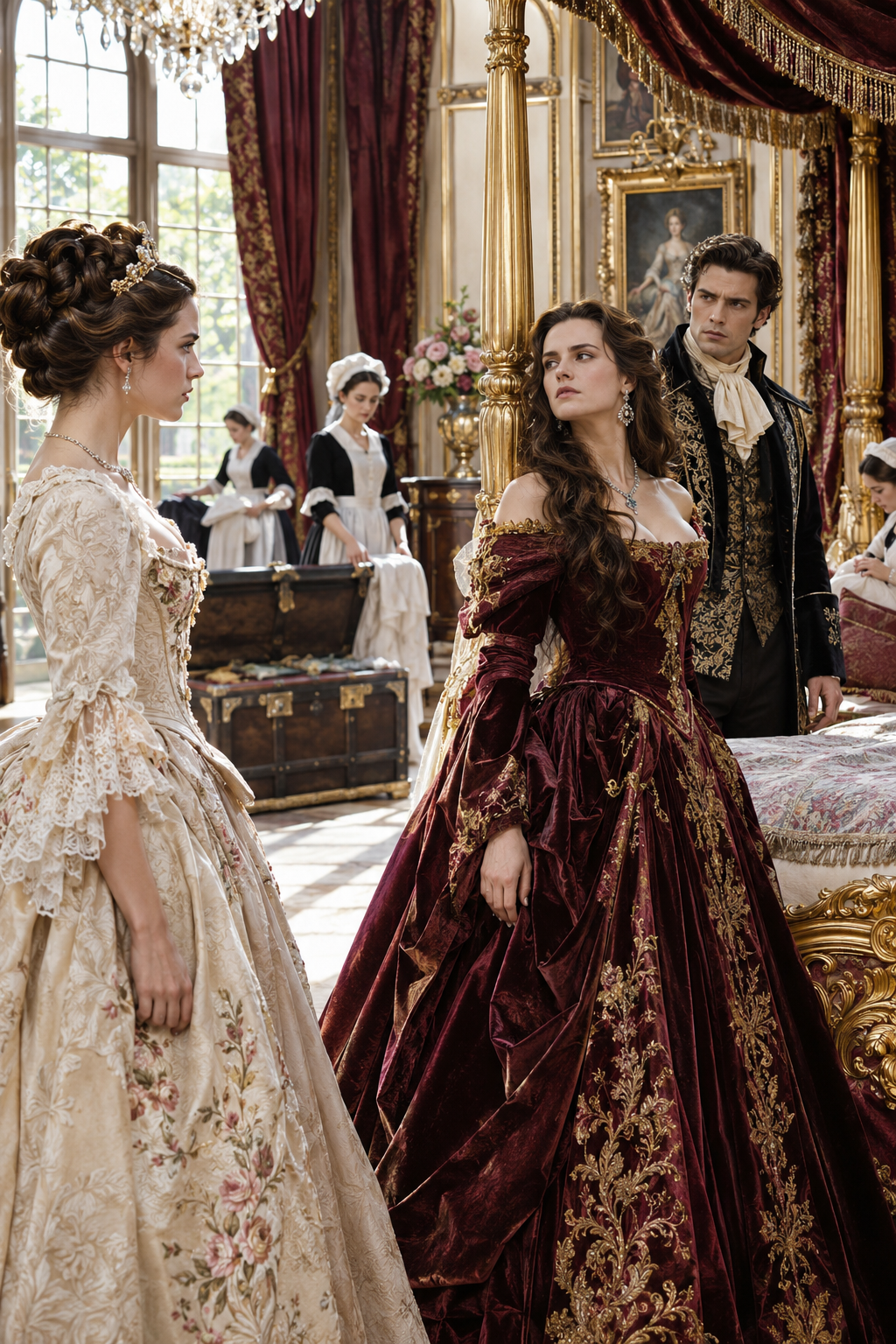
“You have until dinner to remove your belongings,” Duke Octavian told his wife. “Lady Calanthe will be sleeping here from now on.”
“The Larkspur Wing does not belong to you, Your Grace.”
For a moment, Octavian simply stared at the solicitor. Then he let out a short, irritated laugh.
“Have you lost your mind? This is Dunmuir House. My family has owned this estate for generations.”
“The greater estate, yes,” the solicitor replied calmly. “However, the western wing was purchased separately by the late Lord Arkwright, shortly before your marriage to his daughter.”
Calanthe stepped forward, tightening the silk robe around her shoulders.
“What does that have to do with us?”
The solicitor turned the document toward Octavian.
“Upon Lord Arkwright’s death, ownership passed directly to Duchess Isolde. The property remains her personal freehold, protected under the terms of her marriage settlement.”
Octavian snatched the document from his hands. His eyes moved quickly across the faded handwriting until they reached the signatures at the bottom.
He recognized his father’s signature immediately.
“This cannot be right.”
“I have verified the original deed against the official property records,” the solicitor explained. “There is no question regarding its validity.”
Octavian looked toward the estate officers.
“And what exactly are these men doing here?”
“Her Grace has formally withdrawn permission for both you and Lady Calanthe to occupy her property. You are required to vacate the Larkspur Wing immediately.”
Calanthe’s mouth fell open.
“You cannot possibly expect me to leave!”
“Your belongings will be packed and transferred wherever you wish, my lady.”
Octavian threw the document onto a nearby table.
“I demand to see my wife.”
“Of course.”
A familiar voice came from the hallway.
Isolde stood behind the officers, dressed in a simple dark blue gown. Her hair was neatly arranged, and her expression was remarkably peaceful.
Octavian marched toward her.
“End this ridiculous performance immediately.”
“I’m afraid the matter is already settled.”
“You would throw your own husband out of his bedroom?”
Isolde looked past him at Calanthe.
“Yesterday, you seemed quite comfortable throwing your own wife out of hers.”
Several servants lowered their heads, hiding their expressions.
Octavian noticed.
“Everyone out!” he shouted.
Nobody moved.
The estate officers looked toward Isolde, waiting for her instructions.
That small gesture wounded Octavian more deeply than anything she had said. For the first time in his own household, his authority meant nothing.
“You have thirty minutes to collect your personal belongings,” Isolde announced. “The servants will assist you.”
Calanthe suddenly began crying.
“Octavian, do something!”
But the duke had nothing left to say.
By the time breakfast was served in the main dining room, trunks and suitcases were being carried through the western entrance. Calanthe followed them furiously, complaining about the treatment she had received.
Octavian walked behind her, his face burning with humiliation.
Isolde remained beside the entrance until the locksmith finished his work. He handed her a set of new keys.
“Everything is secure, Your Grace.”
“Thank you.”
She returned to her bedroom and opened the curtains. Morning sunlight spilled across the familiar carpet.
Her maid, Margaret, stood near the fireplace.
“Shall I have your belongings brought back, Your Grace?”
“Yes, please.”
Margaret hesitated before speaking again.
“Your father would have been proud of you.”
Isolde looked down at the keys in her hand.
“I wish he were here.”
For the first time in two days, her composure broke. She sat on the edge of her bed and allowed herself to cry.
She wasn’t crying because she had lost her bedroom. She was crying because the man she had loved for years had deliberately tried to make her feel worthless.
She had defended him against criticism, supported him through financial difficulties, and worked tirelessly to restore his family’s reputation.
In return, he had replaced her without a second thought.
But reclaiming her bedroom was only the beginning.
Later that morning, Octavian arranged for Calanthe to occupy a luxurious suite in the eastern section of Dunmuir House.
He ordered fresh flowers, expensive furnishings, and a private dinner to calm her anger.
“This is merely a temporary inconvenience,” he assured her. “Isolde will come to her senses.”
Calanthe folded her arms.
“I was humiliated in front of servants. You promised me that I would eventually become the most important woman in this household.”
“And you will.”
“Then prove it.”
Octavian immediately sent instructions to the estate manager, ordering him to purchase everything Calanthe requested.
An hour later, the manager appeared in his study carrying a leather ledger.
“I’m afraid we cannot authorize these purchases, Your Grace.”
Octavian barely looked up.
“Why not?”
“The household account has insufficient available funds.”
“Then transfer money from the reserve account.”
“That account is no longer accessible to us.”
Octavian slowly lowered his newspaper.
“What are you talking about?”
The manager opened the ledger.
“Her Grace has instructed her financial representatives to separate her private Arkwright accounts from the estate’s operating accounts.”
“Those funds have always been available.”
“Because the duchess permitted it, Your Grace.”
Octavian rose from his chair.
“How much has she withdrawn?”
The manager looked uncomfortable.
“Perhaps it would be better if you examined these records yourself.”
He placed several statements on the desk.
Octavian began reading.
At first, he assumed there had been some accounting error. Then he turned another page, followed by another.
The repairs to the estate’s roof had been paid for by Isolde. The restoration of the gardens, the servants’ wages during difficult winters, the maintenance of the stables, and even several outstanding family debts had all been covered by her private fortune.
His hunting trips, expensive dinners, imported wines, and extravagant parties had also been supported by her money.
For years, Octavian had believed that his estate was financially successful.
In reality, his wife had been keeping it alive.
“Why was I never informed of this?” he demanded.
“Her Grace presented the annual financial summaries to you personally,” the manager replied. “You generally instructed her to handle the details.”
Octavian remembered those conversations.
He had dismissed them because he considered household finances boring. Whenever Isolde tried discussing expenses, he would tell her that she worried too much.
Now every neglected conversation returned to him.
“What remains in my accounts?”
The manager gave him the figure.
Octavian sank into his chair.
It was barely enough to maintain his current lifestyle for several months.
Meanwhile, Isolde was meeting with her solicitor in the Larkspur Wing.
“I want all outstanding wages paid,” she instructed. “Any commitments I personally authorized must be honored. The servants should not suffer because of my husband’s decisions.”
“And future expenses?”
“Those are his responsibility.”
The solicitor nodded.
“Your husband may attempt to challenge the financial separation.”
“Then we will answer him through the proper legal channels.”
She signed the remaining papers without hesitation.
That afternoon, Octavian stormed into the western courtyard and discovered that his old key no longer worked.
He knocked until Margaret opened the door.
“I need to speak with the duchess.”
“Her Grace is expecting you.”
Isolde received him in her sitting room.
Octavian wasted no time.
“You have interfered with my financial affairs.”
“No. I have withdrawn from them.”
“You cannot abandon your responsibilities whenever you please.”
Isolde closed the book she had been reading.
“Which responsibilities are you referring to? Maintaining your estate? Paying your debts? Financing the entertainment of your mistress?”
“Calanthe has nothing to do with this.”
“She has everything to do with the decision you made.”
Octavian began pacing.
“You are behaving out of jealousy.”
Isolde studied him for a moment.
“Do you truly believe that I spent years supporting this household because I wanted to compete with another woman?”
He stopped walking.
“I supported you because you were my husband. I believed we were building something together. But you treated my loyalty as an obligation and my generosity as your entitlement.”
“You are still my wife.”
“And yesterday, that title was not important enough to protect me from humiliation.”
Octavian opened his mouth, but no answer came.
Isolde stood.
“You wanted the freedom to make decisions without considering me. You have it now. You will also have the responsibility of paying for those decisions.”
Over the following weeks, Dunmuir House began to change.
Several unnecessary carriages were sold. Expensive social gatherings were canceled. Orders for imported goods were reduced, and the estate manager introduced a strict budget.
Octavian hated every moment of it.
He had spent years enjoying the privileges of wealth without understanding where that wealth came from.
Calanthe was equally unhappy.
When a jeweler refused to deliver a necklace without immediate payment, she confronted Octavian in the drawing room.
“You promised me that necklace.”
“I have more urgent expenses.”
“Surely a duke can afford a simple piece of jewelry.”
“Not everything is as simple as you imagine.”
Calanthe stared at him.
“Are you telling me that your wife controls your money?”
“She controls her own money.”
“And apparently that was the only money worth having.”
Octavian’s expression hardened.
“Be careful.”
“Why should I be careful? You told me she was dependent on you. You said she had no influence beyond her little household duties.”
He turned away.
Calanthe suddenly understood that the life he had promised her was built upon another woman’s fortune.
Her affection began disappearing almost overnight.
She stopped joining him for breakfast. Her complaints became more frequent, and she started receiving letters from acquaintances in the capital.
One evening, Octavian returned from a difficult meeting with his creditors and found her maid packing several dresses.
“Where are you going?”
Calanthe continued examining her jewelry.
“I have been invited to stay with friends.”
“For how long?”
“I haven’t decided.”
Octavian watched her place a necklace inside a velvet case.
“You are leaving because I cannot give you everything you want.”
She finally looked at him.
“Octavian, I never agreed to spend my life worrying about bills.”
“And what about everything you said to me?”
Calanthe sighed.
“You made promises you couldn’t keep. That is hardly my fault.”
Something inside him finally broke.
He remembered Isolde sitting beside him during his father’s funeral. He remembered her working late into the night to settle disputes with tenants and visiting sick servants when nobody expected her to.
She had remained beside him when the estate faced financial trouble. She had never demanded expensive gifts as proof of his affection.
And he had traded that loyalty for someone who was now packing her belongings because the gifts had stopped.
“Then go,” he said quietly.
Calanthe seemed surprised.
“Excuse me?”
“Our relationship is over. Take your belongings and leave.”
She studied his face, perhaps expecting him to change his mind.
He didn’t.
By sunset, her carriage had disappeared down the road.
For the first time in years, Octavian ate dinner completely alone.
The silence was unbearable.
He looked toward the empty chair where Isolde used to sit and remembered how often he had ignored her attempts at conversation.
He had once believed her competence made him appear weak. Now he understood that his weakness had been his refusal to appreciate it.
Several days later, he received another envelope from Isolde’s solicitor.
Inside was a formal request for legal separation.
Octavian read the papers three times.
Until that moment, he had assumed that Isolde’s actions were temporary. He believed she wanted an apology, perhaps a public gesture of regret.
He had never seriously considered that she might leave him forever.
He immediately went to the Larkspur Wing.
Isolde was standing beside an open trunk when he entered her sitting room.
Several books and framed family portraits had already been packed.
“Where are you going?” he asked.
“I have purchased a house near the coast.”
“You purchased another house?”
“Yes.”
“Without discussing it with me?”
Isolde gave him a tired look.
“I no longer require your approval.”
Octavian held up the separation papers.
“Is this really what you want?”
“It is.”
“Calanthe is gone.”
“I heard.”
“I ended things with her.”
Isolde returned to arranging her belongings.
“That was your decision.”
“Doesn’t it mean anything to you?”
She stopped.
“Would you have ended the affair if I had continued paying for your lifestyle?”
The question struck him with painful accuracy.
He wanted to deny it, but he couldn’t.
Instead, he sat down.
“I owe you an explanation.”
Isolde remained standing.
Octavian looked at his hands.
“When we married, everyone admired you. My father praised your judgment. The estate manager trusted your decisions. Even our guests seemed more interested in your opinions than mine.”
He swallowed before continuing.
“I was supposed to be the duke. Yet whenever something went wrong, you were the person everyone turned to.”
“Because I was willing to help.”
“I know that now.”
His voice grew quieter.
“Calanthe made me feel important. She admired my title and laughed at my jokes. She never questioned my decisions. With her, I could pretend that I was everything I wanted to be.”
Isolde listened without interrupting.
“When I gave her your bedroom, I wanted to prove that I was still in control. I wanted to remind you that I was the head of this household.”
“And did humiliating me make you feel stronger?”
Octavian shook his head.
“No. It made me cruel.”
His eyes filled with tears.
“I betrayed you because I was insecure. You had done nothing wrong. I punished you for possessing qualities I should have admired.”
For years, Isolde had dreamed of hearing her husband acknowledge the sacrifices she had made.
Now that the words had finally arrived, she discovered they could not restore what he had destroyed.
“I’m sorry, Isolde,” he whispered. “I truly am.”
She sat across from him.
“I believe you.”
Hope immediately appeared on his face.
“Then perhaps we can begin again.”
“No, Octavian.”
His expression collapsed.
“Please. Give me a chance to prove that I can change.”
“You should change. You should become a better man. But you must do that because it is the right thing to do, not because you expect me to return.”
He reached toward her hand.
She gently withdrew it.
“I spent years believing that loving someone meant enduring whatever they did to me,” she continued. “I kept making excuses for your behavior. Every time you hurt me, I convinced myself that being more patient would make things better.”
Octavian wiped his eyes.
“I never realized how unhappy you were.”
“You never asked.”
The room became painfully quiet.
Isolde looked toward the garden outside.
“I forgive you, Octavian. I don’t want to carry anger with me for the rest of my life. But forgiveness does not mean giving you another opportunity to break my heart.”
He lowered his head.
This time, he did not argue.
The legal separation was finalized several months later. Isolde retained her private fortune, her inherited properties, and complete ownership of the Larkspur Wing.
She arranged for the wing to remain securely closed until she decided what to do with it.
On her final morning at Dunmuir House, the servants gathered near the entrance.
Margaret was accompanying her to the coast, while several other employees had accepted positions elsewhere with Isolde’s assistance.
The remaining servants thanked her for ensuring that their wages and outstanding benefits had been paid.
Octavian stood at the bottom of the staircase.
He looked older than he had only a few months earlier.
“Your carriage is ready,” he said.
“Thank you.”
He hesitated.
“Will I ever see you again?”
“Perhaps someday.”
She offered him a small, sincere smile.
“I hope you find peace, Octavian.”
“And I hope you find happiness.”
For once, he said something without expecting anything in return.
Isolde stepped into her carriage. As it moved through the gates, she looked back at Dunmuir House one final time.
She remembered arriving there as a young bride, filled with hope and eager to become the perfect wife.
She had spent years believing that her greatest achievement would be making her husband happy.
Now she understood how much of herself she had sacrificed in pursuit of that impossible goal.
Her new home was smaller than Dunmuir House, but it overlooked the ocean. There were gardens, bright windows, and a comfortable library where she could spend entire afternoons reading.
She established a charitable fund to help widows and women facing financial hardship. She also supported educational programs that taught young women how to manage money, understand contracts, and protect their property.
She wanted them to possess the knowledge that had ultimately protected her.
One spring afternoon, nearly two years after her departure, a letter arrived from Octavian.
He explained that he had gradually reduced the estate’s debts, learned to manage its finances, and begun working closely with the people whose advice he had once ignored.
He did not ask her to return.
Instead, he thanked her for everything she had done and apologized once more for taking her devotion for granted.
At the bottom of the letter, he had written something that made Isolde pause.
“I once believed that being powerful meant having someone beneath me. You taught me that a man who must diminish his wife to feel important possesses very little strength at all.”
Isolde folded the letter carefully and placed it inside her desk.
She was glad he had learned something from their painful marriage. But she no longer measured her happiness by his progress.
That evening, Margaret found her sitting in the garden, watching the sun disappear beyond the ocean.
“Are you happy here, Your Grace?”
Isolde looked around at the flowers she had planted, the house she had chosen, and the peaceful life she had built.
“Yes, Margaret. More than I ever imagined.”
She had once thought losing her marriage would mean losing everything.
Instead, leaving it had allowed her to rediscover the woman she had forgotten while trying to please someone else.
Octavian had believed that taking away her bedroom would remind her of her place.
In a way, it had.
It reminded her that her place was not beneath a man who disrespected her, nor beside someone who valued her only for what she provided.
Her place was wherever she could live with dignity, freedom, and peace.
And although she had the wealth to reclaim an entire wing of a magnificent estate, her greatest victory had never been the property, the money, or the humiliation of those who betrayed her.
It was the moment she finally understood that she did not need anyone’s permission to choose herself.
She could forgive without returning. She could love without surrendering her dignity. And she could begin again without apologizing for wanting a better life.
The woman who had once quietly packed her belongings because her husband ordered her to leave was now living in a home where nobody could ever make her feel unwelcome.
This time, every door she opened led to a life that belonged entirely to her.
The following summer, Isolde made one final decision concerning Dunmuir House.
She offered to sell the Larkspur Wing back to Octavian at a fair price, allowing him to reclaim that part of his ancestral home without placing himself in further debt.
Octavian accepted, arranging to pay for the property in installments using income from the estate.
When the agreement was signed, he sent her a handwritten note.
“Thank you for giving me the opportunity to rebuild what I nearly destroyed. I understand now that your kindness was never something I deserved simply because I was your husband.”
Isolde used the proceeds to expand her charitable foundation.
Among the women she helped was a young widow whose relatives had attempted to take possession of her inheritance. With legal assistance and financial support, the woman successfully defended her property and opened a small business.
Months later, she visited Isolde to express her gratitude.
“You changed my life,” the young woman said, fighting back tears.
Isolde gently took her hand.
“You changed your own life. I merely helped you discover that you had a choice.”
Years passed, and Isolde became known not simply as the Duchess of Dunmuir, but as a woman whose generosity and determination had given countless others a chance to begin again.
She never regretted leaving Octavian.
Their marriage had taught her painful lessons, but she refused to allow those lessons to make her bitter.
As for Octavian, he continued managing his estate with greater care. He never forgot the morning he had been escorted out of the Larkspur Wing, but what haunted him most was not the embarrassment of losing his bedroom.
It was the memory of a devoted wife whose love he had mistaken for weakness.
He had finally become the responsible man Isolde had once hoped he would be, but he understood that becoming better did not erase the consequences of his earlier choices.
Some mistakes could be forgiven without being undone.
One evening, Isolde stood beside an open window in her coastal home, listening to the waves.
On her desk rested a portrait of her father, several letters from women her foundation had helped, and a small brass key from her former bedroom.
She picked up the key and smiled.
Once, it had represented her right to occupy a room.
Now, it reminded her of something far more valuable: her right to decide how she would live.
She placed it inside a drawer and walked downstairs, where Margaret was waiting to join her for dinner.
There was laughter in the house, warmth around the table, and no fear of what tomorrow might bring.
Isolde had everything she needed.
Not because she had defeated her husband, but because she had stopped allowing his treatment of her to determine her worth.
Life had taught her that kindness should never require surrendering self-respect, loyalty should never demand accepting betrayal, and forgiveness should never come at the expense of personal freedom.
Sometimes, the most courageous decision is not fighting to keep someone in your life.
It is accepting that you deserve a life in which you no longer have to fight to be valued.
And that was the life Isolde finally chose.
THE END.