“You have thirty days to marry me, Miss Hawthorne. Otherwise, I will take Oak Haven.”
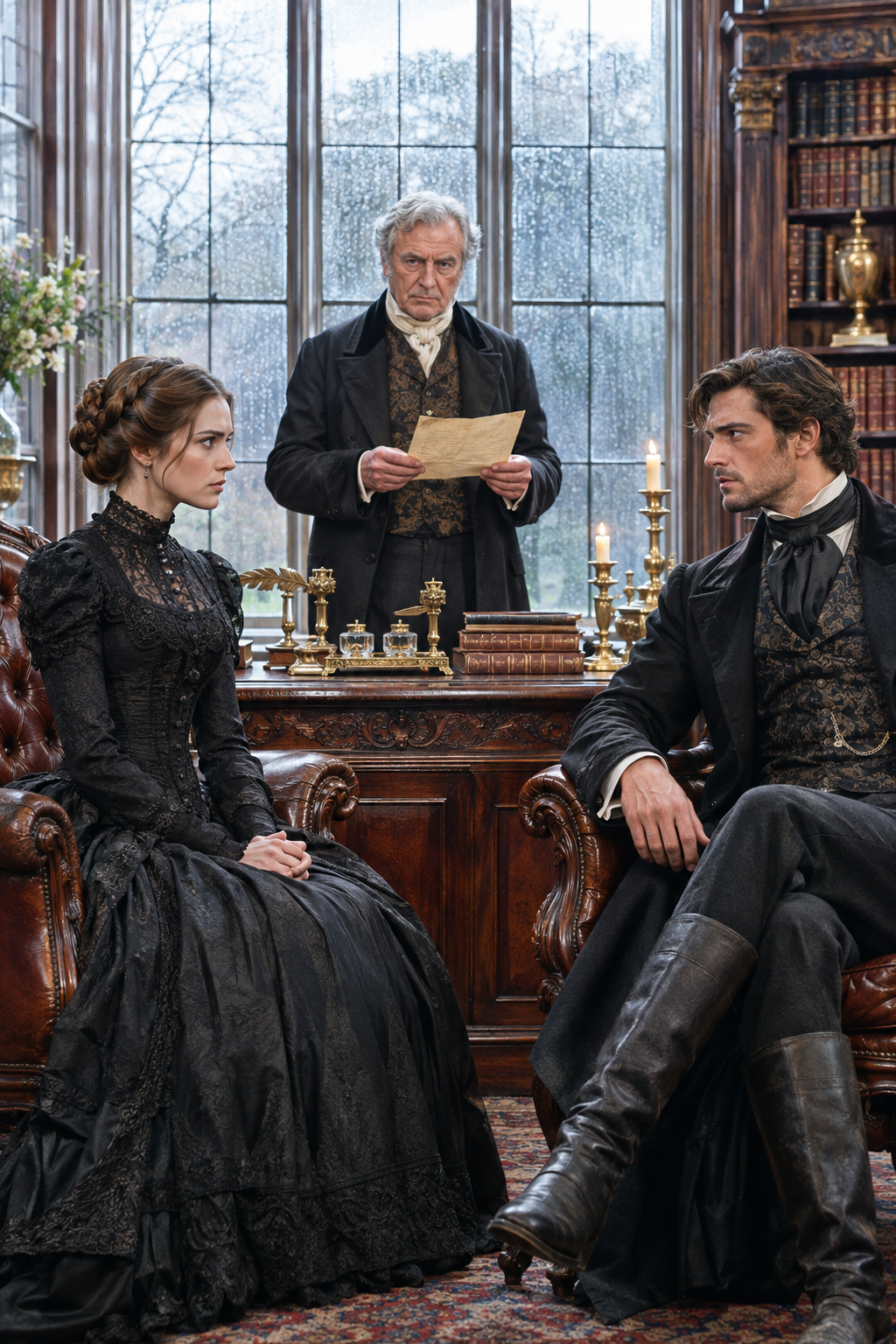
“There is something we must settle before Monday,” Arthur said, keeping one hand firmly on the marriage agreement.
Beatrice Hawthorne looked at him across the desk. “Another condition, Your Grace? I thought we had already discussed enough conditions to fill a book.”
“This one concerns your uncle’s inheritance.”
Her expression changed.
Arthur noticed immediately.
“The twenty thousand pounds,” he continued. “You believe that money will become yours once the legal arrangements are completed.”
“That is what my uncle’s solicitor told me.”
“Did he explain why your uncle left it under such unusual conditions?”
Beatrice frowned. “He said my uncle wanted to make certain Oak Haven remained in the family.”
Arthur opened a drawer and removed a folded document.
“Your uncle owed several substantial debts before his death. Some were secured against the estate.”
“I know about the debts.”
“Not all of them.”
A cold feeling settled in Beatrice’s stomach.
Arthur placed the document on the desk but did not push it toward her.
“I need your permission to examine the estate accounts before we marry. Every account. Every agreement. Every transaction your uncle made during his final five years.”
“Why?”
“Because I refuse to enter a marriage without knowing exactly what I am marrying into.”
Beatrice stared at him.
“You mean what property you are acquiring.”
Arthur did not deny it.
For some reason, his silence hurt more than an argument would have.
“Very well,” she said. “But I have a condition of my own.”
His eyebrow rose.
“I will examine those accounts with you. Nothing concerning Oak Haven will be discussed behind my back.”
Arthur studied her for several seconds.
Then he extended his hand.
“Agreed.”
Beatrice shook it.
His hand was warm, his grip firm.
Neither of them knew that the agreement they had just made would uncover a secret capable of destroying both their families.
Monday arrived beneath a gray sky.
By seven in the morning, Beatrice was already standing in Oak Haven’s lower valley, her boots sinking into the wet earth.
A dozen workers waited beside a wagon filled with shovels and drainage tools.
Arthur arrived shortly afterward on horseback.
He looked at Beatrice’s muddy dress and frowned.
“You are not dressed for a morning of supervising laborers.”
“I am dressed for the work that needs doing.”
“You could have remained at Rothmier House.”
“And you could have remained in bed.”
One of the workers coughed to hide a laugh.
Arthur dismounted.
“Show me where you believe the spring begins.”
Beatrice led him across the valley toward a narrow strip of reeds growing beside an old stone wall.
“My grandfather showed me this place when I was a child,” she explained. “He said the water ran beneath the hill long before anyone built the present road.”
Arthur studied the ground.
“The surveyor marked the spring farther east.”
“The surveyor came during a dry summer.”
“And you are certain?”
Beatrice crouched and pressed her fingers into the soil.
“Look at the reeds. They grow here even when the rest of the valley dries out.”
Arthur knelt beside her.
He examined the earth, then called for the foreman.
“Begin here. Follow Miss Hawthorne’s instructions until we reach the old boundary ditch.”
The foreman hesitated.
“Your Grace, the surveyor’s plans—”
“Have been revised.”
Beatrice looked at Arthur in surprise.
He did not smile.
But when he stood, he offered her his hand.
She accepted it.
For the first time since their strange engagement began, she felt they might actually accomplish something together.
By noon, the workers had uncovered a narrow stream of clear water beneath the packed earth.
The foreman stared at it.
“Well, I’ll be.”
Beatrice grinned.
Arthur looked from the water to her face.
“You were right.”
“Was that painful to admit?”
“Extremely.”
She laughed before she could stop herself.
Arthur watched her for a moment longer than necessary.
Then he turned away.
The work continued for three days.
Each morning, Beatrice arrived before breakfast. Each afternoon, Arthur joined her whenever his estate business allowed.
They argued over drainage routes, expenses, and which fields should be repaired first.
Yet their disagreements slowly changed.
Arthur began asking for her opinion before making decisions.
Beatrice discovered that beneath his cold manner was a man who remembered every tenant’s name and knew exactly how much grain his villages would need through winter.
He was demanding, sometimes unbearably so, but he was not careless.
One afternoon, they visited Thomas Bell, the grieving tenant whose eviction Arthur had postponed.
Thomas stood awkwardly outside his small cottage.
“My lord,” he said, lowering his head.
Arthur nodded.
“Miss Hawthorne tells me your wife died in February.”
Thomas swallowed.
“Yes, Your Grace.”
“And you have two children?”
“Three, sir. The youngest is only four.”
Arthur looked toward the cottage, where three small faces watched through the window.
“You will have the three months we agreed upon. After that, we will review your circumstances.”
Thomas’s eyes filled with tears.
“I don’t know how to thank you.”
“Thank Miss Hawthorne.”
Beatrice turned toward Arthur.
He was already walking back to the carriage.
That evening, she found him alone in the library.
“You could have taken credit for helping Thomas.”
Arthur did not look up from his book.
“Why would I?”
“Most men in your position enjoy being thanked.”
“I am not most men.”
“No,” Beatrice said softly. “You certainly are not.”
Arthur closed his book.
For a brief moment, something unguarded passed between them.
Then a servant entered with a letter.
The seal belonged to Beatrice’s late uncle’s solicitor.
Arthur broke it open.
As he read, his expression darkened.
“What is it?” Beatrice asked.
“The estate accounts have arrived.”
“And?”
Arthur folded the letter.
“We need to go to London.”
They left two mornings later.
Beatrice had rarely traveled beyond the neighboring counties, and London overwhelmed her with its crowded streets, endless carriages, and grand buildings.
Arthur, however, seemed entirely at ease.
He took her directly to the offices of Mr. Edmund Vale, the solicitor who had handled her uncle’s affairs.
Mr. Vale was a thin, nervous man with carefully combed hair.
He greeted Arthur with exaggerated politeness.
“Your Grace. Miss Hawthorne. What an unexpected pleasure.”
Arthur placed a thick folder on the desk.
“We require an explanation.”
Mr. Vale’s smile faded.
“Concerning what matter?”
“The estate accounts.”
The solicitor adjusted his spectacles.
“I believe everything was explained in my previous correspondence.”
“Then explain this.”
Arthur opened the folder and pointed to a series of payments.
Beatrice leaned forward.
Several large sums had been withdrawn from Oak Haven’s accounts during the final years of her uncle’s life.
The payments were listed as improvements to roads, drainage systems, and tenant housing.
But Beatrice recognized the dates.
“No drainage work was done that year,” she said.
Mr. Vale cleared his throat.
“Your uncle may have arranged for preliminary surveys.”
“And the tenant cottages?” she asked. “The roofs were leaking when I arrived. Several families have been repairing them themselves.”
Mr. Vale reached for a handkerchief.
“Estate management can be complicated, Miss Hawthorne.”
Arthur’s voice became dangerously quiet.
“Where did the money go?”
The solicitor looked toward the door.
“I would need time to review the records.”
“You have until tomorrow.”
Mr. Vale rose abruptly.
“Your Grace, I must protest—”
“Then protest with the documents in your hands.”
Arthur stood.
Beatrice followed him out.
Once they reached the carriage, she turned to him.
“You believe my uncle stole money from his own estate?”
“I believe someone did.”
“And you suspect Mr. Vale?”
“I suspect anyone who handled the accounts.”
Beatrice stared through the carriage window.
Her uncle had been distant, selfish, and often cruel.
But she had never imagined his neglect might conceal something worse.
“What happens if the money is gone?”
Arthur was silent.
“Arthur?”
It was the first time she had used his given name without thinking.
He looked at her.
“We find out where it went.”
“And if we cannot?”
His jaw tightened.
“Then we find another way to save Oak Haven.”
She wanted to believe him.
But that evening, she overheard a conversation that shattered her growing trust.
Arthur was speaking to his steward in the sitting room of their London residence.
“The western boundary is essential,” he said. “Without it, the expansion cannot proceed.”
“And Miss Hawthorne?” the steward asked.
“She will sign the marriage settlement.”
“Even if she discovers the full value of the land?”
A long silence followed.
Then Arthur said, “Leave that to me.”
Beatrice stepped backward.
Her heart hammered.
The full value of the land?
What had Arthur failed to tell her?
She returned to her room without making a sound.
For the first time, she wondered whether the duke’s sudden willingness to help Oak Haven had been nothing more than a carefully planned deception.
The next morning, she refused breakfast.
Arthur found her standing beside the window, already dressed for travel.
“We are expected at the solicitor’s office in an hour,” he said.
“I am returning to Oak Haven.”
He stopped.
“Why?”
“Because I no longer know whether I can trust you.”
Arthur’s expression hardened.
“Explain yourself.”
“I heard your conversation last night.”
He said nothing.
“You know something about my land that I do not.”
“Beatrice—”
“Do not tell me I misunderstood.”
Arthur walked toward the fireplace.
For several moments, he seemed to struggle with himself.
Then he turned.
“The western boundary contains a valuable stretch of land. I intended to use it to connect my properties and construct a new road.”
“That much you told me.”
“What I did not tell you is that the route would also allow access to a proposed commercial canal.”
Beatrice stared at him.
“A canal?”
“If the project receives approval, land along the route could become extremely valuable.”
“And you wanted Oak Haven before that happened.”
“Yes.”
The admission struck her like a slap.
“You knew.”
“I knew there was a possibility.”
“You offered marriage to a desperate woman because you believed her land might make you richer.”
Arthur’s face tightened.
“I offered marriage because it would unite the properties and prevent Oak Haven from being sold to creditors.”
“And benefit you enormously.”
“Yes.”
Beatrice looked away.
At least he had stopped pretending.
“Why did you not tell me?”
“Because I thought you would refuse.”
She laughed bitterly.
“So you decided I did not deserve the truth.”
Arthur took a step toward her.
“I was wrong.”
The words surprised her.
He continued, quieter now.
“I have spent my life making decisions based on what is practical. I saw an estate in trouble and an arrangement that could benefit us both.”
“You saw a bargain.”
“At first.”
Beatrice looked at him.
Arthur’s expression had changed.
“Then I met a woman who knew more about her land than any surveyor I employed. A woman who would argue with a duke over a grieving farmer. A woman who would stand in the rain to save fields most people would have abandoned.”
Her throat tightened.
“Do not make this harder.”
“I am trying to tell you that my reasons are no longer what they were.”
“Then prove it.”
Arthur waited.
“Give me the truth about everything. No more private arrangements. No more decisions made for me.”
He nodded slowly.
“You have my word.”
Beatrice wanted to believe him.
But trust, once damaged, could not be repaired with a single promise.
They returned to Mr. Vale’s office together.
The solicitor was gone.
His clerk stood trembling beside an empty desk.
“Mr. Vale left before dawn,” he explained.
“Where?” Arthur demanded.
“I do not know, Your Grace.”
Arthur examined the room.
Several filing cabinets had been emptied.
On the desk lay a half-burned letter.
Beatrice noticed the familiar handwriting immediately.
“That belonged to my uncle.”
She picked it up carefully.
Most of the page had been destroyed, but a few lines remained.
One sentence made her blood run cold.
“The money must never reach Rothmier.”
Beatrice looked at Arthur.
He was staring at the same words.
“What does that mean?” she whispered.
Arthur’s face had gone pale.
“I do not know.”
But something in his expression told her the letter had awakened an old memory.
They returned to Oak Haven immediately.
During the journey, Arthur told Beatrice about a bitter dispute between their families nearly twenty years earlier.
His father, the previous Duke of Rothmier, had attempted to purchase part of Oak Haven.
Beatrice’s uncle had refused.
The disagreement had become public, and the two men had never spoken again.
“My father believed your uncle had cheated him,” Arthur said.
“Cheated him how?”
“He claimed that money had been paid for land that was never transferred.”
“How much?”
Arthur hesitated.
“Twenty thousand pounds.”
Beatrice stared at him.
The exact amount of her inheritance.
“Surely that cannot be a coincidence.”
“I am beginning to think very little about this is coincidence.”
When they arrived at Oak Haven, the drainage workers were waiting with troubling news.
The trench had collapsed during the night.
Water was pouring into the lower fields faster than before.
Arthur rode straight to the valley.
Beatrice followed.
The foreman met them beside a broken section of the trench.
“Someone removed the timber supports, Your Grace.”
Arthur dismounted.
“Are you certain?”
“Yes, sir. They did not fail naturally. The fastening ropes were cut.”
Beatrice looked across the flooded fields.
“If we cannot repair this before the next heavy rain, the spring planting will be ruined.”
Arthur called the workers together.
“Bring every available wagon. We reinforce the trench today.”
The foreman shook his head.
“We have not enough timber.”
“Take it from my eastern woodland.”
“That will cost a fortune, Your Grace.”
Arthur looked at Beatrice.
“Then it will cost a fortune.”
For the next two days, the valley became a battlefield against the rising water.
Men worked in mud up to their knees.
Women from the village brought hot food and dry blankets.
Beatrice organized supplies, checked the drainage levels, and helped carry tools.
Arthur worked beside the laborers until his hands blistered.
On the second evening, a sudden storm broke over Oak Haven.
Rain hammered the fields.
The temporary bank began to give way.
“Everyone back!” the foreman shouted.
Beatrice was standing near the lower trench when the earth shifted beneath her feet.
She slipped.
Before she could regain her balance, the bank collapsed.
Cold water swept her into the ditch.
She struggled to stand, but the current dragged her toward a fallen tree.
Then someone caught her arm.
Arthur.
He had jumped into the water after her.
“Hold on!” he shouted.
She grabbed his coat.
Together they fought toward the bank, where the workers pulled them to safety.
Beatrice collapsed on the grass, coughing.
Arthur knelt beside her.
“Are you hurt?”
She shook her head.
His hands trembled as he brushed wet hair from her face.
“You foolish woman,” he whispered.
She managed a weak smile.
“You jumped into a flooded trench.”
“I noticed.”
“You might have drowned.”
His expression changed.
“So might you.”
For one breathless moment, the storm seemed to disappear.
Then Arthur pulled her against him.
He held her so tightly that she could feel his heart racing.
“I thought I had lost you,” he said.
Beatrice closed her eyes.
She had spent weeks telling herself their marriage would be nothing more than an agreement.
But no agreement could explain the way she felt in his arms.
The next morning, the rain stopped.
The repaired drainage channel held.
Water began flowing away from the fields.
The villagers cheered when the first stretch of farmland emerged from beneath the flood.
Yet their victory was short-lived.
A stranger arrived at Oak Haven carrying a leather case and a sealed letter.
He introduced himself as Mr. Henry Whitcomb, an accountant formerly employed by Beatrice’s uncle.
“I have been looking for Miss Hawthorne,” he said.
Arthur immediately ordered that they speak in private.
Mr. Whitcomb appeared exhausted.
“I worked for your uncle for twelve years,” he told Beatrice. “I left when I discovered what Mr. Vale was doing.”
“What was he doing?”
“Moving money between accounts. Hiding payments. Forging signatures.”
Beatrice gripped the edge of her chair.
“Why did you not report him?”
“I tried. Your uncle dismissed me.”
Arthur leaned forward.
“Do you have proof?”
Mr. Whitcomb opened his case.
Inside were copies of account books, receipts, and several letters.
“I kept these because I feared the truth would disappear.”
Beatrice began examining the documents.
Then she stopped.
One payment had been made in the name of the late Duke of Rothmier.
Another had been authorized using her uncle’s signature.
Both were dated years after Arthur’s father had died.
“That is impossible,” she whispered.
Mr. Whitcomb nodded.
“Exactly.”
Arthur took the papers.
His expression became unreadable.
Someone had used his father’s name to move money long after his death.
And the trail led directly to Mr. Vale.
“But why?” Beatrice asked.
Mr. Whitcomb hesitated.
“Because your uncle discovered something about the western boundary.”
Arthur looked up sharply.
“What?”
The accountant removed a second document.
It was an old survey map.
“The boundary recorded in the current deeds is incorrect. The original survey placed the western line much farther east.”
Beatrice leaned closer.
“Then Oak Haven is larger than we believed.”
“Considerably larger.”
Arthur stared at the map.
The disputed land included the very route proposed for the canal.
Mr. Whitcomb continued.
“Your uncle intended to correct the deeds. But Mr. Vale persuaded him to delay. He claimed the matter could be settled quietly.”
“And instead?” Arthur asked.
“He used the confusion to arrange fraudulent loans against land your uncle legally owned.”
Beatrice felt sick.
Her uncle had been neglectful and stubborn, but perhaps he had also been trapped.
“Where is Mr. Vale now?”
“I believe he intends to leave England.”
Arthur rose.
“Then we must act quickly.”
They traveled to the county magistrate with the evidence.
An investigation began immediately.
But before the authorities could locate Mr. Vale, another letter arrived.
It was addressed to Beatrice.
Inside was a single sheet of paper.
“If you wish to keep Oak Haven, abandon the marriage. Otherwise, the truth about your uncle will become public.”
There was no signature.
Beatrice read the message twice.
Arthur watched her.
“What does it say?”
She handed it to him.
His expression darkened.
“This is a threat.”
“It is also proof that someone knows what we have discovered.”
Arthur folded the letter.
“We should postpone the wedding until this is settled.”
Beatrice looked at him.
“You would release me from the agreement?”
“Yes.”
“Even if it means losing the western land?”
Arthur met her eyes.
“Yes.”
She searched his face for the calculating man who had first offered her marriage.
He was still there, somewhere.
But something greater had grown beside him.
“Then perhaps,” she said quietly, “we should stop allowing other people to decide our future.”
Arthur looked surprised.
“What are you suggesting?”
“That we continue the investigation. Together. And that neither of us makes a decision about marriage until we know the truth.”
He nodded.
For the first time, their future belonged to both of them.
The breakthrough came three days later.
A young clerk from Mr. Vale’s office arrived at Rothmier House carrying a small wooden box.
He had found it hidden beneath loose floorboards in the solicitor’s private room.
Inside were letters, an original land deed, and a signed confession.
The confession had been written by Beatrice’s uncle shortly before his death.
Beatrice recognized his handwriting.
Her hands shook as she unfolded the pages.
The letter revealed that her uncle had discovered Mr. Vale’s fraud years earlier.
Instead of reporting him, he had accepted a secret arrangement.
Mr. Vale would return part of the stolen money and conceal the illegal loans.
In exchange, Beatrice’s uncle would remain silent.
But the solicitor had continued stealing.
By the time her uncle realized the truth, the estate was nearly ruined.
The twenty thousand pounds had been placed in trust as an attempt to protect what remained.
Beatrice lowered the letter.
“He knew.”
Arthur said nothing.
“He knew people were suffering. He knew the cottages needed repairs. He knew the fields were flooding. And he did nothing.”
Her voice broke.
“He protected his reputation instead of his tenants.”
Arthur moved beside her.
“Beatrice—”
“I spent years believing he simply did not care. But he knew exactly what was happening.”
Tears slipped down her cheeks.
Arthur gently took the letter from her trembling hands.
“His mistakes do not have to become yours.”
She looked at him.
“What if it is too late?”
“It is not.”
He placed the original deed on the table.
“This proves Oak Haven owns the disputed land. The fraudulent loans can be challenged. And the stolen money may be recovered.”
Beatrice stared at the document.
For the first time, there was a real chance to save her home without sacrificing herself.
But the greatest surprise was still waiting.
When the authorities finally captured Mr. Vale at a coastal port, he attempted to bargain for a lighter punishment.
He claimed Arthur had known about the fraud.
The accusation spread quickly.
Within days, rumors reached every drawing room in the county.
People whispered that the Duke of Rothmier had arranged the entire marriage to obtain land he knew was worth a fortune.
Some even claimed he had helped Mr. Vale conceal the missing money.
Arthur denied the accusations.
But his reputation, already feared rather than loved, made people eager to believe the worst.
Beatrice watched the scandal unfold.
She knew Arthur had concealed the canal proposal.
She knew he had originally approached her for practical reasons.
But she also knew he had risked his life to save hers, spent his own money protecting her tenants, and given her the freedom to walk away.
When the magistrate summoned them for a formal hearing, Beatrice made her decision.
She would testify.
Arthur found her preparing her papers the night before.
“You do not have to defend me,” he said.
“I am not defending you because I have to.”
“Then why?”
“Because the truth matters.”
He looked at her for a long moment.
“I have not always been truthful with you.”
“No,” she agreed. “You have not.”
Arthur lowered his eyes.
“And I may never deserve your forgiveness.”
Beatrice stepped closer.
“Forgiveness is not something you earn by pretending you never made mistakes. You earn it by changing what you do next.”
Arthur looked up.
She took his hand.
“You gave me the choice to leave. Now I am choosing to stay and see this through.”
At the hearing, the courtroom was crowded.
Tenants, landowners, servants, and curious townspeople filled every available seat.
Mr. Vale sat beside his legal representative, looking pale and furious.
The magistrate examined the documents one by one.
The forged signatures were confirmed.
The false loans were exposed.
The original deed established Oak Haven’s rightful boundaries.
Then Beatrice was called to speak.
She stood before the magistrate, aware that every eye in the room was fixed on her.
“Miss Hawthorne,” he asked, “did the Duke of Rothmier attempt to obtain your estate through marriage?”
“Yes,” she answered.
A murmur swept through the courtroom.
Arthur remained still.
Beatrice continued.
“He proposed an arrangement that would benefit him. He did not initially tell me everything he knew about the potential value of my land.”
The room fell silent.
“But when I challenged him, he admitted the truth. He allowed me access to the accounts. He helped uncover the fraud. And when the evidence became clear, he offered to release me from our agreement.”
The magistrate leaned forward.
“Are you saying His Grace had no involvement in the fraudulent transactions?”
“I am saying the evidence shows those transactions were arranged by Mr. Vale. And I am saying that the duke’s actions after discovering them were directed toward protecting Oak Haven.”
Mr. Vale suddenly stood.
“This is absurd!”
The magistrate ordered him to sit.
But the solicitor had lost his composure.
“She knows nothing! Her uncle agreed to everything!”
Beatrice turned toward him.
“Then why did you forge signatures after his death?”
Mr. Vale froze.
The courtroom became utterly quiet.
Beatrice held up one of the account books.
“And why did you use the name of a duke who had already been dead for three years?”
Mr. Vale opened his mouth.
No words came.
The magistrate ordered him taken into custody.
The investigation continued for several weeks, but the essential truth had finally emerged.
Mr. Vale had exploited the dispute between the two families, stolen money through false transactions, and used forged documents to conceal his crimes.
Beatrice’s uncle had helped cover up the early wrongdoing out of fear and pride.
Arthur’s father had been deceived.
And Oak Haven had suffered for years because powerful men had valued their reputations more than the people who depended on them.
The fraudulent claims against Oak Haven were eventually set aside.
The inheritance remained protected, and proceedings began to recover the stolen funds.
The corrected boundary also gave Beatrice a valuable bargaining position in the proposed canal project.
She no longer needed to marry Arthur to save her estate.
That realization changed everything.
One evening, Arthur asked her to meet him in the garden at Rothmier House.
The roses were beginning to bloom.
Beatrice found him standing beside the stone fountain, holding a folded document.
“I have something for you,” he said.
She smiled faintly.
“Another contract?”
“In a manner of speaking.”
He handed it to her.
It was a formal release from their marriage agreement.
Every obligation had been canceled.
Oak Haven would remain hers.
Arthur had also arranged for the drainage project to be completed under a separate, fairly priced agreement, with no claim to her land.
Beatrice read the document slowly.
“You are giving up everything you wanted.”
Arthur shook his head.
“Not everything.”
She looked at him.
He took a breath.
“When I first came to Oak Haven, I saw fields, roads, and opportunities. I believed every problem could be solved with enough money and a carefully written agreement.”
“And now?”
“Now I know there are things no agreement can purchase.”
He stepped closer.
“I cannot buy your trust. I cannot demand your affection. And I have no right to ask you to sacrifice your freedom because I happen to want you beside me.”
Beatrice’s eyes filled with tears.
Arthur continued.
“I love you, Beatrice. I did not intend to. I certainly did not expect to. But somewhere between arguing over tenants and standing knee-deep in a flooded ditch, you became the most important person in my life.”
She laughed through her tears.
“That is a rather unusual declaration.”
“I have never been especially skilled at romance.”
“No,” she whispered. “You have not.”
Arthur smiled sadly.
“You are free to leave. I will not stand in your way.”
Beatrice looked down at the release document.
For weeks, she had feared losing Oak Haven.
Then she had feared losing her independence.
Now, with both safely in her hands, she realized what she truly wanted.
She folded the paper and placed it beside the fountain.
“Arthur, do you remember what you said when we first met?”
“That I rarely joke about business?”
“That marriage would solve our problems.”
He winced.
“I remember.”
“You were wrong.”
“I know.”
“Marriage cannot repair dishonesty. It cannot replace respect. And it certainly cannot turn two strangers into partners simply because they sign their names.”
Arthur nodded.
“But,” she continued, taking his hand, “two people who learn to trust each other might build something worth protecting.”
His breath caught.
“Beatrice?”
“I love you too.”
For once, the Duke of Rothmier had absolutely nothing to say.
Beatrice smiled.
“And I would very much like to marry you.”
Arthur stared at her.
“Are you certain?”
“Entirely.”
“Even knowing how difficult I can be?”
“Your Grace, I have survived your temper, your contracts, and your terrible habit of believing you are always right.”
He laughed.
She had never heard him laugh quite like that.
Then he drew her into his arms and kissed her.
There was no audience, no grand announcement, and no promise of a perfect future.
There were only two people who had finally learned the difference between possession and love.
They married six weeks later in the small church near Oak Haven.
Beatrice refused an extravagant ceremony.
Instead, she invited the tenants, workers, and families who had helped save the estate.
Thomas Bell attended with his three children.
The foreman who had repaired the drainage trench stood proudly beside his wife.
Even the village children, who had once been frightened of the stern duke, gathered around him without hesitation.
Arthur surprised everyone by kneeling to speak with Thomas’s youngest daughter when she offered him a crooked bunch of wildflowers.
He accepted them with the seriousness of a man receiving a royal honor.
Beatrice watched from the church steps, smiling.
After the ceremony, they returned to Oak Haven for a celebration beneath the old oak trees.
The lower valley had finally dried enough for planting.
New drainage channels carried water safely toward the river.
Repairs had begun on the cottages.
And Beatrice had established a small committee of tenants to help decide which improvements the estate needed most.
Arthur initially questioned the arrangement.
Then he attended the first meeting.
By the end of it, he admitted the tenants understood certain problems better than anyone sitting in an estate office.
Beatrice nearly fell out of her chair.
“You admitted someone else was right,” she teased afterward.
“Do not spread that rumor.”
She laughed and kissed his cheek.
Over the following year, Oak Haven changed.
The fields became productive again.
The cottages received new roofs.
Thomas Bell was given paid work helping maintain the drainage channels, allowing him to support his children without fear of eviction.
The canal proposal eventually moved forward, but only after Beatrice negotiated terms that protected the village, compensated affected tenants, and preserved the most important farmland.
Arthur stood beside her during every negotiation.
He offered advice when she asked.
He remained silent when she did not.
And when one businessman suggested that a duchess ought to leave such matters to her husband, Arthur replied calmly, “My wife knows more about this land than anyone in this room. I suggest you listen.”
Beatrice never forgot those words.
Neither did the businessman.
Years later, visitors to Oak Haven often remarked on the unusual partnership between the Duke and Duchess of Rothmier.
Some said she had softened him.
Others insisted he had given her the power to restore her family home.
Both explanations missed the truth.
Beatrice had never needed Arthur to give her courage.
She had possessed it long before they met.
And Arthur had never needed Beatrice to make him weak enough to love.
He had needed someone brave enough to show him that kindness and strength could exist together.
One autumn afternoon, they walked through the lower valley with their young daughter, Eleanor.
The child ran ahead, gathering fallen leaves and asking endless questions.
“Mother,” she called, pointing toward the flowing drainage channel, “did Father really jump into that water to save you?”
Beatrice smiled.
“He did.”
Eleanor turned to Arthur.
“Were you frightened?”
Arthur looked at his wife.
“Very.”
“Because the water was deep?”
He shook his head.
“Because I thought I might lose someone I loved.”
Eleanor considered this carefully.
Then she took his hand.
“Was that when you became brave?”
Arthur smiled.
“No, sweetheart. That was when I learned that being brave does not mean never being afraid.”
Beatrice squeezed his other hand.
They continued walking as the afternoon sunlight settled over the fields.
Once, Oak Haven had been a place of debts, fear, and broken promises.
Now it was a home filled with work, laughter, and hope.
And whenever Beatrice passed the old stone wall where she had first shown Arthur the hidden spring, she remembered the frightened young woman who had agreed to marry a duke because she believed she had no other choice.
She wished she could tell that younger version of herself something important.
That desperation was not the same as weakness.
That accepting help did not mean surrendering independence.
And that a person who truly loved her would never require her to become smaller so he could feel powerful.
Arthur had entered her life believing land was the most valuable thing she possessed.
He had been wrong.
Her greatest wealth had always been her courage, her compassion, and her determination to protect those who trusted her.
In the end, the duke did not save Oak Haven by claiming it as his own.
He helped save it by learning to respect the woman who already called it home.
And Beatrice did not find happiness because she married a wealthy man.
She found it because she refused to trade her dignity for security—and eventually chose a man who understood the difference.
Their story became a quiet lesson passed down through the generations: love is not measured by how much someone can give you, how powerful they are, or how many promises they make when everything is easy.
It is measured by what they do when the truth is uncomfortable, when circumstances become difficult, and when loving you means giving you the freedom to choose.
Because the strongest marriage is not one in which one person rescues the other.
It is one in which two people stand together, face what life brings, and never forget that respect is the foundation on which lasting love is built.
Many years passed, and Oak Haven became one of the most prosperous estates in the county.
But Beatrice never forgot the difficult days when she had almost lost everything.
She continued visiting the tenant cottages, listening to their concerns, and making certain no family was forgotten simply because they lacked money or influence.
Arthur often accompanied her.
The man once feared for his cold decisions had become known for something entirely different: his fairness.
Their daughter, Eleanor, grew into a thoughtful young woman who inherited her mother’s determination and her father’s sharp mind.
On her eighteenth birthday, Arthur gave her a beautiful gold necklace.
Beatrice gave her something far less expensive.
It was the old map of Oak Haven, carefully preserved in a wooden frame.
Eleanor examined it with curiosity.
“Why this map, Mother?”
“Because it reminds me of the day your father finally listened to me.”
Arthur chuckled from his chair.
“I seem to remember listening quite frequently.”
“Eventually,” Beatrice replied.
Eleanor laughed.
Then her mother pointed toward the lower valley.
“That little spring changed more than the land, sweetheart. It taught us that something valuable can remain hidden for years simply because nobody thinks to look closely enough.”
Eleanor studied the map.
“And what should I remember when I have a home of my own?”
Beatrice took her daughter’s hand.
“Never allow anyone to convince you that your worth depends on what you own, whom you marry, or how much power you possess.”
Arthur rose and joined them.
“And never mistake kindness for weakness,” he added. “Some of the strongest people you will ever meet are those who choose compassion when cruelty would be easier.”
Years later, when Arthur’s hair had turned silver and Beatrice’s steps had grown slower, they still walked together through the gardens.
One evening, they stopped beside the fountain where Arthur had once released her from their marriage agreement.
“Do you ever regret marrying me?” he asked with a familiar teasing smile.
Beatrice pretended to consider the question.
“Only when you insist on reorganizing my office.”
Arthur laughed.
Then she rested her head against his shoulder.
“No, Arthur. Not once.”
He kissed her forehead.
“I came to Oak Haven looking for land,” he whispered.
“And what did you find?”
Arthur looked at the woman who had challenged him, changed him, and loved him through every difficult season.
“My home.”
Beatrice smiled and held his hand a little tighter.
As the sun disappeared behind the hills, the two remained beside the fountain, surrounded by the life they had built together.
Their happiness had not come from wealth, titles, or a perfect beginning.
It had grown from difficult choices, painful truths, forgiveness, and the courage to change.
And that became the lasting legacy of Oak Haven.
True love does not demand that someone surrender their freedom. It gives them every reason to stay, even when they are free to leave.
THE END.