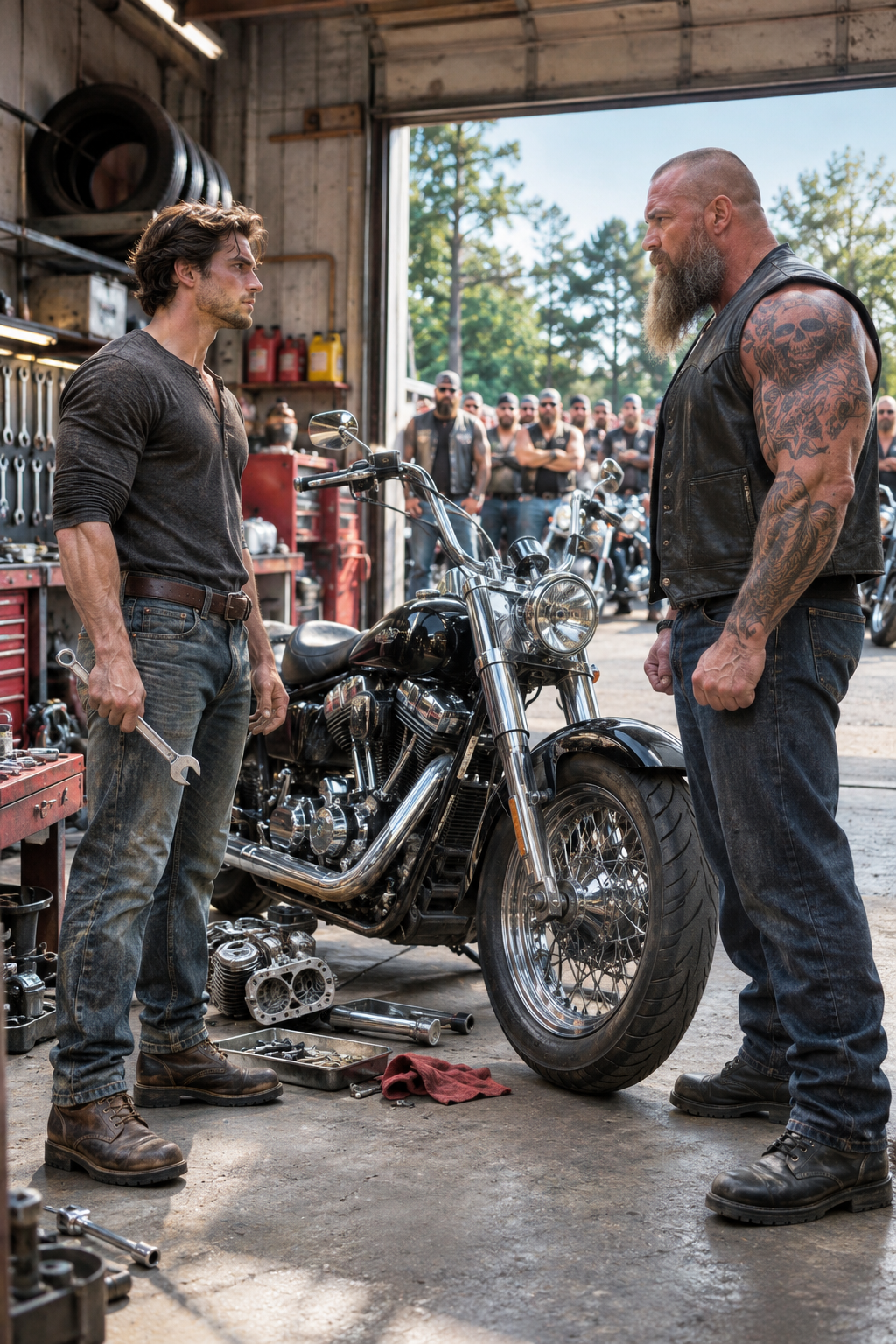
“You have seven hours to fix this motorcycle. If it isn’t running by then, I’m burning your garage to the ground.”
Frank took a deep breath.
“That motorcycle wasn’t supposed to come here. It was supposed to be the reason you never came home.”
Grip released his arm.
“Start making sense.”
“Tomorrow morning, you’re leading the memorial ride for Danny Morrison. Nearly two hundred riders are expected to follow you. Everyone knows you’ll be riding that Knucklehead.”
Grip’s expression changed.
Danny Morrison had been his closest friend for thirty years. He had died eighteen months earlier in a motorcycle accident.
Frank continued.
“Someone wanted another accident. Something that would look like mechanical failure. Nobody would question it, especially on a motorcycle that old.”
“Give me a name.”
Frank glanced nervously at the men surrounding him.
“Warren Bishop.”
The garage became completely silent.
One of the younger bikers dropped a wrench.
Caleb didn’t recognize the name, but judging by their reactions, everyone else did.
Grip stared at Frank.
“You’re accusing my own vice president?”
“I heard him talking to Victor. He promised him twenty thousand dollars when the job was finished.”
Grip slowly shook his head.
“Warren’s been riding beside me for twenty-three years.”
“And Victor has been terrified ever since he realized what he’d done.”
Frank reached inside his jacket and pulled out a folded piece of paper.
It was a repair invoice bearing the motorcycle’s identification number.
At the bottom, someone had handwritten a payment amount and Warren’s initials.
Grip studied it carefully.
“This proves nothing.”
“There’s more,” Frank said. “Victor kept records because he was afraid Warren would eventually come after him, too.”
“Where’s Victor now?”
“Missing. His wife hasn’t seen him since yesterday morning.”
Caleb felt a chill run through him.
Suddenly, the motorcycle sitting on his lift seemed like the least of his problems.
Grip turned toward his men.
“Nobody calls Warren. Nobody tells him what happened here.”
Then Caleb noticed something outside.
The dark vehicle across the street had disappeared.
“Mr. Henderson,” he said quietly, “I think we’re being watched.”
Grip walked to the window.
“Since when?”
“About three hours ago.”
Frank backed away from the entrance.
“They followed me.”
Before anyone could respond, the sound of approaching motorcycles filled the street.
Five riders pulled into the parking lot.
The man leading them was tall, broad-shouldered, and dressed in a spotless leather vest. His gray beard was neatly trimmed, and he wore a silver ring on nearly every finger.
He removed his sunglasses and smiled.
“Grip! Heard you finally found somebody willing to work on that old piece of junk.”
Nobody returned his smile.
Caleb immediately understood who he was.
Warren Bishop.
Warren entered the garage, looking from Grip to the motorcycle.
Then he noticed Frank.
For a fraction of a second, his smile disappeared.
“Frank. Didn’t expect to see you here.”
Frank said nothing.
Warren turned toward Caleb.
“So you’re the miracle mechanic?”
“I’m still working on it.”
“How old are you?”
“Nineteen.”
Warren laughed.
“Grip, you’re trusting your life to a teenager now?”
Grip folded his arms.
“Seems like trusting older men hasn’t worked out too well lately.”
Warren’s eyes narrowed.
“What does that mean?”
“It means the kid found something interesting.”
Caleb watched Warren glance toward the repaired frame.
The man’s expression remained calm, but his fingers stopped moving.
“What’d he find?”
“Some bad welding.”
“It’s an eighty-year-old motorcycle. What did you expect?”
Grip stepped closer.
“Funny thing is, those welds weren’t eighty years old.”
The two men stared at each other.
Warren finally shrugged.
“Take it up with whoever worked on it.”
“I intend to.”
Caleb could feel the tension building.
Several bikers moved closer to the entrance.
Frank looked ready to collapse.
Then Warren smiled again.
“Whatever’s bothering you, brother, we’ll discuss it tomorrow. We’ve got a memorial ride to prepare for.”
He turned toward Caleb.
“Make sure that motorcycle runs.”
After Warren and his men departed, Grip stood motionless for almost a minute.
Then he slammed his fist against the workbench.
“Twenty-three years!”
Caleb flinched.
Grip picked up the invoice again.
“I brought that man into the club. Helped him when he lost his house. Paid his hospital bills.”
Frank lowered his head.
“I’m sorry.”
Grip looked toward the motorcycle.
“Finish it, kid.”
Caleb checked the clock.
He had forty-seven minutes remaining.
He installed the fuel tank, checked the electrical connections, and completed his final inspections. Everything appeared ready.
But when he attempted to start the motorcycle, the engine refused to fire.
He tried again.
Nothing.
Grip approached the lift.
“What’s wrong?”
“I’m checking.”
Caleb examined the ignition system.
The components looked correct, but something wasn’t behaving as it should.
He removed a cover and discovered another damaged part hidden beneath it.
Someone had interfered with the motorcycle’s electrical system.
The frame wasn’t the only thing that had been tampered with.
Caleb searched his shelves for a replacement.
He found nothing.
His uncle had collected hundreds of old motorcycle components, but many remained packed away in storage boxes.
With twenty-nine minutes left, Caleb rushed into the back room.
He opened drawers, overturned containers, and searched through dusty cabinets.
Finally, beneath a pile of old service manuals, he discovered a wooden box marked with his uncle’s handwriting.
VINTAGE HARLEY PARTS — KEEP.
Inside was exactly what he needed.
But there was something else.
A faded photograph lay beneath the spare components.
Caleb picked it up.
Three young men stood beside a motorcycle outside the garage.
One was his uncle Raymond.
Another was Grip.
The third man was Warren Bishop.
Caleb turned the photograph over.
Written on the back were six words.
Some brothers aren’t brothers at all.
Caleb stared at the message.
His uncle had known these men.
And he had never mentioned them.
“Caleb!” someone shouted from the garage.
He shoved the photograph into his pocket and hurried back.
With eleven minutes remaining, he finished installing the replacement component.
Grip stood beside the motorcycle.
The entire garage watched as Caleb attempted to start it.
The engine coughed.
Then it stopped.
Caleb made a small adjustment and tried again.
A thunderous roar erupted from the exhaust.
The old Harley came alive.
Its deep, uneven rumble filled the garage, shaking the windows and rattling the tools hanging on the walls.
One of the prospects cheered.
Grip stared at the motorcycle as though he were seeing an old friend return from the dead.
Caleb let the engine run briefly before shutting it down.
“It’s running,” he said. “But nobody rides it until the frame repairs have been independently inspected.”
Grip looked at the clock.
Three minutes remained.
Then he looked at Caleb.
“You did it.”
Caleb wiped his hands.
“There’s something else.”
He handed Grip the photograph.
The biker’s face changed immediately.
“Where’d you get this?”
“My uncle’s storage room.”
“Your uncle?”
“Raymond Ward.”
Grip stared at him.
“Raymond was your uncle?”
Caleb nodded.
Grip lowered himself onto a nearby chair.
For the first time that day, the enormous man looked exhausted.
“I haven’t seen Raymond in almost fifteen years.”
“He died eight months ago.”
Grip looked up sharply.
“How?”
“Car accident. The police said he lost control on a rural road.”
Frank suddenly turned away.
Caleb noticed.
“What?”
Frank didn’t answer.
Caleb stepped toward him.
“What aren’t you telling me?”
Grip rose from his chair.
“Frank?”
The older man’s hands began trembling.
“Raymond knew things about Warren. Things Warren didn’t want anybody finding out.”
Caleb felt his heartbeat quicken.
“What kind of things?”
“Money disappearing from charity collections. Illegal deals conducted behind the club’s back. Raymond kept records.”
Grip frowned.
“Raymond left because of that argument with Warren.”
“He left because Warren threatened his family,” Frank replied.
Caleb remembered his uncle’s habit of checking the garage doors twice every night. He remembered the mysterious phone calls Raymond would never answer in front of him.
And he remembered their final conversation.
His uncle had told him that being a good mechanic meant more than fixing machines.
It meant making sure people came home alive.
“Are you saying my uncle’s death wasn’t an accident?”
Frank looked at the floor.
“I don’t know. But two days before he died, he called me. He said he finally had enough evidence to expose Warren.”
Caleb felt sick.
For eight months, he had struggled to accept Raymond’s death.
Now everything he believed about it was falling apart.
Grip placed the photograph on the workbench.
“Where would Raymond have kept those records?”
Caleb thought about his uncle’s office.
Most of the paperwork had been sorted after the funeral. There had been unpaid bills, old receipts, insurance documents, and customer records.
Nothing unusual.
Then he remembered something.
A locked metal cabinet beneath Raymond’s desk.
Caleb had never found the key.
He hurried into the office and pulled the cabinet away from the wall.
Behind it, taped beneath the desk, was a small envelope.
His name was written across the front.
CALEB.
His hands shook as he opened it.
Inside was a key and a handwritten letter.
Caleb began reading.
“If you’re reading this, something has probably happened that prevented me from explaining everything myself. I hope I’m wrong. I hope you’ll find this letter someday and laugh at your paranoid old uncle.”
Caleb stopped.
His vision blurred.
Grip waited silently behind him.
Caleb continued.
“There are people who mistake loyalty for silence. They believe being someone’s friend means protecting them even when they’re hurting others. Never become one of those people. The truth might cost you something, but a lie can cost someone else everything.”
Caleb unlocked the cabinet.
Inside were several notebooks, photographs, financial documents, and a small digital recorder.
Grip opened one of the notebooks.
Page after page contained names, dates, payments, and detailed descriptions of missing money.
Frank recognized several entries.
“This is what Victor was talking about.”
Caleb picked up the recorder.
Before he could examine it, a loud crash came from the garage.
Someone shouted.
The lights went out.
For several seconds, Caleb couldn’t see anything.
Then orange light flickered beneath the office door.
“Fire!” one of the prospects screamed.
Smoke began pouring into the hallway.
Grip grabbed Caleb’s shoulder.
“Get outside!”
“The records!”
“Bring what you can!”
Caleb stuffed the notebooks and recorder into an old canvas bag.
Grip led him toward the rear exit.
Outside, several bikers were already moving away from the building.
Flames were spreading through the front section of the garage.
Caleb watched in horror.
His uncle’s tools.
The photographs on the walls.
The workbench where Raymond had taught him to rebuild his first engine.
Everything was disappearing behind thick smoke.
Then Caleb heard a voice.
“Help!”
Frank was still inside.
Grip turned toward the building.
Without hesitation, he moved toward the rear entrance.
Caleb grabbed his arm.
“You can’t go in there!”
“Frank’s inside!”
Grip disappeared through the doorway.
Caleb stood helplessly as smoke swallowed him.
Someone called emergency services while the others shouted Frank’s name.
Seconds felt like minutes.
Finally, Grip emerged, dragging Frank toward safety.
Both men collapsed onto the pavement.
Caleb rushed forward.
Frank was coughing violently, but he was conscious.
Grip’s jacket was scorched, and his hands were burned.
In the distance, sirens approached.
Caleb looked back at the garage.
The old wooden sign above the entrance broke loose and crashed to the ground.
WARD’S MOTORCYCLE REPAIR.
Established 1987.
Caleb dropped to his knees.
He had spent eight months fighting to keep the business alive.
Now he was watching it burn.
Grip sat beside him.
Neither man spoke.
When firefighters arrived, they worked desperately to contain the flames.
The police separated everyone and began taking statements.
One of the prospects reported seeing a vehicle speed away moments before the fire started.
Caleb handed Raymond’s records to a detective.
Grip watched him do it.
“You sure about that, kid?”
Caleb looked at the burning garage.
“My uncle wanted the truth to come out.”
Grip nodded slowly.
“Then we’ll make sure it does.”
Later that night, Caleb sat outside the hospital while doctors treated Grip and Frank.
His phone rang.
An unfamiliar number appeared on the screen.
He answered.
“Caleb Ward?”
The voice sounded weak.
“Who is this?”
“Victor Crane.”
Caleb stood immediately.
“Where are you?”
“Somewhere safe. For now.”
“Warren tried to kill Grip. He burned my garage.”
Victor remained silent for several seconds.
“Listen carefully. Your uncle came to see me before he died. He wanted me to testify against Warren.”
“Did Warren kill him?”
“I can’t prove that. But Raymond recorded a conversation that Warren would’ve done anything to destroy.”
Caleb remembered the recorder.
“The police have it.”
Victor exhaled.
“Good. Then maybe there’s finally a chance.”
“Why did you damage the motorcycle?”
Victor’s voice cracked.
“Warren threatened my daughter. I was scared. I told myself I didn’t have a choice.”
“You could’ve warned somebody.”
“I know.”
Caleb tightened his grip on the phone.
“You almost killed a man.”
“I know that, too.”
Victor began crying.
“I’m tired of being afraid.”
Caleb told him to contact the detective handling the investigation and offered to pass along his number.
Victor agreed.
The following morning, the memorial ride was canceled.
By noon, news of the garage fire had spread throughout the Central Valley.
Customers arrived at the ruined property carrying photographs of motorcycles Raymond had repaired over the years.
An elderly woman brought coffee.
A farmer offered temporary storage space.
A retired mechanic volunteered his tools.
Caleb appreciated every gesture, but he couldn’t imagine starting over.
The insurance coverage was limited.
His savings were almost gone.
And the garage was beyond repair.
Then, shortly after sunset, motorcycles began arriving.
Grip led the group in a borrowed pickup truck, his hands wrapped in bandages.
Behind him were dozens of riders.
They carried lumber, toolboxes, equipment, and envelopes.
Caleb stared at them.
“What is all this?”
Grip stepped out of the truck.
“People who owe your uncle more than they ever realized.”
An older biker approached Caleb.
“Raymond fixed my motorcycle for free when my wife was dying. Said I needed the money for her medicine.”
Another man stepped forward.
“He gave me work when nobody else would hire me.”
A third pointed toward the ruined building.
“I learned how to rebuild engines right there.”
Caleb listened as strangers told stories about the man who had raised him.
Stories Raymond had never told.
Grip handed Caleb an envelope.
Inside were donations collected from riders and local businesses.
Caleb looked up.
“I can’t take this.”
“It’s not charity,” Grip replied. “It’s people paying back a debt.”
Before Caleb could respond, another vehicle entered the property.
A police detective stepped out.
“We’ve located Victor Crane,” she announced. “He’s cooperating with investigators.”
Grip approached her.
“And Warren?”
“We have him in custody.”
Caleb felt his chest tighten.
The detective explained that Raymond’s records, Victor’s testimony, and additional evidence had provided grounds for several serious criminal charges.
The garage fire was also being investigated as a deliberate attack.
Then she turned toward Caleb.
“We’re reopening your uncle’s case.”
Caleb closed his eyes.
He had waited eight months for someone to tell him that Raymond’s death deserved another look.
Now, standing among the ashes of everything he owned, he finally heard those words.
Months passed.
Warren Bishop was eventually convicted on multiple charges connected to the conspiracy against Grip, financial crimes, and the destruction of Caleb’s garage.
The renewed investigation into Raymond’s death uncovered evidence linking Warren to the fatal accident.
Additional charges followed.
Victor testified in court and accepted responsibility for his involvement.
Frank survived the fire and slowly recovered.
Grip visited him regularly.
Meanwhile, Caleb worked harder than he ever had.
With help from the community, the garage was rebuilt.
The new building was larger, brighter, and equipped with better machinery.
Above its entrance hung the original sign, rescued from the wreckage and carefully restored.
WARD’S MOTORCYCLE REPAIR.
Established 1987.
Rebuilt by the people it served.
On opening day, Caleb stood outside wearing his uncle’s old work shirt.
Hundreds of people gathered in the parking lot.
Among them were families, farmers, mechanics, veterans, and motorcycle riders.
Grip arrived on the restored 1947 Knucklehead, which had survived the fire after being moved outside before the flames spread.
Its frame had since passed a professional inspection.
He parked in front of Caleb.
The old engine sounded beautiful.
Grip removed his helmet.
“Got something for you.”
He handed Caleb a small wooden plaque.
Engraved on it were the words:
A GOOD MECHANIC FIXES MACHINES.
A GREAT ONE SAVES LIVES.
Caleb smiled, fighting back tears.
Grip looked toward the rebuilt garage.
“There’s something I’ve been meaning to say.”
“What?”
“The first time I came here, I threatened to burn your shop down.”
Caleb nodded.
“I remember.”
“I thought being feared meant being respected. Took a nineteen-year-old kid to show me the difference.”
Grip extended his hand.
“I’m sorry.”
Caleb shook it.
“Just don’t bring me another motorcycle with a seven-hour deadline.”
Grip laughed.
“Fair enough.”
Later that afternoon, after most of the visitors had left, a teenage boy approached the garage pushing a broken motorcycle.
His clothes were dirty, and one of his shoes had a hole in it.
“Sir,” the boy said nervously, “how much would it cost to fix this?”
Caleb examined the motorcycle.
“Depends. What’s wrong with it?”
“It won’t start. I need it to get to work. I don’t have much money, though.”
Caleb looked toward the photograph of Raymond hanging above his workbench.
He remembered being fourteen years old, standing in that same garage, feeling useless and uncertain about his future.
His uncle had handed him a wrench and told him that everybody deserved a chance to become something better.
Caleb turned back toward the boy.
“Tell you what. I’ll fix it if you help me.”
The boy looked confused.
“You mean work here?”
“If you’re willing to learn.”
For the first time, the teenager smiled.
Caleb handed him a clean pair of gloves.
“Come on. Let’s see what we’re dealing with.”
Outside, Grip watched through the garage window.
He smiled quietly before climbing onto his motorcycle.
Years later, people throughout the Central Valley would still tell the story of the nineteen-year-old mechanic who had been given seven hours to repair an impossible motorcycle.
Some remembered the betrayal.
Others remembered the fire.
But those who knew Caleb understood that the most important part of his story wasn’t how quickly he repaired the Harley.
It was the choice he made when telling the truth could have cost him everything.
Caleb had lost his garage, uncovered a painful secret about his uncle, and faced men who believed fear could purchase silence.
Yet he refused to become like them.
He discovered that courage wasn’t the absence of fear. It was doing what was right even when fear gave you every reason to walk away.
And although Raymond never lived to see the garage rebuilt, his greatest legacy survived.
It lived in every honest repair, every struggling customer Caleb helped, and every young person he taught to work with integrity.
The motorcycle had been repaired in seven hours.
The damage caused by years of betrayal took much longer to heal.
But Caleb learned that broken things could be rebuilt, lost trust could sometimes be restored, and even the darkest chapter of a person’s life could become the beginning of something meaningful.
All it took was someone brave enough to stop hiding the cracks and start repairing what was underneath.
Three years later, on a cold November morning, Caleb arrived at the garage to find a woman standing beneath the restored wooden sign.
She was holding a photograph in one hand and a motorcycle helmet in the other.
“Are you Caleb Ward?” she asked.
“Yes. How can I help you?”
The woman studied his face.
“My name is Emily Morrison. Danny Morrison was my father.”
Caleb immediately recognized the name.
Danny had been Grip’s closest friend, the man whose memorial ride had nearly become another tragedy.
“I’m sorry about your father,” Caleb said.
Emily handed him the photograph.
It showed Danny standing beside a blue Harley-Davidson, smiling with his arm around a little girl.
“I was twelve when that picture was taken. My father promised he’d teach me to ride someday.”
She paused.
“He never got the chance.”
Caleb invited her inside.
The garage had changed considerably over the past three years. Six mechanics now worked beneath its roof, including Noah, the teenage boy Caleb had once helped without asking for payment.
Noah had become one of his most talented employees.
Emily looked around before placing a thick envelope on Caleb’s desk.
“I received this last week. There was no return address.”
Inside were several photographs of her father’s motorcycle after his fatal accident, along with a handwritten note.
Caleb read it twice.
Your father’s death deserves the same investigation Raymond Ward received. Ask Henderson what happened the night before Danny died.
Caleb looked up.
“Have you spoken to Grip?”
“Three times. He won’t return my calls.”
That surprised him.
Grip had spent the previous three years distancing himself from the people and habits that had nearly destroyed his life. He regularly visited the garage and helped organize fundraising events for struggling families.
But whenever Danny’s name came up, he became unusually quiet.
“There’s something else,” Emily said.
She removed a small photograph from the envelope.
It showed Danny’s motorcycle parked outside Victor Crane’s former repair shop.
The date printed in the corner was two days before Danny’s death.
Caleb felt the familiar sensation of something tightening inside his chest.
“Where’s the motorcycle now?”
“In a storage unit. My mother couldn’t bring herself to sell it.”
“Can you bring it here?”
Emily nodded.
“That’s why I came.”
Two hours later, a trailer arrived carrying the remains of Danny Morrison’s Harley.
The front wheel was twisted, the fuel tank badly dented, and the handlebars bent almost beyond recognition.
Caleb approached it carefully.
For three years, he had hoped never to encounter another motorcycle carrying such a terrible secret.
Noah helped him position it beneath the inspection lights.
“Do you think somebody messed with this one, too?” Noah asked.
“I don’t know yet.”
Caleb spent the next several hours examining the damaged machine.
Most of the destruction was consistent with a serious collision.
But something beneath the layers of rust and dirt caught his attention.
He called Noah over.
“Look at this.”
Noah leaned closer.
“That doesn’t look original.”
“No, it doesn’t.”
Caleb documented the suspicious damage without disturbing it further.
He knew better than to draw conclusions before a qualified investigator examined the evidence.
Then he called Grip.
The biker answered on the fourth ring.
“What’s happening, kid?”
“Emily Morrison came to see me.”
Silence.
“She brought Danny’s motorcycle.”
Grip’s breathing changed.
“Caleb, leave that motorcycle alone.”
“Why?”
“Some things are better left buried.”
Caleb stared at the photograph of Raymond above his workbench.
“You know I don’t believe that.”
Grip hung up.
Twenty minutes later, the familiar sound of the Knucklehead approached the garage.
Grip walked inside without removing his gloves.
When he saw Danny’s motorcycle, he stopped.
For a moment, Caleb thought the older man might turn around and leave.
Instead, Grip walked toward it and gently touched the damaged fuel tank.
“I helped him paint this,” he whispered.
Emily stepped out of the office.
“Why haven’t you answered my calls?”
Grip lowered his head.
“Because I didn’t know what to tell you.”
“Try the truth.”
The words struck him harder than any accusation could have.
Grip pulled a chair toward the workbench and sat down.
“The night before your father died, he came to my house. He told me Warren was stealing money from the club’s charity fund.”
Emily listened without moving.
“He wanted me to help expose him. I told him he was imagining things.”
“Why?”
“Because Warren was my friend. And admitting Danny was right would’ve meant admitting I’d been wrong about someone for years.”
Grip rubbed his face.
“We argued. Danny called me a coward. I told him to get out.”
His voice began to break.
“The next morning, I got the phone call.”
Emily’s eyes filled with tears.
“You knew my father was investigating Warren?”
“Yes.”
“And you never told the police?”
“No.”
“Not even after what happened to Caleb’s uncle?”
Grip shook his head.
“I convinced myself Danny’s accident was unrelated. I wanted to believe it.”
Emily stepped backward.
“You let my mother spend years thinking my father had been careless.”
“Emily—”
“Don’t.”
She turned and walked outside.
Grip remained seated, staring at the ruined motorcycle.
Caleb stood beside him.
“You need to make a statement.”
Grip nodded.
“I know.”
“And you need to tell them everything. Even the things that make you look bad.”
The older man looked at him.
“Raymond would’ve said the same thing.”
“Then you should’ve listened to him.”
That evening, Grip contacted the detective who had investigated Warren Bishop.
He spent nearly four hours answering questions.
Danny’s motorcycle was transferred to an independent forensic examination facility, and the authorities began reviewing the original accident records.
For the first time in years, Emily had reason to believe she might receive answers.
But someone else was paying attention.
Two days later, Caleb arrived at work to find a brick lying beneath his shattered office window.
Wrapped around it was a piece of paper.
BISHOP WAS ONLY THE BEGINNING.
Noah discovered Caleb standing beside the broken glass.
“Should we close?”
Caleb considered the question.
Three years earlier, he would have been terrified of losing everything again.
He was still afraid.
But now he had employees whose safety depended on his decisions.
“Everybody goes home until the police finish here,” he said.
Noah frowned.
“What about the customers?”
“They can wait.”
Caleb photographed the damage and contacted the authorities.
By midday, the garage was surrounded by investigators.
Detective Laura Bennett, the woman who had handled Raymond’s case, arrived shortly afterward.
She examined the note.
“Warren has been in prison for three years,” Caleb said. “Who’s doing this?”
“That’s what we need to find out.”
“Could he still be giving orders?”
“It’s possible. But don’t assume anything.”
She looked toward the broken window.
“Whoever sent this wants you frightened. Take that seriously.”
That afternoon, Caleb received a telephone call from Victor Crane.
Victor had served time for his involvement in the conspiracy against Grip and was now working under supervision at a small agricultural equipment shop.
“I heard about Danny’s motorcycle,” Victor said.
“How?”
“Frank called me.”
Caleb waited.
“There’s a man you need to know about,” Victor continued. “His name is Leonard Voss.”
“Who is he?”
“Warren’s business partner. He financed several of Warren’s operations. Most people never knew he existed.”
“Was he involved in Danny’s death?”
“I don’t know. But Danny discovered something that frightened both of them.”
Caleb immediately passed the information to Detective Bennett.
Over the following week, investigators uncovered financial connections between Warren Bishop and several companies controlled by Voss.
One company had received substantial payments from funds originally intended for charitable organizations.
Another had purchased property shortly after Danny’s death.
The investigation was growing larger than anyone had expected.
Then Emily disappeared.
Her mother called Caleb shortly before midnight.
“She was supposed to come home three hours ago. She’s not answering her phone.”
Caleb contacted Detective Bennett immediately.
Emily’s abandoned car was discovered the following morning outside a closed roadside diner.
Her handbag remained inside.
There was no sign of Emily.
When Grip heard the news, he became furious.
“I’m finding Voss.”
Caleb blocked his path.
“And then what?”
“I’ll make him tell me where she is.”
“You don’t even know whether he’s responsible.”
Grip clenched his fists.
“That’s Danny’s daughter!”
“Exactly. Don’t make another decision you’ll regret for the rest of your life.”
Grip stared at Caleb.
The anger slowly drained from his face.
He sat down.
“I can’t lose her, too.”
“Then help the police find her.”
Several hours later, investigators received information from a witness who had seen Emily being forced into another vehicle.
The authorities traced the vehicle to a property associated with one of Voss’s companies.
Caleb and Grip waited at the garage while officers carried out the rescue operation.
Neither man could concentrate on anything.
Noah brought them coffee that remained untouched.
Finally, Caleb’s phone rang.
It was Detective Bennett.
“We found her.”
Caleb stood so quickly that his chair fell backward.
“Is she alive?”
“Yes. She’s frightened and injured, but she’s alive.”
Grip covered his face with both hands.
For the first time since Caleb had known him, he openly wept.
Leonard Voss was arrested that evening.
Several other individuals were taken into custody during the investigation.
Emily was transported to a hospital, where she was reunited with her mother.
Grip waited outside her room for nearly two hours before a nurse told him Emily wanted to see him.
He entered slowly.
Emily had bruises on her face and a bandage around her wrist.
Grip stopped beside her bed.
“I’m sorry,” he said.
She looked at him.
“I know.”
“I should’ve believed your father. I should’ve stood beside him.”
Emily reached for his hand.
“You can’t change what happened.”
Grip nodded.
“But you can stop running from it,” she continued.
He squeezed her hand gently.
“I promise.”
The investigation lasted another eleven months.
Financial records, witness testimony, and newly examined evidence revealed that Danny Morrison had uncovered a criminal operation involving Warren and Voss.
His death had not been an ordinary motorcycle accident.
The truth devastated Emily’s family, but it also relieved them of the questions that had haunted them for years.
Voss was convicted of serious crimes, including his involvement in the conspiracy and Emily’s abduction.
Additional convictions followed for several of his associates.
Warren faced further prosecution.
When the final verdict was announced, Caleb sat beside Emily and Grip in the courtroom.
Nobody celebrated.
There was no victory that could bring Danny or Raymond back.
But there was finally accountability.
Outside the courthouse, reporters surrounded them.
One asked Caleb whether he considered himself a hero.
Caleb shook his head.
“I repair motorcycles. The people who testified despite being afraid deserve recognition. So do the investigators who refused to give up.”
Another reporter asked what motivated him to become involved.
Caleb thought for a moment.
“Someone once taught me that ignoring a dangerous problem doesn’t make it disappear.”
He looked toward Emily.
“Sometimes it just means somebody else pays the price.”
Six months later, Caleb invited Emily to the garage.
When she arrived, the main workshop was unusually quiet.
Noah stood beside a motorcycle covered with a white sheet.
Grip waited nearby.
“What’s going on?” Emily asked.
Caleb smiled.
“Something we thought you should see.”
He removed the sheet.
Beneath it stood a beautifully restored blue Harley-Davidson.
Emily immediately recognized the fuel tank.
Her father’s motorcycle.
She covered her mouth.
The damaged machine had been released after the investigation, and Emily had given Caleb permission to restore whatever could safely be preserved.
He and his mechanics had spent months rebuilding it, replacing unsafe components and preserving the original details wherever possible.
Even the small scratch Danny had accidentally made while painting the tank remained visible.
Emily walked around the motorcycle slowly.
“I don’t know what to say.”
Grip handed her a helmet.
“Your father wanted to teach you how to ride.”
Emily looked at him.
“I remember.”
“If you’ll let me, I’d like to help you learn.”
She smiled through her tears.
“I’d like that.”
Over the following months, Emily completed professional motorcycle training.
Grip helped her practice and gradually became part of her life again.
Their relationship wasn’t perfect.
There were difficult conversations, painful memories, and moments when Emily still struggled to forgive him.
But Grip never demanded forgiveness.
He understood that trust wasn’t something he could recover through promises alone.
He had to earn it through his actions.
On the anniversary of Danny’s death, Emily organized a memorial ride dedicated to both Danny Morrison and Raymond Ward.
The event raised money for vocational training scholarships for young people who couldn’t afford technical education.
More than three hundred riders attended.
Caleb watched from the garage entrance as Emily started her father’s restored Harley.
Grip rode beside her on the old Knucklehead.
Before leaving, Emily looked toward Caleb.
“You coming?”
Caleb smiled.
“Wouldn’t miss it.”
He climbed onto a motorcycle Raymond had begun restoring years before his death.
Noah had helped him finish it.
As the riders departed, the sound of their engines echoed across the valley.
For Caleb, it was more than a memorial.
It was proof that something good could grow from even the most painful circumstances.
Ten years later, Ward’s Motorcycle Repair had become one of the most respected independent restoration shops in California.
Caleb established a training program that offered apprenticeships to teenagers from disadvantaged backgrounds.
Noah became his business partner.
Emily managed the scholarship foundation.
And Grip, now an elderly man with silver hair and aching joints, visited almost every Saturday.
One morning, he arrived carrying the keys to his Knucklehead.
He placed them on Caleb’s desk.
“She’s yours.”
Caleb looked at him in disbelief.
“What?”
“I’m getting too old to ride her safely.”
“Grip, this motorcycle means everything to you.”
The older man smiled.
“Not everything.”
He glanced around the workshop, watching the young apprentices learning their trade.
“Things change when you get older. You start realizing what actually matters.”
Caleb picked up the keys.
“I’ll take care of her.”
“I know you will.”
Grip walked toward the door, then stopped.
“You remember what I said the first time I walked into this place?”
Caleb laughed.
“Seven hours.”
Grip smiled.
“Worst introduction I ever made.”
“Probably.”
The old biker looked at Raymond’s photograph.
“Your uncle would’ve been proud of you.”
Caleb swallowed hard.
“Thank you.”
Grip passed away peacefully the following winter.
At his funeral, Emily spoke about a man who had made terrible mistakes but had spent his remaining years trying to become someone better.
Caleb listened quietly.
He knew Grip’s transformation didn’t erase the harm he had caused.
But it demonstrated that people could accept responsibility, change their behavior, and spend the rest of their lives doing something worthwhile.
After the funeral, Caleb returned to the garage.
He placed a photograph of Grip beside Raymond’s picture.
Beneath both photographs stood the wooden plaque Grip had given him years earlier.
A GOOD MECHANIC FIXES MACHINES.
A GREAT ONE SAVES LIVES.
Just before closing, a young apprentice approached him.
“Mr. Ward, can I ask you something?”
“Of course.”
“Why do you always spend so much time checking things nobody else can see?”
Caleb looked toward the old Knucklehead resting beneath the workshop lights.
“Because the things nobody sees are often the things that matter most.”
The apprentice considered his answer.
“Even if the customer never knows?”
“Especially then.”
Caleb handed him an inspection light and returned to the motorcycle they had been working on.
Outside, the sun disappeared behind the mountains, casting a golden glow across the restored garage sign.
Many years had passed since a threatening stranger had walked through those doors and given a frightened nineteen-year-old mechanic seven hours to save his business.
Caleb had believed that day would determine whether he had a future.
He never imagined it would shape the futures of so many other people.
He had learned that justice required courage, forgiveness required accountability, and loyalty without honesty could become a dangerous thing.
Most importantly, he understood that the true measure of a person’s life wasn’t the wealth they accumulated, the power they possessed, or the fear they inspired.
It was the number of lives they left better than they found them.
Raymond had taught him that lesson.
Grip had learned it the hard way.
And now Caleb would spend the rest of his life passing it on.
Because motorcycles could carry people thousands of miles, but kindness, integrity, and courage could travel much farther.
They could survive long after the hands that first offered them were gone.
On the twentieth anniversary of the garage fire, Caleb received a package that had been delivered without a return address.
Inside was an old leather wallet, a brass key, and a sealed letter.
He recognized the handwriting immediately.
It belonged to Grip.
Caleb sat down at his desk and carefully opened the envelope.
“Caleb, if you’re reading this, I’ve probably been gone for a while. There is one last thing I never found the courage to tell you.”
Caleb stopped reading for a moment.
Even after all these years, he could almost hear the old biker’s rough voice.
“Your uncle Raymond saved my life long before you did. I was twenty-seven, angry at the world, and convinced that violence could solve every problem. One night, after making some terrible decisions, I ended up outside his garage with nowhere to go.”
“He could have turned me away. Instead, he gave me food, a place to sleep, and work until I could stand on my own feet.”
“I promised him I would never forget what he had done for me. But somewhere along the way, I became exactly the kind of man he had warned me against.”
“When I threatened your garage that afternoon, I didn’t know whose shop it was. Finding out that you were Raymond’s nephew made me ashamed of the person I had become.”
“You gave me another chance without even realizing it.”
Caleb wiped his eyes and continued reading.
“The key belongs to a building outside Fresno. I bought it several years ago. Everything has been arranged through my attorney. I want you to use it for something better than anything I ever accomplished.”
“Don’t name it after me. Name it after the man who started all of this.”
“Thank you for showing an old fool that it was never too late to change.”
“Your friend, Silus.”
Caleb remained in his office long after everyone else had gone home.
The following morning, he contacted Grip’s attorney and learned that the building was a former automotive training center that had been closed for nearly a decade.
Grip had purchased the property and established a fund to support its renovation.
Caleb drove there with Noah and Emily.
The building was covered in dust, several windows were broken, and weeds had grown through the parking lot.
But inside were spacious classrooms, abandoned workstations, and enough room to accommodate dozens of students.
Noah walked through the main workshop.
“We could teach more than motorcycle repair here.”
“Automotive mechanics, welding, electrical systems,” Emily added.
Caleb looked around.
“And we could give kids somewhere to go when they think they’ve run out of options.”
Over the next eighteen months, the three of them worked to transform the abandoned building.
Local businesses donated equipment. Retired mechanics volunteered as instructors. Former apprentices returned to help renovate classrooms.
People who had once received help from Raymond contributed whatever they could.
Finally, on a bright spring morning, the Raymond Ward Technical Training Center opened its doors.
Its first group consisted of thirty-two students.
Some came from foster homes. Others had dropped out of school or struggled to find employment. Several had made mistakes that threatened to define the rest of their lives.
Among them was a seventeen-year-old named Lucas.
He rarely spoke, avoided eye contact, and became angry whenever someone corrected him.
During his second week, he accidentally damaged an expensive engine component.
Terrified of being expelled, Lucas hid the broken part and blamed another student.
Caleb discovered what had happened.
He called Lucas into his office.
The teenager stood beside the door, refusing to sit down.
“Just tell me I’m kicked out,” Lucas muttered.
“Is that what you want?”
“Doesn’t matter. Everybody gives up on me eventually.”
Caleb studied him.
For a moment, he saw something familiar in the boy’s expression.
It was the same fear he had seen in Victor Crane, the same anger that had once controlled Grip, and the same uncertainty he had experienced after losing Raymond.
“Breaking something doesn’t make you a bad mechanic,” Caleb said.
Lucas looked up.
“But hiding the damage could make you a dangerous one.”
Caleb placed the broken component on his desk.
“You’re going to replace this. You’re going to apologize to the student you blamed. And tomorrow morning, you’re going to come back here and continue learning.”
Lucas stared at him.
“You’re not throwing me out?”
“No. But I’m expecting you to do better.”
The teenager’s expression slowly changed.
Nobody had ever spoken to him that way before.
Over the following months, Lucas became one of the hardest-working students in the program.
He still made mistakes, but he stopped hiding them.
When he graduated, Caleb helped him secure a position at a respected repair shop.
Years later, Lucas returned as an instructor.
He often told his students about the day a mechanic had given him something more valuable than forgiveness.
He had given him responsibility and another chance.
As the training center grew, Caleb gradually stepped away from the daily operations of his garage.
Noah managed the business, while Emily expanded the scholarship foundation throughout California.
Thousands of young people eventually benefited from the programs that had begun with one man’s decision to help a frightened teenager.
Caleb never became particularly wealthy.
He turned down several offers to sell the garage to national companies, preferring to keep it independent.
He still worked on motorcycles whenever his schedule allowed.
And every year, on the anniversary of Raymond’s death, he took Grip’s old Knucklehead out for a ride.
One autumn afternoon, many decades after that unforgettable seven-hour deadline, Caleb returned from his final ride.
His hair had turned white, his hands were stiff, and his eyesight was no longer what it used to be.
He parked the motorcycle inside the original garage and switched off the engine.
Noah, who was preparing for retirement himself, walked over.
“How was it?”
Caleb smiled.
“Still runs beautifully.”
“You thinking about riding again next year?”
Caleb looked at the motorcycle.
“No. I think she’s carried me far enough.”
Together, they moved the Knucklehead to a permanent display inside the training center.
Beside it, they placed the original repair invoice, photographs of Raymond and Grip, and a short account of what had happened all those years earlier.
Caleb insisted that the story include his fear, Grip’s threats, Victor’s mistakes, and the consequences of Warren’s betrayal.
He didn’t want visitors to believe that the people involved had been perfect.
He wanted them to understand that every meaningful change had begun with a difficult choice.
Several months later, Caleb passed away peacefully at home, surrounded by the people he loved.
His funeral brought together generations of mechanics, former students, customers, and families.
Emily, now an elderly woman herself, stood before the gathering.
“Caleb spent his life repairing things that other people thought were beyond saving,” she said.
“Sometimes those things had engines. Sometimes they had broken hearts, difficult pasts, or futures they couldn’t imagine.”
She looked toward the young mechanics standing together.
“He never promised that doing the right thing would be easy. He simply showed us that it was worth doing.”
After the funeral, the training center remained open.
Engines continued to roar inside its workshops. Students continued to make mistakes, learn new skills, and discover abilities they never knew they possessed.
Above the entrance hung a simple wooden sign bearing a sentence taken from Raymond’s original letter.
THE TRUTH MIGHT COST YOU SOMETHING, BUT A LIE CAN COST SOMEONE ELSE EVERYTHING.
One morning, a young student stopped beside the old Knucklehead.
He read the story displayed beneath it and turned toward his instructor.
“Did all of this really start because somebody brought in a broken motorcycle?”
Lucas, now the director of the training center, smiled.
“Not exactly.”
The student looked confused.
“Then how did it start?”
Lucas glanced at the photographs of Raymond, Grip, and Caleb.
“It started because someone decided that another person’s life was more important than his own fear.”
The student looked at the motorcycle again.
For the first time, he understood why an old machine occupied the most important place in the building.
It represented a choice that had changed countless lives.
Caleb Ward had been given seven hours to repair a motorcycle.
Instead, he had spent a lifetime repairing the damage that fear, dishonesty, and cruelty had left behind.
He had proven that strength did not require intimidation, that kindness was not weakness, and that a person’s past did not have to determine their future.
The garage that someone had once threatened to destroy became the foundation upon which thousands of people rebuilt their lives.
And long after Caleb was gone, his legacy continued through every student who chose honesty over convenience, compassion over judgment, and courage over silence.
The greatest things we leave behind are rarely the things we own.
They are the people we help become better than they believed they could be.
That was Raymond’s legacy.
That was Caleb’s greatest achievement.
And that was how seven hours changed generations.
THE END.