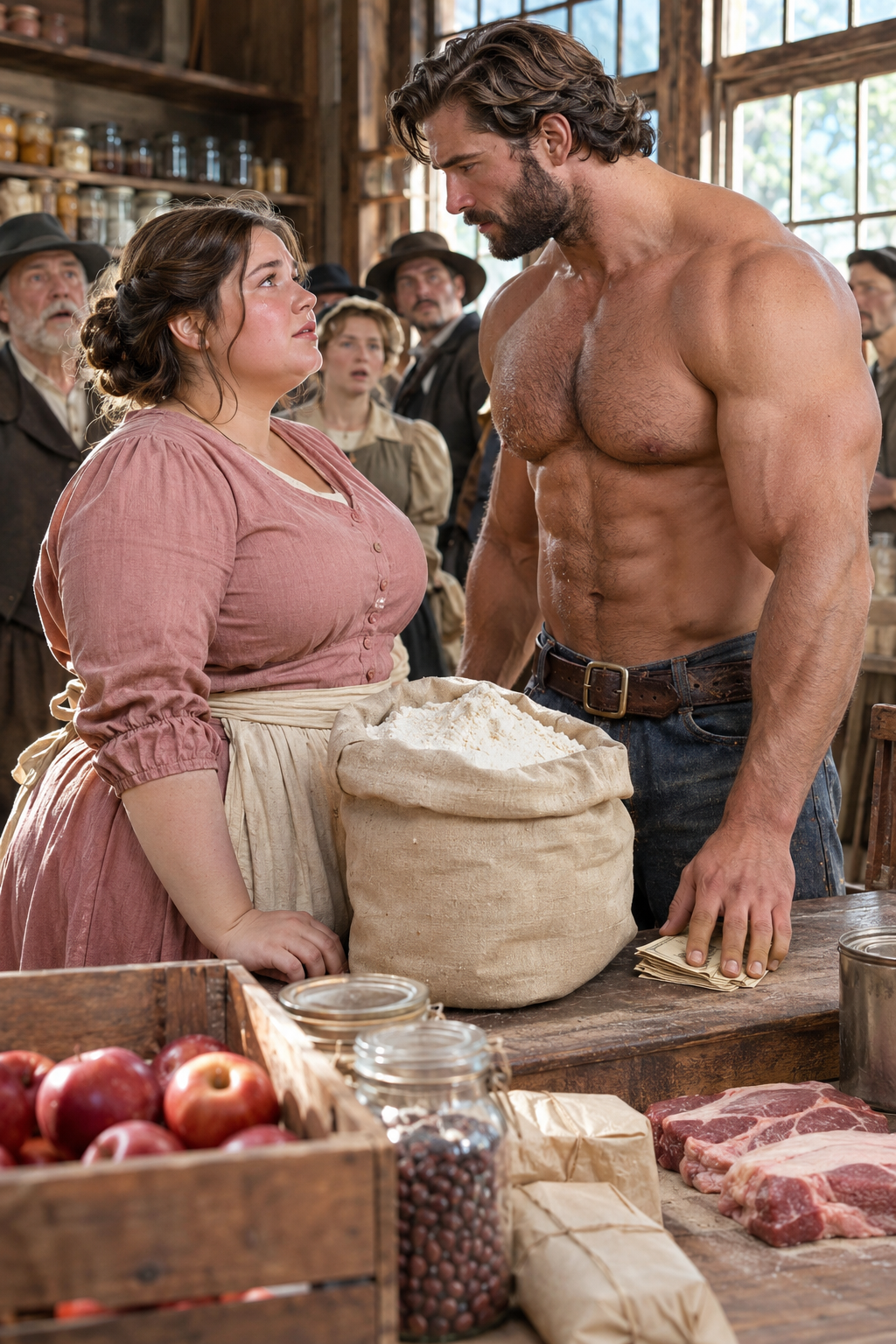
“You can have my daughter’s labor for the entire winter,” Margaret Whitaker told the storekeeper. “Just give me enough flour to keep my youngest alive.”
“Caleb Dawson,” Ethan answered. “My foreman. He’s been managing the feed supplies for nearly six years.”
Sarah looked down at the discolored grain in her palm. “Then you need to stop him from feeding the horses until we understand what’s happening.”
Ethan didn’t argue. He walked straight to the barn entrance and called for every ranch hand to stop what they were doing.
Within minutes, the men gathered around him. Among them was Caleb Dawson, a tall, narrow-faced man with gray hair and a leather vest.
“What seems to be the trouble?” Caleb asked.
Ethan pointed toward the open grain sacks.
“Sarah found something wrong with the feed.”
Caleb glanced at her before letting out a short laugh.
“She’s been here half a day, Ethan. I’ve been feeding horses since before she could walk.”
“Then perhaps you can explain this,” Sarah said, holding out the spoiled grain.
Caleb barely looked at it.
“Moisture gets into sacks sometimes. Nothing unusual about that.”
“Then why is the grain on top perfectly dry?”
His smile disappeared.
“Are you questioning how I do my job?”
“I’m trying to understand why the horses are dying.”
The other ranch hands exchanged uncomfortable looks. Nobody had ever seen anyone challenge Caleb so openly, especially a young woman who had arrived that morning.
Ethan stepped between them.
“Until we know what’s wrong, nobody touches these sacks. Bring fresh hay from the western storage shed.”
Caleb’s jaw tightened.
“You’re taking her word over mine?”
“I’m taking the condition of my horses seriously.”
Caleb walked away without another word.
Sarah watched him disappear behind the barn. Something about his reaction bothered her more than the spoiled grain itself.
That evening, she examined every sick horse. Some refused to eat. Others trembled despite the warmth of their stalls. One young gelding could barely stand.
Sarah worked until her fingers became stiff from the cold. She brought clean water, changed bedding, and stayed beside the weakest animals.
Near midnight, Ethan entered carrying two bowls of hot stew.
“You missed supper.”
“I wasn’t hungry.”
“Your stomach might disagree.”
She smiled faintly and accepted the bowl. It was the first meal in weeks she could eat without worrying whether Annie had enough.
Ethan sat on an overturned bucket.
“How many do you think we can save?”
Sarah lowered her spoon.
“I don’t know. But we need a veterinarian.”
“I sent a rider into town. He should return tomorrow.”
For a while, they ate in silence. Then Sarah asked a question she had been considering all evening.
“Have you always trusted Caleb?”
“With my ranch, my money, and sometimes my life.”
“Has anything changed recently?”
Ethan thought for a moment.
“He’s been worried about money. His wife was sick before she passed last spring. Beyond that, nothing I know of.”
Sarah didn’t want to accuse a grieving man without proof. Poverty could make people desperate. She understood that better than most.
But desperation didn’t explain everything.
The following morning, she returned to the storage room and discovered something that made her blood run cold.
Three of the suspicious grain sacks were missing.
She immediately found Ethan near the corral.
“Someone moved the feed.”
His expression darkened.
“I gave orders that nothing was to be touched.”
They questioned the ranch hands. Most denied entering the storage room, but a young worker named Tommy finally admitted seeing Caleb there before sunrise.
“He told me the sacks were damaged,” Tommy said nervously. “Said he was taking them away.”
“Where?” Ethan demanded.
“I don’t know, sir.”
They found Caleb repairing a fence near the northern pasture.
Ethan confronted him about the missing sacks.
“I disposed of them,” Caleb replied. “Didn’t see much sense keeping rotten feed around.”
“After I specifically told you not to touch them?”
Caleb dropped his hammer.
“You’re making a mistake trusting that girl. People in town are already talking about her.”
Sarah felt her cheeks grow hot.
“What are they saying?”
“That her mother sold her to you. That she’s earning her keep in ways that have nothing to do with horses.”
Ethan took one step forward.
“Say another word like that, and you’ll be looking for work elsewhere.”
Caleb raised his hands, but the look he gave Sarah was filled with resentment.
Later that morning, Dr. Samuel Bennett, the veterinarian, arrived. He examined the horses and inspected the remaining grain.
His conclusion was troubling.
“This feed is badly spoiled. It could certainly explain some of their symptoms. But I can’t tell you whether it’s the only cause without further examination.”
He recommended removing every questionable sack and carefully monitoring the sick animals.
Then he asked how long the ranch had been purchasing grain from its current supplier.
“Years,” Ethan answered. “Briggs handles our orders.”
Sarah froze.
“Mr. Briggs? From the general store?”
Ethan nodded.
Suddenly, she remembered something from the morning her mother had tried to bargain away her winter labor.
Behind the counter, she had noticed several grain sacks with dark stains near their bottoms. Briggs had quickly ordered his assistant to move them into the back room.
At the time, she had thought nothing of it.
Now the memory seemed important.
“Could we look at the purchase records?” she asked.
Ethan took her into his office, where account books filled an entire shelf.
For nearly two hours, they examined receipts. Sarah had learned basic reading and arithmetic from her father before he died, and she carefully compared the quantities and prices.
Then she noticed a strange pattern.
The ranch had been paying premium prices for high-quality grain, but several delivery receipts carried different product markings.
“Look at these,” she said.
Ethan leaned over her shoulder.
The same discrepancy appeared repeatedly, beginning almost four months earlier.
Every receipt had been signed by Caleb.
Ethan closed the account book slowly.
“Either Briggs has been cheating me, or Caleb knows something he hasn’t told me.”
“Maybe both,” Sarah whispered.
Before they could investigate further, a wagon arrived outside the ranch house.
Sarah recognized her mother immediately.
Margaret climbed down, holding Annie’s hand. The little girl ran toward Sarah and wrapped her arms around her waist.
“Sarah! Mama said you weren’t coming home!”
Sarah knelt and hugged her tightly.
“Of course I’ll come home to see you.”
But Margaret hadn’t come for a visit.
She demanded to speak with Ethan about Sarah’s wages.
“She’s my daughter,” Margaret insisted. “Her earnings should come to me. We have expenses.”
Ethan remained calm.
“Sarah works here. Sarah receives her wages.”
Margaret turned toward her daughter.
“After everything I’ve done for you, you’re going to keep that money for yourself?”
Sarah looked at Annie’s thin face.
The familiar guilt returned. For years, every decision she made had been shaped by the fear that her sister might go hungry.
“I’ll help you, Mama,” she said. “But I need to keep some of what I earn.”
Margaret stared at her as though she had committed a terrible betrayal.
“Who put those ideas into your head?”
“Nobody.”
“Then you’ve forgotten where you came from.”
Sarah swallowed hard.
“No, Mama. That’s exactly why I need things to change.”
Margaret slapped her.
The sound silenced everyone standing nearby.
Annie began crying.
Ethan moved forward, but Sarah raised her hand.
She didn’t want another person fighting her battles.
“Don’t ever do that again,” Sarah said, her voice shaking. “I love you, but you don’t get to hurt me because I disagree with you.”
Margaret seemed stunned.
For the first time, her daughter hadn’t lowered her head and apologized.
Sarah arranged for Annie to receive a warm meal before they left. She also promised to bring groceries home on her next day off.
But she refused to surrender her wages.
After the wagon disappeared, Sarah sat on the porch and cried.
Ethan approached quietly.
“You did something difficult today.”
“I feel like a terrible daughter.”
“Taking care of your family doesn’t mean giving them permission to destroy you.”
His words stayed with her long after he returned to work.
That afternoon, the veterinarian announced that several horses were showing signs of improvement. The weakest gelding, however, was still in danger.
Sarah spent another night beside him.
Shortly before dawn, Tommy appeared at the stable entrance.
“Miss Sarah? There’s something I need to tell you.”
He kept glancing behind him.
“Caleb didn’t throw those sacks away. I saw him take them to the old equipment shed beyond the creek.”
“Why didn’t you tell Mr. Hail?”
Tommy looked ashamed.
“Caleb said he’d have me fired if I spoke.”
Sarah thanked him and immediately informed Ethan.
Together, they rode toward the abandoned shed.
Inside, beneath a torn canvas, they discovered the missing sacks. Beside them were dozens of empty bags bearing the markings of a premium grain company.
There was also a small wooden box containing handwritten records.
Ethan opened it.
The pages listed deliveries, payments, and amounts of money divided between two men.
The initials beside those amounts were unmistakable.
C.D. and H.B.
Caleb Dawson and Henry Briggs.
Ethan stared at the figures in disbelief.
Thousands of dollars had been stolen from him through fraudulent grain purchases. Cheap, damaged feed had been substituted for the quality supplies he believed he was buying.
The horses had paid the price.
“My father hired Caleb,” Ethan said quietly. “He ate at our table. He helped bury my parents.”
Sarah could hear the pain beneath his anger.
Before she could respond, a voice came from the doorway.
“You shouldn’t have come here.”
Caleb stood outside, holding the reins of his horse.
Ethan stepped toward him.
“How long?”
Caleb looked at the open box.
“Ethan, I can explain.”
“How long have you been stealing from me?”
Caleb’s shoulders sagged.
“It started when Martha got sick. The doctor wanted money I didn’t have. Briggs offered me a way to earn extra.”
“So you fed my horses garbage?”
“I didn’t know they’d get that sick!”
“But you knew the feed was damaged.”
Caleb looked away.
Ethan’s voice grew quieter.
“You could have asked me for help.”
“I already owed you money. I was ashamed.”
“And after your wife died?”
Caleb had no answer.
The theft had continued long after his original excuse was gone.
Sarah looked at him with sadness.
“Those animals trusted you.”
Caleb suddenly became angry.
“Don’t lecture me about hardship! You think you’re better than me because the richest man in the county took pity on you?”
“No,” Sarah answered. “I know what it’s like to be desperate. That’s why I know desperation doesn’t make every choice acceptable.”
Caleb reached toward the wooden box, but Ethan pulled it away.
“It’s over, Caleb.”
For a moment, nobody moved.
Then Caleb turned, mounted his horse, and rode away.
Ethan didn’t pursue him. Instead, he gathered the evidence and returned to the ranch.
He sent Tommy to notify the sheriff.
By evening, the entire town knew something had happened at Hail Ridge.
Briggs, desperate to protect his reputation, began spreading a different story. He claimed Sarah had manipulated Ethan into dismissing an innocent employee and was trying to gain control of the ranch’s money.
Some people believed him.
Others remembered how Margaret had attempted to exchange Sarah’s labor for groceries.
The rumors became crueler.
When Sarah accompanied Ethan into town two days later, conversations stopped as she passed. A woman pulled her daughter away from the sidewalk.
Inside the general store, Briggs greeted them with a false smile.
“Come to make more accusations?”
Ethan placed copies of the receipts on the counter.
“Come to ask why you’ve been charging me for grain I never received.”
Briggs glanced at the papers.
“Your foreman handled those purchases. Whatever happened is between you and him.”
“Then why are your initials in his private records?” Sarah asked.
Briggs’s face turned pale.
Several customers moved closer.
“You little troublemaker,” he hissed. “Your mother should have taught you to keep your mouth shut.”
A familiar voice answered from behind them.
“Maybe I should have taught her to speak sooner.”
Sarah turned.
Margaret stood near the entrance with Annie beside her.
She looked frightened, but she continued.
“I’ve been buying food from this man on credit for months. Every time I made a payment, somehow my debt grew.”
Briggs slammed his hand on the counter.
“You owe what my books say you owe!”
Margaret pulled several folded receipts from her coat.
“Then explain these.”
Other customers began asking questions about their own accounts. A farmer complained about damaged seed. An elderly widow said she had been charged twice for the same flour delivery.
When the sheriff arrived, he found a store full of angry people.
Caleb had already been located at a neighboring ranch. After questioning him and reviewing the records, the sheriff took Briggs into custody as well.
The investigation eventually uncovered years of dishonest dealings involving several local families.
For Sarah, however, the most important moment came outside the store.
Margaret approached her slowly.
“I heard what people were saying about you,” she whispered. “And I realized I helped give them a reason to say it.”
Sarah said nothing.
“I was scared Annie would starve. I thought if I could trade your work for food, everything would be all right.”
“You didn’t ask me what I wanted.”
Margaret began crying.
“I know. Your father would have been ashamed of what I did.”
Sarah took her mother’s hand.
“You don’t have to be ashamed forever, Mama. But things can’t go back to the way they were.”
Margaret nodded.
“I understand.”
It wasn’t a perfect apology, and it couldn’t erase years of pain. But it was a beginning.
Over the following weeks, Hail Ridge slowly recovered. Most of the sick horses regained their strength, although two could not be saved.
Sarah grieved for them deeply.
Ethan never blamed her for the losses. Instead, he credited her with preventing many more.
He offered to increase her wages to thirty-five dollars a month and placed her in charge of animal care.
“You’ve earned it,” he said.
Sarah accepted proudly.
She used part of her earnings to help Margaret rent a smaller, warmer house. Margaret began taking in sewing work, while Annie returned to school.
For the first time, helping her family felt like a decision Sarah could make rather than a duty forced upon her.
Winter settled over the valley.
One evening, Ethan found Sarah standing beside the mare she had treated on her first day.
The animal’s wound had healed completely.
“She trusts you,” he observed.
Sarah stroked the mare’s neck.
“She needed someone to understand why she was afraid.”
Ethan smiled.
“Sounds familiar.”
Their friendship had grown quietly over the months. They shared meals, discussed ranch decisions, and sometimes sat on the porch watching the sunset.
Sarah discovered that beneath Ethan’s intimidating appearance was a man who understood loneliness.
He had spent years building a successful ranch but rarely allowed anyone close enough to share his life.
One spring morning, he asked Sarah to walk with him beyond the eastern pasture.
Wildflowers covered the hillside, and the mountains were still white with snow.
Ethan seemed unusually nervous.
“I’ve been trying to find the right way to say something.”
Sarah looked at him curiously.
“You usually don’t have trouble giving orders.”
“This isn’t an order.”
He took a deep breath.
“I care about you, Sarah. More than I expected to. And I’d like to know whether you might feel the same.”
She stopped walking.
Part of her had been waiting for those words. Another part feared what they might mean.
“If I said no, would I lose my job?”
Ethan looked directly into her eyes.
“No.”
“My cabin?”
“No.”
“And if I needed time?”
“Then you’d have time.”
Sarah smiled as tears gathered in her eyes.
“I don’t think I need much.”
She reached for his hand.
They married the following autumn in a small ceremony beneath the cottonwood trees at Hail Ridge.
Annie carried flowers. Margaret cried throughout the ceremony. Tommy, now a trusted ranch hand, helped decorate the barn for the celebration.
But marriage didn’t end Sarah’s work.
She continued managing the horses and eventually established a small training program for young women who needed employment.
Each worker received fair wages, safe lodging, and the freedom to leave whenever she wished.
Years later, Annie became a schoolteacher. Margaret grew more independent and developed a relationship with Sarah built on respect rather than guilt.
Caleb and Briggs were held accountable through the courts. Some of the stolen money was recovered, and Ethan used part of it to help families who had been cheated.
One afternoon, a frightened young woman arrived at Hail Ridge with a worn suitcase and nowhere to go.
She offered to work without wages in exchange for food and shelter.
Sarah remembered standing beside her mother at Briggs’s general store, believing her future belonged to whoever could afford it.
She invited the young woman inside, served her a warm meal, and explained the available jobs.
“How much would I owe you for the food?” the woman asked.
“Nothing.”
“And if I decide not to stay?”
“That’s your choice.”
The young woman stared at her in disbelief.
Sarah smiled gently.
Outside, Ethan was helping their children learn to ride. The mare Sarah had rescued years earlier grazed peacefully nearby.
Looking at the life she had built, Sarah understood that Ethan’s greatest gift had never been the groceries, the money, or even the cabin.
It was the freedom to decide what happened to her own life.
And everything she had accomplished afterward had grown from that freedom.
Kindness was not supposed to create another debt. Love was not supposed to demand obedience. And helping someone in need never gave another person the right to own their future.
Sometimes, the greatest thing you can give another human being is an opportunity without a condition attached.
Ethan had given Sarah that opportunity when she needed it most.
Now, she was spending her life making sure others received the same chance.
The young woman’s name was Clara Bennett. She was nineteen, and everything she owned fit inside the small suitcase she carried.
Her father had died the previous winter, leaving behind debts she had no means of paying. A wealthy landowner had offered to settle those debts if she agreed to marry him.
When she refused, her relatives called her selfish and foolish.
“I thought coming here might be my last chance,” Clara admitted.
Sarah sat across from her at the kitchen table.
“Then I’m glad you came.”
Clara stayed at Hail Ridge and learned to care for the horses. At first, she apologized for every little mistake. Whenever someone raised their voice, she lowered her head and became unusually quiet.
Sarah recognized those habits.
She had once lived the same way.
Instead of criticizing Clara, she patiently taught her how to correct her mistakes and trust her own judgment.
Within a year, Clara became one of the ranch’s most dependable employees.
But an unexpected visitor soon reminded Sarah that not every wound from the past had healed.
One cold November afternoon, an older man appeared at the ranch entrance. His coat was torn, his boots were worn, and his face looked considerably older than Sarah remembered.
It was Caleb Dawson.
Ethan was repairing a gate when he recognized him.
“What are you doing here, Caleb?”
The former foreman removed his hat.
“I heard you were hiring.”
Ethan stared at him.
“After everything that happened, you came here looking for work?”
Caleb lowered his eyes.
“I served my sentence. I’ve tried finding work elsewhere, but nobody wants to hire a man with my history.”
Sarah approached them quietly.
Caleb looked at her with visible shame.
“I owe you an apology, Mrs. Hail. I should have given it years ago.”
Sarah waited.
“You were trying to save those horses, and I tried to ruin your reputation because you discovered what I’d done.”
His voice broke.
“I blamed everyone except myself. Losing Martha hurt, but that doesn’t excuse the choices I made afterward.”
Ethan remained silent for a long moment.
“You understand that I can never trust you with the ranch’s accounts again?”
“Yes, sir.”
“And forgiveness doesn’t mean pretending nothing happened.”
“I understand.”
Sarah looked toward the distant pasture, where several fences needed repairing before winter.
“There might be some work available,” she said. “But you’ll have to earn back people’s trust.”
Caleb nodded, tears filling his eyes.
“That’s more than I deserve.”
Over the following months, Caleb repaired fences, cleared fallen branches, and performed whatever duties he was assigned. He never complained about his wages or asked for special treatment.
Slowly, the bitterness that had once consumed him began to disappear.
He could not change the past, but he could choose what kind of man he would become.
Sarah believed that mattered.
Several years later, Margaret became seriously ill.
Sarah brought her mother to Hail Ridge, where she could receive proper care. Annie returned from the town where she taught school, and the sisters took turns sitting beside their mother’s bed.
One evening, Margaret reached for Sarah’s hand.
“Do you remember that morning at Briggs’s store?”
Sarah nodded.
“I’ve thought about it almost every day since.”
Margaret’s eyes filled with tears.
“I was so afraid of losing Annie that I nearly destroyed your future.”
“Mama, you don’t need to punish yourself forever.”
“I just want you to know how proud I am of you. Not because you married a wealthy man. Not because you helped us. Because you became the woman I should have encouraged you to be.”
Sarah leaned forward and kissed her mother’s forehead.
“I love you, Mama.”
Margaret passed away peacefully three days later, surrounded by her daughters and grandchildren.
At her funeral, Sarah spoke about a woman who had made mistakes but had also found the courage to acknowledge them.
She spoke about forgiveness, responsibility, and the possibility of becoming better, even late in life.
As the years passed, Hail Ridge became known throughout the county for more than its beautiful horses.
It became a place where people could rebuild their lives.
Women who had escaped unhappy homes found honest employment. Young people without families learned valuable skills. Workers who had fallen on difficult times received opportunities to support themselves.
Sarah never promised anyone an easy life. She expected hard work, honesty, and respect.
But nobody was ever asked to surrender their dignity in exchange for a meal.
One summer evening, Sarah and Ethan sat together on the porch. Their hair had turned gray, and their children were grown.
Beyond the fence, a group of young workers led horses toward the barn.
Ethan reached for his wife’s hand.
“Do you ever wonder what would have happened if I hadn’t walked into Briggs’s store that morning?”
Sarah smiled.
“Sometimes.”
“I nearly didn’t go. I had planned to send Caleb instead.”
She looked at him in surprise.
“Really?”
He nodded.
“Something made me change my mind.”
Sarah rested her head against his shoulder.
“I’m glad you did.”
Ethan looked across the ranch they had built together.
“I thought I was helping a hungry family that day. I never imagined you would save my ranch and change so many lives.”
Sarah squeezed his hand.
“You gave me a chance. What happened afterward was something we built together.”
Years later, after Ethan and Sarah were gone, their children continued running Hail Ridge according to the principles their parents had established.
Above the entrance to the ranch house hung a simple wooden sign bearing words Sarah had written herself.
“Help people stand on their own feet. Never make them kneel for your kindness.”
Visitors often stopped to read it.
Few knew the entire story behind those words.
They didn’t know about the starving little girl named Annie, the desperate mother, the dishonest storekeeper, or the frightened young woman who had nearly lost control of her own future.
They didn’t know that everything had begun with a few bags of groceries and a rancher’s refusal to treat a human being as something that could be purchased.
But the people who found shelter, employment, and hope at Hail Ridge carried that kindness into their own communities.
And so, a single act of compassion continued changing lives long after the people responsible for it had passed away.
Sarah Whitaker had once believed that poverty meant she had no right to choose her future.
She died knowing that a person’s worth could never be measured by the money in their pocket, the clothes on their back, or the hardships they had endured.
Her greatest legacy was not the ranch she helped save or the wealth she eventually acquired.
It was the countless people who learned, because of her, that receiving help did not mean surrendering their freedom.
True generosity asks for neither ownership nor obedience. It gives people the strength to build a life of their own.
And sometimes, one person’s kindness becomes the beginning of a better world for generations to come.
THE END.