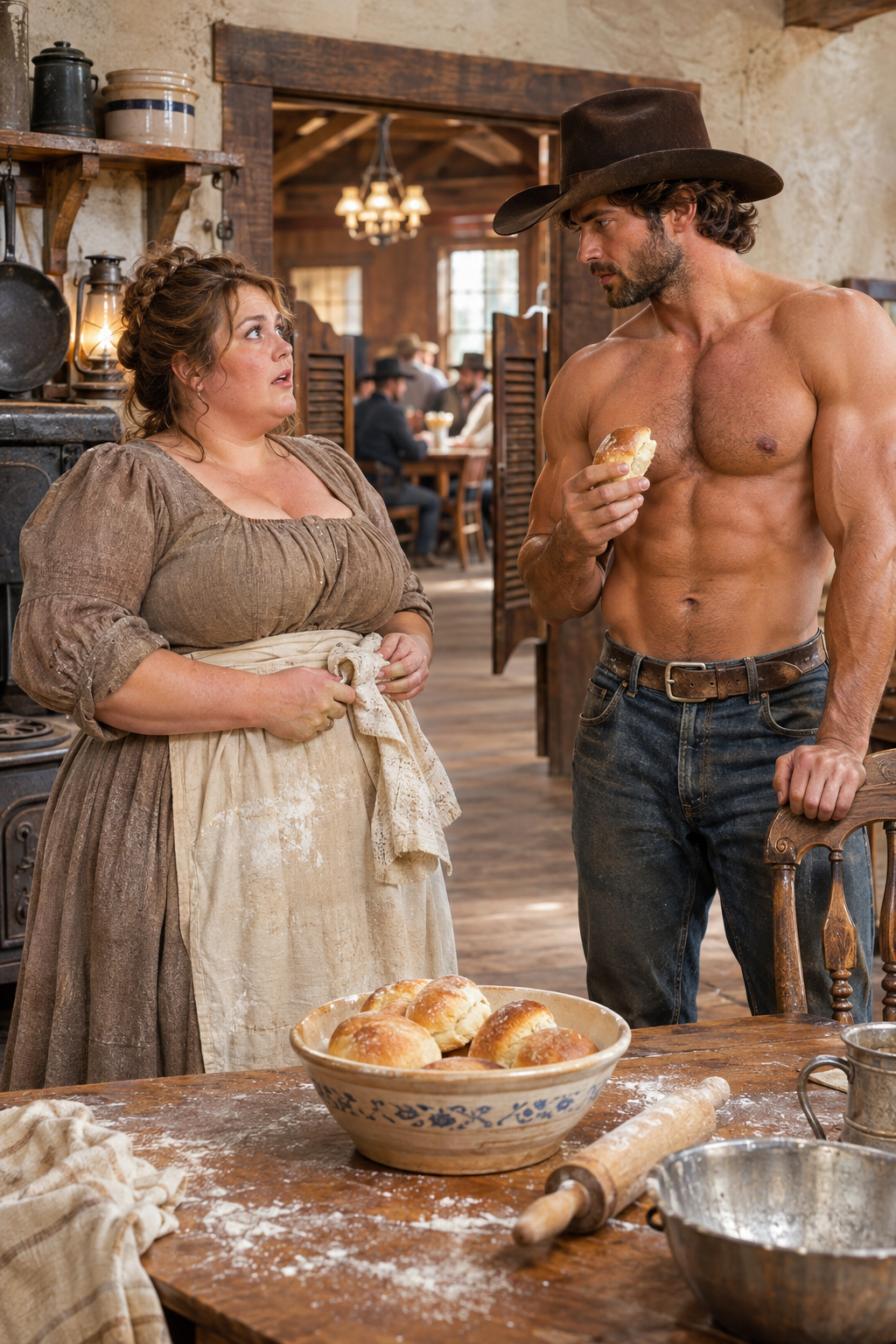
“Who cooked this meal?” the giant rancher demanded, and the hotel owner suddenly went pale.
“Florence, there’s something you need to understand about why I’m here.”
Gordon Talbot stood just inside the kitchen doorway, brushing snow from his expensive wool coat. His boots left muddy marks across the floor Florence had scrubbed that morning.
Miles Corbett rose slowly from his chair.
“Then I suggest you explain yourself,” he said.
Gordon glanced at the ranch owner, then turned toward Florence with a smile she knew far too well. It was the same smile he used whenever he wanted something and believed the other person had no choice but to give it.
“The Grand Union is expanding,” Gordon announced. “We’re adding six guest rooms and a proper dining hall. Business has never been better.”
Florence placed the bread dough she had been kneading beneath a clean towel.
“I’m pleased for you, Mr. Talbot.”
“Of course you are. And naturally, I’ve been thinking about the people who helped make that success possible.”
Miles folded his arms.
“Interesting time to remember them.”
Gordon ignored him.
“I’ve come to offer you your old position back, Florence. With a considerable raise.”
Florence looked at him without speaking.
“Twenty-eight dollars a month,” Gordon declared proudly. “Regular wages, steady employment, and a respectable establishment. Surely that’s better than spending winter in the middle of nowhere.”
For a moment, the kitchen was silent except for the crackling stove.
Twenty-eight dollars.
It was more than Gordon had ever paid her.
There had been a time when Florence would have accepted that offer without hesitation. She would have thanked him, packed her few belongings, and returned to the narrow kitchen where she had spent so many years.
But something had changed during her weeks at Crosswind Ranch.
She had discovered what it felt like to have people listen when she spoke.
She had discovered what it meant to be trusted.
And perhaps most dangerously of all, she had begun to believe she deserved both.
“That’s a generous offer,” Florence said carefully. “May I ask a question?”
Gordon smiled.
“Certainly.”
“Will I be supervising the new dining room?”
His smile weakened.
“Well, not exactly.”
“Will I be allowed to meet the guests?”
Gordon shifted his weight.
“Florence, you know how these things work.”
“I’m asking whether I’ll be allowed to meet them.”
Miles remained silent, but his attention never left Gordon’s face.
The hotel owner sighed.
“We’ve hired a young woman from Denver to serve as hostess. Very polished. Excellent manners. Quite suitable for greeting important visitors.”
Florence felt something cold settle inside her.
“And where would I be?”
“In the kitchen, naturally.”
“Behind the same door?”
Gordon frowned.
“I don’t see why that matters.”
Florence looked down at her hands.
They were strong hands, marked by small burns and years of work. Hands that had fed travelers, ranchers, merchants, and families. Hands that had prepared celebration dinners for people who never knew her name.
Those hands had built much of Gordon Talbot’s reputation.
Yet he still believed they should remain invisible.
“Would the new hostess be telling guests she prepared the meals?” Florence asked.
Gordon gave an impatient laugh.
“Guests aren’t interested in the details of kitchen arrangements.”
“But they would see her.”
“Of course.”
“And they wouldn’t see me.”
“Florence, please don’t make this difficult.”
She lifted her eyes.
“I’m not making anything difficult, Mr. Talbot. I’m simply trying to understand what you’re offering.”
Gordon’s expression hardened.
“I’m offering you more money than you’ve ever earned in your life.”
Miles moved toward the table.
“And she’s asking what you’re expecting in return.”
Gordon turned sharply.
“This is a private business matter, Corbett.”
“Then you should have discussed it privately instead of walking into my kitchen and insulting the woman who runs it.”
The words landed harder than either man seemed to expect.
My kitchen.
Florence felt her throat tighten.
Gordon noticed.
For the first time since entering the ranch house, uncertainty crossed his face.
Then he reached into his coat and produced a folded letter.
“Perhaps this will help you make a sensible decision.”
He placed it on the table.
Florence recognized the handwriting on the outside.
It belonged to Mrs. Hargrove, the elderly laundress who had worked at the Grand Union for nearly twenty years.
Florence reached for the letter.
“Is she all right?”
“She’s getting older,” Gordon replied. “The hotel is changing. There may not be room for everyone once the renovations are complete.”
Florence unfolded the paper.
The letter was short.
Mrs. Hargrove wrote that she missed Florence terribly. The new kitchen workers were careless, the meals were often late, and Gordon had become impossible to please.
She also mentioned that her own position might be eliminated when the hotel hired younger staff.
At the bottom, in shaky handwriting, she had added:
Don’t come back on my account, dear. You’ve spent enough years making other people comfortable while forgetting yourself.
Florence read those words twice.
Gordon watched her closely.
“She depends on that hotel,” he said. “You know how difficult it would be for a woman her age to find another position.”
Florence folded the letter.
“Are you threatening to dismiss her if I refuse?”
Gordon looked offended.
“I’m explaining the realities of business.”
“No,” Miles said quietly. “You’re explaining how you intend to frighten her.”
Gordon’s face flushed.
“You have no understanding of what it takes to operate a respectable hotel.”
Miles took one step forward.
“I understand that a respectable man doesn’t use an elderly woman’s livelihood to force another woman into obedience.”
The two men stared at each other.
Florence could feel the tension rising.
She had seen Gordon angry before. She knew how quickly his polished manners disappeared when someone challenged him.
But this time she wasn’t standing alone in his kitchen.
“Mr. Talbot,” she said, “you’ve traveled a long way. Please sit down while I finish the bread.”
Gordon blinked.
“The bread?”
“Yes. My work doesn’t stop because you’ve arrived.”
Miles turned away to hide the beginning of a smile.
Gordon sat reluctantly.
Florence returned to kneading.
For several minutes, nobody spoke.
Then the back door opened and young Samuel Price stumbled inside.
Samuel was the youngest ranch hand, barely nineteen, with a narrow face and an endless appetite.
His cheeks were red from the cold.
“Mr. Corbett,” he said urgently. “Walt’s back from the south trail.”
Miles straightened.
“Did he find the freight wagon?”
Samuel shook his head.
“Not the wagon. But he found tracks near the old creek crossing.”
“What kind?”
“Wagon tracks. Two sets of horses. And somebody’s been through there recently.”
Gordon suddenly became very interested in the fire.
Miles noticed.
“Where exactly?”
“About four miles east of the crossing. Walt says the tracks lead toward the abandoned timber camp.”
Florence looked up.
The supply wagon was already several days overdue.
Without its flour, beans, lamp oil, and medical supplies, the ranch would soon face serious trouble.
The eighteen men could survive on beef and whatever remained in storage, but the animals required feed, and winter storms were closing the roads.
Miles reached for his coat.
“Tell Walt to saddle two horses.”
Samuel hurried away.
Gordon cleared his throat.
“Surely this can wait until morning.”
Miles turned.
“Why would it?”
“Because the weather is worsening. No sensible man rides into the hills with snow coming.”
“Then it’s fortunate I didn’t ask for your advice.”
Gordon rose.
“I should be leaving myself.”
Florence glanced toward the window.
The sky had darkened.
“It’s too late to ride back to Millstone safely.”
“I’ve made the journey before.”
“Not in weather like this,” Miles said. “You can stay in the bunkhouse tonight.”
Gordon looked horrified.
“With the ranch hands?”
“There’s a clean bed available.”
“I’d prefer a private room.”
“So would several of my men,” Miles replied. “But we make do.”
Florence nearly smiled.
Gordon reluctantly removed his coat.
Before Miles left, Florence followed him to the back porch.
Snow was beginning to fall in thick, heavy flakes.
“Be careful,” she said.
Miles adjusted his gloves.
“I intend to.”
“There’s coffee in the blue flask. And bread wrapped beside it.”
He looked at the small bundle she was holding.
“You thought of everything.”
“Not everything.”
“What did I miss?”
She hesitated.
Then she said, “If the wagon’s been damaged, bring back whatever supplies you can. Especially the medicine chest.”
Miles nodded.
He started down the steps, then stopped.
“Florence?”
“Yes?”
“Don’t let Talbot convince you that you owe him your future because he once gave you a job.”
She stared at him.
Miles continued, “A man can pay someone wages and still fail to give them the respect they’ve earned.”
Before she could answer, he walked into the snow.
Florence stood watching until he disappeared behind the stable.
Inside, Gordon was waiting.
“You seem very comfortable here,” he observed.
“I am.”
“A ranch kitchen is hardly a permanent future for a woman your age.”
Florence closed the door.
“What would you consider a proper future?”
“Security. Stability. A respectable position.”
“I had those things at your hotel.”
“Exactly.”
“And I was miserable.”
Gordon looked startled.
Florence had never said that aloud before.
She had barely admitted it to herself.
“You were employed,” he said.
“I was hidden.”
“You’re exaggerating.”
“Am I?”
Gordon crossed his arms.
“Florence, appearances matter in business. People expect a certain standard.”
“And I didn’t meet yours.”
He said nothing.
She nodded slowly.
“Thank you.”
“For what?”
“For finally being clear.”
Gordon looked toward the doorway, where several ranch hands were gathering for supper.
He lowered his voice.
“You’re making a terrible mistake. Men like Corbett may enjoy playing the gentleman, but sooner or later they’ll remember what sort of woman belongs beside them.”
Florence felt the words strike a familiar wound.
For years, she had accepted the idea that her appearance made her less worthy of kindness, admiration, or affection.
Gordon had never needed to say it plainly.
His actions had taught her well enough.
But she thought of Miles removing his hat when they first met.
She thought of the ranch hands thanking her after meals.
She thought of Samuel bringing her wildflowers from the creek bank because he said the kitchen needed something cheerful.
And she thought of the night she had accidentally called Crosswind home.
“Mr. Talbot,” she replied, “I don’t need to belong beside anyone to know where I belong.”
Gordon opened his mouth.
Before he could answer, Samuel returned carrying an armful of firewood.
“Miss Florence, do you want the big kettle filled?”
“Yes, please.”
Samuel glanced at Gordon.
“Are you staying for supper, sir?”
“Apparently.”
“Then you’re lucky,” Samuel said cheerfully. “She’s making chicken pie.”
Gordon looked at Florence.
She simply returned to her work.
By evening, the storm had grown fierce.
Wind rattled the shutters, and snow gathered against the windows.
The ranch hands ate in uneasy silence.
Usually, supper was filled with laughter, complaints about the weather, and arguments over cards.
Tonight, everyone kept looking toward the door.
Miles had been gone for hours.
Florence served the last portion of pie, then covered two plates and placed them near the stove.
Gordon noticed.
“Still waiting for him?”
“For everyone who’s missing.”
“There’s no sense letting good food go to waste.”
“Then it’s fortunate I know how to keep it warm.”
Across the table, Samuel coughed to hide a laugh.
Near midnight, a horse whinnied outside.
Florence was the first to reach the door.
Miles appeared through the snow, supporting Walt Mercer, one of his oldest ranch hands.
Walt’s left arm hung awkwardly at his side.
“Clear the table,” Miles ordered.
Florence was already moving.
Within moments, she had hot water, clean cloth, and the small medical supplies kept in the kitchen.
Walt had fallen when his horse slipped on the icy trail.
His arm was badly bruised, and his shoulder appeared injured.
Florence helped him sit while Miles removed his frozen coat.
“Did you find the wagon?” she asked.
Miles nodded grimly.
“Found what’s left of it.”
Every man in the room went quiet.
“What happened?” Samuel asked.
“The wagon’s stuck near the timber camp. One wheel is broken, and most of the freight has been unloaded.”
“Unloaded by who?” another ranch hand demanded.
“That’s what I intend to find out.”
Florence looked at Miles.
“Was the driver there?”
“No.”
“Any sign of him?”
“His blanket and personal bag were still in the wagon. But there were fresh horse tracks heading toward Millstone.”
Gordon shifted near the fireplace.
Miles turned toward him.
“Talbot, you came from town today.”
“Yes.”
“Did you hear anything about a missing freight driver?”
“Nothing.”
“Did you pass anyone on the east road?”
“Not that I recall.”
Miles studied him.
“That’s strange.”
“What’s strange?”
“The road into Crosswind passes close to the creek crossing. You must have noticed the abandoned wagon.”
Gordon’s face tightened.
“I traveled the north road.”
Miles shook his head.
“The north road’s been blocked since last week’s storm.”
Silence fell.
Gordon stared at him.
“Then perhaps I misunderstood which road you meant.”
Florence felt a sudden uneasiness.
She had worked for Gordon long enough to recognize when he was lying.
His voice always became unusually formal.
Miles did not accuse him.
Instead, he helped Walt toward the bunkhouse and instructed the men to keep the horses ready.
When he returned, Florence was waiting beside the stove.
“You think Gordon knows something,” she said.
“I think he knows more than he’s telling us.”
“Why would he?”
Miles rubbed his tired face.
“That’s the question.”
Florence considered the matter.
Then she remembered something.
“When Gordon first arrived, he seemed certain I’d agree to return with him.”
Miles nodded.
“He’s accustomed to getting his way.”
“But he also seemed certain the ranch couldn’t keep me.”
Miles looked at her.
“What exactly did he say?”
Florence repeated his remarks about winter, isolation, and the uncertainty of ranch life.
Miles became very still.
“The freight was supposed to arrive four days ago,” he said. “Without those supplies, we’ll have trouble keeping everyone here through December.”
“You think someone delayed it deliberately?”
“I don’t know.”
He looked toward the dark window.
“But tomorrow I’m going to find out.”
Morning brought a bitter wind and nearly two feet of fresh snow.
Gordon announced that he intended to return to Millstone immediately.
Miles refused to let him travel alone.
“You’ll wait until the road is safe,” he said.
Gordon protested.
Miles remained unmoved.
By noon, two ranch hands returned from inspecting the freight wagon.
They brought three sacks of flour, a crate of lamp oil, and a small leather pouch found beneath the driver’s seat.
Inside the pouch was a folded shipping receipt.
Miles spread it across the kitchen table.
Florence stood beside him.
The document listed the supplies ordered for Crosswind Ranch.
At the bottom was a handwritten note.
Delivery held pending further instructions.
Below it was a signature neither Florence nor Miles recognized.
Gordon glanced at the paper.
“Freight companies make mistakes all the time.”
Miles looked up.
“Interesting that you knew it was a freight company.”
“Who else would handle a delivery?”
“Someone who wanted it stopped.”
Gordon’s expression darkened.
“I won’t stand here and be accused of something without proof.”
“Then sit down,” Miles replied. “Nobody’s accusing you yet.”
Florence stepped between them.
“Enough. We have a wounded man, hungry animals, and a storm that hasn’t finished. Whatever happened to the wagon, shouting won’t fix it.”
Miles immediately stepped back.
Gordon looked surprised.
Florence turned to Samuel.
“Take the flour to the pantry. Count every sack. Then ask the men to bring in whatever potatoes and dried beans remain in storage.”
“Yes, ma’am.”
She faced Miles.
“How many days until another wagon can reach us?”
“If the weather clears, perhaps five.”
“And if it doesn’t?”
“Longer.”
Florence nodded.
“Then we’ll plan for longer.”
For the next two days, she ran the ranch kitchen with the precision of a military commander.
She measured flour, stretched meat into thick stews, baked smaller loaves, and turned leftover vegetables into filling soups.
Nothing was wasted.
The ranch hands helped without complaint.
One repaired the pantry shelves. Another hauled extra firewood. Samuel volunteered to scrub pots, though his enthusiasm exceeded his skill.
Florence gave everyone a task.
And somehow, despite the shortage, nobody went hungry.
Gordon watched all of it.
On the third evening, he found Florence alone in the kitchen.
“You’ve made quite an impression,” he said.
She continued slicing potatoes.
“The men work hard. They deserve decent meals.”
“That’s exactly why I need you back.”
Florence stopped.
Gordon stepped closer.
“The Grand Union is losing customers.”
She turned.
“You said business had never been better.”
“The rooms are full. But the dining room is struggling.”
“What happened?”
“The new cook isn’t capable of handling the work. We’ve had complaints. Important guests are eating elsewhere.”
Florence waited.
Gordon lowered his voice.
“I need someone who knows how to restore the hotel’s reputation.”
“Someone who knows how to cook.”
“Yes.”
“Someone who can organize a kitchen.”
“Precisely.”
“Someone whose food brings people through the door.”
“Florence, you understand perfectly.”
She placed the knife on the table.
“Then why can’t that person be seen?”
Gordon’s face changed.
For once, he had no immediate answer.
Florence removed her apron and folded it carefully.
“Do you know what I remember most about working at your hotel?”
Gordon sighed.
“Must we discuss this again?”
“I remember the evening the governor’s party came through Millstone. You asked me to prepare a special dinner. I worked fourteen hours.”
“It was an important occasion.”
“The guests praised every course. They asked to meet the cook.”
Gordon looked away.
“You told them the cook had already gone home.”
“That was years ago.”
“I was standing behind the door.”
He said nothing.
“I heard them applauding. And I remember thinking that perhaps one day I would be good enough to step into the dining room.”
Florence’s voice remained steady.
“But no matter how well I cooked, that day never came.”
Gordon rubbed his forehead.
“Business requires difficult decisions.”
“So does life.”
She reached into the pocket of her dress.
Her fingers closed around a small brass key.
It was the key to the Grand Union’s back kitchen.
She had carried it for years, even after leaving the hotel.
At first, she had kept it because she expected to return.
Later, she had kept it because she didn’t know how to let go.
Now she placed it on the table.
Gordon stared at it.
“What’s this?”
“My kitchen key.”
“I can see that.”
“I’m returning it.”
His eyes widened.
“Florence, don’t be foolish.”
“I’m not coming back.”
He looked at the key, then at her.
“Twenty-eight dollars a month. I could perhaps make it thirty.”
She shook her head.
“Thirty-two.”
“No.”
“Florence, you’re being unreasonable.”
She looked directly at him.
“You’ve spent years telling me I should be grateful for whatever you offered. But gratitude doesn’t mean accepting humiliation.”
Gordon’s face reddened.
“You’ll regret this.”
“Perhaps,” she said. “But if I do, at least the decision will have been mine.”
For a moment, neither moved.
Then Gordon picked up the key.
“You think these men will respect you forever?”
“I don’t know.”
“You think Corbett will always protect you?”
Florence’s expression softened.
“Mr. Talbot, that’s what you still don’t understand. I didn’t come here looking for someone to protect me.”
She glanced toward the kitchen, the clean shelves, the simmering stew, and the handwritten supply list beside the stove.
“I came here to do my work. And for the first time, people see the person doing it.”
Gordon left without another word.
The following morning, the weather finally cleared enough for travel.
Miles arranged for two ranch hands to escort Gordon back toward Millstone.
Before leaving, Gordon stood beside his horse, looking older than Florence remembered.
She came outside carrying a wrapped package.
He eyed it suspiciously.
“What’s that?”
“Bread and cold chicken. The journey will take several hours.”
Gordon stared at her.
“After everything I said?”
“You still need to eat.”
He accepted the package slowly.
For the first time, his usual confidence seemed to desert him.
“Florence,” he began, “I never meant—”
She waited.
But Gordon could not finish.
Perhaps he didn’t know how to apologize.
Perhaps he still believed he had done nothing wrong.
Florence no longer needed to find out.
“Safe travels, Mr. Talbot.”
She turned and went inside.
By the end of the week, the missing freight driver had been found in Millstone.
He had taken shelter after his wagon broke down and, fearing the storm, had left the cargo near the timber camp. The freight agent had delayed arranging a replacement team while waiting for authorization from the shipping office.
The handwritten note had referred to that delay.
There was no proof Gordon had interfered.
Miles accepted the explanation, though he remained annoyed that nobody had sent word.
The important thing was that the supplies were recovered.
With the roads reopening, the ranch could finally prepare for the hardest weeks of winter.
But another problem remained.
Florence’s six-week contract was almost finished.
She knew the exact date.
She had counted it several times.
And each time, she felt a small ache she couldn’t explain.
One evening, Miles found her sitting at the kitchen table, reviewing the pantry inventory.
“You’ve been quiet today,” he said.
“Have I?”
“Quieter than usual.”
She smiled faintly.
“That’s quite an achievement.”
He pulled out a chair.
“Something troubling you?”
Florence folded the paper.
“My contract ends next Tuesday.”
Miles looked down.
“I know.”
“I suppose you’ll need to find another cook.”
“Suppose I will.”
She tried to keep her expression calm.
“You should start looking soon.”
Miles studied his hands.
“I’ve been thinking about that.”
Florence waited.
“I could offer you another contract,” he said. “Six months this time. Better wages. Same conditions.”
Her heart lifted.
Then she forced herself to remain practical.
“That’s a generous offer.”
“You’ve earned it.”
She looked toward the stove.
“And after six months?”
Miles was silent.
Florence gave a small, embarrassed laugh.
“Forgive me. I shouldn’t ask questions about a future that hasn’t happened.”
“Why not?”
“Because I know how quickly circumstances change.”
Miles leaned forward.
“Florence, I’ve owned this ranch for eleven years. I’ve hired men who stayed a week and men who stayed a decade. I’ve watched good workers leave because they found better opportunities.”
He paused.
“But I’ve never had someone make this place feel the way it does now.”
Florence’s fingers tightened around the paper.
“What way?”
Miles looked around the kitchen.
“Like people belong here.”
She swallowed.
“That isn’t only because of me.”
“No. But you helped us remember it.”
Outside, the wind moved softly through the bare cottonwood trees.
Florence took a breath.
“Mr. Corbett—”
“Miles.”
She looked up.
“You can call me Miles.”
She smiled.
“All right. Miles.”
He smiled back.
“There’s something else I’ve been meaning to ask.”
Her heart began beating faster.
But before he could continue, Samuel burst through the door.
“Miss Florence! Walt says the Christmas supplies are finally coming!”
Miles closed his eyes.
Florence laughed.
For once, the interruption felt like a blessing.
Christmas arrived beneath a bright, clear sky.
The ranch house smelled of cinnamon, fresh bread, roasted meat, and apple pie.
Florence had saved ingredients for weeks to prepare a proper holiday dinner.
The eighteen ranch hands crowded around the long table in their cleanest shirts.
Walt’s shoulder had healed enough for him to carve the roast.
Samuel had polished his boots until they shone.
Miles stood at the head of the table.
Before anyone began eating, he raised his glass.
“I’ve spent a good many winters at Crosswind,” he said. “Some were harder than others.”
The men quieted.
“This one reminded me that a ranch isn’t built only with fences, cattle, and hard work.”
He looked toward Florence.
“It’s built by people who care whether the person beside them has enough to eat, a warm place to sleep, and a reason to come back tomorrow.”
Florence lowered her eyes.
Miles continued.
“We’re fortunate to have someone who understands that better than most.”
The men began applauding.
Samuel stood.
“Three cheers for Miss Florence!”
The room erupted.
Florence laughed through tears she could no longer hide.
For years, she had listened to applause through a closed kitchen door.
Now she stood in a room full of people who were applauding her.
Miles pulled out the empty chair beside him.
“Sit down, Florence. Supper’s ready.”
She looked at the chair.
Then at the faces around the table.
Nobody seemed surprised that she belonged there.
She sat.
After dinner, the men moved to the bunkhouse for music and cards.
Florence remained behind to straighten the kitchen.
Miles found her washing the last serving dish.
“You know,” he said, “we employ eighteen capable men.”
“I’ve noticed.”
“Any one of them can wash a plate.”
“Not as well as I can.”
He laughed.
Then he took the dish from her hands and placed it on the counter.
“Florence, would you walk with me?”
She hesitated.
“It’s cold.”
“I know.”
“And dark.”
“There’s a moon.”
She studied his face.
Then she removed her apron.
They walked to the front porch.
The ranch lay quiet beneath the stars. Snow covered the fields, and warm light glowed from the bunkhouse windows.
For a while, neither spoke.
Finally, Miles cleared his throat.
“I’ve been trying to find the right words for something.”
Florence smiled nervously.
“That doesn’t sound like you.”
“It isn’t.”
He looked toward the distant hills.
“When I first tasted your cooking, I knew you were talented. I thought hiring you would solve a problem at the ranch.”
“And did it?”
“It solved several.”
She laughed softly.
“But it created another.”
Florence turned toward him.
“What problem?”
Miles looked directly at her.
“I’ve become accustomed to seeing you every morning. To hearing you argue with Samuel about stealing biscuits. To finding you waiting with supper when I’ve been out too long.”
Her smile faded into something more tender.
“I’ve become accustomed to those things too.”
“I don’t want you to stay because you need employment,” Miles said. “And I don’t want you to feel you owe me anything.”
Florence’s breath caught.
“I want you to stay because you choose to.”
He paused.
“And if someday you decide there’s a place for me in your life beyond this ranch, I’d be grateful for the chance to earn it.”
Florence looked at the enormous man standing beside her.
He could have frightened most people simply by entering a room.
Yet he stood before her now with the nervous expression of a boy asking for his first dance.
“Miles,” she whispered, “are you asking me to court you?”
He gave a quiet laugh.
“I believe I’m making a terrible mess of asking whether I may court you.”
Florence felt tears rise again.
She thought of Gordon Talbot and the years she had spent believing no man would ever look at her with affection.
She thought of the kitchen door that had kept her hidden.
Then she looked at Miles.
“You may,” she said.
His face brightened.
“But I have conditions.”
Miles laughed.
“Of course you do.”
“I keep my own room until I decide otherwise.”
“Agreed.”
“I keep full authority over the kitchen.”
“Absolutely.”
“And if we disagree, you listen to what I have to say.”
He took her hand gently.
“Florence, I believe you’ve already trained me to do that.”
She laughed, and he kissed her hand.
They stood together beneath the winter stars.
The future remained uncertain.
There would be hard seasons, disagreements, losses, and days when love alone would not make life easy.
But Florence was no longer afraid of uncertainty.
She had learned that security without dignity could become another kind of prison.
And she had discovered that belonging was not something another person could grant her by deciding she was acceptable.
It began when she stopped accepting the idea that she was not.
The following spring, Florence signed a new contract making her the permanent manager of Crosswind’s kitchen, with wages reflecting her responsibilities.
Miles insisted on putting everything in writing.
She insisted on reading every word.
Their courtship continued through the changing seasons, built on quiet conversations, shared responsibilities, and the steady respect that had brought them together.
In Millstone, the Grand Union Hotel eventually found another capable cook.
But Gordon Talbot never again tasted Florence Whitcomb’s apple pie.
And whenever travelers asked about the remarkable meals served at Crosswind Ranch, Miles never took credit for them.
He simply smiled and said, “You’ll have to meet Florence.”
Years later, Florence would remember that first winter not as the season a wealthy rancher rescued her from an unhappy life, but as the season she finally recognized her own worth.
Miles had opened a door.
She had chosen to walk through it.
And that made all the difference.
Because the most important lesson Florence learned was not that someone might eventually love her despite the things the world considered imperfect.
It was that she had never needed to become someone else to deserve respect, happiness, or love.
A person’s worth does not disappear because others refuse to recognize it.
And sometimes, the bravest thing anyone can do is return the key to a door that has kept them small—and choose a place where they can finally stand tall.
As spring turned into summer, Crosswind Ranch became more than a place where Florence Whitcomb worked. It became the first place where she could imagine spending the rest of her life.
Her relationship with Miles grew slowly, without grand promises or hurried decisions. He continued to court her with the same patience and respect he had shown from the beginning.
Some evenings, they walked along the creek after supper. Other nights, they sat on the porch, talking about the ranch, their hopes, and the years they had spent believing happiness belonged to other people.
One warm evening, Miles brought Florence to the hill overlooking Crosswind.
The setting sun painted the fields gold, and the ranch house stood below them with smoke rising gently from its chimney.
“I’ve been thinking about something,” Miles said.
Florence smiled. “That usually means you’re about to ask me a difficult question.”
He laughed nervously.
“Perhaps the most difficult question I’ve ever asked.”
Then he reached into his coat and took out a small velvet box.
Florence stopped breathing for a moment.
“Florence,” he said, opening it, “I can’t promise that every year will be easy. Ranch life has a way of testing even the strongest people. But I can promise that you’ll never have to hide who you are, or wonder whether your voice matters in our home.”
His large hands trembled slightly.
“Would you marry me?”
Florence looked at the simple gold ring.
For a moment, she remembered the woman she had once been, standing alone behind the Grand Union Hotel’s kitchen door, listening to strangers praise food she had prepared while someone else accepted their gratitude.
That woman had believed she should be thankful for whatever small place the world allowed her.
Now, standing beneath the open sky, Florence understood how much her life had changed.
“Yes, Miles,” she whispered. “I would be honored.”
He slipped the ring onto her finger.
Then, with a tenderness that brought tears to her eyes, he drew her into his arms.
They married that autumn in a small ceremony at Crosswind Ranch.
All eighteen ranch hands attended, dressed in their finest clothes. Samuel, who had grown into a confident young man, proudly carried the flowers.
Mrs. Hargrove traveled from Millstone to witness the wedding. When she embraced Florence, she held her tightly and whispered, “I always knew there was a beautiful life waiting for you, dear. I’m only sorry you had to wait so long to find it.”
Florence smiled through her tears.
“I didn’t find it by waiting,” she answered. “I found it when I finally decided to leave.”
Their wedding supper was prepared by the ranch hands under Florence’s careful instructions.
The biscuits were slightly uneven, the potatoes were overcooked, and Samuel accidentally burned one of the pies.
Florence declared it the finest meal she had ever eaten.
Years passed, and Crosswind Ranch prospered.
Florence continued managing the kitchen, but she also helped Miles make decisions about supplies, wages, and the care of their workers.
Her judgment proved just as valuable as her cooking.
Whenever a new employee arrived, she made certain that person was treated with dignity, regardless of appearance, background, or position.
And when young women from Millstone came looking for work, Florence offered them something she had once desperately needed herself: a fair wage, a chance to learn, and the assurance that their efforts would be recognized.
One afternoon, many years later, a traveler stopped at Crosswind and asked Miles about the woman whose cooking had become famous throughout the county.
Miles smiled and pointed toward the garden, where Florence was gathering herbs.
“That’s my wife,” he said proudly. “And she’s the reason this place became a home.”
Florence heard him and shook her head with a smile.
“You’re giving me too much credit again.”
Miles walked over and took her hand.
“Not nearly enough.”
She looked at the ranch house, the open fields, and the people moving through the yard.
Once, she had believed that being unseen meant she was unworthy of being noticed.
Now she understood the truth.
Her value had never depended on whether Gordon Talbot approved of her, whether strangers admired her appearance, or whether a man chose to love her.
She had been worthy all along.
The difference was that she had finally learned to believe it.
And that became the lesson she carried for the rest of her life:
Never spend your entire life trying to earn a place in someone’s world when they insist on keeping you hidden. Your talents deserve recognition, your kindness deserves respect, and your heart deserves a home where you are welcomed exactly as you are.
Sometimes, the greatest change in a person’s life begins with a simple decision.
Not to become more beautiful.
Not to become more impressive.
Not to prove anything to those who refused to see their worth.
But to walk away from the people who make them feel small.
Because the right people will never ask you to disappear in order to belong.
And Florence Whitcomb, the woman once hidden behind a hotel kitchen door, spent the rest of her days proving that a life filled with dignity, purpose, and love is worth more than any amount of money offered to keep someone invisible.
THE END.