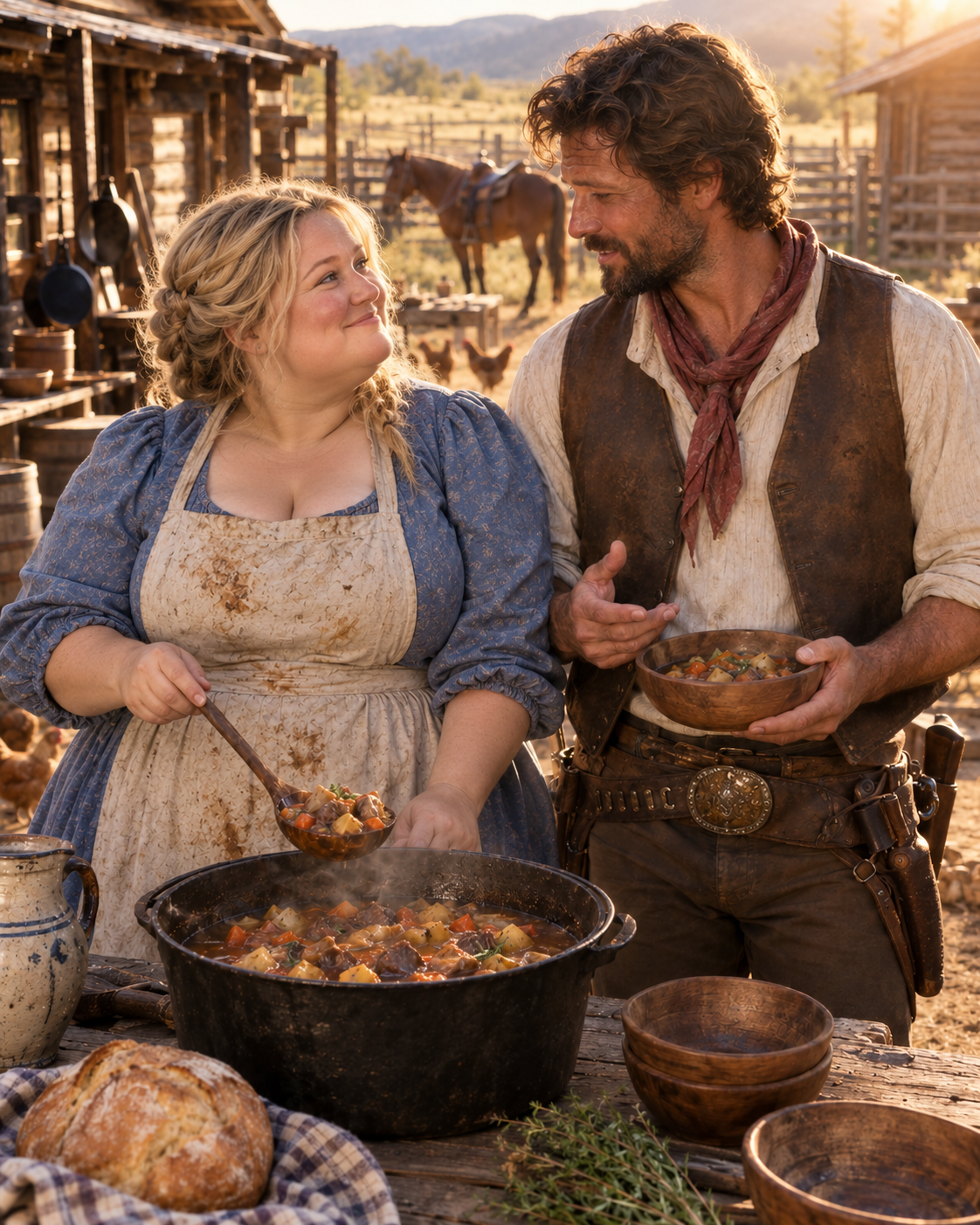
When Caleb Morgan dumped my pot of stew into the dirt at Morgan Creek Ranch, he laughed with twenty starving cowboys, never knowing I had already uncovered his darkest secret.
I stared at the envelope until the letters seemed to move.
I know why you really came.
For several seconds, the sounds of the roadside stand faded around me. The clink of coins, the low laughter of the cowboys, the bells around the goats’ necks—all of it seemed to drift somewhere far away.
Caleb noticed my expression.
“What is it?”
I slipped the envelope beneath my apron before he could see the writing.
“Nothing.”
His eyes narrowed.
“Abigail.”
“I said nothing.”
But Caleb Morgan had learned enough about me in the past few weeks to know when I was lying.
He stepped closer.
“Who sent it?”
I looked toward the road.
A wagon was disappearing into the orange dust, its wheels leaving two dark tracks behind it.
Nobody else was nearby.
I lowered my voice.
“Your brother.”
Caleb’s face changed instantly.
The warmth disappeared from his eyes.
“Where is it?”
I handed him the envelope.
He read the six words.
Then he read them again.
His jaw tightened.
“He’s here.”
“I thought he was in San Antonio.”
“So did I.”
Caleb turned toward the ranch house.
“Get inside.”
“Why?”
“Because if Elias sent this, he doesn’t want a conversation.”
He folded the letter into his fist.
“He wants something.”
I followed him anyway.
“I want to know what.”
Caleb stopped at the kitchen door.
“Abigail, you don’t understand my brother.”
“I understand men who hide things.”
He looked at me.
“And I understand women who walk into a failing ranch with a cooking pot and somehow know exactly where the missing money is going.”
His voice was quiet.
Too quiet.
“What are you accusing me of?”
“I’m not accusing you.”
“Then what are you saying?”
Caleb hesitated.
“I’ve wondered from the beginning why you chose this ranch.”
The question struck harder than I expected.
I looked away.
“I needed work.”
“That isn’t the whole truth.”
“No.”
The word escaped before I could stop it.
Caleb stared at me.
For the first time since I had arrived at Morgan Creek, I realized the secret I had carried all those miles was no longer mine alone.
Before I could explain, a gunshot cracked across the ranch.
Every man outside froze.
Then another shot tore through the air.
The cowboys reached for their rifles.
Caleb shoved me behind the kitchen wall.
“Stay here.”
“Caleb—”
“Abigail, for once in your life, do exactly what I say.”
He ran outside.
I waited three seconds.
Then I grabbed the iron skillet from the stove and followed him.
The shot had come from the north pasture.
A horse screamed.
Men scattered toward the corral.
Caleb mounted before anyone could saddle a second horse.
“Lock the house!” he shouted.
Then he rode toward the smoke rising beyond the fence.
I stood in the yard, heart pounding.
Something was wrong.
Not just with Elias.
With everything.
I ran back inside and pulled the envelope from beneath my apron.
There was something else inside.
A small brass key.
And on the back of the letter, written in the same hand, were four more words.
“Third floor. Old church.”
There was no third floor in the ranch house.
But there was an abandoned church two miles east of Morgan Creek.
I had seen it the week before.
Its bell tower had collapsed, but the old wooden building still stood.
I knew I should wait for Caleb.
I also knew that whatever Elias had hidden there might explain why someone had been stealing from the ranch.
So I saddled the fastest horse I could find.
The church stood alone beneath a pale moon when I arrived.
Its windows were broken.
The door hung crookedly from one hinge.
I entered with the brass key in my hand.
There was no third floor.
But above the sanctuary was a narrow loft hidden behind a wooden panel.
The key fit a small lock.
Inside was a metal box.
My hands trembled as I opened it.
There were letters.
Dozens of them.
Bank receipts.
Land deeds.
A cattle-sale record.
And one photograph.
I picked it up.
My breath stopped.
The photograph showed three men standing beside a cattle wagon.
One was Elias Morgan.
One was a banker I recognized from town.
And the third man was my father.
I sat down hard on the floor.
My father had been dead for six years.
Yet I recognized his coat.
His face.
The silver watch chain across his vest.
Beneath the photograph was a letter dated nine years earlier.
I unfolded it.
Abigail,
If you are reading this, then I have failed to put things right.
I knew about the Morgan land deal.
I knew they were being cheated.
I knew men in the bank were falsifying cattle weights and property records.
I thought I could expose them.
Instead, they threatened your mother and me.
I signed papers I should never have signed.
Your father’s handwriting blurred in front of my eyes.
At the bottom of the page was one sentence that made my blood run cold.
The land they are stealing is not only theirs.
It belongs to you.
I read the sentence again.
Then again.
A floorboard creaked behind me.
I spun around.
Elias Morgan stood in the doorway.
He was holding a revolver.
“I wondered how long it would take you.”
I stood slowly.
“You killed my father.”
Elias’s expression barely changed.
“No.”
“You knew him.”
“Yes.”
“You were there.”
“Yes.”
“Then tell me the truth.”
He stepped inside.
“Your father discovered that the original Morgan Creek deed had been altered.”
“Altered?”
“The land your father thought he had purchased from the county was part of an older grant. Your family owned a claim to it.”
My hands tightened around the letter.
“Why did my father sign it away?”
“Because we told him your mother would die if he didn’t.”
The room seemed to tilt.
I stared at him.
“You threatened my mother?”
“I did not.”
“Then who did?”
Elias looked toward the window.
“My father.”
I suddenly understood.
The ledger.
The missing money.
The fear in Caleb’s eyes.
The shame he had carried like a second skin.
“This isn’t about saving the ranch,” I whispered.
“No.”
“It’s about covering up what your family did.”
Elias smiled.
“Now you understand.”
“What do you want from me?”
“Your signature.”
He placed another document on the table.
A transfer of ownership.
Morgan Creek Ranch would be transferred to Elias in exchange for a small payment.
I laughed bitterly.
“You expect me to sign this?”
“You will.”
“No.”
His revolver lifted.
“You will.”
A voice came from behind him.
“Put the gun down, Elias.”
Caleb stood in the doorway.
His rifle was aimed directly at his brother.
Elias slowly turned.
For a moment, the two brothers stared at each other.
Then Elias smiled.
“You followed her.”
“Of course I did.”
“You should have stayed out of this.”
“I stayed out of it for twelve years.”
Caleb’s voice shook.
“I’m done.”
Elias laughed.
“You think you can destroy me?”
“No.”
Caleb’s finger tightened against the trigger.
“I think the truth will.”
Elias fired first.
The shot struck the wooden beam above Caleb’s head.
Caleb fired back.
Elias stumbled.
The revolver fell from his hand.
He dropped to one knee, clutching his shoulder.
Caleb did not fire again.
Instead, he lowered his rifle.
“Why?” I whispered.
“Because I won’t become him.”
Those words changed everything.
Elias looked at his brother with disbelief.
“You’ve always been weak.”
Caleb shook his head.
“No.”
He walked forward.
“I’ve been afraid.”
Then he picked up the documents from the table.
“And I’m not anymore.”
We returned to the ranch before sunrise.
The cowboys gathered in the main room while Caleb told them everything.
Nobody interrupted.
When he finished, the room remained silent.
One of the older ranch hands, Samuel, finally spoke.
“So the money disappearing from the ranch…”
“Elias,” Caleb said.
“And the land?”
“Stolen through forged records.”
“And Abigail?”
Caleb looked at me.
“Her family has a legal claim to part of this ranch.”
A murmur moved through the room.
I expected anger.
Instead, Samuel shook his head.
“Then we make it right.”
Caleb looked at him.
“Just like that?”
Samuel shrugged.
“Nothing simple about it.”
He looked around at the others.
“But we’ve been eating her stew for three weeks.”
A few men laughed quietly.
“I’d rather owe a debt to someone who fed us than to a man who starved us.”
The tension broke.
One by one, the cowboys nodded.
That morning, we rode into town.
Elias was taken to the sheriff.
The banker whose name appeared in the records tried to deny everything.
But the documents were too many.
The letters were too clear.
And Caleb testified against his own brother.
For two weeks, Morgan Creek Ranch became the center of every conversation in the county.
Some people called Caleb a traitor to his family.
Others called him brave.
Some said I had come to the ranch to steal it.
Others said I had saved it.
I stopped listening.
Because there was something more important than what people called us.
The truth had finally been spoken.
The county judge reviewed the old land records.
My father’s original claim was valid.
But the Morgan family had also invested decades of labor into the property.
The final ruling divided the land according to the original boundaries.
A portion went to me.
The main ranch remained with Caleb.
Neither of us was entirely satisfied.
Neither of us was destroyed.
And perhaps that was the fairest ending the law could give us.
One evening, Caleb found me sitting beside the goat pasture.
“You could sell your land,” he said.
“I know.”
“You could leave Texas.”
“I know.”
“You could hate me.”
I looked at him.
“I don’t.”
He sat beside me.
For a while, neither of us spoke.
The sun was setting behind the mesquite trees.
“You never told me why you really came here,” he said.
I smiled.
“I think you already know.”
“I want to hear you say it.”
I looked toward the hills.
“My father left me one letter before he died.”
Caleb waited.
“He told me that if anything ever happened to him, I should never trust the Morgan family.”
Caleb lowered his eyes.
“But he also told me something else.”
“What?”
“He said fear makes people bury the truth.”
I looked at him.
“And he told me never to let someone else’s fear decide what I become.”
Caleb was silent.
“So you came here looking for answers.”
“Yes.”
“And the cooking?”
I laughed.
“That part was practical.”
He smiled.
“I suppose it was.”
The following spring, Morgan Creek changed.
The rains finally came.
The cracked red earth softened.
Grass returned to the pastures.
The goats multiplied.
The roadside stand became a permanent little store beside the main road.
We added dried meat, preserves, cheese, candles, soap, bread, and jars of stew.
Travelers began stopping deliberately.
Some came because they had heard the story.
Others came because the food was good.
I didn’t mind either reason.
Caleb rebuilt the fences.
Samuel took charge of the cattle.
The younger cowboys learned to make cheese and soap.
Even men who had once laughed at my cooking began asking for my recipes.
One afternoon, a thin boy named Tommy appeared at the stand.
He couldn’t have been more than twelve.
He stared at the bread.
“You hungry?” I asked.
He nodded.
I gave him a loaf.
He hesitated.
“I don’t have money.”
“Then you don’t owe me money.”
He looked confused.
“What do I owe?”
“Nothing.”
He held the bread against his chest.
“But why?”
I thought about the first day I had arrived at Morgan Creek.
The laughter.
The spilled stew.
The humiliation.
Then I thought about everything that had happened afterward.
“Because someone once gave me a chance when they didn’t have to.”
Tommy smiled.
Then he ran down the road.
Caleb had been watching from the porch.
“You know you’ll go broke giving food away.”
“Then I’ll make more.”
He laughed.
“You always have an answer.”
“No.”
I looked toward the pasture.
“I just learned not to waste what I have.”
Months later, we discovered one final surprise.
The old photograph of my father, Elias, and the banker had been sent to a lawyer in Austin.
The lawyer found another document hidden in the county archives.
It proved that my father had never willingly surrendered his claim.
The signature on the final deed had been forged.
That meant the land I had inherited was larger than anyone had realized.
I had a choice.
I could demand the entire property.
I could drag the Morgan name through court.
I could spend years fighting for every acre.
Instead, I walked into Caleb’s office with the document in my hand.
He read it.
Then he looked at me.
“How much?”
I shook my head.
“It’s not about money.”
“Then what do you want?”
“Something better.”
He waited.
“Let’s create a fund.”
“For what?”
“For people who have nowhere else to go.”
Caleb frowned.
“Farmers in droughts. Families who’ve lost their land. Children without parents. Anyone who needs a place to start again.”
He stared at me for a long time.
“You’d use your inheritance for that?”
“Not all of it.”
I smiled.
“Just enough to make sure nobody has to choose between hunger and surrender.”
Caleb stood.
Then he extended his hand.
“I’ll match it.”
We shook hands.
It became the Morgan Creek Fund.
Years later, people would forget the exact details of the old scandal.
They would forget which banker had forged which paper.
They would forget how many dollars had disappeared from the ranch.
But they remembered the little roadside store.
They remembered the meals given to travelers who couldn’t pay.
They remembered families who received seeds, tools, and enough money to survive one more season.
And they remembered the woman who had arrived at Morgan Creek with one battered iron pot.
I kept that pot.
It still had the dent Caleb had made when he kicked it into the dirt.
I never repaired it.
Whenever someone asked why, I told them the truth.
“Because sometimes the things that hurt us become reminders of how far we’ve come.”
Caleb never apologized for that day again.
He didn’t need to.
He spent the rest of his life proving that a person could choose differently from the people who came before him.
And I learned something I had not understood when I first stepped onto the ranch.
Saving a broken place does not always mean rebuilding it exactly as it was.
Sometimes you have to tear out the rotten boards.
Sometimes you have to expose the hidden damage.
Sometimes you have to admit that the people you love have done terrible things.
And sometimes, the greatest act of courage is refusing to become cruel simply because cruelty was once used against you.
Years later, when the rains came and the grass turned green across Morgan Creek, I would stand outside the store at sunset and listen to the goat bells moving through the pasture.
The same wind that had once carried dust now carried the smell of wet earth.
Children ran between the buildings.
Cowboys laughed over dinner.
The old ranch no longer felt like a place haunted by secrets.
It felt alive.
One evening, Caleb joined me beneath the wooden sign.
“Morgan Creek Goods,” he said.
“You remember when you thought it would fail?”
“I never said that.”
“You didn’t have to.”
He smiled.
Then he looked at the iron pot sitting on the shelf behind the counter.
“You really kept it.”
“Of course.”
He shook his head.
“You are a strange woman, Abigail Morgan.”
I raised an eyebrow.
“Abigail Morgan?”
He looked at me with a quiet smile.
“If we’re going to spend the rest of our lives building this place together, I thought you might as well have the name.”
I laughed.
“You could have asked.”
“I was afraid you’d throw the pot at me.”
“I considered it.”
He laughed.
Then he took my hand.
Beyond us, the goats moved through the grass beneath a golden sky.
The ranch had survived.
Not because one person was strong enough to save it.
Not because the truth came easily.
And not because the past could be erased.
It survived because people finally stopped wasting what they had—food, land, trust, courage, and second chances.
I had arrived at Morgan Creek believing I needed a job.
Instead, I found a secret.
I found a family carrying a terrible wound.
I found the courage to uncover the truth.
And, most unexpectedly, I found a place worth rebuilding.
The old iron pot remained on the shelf for all of it.
A dented reminder of the day twenty starving cowboys laughed at me.
A reminder of the man who thought humiliation would make me leave.
A reminder that the smallest things can become the beginning of something much larger.
Because sometimes survival begins with a single meal.
Sometimes justice begins with one hidden letter.
And sometimes the future begins the moment someone decides that what was broken does not have to stay broken.
That was the lesson Morgan Creek taught me.
You cannot choose the truth you inherit.
You cannot change the wrongs committed before you arrived.
But you can choose what you do with the truth once you find it.
And sometimes, choosing to rebuild instead of destroy is the most powerful revenge of all.
THE END.