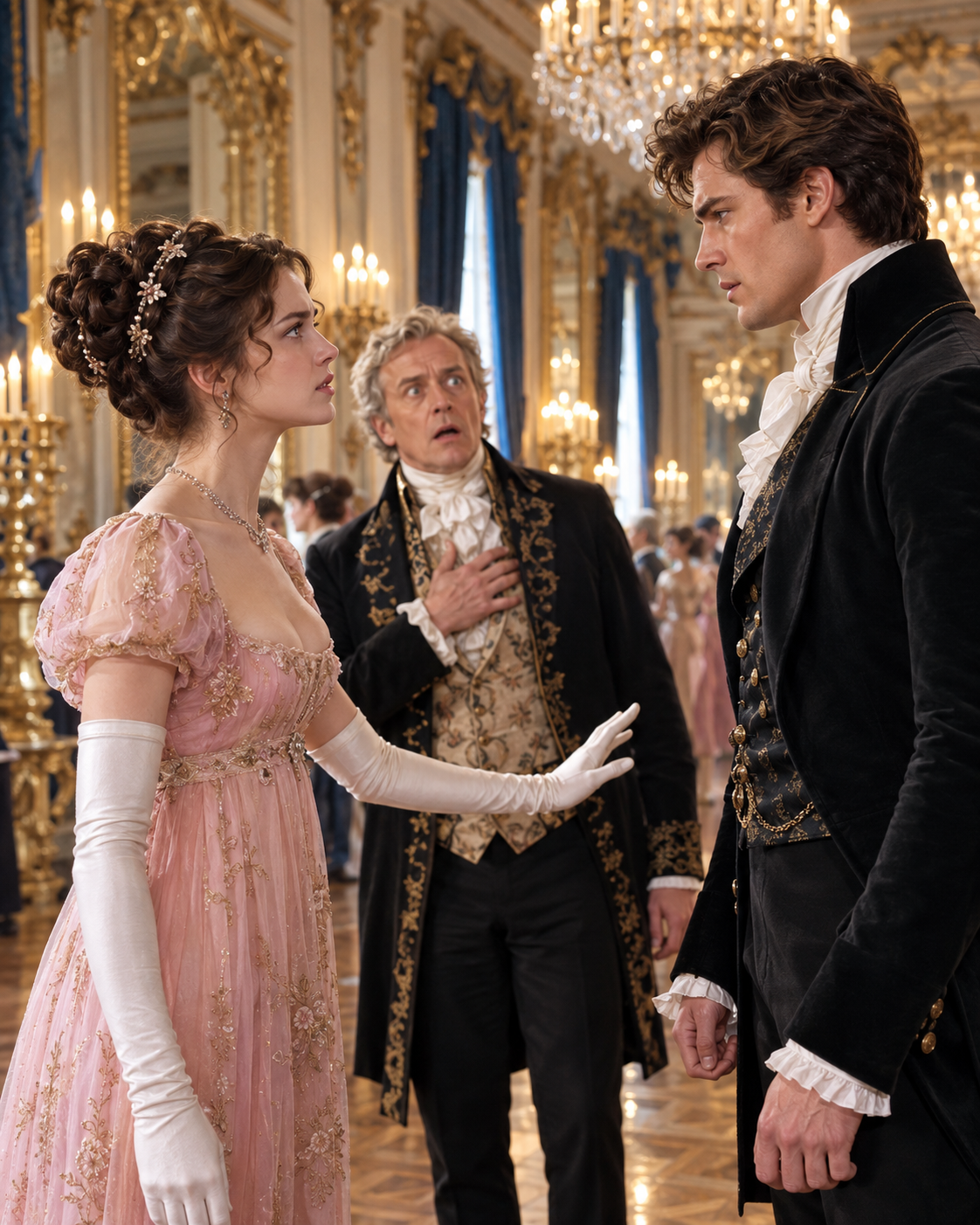
Three days earlier, Beatrice Croft had been nothing more than a woman Arthur Pendleton, Duke of Westmore, believed he could dismiss with a single cruel sentence in a glittering London ballroom.
The room went silent.
Beatrice Croft stood at the long mahogany table with one hand resting beside the final pages of the Baltic timber treaty. Three days of exhausting negotiations had reduced the Russian delegation to a tense, watchful quiet, but the document before them was finally complete.
Every clause had been examined.
Every number had been challenged.
Every phrase had been weighed carefully enough that a single careless translation could have destroyed the agreement.
Across the table, Count Vulkov slowly lifted his eyes from the final page.
“You are certain this is what your government means to offer?”
Beatrice answered in fluent Russian.
“I am certain this is what your side has agreed to accept.”
A faint smile touched the count’s mouth.
It was not a friendly smile.
It was the expression of a man who had spent three days searching for weakness and had finally accepted that he would not find it in her.
Arthur Pendleton, Duke of Westmore, watched from the other end of the table.
He had barely spoken.
For once, the most powerful man in the room understood that speaking would only get in the way.
The treaty was signed.
The pen scratched across the final page.
One signature.
Then another.
And another.
At last, Count Vulkov leaned back.
“The lady,” he said in English, “is more formidable than your advisers.”
Arthur did not look away from Beatrice.
“I know.”
Those two words made her glance toward him.
Something had changed in his voice.
There was no mockery in it.
No arrogance.
No trace of the man who had stood in a London ballroom and called her a mouse in a borrowed gown.
Only respect.
Beatrice gathered the papers.
“Then the matter is finished.”
“Not quite,” Arthur said.
She stopped.
The count’s attention shifted between them, sensing something private beneath the formal exchange.
Arthur rose.
“You have earned your payment.”
“I have.”
“And you intend to leave immediately.”
“I do.”
The answer was so calm that it irritated him.
Perhaps because he had spent the last three days discovering how much he disliked the thought of Westmore House without her in it.
Beatrice placed the final document inside its leather folder.
“Four thousand five hundred pounds, Your Grace.”
Arthur’s mouth tightened.
“You shall have every penny.”
“I expected nothing less.”
“And after that?”
She looked at him.
“After that, I go home.”
The simplicity of the answer struck harder than any accusation could have.
Arthur had imagined that after the treaty was signed, he would find some natural reason to keep her there.
Another negotiation.
Another document.
Another problem requiring her extraordinary abilities.
But Beatrice had anticipated him.
She had entered Westmore House with one purpose.
Earn the money.
Settle her father’s debts.
Protect her family.
Leave.
She had never asked him to save her.
And that realization disturbed him more deeply than he cared to admit.
The Russian delegation departed that evening.
The household returned to its usual silence.
Yet Arthur found himself standing alone in the library long after everyone else had retired.
The treaty lay on the desk.
The numbers were favorable.
The agreement could save Westmore’s remaining commercial interests.
It might even give him time to recover from the financial disasters his father had left behind.
But he could not stop thinking about the woman who had made it possible.
He remembered the first night.
The ballroom.
The laughter.
Her expression when he had insulted her.
She had not cried.
She had not protested.
She had simply looked at him as though she had learned something about him that everyone else in the room had failed to notice.
At the time, he had mistaken her silence for weakness.
Now he understood it had been restraint.
There was a difference.
A profound one.
Arthur pushed himself away from the desk.
He knew exactly what he had to do.
And, for perhaps the first time in his life, he did not care what society would think.
The next morning, Beatrice was preparing to leave Westmore House.
Her trunks had been packed.
Her father’s remaining papers were secured.
The payment Arthur had promised sat inside a sealed envelope.
For the first time in years, she could imagine opening her front door without fearing a creditor would be waiting.
She had almost reached the carriage when she heard footsteps behind her.
“Beatrice.”
She turned.
Arthur was coming down the steps.
He was not dressed for a morning appointment.
He was dressed as though he had made a decision and had no intention of delaying it.
“I thought you might be occupied with your guests,” she said.
“They have gone.”
“Then I assume the treaty is safe.”
“It is.”
“Good.”
She turned toward the carriage.
Arthur caught himself before reaching for her.
He stopped several feet away.
“I owe you an apology.”
Beatrice looked back.
“You do.”
“I should have given it before asking for your help.”
“Yes.”
“And I should never have said what I said in that ballroom.”
“No.”
His jaw tightened.
She was making this difficult.
Not because she was cruel.
Because she refused to make it easier than it deserved to be.
Arthur exhaled.
“You were right to demand payment.”
“I know.”
“And you were right not to trust me.”
Her expression softened slightly.
“Perhaps.”
He stepped closer.
“I was wrong about you.”
Beatrice studied him.
“That is not the same as understanding me.”
“No.”
For the first time, Arthur smiled faintly.
“I am beginning to.”
She said nothing.
He continued.
“You have spent your entire life being underestimated.”
“So have you.”
The words landed unexpectedly.
Arthur stared at her.
“What?”
“Your father left you a ruined estate and a mountain of obligations. You inherited a title that looked valuable from the outside and a financial disaster hidden underneath it.”
His expression changed.
“You knew.”
“I can read a balance sheet.”
“You had no reason to look.”
“I had three days inside your house.”
She tilted her head.
“You were not the only one paying attention.”
Arthur gave a quiet laugh.
“There it is.”
“What?”
“The part of you that refuses to let me have the last word.”
“I thought you appreciated that.”
“I do.”
The admission was immediate.
Beatrice looked away.
She should leave.
Every sensible part of her told her to leave.
The debt would be paid.
Her family would be safe.
Whatever strange understanding had grown between them belonged to those three extraordinary days and should remain there.
But Arthur was not finished.
“I don’t want another duchess.”
Her eyebrows lifted.
“I beg your pardon?”
“I have had enough conversations with women who are trained to agree with everything I say.”
“That sounds like a personal problem.”
“It is.”
His smile disappeared.
“I want someone who will tell me when I am wrong.”
“You have just described an exhausting marriage.”
“I have just described you.”
Silence settled between them.
Beatrice felt her heartbeat quicken.
Arthur stepped closer.
“I want an equal.”
“You hardly know me.”
“I know enough.”
“You know how I negotiate.”
“I know how you think.”
“You know how much I charge.”
“I know you were willing to risk your own reputation to protect your family.”
Her eyes narrowed.
“That is not the same thing as knowing me.”
“No,” he said softly. “But it is enough to make me want to know the rest.”
She looked toward the waiting carriage.
Then back at him.
“You are the Duke of Westmore.”
“I am aware.”
“And I am the daughter of a man whose debts nearly destroyed my family.”
“I am aware of that too.”
“You could marry someone with money.”
“I could.”
“Someone with connections.”
“Yes.”
“Someone who would make your life easier.”
Arthur’s expression became almost amused.
“Beatrice, I have spent my entire life choosing what was supposed to make my life easier.”
“And how has that worked?”
“Poorly.”
Despite herself, she laughed.
It was a small sound.
But Arthur looked at her as though he had been given something precious.
Then he said the words that changed everything.
“I don’t want a timid duchess.”
Beatrice’s smile faded.
“I want a wolf.”
The morning air seemed suddenly colder.
She stared at him.
“You called me a mouse.”
“I was an idiot.”
“That much has been established.”
He smiled.
“I was wrong because I saw a quiet woman and assumed she was weak.”
“And now?”
“Now I know quiet can be dangerous.”
She looked at him for a long moment.
“And what exactly do you expect this wolf to do?”
“Challenge me.”
“That sounds exhausting.”
“Probably.”
“Argue with you.”
“Frequently.”
“Question your decisions.”
“Please do.”
“Refuse to obey you.”
Arthur’s expression softened.
“I would prefer you choose to stand beside me.”
That was different.
Very different.
Beatrice had spent years watching men speak about women as though marriage were ownership dressed in respectable language.
Arthur was not offering her obedience.
He was offering partnership.
It frightened her.
Perhaps that was why she believed him.
“You make it sound simple,” she whispered.
“It won’t be.”
“No.”
“My debts remain.”
“So do mine.”
“My family expects things.”
“So does mine.”
“There will be gossip.”
“There always is.”
“And if I refuse?”
Arthur’s face became still.
“Then I will accept your answer.”
She searched his expression for manipulation.
There was none.
That mattered.
“You would really let me leave?”
“Yes.”
She looked at the carriage again.
Freedom was sitting there.
The road home was open.
The money was secured.
She could walk away from the duke and never see him again.
Yet something inside her had already changed.
Perhaps it had begun in the ballroom when he insulted her.
Perhaps in the library when he discovered she could understand Russian.
Perhaps during the second night, when they had both remained awake over financial ledgers and realized that their fathers had left them nearly identical burdens.
Or perhaps it had happened when Arthur stopped trying to impress her.
Whatever the reason, Beatrice knew one thing.
She did not want a man who needed her to be smaller.
And Arthur, strangely enough, seemed to want exactly the opposite.
She took a slow breath.
“If I agree,” she said, “you will never call me a mouse again.”
“Never.”
“You will never expect me to remain silent simply because other people are listening.”
“I would be disappointed if you did.”
“You will not interfere with my family’s affairs without my permission.”
“Agreed.”
“You will not use your title to win an argument.”
Arthur considered that.
“That may be the hardest condition.”
She almost smiled.
“And?”
“And I agree.”
Beatrice stepped toward him.
“One more thing.”
“What?”
“If you ever humiliate me in public again, I will make certain you regret it in three languages.”
Arthur laughed.
It was the first completely unguarded laugh she had heard from him.
“Then I suppose I had better be careful.”
“You had.”
He extended his hand.
Not commandingly.
Not as a duke.
As a man asking another person to walk beside him.
Beatrice looked at it.
Then she placed her hand in his.
Arthur closed his fingers around hers.
There was no grand audience.
No ballroom.
No orchestra.
No crowd waiting to witness the union of a duke and an unexpected bride.
Only the quiet steps of Westmore House, a waiting carriage, and two people who had spent three days discovering that the burdens inherited from their fathers did not have to define the rest of their lives.
Arthur leaned closer.
“Will you marry me?”
Beatrice looked directly into his eyes.
“You are remarkably confident for a man who has only just learned not to underestimate me.”
“I am terrified.”
That answer surprised her.
She laughed softly.
“Good.”
“Is that a yes?”
“It is a beginning.”
And somehow, that was better.
The wedding that followed was not the spectacle London society expected.
There were whispers, of course.
There were raised eyebrows.
There were people who could not understand why a duke would choose a woman who had no grand fortune, no influential family name, and no interest in pretending to be delicate.
But Arthur stopped listening.
Beatrice never tried to become the duchess society wanted.
She remained herself.
She continued studying languages.
She helped reorganize the household accounts.
She examined commercial correspondence that Arthur’s advisers had ignored.
She questioned investments.
She challenged assumptions.
And, slowly, Westmore House began to recover.
Not because Beatrice magically solved every problem.
Not because Arthur suddenly became a perfect man.
But because, for the first time, they stopped carrying their burdens alone.
Their fathers’ failures had once seemed like inheritances they could never escape.
Instead, those failures became lessons.
Arthur learned that wealth could disappear, titles could become liabilities, and pride could turn a manageable problem into a catastrophe.
Beatrice learned that independence did not mean refusing every hand extended toward her.
Sometimes strength meant choosing the person whose hand you trusted.
Years later, when people asked Arthur how he had chosen his duchess, he never mentioned the ballroom.
He never mentioned the insult.
He never mentioned the treaty.
He simply said that he had met a woman who looked at a problem, refused to be intimidated by it, and solved what everyone else had decided was impossible.
And when someone once joked that the Duke of Westmore had married a wolf, Arthur smiled.
“Yes,” he said.
“And I have never regretted it.”
Beatrice heard him from across the room.
She raised one eyebrow.
Arthur immediately added, “A very formidable wolf.”
She shook her head.
Some things, she had learned, never changed.
But perhaps that was the point.
Their story had not begun with love.
It had begun with pride, debt, humiliation, and a treaty that neither of them expected to matter beyond three difficult days.
Yet sometimes the people who enter our lives through our greatest mistakes become the people who teach us the most important lessons.
Arthur had thought Beatrice needed rescuing.
Beatrice had believed she had to rescue herself from everyone.
They were both wrong.
What they truly needed was someone who could stand beside them without asking either of them to become smaller.
The greatest bargain they made was never written on the pages of the Baltic treaty.
It was the quiet agreement between two people to face the future as equals.
And that was worth far more than £4,500.
The first winter of their marriage arrived quietly at Westmore House.
Snow settled over the gardens, covering the bare hedges and stone paths until the estate looked almost peaceful. Inside, however, peace was something Arthur and Beatrice had yet to learn.
They had discovered that being equal did not mean agreeing.
In fact, it meant quite the opposite.
“You cannot sell the northern timber rights,” Beatrice said, dropping a stack of accounts onto Arthur’s desk.
Arthur looked up from his correspondence.
“I can.”
“You can,” she corrected, “but you should not.”
He leaned back in his chair.
“And why, precisely, should I not?”
“Because you are looking at this quarter’s figures instead of the next five years.”
Arthur glanced down at the accounts.
“The estate needs immediate capital.”
“And selling those rights will give you immediate capital.”
“Yes.”
“And leave you dependent on another merchant within three years.”
Arthur paused.
Beatrice folded her arms.
“I thought you wanted me to challenge you.”
“I did.”
“You are welcome.”
He stared at her for several seconds.
Then he laughed.
“You are impossible.”
“You knew that before you married me.”
“I underestimated the scale of the problem.”
She tried not to smile.
“You are learning.”
That became the pattern of their marriage.
Arthur handled negotiations with bankers, merchants, and men who believed a duke should never admit uncertainty.
Beatrice examined the figures those men brought him.
Arthur maintained the family’s political and commercial connections.
Beatrice questioned the assumptions behind them.
He learned to listen.
She learned that allowing someone to help did not make her weak.
Together, they began rebuilding Westmore.
But just as the estate seemed to be finding its footing, a letter arrived from London.
It was sealed with the crest of the Pendleton family’s oldest banking house.
Arthur opened it at breakfast.
His expression changed almost immediately.
Beatrice noticed.
“What is it?”
He folded the letter.
“Nothing.”
She put down her teacup.
“Arthur.”
He sighed.
“You know that expression never works on me.”
He handed her the letter.
The bank was demanding immediate repayment of an old obligation.
Not one Arthur had created.
One his father had concealed.
The amount was enormous.
Large enough to threaten everything they had rebuilt.
Beatrice read the letter twice.
“How long?”
“Six weeks.”
“And how much liquid capital do we have?”
“Enough to survive.”
She looked up.
“Not enough to pay them.”
“No.”
Arthur stood and walked toward the window.
For the first time since their marriage, Beatrice saw something she had not seen even during the treaty negotiations.
Fear.
Not panic.
Not weakness.
Fear born from responsibility.
“If I lose Westmore,” he said quietly, “your family loses everything with me.”
Beatrice folded the letter.
“No.”
Arthur turned.
“No?”
“You are still thinking like a man trying to carry the entire estate on his shoulders.”
“I am responsible for it.”
“So am I.”
He stared at her.
She walked toward the desk.
“Bring me every account your father left.”
“Beatrice—”
“Every account.”
He hesitated.
Then he nodded.
For three nights, they worked until dawn.
They discovered hidden investments, old contracts, abandoned claims, unpaid debts, and one particularly suspicious agreement involving a London shipping company.
Beatrice recognized the name immediately.
“Arthur.”
“What?”
“This company appears in three separate ledgers.”
“Yes.”
“But it was never listed among your father’s active investments.”
He leaned over the page.
“That cannot be right.”
“It is.”
She pointed to the dates.
“Look.”
Arthur’s face hardened.
The company had been receiving payments for years.
Payments authorized by his father.
Payments that had never appeared in the official estate accounts.
“Someone was taking money.”
Arthur whispered the words.
Beatrice nodded.
“Someone still may be.”
The discovery changed everything.
Instead of being merely victims of an inherited financial disaster, they now had evidence that someone had deliberately concealed assets.
Arthur immediately wanted to confront the company’s director.
Beatrice stopped him.
“Not yet.”
“Why?”
“Because if he knows what we have found, he will destroy whatever evidence remains.”
Arthur looked at her.
The old Arthur might have ignored the advice.
This Arthur listened.
“What do you suggest?”
“We let him believe we know nothing.”
And so they created a plan.
Arthur returned to London and behaved exactly as society expected.
He attended dinners.
He met merchants.
He spoke casually about Westmore’s financial difficulties.
He even allowed rumors to circulate that the estate might be forced to sell part of its land.
Meanwhile, Beatrice quietly examined correspondence, compared signatures, and followed the money.
The trail eventually led to a warehouse near the Thames.
And there, she found something neither of them expected.
A series of contracts proving that Arthur’s father had secretly acquired shares in several shipping ventures.
The shares were worth far more than the estate’s outstanding debts.
Someone had been hiding them.
But why?
Arthur and Beatrice returned to Westmore House with the documents.
Arthur read them in silence.
“My father knew.”
“Yes.”
“He knew the estate was not ruined.”
“It appears so.”
“Then why did he allow creditors to believe otherwise?”
Beatrice looked at the final document.
“Because he owed someone something.”
Arthur frowned.
“Who?”
She turned the page.
There was a name.
Count Vulkov.
Arthur stared at it.
The Russian delegation.
The treaty.
Three days that had changed their lives.
Suddenly, the past was connected to the present.
Beatrice read the final paragraph aloud.
“Your father pledged future timber revenues as security for a private loan.”
Arthur closed his eyes.
“So the Baltic treaty was never just about trade.”
“No.”
“It was about recovering control of the timber rights.”
“Yes.”
He looked at her.
“And Vulkov knew.”
“Perhaps.”
The next morning, a messenger arrived.
A Russian seal marked the letter.
Arthur broke it open.
Count Vulkov had returned to London.
He wished to meet.
Privately.
That evening, Arthur and Beatrice entered a quiet room at a London hotel.
Count Vulkov was waiting.
He looked older than he had months earlier.
But his eyes were as sharp as ever.
“I wondered when you would discover the truth,” he said.
Arthur remained standing.
“You knew my father.”
“I did.”
“You lent him money.”
“Yes.”
“And he pledged the timber rights.”
“Yes.”
“Why did you never claim them?”
The count glanced at Beatrice.
“Because your wife negotiated a treaty that changed the value of those rights.”
Beatrice’s eyes narrowed.
“What are you saying?”
“Before your negotiation, Westmore’s timber interests were worth very little. After the treaty, they became valuable.”
Arthur understood.
The treaty had not merely saved his estate.
It had increased its value.
Vulkov continued.
“Your father believed the estate would eventually collapse. He intended to surrender everything.”
“And you stopped him?”
“No.”
The count paused.
“I offered him another choice.”
Arthur waited.
“He could keep the estate if he found someone capable of turning it around.”
Arthur almost laughed.
“You expected him to find Beatrice?”
“I expected him to find someone intelligent.”
Beatrice frowned.
“And instead he found a son.”
The count’s expression softened.
“Sometimes history chooses its own solution.”
Arthur sat down.
“So what do you want now?”
“Nothing.”
That answer surprised them both.
“I wanted the debt repaid,” Vulkov said. “You have done so indirectly by increasing the value of the treaty and stabilizing the estate.”
He rose.
“The matter is finished.”
Before leaving, he looked at Beatrice.
“You were right about one thing.”
“What?”
“The duke needed a wolf.”
Arthur smiled.
Beatrice rolled her eyes.
“I am beginning to regret that phrase.”
Vulkov laughed.
It was the first time either of them had heard him do so.
When they returned home, Arthur found Beatrice standing in the library.
The fire was burning low.
The estate was safe.
The hidden assets would cover the remaining debts.
Westmore was no longer on the edge of ruin.
Arthur stood beside her.
“You saved me.”
She shook her head.
“No.”
He looked at her.
“We saved each other.”
Beatrice smiled.
“That sounds better.”
He reached for her hand.
“Do you remember what you said the day we met?”
“That you were an idiot?”
“Before that.”
She thought for a moment.
“I remember you calling me a mouse.”
“I deserved that.”
“You did.”
Arthur looked toward the window.
“I spent years believing strength meant never needing anyone.”
Beatrice squeezed his hand.
“And I spent years believing independence meant never trusting anyone.”
He looked at her.
“We were both wrong.”
“Yes.”
Outside, snow began to fall again.
The same estate that had once seemed like a prison now looked like a home.
Arthur bent and kissed her forehead.
“I have one more question.”
Beatrice raised an eyebrow.
“What now?”
“If we had never met in that ballroom, what do you think would have happened?”
She considered it.
“I would have paid my father’s debts.”
“And me?”
“You would probably have made another terrible financial decision.”
He laughed.
“Probably.”
She rested her head against his shoulder.
“And perhaps we would both have survived.”
“Survived?”
“Yes.”
She looked up at him.
“But we would not have learned how to live.”
Arthur said nothing.
He understood.
Their marriage had never been built on rescue.
It had been built on recognition.
He had recognized the intelligence behind her silence.
She had recognized the burden beneath his arrogance.
They had both inherited failures they had never created.
But they had refused to inherit the same mistakes.
Years later, people would still tell the story of the Duke and Duchess of Westmore.
Some would remember the Russian treaty.
Others would remember the financial recovery.
A few would remember the scandalous beginning of their courtship.
But Beatrice remembered something simpler.
She remembered a ballroom.
A borrowed gown.
A cruel sentence.
And the moment she realized that being underestimated could become its own kind of freedom.
Arthur remembered it differently.
He remembered the woman he had dismissed.
The woman who had walked into his greatest crisis, named her price, and solved a problem that had defeated every man around him.
And whenever someone asked why he had married her, he always gave the same answer.
“Because she never asked me to become someone else.”
Then he would smile.
“And because she was the only person in England who was brave enough to tell a duke when he was being foolish.”
Beatrice always corrected him.
“Not the only one.”
“No?”
“No.”
She would look at him with that familiar spark in her eyes.
“Just the one you married.”
And that was how their story ended—not with a perfect life, nor with every problem magically solved, but with something far more valuable.
Two people who had once believed they had to carry their inherited burdens alone had learned that love was not about finding someone to rescue you.
It was about finding someone strong enough to stand beside you.
Someone who could challenge you without diminishing you.
Someone who could see your flaws and still choose you.
Arthur had once called Beatrice a mouse because he could not see her strength.
By the time their story was finished, he understood the truth.
She had never been a mouse.
She had simply been waiting for someone capable of recognizing the wolf beneath the silence.
And when he finally did, neither of them ever looked back.
THE END.