They threw their king into the river—and then spent three nights celebrating his death.
The door exploded inward.
Snow rushed into the shelter with the soldiers.
The woman screamed and stumbled backward.
The wolf moved before she could even breathe.
One moment he stood beside the fire.
The next, he was a blur of gray fur and blood.
The first soldier raised his sword.
The wolf struck his wrist.
Bone cracked.
The sword fell into the snow.
A second soldier lunged.
The wolf caught him by the chest and threw him against the wooden wall so hard that the entire shelter shook.
“Don’t kill them!” the woman cried.
The wolf stopped.
His jaws were inches from the soldier’s throat.
For a heartbeat, the shelter became silent.
Then the wolf released him.
The wounded soldier crawled backward, staring at the enormous animal with terror.
“He… he understands us,” one of the others whispered.
The wolf slowly turned his head.
His golden eyes fixed on them.
“No,” he growled.
“I understand everything.”
The soldiers froze.
Then something outside howled.
A single howl.
Another answered from the forest.
Then another.
Within seconds, the entire valley seemed to come alive.
The soldiers looked toward the broken doorway.
Shapes moved between the trees.
Dozens.
No—hundreds.
Wolves emerged from the snow, their breath rising like smoke in the moonlight.
Some were scarred.
Some were enormous.
Some were so old that their fur had turned white.
But every one of them stared at the wounded wolf.
And every one waited.
The woman finally understood.
They had not come to attack.
They had come to obey.
The largest wolf stepped forward and lowered his head.
Then another.
Then another.
The soldiers dropped their weapons.
One whispered, “The old king…”
The wolf’s ears lifted.
“What did you call him?”
The soldier swallowed.
“The king.”
The woman looked at the stranger beside her.
“You really are the king?”
He did not answer immediately.
Instead, he looked at the soldiers.
“Tell me who sent you.”
No one spoke.
The wolf took one step forward.
“Tell me.”
“The Regent,” one finally whispered.
The woman frowned.
“Regent?”
The king’s expression changed.
For the first time, the woman saw something colder than anger in his eyes.
Grief.
“They told the kingdom I was dead,” he said.
“They crowned my younger brother.”
The soldier nodded nervously.
“He sits on your throne.”
“My throne,” the wolf repeated.
“And how long has he sat there?”
“Three days.”
The king looked toward the distant mountains.
Three days.
Exactly three days since the river had swallowed him.
Three days since his brother had celebrated his death.
Three days since the palace bells had rung for a king whose body had never been found.
His claws sank into the snow.
“Take me to him.”
The soldiers exchanged terrified looks.
“You can’t,” one said.
“Why?”
“Because the whole kingdom believes you are dead.”
The king smiled.
It was not a happy smile.
“Then let them believe a little longer.”
He turned toward the woman.
She was still holding the knife.
Her hands were trembling.
“What is your name?”
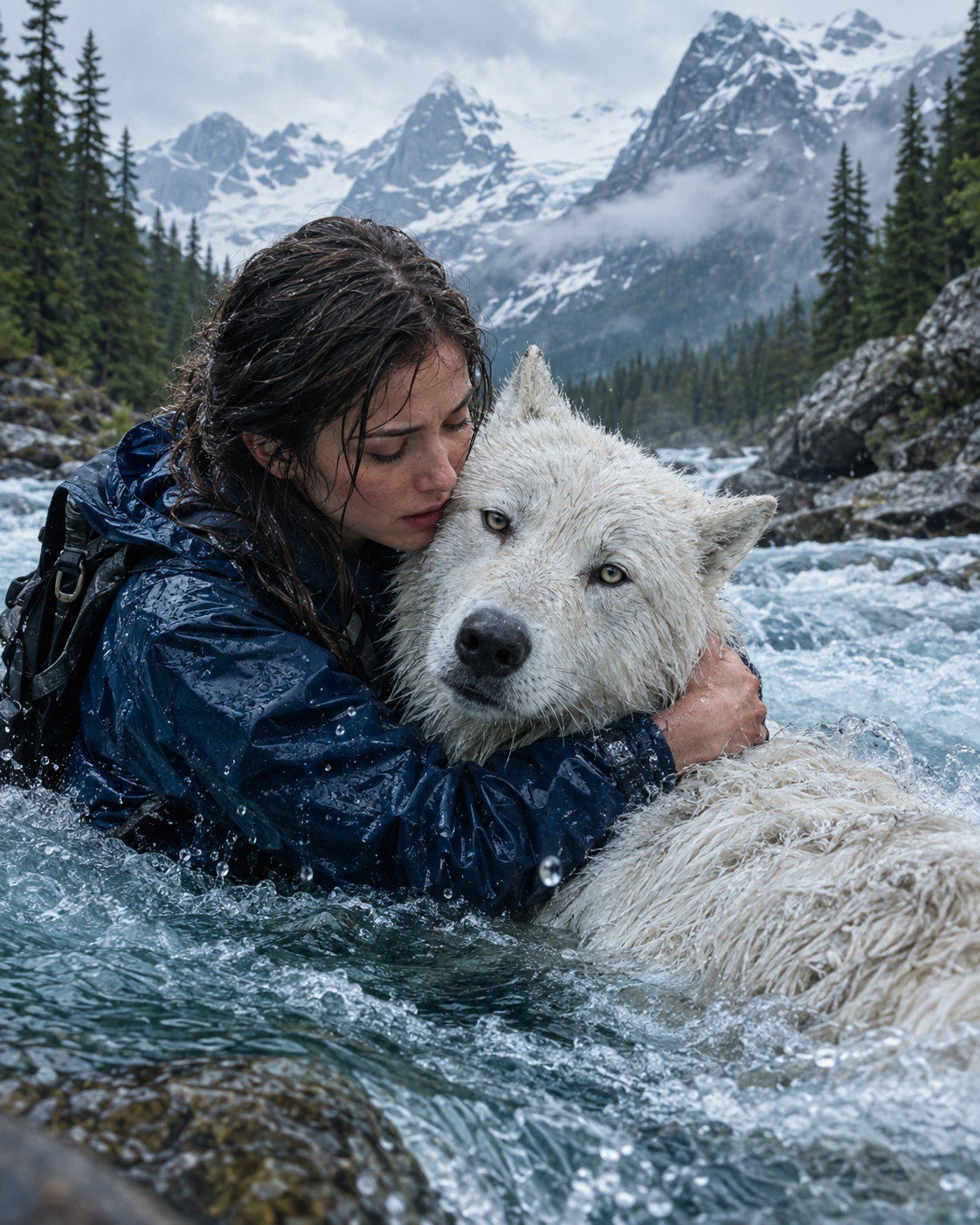
She hesitated.
“Elsa.”
“Elsa,” he repeated.
It was the first time anyone had spoken her name with such respect.
“You saved my life.”
“I didn’t know you were a king.”
“That is why it matters.”
He walked toward the wolves.
Elsa followed.
“Where are we going?”
“To war.”
She stopped.
“I cannot fight a war.”
The king looked back at her.
“No.”
His voice softened.
“You already won the first battle.”
She didn’t understand.
“You chose to save something everyone else would have left to die.”
Then he disappeared into the forest.
Elsa stood beneath the broken doorway, watching hundreds of wolves follow him into the darkness.
For the first time in her life, she wondered whether kindness could truly change the fate of a kingdom.
By sunrise, the king had reached the hidden valley.
It was a place no human army could easily enter.
Mountains surrounded it on three sides.
A frozen river cut through its center.
And beneath the cliffs stood ancient stone halls carved into the mountain.
This was where the old rulers had once made their secret pact with the wolves.
The king entered alone.
An old white wolf approached him.
Its eyes were cloudy with age.
“You took too long,” it said.
The king lowered his head.
“I almost died.”
“You did die.”
The king looked up.
The old wolf’s gaze sharpened.
“Your name was erased three nights ago.”
“My brother took the crown.”
“Your brother took more than the crown.”
The king’s face hardened.
“What do you mean?”
The old wolf turned.
“Come.”
Deep inside the mountain was a chamber illuminated by blue fire.
On the walls were paintings of kings and wolves standing together.
But the final painting had been scratched apart.
At its center was a symbol shaped like a broken circle.
“The ancient seal,” the old wolf said.
“The seal that protects your kingdom.”
The king stared at it.
“Why is it broken?”
“Because your brother broke it.”
The king stepped closer.
“That is impossible.”
“He wanted more than power.”
The old wolf looked directly into his eyes.
“He wanted the wolves to disappear.”
The king felt a chill that had nothing to do with the cold.
“Why?”
“Because as long as the wolves remain, the royal family cannot rule through fear.”
The king remembered his brother’s words from the night of the betrayal.
You were always too weak.
Too merciful.
Too willing to listen.
He had thought it was jealousy.
Now he understood.
His brother had not wanted to become king.
He had wanted to become the only power left.
“What did he do?”
“He opened the northern mines.”
The king’s eyes widened.
“Those mines are forbidden.”
“Not anymore.”
The northern mines contained a black stone known as nightstone.
It could absorb the ancient magic that connected the wolves to the kingdom.
If enough was removed, the wolves would weaken.
Then the king would have no army.
No protection.
No claim.
His brother had planned everything.
The assassination.
The river.
The false funeral.
The destruction of the seal.
And now the mines.
“How long?”
The old wolf looked toward the mountain.
“Two days.”
“Until what?”
“Until the seal is completely broken.”
The king turned.
“Then we have two days.”
“No.”
The old wolf shook its head.
“You have one.”
The king frowned.
“Why?”
“Because tomorrow night, your brother will perform the final ceremony.”
“And if he succeeds?”
The old wolf’s eyes became strangely sad.
“Every wolf in these mountains will forget the kingdom.”
The king was silent.
“They won’t die,” the old wolf continued.
“They will simply no longer recognize your blood.”
The king clenched his fists.
Then Elsa’s face appeared in his mind.
A woman who had saved him without knowing who he was.
A woman who had nothing.
No army.
No wealth.
No power.
And yet she had done what powerful men had failed to do.
She had chosen compassion.
“I need her.”
The old wolf stared at him.
“Why?”
“Because she reminds me what I am fighting for.”
The next morning, Elsa arrived at the valley.
She came riding an old horse that clearly hated every step it took.
The wolves surrounded her.
She looked terrified.
The king walked toward her.
“You shouldn’t have come.”
She dismounted.
“You said you were going to war.”
“I am.”
“Then someone has to make sure you don’t die again.”
The king almost smiled.
“You are very brave.”
“No,” Elsa said.
“I am frightened.”
“Then why come?”
“Because you saved me once.”
She looked around at the wolves.
“And I suppose I am responsible for you now.”
The king laughed.
It was the first time he had laughed since the betrayal.
The sound surprised even him.
But there was no time for more.
A scout came running through the snow.
“Humans!”
The king’s expression changed.
“How many?”
“Thousands.”
The valley fell silent.
The army of the new king had arrived.
Black banners appeared between the mountains.
At their center rode a man wearing a golden crown.
The king’s brother.
Prince Adrian.
The man who had thrown him into the river.
Adrian stopped before the valley.
He raised his hand.
A horn sounded.
“By order of the king,” he shouted, “surrender the traitor hiding among the wolves!”
Elsa looked at the king.
“You?”
The king stepped forward.
“No.”
He walked into the open snow.
“Me.”
The soldiers stared.
Adrian slowly removed his gloves.
For a moment, neither brother spoke.
Then Adrian smiled.
“You survived.”
“You sound disappointed.”
“I am.”
The king’s voice became cold.
“You killed our father.”
Adrian’s smile disappeared.
“You were always sentimental.”
“He trusted you.”
“He was weak.”
“And you?”
Adrian spread his arms.
“Look around you.”
Behind him stood thousands of soldiers.
“I have united the kingdom.”
“You murdered its king.”
“I removed an obstacle.”
“You murdered your brother.”
“I removed another.”
Elsa felt sick.
Adrian looked past the king.
Then his eyes fell on her.
“And that must be the woman.”
The king moved instantly, placing himself between them.
Adrian laughed.
“So the great king hides behind a peasant now?”
“No.”
The king’s voice echoed across the valley.
“I stand in front of her.”
The wolves began growling.
Adrian raised his hand.
Archers appeared along the ridge.
The king saw the black arrows.
Nightstone tips.
“Don’t,” he warned.
Adrian smiled.
“Do you know what I discovered while you were drowning?”
He pulled a small black crystal from his coat.
“The wolves can bleed.”
He crushed it.
A wave of darkness spread across the valley.
The wolves screamed.
Hundreds collapsed.
Elsa fell to her knees.
The king roared.
He ran toward Adrian.
Arrows filled the sky.
The wolves charged.
The battle began.
Snow turned red.
Swords clashed against claws.
Men screamed as wolves tore through the front lines.
But the black arrows changed everything.
Every wolf struck by one became weaker.
Some collapsed immediately.
Others stumbled away.
The king fought through the soldiers, but more came.
Then Adrian appeared before him.
Sword in hand.
“You always had the wolves,” Adrian said.
“You never deserved them.”
The king blocked the first strike.
“You’re wrong.”
Another strike.
“They never belonged to me.”
Another.
“I belonged to them.”
Adrian attacked with fury.
The king was still wounded.
His injured leg buckled.
Adrian saw the weakness.
He drove his sword forward.
The blade pierced the king’s side.
Elsa screamed.
The king fell.
Adrian raised his sword for the final blow.
Then Elsa stepped between them.
She held the same small knife she had carried in the shelter.
Adrian laughed.
“You?”
“Yes,” she said.
Her voice shook.
“But I am not alone.”
Behind her stood the surviving wolves.
Blood covered their fur.
Their eyes burned with rage.
Adrian looked around.
“Kill them.”
The soldiers hesitated.
Then something strange happened.
One soldier lowered his sword.
Another followed.
Then another.
A captain removed his helmet.
“I fought for the old king,” he said.
Adrian stared at him.
“The old king is dead.”
The captain looked at the wounded man in the snow.
“No.”
“He isn’t.”
More soldiers lowered their weapons.
Adrian’s face twisted with fury.
“You swore loyalty to me!”
The captain shook his head.
“We swore loyalty to the crown.”
He looked at the king.
“Not the man who stole it.”
Adrian backed away.
“You’re all traitors.”
“No,” Elsa said.
“We’re witnesses.”
Adrian turned and ran.
The king tried to rise.
Elsa caught him.
“Don’t.”
“He’ll reach the mines.”
“I know.”
“Then we go.”
“You’re bleeding.”
“So are the wolves.”
Elsa stared at him.
Then she helped him stand.
Together, they entered the mountain.
The final ceremony had already begun.
Deep beneath the earth, Adrian stood before the broken seal.
Nightstone surrounded him.
Black fire burned in a circle.
He raised the royal crown above the stone.
“By blood,” he whispered.
“By power.”
“By right.”
The seal cracked.
The wolves outside cried out.
The king entered the chamber.
“Adrian!”
His brother turned.
“You should be dead.”
“I was.”
Adrian smiled.
“Then die properly this time.”
He slammed the crown onto the stone.
The chamber shook.
A wave of darkness struck the king.
He fell to one knee.
Elsa grabbed his arm.
“Don’t let go.”
“I can’t stop it.”
“Yes, you can.”
“How?”
She pointed toward the seal.
“The crown.”
The king looked at it.
Adrian laughed.
“You think removing a crown will undo everything?”
“No,” Elsa said.
“I think returning it will.”
The king understood.
The old law.
The crown did not create the king.
The king gave meaning to the crown.
He crawled toward the seal.
Adrian attacked.
Elsa threw herself between them.
The blade stopped inches from her chest.
The king grabbed Adrian’s wrist.
The brothers struggled.
“You wanted everything,” the king said.
Adrian snarled.
“I wanted what you were too weak to take.”
“You had the crown.”
“I wanted them to fear me.”
“That is why you lost.”
The king twisted his brother’s arm.
The sword fell.
Adrian punched him.
The king staggered.
Adrian reached for the crown.
Elsa kicked it away.
It rolled across the stone floor.
Adrian stared at her.
“You insignificant—”
He lunged.
The king caught him.
Both brothers crashed against the edge of the ancient seal.
A crack appeared beneath Adrian’s feet.
The darkness opened.
Adrian looked down.
Then up.
For the first time, fear entered his eyes.
“Help me.”
The king froze.
His brother was hanging over the abyss.
One hand gripping the edge.
The easy choice was to let go.
No one would blame him.
Adrian had killed their father.
Stolen the throne.
Thrown him from a cliff.
Destroyed the wolves’ ancient home.
The king reached down.
Adrian grabbed his hand.
Elsa stared in disbelief.
“You’re saving him?”
The king struggled to pull his brother upward.
“I won’t become him.”
Adrian suddenly smiled.
Then he tried to pull the king down with him.
The king’s grip slipped.
Elsa grabbed the king’s arm.
The old wolves appeared at the chamber entrance.
The king looked at them.
“Help me.”
They rushed forward.
Together, they pulled the king away from the edge.
Adrian fell.
His scream vanished into darkness.
Silence returned.
The crown lay beside the broken seal.
The king picked it up.
For a long moment, he looked at it.
Then he placed it on the ground.
Not on his head.
On the seal.
The ancient symbol began to glow.
The black stones cracked.
Light poured through the chamber.
Across the mountains, wolves lifted their heads.
The magic returned.
The snow stopped falling.
And somewhere deep beneath the earth, the broken seal closed.
When the king returned to the palace, the bells rang again.
But this time, they did not announce a death.
They announced his return.
The people filled the streets.
Some cried.
Some knelt.
Some simply stared.
The king walked through the gates without armor.
Beside him walked Elsa.
Behind them came the wolves.
Adrian’s soldiers surrendered before sunset.
The corrupt council was removed.
The stolen crown was placed before the king.
The oldest councilman bowed.
“Your Majesty.”
The king looked at the crown.
Then at the people.
Then at Elsa.
“I will wear it,” he said, “but never forget what it means.”
He turned to the crowd.
“A crown is not proof that a person deserves to rule.”
The streets became silent.
“Blood is not proof.”
“Power is not proof.”
“Fear is not proof.”
He lifted the crown.
“Character is.”
He placed it on his head.
Then he removed it again.
“And a king who forgets the people beneath him is no king at all.”
The crowd began to cheer.
But the king did not smile.
He looked toward the mountains.
The wolves were already leaving.
The old white wolf paused at the edge of the forest.
The king walked toward him.
“Will you stay?”
The wolf shook its head.
“We never belonged in your palace.”
“Then where will you go?”
“Where we have always been.”
The king nodded.
“Will I see you again?”
The old wolf looked at him.
“When you forget why you wear the crown.”
Then he disappeared into the trees.
Years passed.
The kingdom changed.
The mines were closed.
The ancient forests were protected.
The poor were allowed to speak before the royal council.
The king opened the palace gates once a month so ordinary people could enter without fear.
And beside the throne, there was always one empty chair.
People often asked why.
The king always gave the same answer.
“It belongs to the person who reminds me when I am wrong.”
That chair belonged to Elsa.
She never wanted a title.
Never asked for gold.
Never became a princess.
She remained exactly what she had been before the night everything changed.
A woman who saw a wounded creature in the snow and decided not to walk away.
One winter evening, many years later, the king stood alone on the palace balcony.
Snow covered the mountains.
A distant howl echoed through the valley.
He smiled.
Then he heard footsteps behind him.
Elsa stood in the doorway.
“You’re thinking too much again.”
The king laughed.
“I was thinking about the river.”
“The river?”
“The night you found me.”
She walked beside him.
“You were almost dead.”
“I remember.”
“You looked terrible.”
“I was a king.”
“You looked like a wet dog.”
The king laughed so loudly that the guards outside turned to look.
Then his expression softened.
“Why did you save me?”
Elsa looked at the mountains.
“I didn’t know you were a king.”
“I know.”
“That was the point.”
The king nodded.
She continued.
“If I’d known, I might have been afraid.”
“Would you have saved me?”
She smiled.
“I don’t know.”
He looked at her.
“That is the most honest answer you’ve ever given me.”
She shrugged.
“You were just a wounded creature.”
The king looked toward the distant forest.
“And that saved me.”
“No,” Elsa said.
“You saved yourself.”
He shook his head.
“You gave me a reason to.”
For a while, neither spoke.
Then another howl rose from the mountains.
This time, hundreds answered.
The king closed his eyes.
He remembered the frozen river.
The blood.
The betrayal.
The crown.
His brother’s hand slipping from his.
And the woman who had dragged a dying wolf through the snow without knowing his name.
He finally understood the lesson hidden inside all of it.
A kingdom could be stolen with an army.
A throne could be taken with a sword.
A crown could be placed on the head of a murderer.
But none of those things could create a true king.
Leadership was not about being feared.
It was about being trusted.
It was not about having people kneel.
It was about being willing to kneel when someone else needed help.
And sometimes, the person who teaches a king how to rule is not a general, a noble, or a prince.
Sometimes it is simply a stranger who sees something broken and chooses to save it.
The king turned from the balcony.
“Come.”
“Where?”
“Home.”
Elsa smiled.
“You mean the palace?”
He shook his head.
“No.”
He looked toward the mountains.
“Home is wherever we remember who we are.”
And together they walked inside as snow covered the kingdom below.
Far beyond the palace, beneath the ancient trees, a pair of golden eyes watched from the darkness.
The old white wolf was gone.
But his successor stood on the ridge.
The wolf raised its head.
And howled.
The king stopped.
He heard it.
He smiled.
Then he bowed his head—not as a king before his subjects, but as a man before an old promise.
The wolves had not forgotten him.
And neither had he forgotten them.
Years later, the story would be told to children around winter fires.
They would hear how a king was thrown from a cliff.
How his enemies celebrated his death.
How a poor woman saved a dying wolf.
How hundreds of wolves came out of the snow.
How a stolen crown was returned.
And how a king defeated his greatest enemy not by becoming more cruel, but by refusing to become cruel at all.
Some children would ask whether the story was true.
The old storytellers would smile.
“Perhaps.”
“But did the king really become a wolf?”
“No.”
“Did wolves really bow to him?”
“Yes.”
“Why?”
The storyteller would lean closer to the fire.
“Because they knew something humans often forget.”
“What?”
“That the strongest ruler is not the one who can make everyone afraid.”
He would look around the room.
“It is the one who has enough power to destroy his enemy—and enough wisdom to choose what kind of person he will be afterward.”
And outside, when the winter wind crossed the mountains, sometimes a wolf would howl in the distance.
The children would fall silent.
Because deep down, they understood.
Some legends are not meant to teach us that kings are powerful.
They are meant to teach us that even kings can be saved.
And sometimes, saving one wounded soul is enough to save an entire kingdom.
THE END.