“They sealed the injured creature’s cage at Terminal 14 while my supervisor called me reckless, but the strange silence in its throat hid a truth nobody there understood.”
The metal fragment was warm when I first picked it up.
That was the part that frightened me most.
The storm had already swallowed the last orange light from the sky, and the runway lights were blinking through a curtain of freezing rain. Everything around me had gone back to normal. Workers were returning to their stations. Cargo handlers were restarting the loaders. Daniel was speaking to someone over his radio.
But I stood alone on the runway, staring at the symbol engraved into that twisted piece of metal.
I knew it.
Three interlocking crescents surrounded by a narrow vertical line.
The same mark appeared on the cargo containers that had arrived at Terminal 14 for the past six months.
Officially, the containers belonged to a company called Northstar BioTransit.
Officially, they carried medical equipment, environmental sensors, and biological research supplies.
I had scanned hundreds of them.
I had never questioned what was inside.
Until now.
“Maren.”
Daniel’s voice came from behind me.
I closed my fingers around the fragment.
“Where did you find that?”
“Inside Echo’s leg.”
His face changed.
Only for a second.
But I saw it.
Daniel looked at the metal, then toward the cargo platforms.
“Give it to me.”
“No.”
His eyes narrowed.
“Maren, this is not a request.”
“You knew something was wrong.”
“I know that you are exhausted.”
“You knew.”
He stepped closer.
“You found an injured animal and became emotionally attached. That happens. But you don’t understand what you’re looking at.”
“Then explain it.”
Daniel said nothing.
Rain struck the metal roof above us like handfuls of gravel.
Finally, he lowered his voice.
“Go home.”
“I want to know what that symbol means.”
“You really don’t.”
“Why?”
“Because some questions don’t lead to answers. They lead to people.”
He walked away before I could respond.
That night, I did not go home.
I went to the cargo office.
Terminal 14 had dozens of security cameras, but only a handful were monitored after midnight. I logged into the shipping database and searched the Northstar manifests.
At first, everything looked ordinary.
Then I noticed something strange.
The weight listed on several containers did not match the weight recorded by the station’s loading sensors.
Not by a few kilograms.
By hundreds.
I checked another shipment.
Same problem.
Then another.
Every container bearing the crescent symbol had a discrepancy.
I pulled the archived inspection reports.
Most had been approved by Daniel.
All of them.
My hands began to shake.
I opened the oldest record I could find.
Six months earlier.
Container 14-NB-773.
Origin: Veyra Research Colony.
Destination: Northern Wildlife Preservation Zone.
Contents: acoustic mapping equipment.
Weight discrepancy: 418 kilograms.
Inspection status: cleared.
I stared at the screen.
Why would acoustic equipment weigh nearly half a ton more than declared?
I searched the destination.
Nothing.
The preservation zone did not exist in the station’s public transportation database.
It existed only in restricted government records.
I should have stopped there.
Instead, I searched for the Grevak migration routes.
The system returned three old environmental studies.
Two had been removed.
The third contained a map.
My breath caught.
Terminal 14 sat directly beside one of the Grevak’s traditional migration corridors.
And the corridor had been marked as abandoned seventeen years ago.
Abandoned because, according to the report, no Grevak packs had been detected in the region for more than a decade.
That was impossible.
I had just watched an entire pack descend onto the runway.
Something had driven them away.
Something had kept them from returning.
At 2:13 in the morning, I heard footsteps outside the office.
I killed the monitor.
The door opened.
Daniel walked in.
He did not look surprised to see me.
“You should have gone home.”
“I found the migration report.”
His jaw tightened.
“And the cargo discrepancies.”
Silence.
“Tell me what Northstar is transporting.”
Daniel closed the door.
For the first time since I had known him, he looked afraid.
“Not here.”
“Then where?”
“Come with me.”
He led me through a maintenance corridor beneath Terminal 14.
We passed locked doors I had never noticed before.
At the end was a freight elevator.
Daniel entered a six-digit code.
The doors opened.
We descended.
The elevator traveled much farther than I expected.
When the doors finally opened, I stepped into a concrete chamber beneath the station.
There were no cargo workers down there.
No equipment.
No medical supplies.
Only rows of steel doors.
And on every door was the crescent symbol.
“What is this?”
Daniel rubbed his face.
“Seventeen years ago, the Grevak stopped using this migration corridor.”
“Why?”
“Because people discovered something beneath it.”
He pressed his hand against one of the steel doors.
“The Grevak don’t just migrate through this region. They follow underground resonance fields. Natural frequencies created by mineral formations deep beneath the earth.”
I frowned.
“Like a compass?”
“More complicated. The packs can hear those frequencies across hundreds of kilometers. They use them to navigate.”
“And Northstar?”
“They discovered that the resonance fields could be amplified.”
My stomach tightened.
“For what?”
“To locate things.”
Daniel opened the steel door.
Inside was a laboratory.
Banks of equipment covered the walls. Huge circular instruments hummed beneath blue lights. At the center stood a cylindrical chamber filled with dark mineral fragments.
“Rare minerals,” Daniel said. “The resonance is strongest around certain deposits. Northstar discovered that Grevak trail tones interact with those deposits.”
“So the animals can locate them?”
“Yes.”
I looked at the equipment.
“They’re using Grevak to find mineral deposits.”
Daniel nodded.
“More accurately, they were using their migration patterns.”
A chill ran through me.
“The abandoned packs.”
“They weren’t abandoned.”
Daniel’s voice was barely a whisper.
“They were intercepted.”
I stepped backward.
“What does that mean?”
“Northstar captured several Grevak juveniles. They implanted resonance devices into their bodies and released them at different points along the migration corridor.”
I looked down at the metal fragment in my hand.
“The devices.”
“Yes.”
“They used the hatchlings as living tracking beacons.”
Daniel looked away.
“When the adults followed the implanted young, Northstar could map the underground resonance fields.”
“How many?”
“Dozens.”
My chest tightened.
“And when they were finished?”
Daniel didn’t answer.
He didn’t need to.
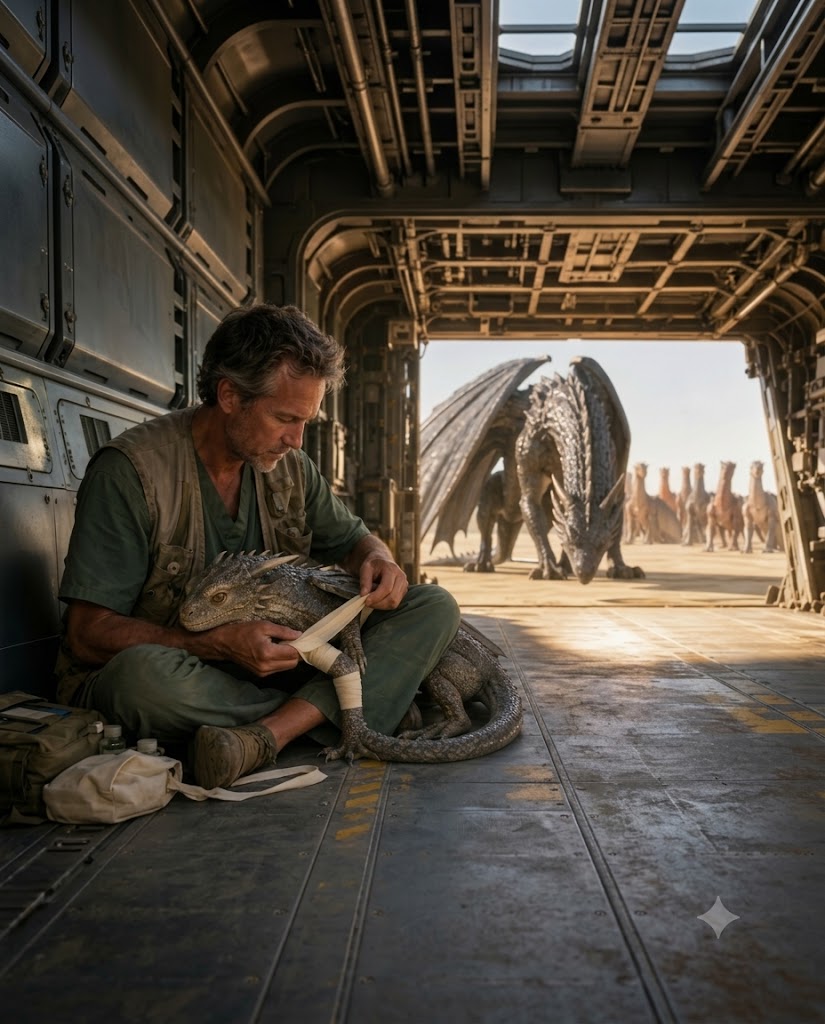
I thought of Echo curled beneath the loading platform.
His crooked leg.
His missing voice.
The way his chest trembled every time he tried to call.
“They put the device in his leg.”
“Yes.”
“And then?”
“He escaped.”
“Or someone let him escape.”
Daniel looked at me.
“I don’t know.”
I stared at the machinery.
“Why would anyone silence him?”
“Because a Grevak with an active trail tone can lead an entire pack back to a tracking site.”
“And Echo could have led them here.”
“Yes.”
“But he couldn’t call.”
“That was the point.”
My fingers tightened around the metal fragment.
Someone had not abandoned Echo.
Someone had silenced him.
Then the lights went out.
Every machine in the laboratory died at once.
Daniel grabbed my arm.
“Don’t move.”
A sound came from the corridor.
One slow metallic step.
Then another.
Someone was coming.
Daniel pulled me behind the equipment.
The laboratory door opened.
A man entered carrying a flashlight.
He wore a Northstar security uniform.
He looked around.
“Reeves?”
Daniel held his breath.
The beam passed across the floor.
Then stopped.
The man’s voice changed.
“Maren?”
I felt Daniel’s hand close around my wrist.
The man knew my name.
The flashlight moved again.
We ran.
Daniel shoved a metal cart into the doorway as the security officer lunged after us.
We sprinted down the corridor.
An alarm began screaming behind us.
“Left!” Daniel shouted.
We turned.
A second guard appeared at the far end.
Daniel pushed open an emergency hatch.
We climbed through a narrow ventilation shaft as boots thundered below us.
The shaft was barely wide enough for my shoulders.
I crawled forward until I could see a faint strip of light ahead.
Then the floor beneath me disappeared.
I fell.
I landed hard on a pile of insulation and heard something crack beneath my ribs.
“Maren!”
Daniel dropped beside me.
“I can breathe,” I gasped.
He looked relieved.
Then I saw where we had fallen.
We were inside an old observation room.
Through a dusty window, I could see the underside of the terminal.
Hundreds of cargo crates sat in rows.
And between them were cages.
My blood went cold.
Inside the cages were Grevak.
Not adults.
Hatchlings.
Six of them.
All injured.
All silent.
I covered my mouth.
Daniel stared through the glass.
“I thought they shut this operation down.”
“You knew?”
“I knew about the first facility. I didn’t know they had restarted it.”
“Then help me.”
“Maren—”
“Help me.”
Something changed in his face.
He nodded.
We found the control panel.
The cage locks were electronically sealed.
Daniel tried the emergency override.
Denied.
I looked through the glass at the smallest hatchling.
It had a crooked front leg.
For a second, I saw Echo again.
I understood then why he had been so terrified of silence.
It wasn’t the absence of sound.
It was the memory of being unable to answer.
I grabbed the emergency hammer from the wall.
“What are you doing?”
“Opening the cages.”
“Maren, those doors are reinforced.”
“Then we’ll keep hitting them.”
We broke the first lock.
Then the second.
Then the third.
The hatchlings scrambled into the observation room, terrified and disoriented.
One of them collapsed against my boots.
I knelt.
“It’s okay.”
It made no sound.
Behind us, the door began to shake.
The guards had found us.
Daniel looked at the remaining cages.
“Go.”
“What?”
“I’ll hold them.”
“No.”
“You saved one Grevak. Save the others.”
He grabbed the emergency radio.
“I can trigger the station evacuation system.”
“And then?”
“Then everyone comes upstairs.”
“What about you?”
He looked at me.
“I’ve spent seventeen years telling myself I was only following orders.”
He swallowed.
“I think I’m tired of that excuse.”
The door burst open.
Daniel hit the evacuation switch.
Every alarm in Terminal 14 erupted simultaneously.
Red lights flooded the facility.
A recorded voice announced an emergency evacuation.
Workers began shouting overhead.
The guards hesitated.
Daniel stepped between them and the hatchlings.
“You’re not taking them.”
One guard raised his weapon.
Then a sound rolled through the building.
Low.
Deep.
Almost too powerful to hear.
The walls vibrated.
Every Grevak hatchling lifted its head.
Another call answered from outside.
Then another.
And another.
The sound grew until the entire terminal seemed to tremble.
I knew that voice.
Echo.
The pack had returned.
Through the observation window, enormous shadows swept across the skylights.
The guards looked upward.
Daniel smiled.
“Looks like they found us.”
The glass ceiling exploded inward.
Grevak descended through the rain like living pieces of the night.
Workers screamed and ran.
The security guards dropped their weapons.
The matriarch landed on the roof above us.
Her trail tone shook dust from the ceiling.
Every hatchling answered.
Not perfectly.
Not loudly.
But they answered.
And suddenly I understood.
The Grevak had never needed humans to save them.
They needed humans to stop hurting them.
We released the remaining cages.
The hatchlings rushed toward the open loading platform.
The adult Grevak formed a circle around them.
Echo landed last.
He was larger already, his silver scales shining beneath the emergency lights.
He looked at me.
Then he looked at Daniel.
Then he turned toward the laboratory.
The matriarch followed his gaze.
She understood.
Her eyes fixed on the equipment beneath the station.
The next sound she made was unlike anything I had ever heard.
The resonance machines exploded.
One after another, the blue lights shattered.
The circular instruments cracked apart.
The mineral chamber split down the middle.
A deep vibration rolled through the ground.
Then the floor began to move.
“Run!” Daniel shouted.
We raced toward the upper levels as the underground laboratory collapsed behind us.
Concrete rained from the ceiling.
Water burst through the walls.
The entire lower facility had been built directly over a natural resonance chamber.
Northstar had not discovered the Grevak’s secret.
They had built their operation around something they did not understand.
And now that secret was breaking free.
We reached the terminal floor just as the runway buckled.
The Grevak rose into the air.
Workers scattered.
Cargo containers toppled.
One of the Northstar trucks slid sideways across the platform and crashed into the loading barrier.
Then the ground went still.
For several seconds, nobody moved.
Rain fell through the broken roof.
The alarms continued to howl.
Daniel stood beside me, bleeding from his forehead.
“Are they all out?”
I looked toward the sky.
The pack was already circling above Terminal 14.
All of them.
The hatchlings.
The adults.
Echo.
No cage remained.
No device remained inside them.
For the first time, the migration corridor belonged to them again.
Federal investigators arrived before sunrise.
Northstar tried to claim that Terminal 14 had been used without authorization.
They denied everything.
Then the investigators found the laboratory.
They found the implants.
They found the records.
They found seventeen years of suppressed migration data.
The truth was no longer something anyone could bury.
Daniel gave a full statement.
He admitted what he had known and what he had ignored.
It cost him his job.
It probably saved his conscience.
As for me, I spent three weeks in hearings explaining how I had found Echo, how he had recovered, and why I had refused to let him be euthanized.
One investigator asked me a question I still remember.
“Why did you risk your career for one injured animal?”
I thought about Echo’s first trail tone.
About the way his entire body had trembled when he finally heard another Grevak answer him.
And I said, “Because sometimes the fact that something cannot speak doesn’t mean it has nothing to say.”
The investigation changed Terminal 14 forever.
The underground facility was dismantled.
The migration corridor was declared protected territory.
Northstar lost its licenses.
Several executives were prosecuted.
New laws were written requiring transit stations along wildlife corridors to report injured migratory species instead of disposing of them.
People called me brave.
I never believed that.
I had been frightened almost every day.
Bravery, I learned, wasn’t the absence of fear.
Sometimes it was simply deciding that fear didn’t get to make the decision.
Months passed.
Winter ended.
Spring came slowly to the northern valleys.
One morning, I received an envelope without a return address.
Inside was a photograph.
It showed the Grevak pack flying over a mountain range.
On the back, someone had written only three words.
HE REMEMBERS YOU.
I stared at the photograph for a long time.
Then I heard something outside my apartment window.
A low vibration.
So faint I almost mistook it for distant thunder.
I stepped onto the balcony.
The sky was clear.
No aircraft.
No storm.
Nothing moved above the rooftops.
Then the sound came again.
A deep, gentle note that seemed to pass through the air and settle inside my chest.
I smiled.
“Echo?”
A shadow crossed the moon.
I looked up.
He was flying alone.
Bigger now.
Stronger.
His silver-gray scales caught the moonlight as he circled once above the city.
Then he released a trail tone.
I raised my hand.
He answered with another.
For a few seconds, we simply called to each other across the distance.
Then Echo turned toward the north.
Toward the mountains.
Toward the place where his pack waited.
I watched until he disappeared.
I used to think that saving something meant keeping it close.
Keeping it safe.
Making sure it never left.
Echo taught me the opposite.
Sometimes love means giving a frightened creature enough safety to remember where it belongs.
Sometimes the smallest act of kindness can expose a truth powerful enough to shake an entire system.
And sometimes silence is not emptiness.
Sometimes silence is the space where a voice is fighting to return.
Years later, people still talked about the night the Grevak came down on Terminal 14.
They remembered the broken roof.
The collapsing laboratory.
The hundreds of workers staring into the sky.
They remembered the investigation and the scandal.
But I remembered something different.
I remembered a tiny hatchling beneath a loading platform, trembling in the freezing rain.
I remembered his crooked leg.
His frightened eyes.
The empty dish on the fourth day.
The first vibration in his chest.
And the moment he finally understood that someone was listening.
That was all it had taken.
One person listening.
One person refusing to believe that a silent creature had nothing left to say.
I never saw Echo that close again.
I didn’t need to.
Every autumn, when the Grevak migration passed over the northern mountains, I would step outside and listen.
Sometimes I heard nothing.
Sometimes the wind was too strong.
Sometimes the clouds covered the stars.
But once in a while, just before dawn, a deep resonant note would travel across the valley.
And whenever I heard it, I remembered the little creature who had once been marked as disposable.
He had not needed me to give him a life.
He had already possessed one.
He only needed someone to protect it long enough for him to find his way home.
That became the lesson I carried with me.
Not every broken thing needs to be fixed by someone else.
Not every lost voice needs to be spoken for.
Sometimes the greatest kindness we can offer is much simpler.
We can stay.
We can listen.
And when the world has already decided that something is worthless, we can be the one person willing to say,
“Wait.
Let me hear what it has to say.”
For several seconds, I could not move.
The metal fragment lay in my palm, cold now, but the skin around it seemed to burn.
Echo was gone.
The Grevak pack had disappeared beyond the clouds, carrying with them the only creature who could tell me what had happened beneath Terminal 14.
I looked at Daniel.
He was still staring at the sky.
“You knew,” I said.
He did not answer.
“You knew something was wrong with those containers.”
His shoulders sank.
“I suspected.”
“That isn’t what I asked.”
Daniel finally looked at me.
There was no anger in his face anymore.
Only exhaustion.
“I knew enough to be afraid.”
That answer frightened me more than a confession would have.
“Then tell me everything.”
He glanced toward the terminal building.
“Not here.”
We walked back inside.
The station had become strangely quiet after the Grevak left. Workers were cleaning the runway, pretending they had not just watched an entire migration pack descend on a commercial terminal.
Daniel led me into his office and locked the door.
Then he opened a drawer I had never seen him use.
Inside was a thin black folder.
No label.
No station identification.
He placed it on the desk.
“I received this seventeen years ago.”
I opened it.
The first page contained a photograph.
It showed a young Grevak lying unconscious on a metal table.
A thin wire disappeared beneath the scales of its hind leg.
I turned the page.
There were more photographs.
Different Grevak.
Different years.
Different injuries.
But the same crescent symbol appeared in every image.
My stomach turned.
“Who did this?”
“Northstar wasn’t always called Northstar.”
Daniel lowered himself into a chair.
“They changed names several times. Research companies. Environmental contractors. Mineral survey groups. Different logos, different directors. Same people.”
“And Terminal 14?”
“Was built over one of their earliest survey sites.”
I looked at him.
“You’re saying this entire station was built for them?”
“Partly.”
I turned another page.
There was a map.
Red lines crossed the mountains surrounding the terminal.
They converged beneath the station.
At the center was a handwritten note:
GREKAV RESONANCE CONFIRMED.
I stared at the word.
“What is under us?”
“We don’t know.”
“You said mineral deposits.”
“We thought that.”
“And now?”
Daniel hesitated.
“Now I think the Grevak were never following the minerals.”
A strange feeling passed through me.
“What were they following?”
“The sound.”
I frowned.
“Sound doesn’t exist underground like that.”
“Not ordinary sound.”
He pointed at the map.
“These formations produce low-frequency vibrations. The Grevak can detect them. But the deeper we drilled, the stronger the readings became.”
“How deep?”
“Three kilometers.”
I stared at him.
“That’s impossible.”
“They reached something.”
“What?”
“We don’t know.”
“Then why did they keep experimenting?”
“Because one of the researchers believed the Grevak weren’t simply navigating the resonance.”
Daniel leaned forward.
“He believed they were responding to it.”
A cold sensation moved down my back.
“Responding how?”
“Like an animal answering a call.”
I looked at the metal fragment.
“And Echo?”
“Echo was part of their final experiment.”
The room seemed to shrink around me.
“They implanted that device in him.”
“Yes.”
“Then released him.”
“Yes.”
“And waited for his pack to follow.”
“Yes.”
“But why did they abandon him?”
Daniel’s expression changed.
“They didn’t.”
My heart stopped.
“What?”
“They were supposed to retrieve him after he reached the migration corridor.”
“Then someone found him first.”
“You did.”
I sat down slowly.
The pieces were beginning to fit.
Echo hadn’t been discarded.
He had escaped the people who implanted him.
Someone had chased him.
He had crawled beneath the loading platform because it was the only place he could hide.
And the reason he had been unable to make a trail tone was not because his throat was damaged.
The device had been suppressing the frequency.
I looked at Daniel.
“Who was supposed to collect him?”
“A Northstar recovery team.”
“Where are they?”
“Dead.”
The word landed heavily.
“What?”
“Three days before you found Echo, their transport crashed in the mountains.”
I remembered the freezing rainstorm.
The distant thunder.
The emergency notices that had appeared on the station monitors that night.
I had assumed the storm caused the accident.
“Was it an accident?”
Daniel shook his head.
“No.”
Before I could ask anything else, the office lights flickered.
Both of us froze.
A low vibration passed through the floor.
Once.
Then again.
The coffee in Daniel’s cup trembled.
“What was that?” I whispered.
Daniel looked at the map.
“It’s starting again.”
“What is?”
“The resonance.”
The lights went out.
A second later, every alarm in Terminal 14 began screaming.
We ran outside.
Workers were rushing toward the exits.
Cargo containers rattled against their restraints.
The runway lights flickered in sequence, disappearing one after another into darkness.
Then the ground beneath my feet vibrated.
Not an earthquake.
Something slower.
Something deliberate.
A sound rose from deep beneath the terminal.
I could feel it in my teeth.
Daniel grabbed my arm.
“Get everyone outside.”
“What about you?”
“I’m going underground.”
“You’ll be killed.”
“Maybe.”
He looked at me.
“But if I’m right, we don’t have much time.”
He ran toward the maintenance corridor.
I followed.
“No!”
He turned.
“Maren, go!”
“I found Echo.”
Daniel stared at me.
“I found him when everyone else had already decided he was worthless.”
I held up the metal fragment.
“And I’m not leaving now.”
For a moment, he said nothing.
Then he nodded.
We descended together.
The deeper we went, the stronger the vibration became.
At the bottom of the elevator shaft, the corridor lights were blinking.
Some of the doors had been forced open by the tremors.
Inside the old laboratory, equipment was flashing by itself.
A monitor showed a map of the mountains.
Red points were appearing across it.
One after another.
Then dozens.
Then hundreds.
I stepped closer.
“What are those?”
Daniel’s face went pale.
“Grevak.”
I looked at the map.
Every red point was moving.
They were coming from the north.
The entire pack had turned around.
They were returning.
“But why?”
A sound came through the ceiling.
Deep.
Resonant.
Familiar.
Echo.
I looked upward.
The vibration intensified.
Then something struck the roof.
Once.
Twice.
On the third impact, the ceiling cracked.
A section of concrete collapsed.
Dust filled the room.
Through the opening came a flash of silver.
Echo landed on the broken floor.
He was breathing heavily.
His wings were torn along one edge.
Blood stained his scales.
I ran toward him.
“Echo!”
He lowered his head.
For a second, he looked exactly like the frightened hatchling I had found beneath the platform.
Then he turned toward the far wall.
He released a low trail tone.
The machines responded.
Every monitor in the laboratory turned on.
Daniel stared.
“That’s impossible.”
The metal fragment in my hand began vibrating.
I held it closer to Echo.
The creature recoiled.
His eyes widened.
Then he made another sound.
The screen displayed a map.
A single location flashed beneath us.
Daniel whispered,
“The chamber.”
“What chamber?”
“The thing they found.”
Echo stepped toward the wall.
Then he struck it with one claw.
The concrete cracked.
Behind it was a narrow tunnel.
Dark.
Ancient.
Not man-made.
The Grevak entered first.
We followed.
The tunnel descended beneath the laboratory.
The walls were covered in strange patterns.
At first I thought they were scratches.
Then my flashlight revealed hundreds of them.
Some looked like spirals.
Others resembled wings.
There were symbols repeated over and over.
The crescent mark was among them.
But it was older.
Much older.
Daniel touched one of the carvings.
“This wasn’t Northstar.”
“No.”
He stared at the wall.
“They found this.”
We continued.
The tunnel opened into an enormous cavern.
My flashlight could not reach the ceiling.
At the center stood something that looked like a tree made of stone.
Its branches spread across the cavern roof.
But it was not a tree.
It was crystal.
Thousands of translucent veins ran through it, glowing faintly beneath the rock.
The air hummed.
Echo walked toward it.
The matriarch landed behind us.
Her enormous body filled the entrance.
She looked at the crystal structure.
Then she looked at me.
I suddenly understood why she had bowed to me on the runway.
Not because I had saved Echo.
Because I had accidentally become part of something much older.
The Grevak were not merely using this place as a navigation system.
They were protecting it.
Daniel approached the crystal.
“Northstar thought this was a mineral deposit.”
I shook my head.
“They were wrong.”
A vibration passed through the cavern.
The crystal lit up.
And for a brief moment, I heard something.
Not a voice.
Not exactly.
It was more like thousands of distant sounds overlapping.
Wind.
Rain.
Wings.
Heartbeat.
A call traveling through mountains.
The Grevak all raised their heads.
Then they answered.
The cavern shook.
Daniel stumbled backward.
The crystal began cracking.
“Maren!”
“What?”
“Get away from it!”
A fracture raced through the structure.
Then another.
The entire chamber began collapsing.
The Grevak lifted into the air.
Echo grabbed the edge of my jacket with his teeth and pulled.
I ran.
Daniel followed.
Behind us, the crystal shattered.
A wave of sound exploded through the cavern.
It was so powerful that I fell to my knees.
For one terrible second, I thought I was dying.
Then everything stopped.
Silence.
Complete silence.
I opened my eyes.
The cavern was still.
The crystal had disappeared into a cloud of dust.
But the walls were glowing.
The old symbols were illuminated in silver.
And from somewhere far above us came hundreds of Grevak calls.
They were answering the chamber.
Echo stood beside me.
His eyes reflected the light.
I touched his scales.
“You knew.”
He lowered his head against my shoulder.
For the first time, I understood that he had not brought us there to uncover a treasure.
He had brought us there because the chamber was dying.
Northstar had drilled into it.
They had disrupted the natural resonance.
They had used the Grevak as tools without understanding that the animals were part of the system they were exploiting.
And now the system was trying to correct itself.
Daniel looked at the collapsing tunnel.
“We have to leave.”
We ran.
The cavern shook harder with every second.
Behind us, rocks fell.
The tunnel narrowed.
At one point Daniel was trapped beneath a fallen beam.
I tried to lift it.
It would not move.
“Maren, go.”
“No.”
“You can’t lift it.”
“I know.”
Echo approached.
He placed one claw against the beam.
Then he called.
The sound passed through the stone.
The beam trembled.
The rock around it cracked.
With a second call, the beam shifted.
I pulled Daniel free.
We stumbled upward.
When we reached the laboratory, the entire underground facility was collapsing.
We barely reached the elevator before the floor disappeared behind us.
The elevator rose violently.
Dust poured through the doors.
When they opened at the terminal level, sunlight flooded in.
Dawn.
We stepped outside.
Behind us, Terminal 14 groaned.
Then the underground section sank several meters into the earth.
The station survived.
Barely.
But the hidden laboratory was gone.
So were the machines.
So was the evidence Northstar had spent seventeen years trying to hide.
Almost all of it.
Daniel pointed toward the runway.
A dozen government vehicles were approaching.
Investigators had arrived.
Apparently, the emergency systems had transmitted everything before the underground facility lost power.
The truth could no longer be contained.
Over the next several months, the story spread far beyond Terminal 14.
Investigators uncovered Northstar’s illegal experiments.
They found evidence of implanted tracking devices in wildlife.
They found falsified migration records.
They found financial records linking the company to several officials.
Most importantly, they found the original research files proving that the Grevak had been protecting the underground resonance chambers for generations.
The corporation collapsed.
The people responsible were arrested.
The migration corridor was permanently closed to commercial traffic.
Terminal 14 was rebuilt farther from the Grevak route.
And the Grevak were finally protected under international wildlife law.
Daniel resigned before the investigation was finished.
When I asked him why, he gave me an answer I never forgot.
“I spent seventeen years believing that following orders made me innocent.”
He looked toward the mountains.
“It doesn’t.”
As for me, I stayed.
Not because I wanted to become a hero.
I never did.
I simply couldn’t forget the little hatchling beneath the loading platform.
The station eventually created a wildlife response unit.
I became part of it.
Our first rule was simple.
No injured animal would ever again be classified as worthless simply because saving it was inconvenient.
Two years passed.
Then three.
Every autumn, the Grevak returned.
They never landed at Terminal 14 again.
They didn’t need to.
They flew over the protected mountains, following the ancient resonance beneath the earth.
Sometimes I watched them from the observation ridge.
And sometimes I could pick out one silver-gray Grevak flying near the front.
Echo.
He had grown enormous.
His wings were broad.
His call was deeper than before.
But whenever he saw me, he always descended slightly from the formation.
One evening, during the first snowfall of winter, I stood alone on the ridge.
The pack was preparing to leave.
Echo circled above me.
I raised my hand.
He answered with a trail tone.
I laughed.
“You remember.”
He called again.
Then the matriarch flew over him.
She was older now.
Her scars were still visible.
She descended until her enormous shadow covered the snow.
For a moment, our eyes met.
Then she released one final call.
Echo joined her.
The pack turned north.
Hundreds of wings moved together.
The sky filled with silver.
I watched until the last Grevak disappeared behind the mountains.
Then I noticed something lying in the snow.
A small piece of metal.
My heart stopped.
I picked it up.
For one terrible moment, I thought Northstar had returned.
But this piece was different.
It was not a tracking device.
It was part of Echo’s old splint.
One of the plastic stirrers had snapped, and somehow the small metal clasp had remained attached.
I smiled.
I closed my hand around it.
All those years ago, I had thought I was saving a helpless animal.
I had been wrong.
Echo had saved something in me too.
He had taught me that compassion does not begin when we understand everything.
It begins when we choose to care before we have all the answers.
He had taught me that silence should never be mistaken for emptiness.
And he had taught me that the creatures we call weak may sometimes be carrying knowledge far greater than our own.
The world had looked at Echo and seen a damaged hatchling.
Northstar had looked at him and seen a tool.
The station had looked at him and seen a problem.
But he had never been any of those things.
He had been a living being trying to find his way home.
Sometimes that is all anyone needs.
A chance.
A little warmth.
A patient hand.
Someone willing to stay when leaving would be easier.
Years later, when people asked me how the events at Terminal 14 began, they expected me to talk about the illegal experiments, the hidden laboratory, or the ancient chamber beneath the earth.
I always told them the same thing.
“It began with a sound nobody else could hear.”
Then I would tell them about a frightened hatchling who had no voice.
And I would tell them that the first thing I learned from him was not how to save a Grevak.
It was how to listen.
Because there will always be things in this world that cannot speak loudly enough to defend themselves.
Animals.
Children.
People who are afraid.
People who have been ignored for so long that they stop trying to explain their pain.
The easiest thing is to look away.
The easiest thing is to say, “It’s not my problem.”
But sometimes the smallest decision to stop and listen can change everything.
Sometimes it can uncover a truth buried for generations.
Sometimes it can save a life.
And sometimes, if we are very lucky, it can lead someone home.
That night, long after the Grevak disappeared beyond the mountains, I stood beneath the falling snow and listened.
For a while, there was nothing.
Then, from impossibly far away, came a deep resonant call.
I closed my eyes.
Another answered.
Then another.
I smiled.
Echo was gone.
But his voice remained.
Not in the station.
Not in the machines.
Not in the records or the evidence or the stories people told.
It remained where it had always belonged.
In the open sky.
And as the sound faded into the distance, I finally understood the truth hidden inside his silence.
A voice does not become less important simply because the world refuses to hear it.
Sometimes it only needs one person to listen long enough.
THE END.