They laughed when Levi Stout ordered me out of Raven Spur’s filthy kitchen, but his cruel dismissal hid a betrayal that would soon change everything.
The sentence was written in a cramped hand beneath Calder’s signature:
“The kitchen, including all fixtures, equipment, and improvements made upon the premises, is hereby considered property of the creditor until the debt of eight hundred dollars is satisfied.”
I read it twice.
Then a third time.
The paper trembled between my fingers.
“Levi,” I called.
He came from the barn with snow melting from the shoulders of his coat.
“What did you find?”
I held out the paper.
He read it without speaking.
For several seconds, the only sound was the wind pushing against the kitchen windows.
Then his jaw tightened.
“Where was this?”
“Under the floorboard.”
His eyes moved toward the stove.
“That board wasn’t loose when I bought the place.”
“Who owned Raven Spur before you?”
He hesitated.
“My father.”
“And before him?”
“My grandfather.”
“Then why would Calder have a claim to the kitchen?”
Levi looked at the document again.
“He wouldn’t.”
The attorney appeared in the doorway before I could answer.
He had the unpleasant habit of entering rooms as though every door already belonged to him.
“What have you found?”
I folded the paper.
“Something that concerns me.”
He smiled.
“Your employment does not give you an interest in this property.”
“No,” I said. “But your inspection does.”
His smile disappeared.
Levi stepped between us.
“Leave her alone, Mr. Vale.”
“So you admit there is a problem.”
“I admit Calder has been lying.”
Vale adjusted his gloves.
“Calder has never been convicted of lying.”
“Neither has a fox been convicted of stealing chickens,” Levi replied. “That doesn’t make the chickens any less dead.”
Vale’s face hardened.
“The inspector arrives tomorrow morning.”
“And if he finds the ranch profitable?”
“Then the creditor will reconsider foreclosure.”
“And if he doesn’t?”
Vale looked directly at me.
“Then Raven Spur goes to auction.”
He left before either of us could respond.
I waited until his footsteps faded.
Then I placed the document on the table.
“Levi, what aren’t you telling me?”
He sat down heavily.
“My father borrowed money from Calder’s company twelve years ago.”
“For what?”
“To survive a drought.”
“And the debt was eight hundred dollars?”
“It was.”
“That cannot be the same debt.”
“It is.”
I stared at him.
“Twelve years?”
“The original debt was smaller. Interest, fees, legal costs. Calder bought the note after my father died.”
“Your father died owing him?”
“No.”
Levi looked toward the window.
“My father paid it.”
My breath caught.
“Then why is Calder still claiming the ranch?”
“That’s what I’ve been trying to discover.”
He pulled a small key from his pocket.
“My father kept his records in an old iron box. After he died, I found the box empty.”
“Who had access?”
“Calder.”
The room seemed suddenly colder.
“And you let him come here?”
“I thought I could prove the debt was fraudulent before he took the ranch.”
“By yourself?”
“I didn’t know who I could trust.”
His eyes met mine.
“And then you arrived.”
I felt something inside me soften, though I did not want it to.
“You should have told me.”
“I know.”
“You should have told me the moment you learned Calder sent me here.”
“I know.”
“You should have—”
“I was afraid.”
The words stopped me.
Levi Stout was not a man who looked afraid.
Angry, certainly.
Proud.
Stubborn enough to fight a thunderstorm if it crossed his pasture.
But afraid?
I had never seen it.
“Of losing the ranch?” I asked.
“Of becoming my father.”
I said nothing.
“He spent his last years believing every person who offered help was trying to take something from him. He died suspicious of everyone.”
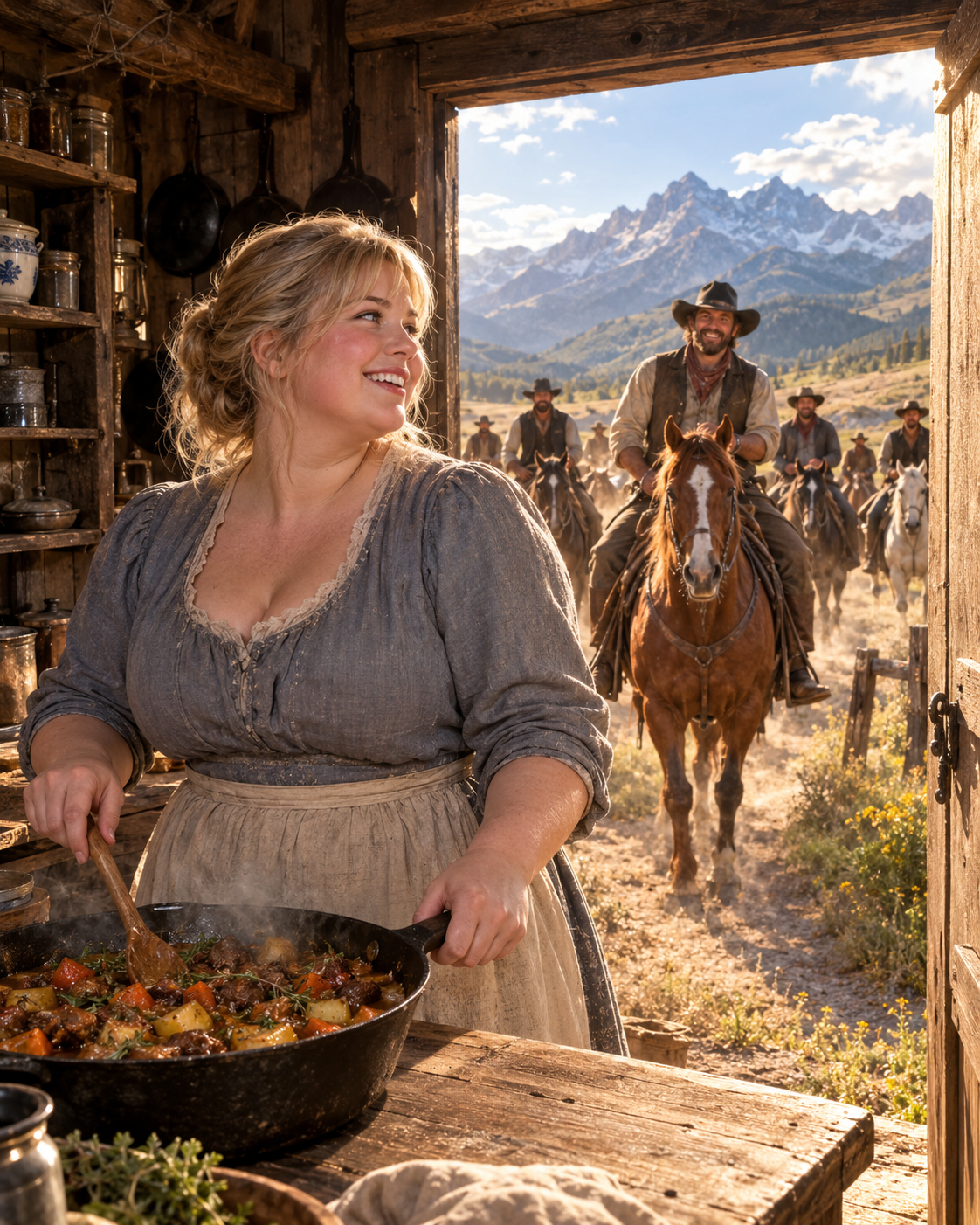
Levi looked at my flour-stained hands.
“I didn’t want to look at you and wonder whether you were another one of Calder’s tricks.”
“And now?”
“Now I wonder why I ever doubted you.”
Before I could answer, a horse screamed outside.
We both turned.
Three riders were approaching the house.
One was Calder.
The other two carried rifles.
Levi rose.
“Stay here.”
“No.”
“Mrs. Morse—”
“I found the paper. I am involved now.”
His mouth tightened.
Then he nodded.
Calder entered without knocking.
He was a broad man with silver hair and a smile that never reached his eyes.
“Levi.”
“Calder.”
His gaze moved to me.
“So this is the woman.”
I held his stare.
“The one you sent.”
He chuckled.
“Sent is a strong word.”
“You arranged my employment.”
“I arranged an opportunity.”
“You arranged a deception.”
His smile vanished.
“Careful, Mrs. Morse.”
“Why? Will you take the kitchen too?”
One of the armed men laughed.
Calder did not.
“You have been here less than a month,” he said. “You know nothing about this ranch.”
“I know the stove was broken when I arrived.”
“Everyone knew that.”
“I know the pantry roof leaked.”
“Everyone knew that.”
“I know there was mold behind the wall, mice beneath the shelves, and almost no food.”
He stepped closer.
“And now?”
“Now the ranch hands eat three meals a day.”
Calder glanced at Levi.
“That is precisely why I came.”
He removed a folded letter from his coat.
“The inspector will consider production, expenses, livestock health, and household management.”
He held out the letter.
“Your books show losses.”
Levi snatched it.
“They’re false.”
Calder smiled.
“Then prove it.”
I looked at the two armed men.
“Who are they?”
“Witnesses.”
“They look like hired guns.”
“They are employees.”
“Of yours?”
“Yes.”
“Then they are hardly witnesses.”
His eyes narrowed.
“You are becoming troublesome.”
“No,” I said. “I am becoming observant.”
For the first time, something like hatred crossed his face.
He turned to Levi.
“Tomorrow at nine.”
Then he left.
The door shut behind him.
Levi looked at the letter.
“He has forged the books.”
“How do you know?”
“My father kept different records.”
“Then we need those records.”
“They’re gone.”
“No,” I said.
He looked up.
“You said the iron box was empty.”
“Yes.”
“Empty is not the same as destroyed.”
He stared at me.
I walked to the stove.
“Your father trusted paper more than people, didn’t he?”
“Yes.”
“Then he would have hidden copies.”
Levi looked around the kitchen.
“Why here?”
“Because nobody searches a kitchen.”
His eyes widened.
We began tearing the room apart.
Behind flour barrels.
Under shelves.
Inside the old wood bin.
Beneath the loose stones near the hearth.
Nothing.
Then I remembered the floorboard.
The document had been hidden beneath it.
I knelt and ran my fingers along the wood.
There was another loose board.
Levi pried it up with a knife.
Beneath it was a narrow wooden box.
Inside lay six ledgers wrapped in oilcloth.
Levi stopped breathing.
He lifted the first ledger.
His father’s handwriting covered the pages.
Dates.
Payments.
Names.
Amounts.
Every transaction with Calder.
Every dollar paid.
Every receipt.
At the bottom of the final page was a total.
Eight hundred and nineteen dollars.
Paid in full.
Levi’s hand began shaking.
“He paid it.”
I nodded.
“And Calder kept collecting.”
Levi turned the page.
There was a second note.
My eyes moved over the faded writing.
“If this book is ever found, the debt is not the danger. The danger is the deed.”
“What deed?” Levi whispered.
We searched the remaining ledgers.
Near midnight, we found it.
A copy of the original land agreement.
Calder had never owned Raven Spur.
But he had acquired a temporary lien over it.
The lien expired if the debt was paid.
Levi’s father had paid it.
Calder had simply never released the lien.
Worse, the document contained a second clause.
If the property were declared unprofitable by an official inspector, Calder could purchase it at a predetermined price far below its value.
The inspection was never meant to determine whether Raven Spur could survive.
It was designed to make sure Calder could steal it cheaply.
Levi sat in silence.
Then he laughed once.
It was a bitter sound.
“My father spent twelve years thinking he had failed.”
“He hadn’t.”
“He died believing he had left me nothing.”
“He left you proof.”
Levi looked at me.
“No.”
He touched the ledger.
“He left me a chance.”
At dawn, we rode into town.
The roads were frozen hard.
The courthouse opened at eight.
We arrived before the clerk.
By half past eight, we had copies made of every relevant document.
But there was one problem.
The original receipts were missing.
Without them, Calder could claim the ledgers were fabricated.
“Who signed the receipts?” I asked.
“Bank clerk.”
“Is he still alive?”
Levi looked at me.
“I think so.”
We found him working behind the counter of a small bank.
His name was Samuel Price.
He was nearly seventy.
When Levi showed him the ledger, the old man removed his spectacles.
“I remember this.”
“You do?”
“Your father came every month.”
“Did he pay Calder?”
“Yes.”
“Do you remember the final payment?”
Price stared at the page.
Then he stood.
“Wait here.”
He disappeared into the back room.
Ten minutes later, he returned with a bundle of old papers.
“I kept copies because Calder once accused me of losing one.”
He handed Levi the receipts.
Every one carried the bank seal.
Every one carried Price’s signature.
And the final receipt bore Calder’s own signature.
Paid in full.
Levi closed his eyes.
For the first time since I had known him, his shoulders seemed lighter.
Then the bank doors opened.
Calder walked in.
Behind him came Mr. Vale.
“You’ve been busy,” Calder said.
Price stood.
“You have no business here.”
Calder ignored him.
“Give me the papers.”
“No.”
Calder’s eyes settled on Levi.
“You don’t understand what you are doing.”
“I understand perfectly.”
“You will lose the ranch.”
“No.”
“You will lose everything.”
Levi stepped forward.
“Not today.”
Calder’s face changed.
“You think a few old receipts will save you?”
“No,” I said.
“They will save him.”
He turned toward me.
“You.”
I held up the receipt.
“You signed this.”
Calder went still.
“You paid him,” I continued. “Then you told his son he still owed you.”
“You don’t know what you’re talking about.”
“The bank does.”
Price lifted his chin.
“And I have copies.”
Calder’s confidence cracked.
Vale looked between us.
“I was not informed of these documents.”
Calder glared at him.
“This is irrelevant.”
“No,” Vale said quietly. “It is not.”
The attorney walked toward the receipts.
He examined the seal.
Then the signature.
Then the date.
“This changes the legal position.”
Calder stepped closer.
“You work for me.”
“I work for the party holding the claim.”
“And I hold the claim.”
“Not if the debt was satisfied.”
Silence.
Then Vale looked at Levi.
“You should have shown me these sooner.”
Levi laughed.
“You never asked.”
The inspector was already waiting at Raven Spur when we returned.
He was a serious man named Elias Boone.
He carried a notebook and spoke little.
Calder stood beside him.
Vale stood farther away.
The ranch hands watched from the barn.
I returned to the kitchen.
Not because I was afraid.
Because I knew what I had to do.
I opened the cupboards.
I lit the stove.
I set bread to rise.
Then I walked outside and called the ranch hands.
“Bring in the cattle records.”
They stared at me.
“What?”
“The inspector needs to see what this place actually produces.”
One cowboy grinned.
“Ma’am, you giving orders now?”
“Yes.”
He tipped his hat.
“Yes, ma’am.”
For the next two hours, Raven Spur became a living machine.
The cattle counts were brought from the barn.
Feed records were assembled.
Repair expenses were listed.
Milk production.
Eggs.
Meat.
Grain.
Every figure.
Every receipt.
Every improvement.
And then I added the kitchen accounts.
Food purchased.
Food preserved.
Food wasted.
Food saved.
The inspector studied the pages.
“You keep these?”
“I started keeping them when I discovered half the supplies were spoiled.”
“Why?”
“Because waste costs money.”
He looked at Levi.
“Who managed the household before her?”
“No one.”
The inspector wrote something down.
Calder interrupted.
“This has nothing to do with the debt.”
“It has to do with profitability,” I replied.
He glared at me.
The inspector nodded.
“She is correct.”
Calder went silent.
By afternoon, the inspector had examined the ranch.
He checked fences.
Cattle.
Barns.
Water supply.
Fields.
And finally the kitchen.
He opened every cupboard.
Looked behind the stove.
Inspected the pantry.
Then he tasted one of my biscuits.
He chewed thoughtfully.
“Good.”
I almost smiled.
“Thank you.”
He looked at Levi.
“Your ranch is not failing.”
Calder’s face went pale.
“It has been mismanaged,” the inspector continued, “but the underlying operation is viable.”
He closed his notebook.
“And the improvements made in the past month are significant.”
Calder stepped forward.
“You cannot ignore the debt.”
“No,” Boone said. “But I can report that the debt is disputed and that documentary evidence exists showing payment.”
Vale cleared his throat.
“I have reviewed the documents.”
Calder turned sharply.
“Then you will report in my favor.”
“I will report the truth.”
The words hung in the cold air.
For once, Calder had nothing to say.
But I knew the story was not over.
That evening, after everyone had gone, I found Levi sitting alone beside the kitchen stove.
He held his father’s final letter.
“What does it say?” I asked.
He handed it to me.
I read:
“My son, if you are reading this, then someone has finally found the truth. Remember this above all else: a home is not saved by the strongest hand. It is saved by the people willing to stand inside it when the roof begins to fall.”
I looked at Levi.
“He knew.”
“Perhaps.”
“He knew someone would need to stay.”
Levi smiled faintly.
“You stayed.”
“I stayed because I had nowhere else to go.”
“No.”
He shook his head.
“You stayed because you believed a ruined place could become something again.”
I looked around the kitchen.
The stove glowed.
Bread cooled on the table.
The ranch hands laughed outside.
For the first time, Raven Spur did not feel like a place I worked.
It felt like a place I belonged.
Three weeks later, Calder was forced to release his claim.
The court accepted the bank records and the original receipts.
His fraudulent accounts were exposed.
The attorney who had represented him withdrew from the dispute.
And the inspector’s report confirmed that Raven Spur was a functioning, profitable cattle operation.
Calder left town without another word.
Levi paid off the remaining legitimate debts over the following year.
He never again borrowed money without reading every line of the agreement.
As for me, I was no longer earning one dollar a day.
Levi offered me a share in the kitchen accounts.
I negotiated for more.
He laughed.
“You’re becoming expensive.”
“I’m becoming observant.”
He smiled.
“Fair enough.”
The ranch changed after that.
The men repaired the cabins.
The barn received a new roof.
The pantry filled with food.
The kitchen became a place where arguments ended over coffee and celebrations began over supper.
One spring morning, Levi came through the kitchen door carrying a small wooden box.
“What’s that?”
“Something I should have given you months ago.”
Inside was a silver key.
I frowned.
“What does it open?”
“The kitchen.”
“I already have a key.”
“Not that kitchen.”
He pointed toward the back of the house.
There was an old room I had never entered.
When I opened the door, I found shelves, a desk, ledgers, and a wide window overlooking the pasture.
“What is this?”
“Your office.”
I stared at him.
“You’re giving me an office?”
“I’m giving you control of the accounts.”
I laughed.
“You trust me that much?”
“I trust you more than I trust myself.”
The words were simple.
But they carried something deeper.
I looked out at the pasture.
The winter of 1886 felt like another lifetime.
I had arrived with a carpetbag, two dresses, and barely enough money for supper.
I had believed I was coming to work in a kitchen.
Instead, I had walked into a battle over truth, ownership, and dignity.
And somewhere along the way, I had learned that a person can enter a place with almost nothing and still bring something no creditor can seize.
Courage.
Work.
Judgment.
And the willingness to say no when someone tries to turn your labor into their lie.
Months later, a framed copy of Calder’s original fraudulent document hung above the office desk.
Not as a trophy.
As a warning.
Beneath it, I wrote one sentence:
“Never let another person define the value of what your hands have built.”
Levi read it one evening.
“You really want that there?”
“Yes.”
“Why?”
“Because someday someone else will need to remember.”
He looked at me for a long moment.
Then he nodded.
“You’re right.”
Outside, the evening sun burned gold across the fields.
Cattle moved slowly toward the water.
Smoke rose from the chimney.
The kitchen windows glowed.
Levi stood beside me.
“Do you ever regret coming here?”
I thought about the filthy kitchen.
The insults.
The hidden papers.
The fear.
The long nights.
The betrayal.
Then I thought about the first cowboy who had tasted one of my biscuits and whispered that he had forgotten food could taste like home.
“No,” I said.
“I thought I came here to earn a dollar a day.”
Levi smiled.
“What did you earn?”
I looked at the ranch, at the people who had once laughed when I was ordered out and now called me when something needed fixing.
“A place where my work mattered.”
He nodded.
“And perhaps something more.”
I turned toward him.
He did not say anything else.
He did not need to.
Some things are better left unspoken until they have earned the right to become promises.
Years later, people would tell the story of how Raven Spur survived.
Some said Levi Stout had fought Calder in court.
Others said the old bank records had saved the ranch.
A few claimed the inspector had discovered everything himself.
But those who had been there remembered something different.
They remembered a woman standing in a ruined kitchen with bleeding hands.
They remembered that she did not walk away when she discovered she had been used.
She stayed.
She looked closer.
She asked questions.
And when the truth was hidden beneath the floor, she was willing to lift the board.
That was how Raven Spur was saved.
Not by money.
Not by power.
Not by a man with a gun or a lawyer with a briefcase.
It was saved because someone refused to believe that being poor, widowed, or underestimated meant being powerless.
The ranch survived.
The kitchen survived.
And so did I.
Because sometimes life gives you a door you never asked to open.
Sometimes behind that door is a trap.
Sometimes it is a betrayal.
And sometimes, if you have the courage to keep looking, you discover that the very place where someone intended to use you has become the place where you finally discover your own worth.
The stove at Raven Spur still burned every morning.
The bread still rose.
The cowboys still argued over coffee.
And whenever a stranger came through the gate carrying a tired face and an uncertain future, there was always a place at our table.
Because I had learned one truth that no contract, creditor, or cruel man could ever take from me:
A home is not the place where someone decides you belong.
A home is the place you help build—and the place where you finally realize that you were never as powerless as they wanted you to believe.
But the story of Raven Spur did not truly end when Calder left town.
For a while, we believed it had.
The cattle were healthy.
The books were clean.
The debts were being paid.
The kitchen stayed warm.
And every morning, when the sun climbed over the eastern ridge, I could look across the pasture and know that nobody was coming to take the ranch from us.
It was a dangerous kind of peace.
The kind that makes people forget how quickly a life can change.
The following autumn, nearly two years after I first arrived at Raven Spur, a drought settled over Texas.
It came slowly.
First the creeks became narrow brown ribbons.
Then the grass turned yellow.
Then the wind began carrying dust across the fields.
By November, the cattle were growing thin.
Every ranch within fifty miles was suffering.
Some men sold their herds.
Others abandoned their land.
Levi refused to do either.
“We have enough hay for six weeks,” he told me one evening.
“Seven if we cut the rations.”
“And after seven?”
He looked toward the dark window.
“We pray for rain.”
I closed the ledger.
“Prayer doesn’t belong in the accounts.”
He smiled.
“Then you handle the accounts. I’ll handle the praying.”
But I knew he was worried.
I had learned his silences by then.
There was the silence he wore when he was angry.
The silence he wore when he was ashamed.
And the silence he wore when he was afraid.
This was the last one.
We began cutting expenses.
The kitchen became simpler.
Less meat.
More beans.
More cornmeal.
Nothing was wasted.
I taught the ranch hands how to preserve vegetables in vinegar and salt.
We repaired everything instead of replacing it.
Old sacks became curtains.
Broken crates became shelves.
Even the scraps from the butcher’s table were boiled into stock.
Nobody complained.
Raven Spur had survived worse than hunger.
Then, one morning, a rider came from town.
He was barely twenty and covered in dust.
“Mrs. Morse?”
“Yes?”
“You’re wanted at the bank.”
My stomach tightened.
“Why?”
He swallowed.
“There’s trouble with the ranch papers.”
Levi was in the north pasture.
I sent a boy to fetch him.
By noon, we were riding toward town.
At the bank, Samuel Price was waiting for us.
He looked older than he had the last time I saw him.
“What happened?” Levi asked.
Price locked the door behind us.
“Someone has filed a claim against Raven Spur.”
Levi’s face hardened.
“Calder?”
“No.”
“Then who?”
Price placed a document on the counter.
The name at the bottom made my blood run cold.
Henry Stout.
Levi’s father.
I stared at the signature.
“That can’t be.”
Price nodded.
“It is.”
“But he’s dead.”
“I know.”
Levi picked up the paper.
His fingers tightened around it.
“What does it say?”
Price lowered his voice.
“It claims your father transferred ownership of Raven Spur twelve years ago.”
Levi looked at me.
“To whom?”
Price hesitated.
“To a company in Austin.”
My heart began pounding.
“What company?”
“The Red River Land and Cattle Company.”
Levi stared at the paper.
“Calder owned part of that company.”
“Not anymore,” Price said.
“Then who does?”
Price looked toward the locked door.
“A man named Thomas Bell.”
Levi’s eyes narrowed.
“Who is he?”
“I don’t know.”
“Then find out.”
Price shook his head.
“That is the problem.”
He opened another file.
“We cannot find him.”
For the first time in two years, I felt the old fear return.
Not the fear of losing a kitchen.
Not the fear of losing money.
The fear of discovering that the past had never truly released us.
We spent the next three days searching through every record in town.
The company existed.
The transfer existed.
The signature existed.
But the man who supposedly purchased the ranch did not.
No address.
No tax records.
No witnesses.
No bank account.
Nothing.
It was as though Thomas Bell had been invented for one purpose.
To take Raven Spur.
On the fourth day, Levi came into my office carrying a letter.
“I found something.”
He placed it on the desk.
The paper was old.
The handwriting was my husband’s.
I stared at the name.
My first husband.
Daniel Morse.
For several seconds, I could not breathe.
“Where did you get that?”
“It was in the county archive.”
“Why would Daniel have written to your father?”
“He didn’t.”
Levi turned the page.
“He wrote to Calder.”
I read the letter.
Daniel had been working as a bookkeeper in San Antonio before he died.
He had discovered something.
A series of fraudulent land transfers.
Ranches were being bought through debts that had already been paid.
The same scheme had been used against several widows and small farmers.
Daniel had threatened to expose it.
Then he had disappeared from the records.
The letter ended with one sentence:
“If anything happens to me, the truth is hidden where men are least likely to look.”
My hands went cold.
“Levi.”
He looked at me.
“I know.”
“You knew?”
“No.”
I pointed to the last line.
“The kitchen.”
His expression changed.
“My kitchen?”
“Not yours.”
I touched the paper.
“Mine.”
We returned to Raven Spur before sunset.
The old kitchen was exactly as I had left it.
The stove.
The shelves.
The table.
The floorboards.
I stood in the center of the room, trying to remember everything about the day I found Calder’s document.
Then I saw it.
A mark beneath the table.
A tiny carved cross.
I had never noticed it before.
Levi moved the table.
Underneath was a square section of wood.
He pried it up.
There was no box.
Only a narrow hollow between the floor and foundation.
Inside lay a metal tube wrapped in oilcloth.
I opened it.
A stack of papers fell into my hands.
Daniel’s papers.
Bank statements.
Letters.
Copies of land deeds.
Names.
Dates.
Payments.
And at the bottom, one document that made Levi sit down.
It was the original transfer agreement for Raven Spur.
The company named on the fraudulent claim had never owned the ranch.
The signature of Henry Stout had been forged.
But there was more.
Daniel had discovered that Calder was not the architect.
He was only the middleman.
The real organizer was someone else.
Someone who had been buying debts through shell companies and using forged transfers to seize ranches throughout Texas.
At the bottom of the final document was a name.
Thomas Bell.
Levi stared at it.
“So he does exist.”
I shook my head.
“No.”
“What?”
“Look at the signature.”
He did.
Then his face changed.
“That isn’t a man’s name.”
“What do you mean?”
“Bell was my mother’s maiden name.”
Silence filled the room.
I looked again.
Thomas Bell.
Then I looked at the old letter from Daniel.
His handwriting.
His initials.
The date.
Everything suddenly fell into place.
“Thomas Bell was an alias.”
Levi stood.
“Whose?”
I pointed to the signature.
“Your father.”
He stepped backward.
“No.”
“Your father used his mother’s surname.”
“That makes no sense.”
“Maybe it does.”
I read the final letter.
Henry Stout had discovered Calder’s fraud years before.
He had tried to expose it.
But he knew Calder controlled the local court, the bank, and several land offices.
So he created another identity.
Thomas Bell.
He transferred the documents into a hidden archive.
He intended to expose the entire scheme.
Then he died.
But before his death, he had entrusted Daniel with the evidence.
Daniel had hidden it in the kitchen.
And Calder had spent years trying to find it.
Levi sat down again.
“My father knew.”
“Yes.”
“He knew everything.”
“Yes.”
“Then why didn’t he tell me?”
I looked at the letter.
“Maybe because he was trying to protect you.”
Levi’s eyes filled with anger.
“Protect me?”
“He may have believed silence was safer.”
“He left me believing he failed.”
“I know.”
Levi stood abruptly.
“He let me hate him.”
“And maybe that was the price he paid to keep you alive.”
He turned away.
For a long time, neither of us spoke.
Then the door opened.
Samuel Price stepped inside.
He was breathing hard.
“Mrs. Morse.”
I turned.
“What happened?”
“The courthouse is on fire.”
Levi grabbed his coat.
“What?”
“Someone set fire to the records.”
We rode through the night.
By the time we reached town, flames were already pouring through the courthouse windows.
People stood in the street shouting.
Men carried buckets.
The sheriff stood helplessly nearby.
Levi jumped from his horse.
“Where are the land records?”
“Inside!”
I ran after him.
“No!”
He turned.
“The records are in the east room,” I shouted. “The county archive.”
“That building is burning.”
“I know.”
“You can’t go in.”
“I have to.”
“Why?”
“Because my husband’s evidence is in there.”
He stared at me.
Then he understood.
We ran inside.
Smoke filled the hallway.
The heat was unbearable.
I wrapped my skirt around my mouth and followed Levi.
The archive room was already burning.
Shelves collapsed around us.
“Which cabinet?” he shouted.
“Three!”
He kicked it open.
Inside were boxes.
We grabbed what we could.
Then the ceiling cracked.
“Levi!”
He pushed me toward the door.
“Go!”
A burning beam crashed behind us.
We stumbled outside.
I fell to my knees.
Levi dropped the records.
For several seconds, neither of us moved.
Then he laughed.
Not because it was funny.
Because we were alive.
The next morning, the sheriff arrested two men.
One confessed.
Calder had paid them to destroy the records.
But there was one thing Calder had not counted on.
The documents we rescued were enough.
And this time, the truth could not be buried.
Federal investigators arrived within weeks.
Other ranchers came forward.
Widows.
Farmers.
Old men who had lost land decades earlier.
They brought their own papers.
Their own stories.
Their own evidence.
The scheme was larger than anyone in Raven Spur had imagined.
Calder was arrested before Christmas.
Thomas Bell remained a mystery.
Until we found his grave.
It was in a small cemetery outside Austin.
The stone read:
Henry Bell Stout.
Born 1838.
Died 1887.
Levi stood before it for a long time.
“He changed his name.”
“Yes.”
“He knew he was dying.”
“Yes.”
“And he still kept fighting.”
“Yes.”
Levi removed his hat.
“I wish I’d known.”
I stood beside him.
“Perhaps you did.”
He looked at me.
“What do you mean?”
“You became the man he hoped you would become.”
Levi looked at the grave again.
Then he smiled.
It was the first peaceful smile I had seen on his face in years.
When we returned to Raven Spur, something had changed.
Not the ranch.
Not the kitchen.
Not the fields.
Levi had changed.
He no longer carried his father’s memory like a wound.
He carried it like a responsibility.
The following spring, he opened the ranch records to the public.
Any farmer in the county could come and learn how to keep accounts.
Any widow could bring a contract and have it read.
Any young rancher could ask questions without being charged a penny.
I helped in the office.
We started a small fund for families facing foreclosure.
We called it the Raven Spur Fund.
Not because we had become wealthy.
We hadn’t.
But because we knew what it felt like to stand on the edge of losing everything.
Years passed.
The drought ended.
Rain returned.
The cattle grew fat again.
The kitchen garden bloomed.
And Raven Spur became known not for the scandal that nearly destroyed it, but for the people who came there afterward.
One evening, an old woman arrived with a broken wagon and two frightened children.
She had lost her husband.
A creditor was threatening to take her farm.
She expected us to tell her there was nothing she could do.
Instead, I invited her into the kitchen.
I made coffee.
Levi opened the books.
We found the error in the creditor’s claim before midnight.
The woman began to cry.
“You saved my farm.”
“No,” I told her.
“We only helped you find what was already yours.”
She looked at me strangely.
“Why would you do that?”
I glanced toward the stove.
Because I remembered.
I remembered a filthy kitchen.
A cruel dismissal.
A hidden document.
A man who thought he could turn my labor into his weapon.
And I remembered the moment I realized that truth was sometimes buried beneath the very floor where people told you to stand.
“You should never have to lose your home because someone expects you not to understand the paper they put in front of you.”
The woman wiped her eyes.
“Who taught you that?”
I smiled.
“Life.”
Years later, when I was an old woman, people would ask me about Raven Spur.
They wanted to know whether I had been afraid.
I always told them the truth.
“Yes.”
They seemed surprised.
They expected heroes to be fearless.
They wanted a story about courage without fear.
But courage had never been that.
Courage was being afraid and still opening the cupboard.
Still lifting the floorboard.
Still asking the question nobody wanted asked.
Still standing when everyone expected you to kneel.
I learned that in a kitchen.
Levi learned it from his father.
And Raven Spur learned it from all of us.
The old stove remained in the kitchen until the day I could no longer climb the stairs without help.
By then, the ranch had grown.
There were new barns.
New workers.
New houses.
But the kitchen remained almost exactly as it had been.
One winter morning, Levi found me sitting beside the stove.
He was older too.
His hair had turned silver.
His hands were scarred.
He placed a cup of coffee beside me.
“Still warm.”
I smiled.
“Just like the first winter.”
He sat down.
“Do you remember what I said when you arrived?”
“You said one dollar a day.”
He laughed.
“I was a fool.”
“You were scared.”
“Same thing.”
“No.”
I looked at him.
“Not the same thing.”
Outside, snow began falling.
Softly.
Quietly.
The same kind of snow that had covered Raven Spur when I first arrived.
But this time, I was not a stranger standing beside the kitchen door with a carpetbag.
I was home.
Levi reached across the table.
His hand covered mine.
“We lost a lot,” he said.
“Yes.”
“But we found something too.”
I looked around the room.
“What?”
He smiled.
“A reason to keep the door open.”
I understood.
Because that was the real legacy of Raven Spur.
Not the land.
Not the cattle.
Not the money.
Not even the victory over Calder.
It was the door.
The willingness to open it for someone who had nowhere else to go.
The willingness to listen before judging.
The willingness to read the fine print.
The willingness to question power when power demanded silence.
And most of all, the willingness to remember that a person’s value is not measured by what they own when they arrive.
It is measured by what they are willing to build when they have almost nothing.
I had arrived at Raven Spur with two dresses, one carpetbag, and enough money for a single supper.
I had been told I was only a cook.
I had been treated as though my work was invisible.
But that kitchen had taught me something no one could ever take away.
There is dignity in honest work.
There is strength in asking questions.
There is freedom in knowing the truth.
And sometimes the smallest voice in the room is the one that notices what everyone else has missed.
The stove crackled.
The snow thickened outside.
Levi squeezed my hand.
And somewhere beyond the windows, the cattle moved through the white fields toward the warm barns.
Raven Spur was still standing.
Not because it had never been threatened.
Not because its people had never been afraid.
It was standing because every time someone tried to take its future away, someone chose to fight for the truth.
I looked at the old kitchen floor.
The boards had been replaced many times.
The secret compartment was gone.
The papers were safe in the courthouse archives.
But I could still remember the first loose board beneath the stove.
The place where everything had changed.
I smiled.
Somewhere beneath that floor, the past had once been waiting to destroy us.
Instead, it had taught us how to survive.
And that, perhaps, was the greatest lesson of all.
You cannot always choose what happens to you.
You cannot always prevent betrayal.
You cannot always stop someone from lying.
But you can choose what you do when the truth finally appears.
You can walk away.
You can surrender.
Or you can pick up the broken pieces, put them on the table, and begin again.
I chose to begin again.
So did Levi.
And Raven Spur became proof that sometimes a ruined place does not need to be rescued by someone powerful.
Sometimes it only needs one person willing to stay long enough to see what it can become.
The last thing I remember from that winter evening was Levi closing the kitchen door against the cold.
He turned the lock.
Then he looked back at me.
“Home?”
I smiled.
“Home.”
And for the first time, the word did not describe a building.
It described everything we had survived together.
Everything we had built.
Everything we had refused to surrender.
Outside, the snow covered the old tracks in the road.
By morning, there would be no sign that anyone had ever passed that way.
But inside Raven Spur, the fire kept burning.
And it would burn for many years after we were gone.
Not because the winter was gentle.
Not because life had been fair.
But because someone, long ago, had learned to keep the fire alive.
And someone else had chosen not to let it go out.
THE END.