They laughed when Caleb Turner threw my flour sack into the muddy street and called me a thief, but the ledger hidden beneath my stove held proof that someone else had been stealing from him for months.
Caleb did not move.
Neither did I.
The saloon seemed to shrink around us as the voices of the evening customers faded into a dull murmur. The fire cracked in the stone hearth. Somewhere behind me, a glass broke, followed by nervous laughter.
I looked down at the ledger again.
My mother’s handwriting stared back at me.
“Margaret, if you ever find this, do not trust the man who owns the saloon.”
My fingers tightened around the page.
My mother had been dead for twelve years.
She could not have known Caleb Turner.
She could not have known where I would end up.
Unless she had.
“Who brought this?” I asked.
The stranger who had delivered the crate stood near the door. He was a thin man with a gray beard, a weather-beaten coat, and a scar running from his left eyebrow to his cheek.
“He said his name was Samuel Reed,” the stranger replied. “Said he was your mother’s brother.”
I stopped breathing.
“My mother had a brother?”
The man nodded.
“Had. Samuel died last month.”
He pushed a folded piece of paper across the table.
“He left instructions that this crate was to find you.”
I unfolded the paper.
The writing was unfamiliar, but the message was unmistakably meant for me.
“Your mother spent years trying to uncover the truth about Dry Creek. She believed the truth was buried beneath the place where Caleb Turner built his fortune. She also believed that the wrong man had been blamed for what happened to your father.”
My vision blurred.
My father.
A name I had not heard spoken with anything but pity since childhood.
He had supposedly been a gambler.
A drunk.
A man who disappeared after stealing money from the railroad company.
That was the story I had been told.
That was the story my mother had allowed me to believe.
I looked up.
Caleb was still watching me.
“Margaret,” he said quietly.
I closed the ledger.
“What do you know about my father?”
His face changed.
Not dramatically.
Just enough.
A slight tightening around his eyes.
A hesitation before he answered.
“Nothing.”
The word landed between us.
Too quickly.
Too smoothly.
I had spent years studying numbers, and numbers had taught me something important.
The most suspicious number was often the one that arrived too quickly.
The same was true of lies.
I stood.
“Then why does my mother’s ledger say not to trust you?”
Caleb glanced at the customers.
“Not here.”
“Why not?”
“Because if that book is what I think it is, there are people in this town who would kill to get it back.”
A cold shiver traveled down my spine.
“You knew about it.”
“I knew your mother kept records.”
“You knew my mother?”
He looked away.
That was answer enough.
I carried the ledger upstairs to my room and locked the door.
For the next hour, I read every page.
Most of it was written in my mother’s careful hand.
Dates.
Names.
Payments.
Freight routes.
Land purchases.
Property transfers.
At first, it looked like the same kind of bookkeeping I had done at the saloon.
Then I noticed the numbers in the margins.
Small figures written beside certain names.
I recognized the pattern.
They were not prices.
They were references.
Page numbers.
I turned to the indicated pages.
My mother’s notes became darker.
“Caleb Turner was not always a saloon owner.”
“He arrived in Dry Creek in 1871.”
“Worked for the railroad.”
“Three months later, Elias Turner died.”
I froze.
Elias Turner.
Caleb’s older brother.
I had heard Caleb mention him once.
He had supposedly died in a mining accident.
I continued reading.
“Elias Turner did not die in a mine.”
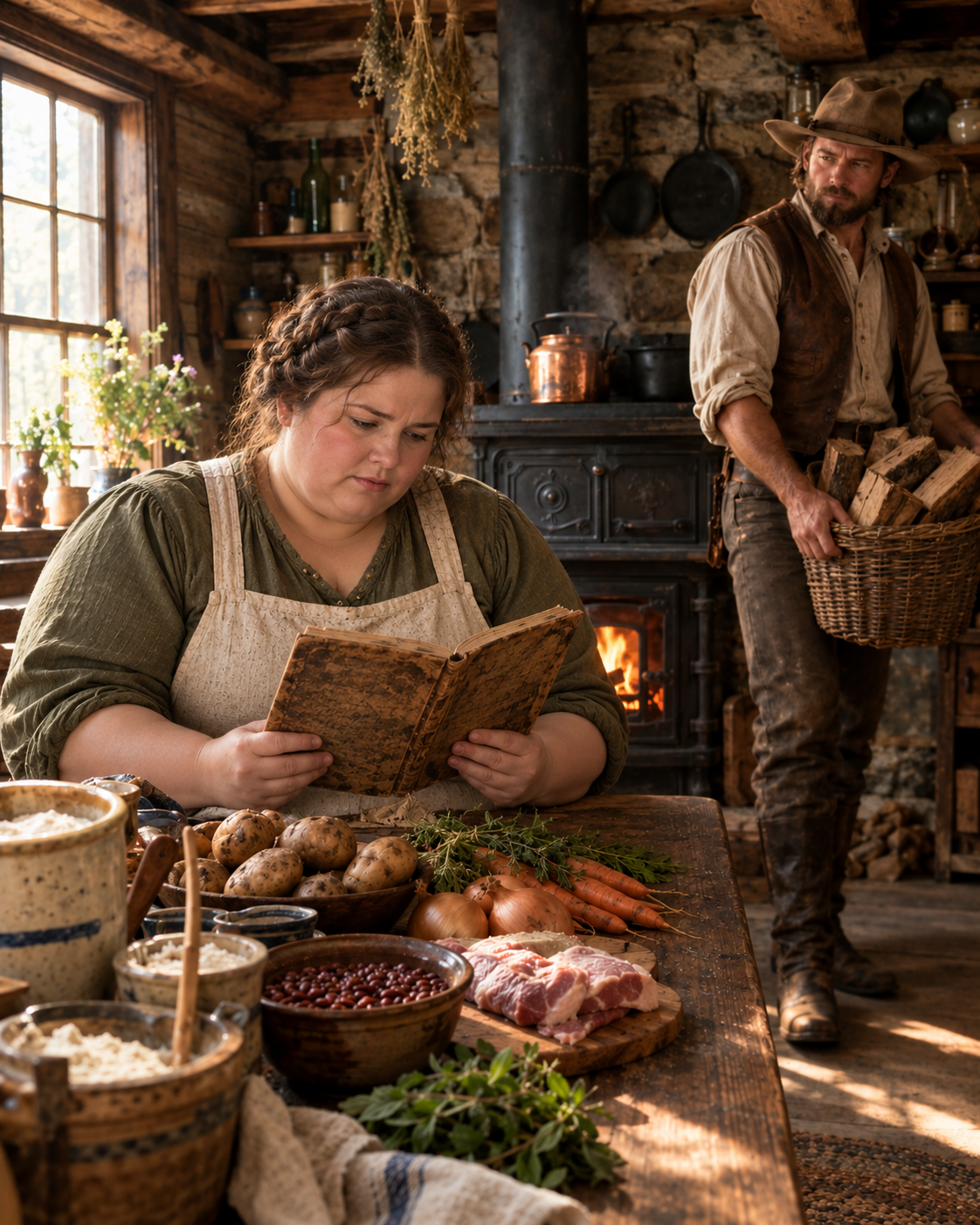
My heart began pounding.
“He was shot.”
The next page had been torn out.
I turned another.
“Your father knew.”
Another torn page.
Then:
“William Turner was accused because he refused to sign the land agreement.”
William Turner.
My father.
I sat back.
The room seemed suddenly too small.
My father had not stolen from the railroad.
He had refused to sign something.
But what?
I kept reading.
My mother had written about a piece of land on the eastern edge of Dry Creek.
A ranch owned by several families.
The railroad wanted it.
So did a group of investors.
My father had been one of the men who refused to sell.
Then came the sentence that made my blood run cold.
“Caleb Turner witnessed the shooting.”
I shut the book.
A knock came at the door.
I reached beneath my mattress and pulled out the small revolver I kept there.
“Who is it?”
“Me.”
Caleb.
I did not open the door.
“What did you witness?”
Silence.
Then his voice came through the wood.
“Your father being shot.”
My hand went numb.
“You lied to me.”
“I was seventeen.”
“You knew my father.”
“Yes.”
“You knew my mother.”
“Yes.”
“And you said you knew nothing.”
“I was afraid.”
I opened the door.
Caleb stood in the hallway.
For the first time since I had known him, he looked less like the confident owner of the saloon and more like the frightened boy my mother’s ledger had described.
“Come in,” I said.
He entered.
I kept the revolver in my hand.
“Start talking.”
Caleb swallowed.
“Your father was not a thief.”
“I know.”
“He was trying to stop a group of men from forcing ranchers off their land. The railroad had hired contractors to make certain people disappear.”
“Disappear?”
“Threats first. Then beatings. Then fires.”
“And my father?”
“He found proof.”
“What proof?”
“A ledger.”
I looked down at the book in my hand.
“This one?”
“No.”
His eyes settled on it.
“That one belonged to your mother.”
“Where is the other ledger?”
“I don’t know.”
“You’re lying again.”
“No.”
He stepped closer.
“I swear to you, Margaret, I haven’t seen it in twelve years.”
“Then why did my mother tell me not to trust you?”
“Because she had every reason.”
That answer surprised me.
Caleb continued.
“I was there when your father was killed. I saw who fired the gun. But I was too afraid to speak.”
“Who?”
He looked at me.
“Harlan Pike.”
The name hit me like a slap.
Pike had been dead for nearly two years.
At least, that was what everyone in town believed.
“What?”
Caleb nodded.
“Harlan Pike was younger then. He wasn’t the respectable storekeeper everyone knew. He worked for the railroad and carried messages between the investors.”
“But Pike was arrested.”
“Yes.”
“For stealing from you.”
“For stealing from everyone.”
I stared at him.
“You knew he was still connected to the old scheme.”
“I suspected.”
“And you hired me knowing my mother had been investigating it?”
“I hired you because you were the best cook who walked through my door.”
“That isn’t an answer.”
“No.”
His voice broke slightly.
“It isn’t.”
He sat down.
“Your mother came to me twelve years ago. She wanted to know what happened to your father. I told her what I knew. She didn’t believe I was telling her everything.”
“Were you?”
“No.”
I waited.
Caleb looked toward the window.
“I knew Pike had ordered the shooting.”
My fingers tightened around the revolver.
“But I also knew someone else had paid him.”
“Who?”
He shook his head.
“I never found out.”
I stared at him.
“You let my mother spend twelve years searching for the truth.”
“I was trying to keep her alive.”
“You call that protecting her?”
“No.”
He looked directly at me.
“I call it cowardice.”
The word hung in the room.
For a moment, neither of us spoke.
Then I noticed something.
A small mark on the inside cover of my mother’s ledger.
A circle crossed by two lines.
I had seen that symbol before.
On the delivery crates.
On the old invoices.
On the warehouse documents.
My breath caught.
“This isn’t finished.”
Caleb stood.
“What?”
I turned the book around.
“The missing ledger.”
He frowned.
“The symbol is on every document connected to the railroad.”
I flipped through the pages.
“It means the original records were kept somewhere else.”
“Where?”
I remembered the stranger’s words.
The place where Caleb Turner built his fortune.
I looked toward the floor.
The saloon had been built over an old freight office.
Caleb saw the realization in my face.
“No.”
“What?”
“Margaret, don’t.”
“You said the truth was buried beneath this place.”
“I said people believed that.”
“Did my mother believe it?”
He didn’t answer.
I grabbed my coat.
“Then we’re going downstairs.”
The cellar door was behind the kitchen.
Caleb followed me with a lantern.
The cellar smelled of damp earth, old wood, and coal.
We searched along the walls.
Nothing.
Then I noticed the stones beneath the old storage shelves.
One was newer than the others.
We moved the shelf.
Caleb crouched and pushed the stone.
It shifted.
Beneath it was a narrow iron ring.
He looked at me.
“You’re sure?”
“No.”
I pulled the ring.
A section of flooring lifted.
A dark passage disappeared beneath the saloon.
The lantern flame trembled.
We descended.
The tunnel was barely wide enough for two people.
After perhaps thirty yards, it opened into a small underground room.
There were shelves.
Boxes.
Old documents.
And in the center, a wooden chest.
My mother’s initials had been carved into its lid.
M.T.
I knelt.
The lock was already broken.
Inside were letters.
Photographs.
A pistol.
And a black leather ledger.
I opened it.
The first page contained a list of names.
Railroad officials.
Land investors.
Freight contractors.
Judges.
Lawmen.
At the bottom of the page was one name I recognized immediately.
Caleb Turner.
I slowly turned toward him.
He looked at the page.
Then he closed his eyes.
“I told you I wasn’t innocent.”
“You were part of it.”
“I was seventeen.”
“Your name is here.”
“I carried messages.”
“Between the men who killed my father?”
“Yes.”
My voice shook.
“And you built this saloon with their money?”
Caleb did not answer.
That was answer enough.
I felt something inside me break.
Not love.
Not trust.
Something older.
The belief that I had finally found a place where I belonged.
I stepped backward.
“You let me think you saved this town.”
“I did.”
“You helped create the problem.”
“Yes.”
“And Pike?”
“He betrayed the group.”
“Why?”
“Because he wanted everything.”
I looked at the ledger again.
The final pages contained my mother’s handwriting.
She had discovered the names.
She had discovered the money trail.
She had discovered that Caleb had later turned against the men who had hired him.
But she had never forgiven him.
One sentence was underlined three times.
“Some men spend their lives trying to repair the damage they caused, but repair is not the same as innocence.”
I closed the book.
“Why didn’t you tell me?”
“Because I wanted one thing in my life that wasn’t built on what I had done.”
“This saloon?”
“You.”
I stared at him.
“You should have told me.”
“I know.”
A sound came from above us.
Footsteps.
Caleb turned off the lantern.
We stood in darkness.
Someone entered the cellar.
Then another.
A whisper drifted down the stairs.
“Find the ledger.”
My blood went cold.
Caleb grabbed my wrist.
“Stay behind me.”
The footsteps approached.
Three men.
Then four.
A match flared.
I recognized the first face.
Deputy Warren.
The town marshal’s assistant.
He had been the man who delivered supplies to Pike’s warehouse.
I had seen him there.
“You,” I whispered.
He smiled.
“You should have stayed out of this.”
Caleb stepped forward.
“Warren.”
“You were always a fool, Turner.”
Warren raised a pistol.
“Give me the ledger.”
Caleb didn’t move.
“You’re working for who?”
Warren laughed.
“Does it matter?”
“It does to me.”
“The investors.”
I felt the blood drain from my face.
“The investors are still alive?”
“Some of them.”
Warren looked at me.
“And your mother’s records are worth more than you understand.”
One of the men lunged.
Caleb struck him with the lantern.
Darkness exploded into shouting.
I ran.
I grabbed the black ledger and held it against my chest.
A gunshot cracked through the cellar.
Caleb grunted.
I turned.
He had fallen against the wall.
Blood spread across his shoulder.
“Go!” he shouted.
I ran toward the tunnel.
Behind me came footsteps.
I reached the kitchen and slammed the cellar door.
The saloon was full of people.
Music had stopped.
Everyone stared.
“Lock the doors!” I shouted.
Nobody moved.
Then the front window shattered.
A bullet tore through the wall.
People screamed.
I grabbed the bell rope beside the bar and pulled it.
Once.
Twice.
Three times.
The alarm rang through Dry Creek.
Doors opened outside.
People poured into the street.
The marshal arrived within minutes.
So did half the town.
Warren and the others tried to escape through the cellar entrance.
They were caught before they reached the alley.
Caleb was carried upstairs.
The bullet had passed through his shoulder.
He would live.
But the ledger changed everything.
The names inside it triggered investigations that lasted for months.
Men who had spent decades believing themselves untouchable suddenly found doors closing.
Land deeds were reopened.
Old cases were examined.
Families learned why their fathers had lost their ranches.
Widows learned who had ordered the fires that killed their husbands.
And I learned the truth about my father.
He had not been a thief.
He had not abandoned us.
He had died trying to protect the people who had trusted him.
My mother had known enough to spend the rest of her life searching for proof.
She had never found it.
But she had left me the path.
Months later, I stood in the cemetery beneath a pale spring sky.
My father’s grave was marked by a simple stone.
William Turner.
Husband.
Father.
I placed my mother’s ledger beside it.
“I know now,” I whispered.
The wind moved through the grass.
For the first time, I did not feel angry.
I felt tired.
And strangely peaceful.
Behind me, footsteps approached.
Caleb stopped several yards away.
His arm was still in a sling.
“I won’t come closer unless you want me to.”
I turned.
“I have a question.”
“Ask.”
“Why did you give me half the saloon?”
He looked toward the town.
“Because you earned it.”
“That isn’t the real reason.”
He smiled sadly.
“No.”
I waited.
“Because I knew I might never be able to make up for what I had done. But I wanted you to have something that belonged to you without having to ask anyone’s permission.”
I looked at him for a long time.
“I don’t know if I can forgive you.”
“I don’t expect you to.”
“But I don’t hate you anymore.”
His eyes lowered.
“That is more than I deserve.”
I walked past him.
Then stopped.
“Caleb.”
He looked up.
“You should know something.”
“What?”
“The saloon is changing.”
He almost smiled.
“Already?”
“I’m turning the back room into an office.”
“For what?”
“A public ledger.”
He frowned.
“Anyone in town can come in and see what we buy, what we sell, and where the money goes.”
He understood.
“You want everything out in the open.”
“Yes.”
He nodded.
“Good.”
That summer, Dry Creek changed.
Not quickly.
Not perfectly.
But honestly.
The families who had lost land began filing claims.
Merchants stopped allowing one man to control every shipment.
Farmers formed their own cooperative.
The town established a small council to inspect freight deliveries.
And the saloon became something no one had expected.
A place where people came not only to drink, but to talk.
To argue.
To share news.
To compare records.
To make sure no single person could quietly control everything again.
I kept the books.
Every number was written clearly.
Every transaction could be questioned.
Every page could be examined.
One evening, nearly a year after the day Caleb had thrown my flour sack into the mud, I stood behind the counter counting receipts.
A young girl sat nearby, watching me write.
She was the daughter of one of the ranchers whose land had been restored.
“Miss Margaret?”
“Yes?”
“Why do you write everything down?”
I smiled.
“Because numbers remember what people sometimes choose to forget.”
She considered that.
“Is that why your mother wrote books?”
“Yes.”
“Was she brave?”
I looked toward the old ledger resting beneath the counter.
“Yes.”
“Were you?”
The question caught me off guard.
I looked around the room.
At the families laughing near the fire.
At the farmers arguing over cards.
At Caleb pouring coffee for an old man whose property had once been stolen.
At the shelves filled with flour, beans, sugar, and salt.
Supplies that arrived honestly.
Supplies nobody could quietly take.
“I don’t know,” I told the girl.
“But I learned something from her.”
“What?”
“That being brave doesn’t mean you aren’t afraid.”
The girl frowned.
“Then what does it mean?”
I closed the ledger.
“It means you decide the truth matters more than your fear.”
Outside, snow began to fall.
The same kind of snow that had covered Dry Creek on the morning Caleb had accused me of stealing.
I remembered the flour in the mud.
The laughter.
The humiliation.
The moment I had believed my life in Dry Creek was over.
If someone had told me then that the accusation would lead me to the truth about my father, I would never have believed them.
Sometimes the worst door in your life is the one that opens onto the truth.
But truth does not always arrive gently.
Sometimes it comes like a storm.
Sometimes it takes away the people you trusted.
Sometimes it forces you to look at the past and admit that the people you admired were not innocent and the people you had been taught to despise were not guilty.
And sometimes, after everything is broken, truth gives you the chance to build something better.
I looked at the ledger one last time before putting it away.
My mother’s final note was still tucked between the pages.
I had read it so many times that I knew every word.
But now I understood what she had really meant.
She had not been telling me to spend my life distrusting everyone.
She had been telling me never to surrender my judgment to anyone simply because I wanted to believe them.
Trust should not be blind.
It should be earned.
And forgiveness should never require forgetting.
Years later, people in Dry Creek would tell the story differently.
Some would say Margaret Turner saved the town.
Others would say Caleb Turner redeemed himself.
Some would insist the railroad men were the true villains.
Others would argue that the town itself had allowed corruption to grow because everyone had been too afraid to question it.
But whenever someone asked me what really happened, I always gave the same answer.
“A lie became powerful because people believed it without checking the ledger.”
Then I would open the book.
And show them the numbers.
Because numbers had taught me what people had failed to teach me.
A missing sack of flour can seem insignificant.
A false accusation can seem temporary.
One frightened silence can seem harmless.
But small acts of dishonesty accumulate.
One stolen sack becomes six.
Six become twenty.
One lie becomes a reputation.
A reputation becomes a prison.
And eventually, an entire town can live inside a story that was never true.
That was why I kept writing.
Not because ink could change the past.
It couldn’t.
My father was still dead.
My mother was still gone.
Caleb could never become the boy he should have been.
None of that could be repaired.
But the future could be recorded differently.
One honest page at a time.
One truthful decision at a time.
One person refusing to look away at a time.
And perhaps that was the greatest lesson my mother had left me.
Truth does not always arrive in time to save the people who deserve saving.
But if someone has the courage to preserve it, truth can still save the people who come after.
That winter, I locked the saloon doors after midnight and stood alone in the quiet room.
The fire had burned low.
The tables were empty.
The ledger lay beneath my hand.
For a moment, I could almost hear my mother’s voice.
Not warning me.
Not telling me whom to fear.
Simply reminding me to look closely.
I smiled.
Then I turned down the lamps.
Outside, snow covered the streets of Dry Creek.
But beneath the snow, the ground remained.
And beneath the silence, the truth remained too.
Waiting for someone brave enough to uncover it.
THE END.