They beat me bloody in Kelvin Island’s prison yard while Warden Saul watched without blinking, because he already knew I had stolen something that could expose his deadly secret.
Cole stepped into the faint blue light of the cavern.
Behind him stood Hesk, pale-faced and carrying a leather satchel.
And behind Hesk were two prisoners I recognized from the lower barracks.
They had no weapons.
Neither did Cole.
But the way they looked at me told me they had already made a choice.
“How many guards?” I whispered.
“Six outside,” Cole said.
“Four more near the western tunnel.”
Hesk closed the cavern door as quietly as he could.
“We don’t have much time.”
The egg scratched again.
A tiny crack appeared across its shell.
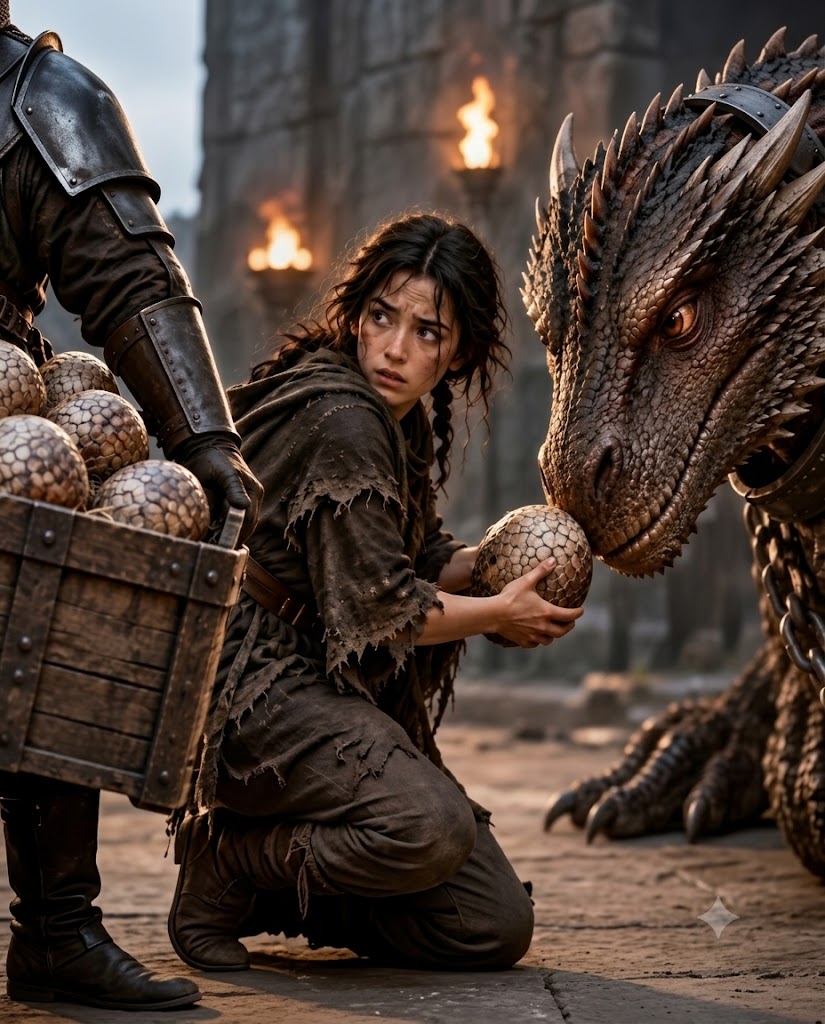
The Harvester lifted her head.
Her broken wing dragged against the stone as she moved between us and the egg.
Cole swallowed.
“I didn’t tell Saul where you were.”
I stared at him.
“You sold me out.”
“I know.”
“You watched them beat me.”
“I know.”
“Why should I believe you now?”
Cole looked down.
“Because Saul told me what he planned to do with the egg.”
Silence filled the cavern.
Even the steam seemed to stop moving.
“What did he say?”
Cole’s voice dropped.
“He said the inspectors won’t see it.”
My stomach tightened.
“What does that mean?”
“He wants to kill it before sunrise.”
The dragon made a low sound.
It wasn’t a roar.
It was something deeper.
Something that seemed to shake the bones inside my chest.
Hesk stepped closer.
“There is more.”
He opened his satchel and pulled out a bundle of papers wrapped in oilcloth.
“I found these in Saul’s office.”
He spread them across the stone.
Production records.
Shipping manifests.
Medical reports.
Names.
Thousands of them.
For years, Saul had been falsifying the amount of respiratory oil leaving Kelvin.
But there was one document that made my blood run cold.
A list of mainland hospitals.
Next to each hospital were numbers.
Patients.
Deaths.
Shortages.
Hesk pointed to one column.
“These are the people who died because their shipments never arrived.”
I looked at the names.
Some were children.
Some were elderly.
Some were families.
All of them had been reduced to numbers on Saul’s ledger.
“He knew,” I whispered.
“Yes.”
“He knew they were dying.”
“Yes.”
“And he kept selling the oil.”
Hesk nodded.
“To private buyers.”
Cole clenched his fists.
“People who could pay ten times the official price.”
The Harvester shifted beside us.
Her golden eye remained fixed on the papers.
I suddenly understood why Saul had never feared the inspectors.
If the island’s records disappeared, the truth disappeared with them.
But there was something Saul hadn’t counted on.
The egg.
If it hatched in front of witnesses, they would see the creature he had been hiding.
A living dragon.
A new source of life.
And perhaps more importantly, proof that the Harvester had not been incapable of producing healthy offspring.
She had been deliberately kept injured.
Deliberately weakened.
Deliberately exploited.
A crash sounded outside.
We all froze.
Then came the scrape of metal against stone.
“They’re here,” Cole whispered.
The Harvester lowered her head.
The egg trembled beneath her body.
A thin golden line appeared along the crack.
Hesk grabbed my arm.
“Kora, listen to me.”
I looked at him.
“If Saul gets that egg, he will destroy every record in this cavern.”
“Then we move the records.”
“There is nowhere to move them.”
I looked toward the ceiling.
There was one place.
The old ventilation shaft.
It had been sealed years ago after a collapse, but the stone around it was blackened by heat.
The geothermal tunnels ran beneath the entire prison.
If we could reach them, we could reach the old maintenance passage.
And the old maintenance passage led to the cliffs.
But the dragon couldn’t fit through it.
Neither could the egg if we carried it.
Unless…
I looked at the Harvester.
“We don’t need to carry the egg.”
Cole frowned.
“What are you thinking?”
“We make them come to us.”
Hesk stared at me.
“That’s madness.”
“Probably.”
The cavern door shook.
Someone outside shouted.
“Open!”
Saul.
The Harvester lifted herself.
Her wounded leg trembled.
She was too weak to fight a dozen men.
But she didn’t need to fight them.
She only needed to make them afraid.
I ran to the rear wall and began pulling loose stones from the ventilation opening.
Cole joined me.
Hesk shoved the papers inside his coat.
The door shook again.
“Kora!” Saul shouted.
“You cannot protect it.”
I stopped.
He knew my name.
He knew exactly where I was.
And suddenly I realized something else.
The guards hadn’t entered because they were waiting.
Waiting for the egg to hatch.
Waiting for the moment when I would be too distracted to notice the trap.
“Cole,” I whispered.
“What?”
“How many prisoners know?”
He hesitated.
“About the oil?”
“About everything.”
“Maybe twenty.”
“Tell them to open every cell.”
His face went pale.
“What?”
“Open the cells.”
“The guards will kill them.”
“They’re already prisoners.”
I looked toward the door.
“Tonight they either remain prisoners, or they become witnesses.”
Cole stared at me.
Then he nodded.
He turned and disappeared into the darkness.
Hesk looked at me as if I had lost my mind.
“You are starting a riot.”
“No.”
I looked at the trembling egg.
“I’m starting a rescue.”
The door exploded inward.
Three guards rushed into the cavern.
The Harvester moved faster than any wounded creature should have been able to move.
Her head struck the first guard and threw him against the wall.
The second raised his spear.
I grabbed his arm.
Hesk slammed a stone into his wrist.
The spear fell.
The third guard froze.
For one second, nobody moved.
Then the dragon roared.
The sound rolled through the cavern and out into the tunnels.
It wasn’t just loud.
It was ancient.
The guard dropped his weapon and ran.
I grabbed the fallen spear.
“Kora!”
Saul stood in the doorway.
He was holding a crossbow.
The bolt was aimed directly at the egg.
I stepped between them.
“Move.”
“No.”
His finger tightened.
“You think this is about the dragon?”
His voice was strangely calm.
“You have no idea what happens if that creature reaches the mainland.”
“People stop dying.”
He smiled.
“No.”
His eyes hardened.
“People stop paying.”
The bolt fired.
The Harvester moved.
The bolt struck her shoulder.
She screamed.
I screamed with her.
The dragon collapsed against the stone.
Blood spread beneath her scales.
Something inside me broke.
I ran at Saul.
He swung the crossbow toward me.
Cole appeared from behind and slammed into him.
The two men crashed into the wall.
Hesk grabbed the crossbow.
“Run!” he shouted.
But the egg began to crack.
Not slowly.
Not anymore.
The shell split from top to bottom.
A tiny claw pushed through.
Then another.
The Harvester lifted her head.
Despite the bolt in her shoulder, she dragged herself toward the egg.
The guards outside began shouting.
And from somewhere beyond them came another sound.
Hundreds of footsteps.
Prisoners.
Cole had opened the cells.
The newborn dragon broke through the shell.
It was smaller than I expected.
No larger than a wolf.
Its scales were black at the tips and gold along its spine.
Two wet wings unfolded from its body.
Its eyes opened.
Golden.
Just like its mother’s.
It looked at the Harvester.
She touched its forehead with her broken snout.
Then the little dragon made a sound I will never forget.
A soft, trembling cry.
The Harvester answered.
For a moment, Kelvin Island disappeared.
There was no prison.
No Saul.
No chains.
Only a mother meeting her child.
Then Saul laughed.
He had blood on his cheek.
Cole was holding him against the wall.
“You think this changes anything?” Saul said.
“The inspectors are coming.”
“Exactly.”
He looked at the newborn dragon.
“They will take it.”
Hesk stepped forward.
“Not if they know the truth.”
Saul smiled.
“You still don’t understand.”
He looked at the papers beneath Hesk’s coat.
“The inspectors aren’t coming to investigate me.”
My stomach dropped.
“They’re coming to buy.”
Nobody spoke.
Saul laughed again.
“Kelvin Island isn’t a prison because people are dangerous.”
He looked at the dragon.
“It’s a prison because everyone outside needs what we have.”
Then a horn sounded from above the cliffs.
Once.
Twice.
Three times.
Hesk’s face changed.
“The inspection ship.”
Saul nodded.
“At sunrise.”
He looked at me.
“And when they arrive, they will find a dead prisoner, a dead dragon, and a missing egg.”
I understood.
He planned to kill us all.
Then blame the prisoners.
The cavern erupted into chaos.
Guards poured through the entrance.
Prisoners surged behind them.
Someone threw a shovel.
Someone else screamed.
The Harvester tried to stand and collapsed again.
I picked up the newborn dragon.
It hissed at me.
“It’s all right,” I whispered.
“I’ve got you.”
A guard raised his weapon.
Cole tackled him.
Hesk dragged the Harvester toward the rear tunnel.
“Go!” he shouted.
I ran.
The newborn dragon clung to my coat.
Behind me came the sounds of fighting.
Metal.
Stone.
Shouting.
Then a gunshot.
I stumbled.
“Cole!”
No answer.
Another shot.
Hesk screamed something I couldn’t hear.
I kept running.
The tunnel narrowed until my shoulders scraped against the walls.
Steam burned my face.
The little dragon was trembling against my chest.
Then I saw daylight.
Not the gray morning outside.
A narrow shaft of moonlight.
The maintenance passage.
We had reached the cliffs.
I climbed through the opening.
Cold wind struck my face.
Below me was the black ocean.
Behind me, the prison burned.
Someone had set fire to the storage buildings.
Flames climbed into the night.
The alarm bells rang across Kelvin.
I looked back.
Prisoners were pouring from the main gates.
Some carried tools.
Some carried nothing.
They were running toward the cliffs.
For the first time, they were running away from Kelvin.
Then Saul appeared.
He stood on the roof of the prison.
He had escaped the cavern.
His coat was torn.
Blood covered one side of his face.
He saw the dragon in my arms.
“Kora!”
I ran.
He followed.
I reached the old bridge leading toward the supply dock.
Halfway across, the bridge shook.
Saul had followed me onto it.
“Give me the dragon.”
“No.”
“It belongs to Kelvin.”
“It belongs to her mother.”
“You don’t understand what you’re carrying.”
“I understand exactly.”
I turned.
The newborn dragon lifted its head.
Its wings opened.
It was afraid.
So was I.
Saul stepped closer.
“You can’t survive out there.”
“Neither can you.”
His expression changed.
Then he charged.
The bridge snapped.
For one terrible second, we both fell.
My hands caught the edge.
The dragon slipped from my coat.
I grabbed it with one arm.
Saul caught the other side.
Below us, waves crashed against the rocks.
He looked at me.
“Give me your hand.”
I stared at him.
“You want me to save you?”
“I want to live.”
So did I.
But then I remembered the names on his ledger.
The children.
The old men.
The families who had died because he had chosen profit over life.
I looked at his hand.
Then at the dragon.
I made my choice.
I pulled myself upward.
Saul’s grip slipped.
His eyes widened.
He fell.
I expected him to disappear into the ocean.
Instead, his hand caught a broken beam.
He hung there.
“Kora!”
I looked down.
He was no longer the warden.
He was just a man hanging over black water.
I could save him.
One movement.
One decision.
I could end everything.
Then I remembered the Harvester’s golden eye.
She had looked at me when I stole her egg.
She could have killed me.
She hadn’t.
She had chosen something else.
I reached down.
Saul grabbed my wrist.
For a second, I pulled.
Then the beam cracked.
Saul looked at me.
He knew.
“Don’t let go.”
“I won’t.”
The beam broke.
He fell.
But I had already tied my coat around the bridge railing.
His body dropped only a few feet before the fabric caught him.
I hauled him toward the edge.
Cole appeared behind me.
His face was covered in blood.
He grabbed Saul by the collar.
Together, we pulled him onto the bridge.
Saul coughed.
He looked at me with disbelief.
“Why?”
I looked at him.
“Because if you die, you become a secret.”
He stared.
“And if you live?”
“You become evidence.”
By sunrise, the prison was surrounded.
The inspection ship entered the harbor beneath a sky the color of ash.
But the inspectors did not arrive to a silent prison.
They arrived to hundreds of prisoners standing outside the gates.
They arrived to burning ledgers spread across the yard.
They arrived to Hesk holding Saul’s records.
And they arrived to the sound of a newborn dragon crying beside its wounded mother.
The inspectors tried to deny everything.
They said the records could have been forged.
They said the prisoners were rioting.
They said Saul had acted alone.
But then Cole stepped forward.
He told them everything.
One by one, other prisoners did the same.
The stories matched.
The missing shipments.
The false numbers.
The private buyers.
The poisoned collar.
The deliberate injuries.
The deaths.
The years of theft.
There were too many witnesses.
Too many records.
Too many names.
Saul could no longer hide behind a prison wall.
They arrested him before noon.
The guards who had followed his orders surrendered one by one.
Some begged for forgiveness.
Some claimed they had only been obeying.
But Hesk said nothing.
He simply handed the inspectors the medical report.
The report that proved the dragon had been slowly poisoned by her collar.
The island was silent after that.
Not peaceful.
Not yet.
Just silent.
For the first time in years, nobody knew what would happen next.
The Harvester was taken to the old healing cavern.
Hesk removed the collar piece by piece.
It took six hours.
When the last piece fell away, the dragon did not move.
Everyone waited.
Then she opened her eyes.
Her newborn crawled toward her.
The mother lowered her head.
The little dragon climbed onto her neck.
And for the first time, the Harvester stood without chains.
She almost fell.
I reached for her.
She did not need me.
She steadied herself.
Then she spread her wounded wings.
The broken one could not fully open.
But the other rose toward the ceiling.
A shaft of sunlight entered through the cavern roof.
It touched her golden scales.
Nobody spoke.
Weeks later, Kelvin changed.
The prison was closed.
The remaining prisoners were given hearings.
The respiratory oil was placed under public control.
The mainland hospitals finally received the shipments that had been withheld.
Some people were still angry.
Some wanted Saul executed.
Some wanted every guard punished.
Some wanted Kelvin destroyed so that nobody could ever use the island again.
But Hesk argued for something different.
“Don’t destroy the place,” he said.
“Remember it.”
So the prison remained.
Not as a prison.
As a place where the truth could never again be hidden.
The cavern became a sanctuary.
The dragons were no longer called Harvesters.
The newborn was given a name.
Auryn.
It meant “first light” in an old island dialect.
Her mother was finally given one too.
Kora.
I laughed when I heard it.
For years, nobody had called her anything.
Now the whole island knew her name.
My own sentence was erased.
So were the sentences of many others.
But I did not leave Kelvin immediately.
I stayed.
There were people who needed help.
There were records to repair.
There were families waiting for news about those who had died.
And there was a dragon that still trusted me enough to sit beside her.
Months passed.
The Harvester’s wounds began to heal.
Her broken wing never returned to what it had been.
But she learned to fly again.
Not high.
Not far.
Only above the cliffs.
Auryn followed her.
The first time they flew together, the entire island came outside to watch.
Two golden shapes crossed the morning sky.
For a few seconds, nobody remembered the prison.
Nobody remembered the chains.
We only watched them fly.
I thought about the night I had stolen that egg.
At the time, I believed I was saving one life.
I had not understood that courage rarely begins with knowing how everything will end.
Sometimes it begins with refusing to accept what everyone else has learned to tolerate.
I had been sent to Kelvin for stealing grain.
I left having learned that the most dangerous theft was not stealing food from a starving town.
It was stealing hope from people and teaching them to believe they deserved nothing better.
Saul had stolen medicine.
But more than that, he had stolen choices.
He had made prisoners believe they were powerless.
He had made doctors believe their voices did not matter.
He had made an injured creature believe that pain was simply the price of survival.
And for years, everyone had survived by looking away.
Until one person didn’t.
Then another.
Then another.
That was how Kelvin changed.
Not because one hero defeated a monster.
Because ordinary people finally decided that silence was no longer safety.
One evening, long after the prison gates had been removed, I sat beside the geothermal field where I had once hidden the egg.
The ground was warm beneath my hands.
The wind carried the smell of salt.
The ocean was still black.
But it no longer looked endless.
Auryn came running across the rocks.
She had grown almost twice as large.
She lowered her head beside me.
I scratched the scales beneath her jaw.
“You remember this place?”
She made a soft sound.
Behind her, Kora appeared.
Her golden eyes met mine.
For a moment, I remembered the first night I had seen her.
The chains.
The blood.
The broken wing.
The terrible silence.
I thought about how close we had all come to believing that was simply the way the world worked.
I placed my hand against her warm scales.
“You were never a Harvester,” I whispered.
“You were a mother.”
Kora closed her eyes.
Above us, Auryn spread her wings.
Then she jumped.
For one frightening second, she fell.
Then the wind caught her.
She rose.
Higher.
Higher.
And Kora followed.
I watched until they disappeared into the orange light of sunset.
Kelvin had taught me many things.
That cruelty can become ordinary when nobody challenges it.
That greed does not always look like a monster.
Sometimes it wears a uniform.
Sometimes it carries a ledger.
Sometimes it speaks politely while people die.
But Kelvin taught me something else too.
A single act of kindness may seem useless when faced with something enormous.
A stolen egg.
A hidden medical report.
A prisoner choosing to speak.
A hand reaching down instead of letting another person fall.
None of those things looked powerful by themselves.
Together, they changed an island.
That night, I walked back toward the sanctuary.
The old prison tower stood empty against the stars.
Someone had carved a sentence into its stone.
I had seen it before.
But I had never truly understood it until then.
It said:
“What we tolerate becomes the world our children inherit.”
I touched the words.
Then I looked toward the sky.
Somewhere beyond the cliffs, two dragons were flying free.
And for the first time, I understood that freedom was not something given to us when the chains were removed.
It was something we chose the moment we decided the chains no longer belonged around anyone’s neck.
Kelvin would never be the same.
Neither would I.
And neither, I hoped, would the people who came after us.
Because sometimes the smallest crack is all it takes.
A crack in a wall.
A crack in a lie.
A crack in an egg.
And through that crack, if someone is brave enough to protect it, something alive can finally break free.
For a long time, I believed the story of Kelvin had ended the day Saul was taken away.
I was wrong.
Some stories do not end when the villain falls.
They end when the people who survived him learn how to live without becoming like him.
Three years passed.
Kelvin changed slowly.
The prison walls remained, but the iron gates were removed.
The watchtowers became shelters for injured travelers.
The old punishment yard became a garden.
Children who had once been born on the mainland and treated in secret because their parents could not afford respiratory oil now came to Kelvin for free treatment.
And beneath the cliffs, where the Harvester had once been chained, dragons flew freely through the morning mist.
But freedom had brought a new problem.
There were more dragons than the sanctuary could protect.
Auryn had grown enormous.
Her wings stretched wider than a fishing boat.
She had inherited her mother’s golden eyes, but not her mother’s broken wing.
Every morning, she disappeared beyond the northern cliffs and returned before sunset.
Nobody knew where she went.
Nobody worried.
Until the day she didn’t come back.
It began with a storm.
The sky turned green before noon.
The sea rose against the cliffs.
Fishermen pulled their boats onto the rocks, and everyone in the sanctuary was ordered indoors.
I stood beneath the old prison tower, watching rain sweep across the island.
Kora was restless.
She paced from one end of the sanctuary to the other.
“She’s coming back,” I told her.
Kora stared at the sky.
She didn’t move.
That frightened me more than the storm.
By midnight, Auryn still hadn’t returned.
At dawn, three fishermen found her.
They carried her on a wooden platform.
Her left wing was torn.
There were deep cuts along her neck.
And around one leg was a strip of metal.
A collar.
I recognized it immediately.
Not because I had seen that particular piece before.
Because I had seen the mark it left.
The same blackened metal.
The same narrow grooves.
The same smell of oil and chemicals.
Saul’s collar.
I felt the blood leave my face.
“Where did you find her?”
The fishermen pointed north.
“Beyond the old volcanic ridge.”
Hesk examined the metal.
His hands began to shake.
“This wasn’t made recently.”
“What does that mean?”
He looked at me.
“It means someone has been building these for years.”
The sanctuary fell silent.
We searched Auryn’s wing.
We found no other wounds except those caused by the trap.
But beneath the metal collar was something worse.
A small metal plate.
A symbol had been stamped into it.
Three circles surrounding a black flame.
Hesk stared at it.
“I know this.”
“From where?”
He didn’t answer.
Instead, he went to the old archives.
He returned an hour later carrying a book covered in dust.
He opened it to a page written more than forty years earlier.
The symbol was there.
A shipping company.
A company that had supplied Kelvin’s prison.
A company that had supplied the buyers of Saul’s stolen oil.
And a company that had officially disappeared seventeen years ago.
I read the name.
“Veyr Maritime.”
Hesk nodded.
“They weren’t just buying the oil.”
My throat tightened.
“What were they buying?”
He turned another page.
“Dragons.”
Nobody spoke.
The storm outside grew louder.
Kora lifted her head.
Her eyes fixed on the northern sea.
Then she roared.
The sanctuary windows shook.
That evening, a ship appeared beyond the cliffs.
It had no flag.
No lights.
No identifying marks.
It anchored just beyond the reef.
Nobody came ashore.
But at midnight, we heard an explosion.
Then another.
The northern sanctuary caught fire.
We ran outside.
Flames rose between the trees.
People shouted.
Dragons scattered into the sky.
And from the darkness came men wearing black coats.
Not prison uniforms.
Not soldiers.
Something worse.
People who had come prepared.
They carried tranquilizer rifles.
Chains.
Metal cages.
I understood immediately.
They weren’t here for the island.
They were here for the dragons.
“Kora!”
She spread her wings.
I grabbed her neck.
“No.”
She looked at me.
“If you fight them here, they’ll use the others against you.”
Her eyes burned.
“Trust me.”
She hesitated.
Then she lowered her head.
The first tranquilizer dart struck her shoulder.
She collapsed.
I screamed.
The sanctuary erupted.
People threw stones.
Fishermen swung axes.
Doctors carried wounded dragons into the caves.
But the attackers kept advancing.
Then I heard a voice behind me.
“Step away from the dragon.”
I turned.
A man stood in the firelight.
Older than Saul.
Gray hair.
Perfect coat.
Calm expression.
He looked at the chaos around him as if he were inspecting a warehouse.
“You must be Kora.”
I stared at him.
“You know my name?”
He smiled.
“We have been looking for you for a very long time.”
“I’ve never met you.”
“No.”
He glanced at the dragons.
“But you have something that belongs to us.”
I stepped between him and Kora.
“What?”
“The first free-born dragon.”
My blood ran cold.
“Auryn?”
“She isn’t merely a dragon.”
He reached into his coat and removed a document.
“She is the first dragon in generations to be born without the genetic damage caused by captivity.”
I didn’t understand.
He continued.
“The creatures used in Kelvin were descendants of dragons bred for oil production. They were deliberately weakened. Easier to control. More productive.”
Hesk stared at him.
“You altered them.”
The man smiled.
“Of course.”
“And the respiratory oil?”
“Highly profitable.”
The truth was suddenly bigger than Saul.
Bigger than Kelvin.
Saul had never created the system.
He had only operated one part of it.
The man folded the document.
“Your sanctuary has interrupted a supply chain worth billions.”
I looked at Kora.
Then at the dragons behind us.
“You mean you have been killing them for money.”
He shrugged.
“Everything has a price.”
I picked up a broken spear.
“Not anymore.”
He sighed.
“That is unfortunate.”
He raised his hand.
The attackers lifted their weapons.
Then a horn sounded from the harbor.
Once.
Twice.
Three times.
The man’s face changed.
A fleet emerged through the storm.
Fishing boats.
Cargo ships.
Medical vessels.
Dozens of them.
Then hundreds.
People from the mainland had come.
Doctors.
Families.
Fishermen.
Former prisoners.
People who had received medicine from Kelvin.
People whose lives had been saved by the sanctuary.
And at the front of the fleet stood Cole.
Older.
Scarred.
But smiling.
He jumped from the boat onto the dock.
“Did you really think we were going to let you do this again?”
The attackers hesitated.
The man in the black coat looked around.
For the first time, he seemed uncertain.
Cole raised a document.
“We found your accounts.”
The man’s face went pale.
Hesk stepped forward.
“And your shipping routes.”
A woman from the mainland held up another bundle.
“Your buyers.”
Another person shouted.
“Your laboratories.”
Then another.
“Your private prisons.”
The truth had escaped Kelvin.
It was everywhere now.
The black-coated man tried to run.
He made it three steps.
A fisherman knocked him to the ground.
The fight lasted less than ten minutes.
When it was over, the attackers were disarmed.
The fire was extinguished.
And the dragons were alive.
But Auryn was still unconscious.
I carried her into the healing cavern.
For three days, she did not wake.
Kora refused to leave her side.
I barely slept.
On the fourth morning, I heard scratching.
I opened my eyes.
Auryn was awake.
Her golden eye looked directly at me.
I laughed.
Then I cried.
She lifted her head.
I touched her face.
“You scared me.”
She nudged my shoulder.
Outside, the sun was rising.
The storm had finally passed.
But something had changed.
The people who had come to Kelvin did not leave.
They stayed.
The sanctuary became an international refuge.
The companies connected to Veyr Maritime were investigated.
Their records exposed years of illegal breeding, trafficking, and deliberate medical shortages.
The respiratory oil system was rebuilt.
Instead of forcing dragons to produce it through captivity, researchers developed a method of collecting the oil naturally, without harming the creatures.
It was slower.
More expensive.
But it worked.
No dragon ever needed to wear a collar again.
As for Saul, he remained alive.
He spent the rest of his life in prison.
Some people hated him.
Others wanted him forgotten.
But his testimony eventually became important.
When investigators asked how the system had survived for so long, Saul gave them a simple answer.
“Because everyone thought someone else would stop it.”
That sentence stayed with me.
Years later, I understood why.
Evil rarely survives because one person is powerful enough to control everyone.
It survives because ordinary people become tired.
Because speaking is dangerous.
Because obedience is easier.
Because silence can feel like survival.
I had once believed courage meant standing alone.
Kelvin taught me otherwise.
Courage was Cole admitting what he had done.
It was Hesk risking his life to preserve a medical report.
It was the prisoners opening their cells.
It was the fishermen sailing into a storm.
It was the doctors refusing to abandon wounded dragons.
It was thousands of ordinary people deciding that one island’s suffering was their problem too.
One evening, many years after the final battle, I returned to the geothermal field.
The sanctuary had expanded around it.
Flowers grew where I had once buried Auryn’s egg.
Children played between the warm stones.
Kora was old now.
Her scales had faded.
Her wounded wing had become stiff.
But she still flew.
Only short distances.
Only when Auryn came with her.
Auryn landed beside me.
She was enormous now.
Her shadow covered the ground.
I smiled.
“You remember?”
She lowered her head.
I placed my hand against her scales.
“This is where it started.”
She made a quiet sound.
I looked toward the cliffs.
Beyond them, the sea glittered beneath the evening sun.
For years, I had wondered whether saving one egg had truly mattered.
Now I knew the answer.
It wasn’t the egg itself.
It was the choice.
The decision to protect something fragile when nobody was watching.
The decision to believe that another life mattered even when the world had assigned it a price.
That was what changed Kelvin.
Not a battle.
Not a prisoner’s rebellion.
Not the downfall of Saul.
It began with one person saying:
“This is wrong.”
And refusing to walk away.
Kora appeared behind us.
She lowered herself slowly onto the warm earth.
Auryn moved closer to her.
Mother and daughter rested together beneath the fading light.
I sat beside them.
For a while, none of us spoke.
Then Auryn suddenly lifted her wings.
The wind moved beneath them.
She looked at me.
I knew what she wanted.
“Go.”
She leaped.
Kora followed.
They rose over the sanctuary.
Higher than the old watchtowers.
Higher than the prison walls.
Higher than the cliffs where so many people had once believed their lives were finished.
I watched until they became two golden points against the sunset.
Then I heard children laughing behind me.
I turned.
One little girl was standing beside the old prison gate.
She pointed toward the sky.
“Will they always be free?”
I smiled.
“They will.”
“How do you know?”
I looked at the gate.
The iron bars had been removed years ago.
Only the stone frame remained.
“Because people remember what happened here.”
The girl frowned.
“Is remembering enough?”
I thought about that.
“No.”
She waited.
“Remembering is only the beginning.”
I knelt beside her.
“We have to choose differently every time we get the chance.”
She looked at the dragons disappearing into the distance.
“Even when it’s difficult?”
“Especially then.”
The sun disappeared.
The first stars appeared above Kelvin.
And somewhere beyond the cliffs, Auryn cried into the night.
The sound traveled across the island.
Not a cry of fear.
Not a cry of pain.
A call.
A promise.
A reminder.
Once, Kelvin had been a place where people were taught to survive by accepting chains.
Now it was a place where every child learned why the chains had been broken.
I never forgot the first night.
The black soil.
The freezing wind.
The tiny egg beneath my hands.
I had thought I was protecting a dragon.
In the end, the dragon had taught me how to protect something much larger.
A conscience.
A choice.
A belief that no life should be treated as a resource simply because someone powerful has decided it is worth less.
Years later, people would ask me what saved Kelvin.
Some said it was the evidence.
Some said it was the prisoners.
Some said it was the fleet that arrived during the storm.
They were all partly right.
But the truth was simpler.
Kelvin was saved the first time someone refused to look away.
And that was the lesson I carried with me for the rest of my life.
When cruelty becomes ordinary, resistance may begin with something very small.
A hand reaching for an injured creature.
A voice telling the truth.
A door being opened.
A secret being carried into the light.
A choice to help someone who cannot repay you.
Those things may seem insignificant.
They may even seem foolish.
But sometimes the smallest act of courage is the first crack in an entire wall.
And through that crack, light enters.
I looked one final time toward the sky.
Two dragons were flying together.
Free.
Untamed.
Unowned.
And I realized that perhaps freedom had never meant having no chains.
Perhaps freedom meant refusing to place them on someone else.
That was how Kelvin survived.
That was how we changed.
And that was how the story ended.
Not with a prison falling.
Not with a tyrant defeated.
But with a child looking into the sky and learning that no living thing should ever have to earn the right to be free.
The wind carried the dragons’ cries across the ocean.
This time, nobody was afraid of the sound.
They listened.
And remembered.
THE END.