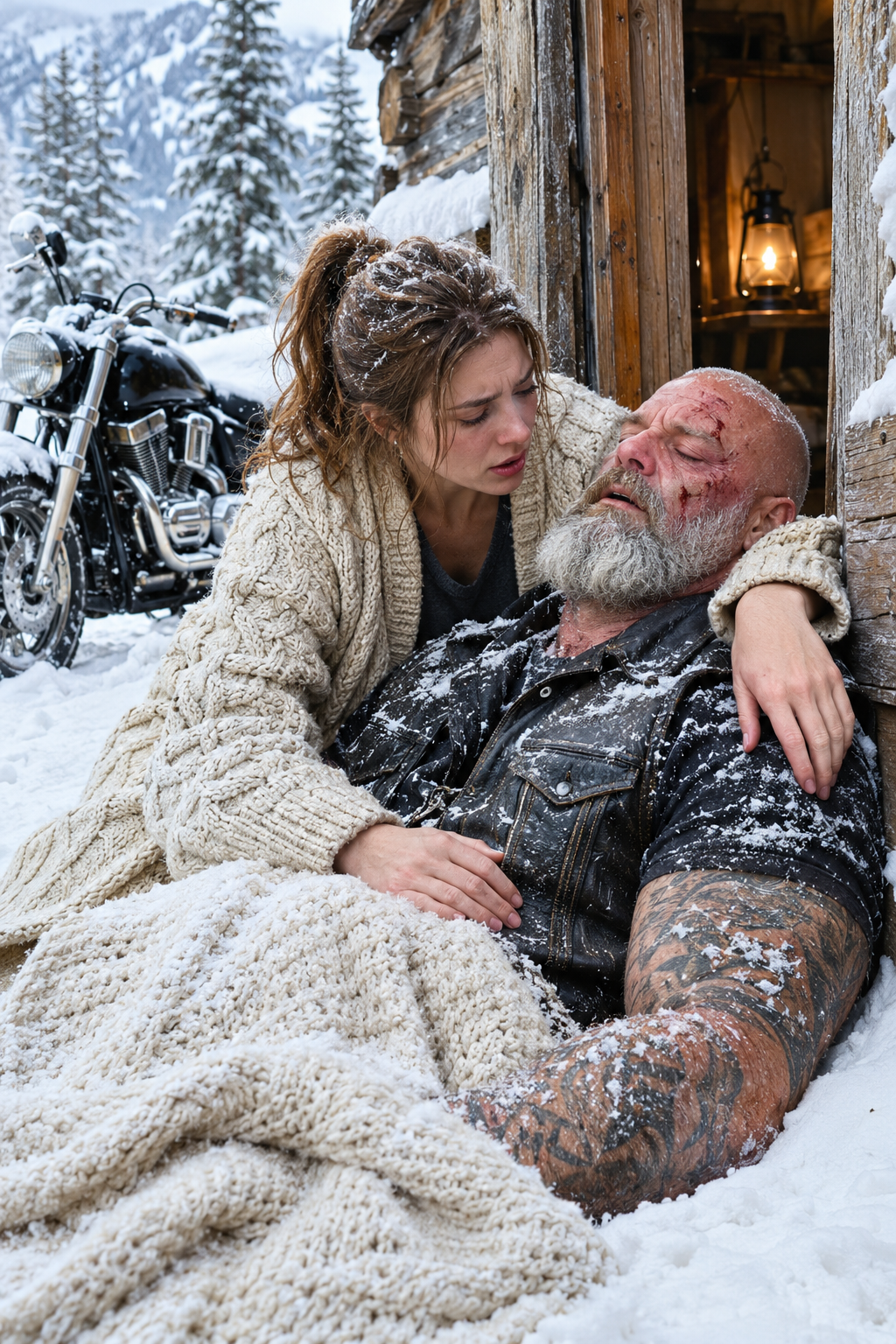
The wounded biker collapsed on her porch, leaving a trail of blood across the snow. Before he passed out, he grabbed her wrist and whispered, “If they find me here, they’ll kill you too.”
The door swung inward with a terrible groan, and a gust of icy wind scattered ashes across the cabin floor.
Dela raised her grandfather’s rifle.
“Take one more step,” she shouted, “and you’ll regret it.”
For a moment, nobody moved.
Then a man wearing a black leather jacket appeared in the doorway, his face half-hidden beneath a woolen mask. He held a shotgun against his chest.
“Well, look at that,” he said. “The little mountain girl has teeth.”
Dela recognized his voice immediately.
Rays.
Behind him, two more men waited on the porch, their weapons pointed toward the cabin.
Cole struggled to stand, pressing one hand against his wounded side.
“Leave her out of this, Rays.”
Rays smiled.
“Still giving orders, President?”
Dela glanced at Cole.
President?
She had assumed he was just another outlaw biker. Apparently, the man she had rescued was someone far more important.
Rays noticed her expression.
“He didn’t tell you? Your guest runs the Iron Wolves Motorcycle Club. Or he used to, anyway.”
Cole’s face hardened.
“What has Frank been telling everyone?”
“That you murdered Tommy Briggs and stole two hundred thousand dollars from the club.”
Cole stared at him.
“Tommy’s dead?”
For the first time, genuine confusion crossed Rays’s face.
Then he laughed.
“Don’t pretend you didn’t know.”
“I left Tommy alive at the warehouse.”
“Funny. Frank says he found Tommy with a bullet in his head. Your gun was lying beside him.”
Cole’s fingers tightened around his pistol.
Dela could see the realization spreading across his face.
Someone hadn’t simply tried to murder him.
Someone had carefully arranged for the entire club to believe he was a killer.
Rays stepped farther inside.
“Enough talking. Drop the weapons.”
Dela didn’t lower her rifle.
Instead, she aimed at the lantern hanging beside the doorway.
“Last warning.”
Rays grinned.
“You won’t shoot.”
Dela pulled the trigger.
The explosion shattered the lantern, sending glass and burning oil across the wooden floor.
Rays stumbled backward, screaming as flames caught his sleeve.
Cole fired once, striking the shotgun from another man’s hands.
“Cellar!” he shouted.
Dela grabbed Bear’s collar and ran toward the kitchen.
Behind her, gunfire erupted.
A bullet tore through a cupboard. Another shattered the clock her grandfather had built.
Cole followed, moving painfully, leaving fresh drops of blood behind him.
Dela yanked aside a faded rug, revealing a narrow trapdoor.
“Down!”
They disappeared into darkness just as Rays kicked his way back inside.
Dela pulled the trapdoor shut.
Above them, boots thundered across the kitchen.
“Find them!” Rays roared.
Cole leaned against the cellar wall, breathing hard.
“You have another way out?”
Dela nodded.
“My grandfather built a tunnel during the winter of ’78. It leads to the old smokehouse.”
Cole looked at her with sudden admiration.
“Your grandfather was a smart man.”
“He was a paranoid man,” Dela whispered. “Apparently, he had good reasons.”
They crawled through a narrow passage lined with frozen earth.
Bear squeezed ahead, his claws scraping against the stones.
Behind them, the cabin shook with another gunshot.
Dela’s heart twisted.
That house contained everything she had left of her family.
Every photograph.
Every letter.
Every memory.
And now strangers were destroying it because she had chosen to save a dying man.
When they finally emerged behind the abandoned smokehouse, the blizzard struck them like a wall.
Cole nearly collapsed.
Dela caught him beneath the arm.
“Keep moving.”
“Leave me,” he gasped.
“Not happening.”
“Dela, listen—”
“No. You listen. I’ve spent four days keeping you alive. You’re not dying because walking is inconvenient.”
Despite the pain, Cole gave a faint laugh.
They struggled through the snow toward the tree line.
Then a terrible sound rose behind them.
An explosion.
Dela turned.
Flames burst through the roof of her cabin, illuminating the storm with a monstrous orange glow.
For a moment, she couldn’t breathe.
Her grandfather’s house was burning.
Her entire world was burning.
Cole watched her face.
“I’m sorry.”
Dela stared at the flames until tears froze against her cheeks.
Then she turned away.
“Be sorry later. Right now, we survive.”
They reached a hunting shelter nearly a mile uphill just before midnight.
It was little more than a wooden box hidden among the pines, but it had a stove, blankets, and a locked cabinet containing emergency supplies.
Dela helped Cole onto a narrow cot.
His bandages were soaked through.
She worked silently, replacing them while Bear stood guard near the door.
Finally, Cole spoke.
“You deserve to know what happened.”
Dela kept working.
“Then tell me.”
“Three weeks ago, I discovered someone was using our club’s shipping business to move stolen medical equipment across state lines. Hospital supplies. Emergency generators. Even donated equipment meant for children’s clinics.”
Dela looked up.
“You’re saying your club was stealing from hospitals?”
“Someone inside it was. I suspected Frank, but I couldn’t prove it.”
“Who was Tommy?”
“My vice president. My best friend for twenty years.”
Cole swallowed.
“He found the financial records. We arranged to meet at an abandoned warehouse. When I arrived, Tommy told me Frank had been working with a private security contractor named Victor Sloane.”
Dela frowned.
“Sloane?”
Cole noticed her reaction.
“You know him?”
“Everyone around here knows that name. His company bought half the timberland after the mill closed.”
Cole nodded grimly.
“Then Tommy showed me something worse. Sloane wasn’t just stealing equipment. He was using the shipments to move illegal weapons.”
Dela’s hands stopped.
“Why would Frank help him?”
“Money. Power. Maybe both. Tommy wanted to expose everything at our next club meeting.”
“What happened?”
“Frank arrived before we could leave. He said he’d come to help. Then he shot me.”
Cole closed his eyes.
“I remember Tommy yelling. I remember falling. When I woke up, Frank was gone, and Tommy was lying beside the loading dock.”
“You thought he was alive.”
“He was breathing when I escaped.”
Silence settled over the shelter.
Then Dela asked the question that had been bothering her.
“Why didn’t Frank finish you?”
Cole’s expression darkened.
“He thought he had.”
Outside, the wind howled through the trees.
Dela stared at the little stove.
She wanted to believe him.
But there was something she couldn’t ignore.
“Cole, you carry a gun. You lead a motorcycle club. And three men just burned down my home because of you.”
“I know.”
“How am I supposed to trust anything you say?”
Cole didn’t answer immediately.
Instead, he slowly removed a silver ring from his finger.
It bore the image of a wolf surrounded by thirteen stars.
“My father gave me this when I started the Iron Wolves. He told me a leader isn’t the man everyone fears. He’s the man people can trust when they’re afraid.”
He placed the ring on the table.
“I forgot that for a long time.”
Dela studied him.
“What does that mean?”
“It means I spent years pretending I didn’t see things I should’ve stopped. Men getting hurt. Families being threatened. People using our name to frighten others.”
His voice grew quieter.
“I told myself we weren’t responsible for what a few bad men did.”
“And now?”
“Now Tommy’s dead, your home is gone, and I’m finally seeing what that excuse cost.”
Dela looked away.
For the first time, she didn’t see a dangerous biker.
She saw an exhausted man confronting the consequences of his own silence.
But regret wouldn’t bring her cabin back.
And it wouldn’t stop Frank.
“We need the police,” she said.
Cole shook his head.
“Not the local sheriff.”
“Why?”
“Sheriff Dalton has been accepting money from Sloane for years.”
Dela felt a chill unrelated to the weather.
“Then who can we trust?”
Cole considered the question.
“One person. A woman named Mara Keene. She’s a state investigator. Tommy contacted her before he died.”
“Where is she?”
“Probably in Graystone. But we need evidence before Frank finds us.”
Dela glanced toward the dark window.
“Evidence like what?”
Cole reached inside his vest and pulled out a small brass key.
“Tommy gave me this before Frank arrived. He said it opened a locker at the old railway station.”
Dela examined the key.
A number was stamped into its surface.
Seventeen.
She suddenly remembered something her grandfather used to say.
When powerful men become dangerous, never fight them with anger. Fight them with the truth they cannot bury.
She closed her fingers around the key.
“Then we go to the station.”
By dawn, the storm had weakened.
Dela led Cole through the forest toward an abandoned logging road where her grandfather had hidden an old pickup truck beneath a canvas cover.
The engine protested before finally starting.
Cole stared at the rusted vehicle.
“Does everything your grandfather owned have a secret?”
Dela almost smiled.
“You haven’t seen his fishing tackle.”
They drove toward Graystone, avoiding the main highway.
Halfway down the mountain, Dela noticed a black SUV parked beside a fallen tree.
Her stomach tightened.
“Cole.”
“I see it.”
A man stepped into the road.
Sheriff Dalton.
He raised one hand, signaling them to stop.
Dela slowed.
Cole reached for his pistol.
“Don’t,” she whispered.
Dalton approached the driver’s window, smiling beneath his thick mustache.
“Morning, Miss Hartley. Heard there was a fire up your way.”
Dela forced herself to remain calm.
“Yes, Sheriff.”
“Terrible business. You hurt?”
“No.”
His eyes shifted toward Cole.
“Well, now. Who’s your friend?”
“My uncle.”
Dalton smiled wider.
“Funny. Didn’t know you had an uncle.”
“Neither did I until last week.”
The sheriff’s smile disappeared.
“Step out of the truck.”
Cole’s hand moved beneath his coat.
Dela suddenly slammed her foot against the accelerator.
The pickup surged forward.
Dalton leaped aside, shouting.
A gunshot cracked behind them.
The rear window exploded.
“Keep driving!” Cole yelled.
Dela wrestled the steering wheel as the truck fishtailed across the icy road.
The SUV roared to life behind them.
Within seconds, it was gaining.
“There’s a bridge ahead!” Dela shouted.
Cole glanced backward.
“They’re too close.”
Dela knew the road better than anyone.
She had driven it with her grandfather every winter since she was fourteen.
And she remembered something Dalton didn’t.
Two hundred yards ahead, a narrow wooden bridge crossed a frozen ravine.
The bridge had been condemned years ago.
Her grandfather had reinforced one side just enough for his pickup to cross.
But only if the driver knew exactly where to place the tires.
“Hold on!”
She accelerated.
The truck thundered onto the bridge.
Wood groaned beneath them.
Dela kept the left wheels inches from the railing.
They reached the opposite side just as the SUV followed.
A tremendous cracking sound split the air.
The center of the bridge collapsed.
The SUV dropped nose-first into the ravine, disappearing beneath a cloud of snow and splintered timber.
Dela slammed on the brakes.
For several seconds, neither spoke.
Then Cole slowly turned toward her.
“Remind me never to play cards with you.”
Dela exhaled shakily.
“Remind me never to rescue another biker.”
They reached Graystone shortly before noon.
The old railway station stood abandoned behind a row of boarded-up shops.
Inside, dust covered the ticket counters, and weeds grew between the floorboards.
Locker seventeen was hidden beneath a staircase.
Dela inserted the key.
The lock clicked.
Inside was a waterproof envelope, a small digital recorder, and a photograph.
Cole picked up the photograph first.
His face drained of color.
Dela leaned closer.
It showed Frank standing beside Victor Sloane.
Between them was Sheriff Dalton.
And behind the three men stood another familiar figure.
Rays.
They were smiling beside crates marked with the emblem of a children’s hospital.
Dela opened the envelope.
There were shipping manifests, bank transfers, and handwritten notes.
But the recorder held something far more important.
Cole pressed play.
Tommy’s voice filled the empty station.
“If you’re hearing this, something happened to me. Frank has been stealing from the club for almost two years. Sloane pays him to move weapons hidden inside medical shipments. Dalton protects their routes.”
A pause.
Then Tommy continued.
“I found something else. Sloane plans to destroy the warehouse tonight. He wants to erase the evidence and blame the explosion on Cole. Frank agreed to help him.”
Cole’s jaw clenched.
Tommy’s voice became strained.
“Cole, if you’re listening, I’m sorry I didn’t tell you sooner. I was afraid. I kept thinking I could fix this without getting anyone hurt.”
Another pause.
“You once told me brothers don’t abandon each other. I hope you still believe that.”
The recording ended.
Cole sat motionless.
Dela saw tears gathering in his eyes.
He wiped them away quickly.
“We have them,” she whispered.
But before Cole could answer, a slow clap echoed through the station.
“Well done.”
Dela spun around.
Frank stood at the entrance.
He was tall and broad-shouldered, with silver hair pulled into a ponytail.
Four armed men surrounded him.
One held Bear’s leash.
The dog growled furiously.
Dela’s blood turned cold.
“Let him go!”
Frank smiled.
“Relax. I found your dog wandering near the road. Beautiful animal.”
Cole stepped in front of her.
“Frank.”
“Cole. You look terrible.”
“You murdered Tommy.”
Frank’s smile faded.
“Tommy made a choice.”
“He trusted you.”
“He threatened everything we built!”
Cole stared at him.
“We built a brotherhood.”
“No,” Frank snapped. “You built a club where everyone worshiped you while I did the dirty work.”
His voice echoed through the empty station.
“Twenty years, Cole. Twenty years of standing behind you. Watching men shake your hand while I handled every problem.”
“So you sold us to Sloane?”
“I gave us a future.”
“You gave us a price.”
Frank’s expression hardened.
“Enough. Give me the recorder.”
Cole glanced toward Dela.
It was a tiny movement.
But she understood.
He was buying time.
Dela slowly slipped her hand into her jacket pocket.
Inside was her grandfather’s old emergency transmitter, a small radio device connected to a mountain rescue frequency.
She had activated it when they entered the station.
Now its red light blinked silently.
Frank extended his hand.
“The recorder.”
Cole raised it.
“You want this? Come take it.”
Frank drew his pistol.
A sharp bark interrupted him.
Bear lunged against the leash, pulling his handler off balance.
Dela seized the moment.
She hurled a metal toolbox toward the nearest gunman.
It struck his knees.
Cole fired at the ceiling.
Glass shattered.
Everyone ducked.
Dela ran toward the ticket counter, but Frank grabbed her by the hair and dragged her backward.
A cold pistol pressed against her temple.
“Drop it, Cole!”
Cole froze.
Frank tightened his grip.
“Now!”
Cole lowered his gun.
Dela struggled, but Frank twisted her arm painfully.
“Your problem,” Frank hissed at Cole, “is that you’ve always cared about the wrong people.”
Cole looked at Dela.
“No,” he said quietly. “My problem was that I stopped caring enough.”
He placed his pistol on the floor.
Frank kicked it away.
“Take them outside.”
The men forced Cole and Dela into a black van parked behind the station.
Bear was shoved into a separate vehicle.
Dela fought until one of the men struck her across the face.
Cole lunged toward him.
Three guns immediately swung in his direction.
“Touch her again,” Cole growled, “and you’ll wish you’d killed me on that mountain.”
Frank laughed.
“You’re in no position to threaten anyone.”
The van doors slammed.
Darkness swallowed them.
For the next forty minutes, the vehicle climbed a winding mountain road.
Dela sat beside Cole, their wrists bound with plastic ties.
Her cheek throbbed.
Her heart pounded.
“I’m sorry,” Cole whispered.
Dela shook her head.
“Stop apologizing.”
“They wouldn’t have touched you if—”
“If I’d left you to die?”
Cole fell silent.
Dela leaned closer.
“My grandfather used to say courage isn’t being unafraid. It’s deciding fear doesn’t get to choose who you become.”
Cole looked at her.
“He sounds like a remarkable man.”
“He was.”
She swallowed.
“And right now, I really wish he were here.”
Cole lowered his voice.
“He is.”
Dela frowned.
“In everything you’ve done since I met you.”
For a moment, the fear inside her loosened.
Then the van stopped.
The doors opened onto an enormous industrial compound surrounded by fences.
Dela recognized it immediately.
Sloane’s abandoned lumber mill.
Floodlights illuminated rows of shipping containers.
Men carried crates toward two waiting trucks.
And near the loading dock stood a fuel tanker.
Frank dragged them toward the main building.
Victor Sloane waited inside, dressed in an expensive charcoal coat.
He looked nothing like a criminal.
That somehow made him more frightening.
“Cole Vance,” Sloane said pleasantly. “I’ve heard so much about you.”
Cole glared at him.
“Where’s the evidence from the warehouse?”
Sloane smiled.
“Destroyed.”
“Not all of it.”
Frank tossed the recorder onto a desk.
Sloane examined it.
“Unfortunately, this complicates things.”
Dela watched him carefully.
He wasn’t angry.
He was calculating.
“Kill them,” Frank said.
Sloane shook his head.
“Not yet. We have a more useful solution.”
He pointed toward the fuel tanker.
“In twenty minutes, this facility will suffer an unfortunate accident. Two fugitives will be found among the wreckage. A tragic ending to a violent criminal dispute.”
Frank looked uneasy.
“What about my men?”
“They’ll leave before the explosion.”
“And the money?”
Sloane smiled.
“Already transferred.”
Dela noticed something in his expression.
Frank didn’t.
Sloane had no intention of allowing witnesses to survive.
Not even his partner.
Two guards dragged Dela and Cole into a storage room and locked the door.
A single bare bulb flickered overhead.
Cole tested the plastic ties around his wrists.
“They’re too tight.”
Dela glanced toward a rusted workbench.
On it lay a broken metal bracket with a jagged edge.
“Help me get over there.”
They shuffled across the room.
Dela pressed her bound wrists against the metal and began sawing.
Minutes passed.
Her skin tore.
Blood ran down her fingers.
Then the plastic snapped.
She freed Cole.
He grabbed her shoulders.
“Listen carefully. Once we’re out, you run.”
“No.”
“Dela—”
“We finish this together.”
Before he could argue, footsteps approached.
The door opened.
Rays entered carrying a pistol.
He stared at their freed hands.
Then he raised his weapon.
“Don’t move.”
Cole stepped forward.
“Rays, Frank is going to let Sloane kill every one of you.”
“Shut up.”
“Look outside. The trucks are leaving. Where’s your ride?”
Rays hesitated.
Cole pressed harder.
“Did Frank tell you about the explosion?”
The color drained from Rays’s face.
“What explosion?”
A distant alarm suddenly began ringing.
Then a voice shouted from outside.
“Everybody out! Sloane’s leaving!”
Rays turned toward the hallway.
Cole seized his wrist.
The pistol discharged into the ceiling.
Dela struck Rays with a wooden stool.
He collapsed.
Cole took the weapon.
“Go!”
They rushed into the corridor.
Outside, chaos had erupted.
Workers were abandoning the compound.
One truck had already disappeared through the gates.
The second was accelerating toward the highway.
Near the loading dock, Frank stood arguing with Sloane.
“You promised me a way out!”
Sloane pointed a pistol at him.
“You should’ve learned when to stop asking questions.”
A gunshot rang out.
Frank fell.
Cole stopped.
For a terrible instant, Dela thought he might run to help the man who had betrayed him.
Instead, Cole raised his pistol.
“Sloane!”
Sloane turned.
Before either man could fire, a deafening roar filled the valley.
Motorcycles.
Dozens of them.
Headlights appeared beyond the fence, sweeping across the compound like a river of fire.
The Iron Wolves had arrived.
At their front rode a woman with a red helmet.
Mara Keene.
Behind her came state police vehicles, their emergency lights flashing.
Dela almost collapsed with relief.
Her transmitter had worked.
The mountain rescue dispatcher had received her signal, traced its location, and alerted state authorities after hearing her whispered warning about armed kidnappers.
Mara had contacted the Iron Wolves members already cooperating with her investigation.
Now the entire compound was surrounded.
Sloane grabbed Dela and pulled her against his chest.
His pistol pressed beneath her chin.
“Everybody back!”
Cole froze.
Police officers spread out behind their vehicles.
Mara stepped forward, her hands raised.
“Victor, it’s over.”
Sloane laughed wildly.
“Nothing is over until I say it is!”
He dragged Dela toward the fuel tanker.
A red digital timer glowed beneath its chassis.
Two minutes.
Dela saw the numbers.
So did Cole.
Sloane noticed their expressions.
His smile returned.
“That’s right. You should all be running.”
Mara shouted for everyone to evacuate.
Officers began moving workers toward the gates.
Cole remained where he was.
“Let her go, Victor.”
Sloane tightened his grip.
“You think you’re a hero?”
“No.”
Cole slowly lowered his pistol.
“I spent too many years pretending I was.”
He took another step.
“But she’s done nothing wrong.”
Sloane’s eyes flickered toward the timer.
Ninety seconds.
Dela felt the cold metal beneath her chin.
She thought of her grandfather.
Of his steady hands teaching her to shoot.
Of his voice telling her that panic was just fear demanding to be obeyed.
Then she noticed the thick hose lying across the concrete beside Sloane’s feet.
She shifted her weight.
Sloane pulled her closer.
“Don’t try anything.”
Dela looked straight at Cole.
“Remember what I told you?”
Cole understood immediately.
He nodded.
“Fear doesn’t get to choose.”
Dela slammed her heel onto the hose and threw herself sideways.
Sloane lost his balance.
His pistol fired into the air.
Cole lunged.
The two men crashed against the loading dock.
Dela rolled free.
Mara’s officers rushed forward.
Sloane struggled to raise his weapon, but Cole pinned his arm beneath one knee.
“It’s over,” Cole growled.
This time, Sloane believed him.
An officer pulled Dela to safety.
“Bomb squad’s coming!” someone shouted.
“There’s no time!” Mara answered.
Forty seconds.
Cole glanced at the timer.
Then he looked toward the tanker driver’s cabin.
The keys were still in the ignition.
He ran.
Dela screamed his name.
Cole climbed into the truck and started the engine.
The massive vehicle lurched forward.
Its tires spun against the icy concrete.
Twenty-five seconds.
“Cole, get out!” Mara shouted.
But Cole drove toward the empty gravel pit beyond the compound.
The tanker smashed through a wooden barrier.
Fifteen seconds.
He threw open the driver’s door.
The truck rolled down the slope.
Cole jumped.
He struck the frozen ground and tumbled behind a mound of gravel.
The tanker disappeared into the pit.
Then the world exploded.
A blinding flash lit the mountain.
The shock wave shattered windows across the compound.
Dela was thrown to her knees.
For several seconds, she heard nothing but a high, terrible ringing.
Then she was running.
“Cole!”
Smoke rolled across the gravel pit.
Burning debris fell through the snow.
“Cole!”
She scrambled over broken rocks, ignoring the officers shouting behind her.
At the bottom of the slope, she saw a motionless figure.
Cole lay facedown in the snow.
Dela dropped beside him.
“No. No, you don’t.”
She turned him over.
His face was covered in blood.
His eyes were closed.
She pressed trembling fingers against his neck.
Nothing.
Her chest tightened.
“Please.”
She checked again.
Then she felt it.
A faint pulse.
“Help!” she screamed. “He’s alive!”
Paramedics rushed down the slope.
As they lifted Cole onto a stretcher, his eyes opened slightly.
He looked at Dela.
“Did we get him?”
She laughed through her tears.
“Yeah, you stubborn old wolf. We got him.”
Cole smiled faintly.
Then he lost consciousness.
Three weeks later, sunlight spilled across a hospital room in Graystone.
Cole sat beside the window, his arm in a sling and fresh scars crossing his chest.
The doctors called his survival extraordinary.
Dela called it exhausting.
She entered carrying two cups of coffee.
“You look terrible,” she announced.
Cole grinned.
“Good morning to you too.”
She handed him a cup.
Outside, snow was melting from the rooftops.
Spring was finally coming.
Mara had visited the previous afternoon with news.
Victor Sloane had been arrested and charged with multiple serious crimes. Sheriff Dalton had survived the ravine crash and was now facing prosecution for corruption and conspiracy.
Rays had agreed to testify.
Frank had survived his gunshot wound too, though he would spend the coming years answering for Tommy’s murder and the betrayal of his club.
The evidence Tommy had hidden had uncovered an entire network of stolen medical supplies, illegal shipments, and bribed officials.
Several hospitals would finally receive equipment that had been stolen from them.
And the Iron Wolves?
They were changing.
Cole had stepped down as president.
Under new leadership, the club had begun cooperating with investigators and removing members involved in criminal activity.
For the first time in decades, Cole didn’t know what came next.
Dela sat beside him.
“Mara says the insurance company finally approved the claim on my cabin.”
Cole looked down.
“I heard.”
“They’re rebuilding it.”
“I know.”
She studied him.
“Something you’re not telling me?”
Cole sighed.
“Possibly.”
Dela narrowed her eyes.
“Cole.”
He reached into the bedside drawer and pulled out a photograph.
It showed her grandfather’s cabin, newly framed, with workers standing beneath the rising roof.
Dela stared.
“What is this?”
“A few of the boys wanted to help.”
“Cole…”
“They’re carpenters, electricians, roofers. Some of them spent years using their skills for the wrong people. They figured it was time to build something worthwhile.”
Dela’s eyes filled.
“You didn’t have to do that.”
Cole smiled.
“I know.”
She looked at the photograph again.
Then she noticed something.
Beside the cabin stood a small wooden sign.
HARTLEY HOUSE.
Beneath it were four words.
NO ONE LEFT OUTSIDE.
Dela covered her mouth.
Her grandfather had once painted those exact words on a board above the porch.
She thought the sign had burned in the fire.
“How did you know?”
Cole’s voice softened.
“I found the old board in the ashes. Only part of it survived. One of the men restored it.”
For a long time, Dela couldn’t speak.
Finally, she reached across the bed and hugged him.
Cole held her gently, like a father embracing a daughter he had almost lost.
“Thank you,” she whispered.
“No, Dela. Thank you.”
She pulled back.
“For what?”
“For reminding me what being a good man actually means.”
Six months later, the rebuilt cabin stood beneath golden autumn trees.
Its windows glowed warmly against the evening sky.
Bear slept beside the fireplace, his paws twitching as he dreamed.
Dela was studying nursing at the community college in Graystone.
After everything that had happened, she had realized something important.
Saving Cole hadn’t been an accident.
Helping people was what she wanted to do with her life.
Not because she believed she could save everyone.
But because she knew what a difference one person could make.
Cole visited every Sunday.
Sometimes he brought groceries.
Sometimes he repaired something that didn’t need repairing.
And sometimes he simply sat on the porch, watching the mountains change color.
He had sold his motorcycle repair business and used part of the money to establish a small emergency assistance fund for families struggling with medical expenses.
He named it the Tommy Briggs Foundation.
The first donation went to the children’s hospital whose equipment had been stolen.
The second helped a single mother pay for her son’s surgery.
Cole never talked much about those things.
He said some debts weren’t meant to be repaid with words.
One evening, Dela found him standing beside her grandfather’s restored sign.
He was staring at the mountains.
“Something wrong?” she asked.
Cole shook his head.
“Just thinking.”
“Dangerous habit.”
He chuckled.
Then his expression grew serious.
“You know, when I crawled onto your porch that night, I was certain I was going to die.”
Dela leaned against the railing.
“You came pretty close.”
“I wasn’t afraid of dying.”
She looked at him.
“What were you afraid of?”
Cole took a long breath.
“That my life wouldn’t have meant anything good.”
The evening wind rustled through the pines.
Dela thought about the man who had arrived bleeding in the snow.
The man who had brought violence to her doorstep.
The man who had nearly died saving her.
And the man who was now quietly trying to make the world better.
“You can’t change the years behind you,” she said. “But you can decide what the years ahead are worth.”
Cole smiled.
“Your grandfather teach you that?”
“No.”
She looked at him.
“You did.”
For a moment, neither spoke.
Then Bear lifted his head and barked.
A vehicle was coming up the driveway.
An old sedan stopped beneath the trees.
A young woman climbed out, holding a little boy’s hand.
She looked nervous.
“Excuse me,” she called. “Is this Hartley House?”
Dela stepped down from the porch.
“Yes.”
The woman swallowed.
“Someone at the hospital told me you sometimes help people who don’t have anywhere else to go.”
Dela glanced at Cole.
He nodded.
The woman looked close to tears.
“My car broke down. My son’s sick, and I don’t have enough money for a motel. I just need somewhere warm until morning.”
Dela looked at the little boy.
His cheeks were red from the cold.
His fingers clung tightly to his mother’s coat.
She remembered another stranger.
Another winter.
Another desperate voice asking for shelter.
And a warning whispered through bloodstained lips.
If they find me here, they’ll kill you too.
She remembered how afraid she’d been.
How easy it would have been to close the door.
How different her life would have become if she had.
Dela smiled.
“Come inside.”
The woman blinked.
“Are you sure?”
“Absolutely.”
Cole opened the front door.
Warm light spilled across the porch.
Bear wagged his tail.
And as the little boy hurried inside, Dela looked once more at the wooden sign above the entrance.
NO ONE LEFT OUTSIDE.
She finally understood why her grandfather had chosen those words.
Kindness wasn’t the absence of danger.
It wasn’t a promise that every stranger could be trusted or that every good deed would be rewarded.
It was the courage to recognize another person’s suffering without surrendering your judgment, your boundaries, or your humanity.
Sometimes doing the right thing would cost you.
Sometimes it would frighten you.
Sometimes it would change everything.
But fear and cruelty had a way of spreading from one person to another.
So did compassion.
And while one act of kindness couldn’t erase every wrong in the world, it could give someone a reason to begin again.
Cole had arrived at Hartley House as a man running from the consequences of his past.
He had found shelter.
Then he had found the courage to face the truth.
Dela had opened her door to a wounded stranger.
In doing so, she had discovered the strength her grandfather had spent a lifetime teaching her to trust.
Neither of them had emerged unchanged.
Neither had escaped without scars.
But those scars no longer represented only what they had suffered.
They represented what they had survived, what they had learned, and what they had chosen to become.
That night, as laughter and the smell of hot soup filled the little cabin, snow began falling softly over the mountains.
And beneath the warm glow of the porch light, the old wooden sign stood as a promise to every frightened traveler who might one day find their way there.
A person’s past may explain who they were, but their choices today determine who they become. And sometimes, the smallest act of mercy is the beginning of the greatest redemption.